
Danger & warning Signs in
Newborn
By
Dr.Mohamed
Introduction
• newborn or neonate is a child under 28 days of age.
• During these first 28 days of life, the child is at highest risk of
dying.
• It is thus, crucial, that appropriate feeding and care are
provided during this period, both to improve the child’s
chances of survival and to lay the foundations for a healthy
life .
• Neonatal danger signs refer to presence of clinical
signs that, would indicate high risk of neonatal
morbidity and mortality and need for early
therapeutic intervention.
• The neonatal period is the most critical time for the
survival of an infant.
• For too many babies, their day of birth is also their
day of death
• Globally 10 million children die annually before their
fifth years, most of them in the neonatal period. More
than 98% of these deaths occur in developing countries.
• almost half of the deaths in under-five-year-olds occur in
infancy, of the infant deaths, about two-thirds occur in
the neonatal period.
• It has also been noted that one-third of all neonatal
deaths occur on the first day of life, almost half within 3
days and nearly three-quarters within the first week of
life.
• Globally preterm birth, intrapartum related
complications (birth asphyxia), infections and
birth defects cause most neonatal deaths.
• The highest numbers are in south-central
Asian countries and the highest rates are
generally in sub-Saharan Africa .
• In these regions, especially the sub-Saharan,
preventable health conditions with access to
affordable and simple interventions account for more
than half of child deaths.
• Most neonatal death take place at home, this
indicating that lack early recognition on the danger
sign and low treatment seeking practice of parents
(care taker) towards modern health care service .
• children are still suffering from morbidities and
mortalities related with danger signs.
• This is mainly attributed to ignore these signs from
health providers inside hospitals or carless parent’s
care seeking practices.
• Reducing child morbidity and mortality requires
immediate caregiver’s recognition of suggestive
danger signs in the child and visiting the nearby
health facility.
• General danger signs are signs used by health practitioners,
and caregivers to identify children who need special care or
to be referred urgently.
• we ask about general danger signs FIRST whenever a child is
assessed.
• A general danger sign is present if:
∗ The child is unable to drink or breastfeed
∗ The child vomits everything
∗ The child has had convulsions with this illness
∗ The child is lethargic or unconscious
• Neonates and young infants often present with non-
specific symptoms and signs that indicate severe
illness.
• These signs might be present at or after delivery or in
a newborn presenting to hospital or develop during
hospital stay.
• The aim of initial management of a neonate
presenting with these signs is stabilization and
preventing deterioration.
• Your newborn baby is going through many
changes in getting used to life in the outside
world.
• Almost, always this adjustment goes well,
however there are certain warning signs you
should watch it .
Some general warning signs with newborns
include, but are not limited to:
No urine in the first 24 hours life. This can be difficult
to assess, especially with disposable diapers.
No bowel movement in the first 48 hours.
A rectal temperature over 100.4 degrees F (38
degrees C) or less than 97.5 degrees F (36.5 degrees
C).
A rapid breathing rate over 60 per minute, or a blue
coloring that does not go away. Newborns normally
have irregular respirations, so you need to count for a
full minute. There should be no pauses longer than
about ten seconds between breaths.
Retractions, or pulling in of the ribs with respirations.
Wheezing, grunting, or whistling sounds while
breathing.
Odor, drainage, or bleeding from the umbilical cord.
Yellow coloring of the eyes, chest, or extremities.
Crying, irritability, or twitching which does not
improve with cuddling and comfort.
A sleepy baby who cannot be awakened enough
to nurse or nipple.
Any signs of sickness (for example, cough,
diarrhea, pale color).
The baby's appetite or suck becomes poor or
weak.
Sick newborn
Early detection,
prompt treatment and
referral (if required)
are necessary to prevent high mortality
Problems in early diagnosis
of sick newborn
• Non-specific signs
• Difficulties in preterm and LBW babies
So, We shall briefly review some of the
important "danger signs" which may suggest
that the neonate is sick and needs early
intervention or referral to an appropriate care
centre.
1.Lethargy and poor sucking
• In a full-term baby, lethargy and poor sucking ,
especially in an infant who was feeding well earlier,
are very important and sensitive indicators of
neonatal illness.
• Most of the mothers shall be able to give this history
and most of the times mothers are rightly
concerned.
• In a preterm baby, however, poor feeding and/or
lethargy may at times be normal.
• Such infants must be carefully assessed for referral,
as even these babies often need better health care
facilities that is available in some hospitals only.
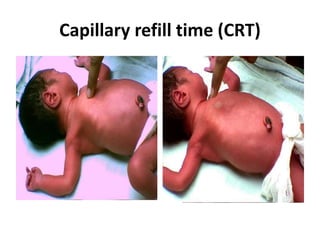
2.Capillary refill time (CRT)
• simple and reliable clinical indicator of perfusion is the
Capillary Refill Time (CRT).
• Perfusion signifies adequacy of circulation.
• Poor perfusion indicates hypotension.
• It should be noted that CRT may be prolonged due to
hypothermia ,also due to peripheral vasoconstriction.
• Normal CRT is < 3 seconds.
• If it takes longer than 3 seconds for blanching to reverse, it
indicates poor perfusion m and needs for reperfusion.
Capillary refill time (CRT)
3.Respiratory problems
• Breathing difficulties indicate serious illness in the
newborn. An increased respiratory rate (more than
60 per minute when counted for at least one minute)
and chest retractions indicate a serious problem.
• It could be due to pneumonia, hyaline membrane
disease, heart failure or malformation.
• Since neonates, especially preterm babies, have a
very soft chest wall and their breathing is mainly
diaphragmatic, one need to count the rise of
abdomen in a minute for counting respiration.
• It is not unusual to find mild indrawing of the lower
part of chest in a preterm without respiratory
distress. The normal breathing pattern in the
newborn is characterized by brief periods of
cessation of breathing called periodic breathing.
• However, cessation of breathing (apnea) when
accompanied by cyanosis and/or bradycardia always
signifies serious illness.
• Respond immediately to an apnea because each
apneic episode is potentially fatal and can result in
irreversible brain damage.
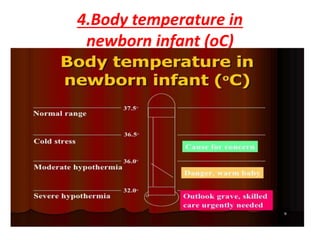
4.Body temperature in
newborn infant (oC)
• Temperature instability is a very important danger
sign in neonates.
• Hypothermia (temperature below 36.5 degrees
centigrade) is a common sign in sick neonates
especially in low birth weight babies.
• Axillary temperature recorded for at least three
minutes will indicate the extent of hypothermia in a
baby who is "cold to touch".
• Such infant with other signs of illness should be reassessed
after warming.
• If the baby does not improve his activity and cry, it indicates a
more serious underlying disorder.
• Unlike adults, neonates often manifest hypothermia as a sign
of infection.
• Fever (temperature above 37.5 degrees) is a sign of infection
usually in term neonates.
• However, in all febrile neonates a diligent search for a possible
infective focus must be made.
5.Failure to pass meconium and
urine
Failure to pass meconium;
.Some babies pass meconium in utero or soon after
birth.
. All healthy babies must pass meconium within 24-48
hours of age.
.Non passage of meconium by 48 hours of age is an
indication for doing appropriate investigations to
exclude intestinal obstruction.
.Pass a lubricated rectal thermometer; few babies may
pass meconium or meconium plug after this
stimulation.
Failure to pass urine;
• After birth, most babies pass urine by 24 hours of age.
• Infants with delayed passage of urine should be
investigated for congenital conditions like obstructive
uropathy and agenesis of kidneys.
• Normal neonates pass urine 6 to 10 times in a day if
feeding is adequate.
• In a baby with delayed passage of urine, first ensure
adequate feeding.
• In a male baby palpate for bladder and kidneys.
• Their enlargement suggests obstructive uropathy which
will need radiological investigations and possible suitable
intervention.
6. vomiting*
• Ingestion of meconium stained amniotic fluid may
lead to vomiting on the first day in many neonates.
• Regurgitation or vomiting soon after feeds is often
due to faulty feeding technique or aerophagy.
• In case of persistent, projectile or bile stained
vomiting in association with failure to pass
meconium during the first 24 hours and or
abdominal distension, the baby should be
investigated for intestinal obstruction.
• Vomiting may be a symptom of raised intracranial
tension due to intraventricular hemorrhage (IVH),
birth asphyxia, meningitis, systemic illness, cardiac
failure or metabolic disorders (CAH, Galactosemia).
• Hypertrophic pyloric stenosis usually presents after
two weeks of age.
• In hiatus hernia or esophageal reflux, vomiting
usually occurs as soon as the baby is put on a cot in
horizontal position.
7. diarrhea
• Change in established bowel pattern towards greater
frequency and looseness should be taken seriously.
• Many infants pass stools while being fed but otherwise
remain alright and keep on gaining weight.
• Breast fed babies pass more frequent stools than formula fed
babies.
• Maternal ingestion of drugs (ampicillin, laxatives) and certain
fruits like mango may result in loose stool in breast fed babies;
it does not need any specific treatment.
• Diarrhea may also occur due to thyrotoxicosis, metabolic
conditions, maternal drug addiction or at times due to
overfeeding.
8.Cyanosis
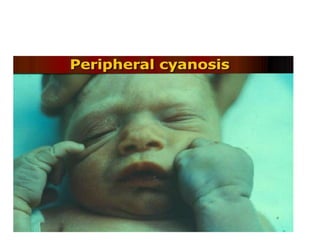
Peripheral cyanosis or acrocyanosis is seen in the
extremities only.
. It may be normal in babies in the first few days of life,
especially when they are cold.
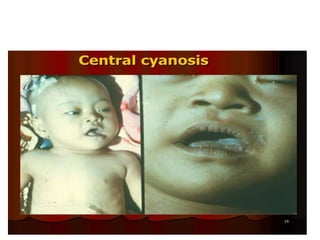
 Central cyanosis is a very important danger sign.
. It is seen all over especially on lips and tongue.
.Central cyanosis indicates underlying cardiac or
respiratory disease and therefore always requires
prompt attention and appropriate referral.
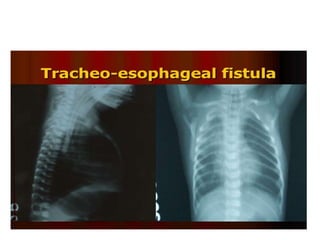
9.Tracheo-esophageal fistula
• A newborn baby with excessive drooling, frothy saliva and
choking and cyanosis during first feed should alert staff to rule
out atresia of the upper digestive tract.
• Overflow of milk and saliva from esophagus and regurgitation
of secretions through the fistulous tract (if present) into the
lungs results in pneumonia.
• Failure to pass a rubber catheter 8 to 10 cm from mouth and
an x-ray help in making the diagnosis.
10.Suspect cardiac disease
• Cardiac disease should be suspected when there is
significant distress with cyanosis, tachycardia,
murmur and hepatomegaly.
• Tachypnea may be marked but chest retractions are
minimal.
• If the baby presents in shock and distress one should
suspect cardiac disease.
11.Abnormal weight loss
pattern
• If birth weight or previous weight records are
available, weight loss pattern is an objective indicator
of not being well in a newborn.
• Weight loss more than 10 percent over birth weight
in a term baby and more than 15 percent in preterm
and any acute loss of more than 5 percent should be
viewed with concern and one should attempt to seek
the cause as early as possible.
12.Pathological jaundice
• Jaundice in the newborn may be physiological, but
when it appears on the first day of life or the skin
staining is up to palms and soles or it persists beyond
2 weeks of life, needs investigation and appropriate
treatment.
• Hyperbilirubinemia if not treated could lead to
kernicterus and severe disabilities.
Danger signs : Summary
• The important danger signs are: lethargy, breathing
problems, temperature instability, failure to pass
meconium and/or urine, vomiting, diarrhea,
cyanosis, jaundice, abdominal distension,
convulsions, bleeding and excessive loss of weight.
• It is evident that all these signs are
not etiology specific but indicate a
sick newborn and the need for early
and safe referral for appropriate care.
Conclusion
• The findings of many studies showed that there was poor
knowledge of parents towards neonatal danger signs.
• Mothers practice for neonatal danger sign was unsafe;
most mothers take their sick neonate to traditional healers
and give home remedies.
• Maternal educational level, household monthly income,
place of birth and source of information are contributing
factors for good knowledge of danger sign.
• Husbands’ educational level and occupation, place of
delivery and PNC follow up were statistically significant for
mothers to bring their neonate to health institution when
they become sick.
Neonatal warning signs

Neonatal warning signs

  • 2.
    Danger & warningSigns in Newborn By Dr.Mohamed
  • 3.
    Introduction • newborn orneonate is a child under 28 days of age. • During these first 28 days of life, the child is at highest risk of dying. • It is thus, crucial, that appropriate feeding and care are provided during this period, both to improve the child’s chances of survival and to lay the foundations for a healthy life .
  • 4.
    • Neonatal dangersigns refer to presence of clinical signs that, would indicate high risk of neonatal morbidity and mortality and need for early therapeutic intervention. • The neonatal period is the most critical time for the survival of an infant. • For too many babies, their day of birth is also their day of death
  • 5.
    • Globally 10million children die annually before their fifth years, most of them in the neonatal period. More than 98% of these deaths occur in developing countries. • almost half of the deaths in under-five-year-olds occur in infancy, of the infant deaths, about two-thirds occur in the neonatal period. • It has also been noted that one-third of all neonatal deaths occur on the first day of life, almost half within 3 days and nearly three-quarters within the first week of life.
  • 6.
    • Globally pretermbirth, intrapartum related complications (birth asphyxia), infections and birth defects cause most neonatal deaths. • The highest numbers are in south-central Asian countries and the highest rates are generally in sub-Saharan Africa .
  • 7.
    • In theseregions, especially the sub-Saharan, preventable health conditions with access to affordable and simple interventions account for more than half of child deaths. • Most neonatal death take place at home, this indicating that lack early recognition on the danger sign and low treatment seeking practice of parents (care taker) towards modern health care service .
  • 8.
    • children arestill suffering from morbidities and mortalities related with danger signs. • This is mainly attributed to ignore these signs from health providers inside hospitals or carless parent’s care seeking practices. • Reducing child morbidity and mortality requires immediate caregiver’s recognition of suggestive danger signs in the child and visiting the nearby health facility.
  • 9.
    • General dangersigns are signs used by health practitioners, and caregivers to identify children who need special care or to be referred urgently. • we ask about general danger signs FIRST whenever a child is assessed. • A general danger sign is present if: ∗ The child is unable to drink or breastfeed ∗ The child vomits everything ∗ The child has had convulsions with this illness ∗ The child is lethargic or unconscious
  • 10.
    • Neonates andyoung infants often present with non- specific symptoms and signs that indicate severe illness. • These signs might be present at or after delivery or in a newborn presenting to hospital or develop during hospital stay. • The aim of initial management of a neonate presenting with these signs is stabilization and preventing deterioration.
  • 11.
    • Your newbornbaby is going through many changes in getting used to life in the outside world. • Almost, always this adjustment goes well, however there are certain warning signs you should watch it .
  • 12.
    Some general warningsigns with newborns include, but are not limited to: No urine in the first 24 hours life. This can be difficult to assess, especially with disposable diapers. No bowel movement in the first 48 hours. A rectal temperature over 100.4 degrees F (38 degrees C) or less than 97.5 degrees F (36.5 degrees C).
  • 13.
    A rapid breathingrate over 60 per minute, or a blue coloring that does not go away. Newborns normally have irregular respirations, so you need to count for a full minute. There should be no pauses longer than about ten seconds between breaths. Retractions, or pulling in of the ribs with respirations. Wheezing, grunting, or whistling sounds while breathing. Odor, drainage, or bleeding from the umbilical cord.
  • 14.
    Yellow coloring ofthe eyes, chest, or extremities. Crying, irritability, or twitching which does not improve with cuddling and comfort. A sleepy baby who cannot be awakened enough to nurse or nipple. Any signs of sickness (for example, cough, diarrhea, pale color). The baby's appetite or suck becomes poor or weak.
  • 15.
    Sick newborn Early detection, prompttreatment and referral (if required) are necessary to prevent high mortality
  • 16.
    Problems in earlydiagnosis of sick newborn • Non-specific signs • Difficulties in preterm and LBW babies So, We shall briefly review some of the important "danger signs" which may suggest that the neonate is sick and needs early intervention or referral to an appropriate care centre.
  • 17.
    1.Lethargy and poorsucking • In a full-term baby, lethargy and poor sucking , especially in an infant who was feeding well earlier, are very important and sensitive indicators of neonatal illness. • Most of the mothers shall be able to give this history and most of the times mothers are rightly concerned.
  • 18.
    • In apreterm baby, however, poor feeding and/or lethargy may at times be normal. • Such infants must be carefully assessed for referral, as even these babies often need better health care facilities that is available in some hospitals only.
  • 19.
    2.Capillary refill time(CRT) • simple and reliable clinical indicator of perfusion is the Capillary Refill Time (CRT). • Perfusion signifies adequacy of circulation. • Poor perfusion indicates hypotension. • It should be noted that CRT may be prolonged due to hypothermia ,also due to peripheral vasoconstriction. • Normal CRT is < 3 seconds. • If it takes longer than 3 seconds for blanching to reverse, it indicates poor perfusion m and needs for reperfusion.
  • 20.
  • 21.
    3.Respiratory problems • Breathingdifficulties indicate serious illness in the newborn. An increased respiratory rate (more than 60 per minute when counted for at least one minute) and chest retractions indicate a serious problem. • It could be due to pneumonia, hyaline membrane disease, heart failure or malformation.
  • 22.
    • Since neonates,especially preterm babies, have a very soft chest wall and their breathing is mainly diaphragmatic, one need to count the rise of abdomen in a minute for counting respiration. • It is not unusual to find mild indrawing of the lower part of chest in a preterm without respiratory distress. The normal breathing pattern in the newborn is characterized by brief periods of cessation of breathing called periodic breathing.
  • 23.
    • However, cessationof breathing (apnea) when accompanied by cyanosis and/or bradycardia always signifies serious illness. • Respond immediately to an apnea because each apneic episode is potentially fatal and can result in irreversible brain damage.
  • 24.
  • 25.
    • Temperature instabilityis a very important danger sign in neonates. • Hypothermia (temperature below 36.5 degrees centigrade) is a common sign in sick neonates especially in low birth weight babies. • Axillary temperature recorded for at least three minutes will indicate the extent of hypothermia in a baby who is "cold to touch".
  • 26.
    • Such infantwith other signs of illness should be reassessed after warming. • If the baby does not improve his activity and cry, it indicates a more serious underlying disorder. • Unlike adults, neonates often manifest hypothermia as a sign of infection. • Fever (temperature above 37.5 degrees) is a sign of infection usually in term neonates. • However, in all febrile neonates a diligent search for a possible infective focus must be made.
  • 27.
    5.Failure to passmeconium and urine Failure to pass meconium; .Some babies pass meconium in utero or soon after birth. . All healthy babies must pass meconium within 24-48 hours of age. .Non passage of meconium by 48 hours of age is an indication for doing appropriate investigations to exclude intestinal obstruction. .Pass a lubricated rectal thermometer; few babies may pass meconium or meconium plug after this stimulation.
  • 28.
    Failure to passurine; • After birth, most babies pass urine by 24 hours of age. • Infants with delayed passage of urine should be investigated for congenital conditions like obstructive uropathy and agenesis of kidneys. • Normal neonates pass urine 6 to 10 times in a day if feeding is adequate. • In a baby with delayed passage of urine, first ensure adequate feeding. • In a male baby palpate for bladder and kidneys. • Their enlargement suggests obstructive uropathy which will need radiological investigations and possible suitable intervention.
  • 29.
    6. vomiting* • Ingestionof meconium stained amniotic fluid may lead to vomiting on the first day in many neonates. • Regurgitation or vomiting soon after feeds is often due to faulty feeding technique or aerophagy. • In case of persistent, projectile or bile stained vomiting in association with failure to pass meconium during the first 24 hours and or abdominal distension, the baby should be investigated for intestinal obstruction.
  • 30.
    • Vomiting maybe a symptom of raised intracranial tension due to intraventricular hemorrhage (IVH), birth asphyxia, meningitis, systemic illness, cardiac failure or metabolic disorders (CAH, Galactosemia). • Hypertrophic pyloric stenosis usually presents after two weeks of age. • In hiatus hernia or esophageal reflux, vomiting usually occurs as soon as the baby is put on a cot in horizontal position.
  • 31.
    7. diarrhea • Changein established bowel pattern towards greater frequency and looseness should be taken seriously. • Many infants pass stools while being fed but otherwise remain alright and keep on gaining weight. • Breast fed babies pass more frequent stools than formula fed babies. • Maternal ingestion of drugs (ampicillin, laxatives) and certain fruits like mango may result in loose stool in breast fed babies; it does not need any specific treatment. • Diarrhea may also occur due to thyrotoxicosis, metabolic conditions, maternal drug addiction or at times due to overfeeding.
  • 32.
    8.Cyanosis Peripheral cyanosis oracrocyanosis is seen in the extremities only. . It may be normal in babies in the first few days of life, especially when they are cold.  Central cyanosis is a very important danger sign. . It is seen all over especially on lips and tongue. .Central cyanosis indicates underlying cardiac or respiratory disease and therefore always requires prompt attention and appropriate referral.
  • 35.
    9.Tracheo-esophageal fistula • Anewborn baby with excessive drooling, frothy saliva and choking and cyanosis during first feed should alert staff to rule out atresia of the upper digestive tract. • Overflow of milk and saliva from esophagus and regurgitation of secretions through the fistulous tract (if present) into the lungs results in pneumonia. • Failure to pass a rubber catheter 8 to 10 cm from mouth and an x-ray help in making the diagnosis.
  • 37.
    10.Suspect cardiac disease •Cardiac disease should be suspected when there is significant distress with cyanosis, tachycardia, murmur and hepatomegaly. • Tachypnea may be marked but chest retractions are minimal. • If the baby presents in shock and distress one should suspect cardiac disease.
  • 38.
    11.Abnormal weight loss pattern •If birth weight or previous weight records are available, weight loss pattern is an objective indicator of not being well in a newborn. • Weight loss more than 10 percent over birth weight in a term baby and more than 15 percent in preterm and any acute loss of more than 5 percent should be viewed with concern and one should attempt to seek the cause as early as possible.
  • 39.
    12.Pathological jaundice • Jaundicein the newborn may be physiological, but when it appears on the first day of life or the skin staining is up to palms and soles or it persists beyond 2 weeks of life, needs investigation and appropriate treatment. • Hyperbilirubinemia if not treated could lead to kernicterus and severe disabilities.
  • 40.
    Danger signs :Summary • The important danger signs are: lethargy, breathing problems, temperature instability, failure to pass meconium and/or urine, vomiting, diarrhea, cyanosis, jaundice, abdominal distension, convulsions, bleeding and excessive loss of weight. • It is evident that all these signs are not etiology specific but indicate a sick newborn and the need for early and safe referral for appropriate care.
  • 41.
    Conclusion • The findingsof many studies showed that there was poor knowledge of parents towards neonatal danger signs. • Mothers practice for neonatal danger sign was unsafe; most mothers take their sick neonate to traditional healers and give home remedies. • Maternal educational level, household monthly income, place of birth and source of information are contributing factors for good knowledge of danger sign. • Husbands’ educational level and occupation, place of delivery and PNC follow up were statistically significant for mothers to bring their neonate to health institution when they become sick.