The document discusses the constructivist evaluation process, highlighting the limitations of mainstream assessment methods and emphasizing the need for more flexible, continuous, and holistic approaches. It introduces various tools such as portfolios, concept mapping, and rubrics to foster a supportive assessment environment that promotes creativity and deeper learning. The document also addresses common myths about assessment and the roles of different stakeholders in the evaluation process.
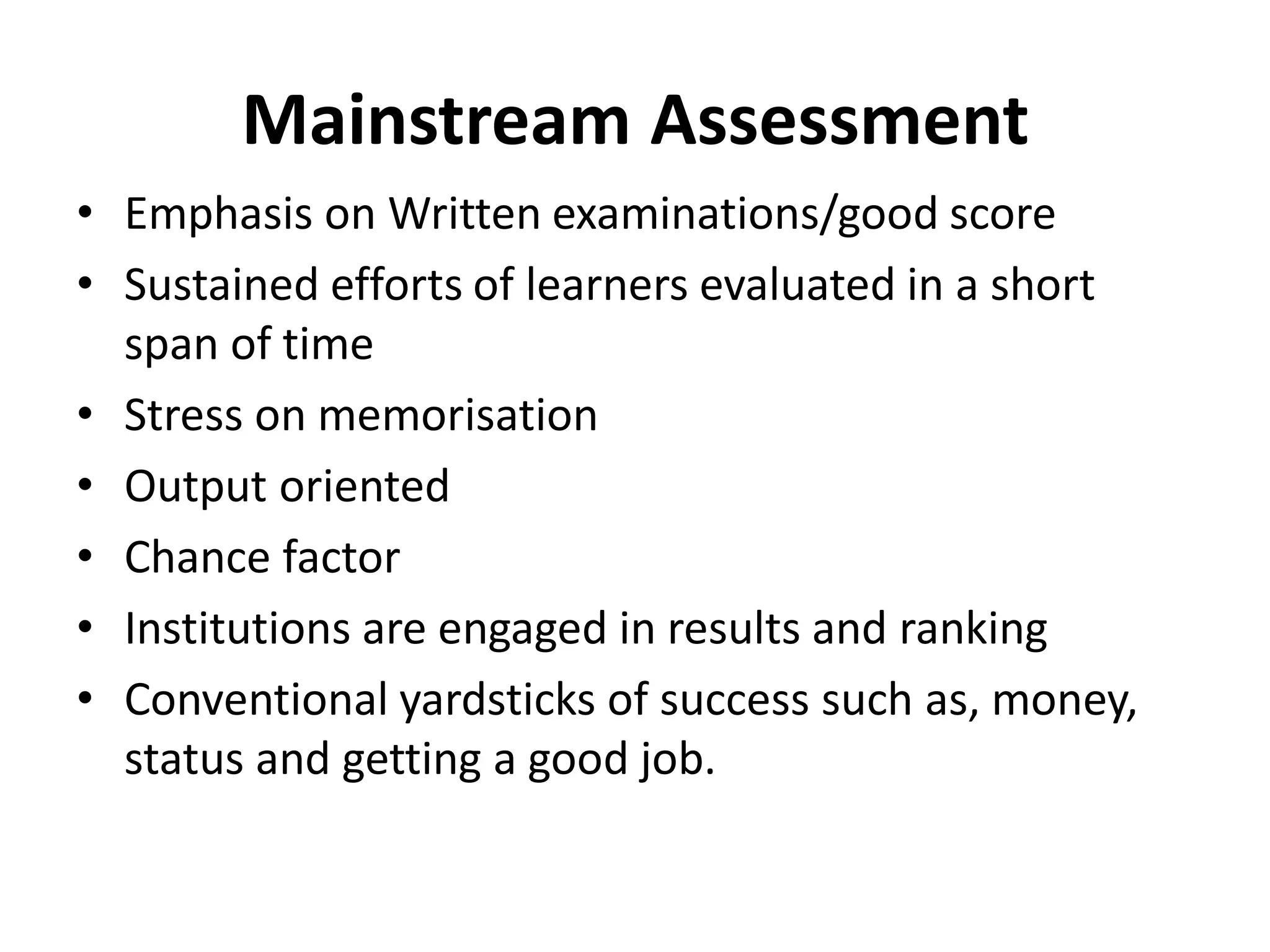
Mainstream Assessment
• Emphasison Written examinations/good score
• Sustained efforts of learners evaluated in a short
span of time
• Stress on memorisation
• Output oriented
• Chance factor
• Institutions are engaged in results and ranking
• Conventional yardsticks of success such as, money,
status and getting a good job.
4.
Mainstream Assessment
• onesize fits all approach
• encourages conformity
• discourages creativity, imagination, freedom
of thought, personal expression, and social
development.
• problematic for people with developmental
disabilities or economic and social
disadvantages.
5.
Myths about Assessment
•Process of learning shuts down during assessment;
• Students’ interaction stops during assessment;
• Criteria of assessment is objective;
• All students/teachers perceive assessment criteria in
the same way;
• assessment means giving grades/marks;
• Evaluation is a one-time event done only to prove
the success or failure of a learner;
• Evaluation is a complicated process that must be
done by an outside expert;
6.
Constructivist Assessment
• ResponsiveEvaluation
• Stakeholders of assessment: Self assessment; Peer
assessment; Collaborative assessment; Parent
Assessment.
• Institution-based assessment
• Learners who have been engaged to construct new
knowledge are expected to learn more during
assessment.
• Assessments include higher order thinking skills:
application, evaluation, analysis, synthesis, creativity.
7.
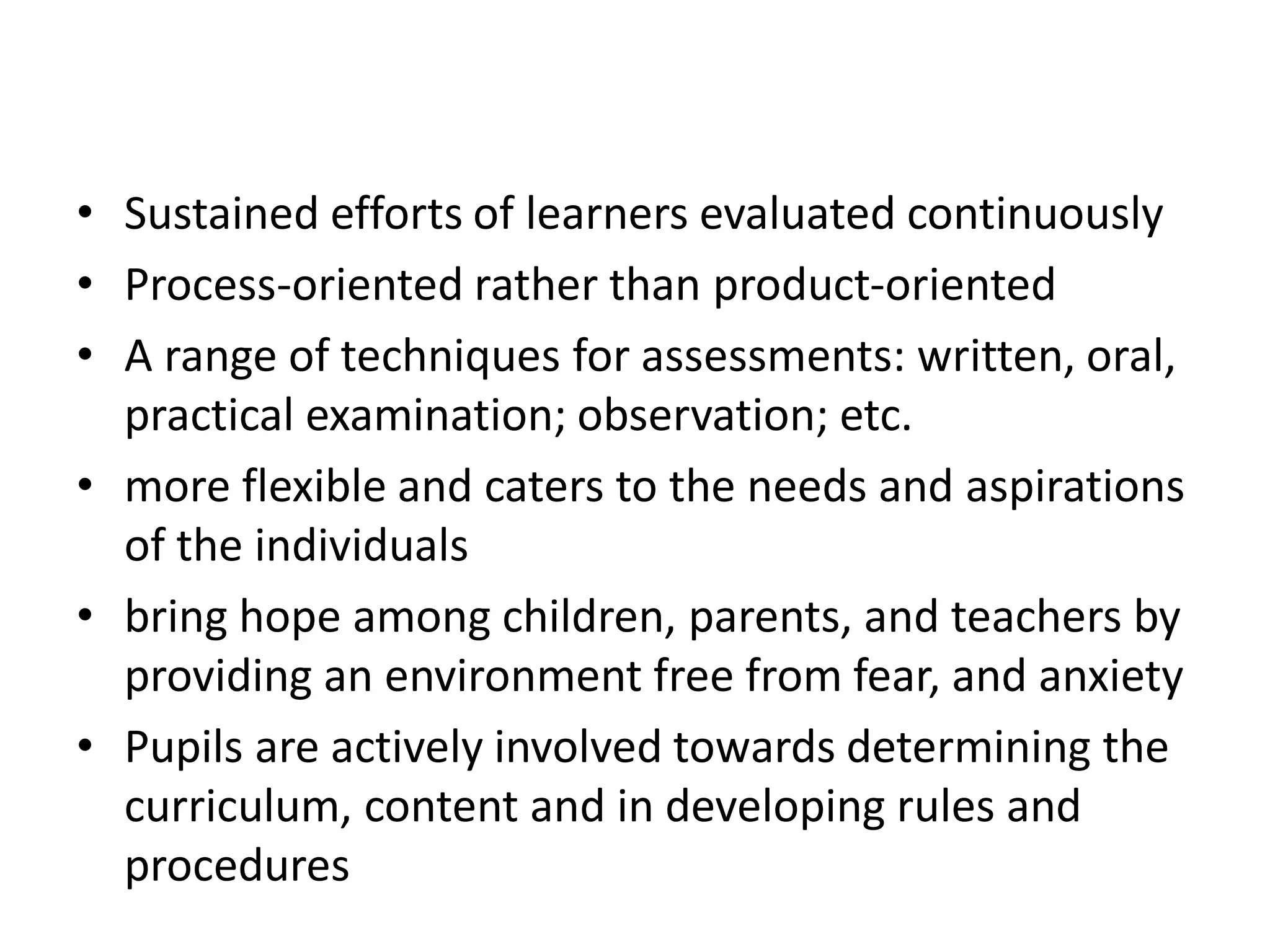
• Sustained effortsof learners evaluated continuously
• Process-oriented rather than product-oriented
• A range of techniques for assessments: written, oral,
practical examination; observation; etc.
• more flexible and caters to the needs and aspirations
of the individuals
• bring hope among children, parents, and teachers by
providing an environment free from fear, and anxiety
• Pupils are actively involved towards determining the
curriculum, content and in developing rules and
procedures
8.
Tools of ConstructivistAssessment
• Portfolio
• Concept mapping
• Observation
• Assignment
• Anecdotal record
• Rubrics
• Project
9.
Portfolio
• Purposeful, multifacetedcollection of
student’s work
• describes about the story of a student's
efforts, growth, progress, or achievement in a
given area over a period of time.
10.
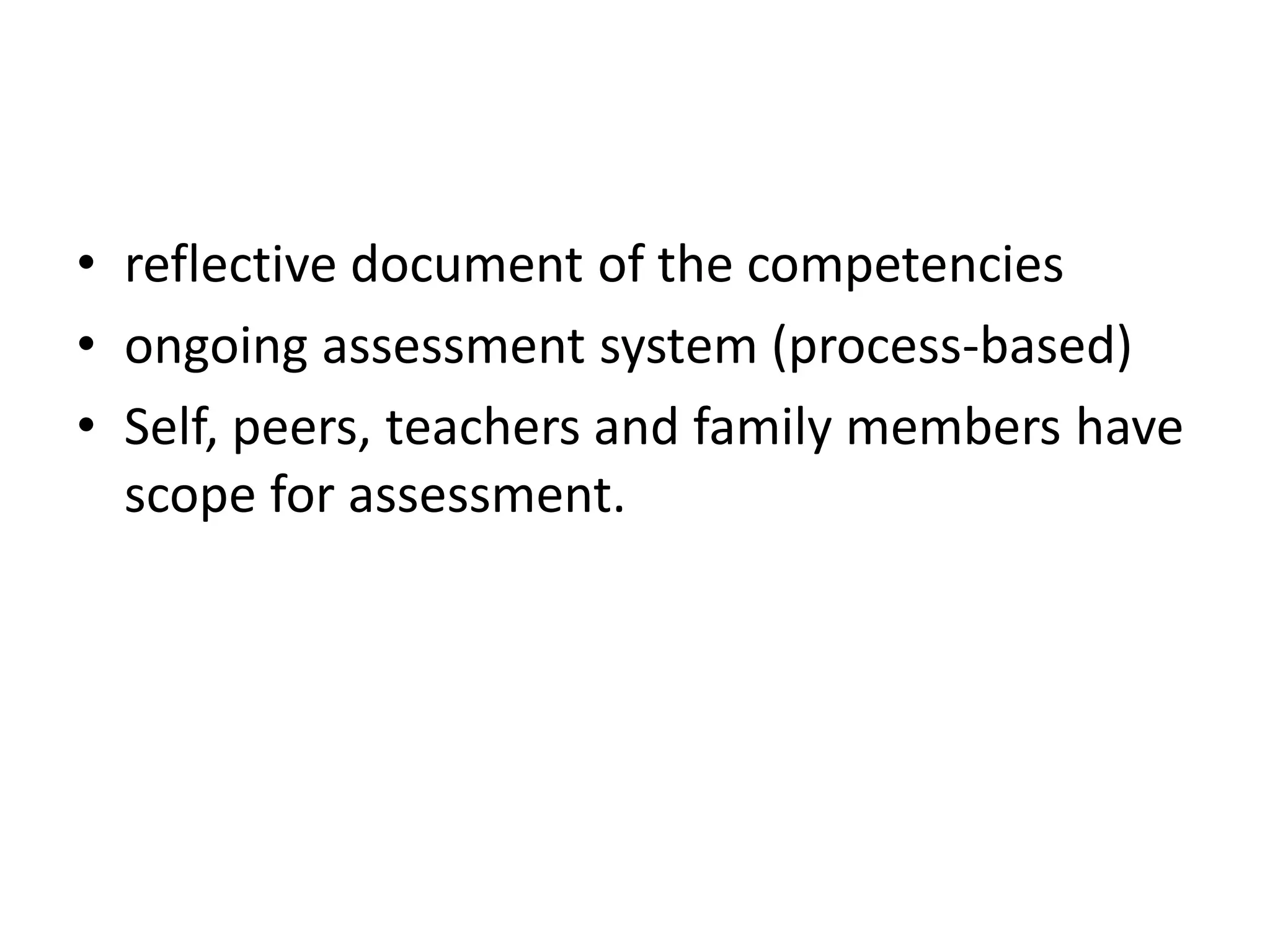
• reflective documentof the competencies
• ongoing assessment system (process-based)
• Self, peers, teachers and family members have
scope for assessment.
11.
Structure of Portfolio
Physicalstructure
• Actual arrangement of documents used to
demonstrate students progress.
• title page, table of content, specific headings,
photographs, charts, drawings, appendices,
etc.
Conceptual structure
• Underlying goals for student learning
12.
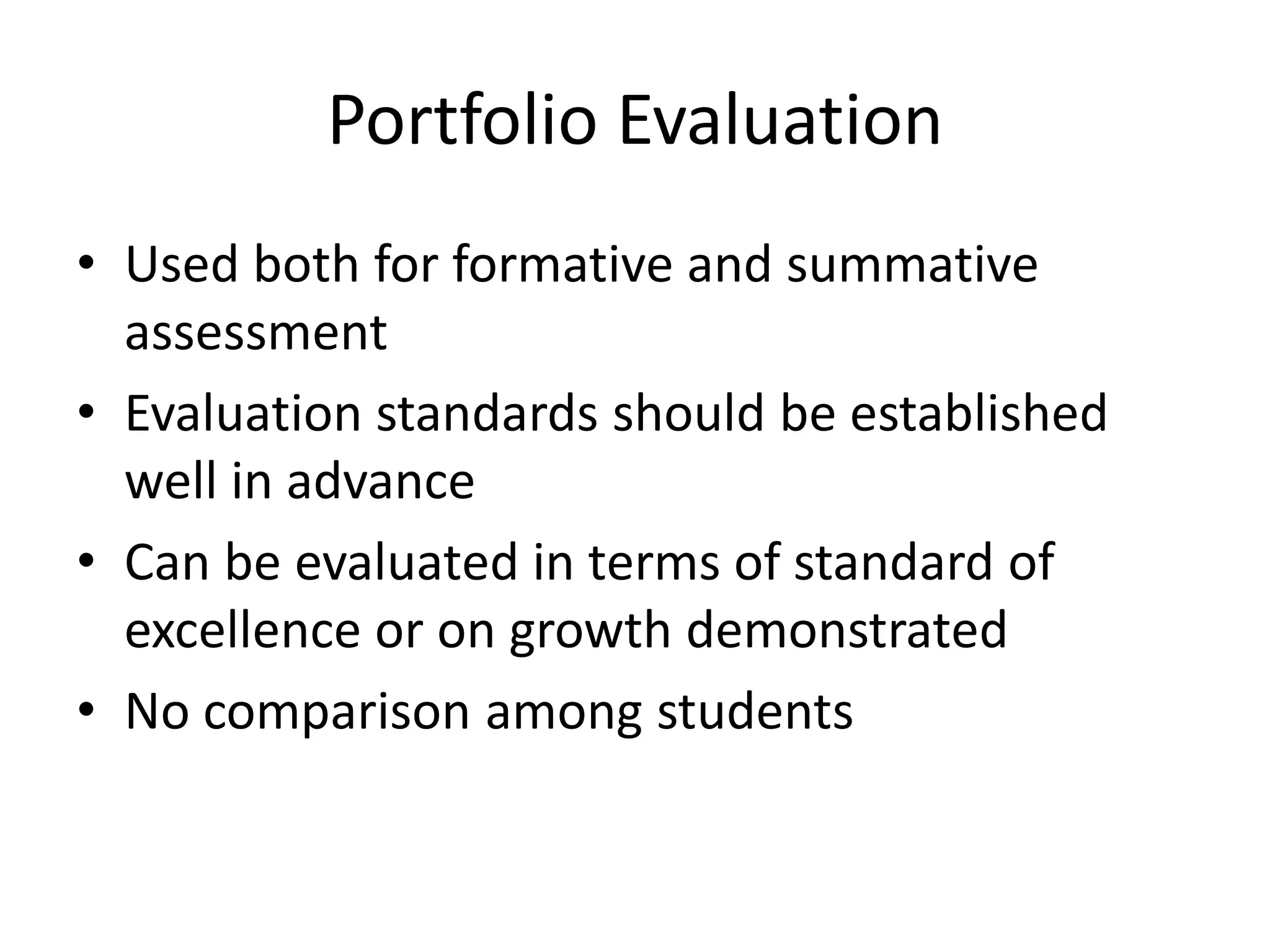
Portfolio Evaluation
• Usedboth for formative and summative
assessment
• Evaluation standards should be established
well in advance
• Can be evaluated in terms of standard of
excellence or on growth demonstrated
• No comparison among students
13.
Problems with PortfolioAssessment
• Large collection of papers, folders, etc.
• Time-consuming
• Not economical
• Not transparent
• Not user-friendly
• Problem of storage
Ausubel’s theory ofMeaningful
Learning
• The most important single factor influencing
learning- what the learner already knows
• Learning takes place by the assimilation of
new concepts and propositions into existing
concepts and propositions held by the
learners
16.
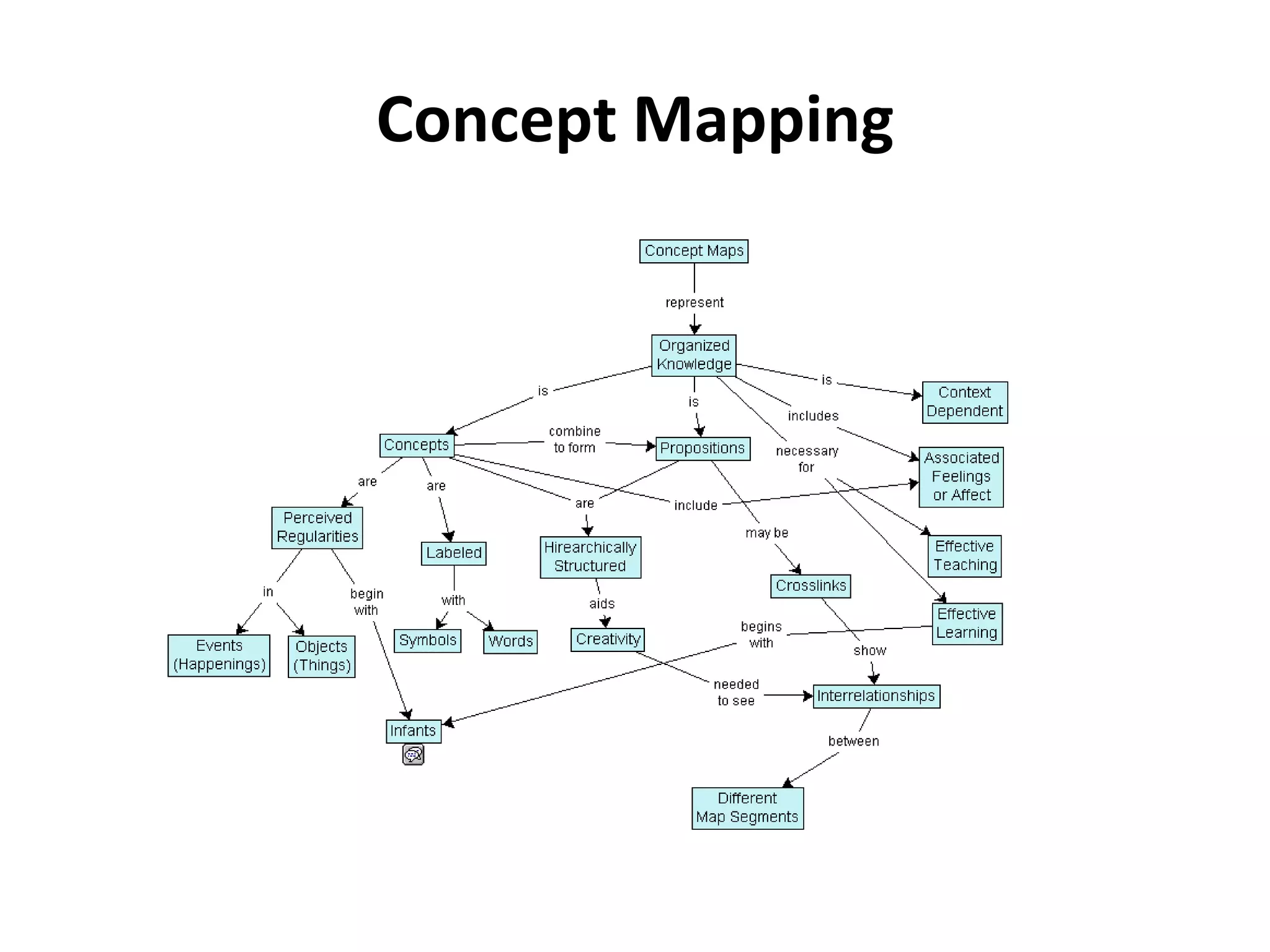
Concept Mapping
• Developedin 1972 by Joseph D. Novak
• Graphical representation of knowledge
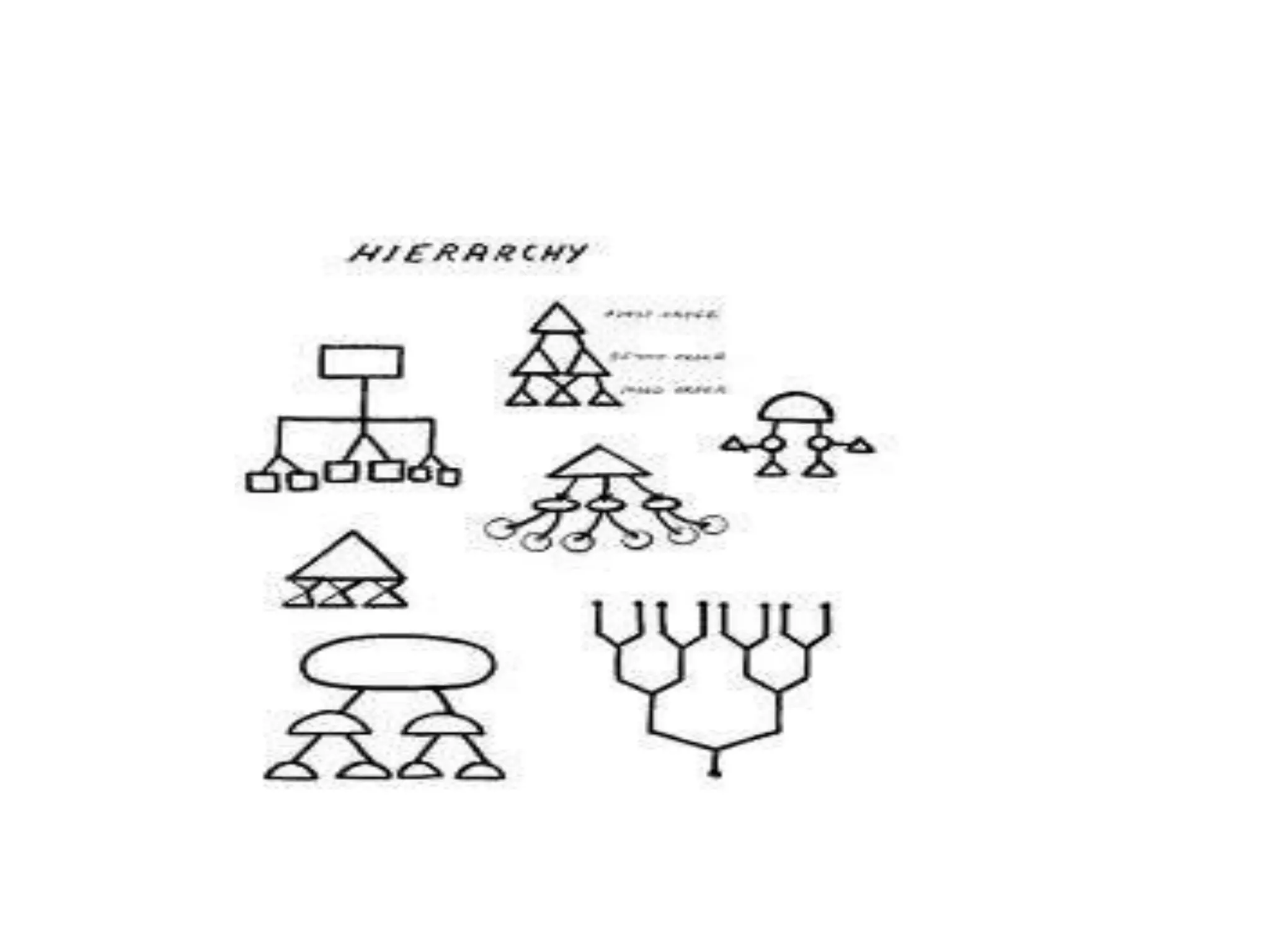
• Knowledge graphs are networks of concepts.
• Networks consist of nodes and links.
• Nodes represent concepts
• links represent the relations between concepts
• Meaningful statement containing 2/more
concepts connected using linking words
Rubrics
• Scoring toolfor subjective assessments
• A rating system by which an assessor can
determine the level of proficiency
• Allows grading simpler and more transparent.
• One can either utilize previously developed
rubrics or create one’s own.
24.
• provides groundfor self-evaluation, reflection
and peer review.
• can be created for any content area
• an ongoing part of the whole teaching and
learning process.
25.
CATEGORY 4 32 1
Contributions Routinely Usually Sometimes Rarely
Quality of Work highest quality. high quality work. Occasionally usually needs to
be checked
Time-
management
Routinely uses
time
Usually uses
time
gets things done
by the deadlines.
Rarely gets
things done by
the deadlines
Problem-
solving
Actively looks
for solutions.
Refines solutions
suggested by
others.
willing to try out
solutions
suggested by
others.
Does not try to
solve problems.
Attitude always positive
attitude
Often positive
attitude
Usually positive
attitude
negative attitude
Focus on the
task
Consistently. Often Sometimes Rarely
Preparedness always ready
to work.
Often ready to
work.
Sometimes
ready to work
Often forgets
26.
Observation
• Information abouta child (his/her behavior)
can be collected in ‘natural’ settings in and
outside the class
• Various aspects of personality development
can be assessed.
• Can be used to assess individuals as well as
groups.
• Assessment can be made during varying time
periods.
• Evidence of child’s performance / knowledge
is based on an ‘on-the spot – record’.
27.
• Whereas observationcan be biased and
subjective can be substantially reduced by
using an observation schedule.
28.
Assignments
• Theme basedtasks to be completed as class
work or homework
• Can be open ended or structured.
• Some could be based on contexts outside
textbooks.
• Provides students an opportunity to search for
information, construct their own ideas, and
articulate the same ideas through spoken,
written and visual expressions
29.
• Provides studentsan opportunity to relate
and synthesize within and outside school
learning
• Assignments should be such that they can be
managed by students on their own
• Should not become the only method of
assessment
30.
• Going beyondcollection of assignments by
following it up with analysis, discussion and
reflection
• Creativity of students is promoted
• Group work is to be encouraged.
31.
Assessment Environment
• Teacher-facilitator
• Teachers explore and incorporate a wide
variety of assessment strategies.
• Students should be given safe and comfort
environment to take responsibilities.
• Teachers should not feel restricted to text-
embedded assessments.
• Teachers should use students input to design
and modify assessments.
32.
Problems and Issues
•Scarcity of resources
• Scarcity of teachers
• Lack of accountability
• Lack of professional ethics
• Reluctant to accept change