ASSESSING
WRITING
The Important of Assessing Writing
Writing assessment refers not only to
evaluating a student’s final paper and
assigning its grade, but also to measuring a
student’s knowledge of the elements of
writing.
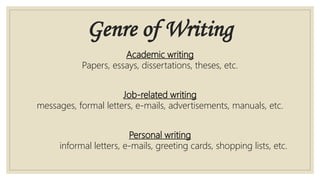
Genre of Writing
Academic writing
Papers, essays, dissertations, theses, etc.
Job-related writing
messages, formal letters, e-mails, advertisements, manuals, etc.
Personal writing
informal letters, e-mails, greeting cards, shopping lists, etc.
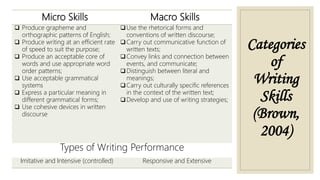
Categories
of
Writing
Skills
(Brown,
2004)
Micro Skills Macro Skills
 Produce grapheme and
orthographic patterns of English;
 Produce writing at an efficient rate
of speed to suit the purpose;
 Produce an acceptable core of
words and use appropriate word
order patterns;
 Use acceptable grammatical
systems
 Express a particular meaning in
different grammatical forms;
 Use cohesive devices in written
discourse
Use the rhetorical forms and
conventions of written discourse;
Carry out communicative function of
written texts;
Convey links and connection between
events, and communicate;
Distinguish between literal and
meanings;
Carry out culturally specific references
in the context of the written text;
Develop and use of writing strategies;
Types of Writing Performance
Imitative and Intensive (controlled) Responsive and Extensive
MICRO SKILL
Imitative writing
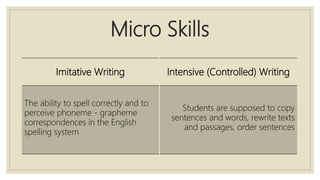
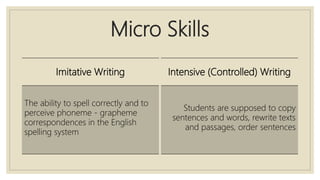
Micro Skills
Imitative Writing
The ability to spell correctly and to
perceive phoneme - grapheme
correspondences in the English
spelling system
Intensive (Controlled) Writing
Students are supposed to copy
sentences and words, rewrite texts
and passages, order sentences
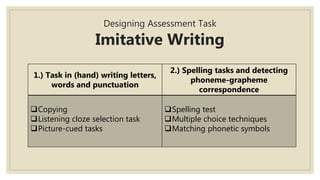
Designing Assessment Task
Imitative Writing
1.) Task in (hand) writing letters,
words and punctuation
2.) Spelling tasks and detecting
phoneme-grapheme
correspondence
Copying
Listening cloze selection task
Picture-cued tasks
Spelling test
Multiple choice techniques
Matching phonetic symbols
Designing Assessment Task
Imitative Writing
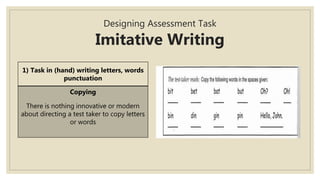
1) Task in (hand) writing letters, words
punctuation
Copying
There is nothing innovative or modern
about directing a test taker to copy letters
or words
Designing Assessment Task
Imitative Writing
1) Task in (hand) writing letters, words
punctuation
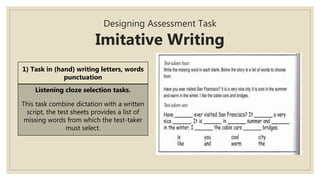
Listening cloze selection tasks.
This task combine dictation with a written
script, the test sheets provides a list of
missing words from which the test-taker
must select.
Designing Assessment Task
Imitative Writing
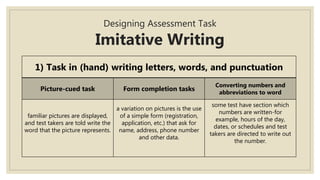
1) Task in (hand) writing letters, words, and punctuation
Picture-cued task Form completion tasks
Converting numbers and
abbreviations to word
familiar pictures are displayed,
and test takers are told write the
word that the picture represents.
a variation on pictures is the use
of a simple form (registration,
application, etc.) that ask for
name, address, phone number
and other data.
some test have section which
numbers are written-for
example, hours of the day,
dates, or schedules and test
takers are directed to write out
the number.
Designing Assessment Task
Imitative Writing
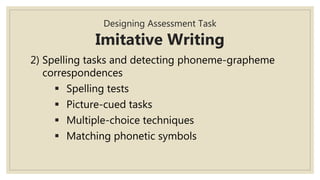
2) Spelling tasks and detecting phoneme-grapheme
correspondences
 Spelling tests
 Picture-cued tasks
 Multiple-choice techniques
 Matching phonetic symbols
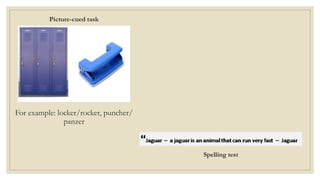
Picture-cued task
For example: locker/rocker, puncher/
panzer
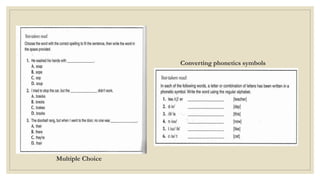
Spelling test
Multiple Choice
Converting phonetics symbols
MICRO SKILL
Intensive (controlled) writing
Micro Skills
Imitative Writing
The ability to spell correctly and to
perceive phoneme - grapheme
correspondences in the English
spelling system
Intensive (Controlled) Writing
Students are supposed to copy
sentences and words, rewrite texts
and passages, order sentences
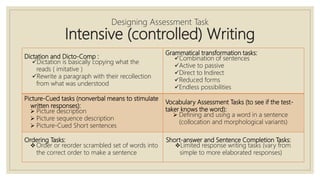
Dictation and Dicto-Comp :
Dictation is basically copying what the
reads ( imitative )
Rewrite a paragraph with their recollection
from what was understood
Grammatical transformation tasks:
Combination of sentences
Active to passive
Direct to Indirect
Reduced forms
Endless possibilities
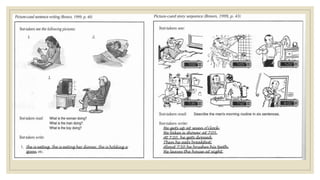
Picture-Cued tasks (nonverbal means to stimulate
written responses):
 Picture description
 Picture sequence description
 Picture-Cued Short sentences
Vocabulary Assessment Tasks (to see if the test-
taker knows the word):
 Defining and using a word in a sentence
(collocation and morphological variants)
Ordering Tasks:
Order or reorder scrambled set of words into
the correct order to make a sentence
Short-answer and Sentence Completion Tasks:
Limited response writing tasks (vary from
simple to more elaborated responses)
Designing Assessment Task
Intensive (controlled) Writing
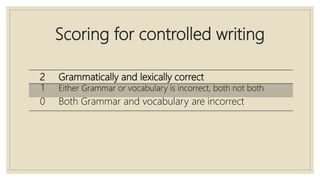
Scoring for controlled writing
2 Grammatically and lexically correct
1 Either Grammar or vocabulary is incorrect, both not both
0 Both Grammar and vocabulary are incorrect
MACRO SKILL
Responsive and Extensive writing
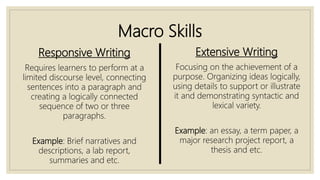
Macro Skills
Responsive Writing
Requires learners to perform at a
limited discourse level, connecting
sentences into a paragraph and
creating a logically connected
sequence of two or three
paragraphs.
Example: Brief narratives and
descriptions, a lab report,
summaries and etc.
Extensive Writing
Focusing on the achievement of a
purpose. Organizing ideas logically,
using details to support or illustrate
it and demonstrating syntactic and
lexical variety.
Example: an essay, a term paper, a
major research project report, a
thesis and etc.
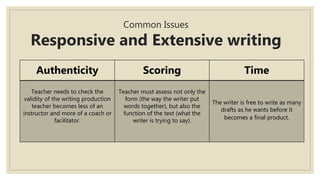
Common Issues
Responsive and Extensive writing
Authenticity Scoring Time
Teacher needs to check the
validity of the writing production
teacher becomes less of an
instructor and more of a coach or
facilitator.
Teacher must assess not only the
form (the way the writer put
words together), but also the
function of the text (what the
writer is trying to say).
The writer is free to write as many
drafts as he wants before it
becomes a final product.
Designing Assessment Task
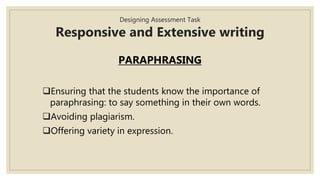
Responsive and Extensive writing
PARAPHRASING
Ensuring that the students know the importance of
paraphrasing: to say something in their own words.
Avoiding plagiarism.
Offering variety in expression.
Designing Assessment Task
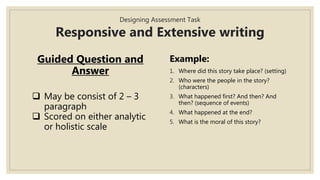
Responsive and Extensive writing
Guided Question and
Answer
 May be consist of 2 – 3
paragraph
 Scored on either analytic
or holistic scale
Example:
1. Where did this story take place? (setting)
2. Who were the people in the story?
(characters)
3. What happened first? And then? And
then? (sequence of events)
4. What happened at the end?
5. What is the moral of this story?
Designing Assessment Task
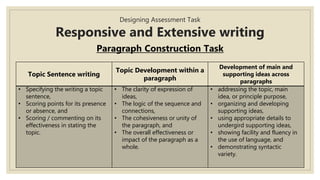
Responsive and Extensive writing
Paragraph Construction Task
Topic Sentence writing
Topic Development within a
paragraph
Development of main and
supporting ideas across
paragraphs
• Specifying the writing a topic
sentence,
• Scoring points for its presence
or absence, and
• Scoring / commenting on its
effectiveness in stating the
topic.
• The clarity of expression of
ideas,
• The logic of the sequence and
connections,
• The cohesiveness or unity of
the paragraph, and
• The overall effectiveness or
impact of the paragraph as a
whole.
• addressing the topic, main
idea, or principle purpose,
• organizing and developing
supporting ideas,
• using appropriate details to
undergird supporting ideas,
• showing facility and fluency in
the use of language, and
• demonstrating syntactic
variety.
Scoring Methods
Responsive and Extensive writing
Holistic Scoring: A single score is assigned to an essay, which
represents a reader's general overall assessment.
Primary Trait Scoring: This type of scoring emphasizes the
effectiveness of the text's achieving. If the purpose or function of an
essay is to persuade the reader to do something, the score for the
writing would rise or fall according to the accomplishment of that
function.
Analytic Scoring: Classroom evaluation of learning is best served
through analytic scoring in which as many as five major elements of
writing are scored.

English - Assessing writing

  • 1.
  • 2.
    The Important ofAssessing Writing Writing assessment refers not only to evaluating a student’s final paper and assigning its grade, but also to measuring a student’s knowledge of the elements of writing.
  • 3.
    Genre of Writing Academicwriting Papers, essays, dissertations, theses, etc. Job-related writing messages, formal letters, e-mails, advertisements, manuals, etc. Personal writing informal letters, e-mails, greeting cards, shopping lists, etc.
  • 4.
    Categories of Writing Skills (Brown, 2004) Micro Skills MacroSkills  Produce grapheme and orthographic patterns of English;  Produce writing at an efficient rate of speed to suit the purpose;  Produce an acceptable core of words and use appropriate word order patterns;  Use acceptable grammatical systems  Express a particular meaning in different grammatical forms;  Use cohesive devices in written discourse Use the rhetorical forms and conventions of written discourse; Carry out communicative function of written texts; Convey links and connection between events, and communicate; Distinguish between literal and meanings; Carry out culturally specific references in the context of the written text; Develop and use of writing strategies; Types of Writing Performance Imitative and Intensive (controlled) Responsive and Extensive
  • 5.
  • 6.
    Micro Skills Imitative Writing Theability to spell correctly and to perceive phoneme - grapheme correspondences in the English spelling system Intensive (Controlled) Writing Students are supposed to copy sentences and words, rewrite texts and passages, order sentences
  • 7.
    Designing Assessment Task ImitativeWriting 1.) Task in (hand) writing letters, words and punctuation 2.) Spelling tasks and detecting phoneme-grapheme correspondence Copying Listening cloze selection task Picture-cued tasks Spelling test Multiple choice techniques Matching phonetic symbols
  • 8.
    Designing Assessment Task ImitativeWriting 1) Task in (hand) writing letters, words punctuation Copying There is nothing innovative or modern about directing a test taker to copy letters or words
  • 9.
    Designing Assessment Task ImitativeWriting 1) Task in (hand) writing letters, words punctuation Listening cloze selection tasks. This task combine dictation with a written script, the test sheets provides a list of missing words from which the test-taker must select.
  • 10.
    Designing Assessment Task ImitativeWriting 1) Task in (hand) writing letters, words, and punctuation Picture-cued task Form completion tasks Converting numbers and abbreviations to word familiar pictures are displayed, and test takers are told write the word that the picture represents. a variation on pictures is the use of a simple form (registration, application, etc.) that ask for name, address, phone number and other data. some test have section which numbers are written-for example, hours of the day, dates, or schedules and test takers are directed to write out the number.
  • 11.
    Designing Assessment Task ImitativeWriting 2) Spelling tasks and detecting phoneme-grapheme correspondences  Spelling tests  Picture-cued tasks  Multiple-choice techniques  Matching phonetic symbols
  • 12.
    Picture-cued task For example:locker/rocker, puncher/ panzer Spelling test
  • 13.
  • 14.
  • 15.
    Micro Skills Imitative Writing Theability to spell correctly and to perceive phoneme - grapheme correspondences in the English spelling system Intensive (Controlled) Writing Students are supposed to copy sentences and words, rewrite texts and passages, order sentences
  • 16.
    Dictation and Dicto-Comp: Dictation is basically copying what the reads ( imitative ) Rewrite a paragraph with their recollection from what was understood Grammatical transformation tasks: Combination of sentences Active to passive Direct to Indirect Reduced forms Endless possibilities Picture-Cued tasks (nonverbal means to stimulate written responses):  Picture description  Picture sequence description  Picture-Cued Short sentences Vocabulary Assessment Tasks (to see if the test- taker knows the word):  Defining and using a word in a sentence (collocation and morphological variants) Ordering Tasks: Order or reorder scrambled set of words into the correct order to make a sentence Short-answer and Sentence Completion Tasks: Limited response writing tasks (vary from simple to more elaborated responses) Designing Assessment Task Intensive (controlled) Writing
  • 18.
    Scoring for controlledwriting 2 Grammatically and lexically correct 1 Either Grammar or vocabulary is incorrect, both not both 0 Both Grammar and vocabulary are incorrect
  • 19.
    MACRO SKILL Responsive andExtensive writing
  • 20.
    Macro Skills Responsive Writing Requireslearners to perform at a limited discourse level, connecting sentences into a paragraph and creating a logically connected sequence of two or three paragraphs. Example: Brief narratives and descriptions, a lab report, summaries and etc. Extensive Writing Focusing on the achievement of a purpose. Organizing ideas logically, using details to support or illustrate it and demonstrating syntactic and lexical variety. Example: an essay, a term paper, a major research project report, a thesis and etc.
  • 21.
    Common Issues Responsive andExtensive writing Authenticity Scoring Time Teacher needs to check the validity of the writing production teacher becomes less of an instructor and more of a coach or facilitator. Teacher must assess not only the form (the way the writer put words together), but also the function of the text (what the writer is trying to say). The writer is free to write as many drafts as he wants before it becomes a final product.
  • 22.
    Designing Assessment Task Responsiveand Extensive writing PARAPHRASING Ensuring that the students know the importance of paraphrasing: to say something in their own words. Avoiding plagiarism. Offering variety in expression.
  • 23.
    Designing Assessment Task Responsiveand Extensive writing Guided Question and Answer  May be consist of 2 – 3 paragraph  Scored on either analytic or holistic scale Example: 1. Where did this story take place? (setting) 2. Who were the people in the story? (characters) 3. What happened first? And then? And then? (sequence of events) 4. What happened at the end? 5. What is the moral of this story?
  • 24.
    Designing Assessment Task Responsiveand Extensive writing Paragraph Construction Task Topic Sentence writing Topic Development within a paragraph Development of main and supporting ideas across paragraphs • Specifying the writing a topic sentence, • Scoring points for its presence or absence, and • Scoring / commenting on its effectiveness in stating the topic. • The clarity of expression of ideas, • The logic of the sequence and connections, • The cohesiveness or unity of the paragraph, and • The overall effectiveness or impact of the paragraph as a whole. • addressing the topic, main idea, or principle purpose, • organizing and developing supporting ideas, • using appropriate details to undergird supporting ideas, • showing facility and fluency in the use of language, and • demonstrating syntactic variety.
  • 25.
    Scoring Methods Responsive andExtensive writing Holistic Scoring: A single score is assigned to an essay, which represents a reader's general overall assessment. Primary Trait Scoring: This type of scoring emphasizes the effectiveness of the text's achieving. If the purpose or function of an essay is to persuade the reader to do something, the score for the writing would rise or fall according to the accomplishment of that function. Analytic Scoring: Classroom evaluation of learning is best served through analytic scoring in which as many as five major elements of writing are scored.