Exploring Formative Assessment –
    Assessment for Learning


        Online Workshop
Who will find this workshop useful?
• Teachers
• Syndicates / departments

• AtoL facilitators

              How to use this workshop:
•   To update, review and/or reflect on formative assessment practice.
•   As a focus for professional development in exploring formative
    assessment.
•   To support AtoL in-depth programmes in schools.
The word ‘assess’

Comes from the Latin verb ‘assidere’ meaning
‘to sit with’. In assessment one is supposed to
sit with the learner. This implies it is something
     we do with and for students and not to
              students (Green, 1998)
What are summative and formative
                 assessment?
The garden analogy
If we think of our children as plants …

Summative assessment of the plants is the process of simply
measuring them. It might be interesting to compare and analyse
measurements but, in themselves, these do not affect the growth of
the plants.

Formative assessment, on the other hand, is the equivalent of
feeding and watering the plants appropriate to their needs - directly
affecting their growth.
Formative and summative assessment


Formative and summative assessment are interconnected. They
seldom stand alone in construction or effect.

The vast majority of genuine formative assessment is informal, with
interactive and timely feedback and response.

It is widely and empirically argued that formative assessment has the
greatest impact on learning and achievement.
Some definitions
Formative assessment

“… often means no more than that the assessment is carried
  out frequently and is planned at the same time as teaching.”
  (Black and Wiliam, 1999)
“… provides feedback which leads to students recognising the
  (learning) gap and closing it … it is forward looking …”
  (Harlen, 1998)
“ … includes both feedback and self-monitoring.” (Sadler, 1989)
“… is used essentially to feed back into the teaching and
  learning process.” (Tunstall and Gipps, 1996)
Some definitions
Summative assessment

“… assessment (that) has increasingly been used to sum up
    learning” (Black and Wiliam, 1999)
“… looks at past achievements
“… adds procedures or tests to existing work
“... involves only marking and feedback grades to student
“… is separated from teaching
“… is carried out at intervals when achievement has to be
    summarised and reported.” (Harlen, 1998)
How do you see assessment?

                                     Assessment point/task
Activity:                            After learning
Use the listed terms as a starting   During learning
point to develop a representation
                                     Feedback
(model, mind-map, concept map)
of how you see the relationship      Feed-forward
between summative and                Learning continuum
formative assessment.                Of learning
This may form the basis for          For learning
professional discussion in your      Looks back
learning community.
                                     Looks forward
                                     Review/reflect
                                     Improve/enhance
What does the research say?
In 1998 Paul Black and Dylan Wiliam of Kings College London
published their wide-ranging analysis of research into classroom-
based assessment:

Inside the Black Box: Raising Standards through Classroom
Assessment

Full text
http://www.kcl.ac.uk/depsta/education/publications/blackbox.html

Summary of research, with a professional reading activity
The Black Box: findings
Black and Wiliam’s research indicates that improving learning through
assessment depends on five deceptively simple factors:

   1. Providing effective feedback to students.
   2. Students’ active involvement in their own learning.
   3. Adjusting teaching to take account of the results of
      assessment.
   4. Recognising the profound influence of assessment on
      students’ motivation and self-esteem - both crucial influences
      on learning.
   5. Ensuring pupils assess themselves and understand how to
      improve.
Implications for classroom practice

•   Sharing learning goals with students.
•   Involving students in self-assessment.
•   Providing feedback that helps students recognise their next steps
    and how to take them.
•   Being confident that every student can improve.
Self-evaluation
Rate yourself from:
             5 – I do this consistently well to: 0 – I don’t do this at all


•   How well do you:
          – Share learning goals with students?
          – Involve students in self assessment?
          – Provide timely focused feedback?
•   Do you have confidence that every student in your class can
    improve?
•   Think now about some of the things that prevent us from
    assessing in a formative manner.
Hattie on feedback
In his 1999 inaugural professorial lecture John Hattie (University of
Auckland) noted:

The most powerful single moderator that enhances achievement is
feedback.

The simplest prescription for improving education must be ‘dollops of
feedback’.

In particular, this should be about:

• how and why the student understands and misunderstands

• what directions the student must take to improve.
(For more on feedback, see PowerPoint ‘Giving Quality Feedback’)
In summary…
Practice drawn from the research base involves:

 Clarifying learning outcomes at the planning stage.
 Sharing learning outcomes with students.
 Encouraging students’ self-assessment against the learning
  outcomes.
 Focusing oral and written feedback on the learning outcomes of
  lessons and tasks.
 Organising individual student target-setting that builds on previous
  achievement as well as aiming for the next level up.
 Appropriate and effective questioning.
 Raising students’ self-esteem through the language of the classroom
  and the ways in which achievement is celebrated.
What do we want for our students?
The test of a successful education is not the amount of knowledge
that a student takes away from a school, but the appetite to know
and the capacity to learn.

If a school sends out students with a desire for knowledge and
some idea of how to acquire and use it, it will have done its work.
Too many students leave school with the appetite killed and the
mind loaded with undigested lumps of information.
(Abbott, 1999)
Links
The following PowerPoint workshops may be found on TKI at
http://www.tki.org.nz/r/assessment/one/formative_e.php
       Planning for Formative Assessment
       For more on learning outcomes or intentions.
       Giving Quality Feedback
       For more on questioning and feedback.
       Teacher-Student Conversations that Promote Learning
       For more on questioning and feedback

http://www.tki.org.nz/r/assessment/two/self_and_peer_e.php
       Teaching the strategies of self and peer assessment
       For a self and peer assessment workshop
This concludes this workshop.

However, for those with a yen to delve deeper, the
following slides provide a theoretical perspective on
assessment.
A Theoretical Perspective on Assessment
Convergent and divergent models

Torrance and Pryor (1998) suggest a framework of convergent and
divergent models for formative assessment.

Convergent assessment aims to discover whether the learner knows,
understands or can do a pre-determined thing.

Divergent assessment aims to discover what the learner knows,
understands or can do.

List the assessment methods used in your school/ classroom.
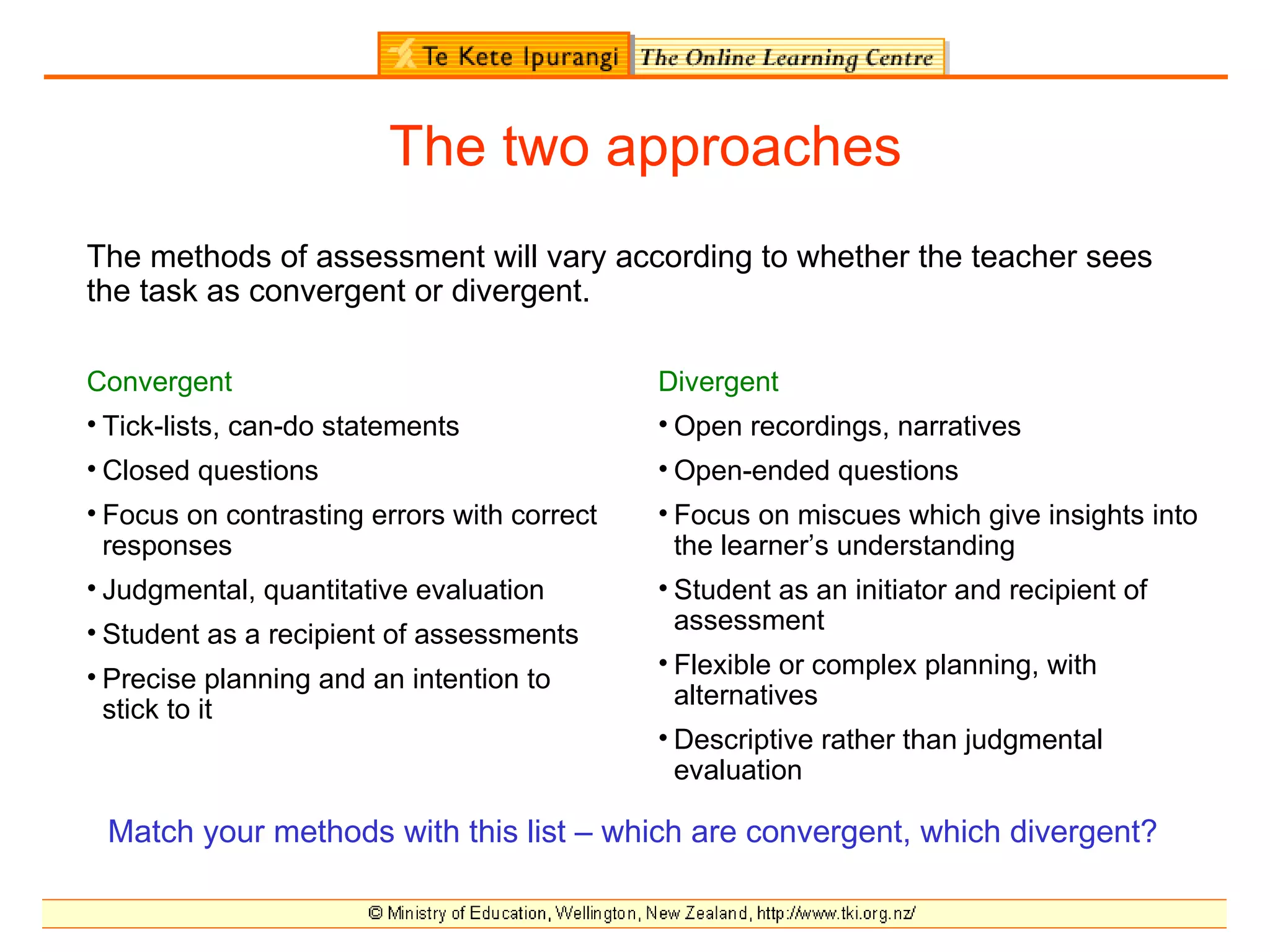
The two approaches
The methods of assessment will vary according to whether the teacher sees
the task as convergent or divergent.

Convergent                                   Divergent
• Tick-lists, can-do statements              • Open recordings, narratives
• Closed questions                           • Open-ended questions
• Focus on contrasting errors with correct   • Focus on miscues which give insights into
  responses                                    the learner’s understanding
• Judgmental, quantitative evaluation        • Student as an initiator and recipient of
• Student as a recipient of assessments        assessment
                                             • Flexible or complex planning, with
• Precise planning and an intention to
                                               alternatives
  stick to it
                                             • Descriptive rather than judgmental
                                               evaluation

 Match your methods with this list – which are convergent, which divergent?
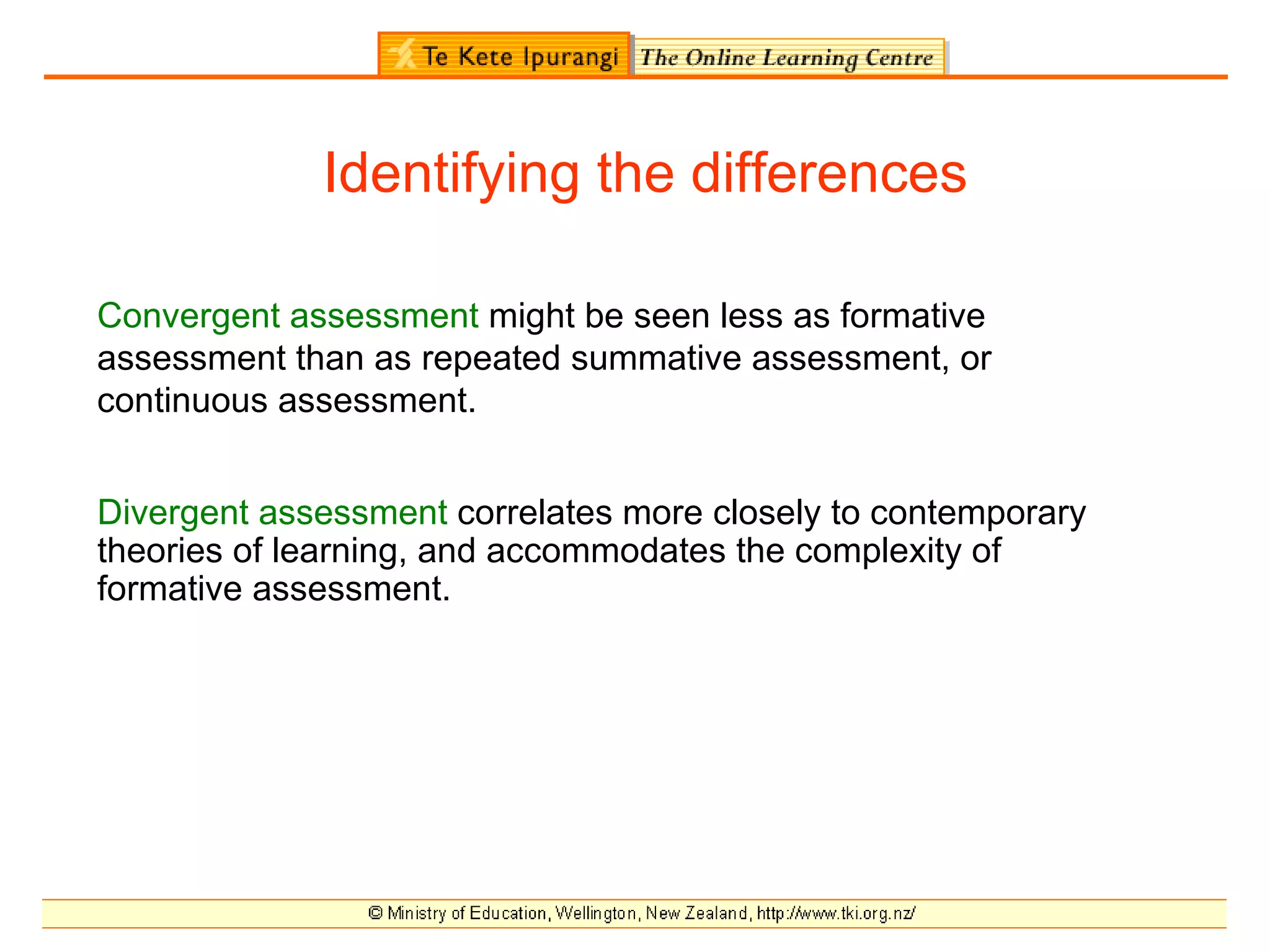
Identifying the differences

Convergent assessment might be seen less as formative
assessment than as repeated summative assessment, or
continuous assessment.


Divergent assessment correlates more closely to contemporary
theories of learning, and accommodates the complexity of
formative assessment.
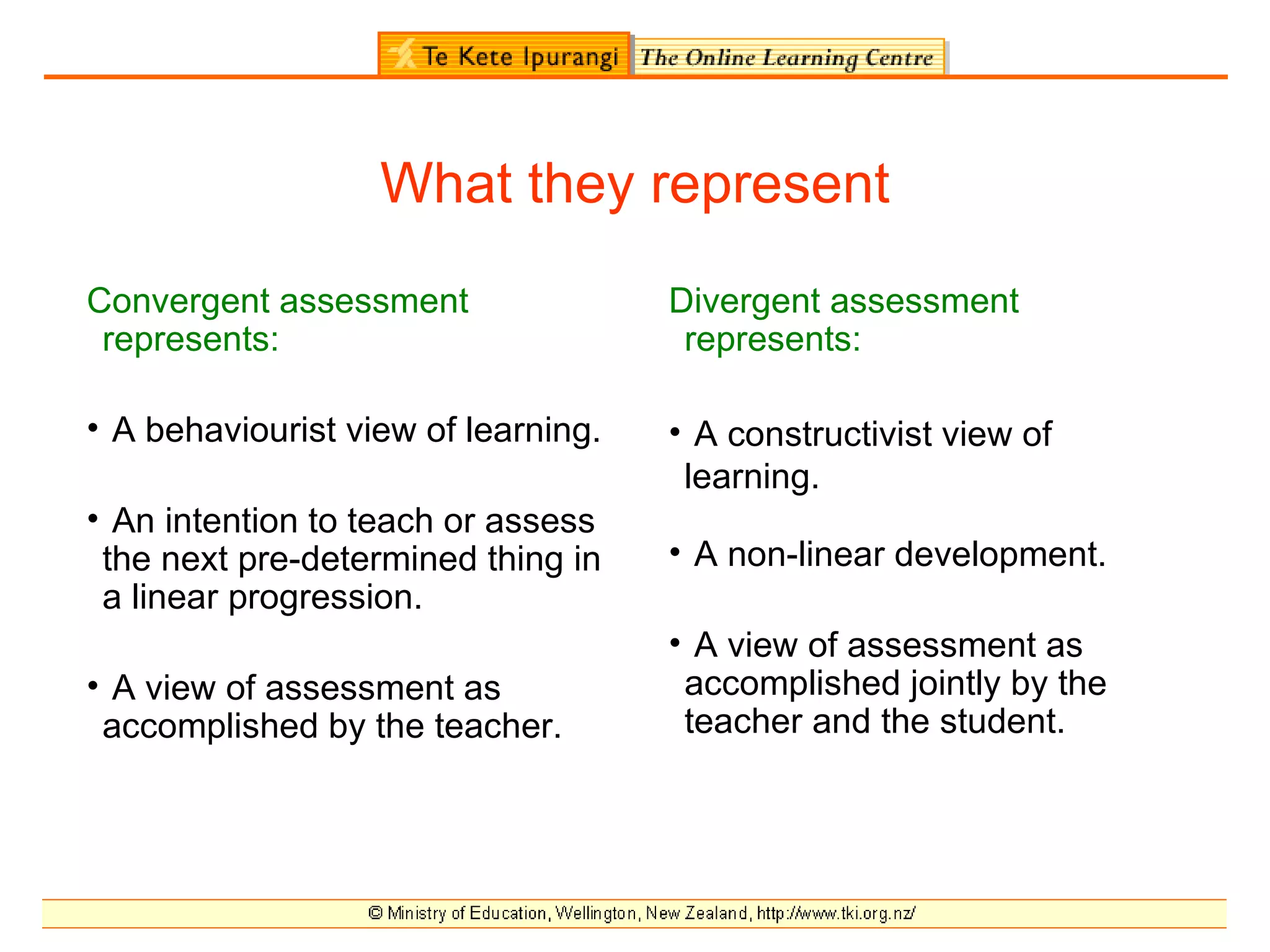
What they represent
Convergent assessment                Divergent assessment
 represents:                          represents:

• A behaviourist view of learning.   • A constructivist view of
                                      learning.
• An intention to teach or assess
 the next pre-determined thing in    • A non-linear development.
 a linear progression.
                                     • A view of assessment as
• A view of assessment as             accomplished jointly by the
 accomplished by the teacher.         teacher and the student.
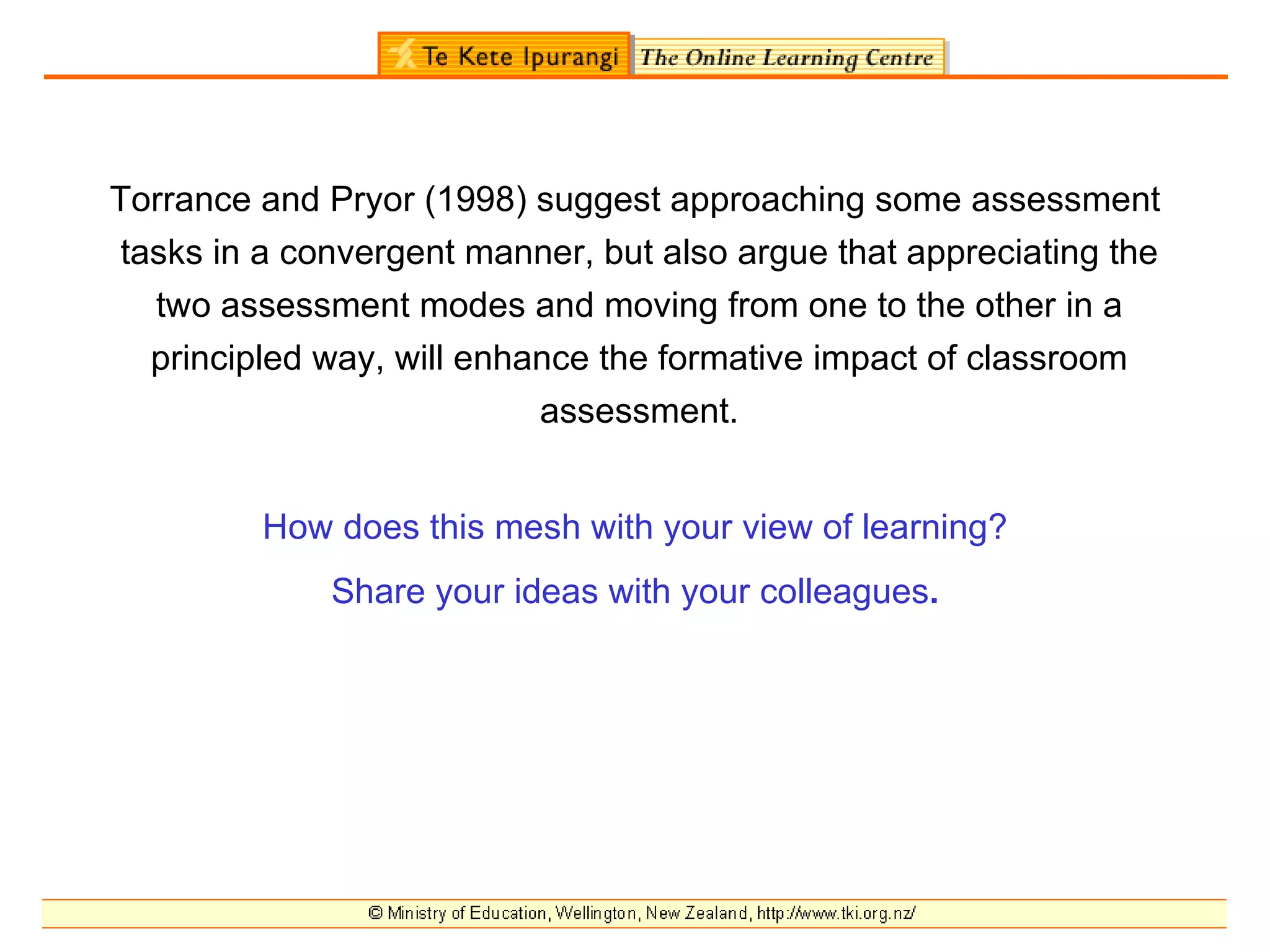
Torrance and Pryor (1998) suggest approaching some assessment
tasks in a convergent manner, but also argue that appreciating the
  two assessment modes and moving from one to the other in a
  principled way, will enhance the formative impact of classroom
                           assessment.


         How does this mesh with your view of learning?
             Share your ideas with your colleagues.
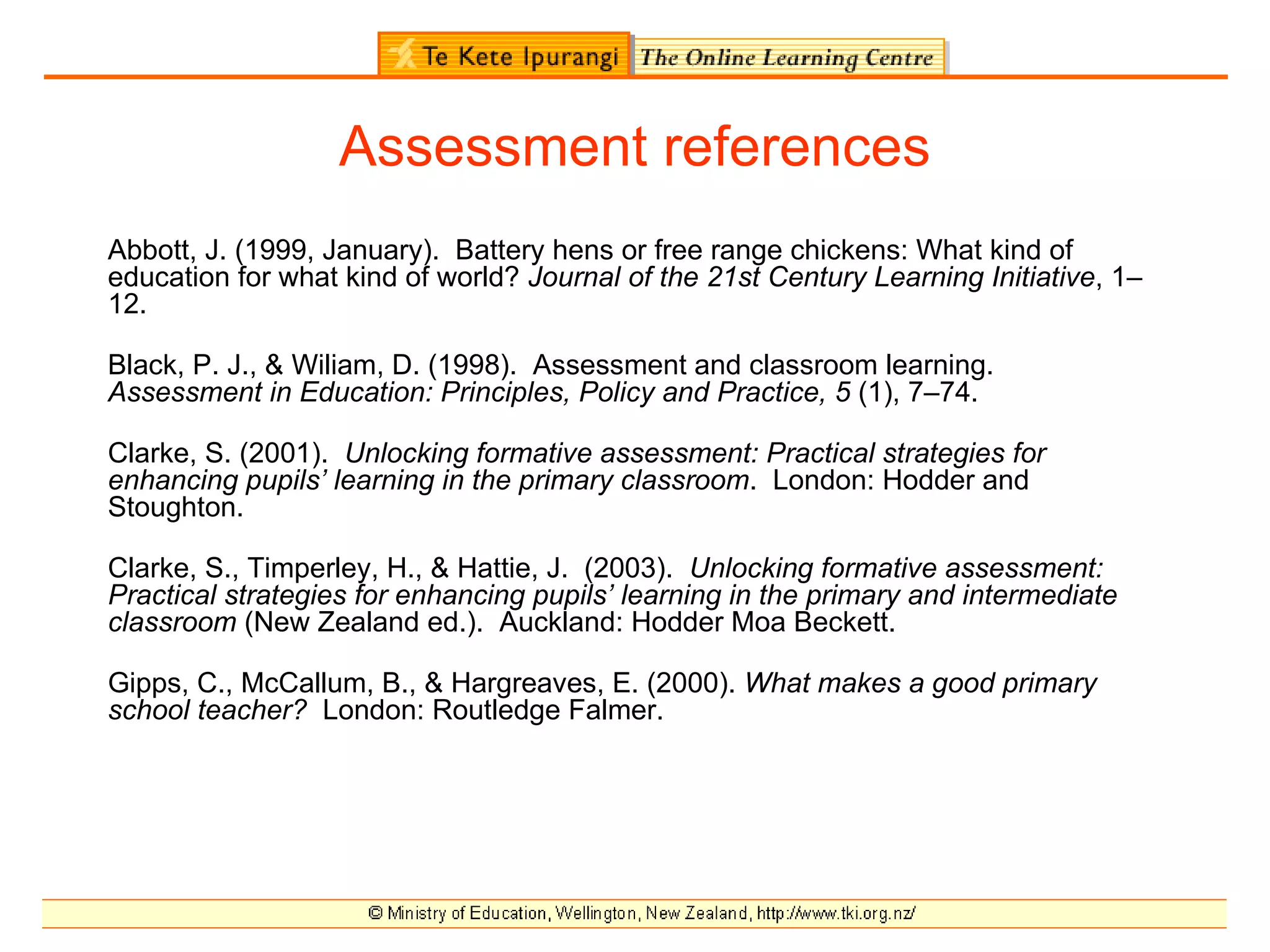
Assessment references
Abbott, J. (1999, January). Battery hens or free range chickens: What kind of
education for what kind of world? Journal of the 21st Century Learning Initiative, 1–
12.

Black, P. J., & Wiliam, D. (1998). Assessment and classroom learning.
Assessment in Education: Principles, Policy and Practice, 5 (1), 7–74.

Clarke, S. (2001). Unlocking formative assessment: Practical strategies for
enhancing pupils’ learning in the primary classroom. London: Hodder and
Stoughton.

Clarke, S., Timperley, H., & Hattie, J. (2003). Unlocking formative assessment:
Practical strategies for enhancing pupils’ learning in the primary and intermediate
classroom (New Zealand ed.). Auckland: Hodder Moa Beckett.

Gipps, C., McCallum, B., & Hargreaves, E. (2000). What makes a good primary
school teacher? London: Routledge Falmer.
Assessment references
Green, J. M. (1998, February). Constructing the way forward for all students. A
speech delivered at “Innovations for Effective Schools” OECD/New Zealand joint
follow-up conference, Christchurch, New Zealand.

Harlen, W. (1998) Classroom assessment: A dimension of purposes and
procedures. In K. Carr (Ed.), SAMEpapers (pp. 75–87). Hamilton, New Zealand:
Centre for Science, Mathematics and Technology Educational Research, University
of Waikato.

Hattie, J. (1999, August). Influences on student learning. Inaugural lecture:
Professor of Education, University of Auckland.

Sadler, R. (1989). Formative assessment and the design of instructional systems.
Instructional Science, 18, 119–44.

Torrance, H., & Pryor, J. (1998). Investigating formative assessment: Teaching and
learning in the classroom. Buckingham: Open University Press.

Tunstall, P., & Gipps, C. (1996). Teacher feedback to young children in formative
assessment: A typology. British Educational Research Journal, 22 (4).

Exploring formative assessment

  • 1.
    Exploring Formative Assessment– Assessment for Learning Online Workshop
  • 2.
    Who will findthis workshop useful? • Teachers • Syndicates / departments • AtoL facilitators How to use this workshop: • To update, review and/or reflect on formative assessment practice. • As a focus for professional development in exploring formative assessment. • To support AtoL in-depth programmes in schools.
  • 3.
    The word ‘assess’ Comesfrom the Latin verb ‘assidere’ meaning ‘to sit with’. In assessment one is supposed to sit with the learner. This implies it is something we do with and for students and not to students (Green, 1998)
  • 4.
    What are summativeand formative assessment? The garden analogy If we think of our children as plants … Summative assessment of the plants is the process of simply measuring them. It might be interesting to compare and analyse measurements but, in themselves, these do not affect the growth of the plants. Formative assessment, on the other hand, is the equivalent of feeding and watering the plants appropriate to their needs - directly affecting their growth.
  • 5.
    Formative and summativeassessment Formative and summative assessment are interconnected. They seldom stand alone in construction or effect. The vast majority of genuine formative assessment is informal, with interactive and timely feedback and response. It is widely and empirically argued that formative assessment has the greatest impact on learning and achievement.
  • 6.
    Some definitions Formative assessment “…often means no more than that the assessment is carried out frequently and is planned at the same time as teaching.” (Black and Wiliam, 1999) “… provides feedback which leads to students recognising the (learning) gap and closing it … it is forward looking …” (Harlen, 1998) “ … includes both feedback and self-monitoring.” (Sadler, 1989) “… is used essentially to feed back into the teaching and learning process.” (Tunstall and Gipps, 1996)
  • 7.
    Some definitions Summative assessment “…assessment (that) has increasingly been used to sum up learning” (Black and Wiliam, 1999) “… looks at past achievements “… adds procedures or tests to existing work “... involves only marking and feedback grades to student “… is separated from teaching “… is carried out at intervals when achievement has to be summarised and reported.” (Harlen, 1998)
  • 8.
    How do yousee assessment? Assessment point/task Activity: After learning Use the listed terms as a starting During learning point to develop a representation Feedback (model, mind-map, concept map) of how you see the relationship Feed-forward between summative and Learning continuum formative assessment. Of learning This may form the basis for For learning professional discussion in your Looks back learning community. Looks forward Review/reflect Improve/enhance
  • 9.
    What does theresearch say? In 1998 Paul Black and Dylan Wiliam of Kings College London published their wide-ranging analysis of research into classroom- based assessment: Inside the Black Box: Raising Standards through Classroom Assessment Full text http://www.kcl.ac.uk/depsta/education/publications/blackbox.html Summary of research, with a professional reading activity
  • 10.
    The Black Box:findings Black and Wiliam’s research indicates that improving learning through assessment depends on five deceptively simple factors: 1. Providing effective feedback to students. 2. Students’ active involvement in their own learning. 3. Adjusting teaching to take account of the results of assessment. 4. Recognising the profound influence of assessment on students’ motivation and self-esteem - both crucial influences on learning. 5. Ensuring pupils assess themselves and understand how to improve.
  • 11.
    Implications for classroompractice • Sharing learning goals with students. • Involving students in self-assessment. • Providing feedback that helps students recognise their next steps and how to take them. • Being confident that every student can improve.
  • 12.
    Self-evaluation Rate yourself from: 5 – I do this consistently well to: 0 – I don’t do this at all • How well do you: – Share learning goals with students? – Involve students in self assessment? – Provide timely focused feedback? • Do you have confidence that every student in your class can improve? • Think now about some of the things that prevent us from assessing in a formative manner.
  • 13.
    Hattie on feedback Inhis 1999 inaugural professorial lecture John Hattie (University of Auckland) noted: The most powerful single moderator that enhances achievement is feedback. The simplest prescription for improving education must be ‘dollops of feedback’. In particular, this should be about: • how and why the student understands and misunderstands • what directions the student must take to improve. (For more on feedback, see PowerPoint ‘Giving Quality Feedback’)
  • 14.
    In summary… Practice drawnfrom the research base involves:  Clarifying learning outcomes at the planning stage.  Sharing learning outcomes with students.  Encouraging students’ self-assessment against the learning outcomes.  Focusing oral and written feedback on the learning outcomes of lessons and tasks.  Organising individual student target-setting that builds on previous achievement as well as aiming for the next level up.  Appropriate and effective questioning.  Raising students’ self-esteem through the language of the classroom and the ways in which achievement is celebrated.
  • 15.
    What do wewant for our students? The test of a successful education is not the amount of knowledge that a student takes away from a school, but the appetite to know and the capacity to learn. If a school sends out students with a desire for knowledge and some idea of how to acquire and use it, it will have done its work. Too many students leave school with the appetite killed and the mind loaded with undigested lumps of information. (Abbott, 1999)
  • 16.
    Links The following PowerPointworkshops may be found on TKI at http://www.tki.org.nz/r/assessment/one/formative_e.php Planning for Formative Assessment For more on learning outcomes or intentions. Giving Quality Feedback For more on questioning and feedback. Teacher-Student Conversations that Promote Learning For more on questioning and feedback http://www.tki.org.nz/r/assessment/two/self_and_peer_e.php Teaching the strategies of self and peer assessment For a self and peer assessment workshop
  • 17.
    This concludes thisworkshop. However, for those with a yen to delve deeper, the following slides provide a theoretical perspective on assessment.
  • 18.
  • 19.
    Convergent and divergentmodels Torrance and Pryor (1998) suggest a framework of convergent and divergent models for formative assessment. Convergent assessment aims to discover whether the learner knows, understands or can do a pre-determined thing. Divergent assessment aims to discover what the learner knows, understands or can do. List the assessment methods used in your school/ classroom.
  • 20.
    The two approaches Themethods of assessment will vary according to whether the teacher sees the task as convergent or divergent. Convergent Divergent • Tick-lists, can-do statements • Open recordings, narratives • Closed questions • Open-ended questions • Focus on contrasting errors with correct • Focus on miscues which give insights into responses the learner’s understanding • Judgmental, quantitative evaluation • Student as an initiator and recipient of • Student as a recipient of assessments assessment • Flexible or complex planning, with • Precise planning and an intention to alternatives stick to it • Descriptive rather than judgmental evaluation Match your methods with this list – which are convergent, which divergent?
  • 21.
    Identifying the differences Convergentassessment might be seen less as formative assessment than as repeated summative assessment, or continuous assessment. Divergent assessment correlates more closely to contemporary theories of learning, and accommodates the complexity of formative assessment.
  • 22.
    What they represent Convergentassessment Divergent assessment represents: represents: • A behaviourist view of learning. • A constructivist view of learning. • An intention to teach or assess the next pre-determined thing in • A non-linear development. a linear progression. • A view of assessment as • A view of assessment as accomplished jointly by the accomplished by the teacher. teacher and the student.
  • 23.
    Torrance and Pryor(1998) suggest approaching some assessment tasks in a convergent manner, but also argue that appreciating the two assessment modes and moving from one to the other in a principled way, will enhance the formative impact of classroom assessment. How does this mesh with your view of learning? Share your ideas with your colleagues.
  • 24.
    Assessment references Abbott, J.(1999, January). Battery hens or free range chickens: What kind of education for what kind of world? Journal of the 21st Century Learning Initiative, 1– 12. Black, P. J., & Wiliam, D. (1998). Assessment and classroom learning. Assessment in Education: Principles, Policy and Practice, 5 (1), 7–74. Clarke, S. (2001). Unlocking formative assessment: Practical strategies for enhancing pupils’ learning in the primary classroom. London: Hodder and Stoughton. Clarke, S., Timperley, H., & Hattie, J. (2003). Unlocking formative assessment: Practical strategies for enhancing pupils’ learning in the primary and intermediate classroom (New Zealand ed.). Auckland: Hodder Moa Beckett. Gipps, C., McCallum, B., & Hargreaves, E. (2000). What makes a good primary school teacher? London: Routledge Falmer.
  • 25.
    Assessment references Green, J.M. (1998, February). Constructing the way forward for all students. A speech delivered at “Innovations for Effective Schools” OECD/New Zealand joint follow-up conference, Christchurch, New Zealand. Harlen, W. (1998) Classroom assessment: A dimension of purposes and procedures. In K. Carr (Ed.), SAMEpapers (pp. 75–87). Hamilton, New Zealand: Centre for Science, Mathematics and Technology Educational Research, University of Waikato. Hattie, J. (1999, August). Influences on student learning. Inaugural lecture: Professor of Education, University of Auckland. Sadler, R. (1989). Formative assessment and the design of instructional systems. Instructional Science, 18, 119–44. Torrance, H., & Pryor, J. (1998). Investigating formative assessment: Teaching and learning in the classroom. Buckingham: Open University Press. Tunstall, P., & Gipps, C. (1996). Teacher feedback to young children in formative assessment: A typology. British Educational Research Journal, 22 (4).