Types of Test
Tamar Mikeladze
Doctoral Student of Telavi State University
English Language Teacher at Telavi State University
2008
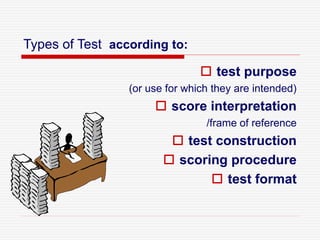
Types of Test according to:
 test purpose
(or use for which they are intended)
 score interpretation
/frame of reference
 test construction
 scoring procedure
 test format
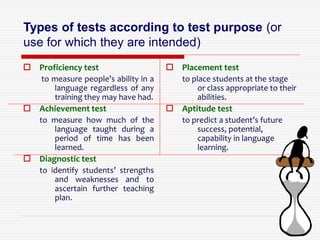
Types of tests according to test purpose (or
use for which they are intended)
 Proficiency test
to measure people’s ability in a
language regardless of any
training they may have had.
 Achievement test
to measure how much of the
language taught during a
period of time has been
learned.
 Diagnostic test
to identify students’ strengths
and weaknesses and to
ascertain further teaching
plan.
 Placement test
to place students at the stage
or class appropriate to their
abilities.
 Aptitude test
to predict a student’s future
success, potential,
capability in language
learning.
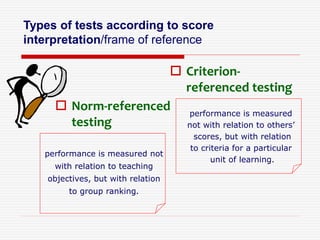
Types of tests according to score
interpretation/frame of reference
 Norm-referenced
testing
 Criterion-
referenced testing
performance is measured not
with relation to teaching
objectives, but with relation
to group ranking.
performance is measured
not with relation to others’
scores, but with relation
to criteria for a particular
unit of learning.
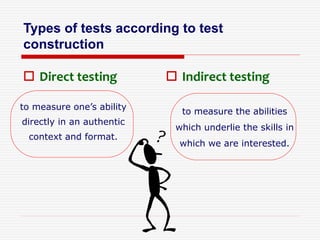
Types of tests according to test
construction
 Direct testing  Indirect testing
to measure one’s ability
directly in an authentic
context and format.
to measure the abilities
which underlie the skills in
which we are interested.
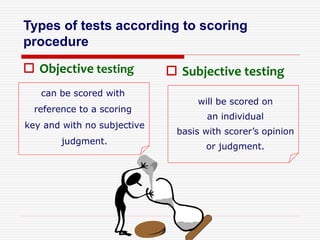
Types of tests according to scoring
procedure
 Objective testing  Subjective testing
can be scored with
reference to a scoring
key and with no subjective
judgment.
will be scored on
an individual
basis with scorer’s opinion
or judgment.
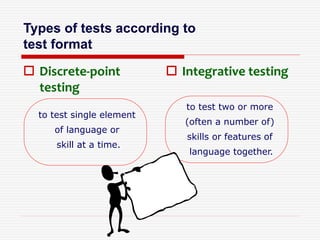
Types of tests according to
test format
 Discrete-point
testing
 Integrative testing
to test single element
of language or
skill at a time.
to test two or more
(often a number of)
skills or features of
language together.
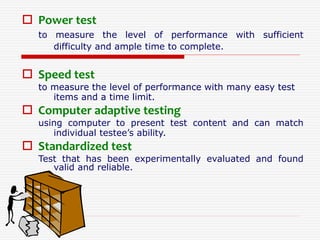
 Power test
to measure the level of performance with sufficient
difficulty and ample time to complete.
 Speed test
to measure the level of performance with many easy test
items and a time limit.
 Computer adaptive testing
using computer to present test content and can match
individual testee’s ability.
 Standardized test
Test that has been experimentally evaluated and found
valid and reliable.
Table of Types of Test/worksheet I
Types of Test and
Features of Test
Proficiency
Test
Aptitude
Test
Achievement
Test
Diagnostic
Test
Norm-referenced
Criterion-referenced
Objective testing
Subjective testing
Discrete-point test
Integrative test


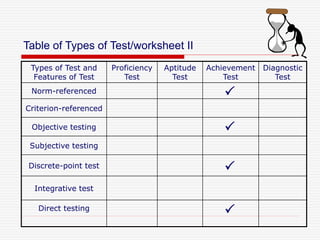
Table of Types of Test/worksheet II
Types of Test and
Features of Test
Proficiency
Test
Aptitude
Test
Achievement
Test
Diagnostic
Test
Norm-referenced
Criterion-referenced
Objective testing
Subjective testing
Discrete-point test
Integrative test
Direct testing




Thank you

types-of-test-and-testing

  • 1.
    Types of Test TamarMikeladze Doctoral Student of Telavi State University English Language Teacher at Telavi State University 2008
  • 2.
    Types of Testaccording to:  test purpose (or use for which they are intended)  score interpretation /frame of reference  test construction  scoring procedure  test format
  • 3.
    Types of testsaccording to test purpose (or use for which they are intended)  Proficiency test to measure people’s ability in a language regardless of any training they may have had.  Achievement test to measure how much of the language taught during a period of time has been learned.  Diagnostic test to identify students’ strengths and weaknesses and to ascertain further teaching plan.  Placement test to place students at the stage or class appropriate to their abilities.  Aptitude test to predict a student’s future success, potential, capability in language learning.
  • 4.
    Types of testsaccording to score interpretation/frame of reference  Norm-referenced testing  Criterion- referenced testing performance is measured not with relation to teaching objectives, but with relation to group ranking. performance is measured not with relation to others’ scores, but with relation to criteria for a particular unit of learning.
  • 5.
    Types of testsaccording to test construction  Direct testing  Indirect testing to measure one’s ability directly in an authentic context and format. to measure the abilities which underlie the skills in which we are interested.
  • 6.
    Types of testsaccording to scoring procedure  Objective testing  Subjective testing can be scored with reference to a scoring key and with no subjective judgment. will be scored on an individual basis with scorer’s opinion or judgment.
  • 7.
    Types of testsaccording to test format  Discrete-point testing  Integrative testing to test single element of language or skill at a time. to test two or more (often a number of) skills or features of language together.
  • 8.
     Power test tomeasure the level of performance with sufficient difficulty and ample time to complete.  Speed test to measure the level of performance with many easy test items and a time limit.  Computer adaptive testing using computer to present test content and can match individual testee’s ability.  Standardized test Test that has been experimentally evaluated and found valid and reliable.
  • 9.
    Table of Typesof Test/worksheet I Types of Test and Features of Test Proficiency Test Aptitude Test Achievement Test Diagnostic Test Norm-referenced Criterion-referenced Objective testing Subjective testing Discrete-point test Integrative test  
  • 10.
    Table of Typesof Test/worksheet II Types of Test and Features of Test Proficiency Test Aptitude Test Achievement Test Diagnostic Test Norm-referenced Criterion-referenced Objective testing Subjective testing Discrete-point test Integrative test Direct testing    
  • 11.