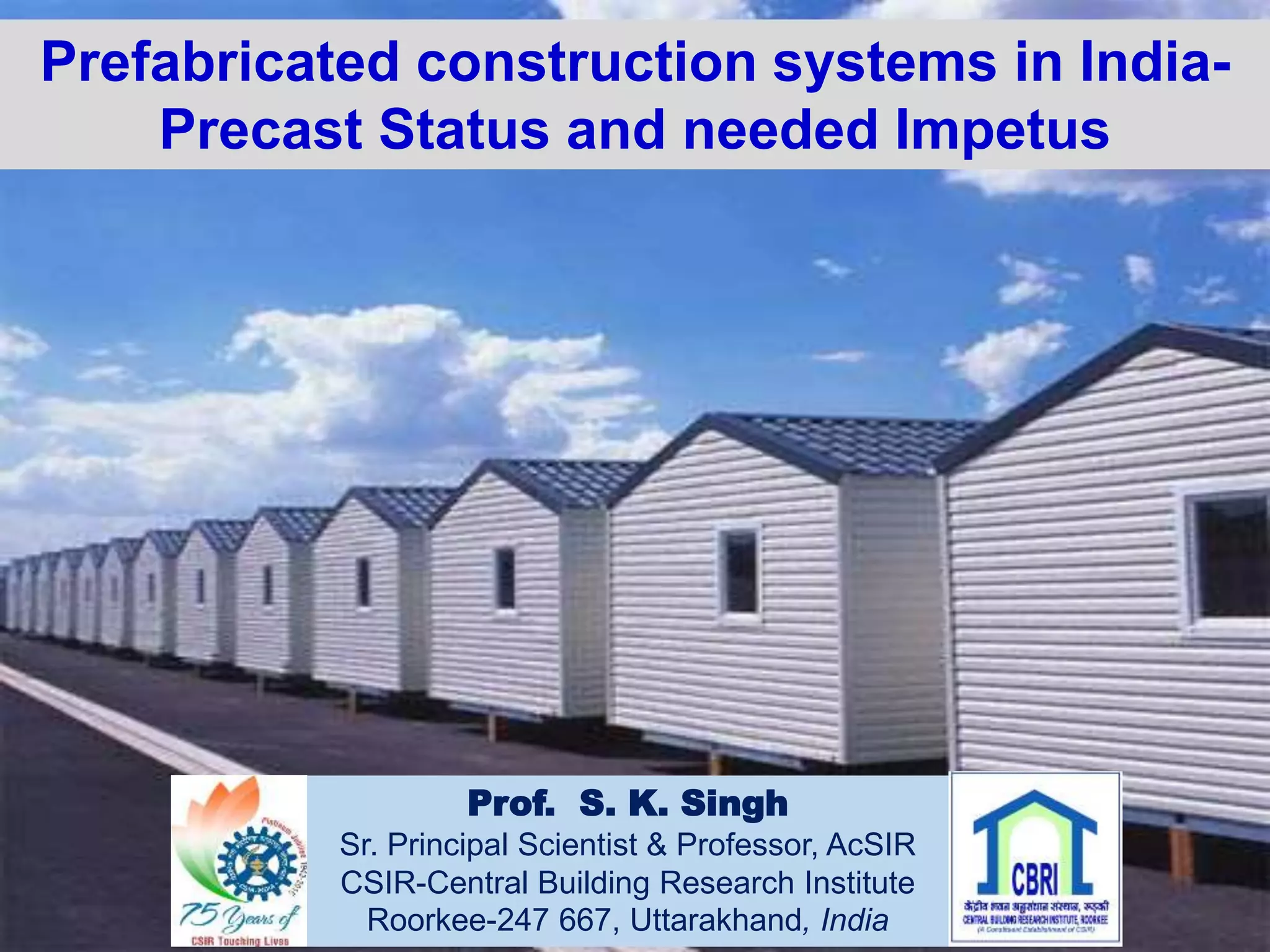
Prefabricated construction systems in India-
Precast Status and needed Impetus
Prof. S. K. Singh
Sr. Principal Scientist & Professor, AcSIR
CSIR-Central Building Research Institute
Roorkee-247 667, Uttarakhand, India
Outline
• Introduction
• Issues
• Affordable Housing
• Why Prefabrication?
• Worldwide Status
• Prefab Technologies
• Sustainable Approach
• Advantages &
Disadvantages
• Summary
CSIR-Central Building Research Institute, Roorkee-247 667, INDIA
Questions to be Answered
Is it
sustainable?
What are the
benefits?
Why prefabricated
construction system?
CSIR-Central Building Research Institute, Roorkee-247 667, INDIA
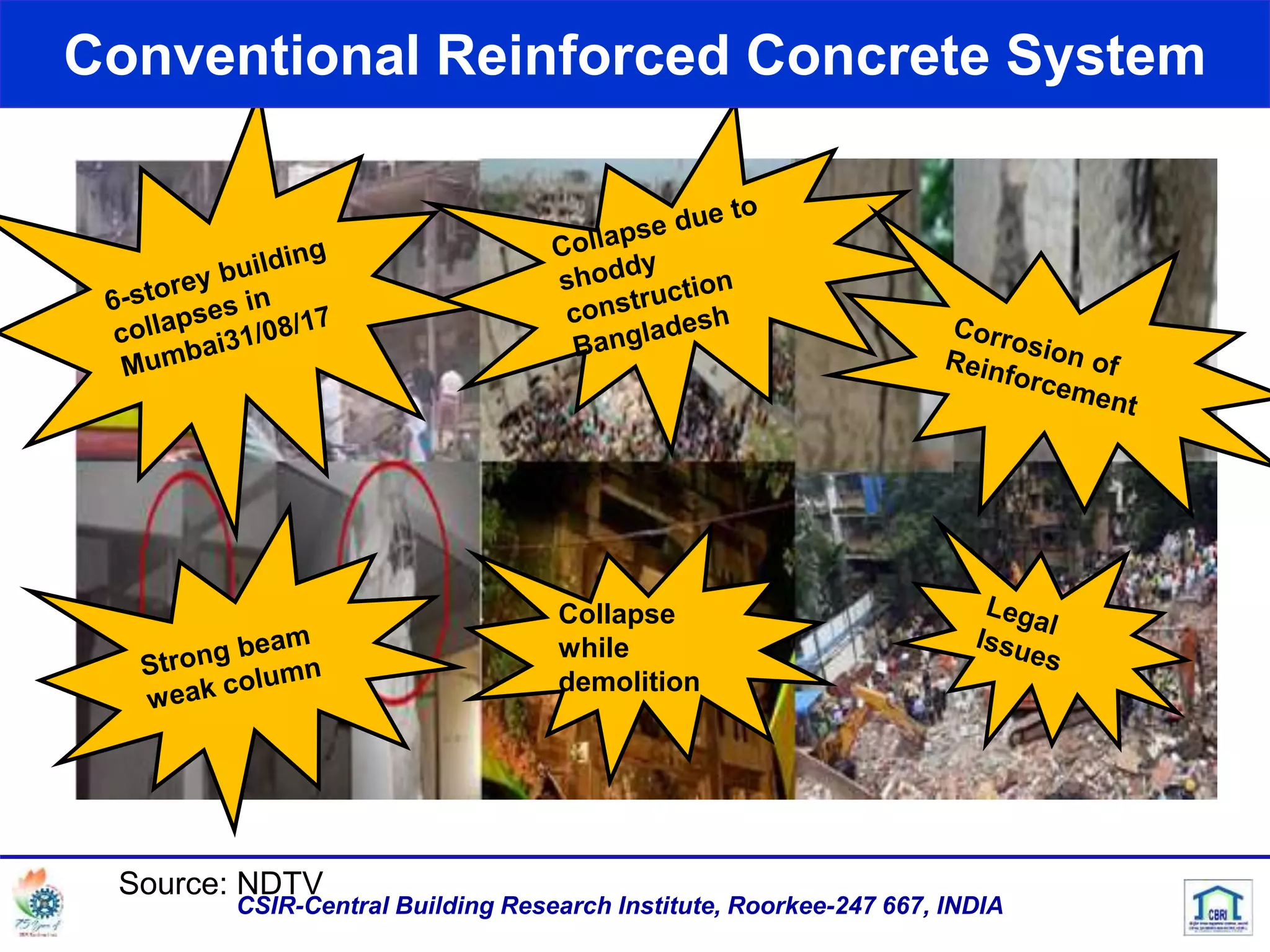
Collapse
while
demolition
Conventional Reinforced Concrete System
Source: NDTV
CSIR-Central Building Research Institute, Roorkee-247 667, INDIA
Problems in India
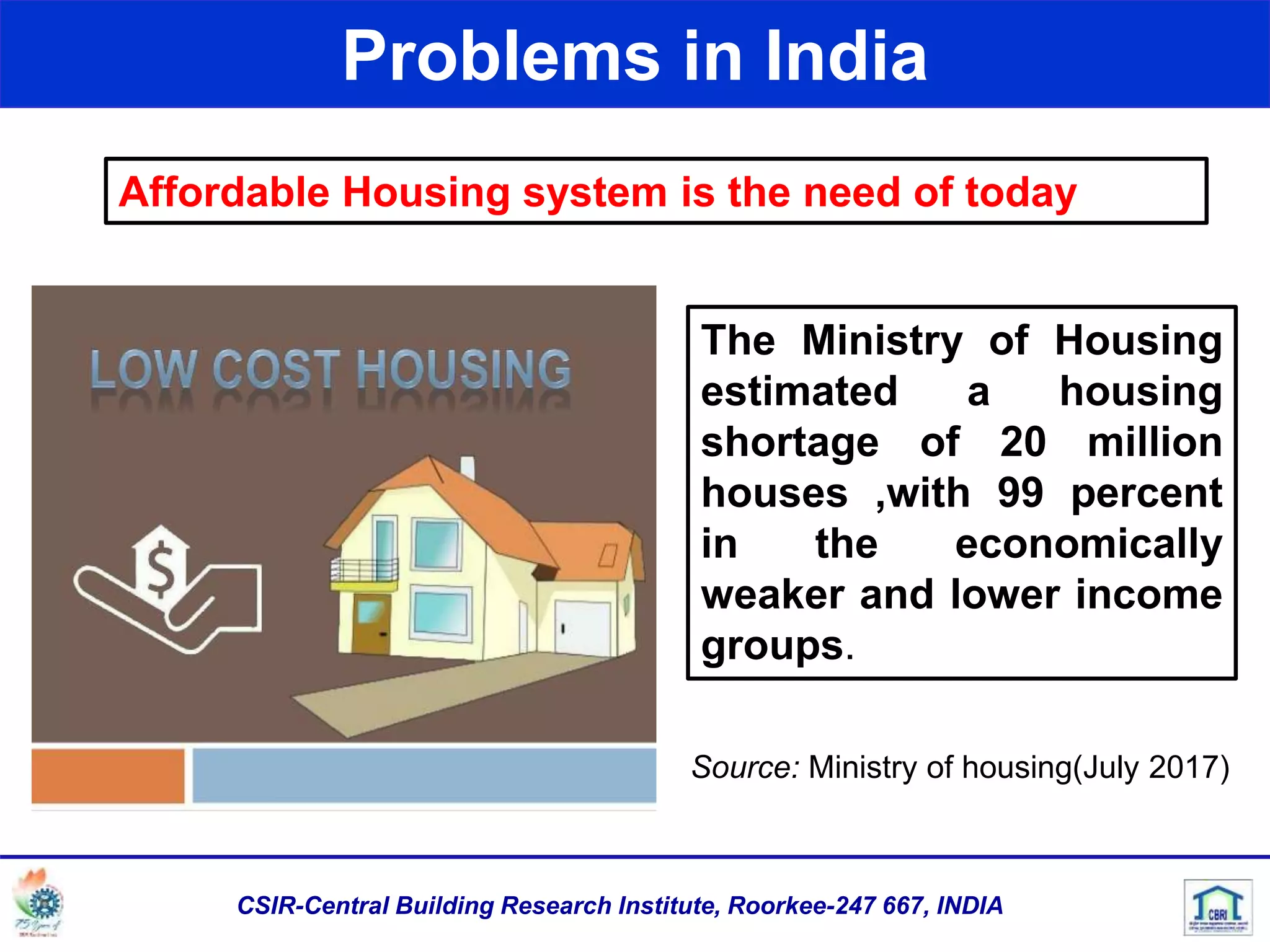
Affordable Housing system is the need of today
The Ministry of Housing
estimated a housing
shortage of 20 million
houses ,with 99 percent
in the economically
weaker and lower income
groups.
Source: Ministry of housing(July 2017)
CSIR-Central Building Research Institute, Roorkee-247 667, INDIA
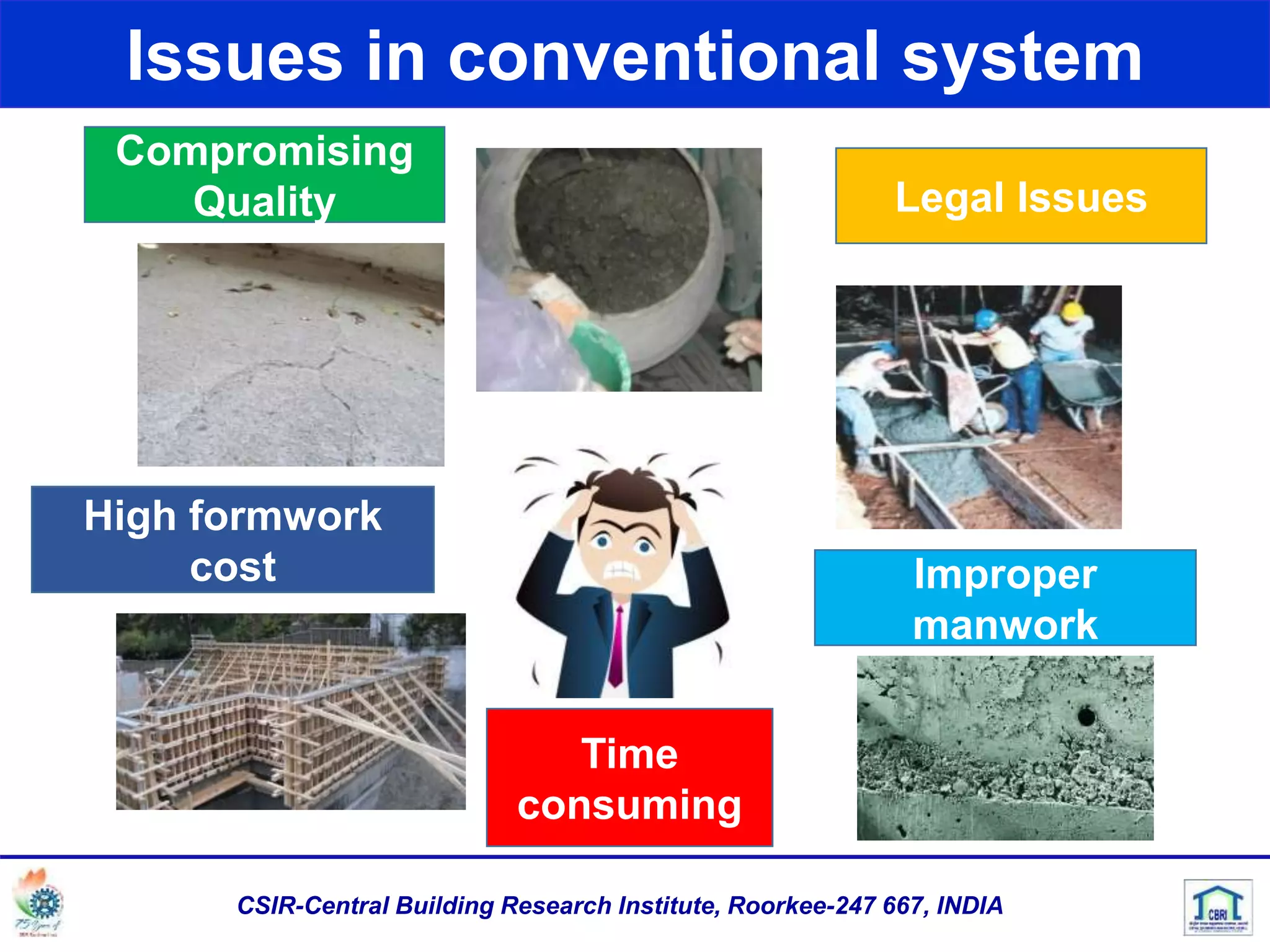
Compromising
Quality Legal Issues
Improper
manwork
Time
consuming
High formwork
cost
Issues in conventional system
CSIR-Central Building Research Institute, Roorkee-247 667, INDIA
Prefabricated Construction System
CSIR-Central Building Research Institute, Roorkee-247 667, INDIA
Introduction
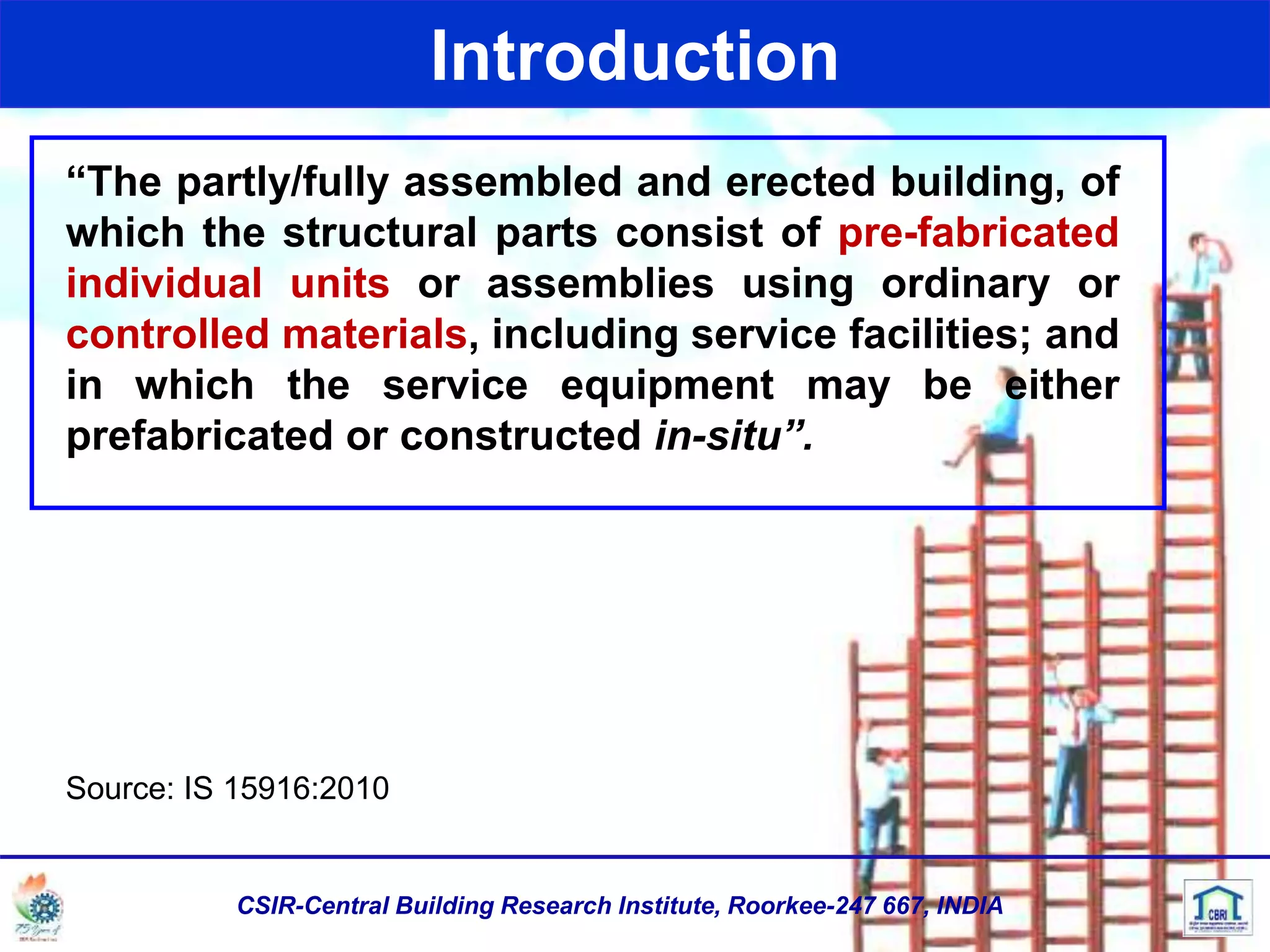
“The partly/fully assembled and erected building, of
which the structural parts consist of pre-fabricated
individual units or assemblies using ordinary or
controlled materials, including service facilities; and
in which the service equipment may be either
prefabricated or constructed in-situ”.
Source: IS 15916:2010
CSIR-Central Building Research Institute, Roorkee-247 667, INDIA
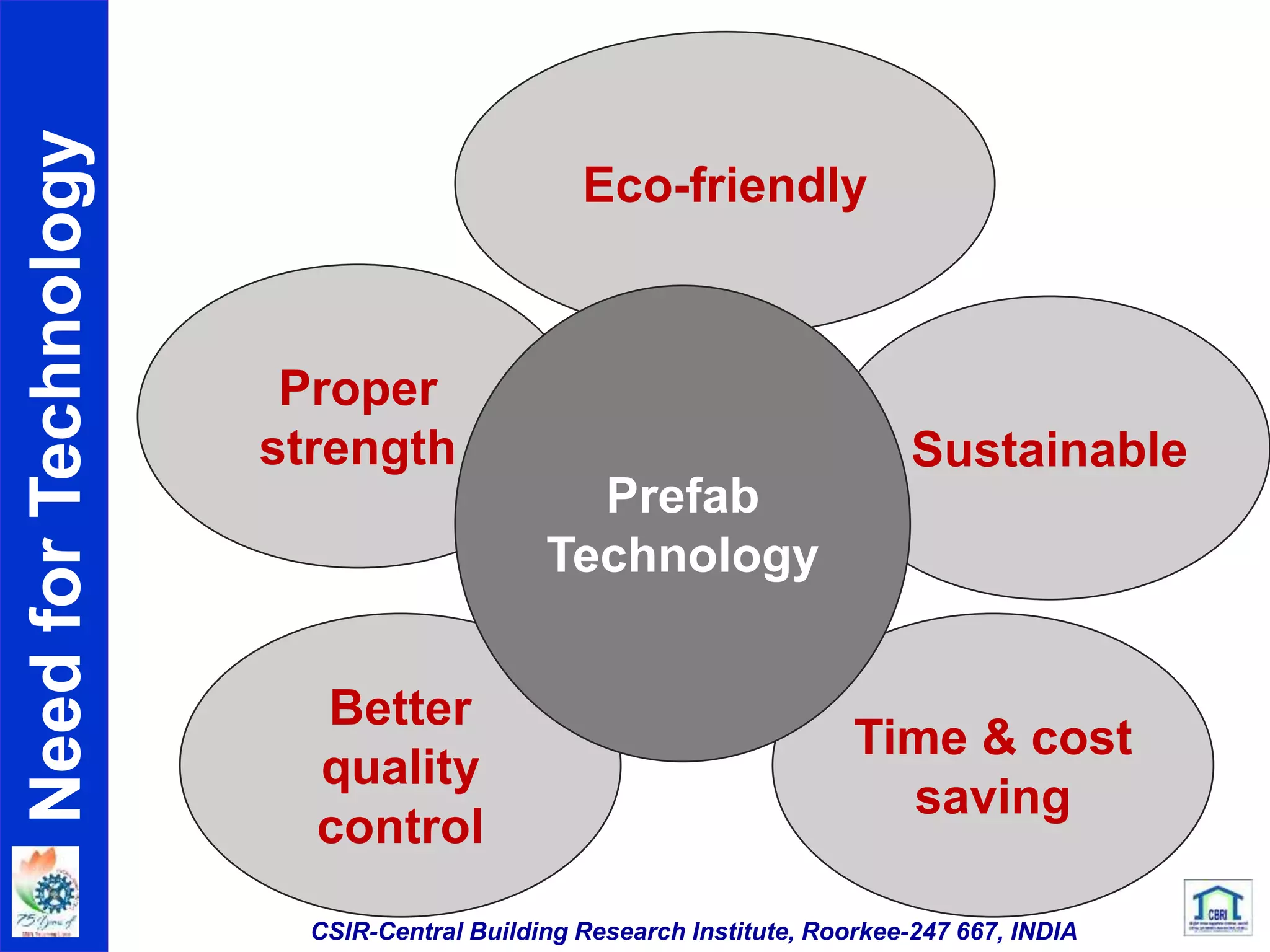
NeedforTechnology
Proper
strength
Better
quality
control
Sustainable
Time & cost
saving
Eco-friendly
Prefab
Technology
CSIR-Central Building Research Institute, Roorkee-247 667, INDIA
Worldwide Status
CSIR-Central Building Research Institute, Roorkee-247 667, INDIA
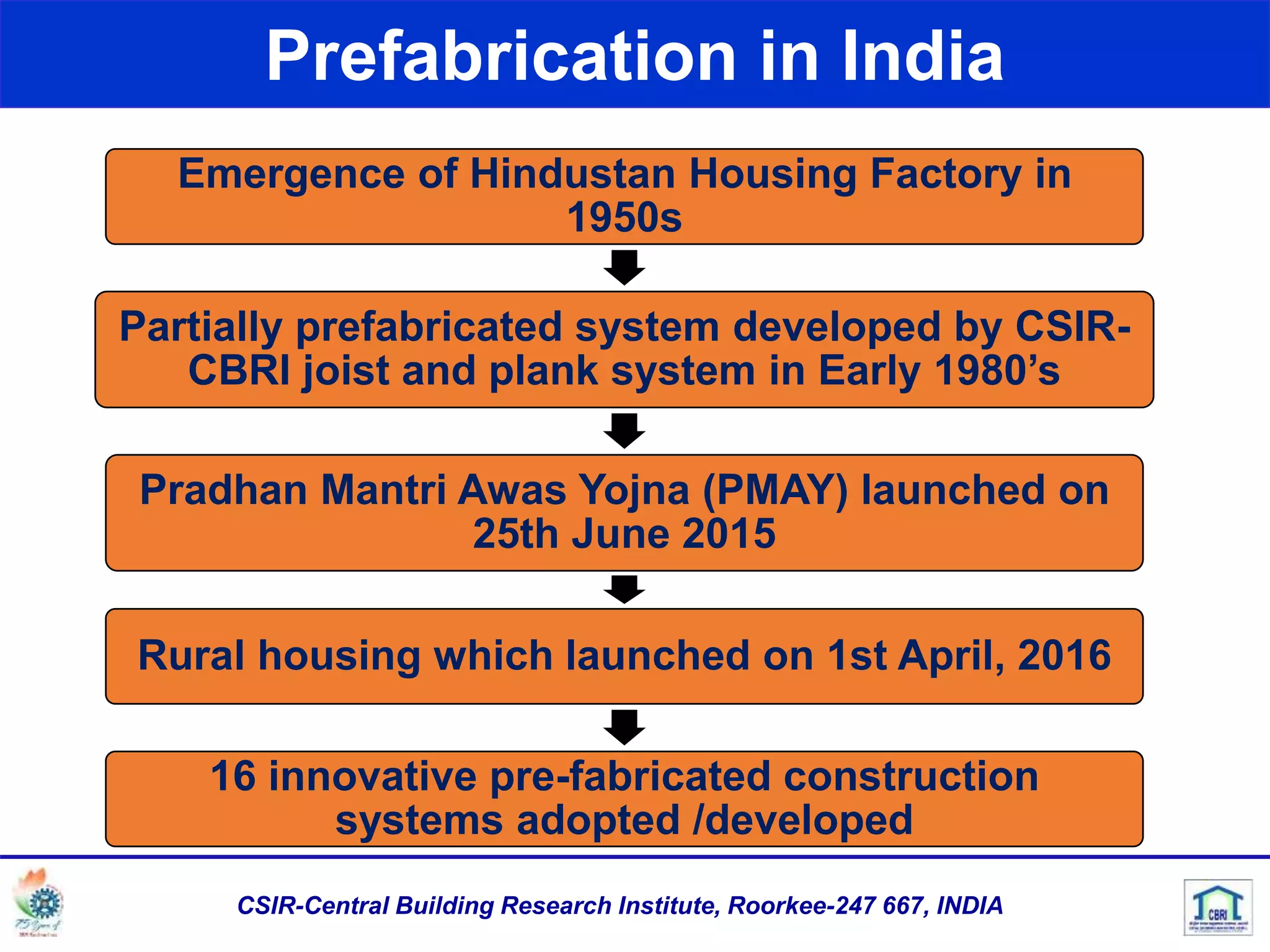
Prefabrication in India
Emergence of Hindustan Housing Factory in
1950s
Partially prefabricated system developed by CSIR-
CBRI joist and plank system in Early 1980’s
Pradhan Mantri Awas Yojna (PMAY) launched on
25th June 2015
Rural housing which launched on 1st April, 2016
16 innovative pre-fabricated construction
systems adopted /developed
CSIR-Central Building Research Institute, Roorkee-247 667, INDIA
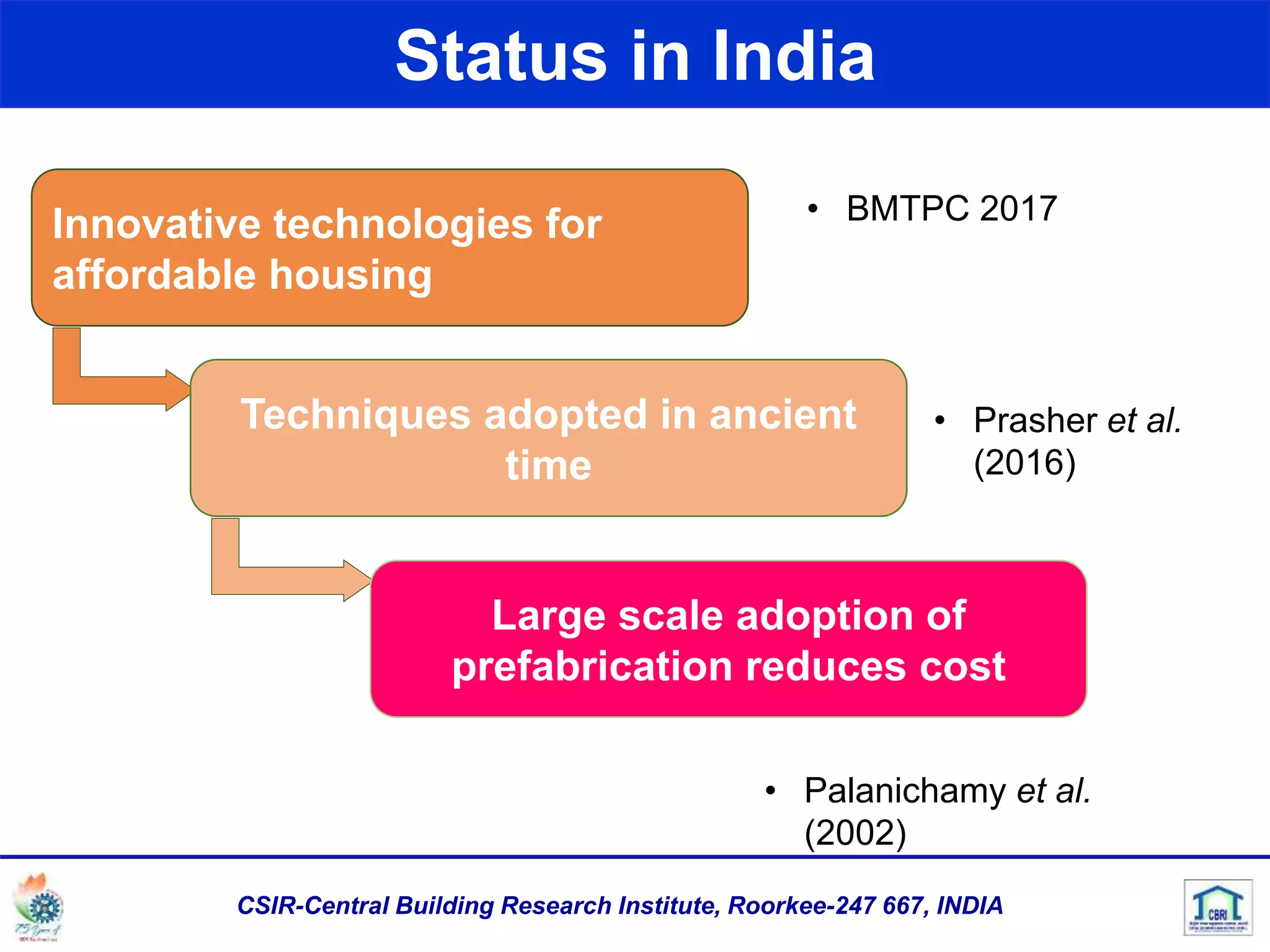
Status in India
Innovative technologies for
affordable housing
Techniques adopted in ancient
time
Large scale adoption of
prefabrication reduces cost
• Prasher et al.
(2016)
• BMTPC 2017
• Palanichamy et al.
(2002)
CSIR-Central Building Research Institute, Roorkee-247 667, INDIA
Worldwide Status
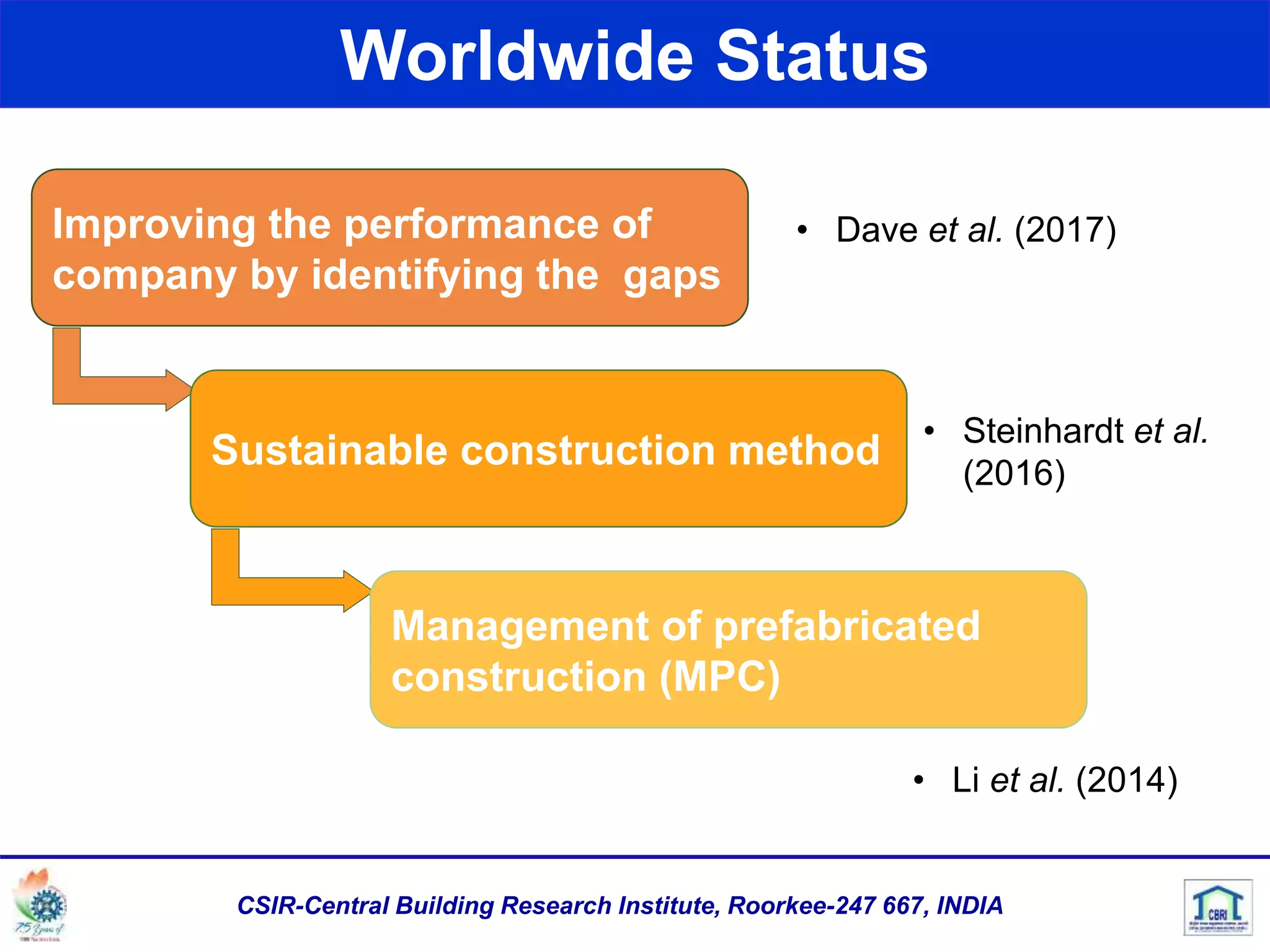
Improving the performance of
company by identifying the gaps
Sustainable construction method
Management of prefabricated
construction (MPC)
• Steinhardt et al.
(2016)
• Li et al. (2014)
• Dave et al. (2017)
CSIR-Central Building Research Institute, Roorkee-247 667, INDIA
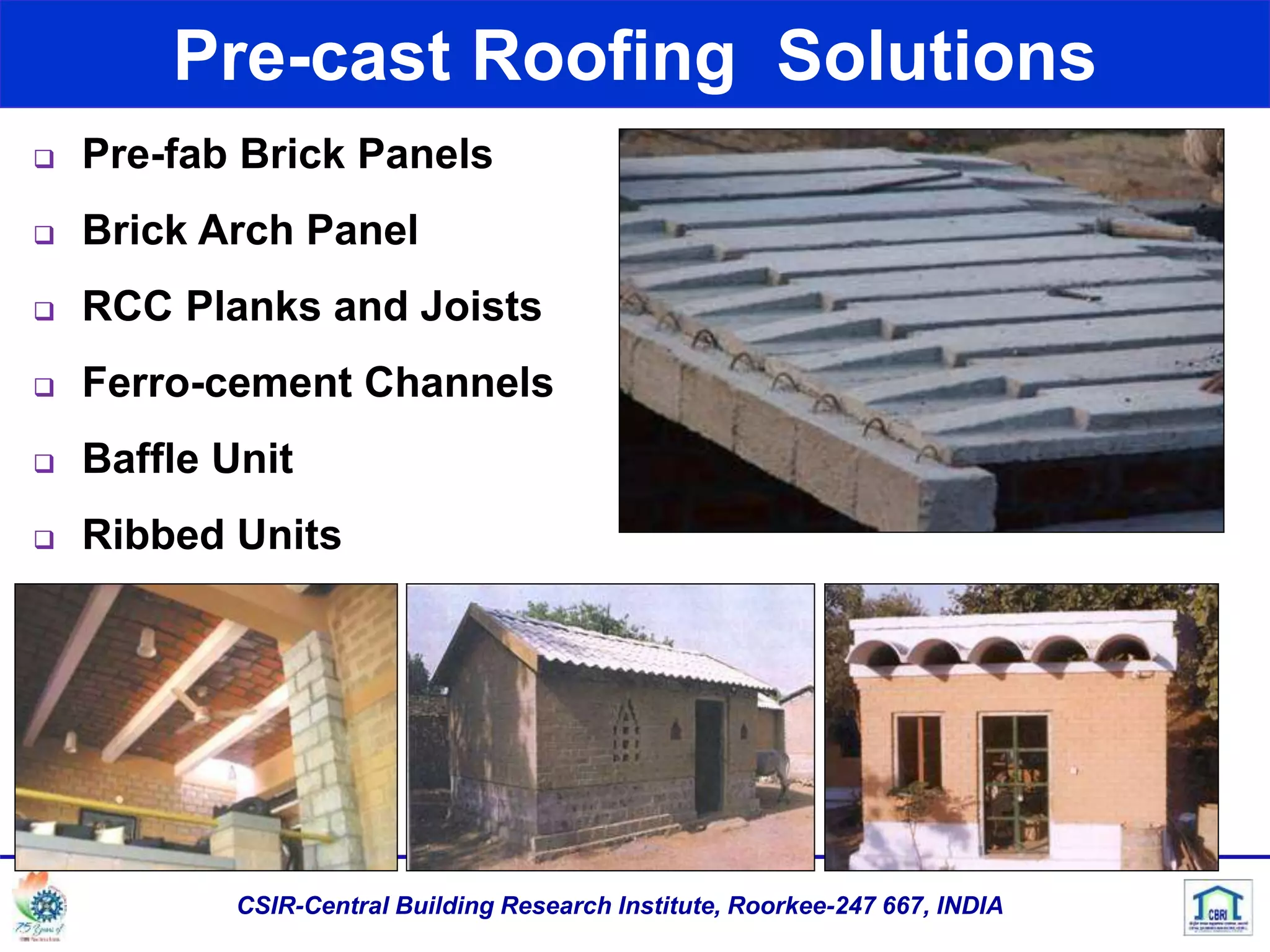
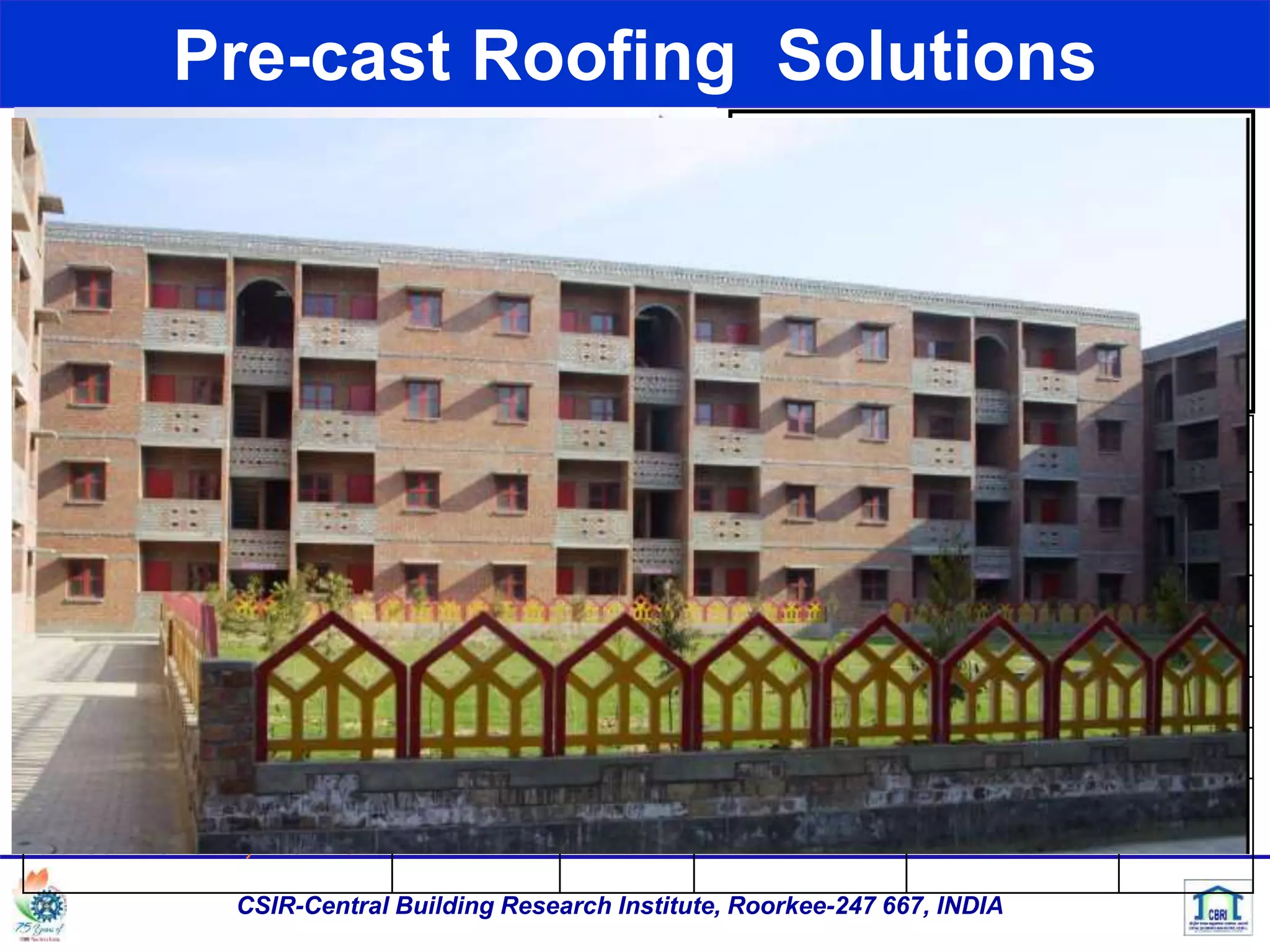
Pre-cast Roofing Solutions
CSIR-Central Building Research Institute, Roorkee-247 667, INDIA
 Pre-fab Brick Panels
 Brick Arch Panel
 RCC Planks and Joists
 Ferro-cement Channels
 Baffle Unit
 Ribbed Units
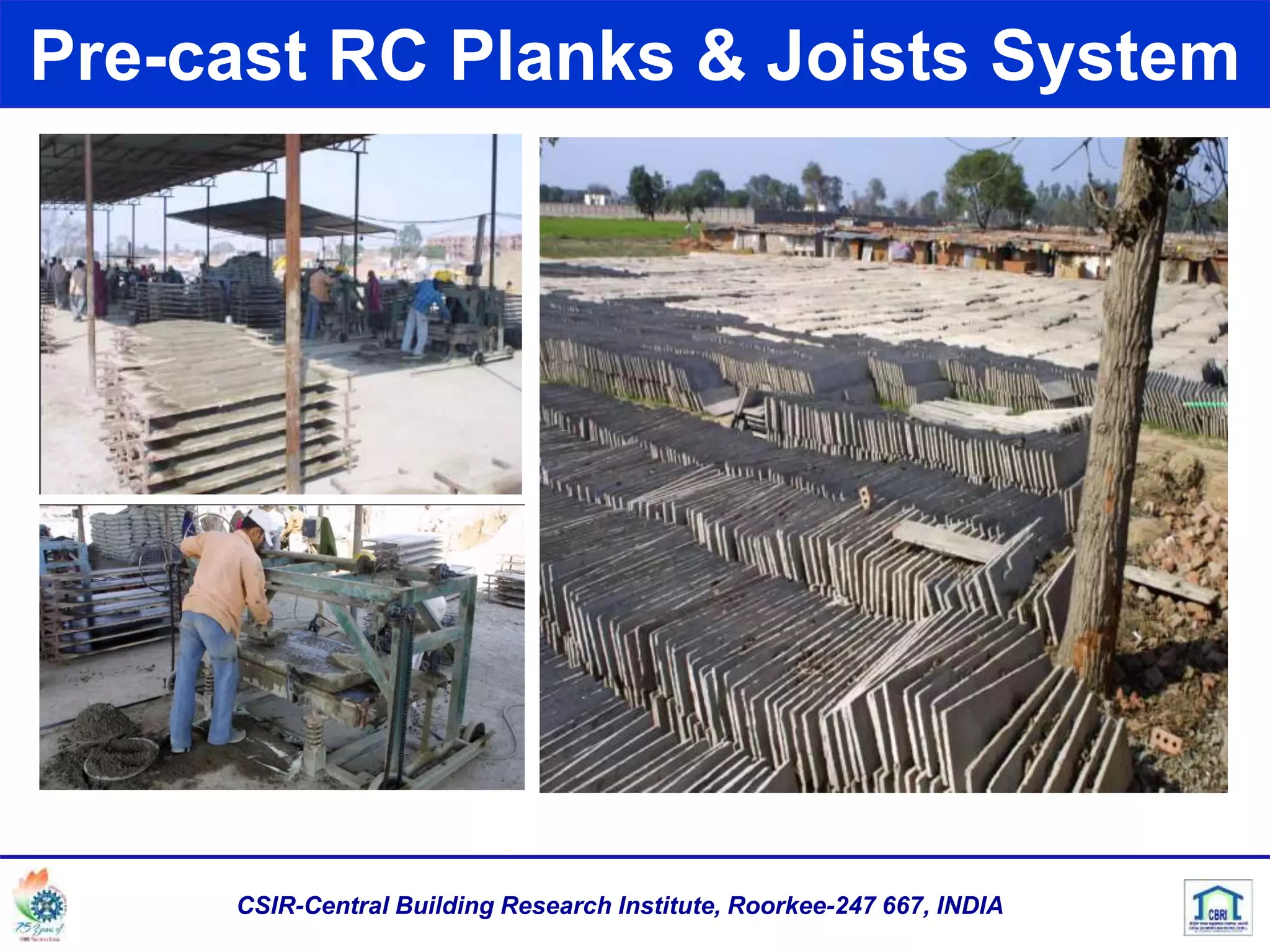
Pre-cast RC Planks & Joists System
CSIR-Central Building Research Institute, Roorkee-247 667, INDIA
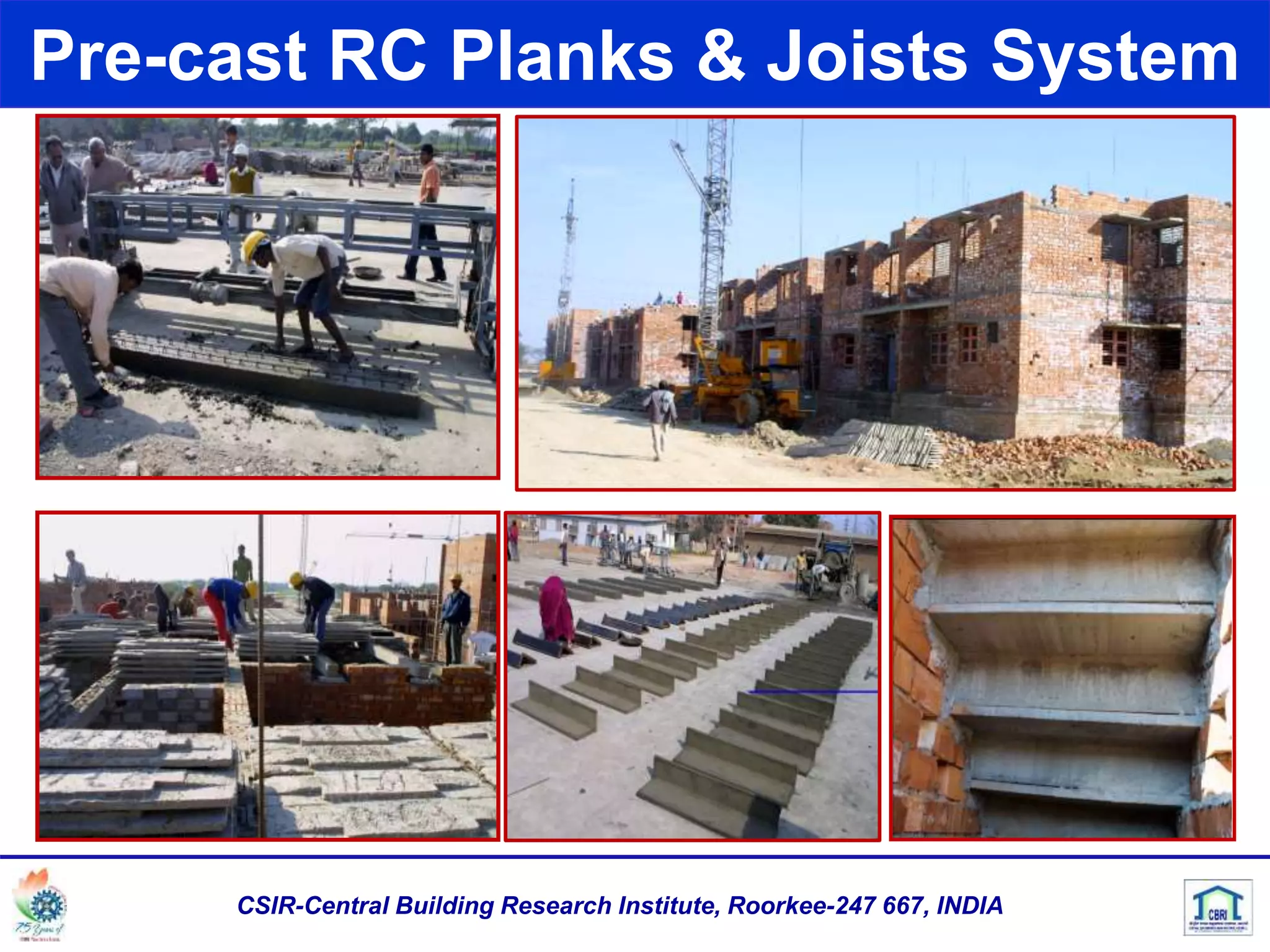
Pre-cast RC Planks & Joists System
Pre-cast Roofing Solutions
CSIR-Central Building Research Institute, Roorkee-247 667, INDIA
Technology Embodied Energy /10 sqm of roof in Mega Joules
Cement Steel Aggregate Total/sq.m saving
RCC Slab 2100 2400 600 5,100 0
RC Plank & Joist 1,617 2064 444 4,125 975
RC Ribbed Slab 1,113 2,064 318 3,595 1,505
RC Channel Unit 1,344 2,352 384 4,080 1,020
L-pan units 1,155 1,320 330 2,805 2,295
Brick panel & RC
JoistBricks: 1,220 MJ
1,800 1,984 140 5,144 - 44
Pre-cast RC Planks & Joist System
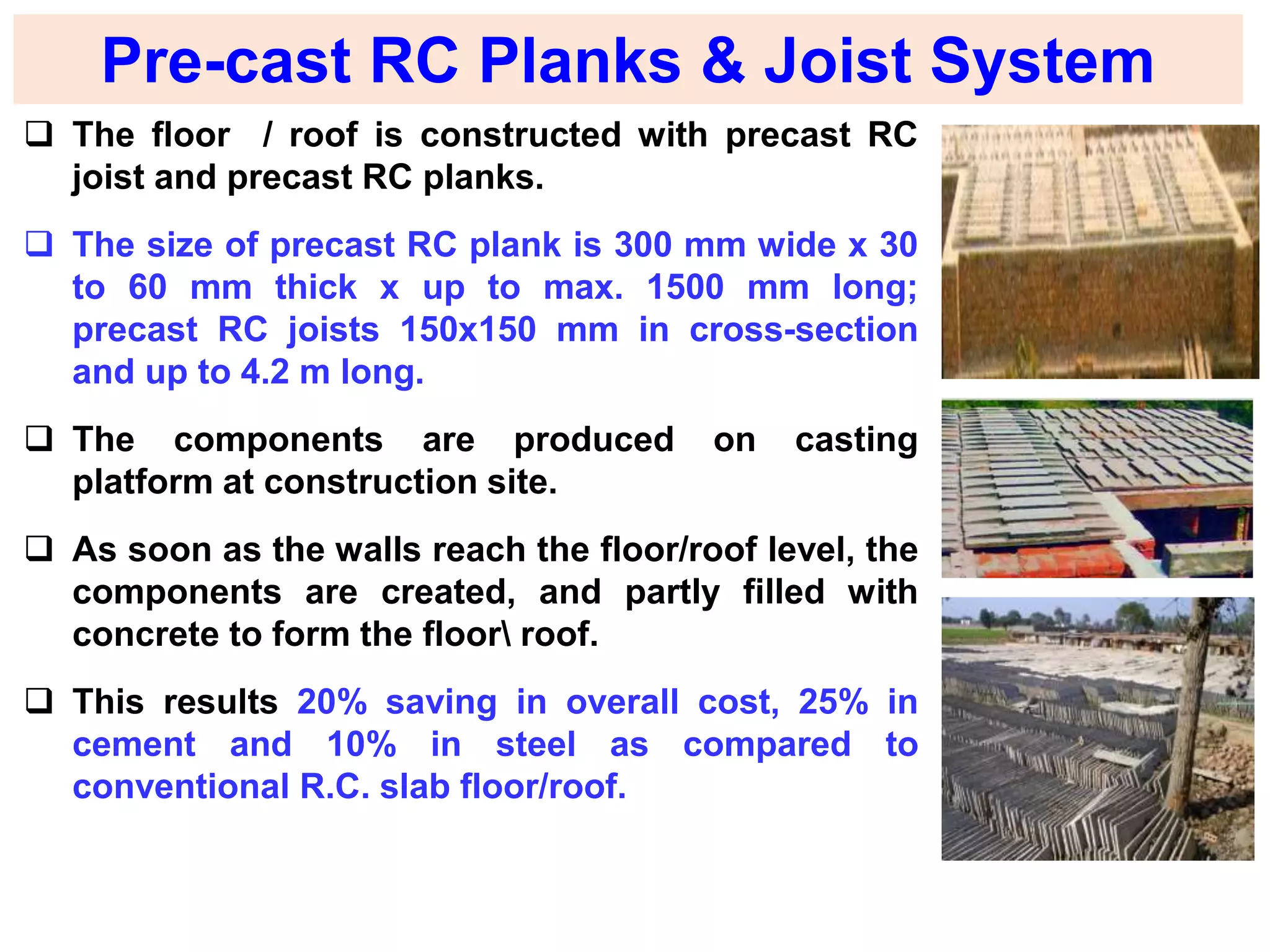
 The floor / roof is constructed with precast RC
joist and precast RC planks.
 The size of precast RC plank is 300 mm wide x 30
to 60 mm thick x up to max. 1500 mm long;
precast RC joists 150x150 mm in cross-section
and up to 4.2 m long.
 The components are produced on casting
platform at construction site.
 As soon as the walls reach the floor/roof level, the
components are created, and partly filled with
concrete to form the floor roof.
 This results 20% saving in overall cost, 25% in
cement and 10% in steel as compared to
conventional R.C. slab floor/roof.
SK Singh, CSIR-CBRI,
Roorkee
Pre-cast RC Planks & Joist System
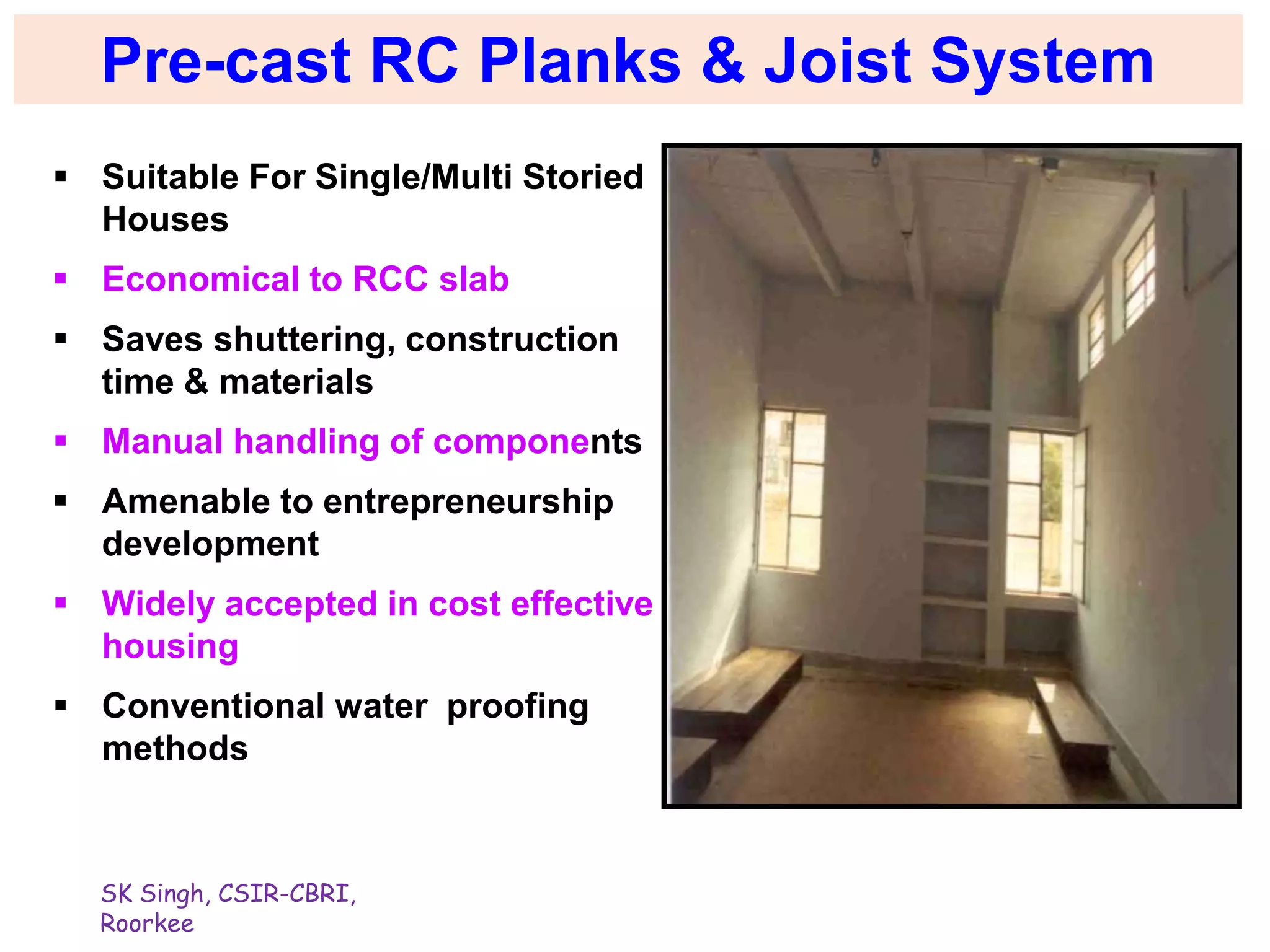
 Suitable For Single/Multi Storied
Houses
 Economical to RCC slab
 Saves shuttering, construction
time & materials
 Manual handling of components
 Amenable to entrepreneurship
development
 Widely accepted in cost effective
housing
 Conventional water proofing
methods
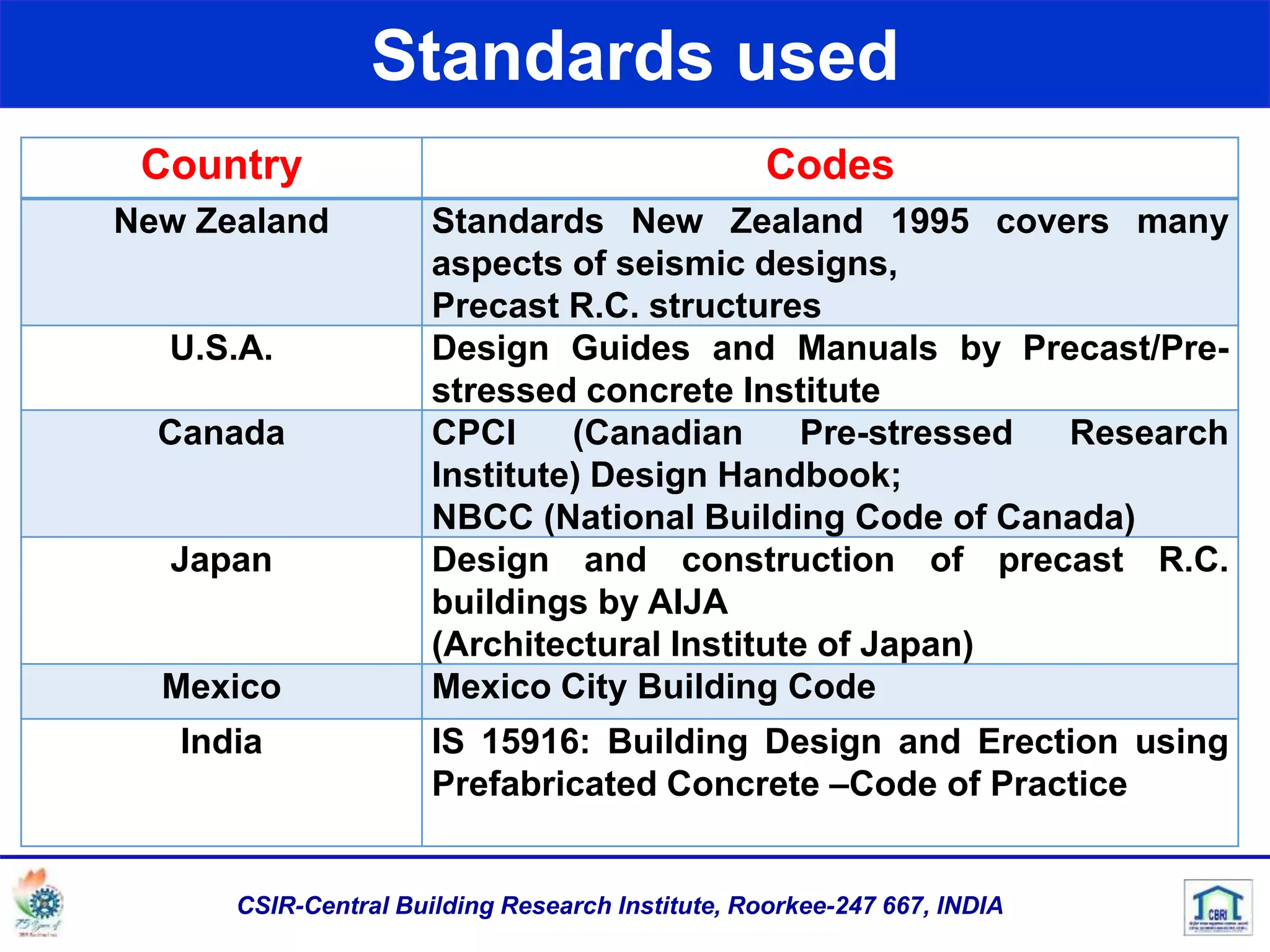
Standards used
Country Codes
New Zealand Standards New Zealand 1995 covers many
aspects of seismic designs,
Precast R.C. structures
U.S.A. Design Guides and Manuals by Precast/Pre-
stressed concrete Institute
Canada CPCI (Canadian Pre-stressed Research
Institute) Design Handbook;
NBCC (National Building Code of Canada)
Japan Design and construction of precast R.C.
buildings by AIJA
(Architectural Institute of Japan)
Mexico Mexico City Building Code
India IS 15916: Building Design and Erection using
Prefabricated Concrete –Code of Practice
CSIR-Central Building Research Institute, Roorkee-247 667, INDIA
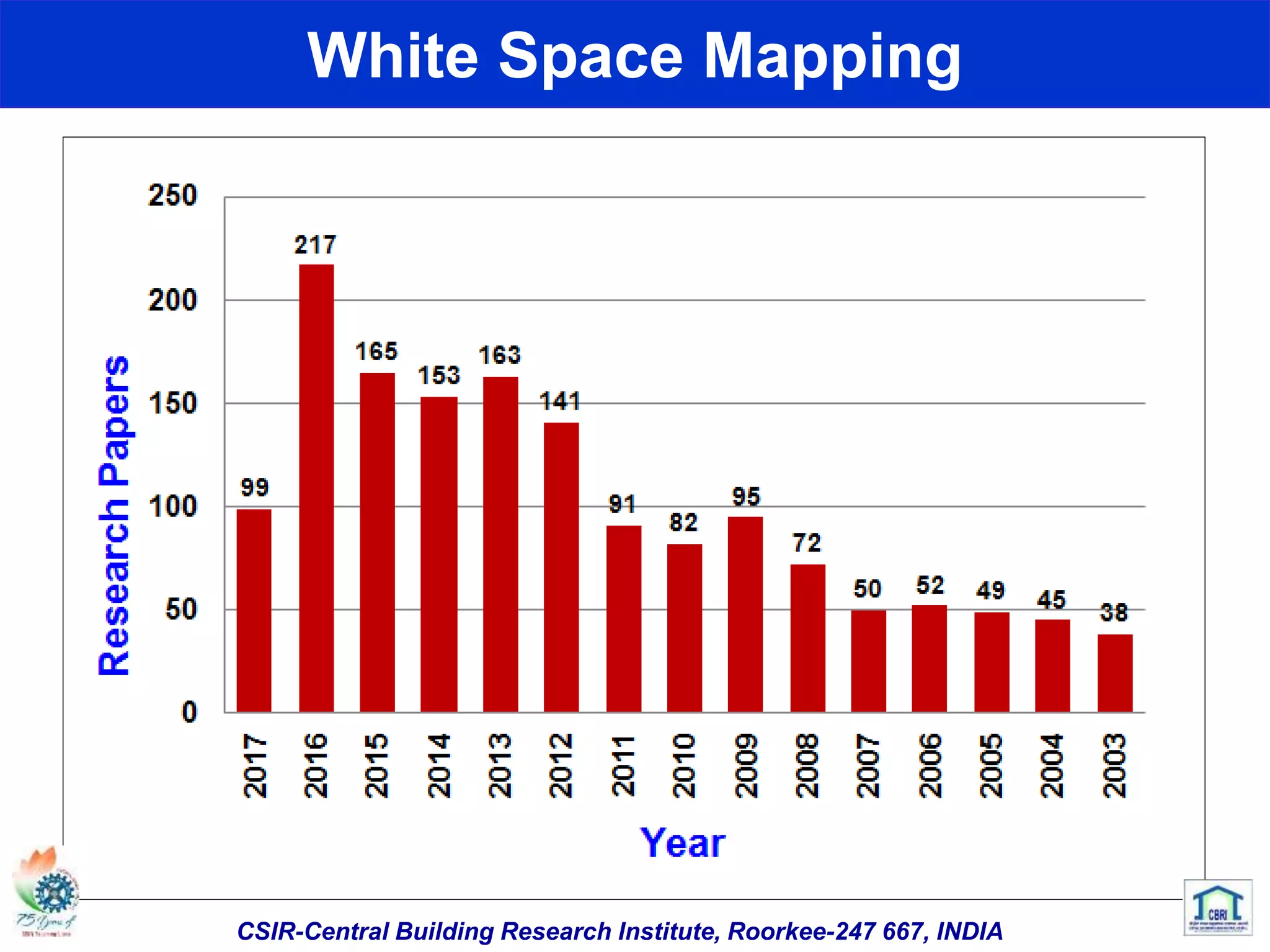
White Space Mapping
2255
294 294
110 70 68 41
0
500
1000
1500
2000
2500
No.ofscientificpublications
World USA China Germany Italy Canada India
CSIR-Central Building Research Institute, Roorkee-247 667, INDIA
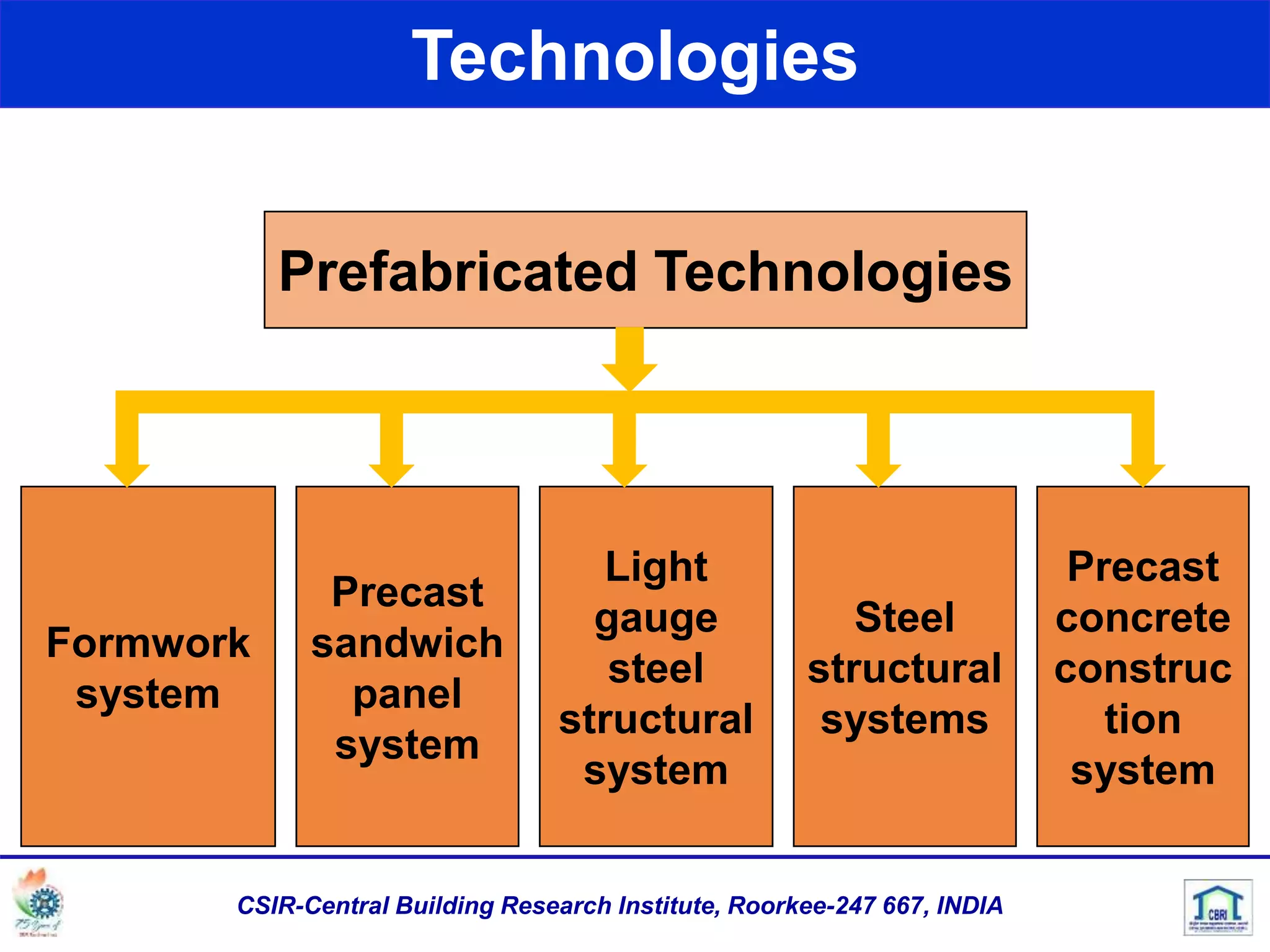
Technologies
Prefabricated Technologies
Formwork
system
Precast
sandwich
panel
system
Light
gauge
steel
structural
system
Steel
structural
systems
Precast
concrete
construc
tion
system
CSIR-Central Building Research Institute, Roorkee-247 667, INDIA
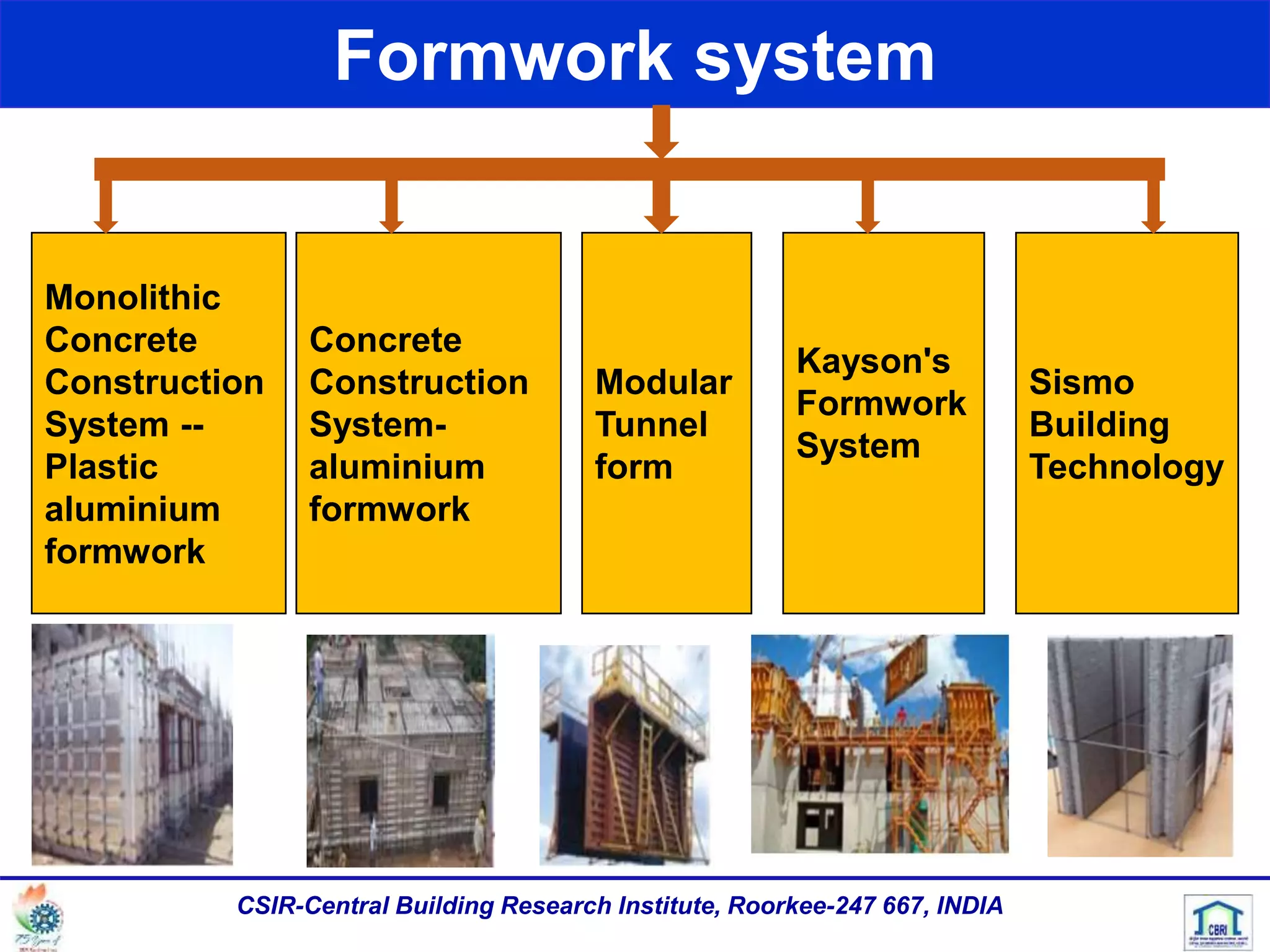
Formwork system
Monolithic
Concrete
Construction
System --
Plastic
aluminium
formwork
Concrete
Construction
System-
aluminium
formwork
Modular
Tunnel
form
Kayson's
Formwork
System
Sismo
Building
Technology
CSIR-Central Building Research Institute, Roorkee-247 667, INDIA
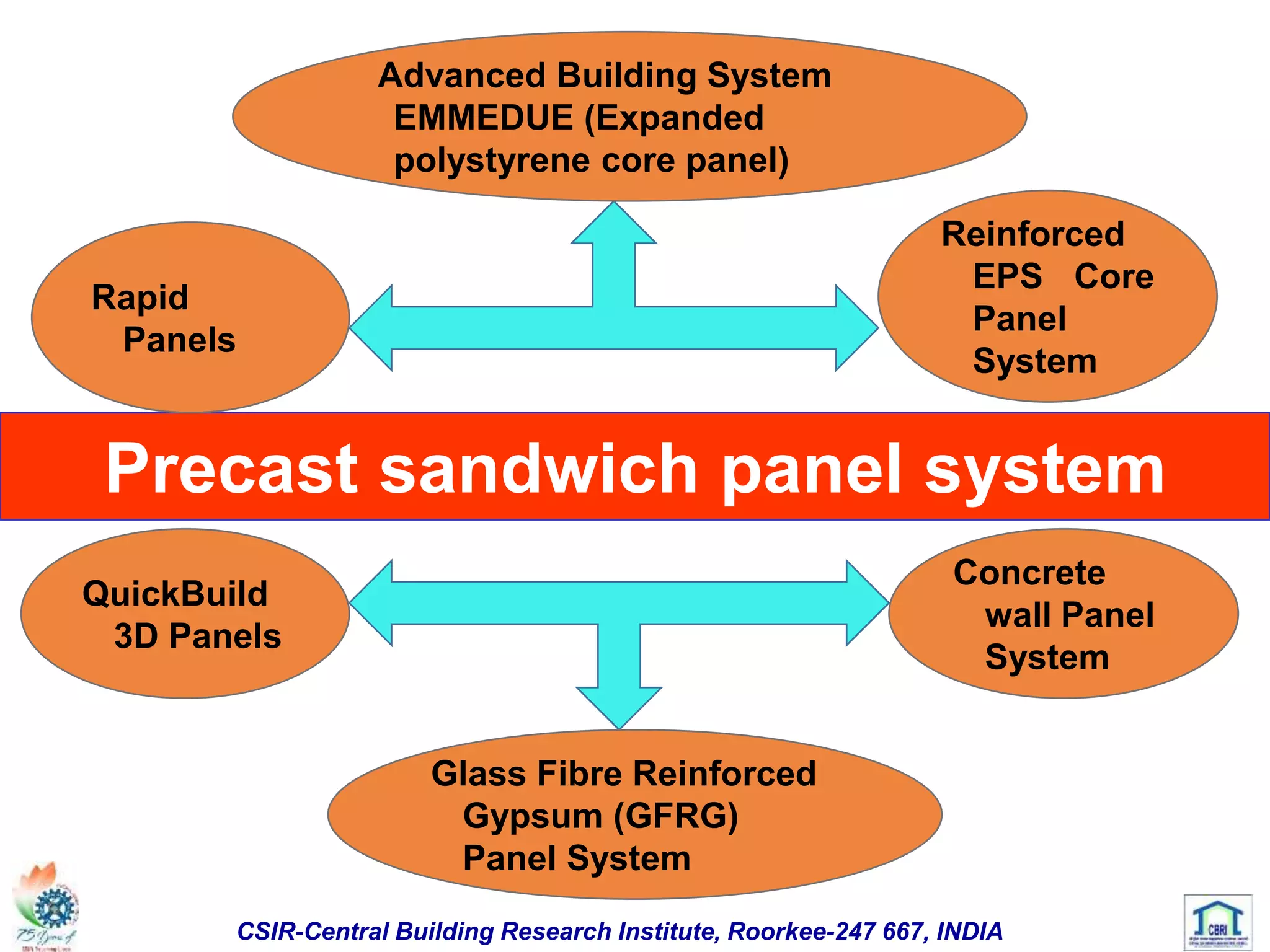
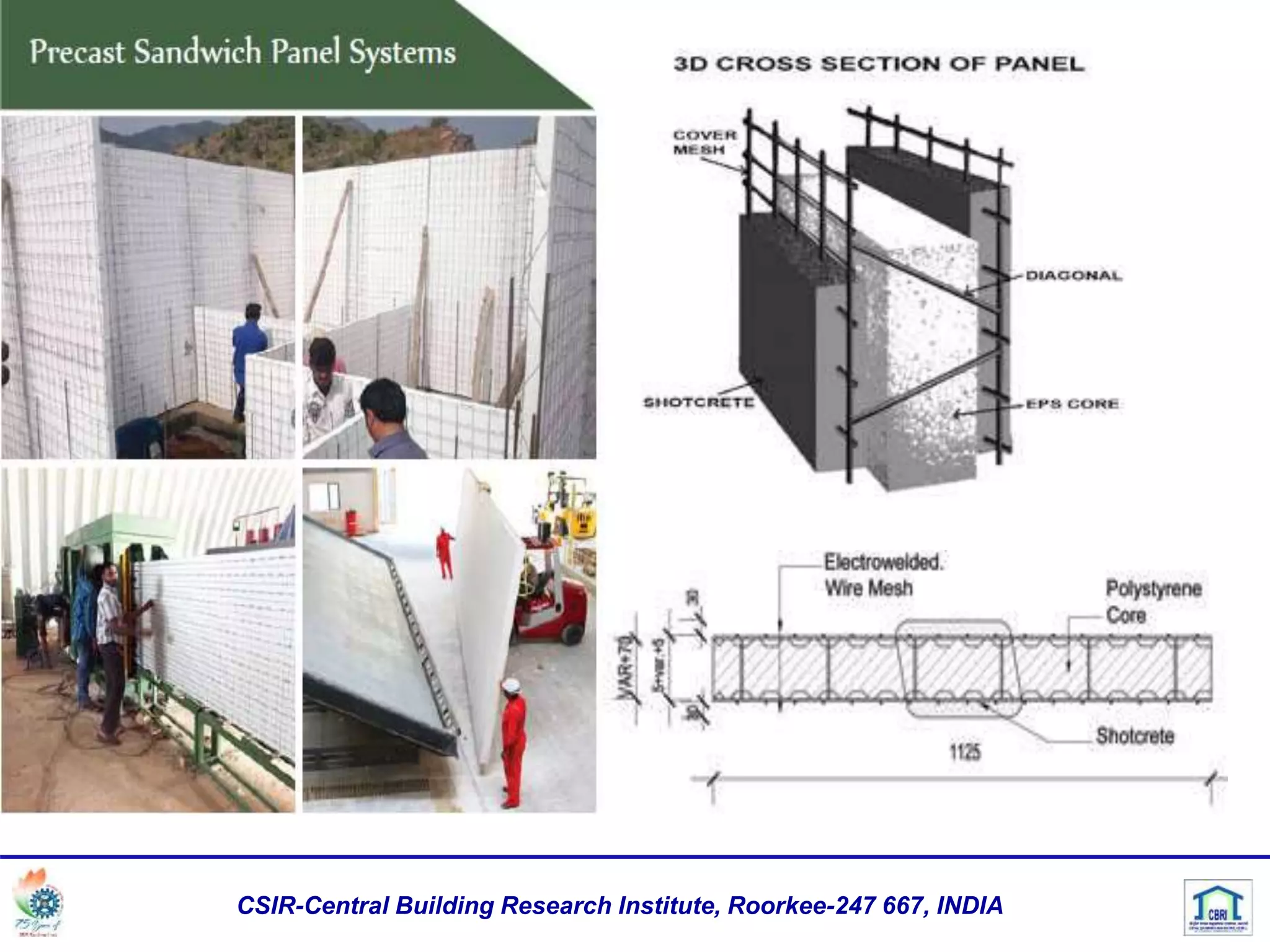
Precast sandwich panel system
Advanced Building System
EMMEDUE (Expanded
polystyrene core panel)
Rapid
Panels
Glass Fibre Reinforced
Gypsum (GFRG)
Panel System
Concrete
wall Panel
System
QuickBuild
3D Panels
Reinforced
EPS Core
Panel
System
CSIR-Central Building Research Institute, Roorkee-247 667, INDIA
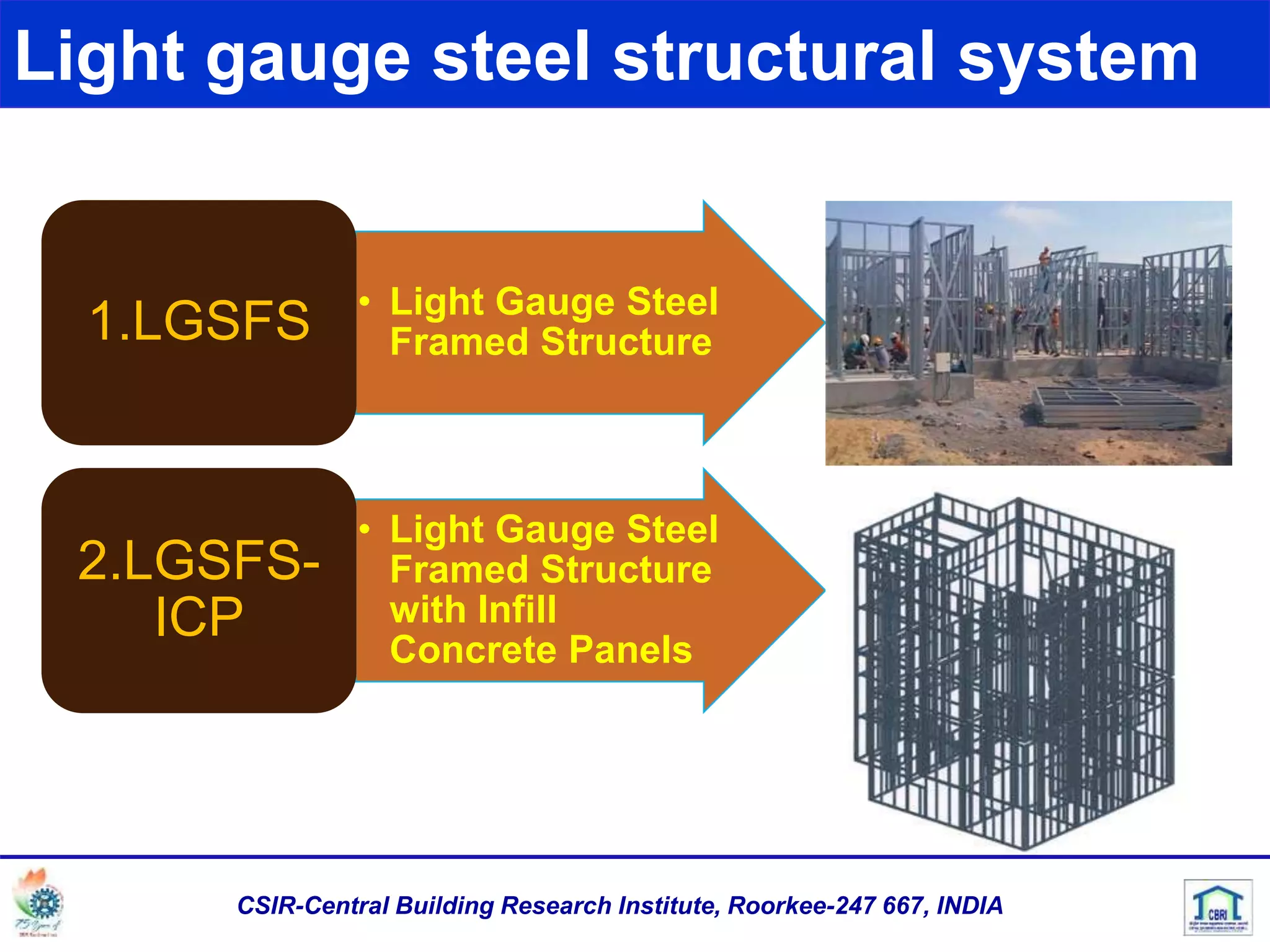
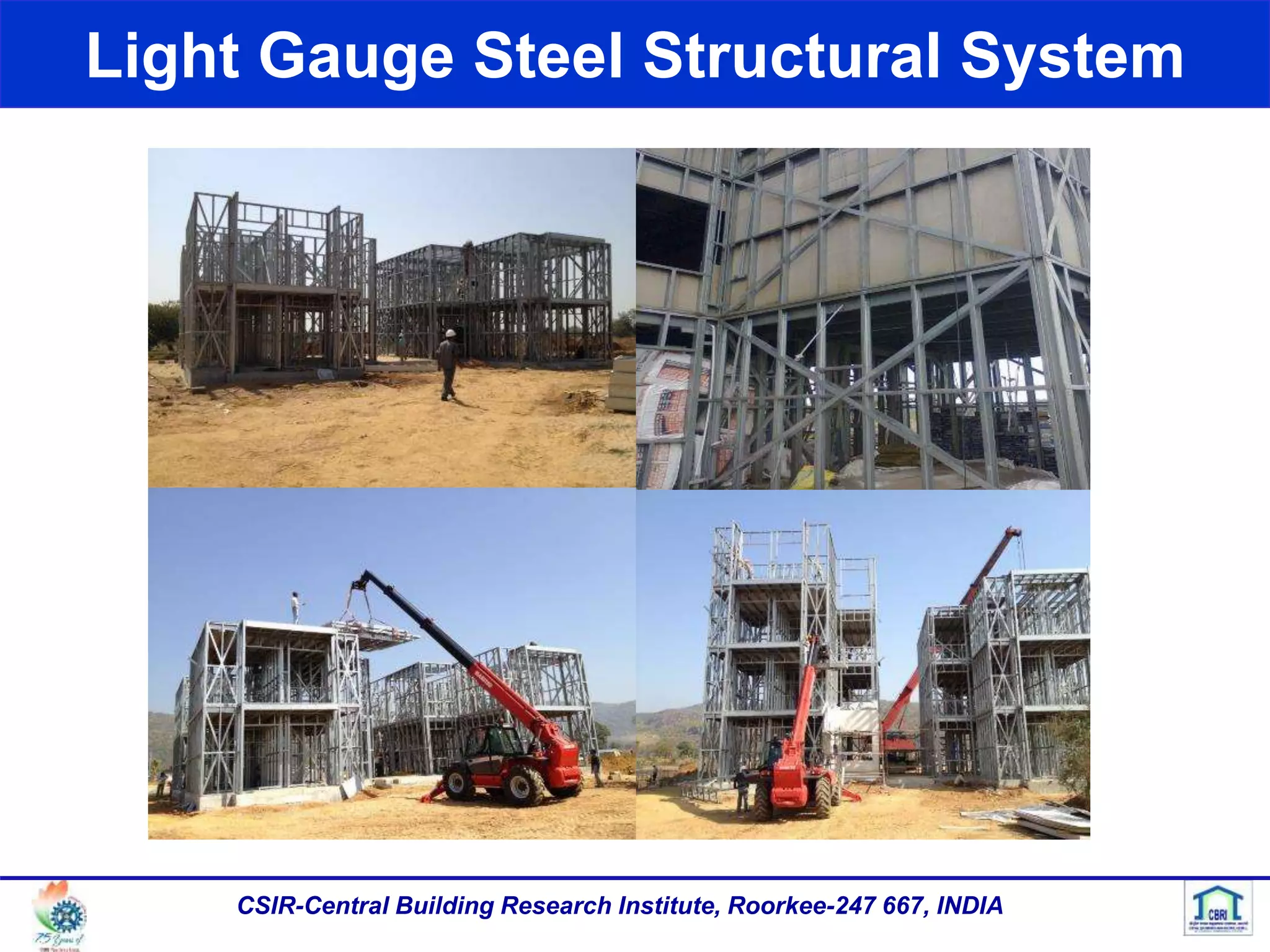
Light gauge steel structural system
• Light Gauge Steel
Framed Structure1.LGSFS
• Light Gauge Steel
Framed Structure
with Infill
Concrete Panels
2.LGSFS-
ICP
CSIR-Central Building Research Institute, Roorkee-247 667, INDIA
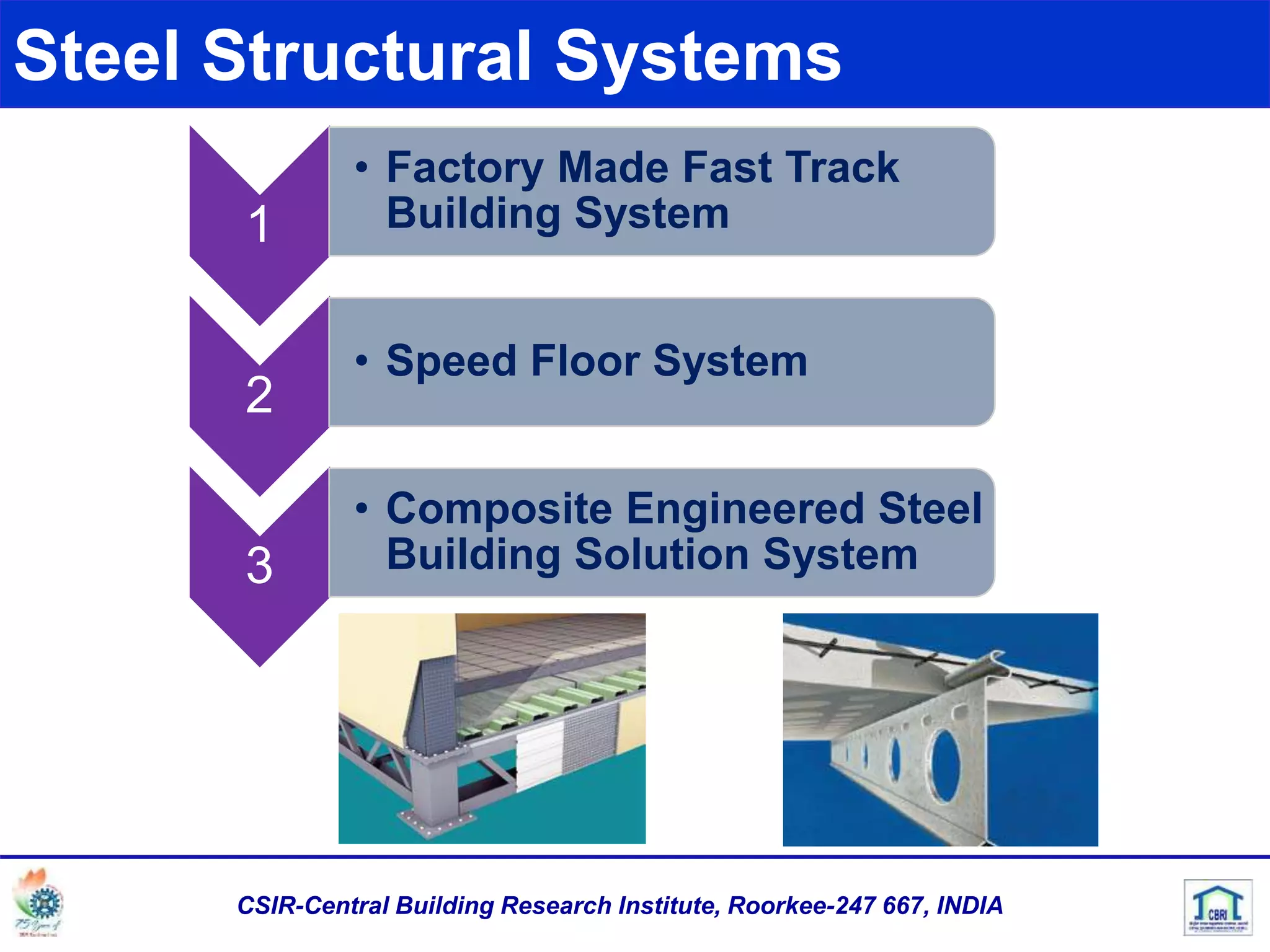
Steel Structural Systems
1
• Factory Made Fast Track
Building System
2
• Speed Floor System
3
• Composite Engineered Steel
Building Solution System
CSIR-Central Building Research Institute, Roorkee-247 667, INDIA
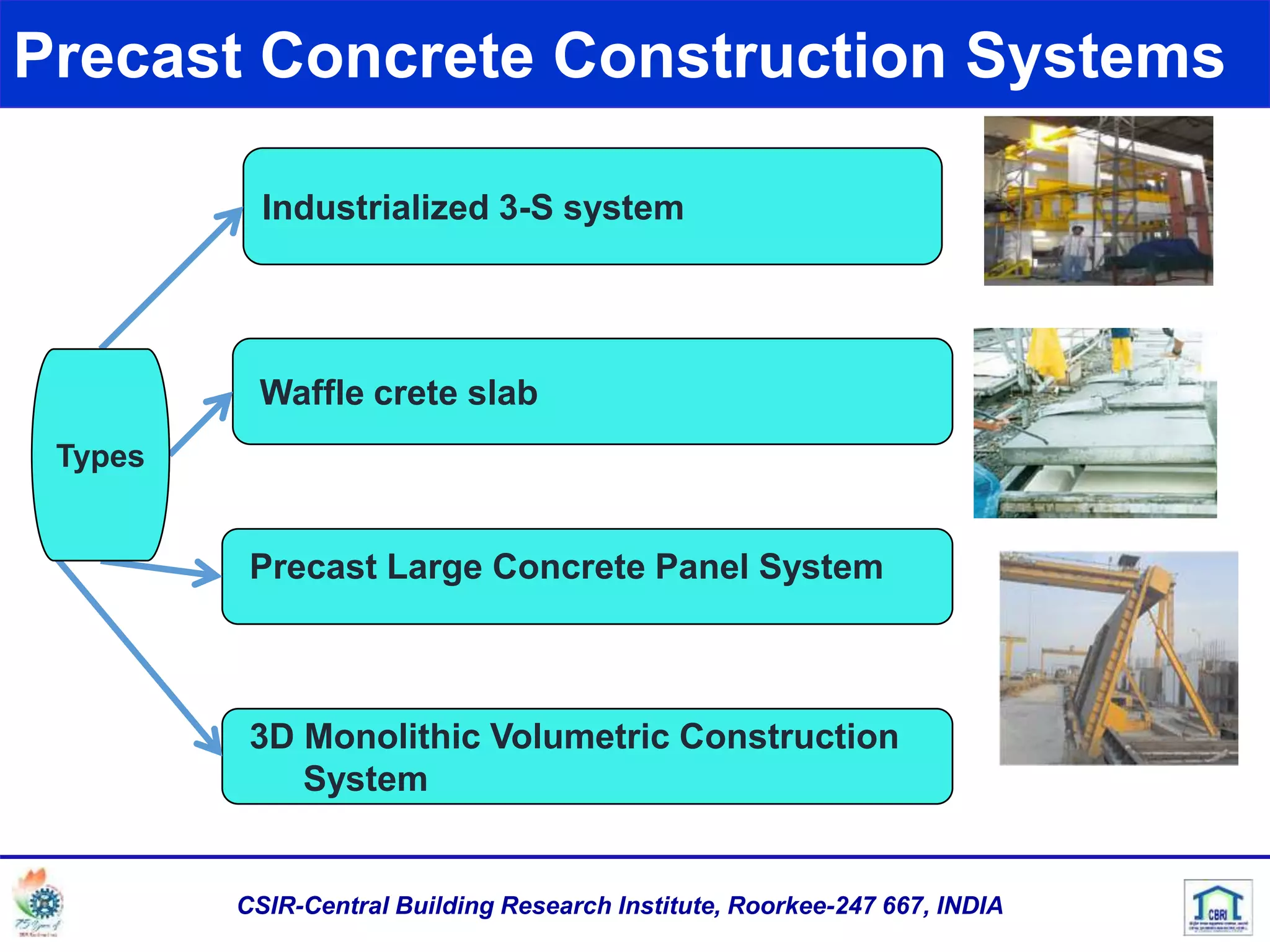
Precast Concrete Construction Systems
Industrialized 3-S system
Waffle crete slab
Precast Large Concrete Panel System
3D Monolithic Volumetric Construction
System
Types
CSIR-Central Building Research Institute, Roorkee-247 667, INDIA
Prefabrication: A Sustainable Approach
Sustainability: Meets the needs of the present without
compromising the ability of future generations.
Prerequisites :
Judicial use of construction materials there by
conservation of natural resources.
Use of products that avoid toxic or other emissions.
Reduction in waste materials during construction &
utilizing C & D wastes in construction.
Reducing emissions during the production of
construction materials.
CSIR-Central Building Research Institute, Roorkee-247 667, INDIA
Prefabrication: A Sustainable Approach
Using more durable materials in buildings thereby
requiring lesser maintenance cost.
Use of energy efficient building materials and
products that save energy or water .
Use of products that contribute to a safe, healthy
built environment.
Use of materials which can be recycled.
Use of construction system minimizing air, water
and noise pollution during construction.
CSIR-Central Building Research Institute, Roorkee-247 667, INDIA
Advantages
Faster construction and low labour costs.
Prefabrication allows for year-round construction.
Mechanization in prefabricated construction
ensures precise conformity to building code
standards and greater quality assurance;
Less on-site waste ,reduced by about 40%(Vivian et
al. 2006).
Less theft of material/equipment.
less property damage due to vandalism.
CSIR-Central Building Research Institute, Roorkee-247 667, INDIA
Worker safety higher.
Computerization in production process.
Quality control and factory sealing.
More comfortable work environment.
Improvement in efficiency and productivity of work
force.
Prefab companies are more likely to have quality-
control programs implemented into their
manufacturing process (Phil Mitchell 2009).
Advantages
CSIR-Central Building Research Institute, Roorkee-247 667, INDIA
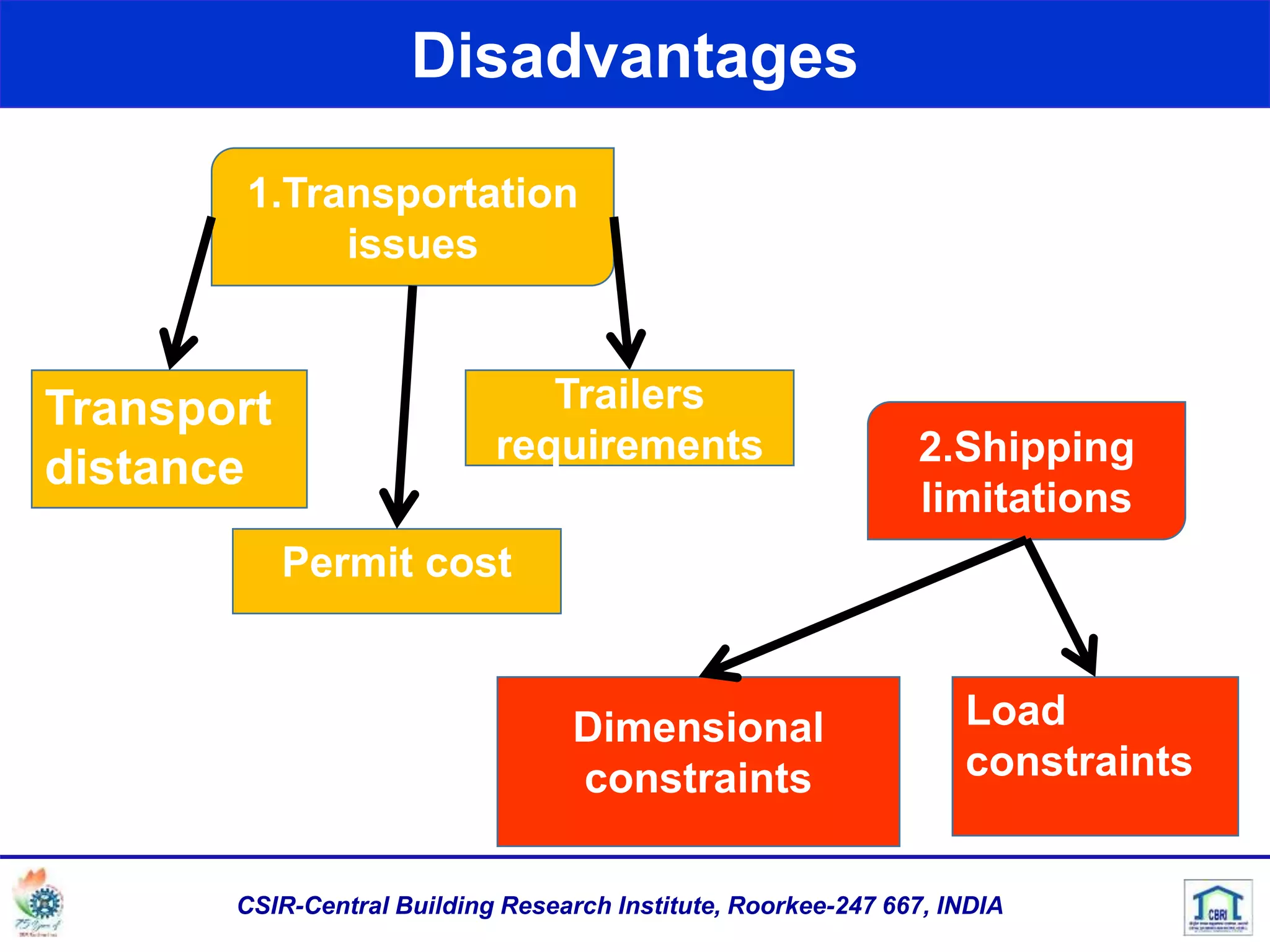
Disadvantages
1.Transportation
issues
2.Shipping
limitations
Permit cost
Trailers
requirements
Transport
distance
Load
constraints
Dimensional
constraints
CSIR-Central Building Research Institute, Roorkee-247 667, INDIA
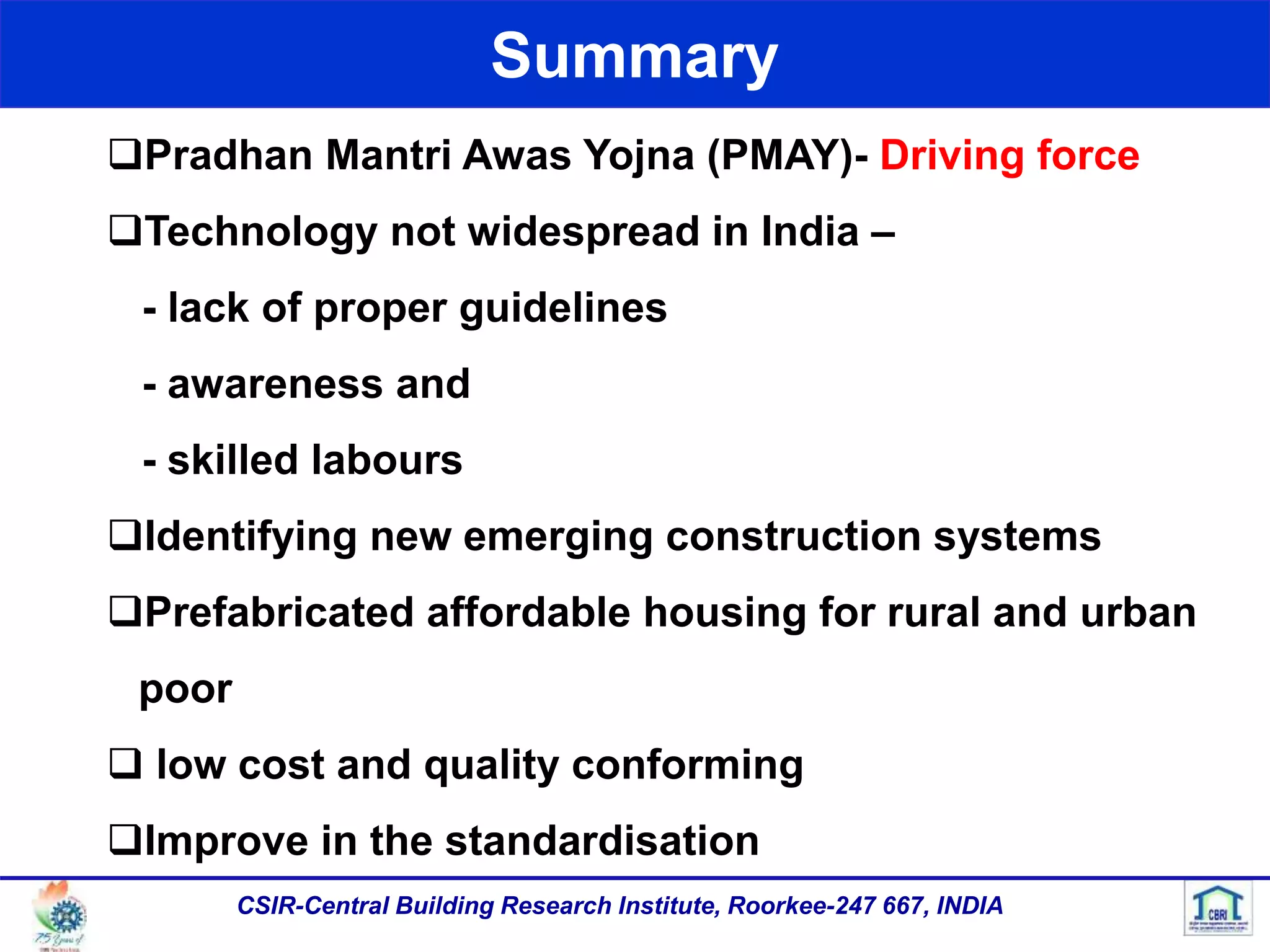
Summary
Pradhan Mantri Awas Yojna (PMAY)- Driving force
Technology not widespread in India –
- lack of proper guidelines
- awareness and
- skilled labours
Identifying new emerging construction systems
Prefabricated affordable housing for rural and urban
poor
 low cost and quality conforming
Improve in the standardisation
CSIR-Central Building Research Institute, Roorkee-247 667, INDIA
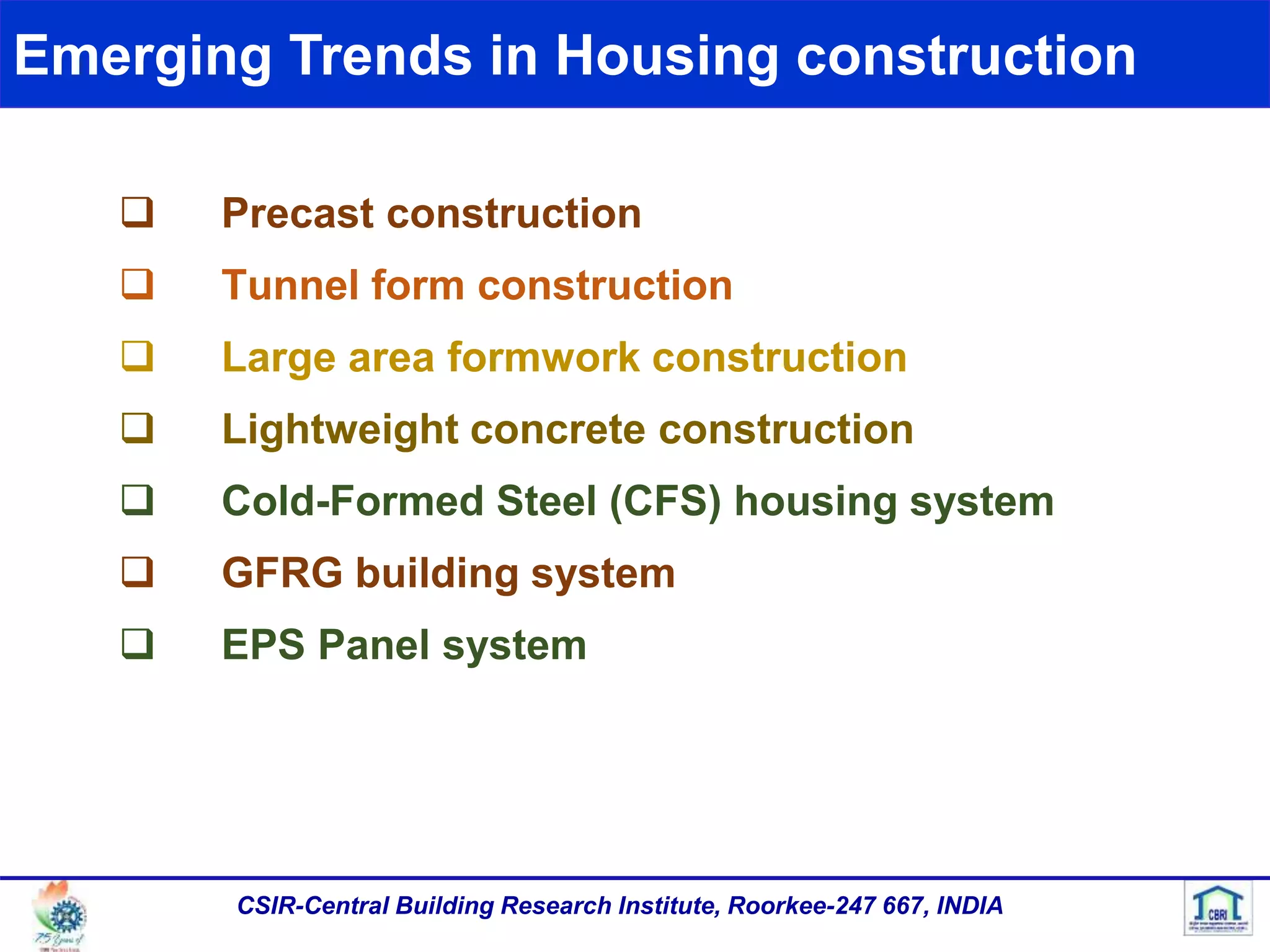
Emerging Trends in Housing construction
CSIR-Central Building Research Institute, Roorkee-247 667, INDIA
 Precast construction
 Tunnel form construction
 Large area formwork construction
 Lightweight concrete construction
 Cold-Formed Steel (CFS) housing system
 GFRG building system
 EPS Panel system
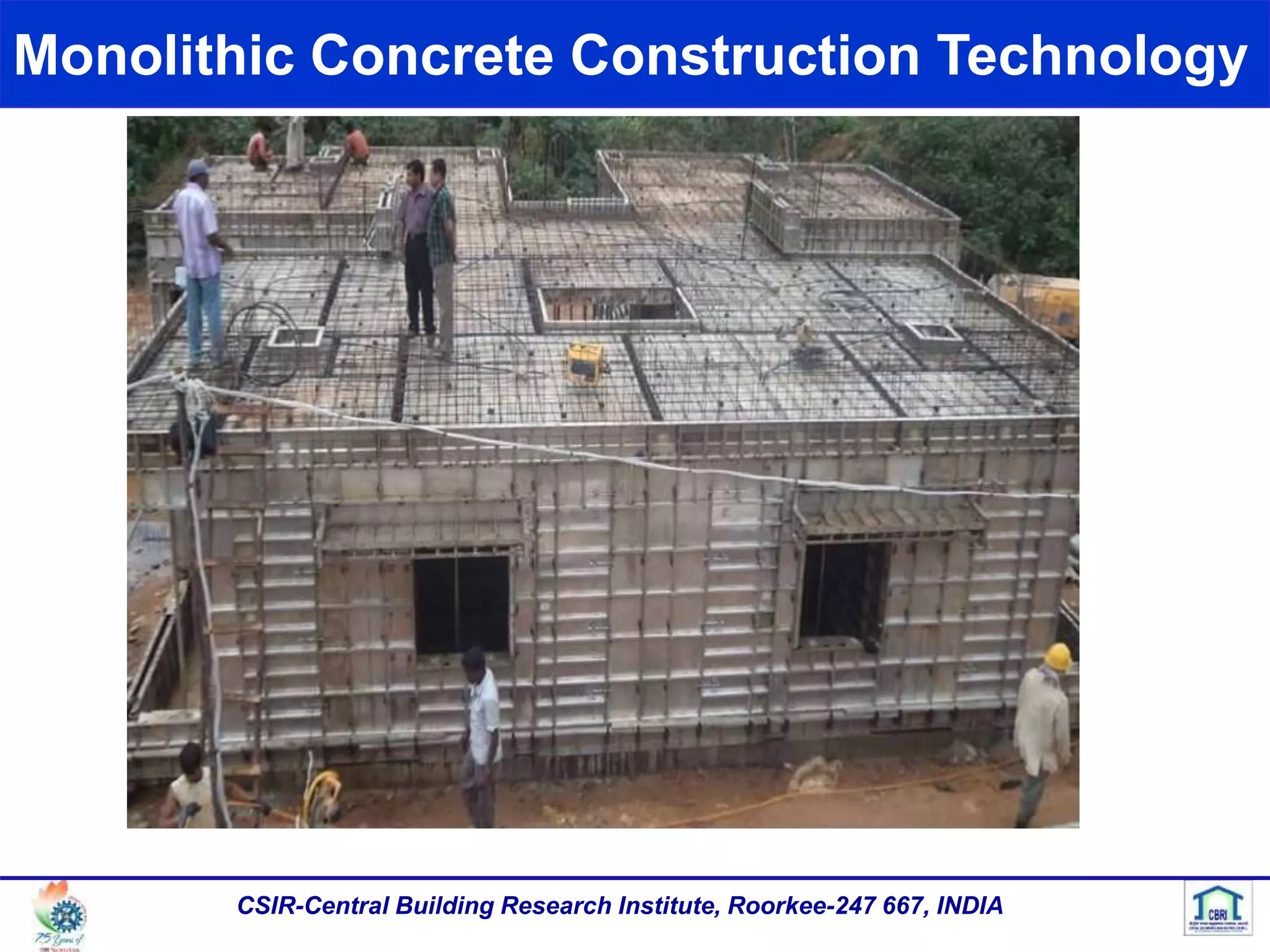
Monolithic Concrete Construction Technology
CSIR-Central Building Research Institute, Roorkee-247 667, INDIA
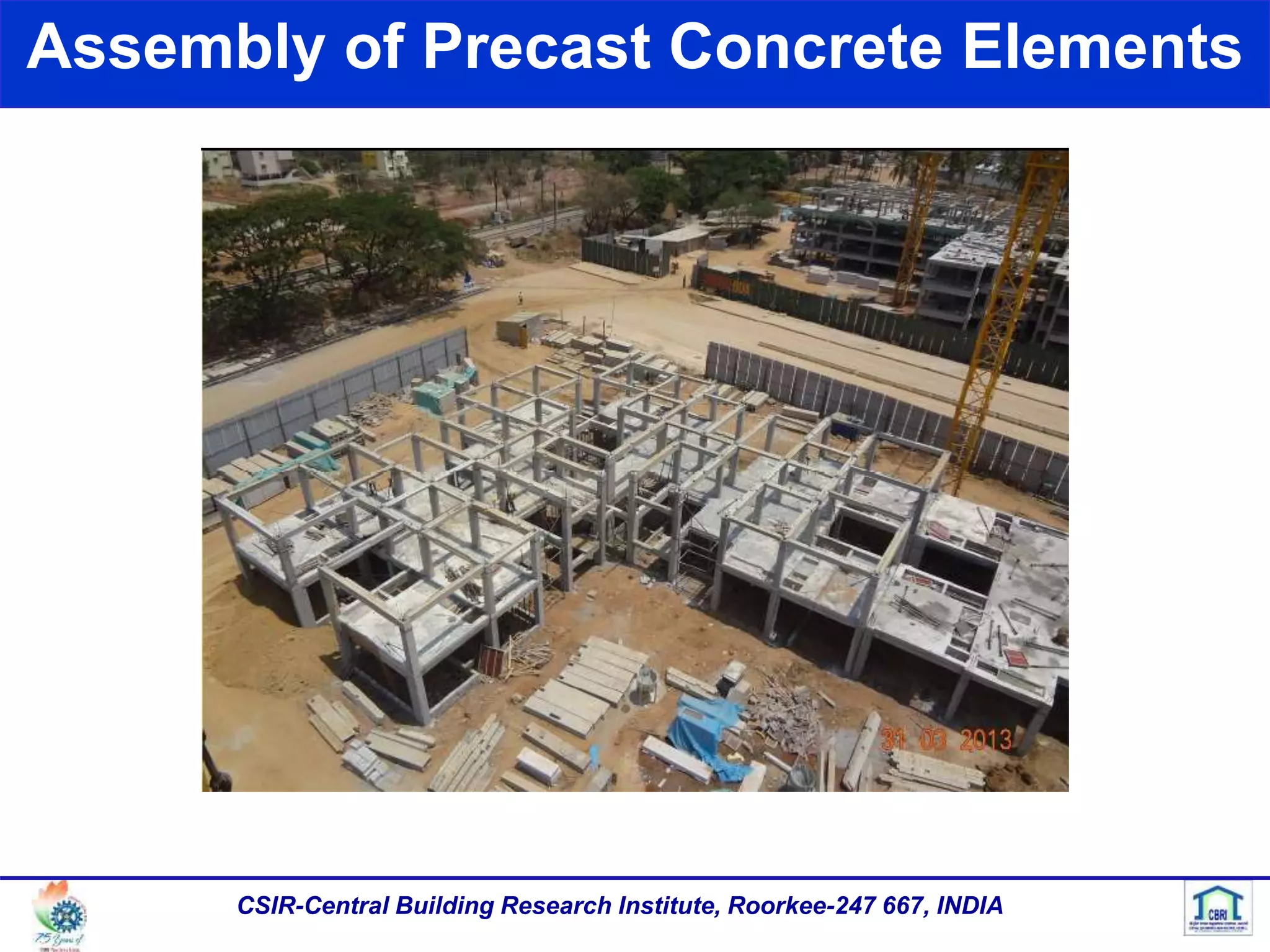
Assembly of Precast Concrete Elements
CSIR-Central Building Research Institute, Roorkee-247 667, INDIA
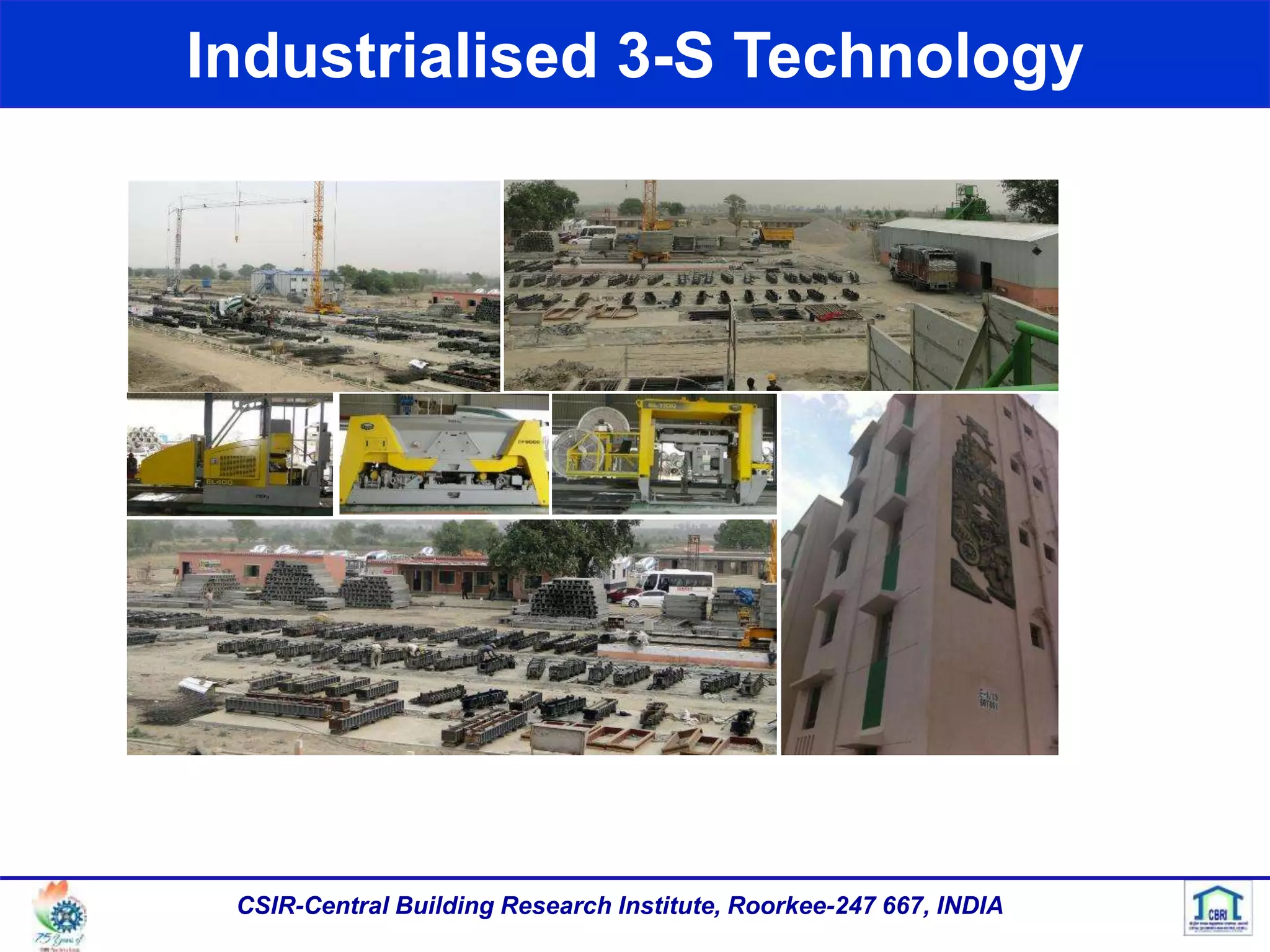
Industrialised 3-S Technology
CSIR-Central Building Research Institute, Roorkee-247 667, INDIA
Prefab Steel Construction
CSIR-Central Building Research Institute, Roorkee-247 667, INDIA
Light Gauge Steel Structural System
CSIR-Central Building Research Institute, Roorkee-247 667, INDIA
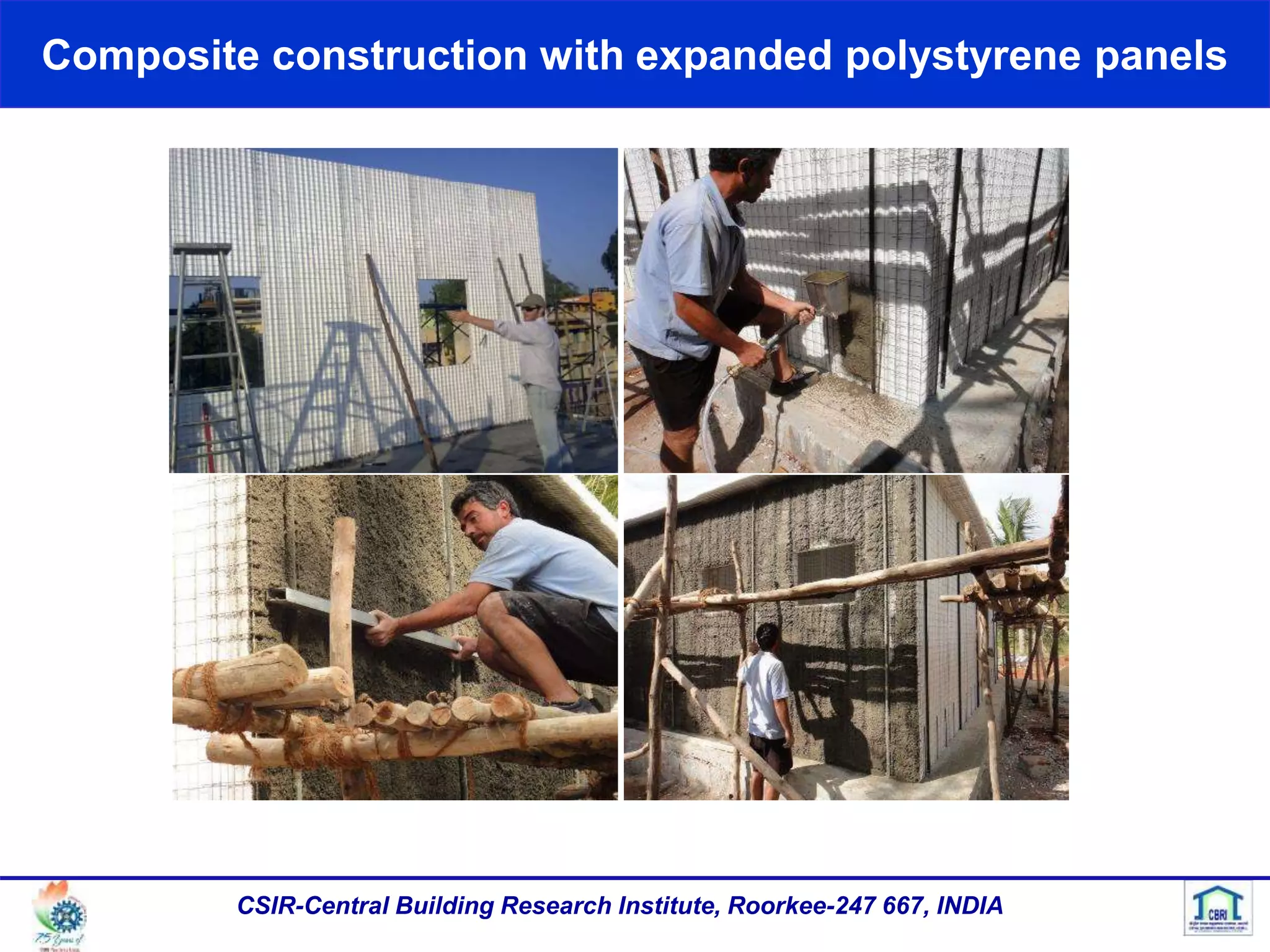
Composite construction with expanded polystyrene panels
CSIR-Central Building Research Institute, Roorkee-247 667, INDIA
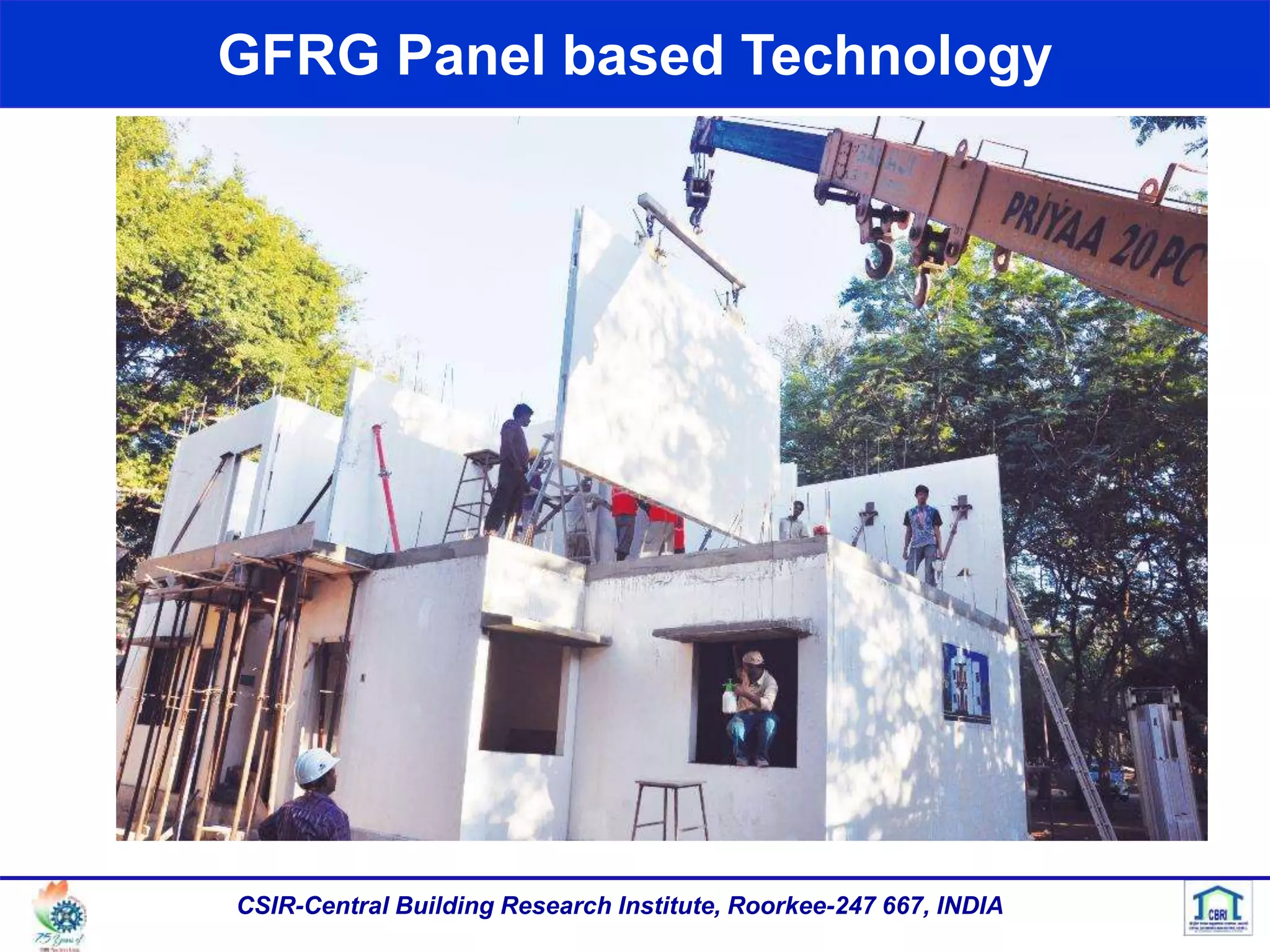
GFRG Panel based Technology
CSIR-Central Building Research Institute, Roorkee-247 667, INDIA
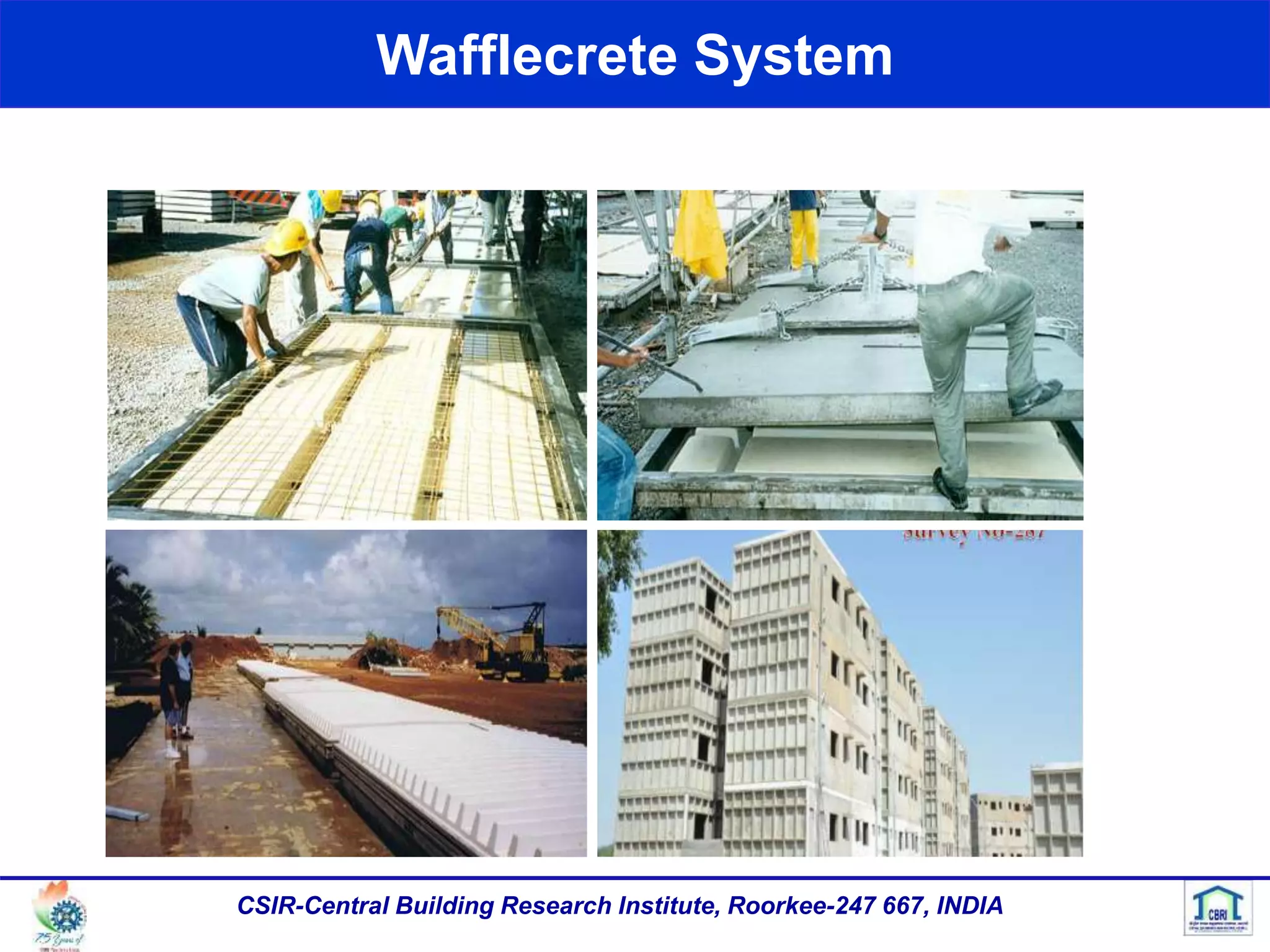
Wafflecrete System
CSIR-Central Building Research Institute, Roorkee-247 667, INDIA
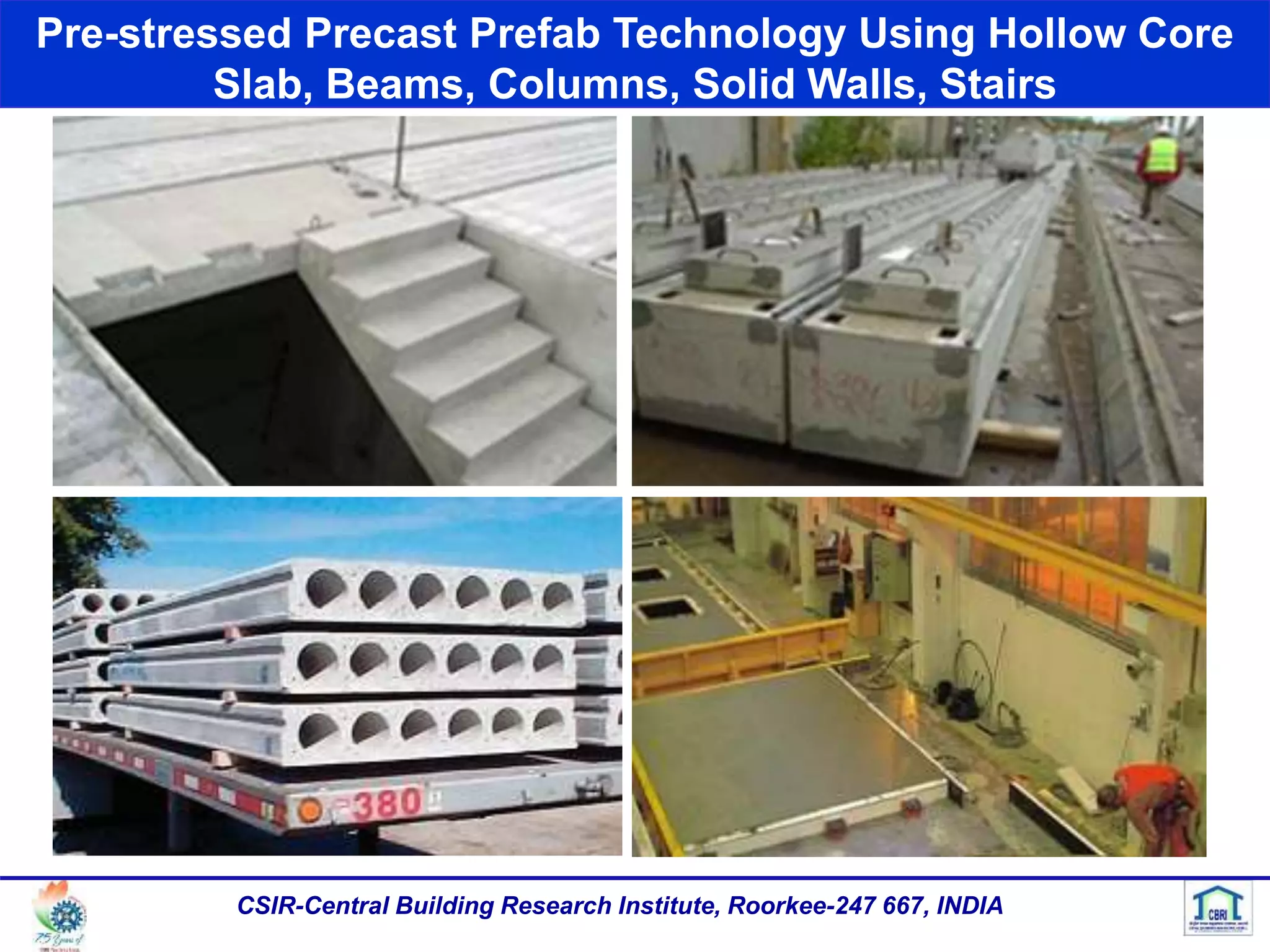
Pre-stressed Precast Prefab Technology Using Hollow Core
Slab, Beams, Columns, Solid Walls, Stairs
CSIR-Central Building Research Institute, Roorkee-247 667, INDIA
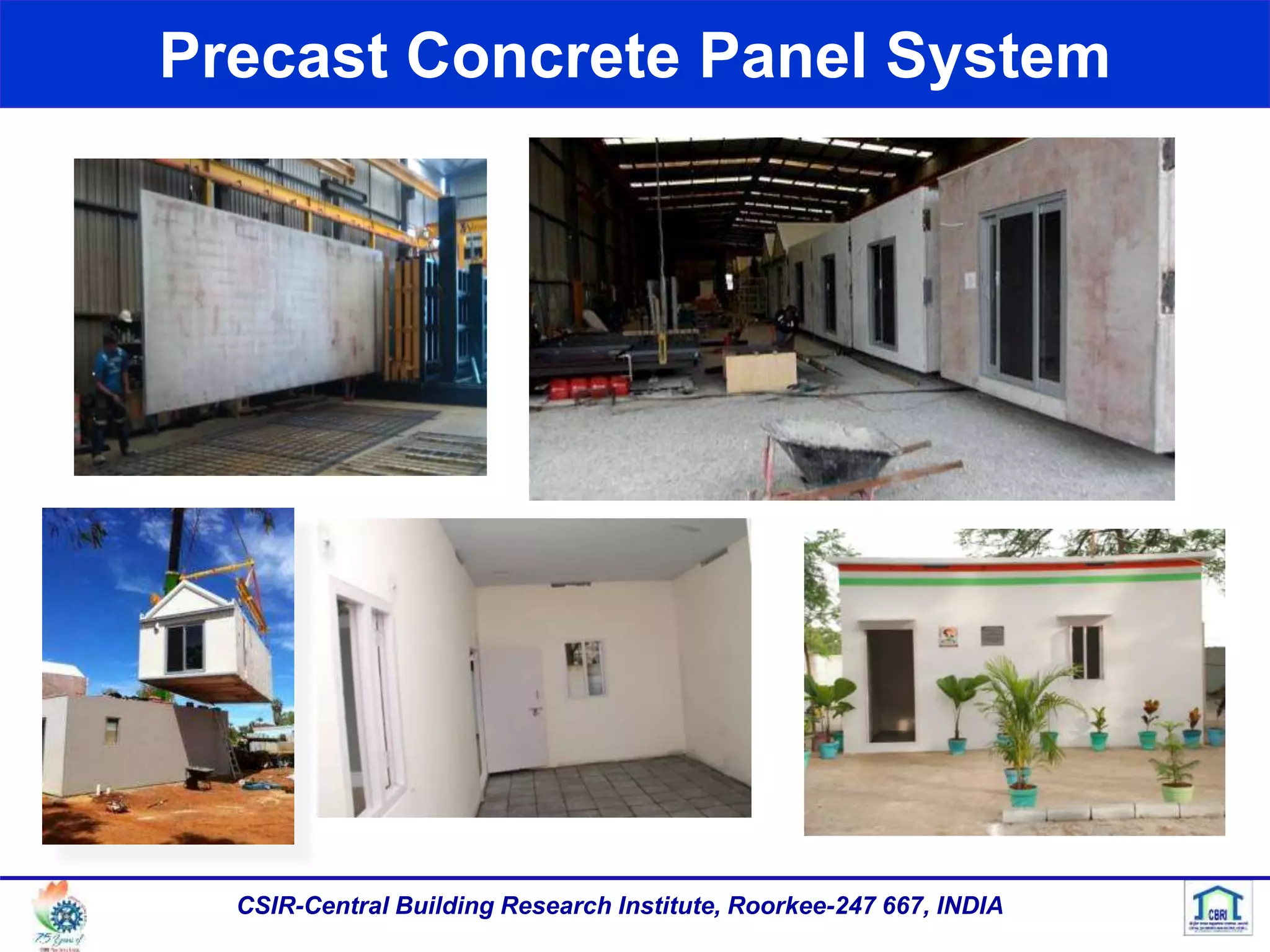
Precast Concrete Panel System
CSIR-Central Building Research Institute, Roorkee-247 667, INDIA
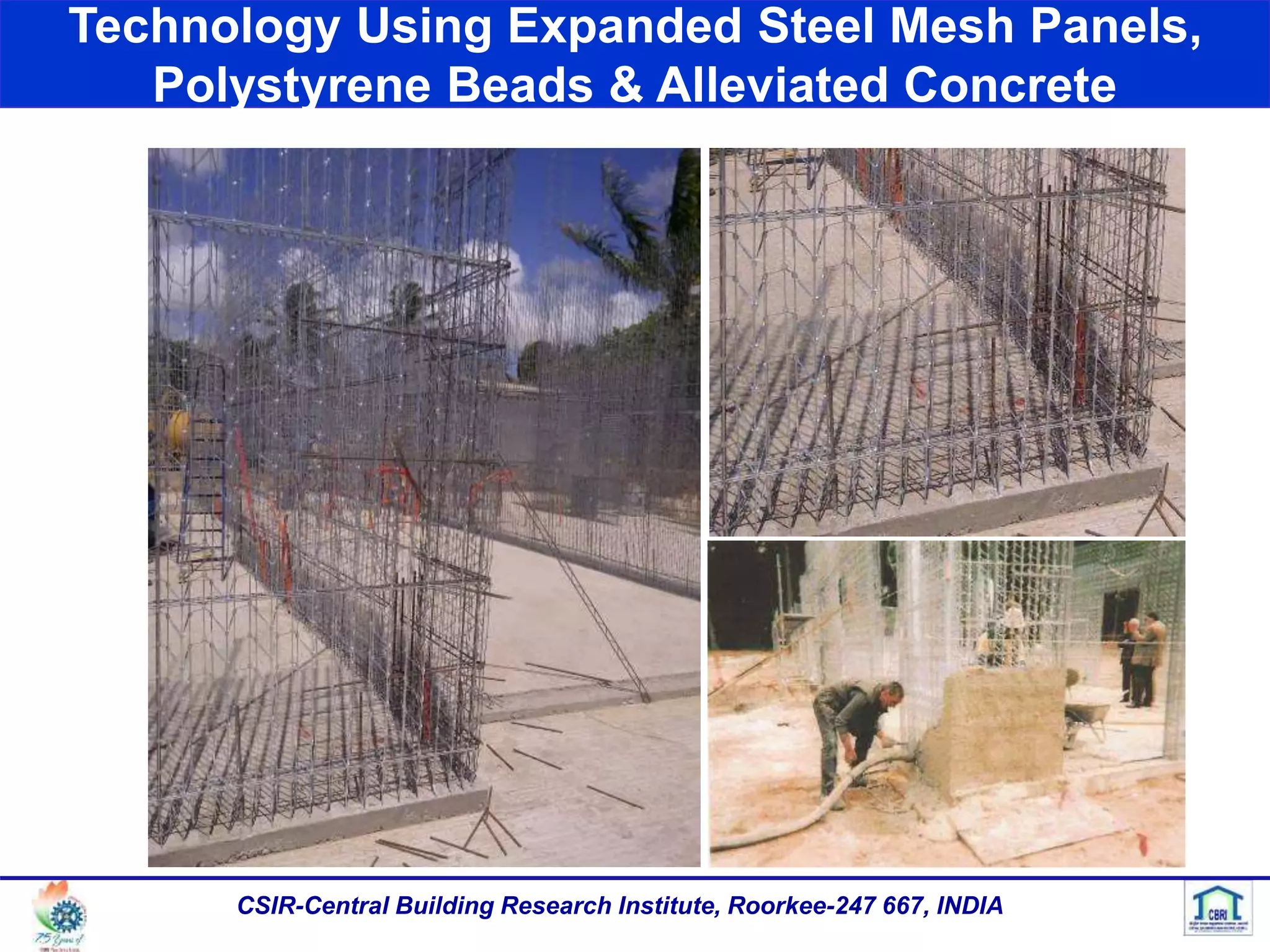
Technology Using Expanded Steel Mesh Panels,
Polystyrene Beads & Alleviated Concrete
CSIR-Central Building Research Institute, Roorkee-247 667, INDIA
Prefabricated construction systems in India- Precast Status and needed Impetus

Prefabricated construction systems in India- Precast Status and needed Impetus

  • 1.
    Prefabricated construction systemsin India- Precast Status and needed Impetus Prof. S. K. Singh Sr. Principal Scientist & Professor, AcSIR CSIR-Central Building Research Institute Roorkee-247 667, Uttarakhand, India
  • 2.
    Outline • Introduction • Issues •Affordable Housing • Why Prefabrication? • Worldwide Status • Prefab Technologies • Sustainable Approach • Advantages & Disadvantages • Summary CSIR-Central Building Research Institute, Roorkee-247 667, INDIA
  • 3.
    Questions to beAnswered Is it sustainable? What are the benefits? Why prefabricated construction system? CSIR-Central Building Research Institute, Roorkee-247 667, INDIA
  • 4.
    Collapse while demolition Conventional Reinforced ConcreteSystem Source: NDTV CSIR-Central Building Research Institute, Roorkee-247 667, INDIA
  • 5.
    Problems in India AffordableHousing system is the need of today The Ministry of Housing estimated a housing shortage of 20 million houses ,with 99 percent in the economically weaker and lower income groups. Source: Ministry of housing(July 2017) CSIR-Central Building Research Institute, Roorkee-247 667, INDIA
  • 6.
    Compromising Quality Legal Issues Improper manwork Time consuming Highformwork cost Issues in conventional system CSIR-Central Building Research Institute, Roorkee-247 667, INDIA
  • 7.
    Prefabricated Construction System CSIR-CentralBuilding Research Institute, Roorkee-247 667, INDIA
  • 8.
    Introduction “The partly/fully assembledand erected building, of which the structural parts consist of pre-fabricated individual units or assemblies using ordinary or controlled materials, including service facilities; and in which the service equipment may be either prefabricated or constructed in-situ”. Source: IS 15916:2010 CSIR-Central Building Research Institute, Roorkee-247 667, INDIA
  • 9.
  • 10.
    Worldwide Status CSIR-Central BuildingResearch Institute, Roorkee-247 667, INDIA
  • 11.
    Prefabrication in India Emergenceof Hindustan Housing Factory in 1950s Partially prefabricated system developed by CSIR- CBRI joist and plank system in Early 1980’s Pradhan Mantri Awas Yojna (PMAY) launched on 25th June 2015 Rural housing which launched on 1st April, 2016 16 innovative pre-fabricated construction systems adopted /developed CSIR-Central Building Research Institute, Roorkee-247 667, INDIA
  • 12.
    Status in India Innovativetechnologies for affordable housing Techniques adopted in ancient time Large scale adoption of prefabrication reduces cost • Prasher et al. (2016) • BMTPC 2017 • Palanichamy et al. (2002) CSIR-Central Building Research Institute, Roorkee-247 667, INDIA
  • 13.
    Worldwide Status Improving theperformance of company by identifying the gaps Sustainable construction method Management of prefabricated construction (MPC) • Steinhardt et al. (2016) • Li et al. (2014) • Dave et al. (2017) CSIR-Central Building Research Institute, Roorkee-247 667, INDIA
  • 14.
    Pre-cast Roofing Solutions CSIR-CentralBuilding Research Institute, Roorkee-247 667, INDIA  Pre-fab Brick Panels  Brick Arch Panel  RCC Planks and Joists  Ferro-cement Channels  Baffle Unit  Ribbed Units
  • 15.
    Pre-cast RC Planks& Joists System CSIR-Central Building Research Institute, Roorkee-247 667, INDIA
  • 16.
    CSIR-Central Building ResearchInstitute, Roorkee-247 667, INDIA Pre-cast RC Planks & Joists System
  • 17.
    Pre-cast Roofing Solutions CSIR-CentralBuilding Research Institute, Roorkee-247 667, INDIA Technology Embodied Energy /10 sqm of roof in Mega Joules Cement Steel Aggregate Total/sq.m saving RCC Slab 2100 2400 600 5,100 0 RC Plank & Joist 1,617 2064 444 4,125 975 RC Ribbed Slab 1,113 2,064 318 3,595 1,505 RC Channel Unit 1,344 2,352 384 4,080 1,020 L-pan units 1,155 1,320 330 2,805 2,295 Brick panel & RC JoistBricks: 1,220 MJ 1,800 1,984 140 5,144 - 44
  • 18.
    Pre-cast RC Planks& Joist System  The floor / roof is constructed with precast RC joist and precast RC planks.  The size of precast RC plank is 300 mm wide x 30 to 60 mm thick x up to max. 1500 mm long; precast RC joists 150x150 mm in cross-section and up to 4.2 m long.  The components are produced on casting platform at construction site.  As soon as the walls reach the floor/roof level, the components are created, and partly filled with concrete to form the floor roof.  This results 20% saving in overall cost, 25% in cement and 10% in steel as compared to conventional R.C. slab floor/roof.
  • 19.
    SK Singh, CSIR-CBRI, Roorkee Pre-castRC Planks & Joist System  Suitable For Single/Multi Storied Houses  Economical to RCC slab  Saves shuttering, construction time & materials  Manual handling of components  Amenable to entrepreneurship development  Widely accepted in cost effective housing  Conventional water proofing methods
  • 20.
    Standards used Country Codes NewZealand Standards New Zealand 1995 covers many aspects of seismic designs, Precast R.C. structures U.S.A. Design Guides and Manuals by Precast/Pre- stressed concrete Institute Canada CPCI (Canadian Pre-stressed Research Institute) Design Handbook; NBCC (National Building Code of Canada) Japan Design and construction of precast R.C. buildings by AIJA (Architectural Institute of Japan) Mexico Mexico City Building Code India IS 15916: Building Design and Erection using Prefabricated Concrete –Code of Practice CSIR-Central Building Research Institute, Roorkee-247 667, INDIA
  • 21.
    White Space Mapping 2255 294294 110 70 68 41 0 500 1000 1500 2000 2500 No.ofscientificpublications World USA China Germany Italy Canada India CSIR-Central Building Research Institute, Roorkee-247 667, INDIA
  • 22.
  • 23.
  • 24.
    Precast sandwich panelsystem Advanced Building System EMMEDUE (Expanded polystyrene core panel) Rapid Panels Glass Fibre Reinforced Gypsum (GFRG) Panel System Concrete wall Panel System QuickBuild 3D Panels Reinforced EPS Core Panel System CSIR-Central Building Research Institute, Roorkee-247 667, INDIA
  • 25.
    CSIR-Central Building ResearchInstitute, Roorkee-247 667, INDIA
  • 26.
    Light gauge steelstructural system • Light Gauge Steel Framed Structure1.LGSFS • Light Gauge Steel Framed Structure with Infill Concrete Panels 2.LGSFS- ICP CSIR-Central Building Research Institute, Roorkee-247 667, INDIA
  • 27.
    Steel Structural Systems 1 •Factory Made Fast Track Building System 2 • Speed Floor System 3 • Composite Engineered Steel Building Solution System CSIR-Central Building Research Institute, Roorkee-247 667, INDIA
  • 28.
    Precast Concrete ConstructionSystems Industrialized 3-S system Waffle crete slab Precast Large Concrete Panel System 3D Monolithic Volumetric Construction System Types CSIR-Central Building Research Institute, Roorkee-247 667, INDIA
  • 29.
    Prefabrication: A SustainableApproach Sustainability: Meets the needs of the present without compromising the ability of future generations. Prerequisites : Judicial use of construction materials there by conservation of natural resources. Use of products that avoid toxic or other emissions. Reduction in waste materials during construction & utilizing C & D wastes in construction. Reducing emissions during the production of construction materials. CSIR-Central Building Research Institute, Roorkee-247 667, INDIA
  • 30.
    Prefabrication: A SustainableApproach Using more durable materials in buildings thereby requiring lesser maintenance cost. Use of energy efficient building materials and products that save energy or water . Use of products that contribute to a safe, healthy built environment. Use of materials which can be recycled. Use of construction system minimizing air, water and noise pollution during construction. CSIR-Central Building Research Institute, Roorkee-247 667, INDIA
  • 31.
    Advantages Faster construction andlow labour costs. Prefabrication allows for year-round construction. Mechanization in prefabricated construction ensures precise conformity to building code standards and greater quality assurance; Less on-site waste ,reduced by about 40%(Vivian et al. 2006). Less theft of material/equipment. less property damage due to vandalism. CSIR-Central Building Research Institute, Roorkee-247 667, INDIA
  • 32.
    Worker safety higher. Computerizationin production process. Quality control and factory sealing. More comfortable work environment. Improvement in efficiency and productivity of work force. Prefab companies are more likely to have quality- control programs implemented into their manufacturing process (Phil Mitchell 2009). Advantages CSIR-Central Building Research Institute, Roorkee-247 667, INDIA
  • 33.
  • 34.
    Summary Pradhan Mantri AwasYojna (PMAY)- Driving force Technology not widespread in India – - lack of proper guidelines - awareness and - skilled labours Identifying new emerging construction systems Prefabricated affordable housing for rural and urban poor  low cost and quality conforming Improve in the standardisation CSIR-Central Building Research Institute, Roorkee-247 667, INDIA
  • 35.
    Emerging Trends inHousing construction CSIR-Central Building Research Institute, Roorkee-247 667, INDIA  Precast construction  Tunnel form construction  Large area formwork construction  Lightweight concrete construction  Cold-Formed Steel (CFS) housing system  GFRG building system  EPS Panel system
  • 36.
    Monolithic Concrete ConstructionTechnology CSIR-Central Building Research Institute, Roorkee-247 667, INDIA
  • 37.
    Assembly of PrecastConcrete Elements CSIR-Central Building Research Institute, Roorkee-247 667, INDIA
  • 38.
    Industrialised 3-S Technology CSIR-CentralBuilding Research Institute, Roorkee-247 667, INDIA
  • 39.
    Prefab Steel Construction CSIR-CentralBuilding Research Institute, Roorkee-247 667, INDIA
  • 40.
    Light Gauge SteelStructural System CSIR-Central Building Research Institute, Roorkee-247 667, INDIA
  • 41.
    Composite construction withexpanded polystyrene panels CSIR-Central Building Research Institute, Roorkee-247 667, INDIA
  • 42.
    GFRG Panel basedTechnology CSIR-Central Building Research Institute, Roorkee-247 667, INDIA
  • 43.
    Wafflecrete System CSIR-Central BuildingResearch Institute, Roorkee-247 667, INDIA
  • 44.
    Pre-stressed Precast PrefabTechnology Using Hollow Core Slab, Beams, Columns, Solid Walls, Stairs CSIR-Central Building Research Institute, Roorkee-247 667, INDIA
  • 45.
    Precast Concrete PanelSystem CSIR-Central Building Research Institute, Roorkee-247 667, INDIA
  • 46.
    Technology Using ExpandedSteel Mesh Panels, Polystyrene Beads & Alleviated Concrete CSIR-Central Building Research Institute, Roorkee-247 667, INDIA

Editor's Notes

  • #4 Drawbacks of Conventional system Advantages of prefabrication system Sustainable approach
  • #5 In the recent incident in Bhendi bazar Mumbai,G+5 structure collapsed due to heavy rain killing 33 people (31/08/2017) Illegal construction led to the collapse killing 150 people (2013) Deep cracks formed in RCC Column, Rebar gets exposed(August, 2015) (Case study, Source: The Constructor) 2005 kashmir earthquake Ghatkopar structure Mumbai collapse during renovation of ground floor(Jul, 25 2017)
  • #6 Growing population Affordable housing for BPL people Easy to build system Everyone should have home
  • #10 Drawbacks of conventional concrete can be overcome using prefabricated system
  • #12 PMAY envisages construction of about 20 million houses by 2022 for urban poor Rural Housing envisages 10 million houses in next three years
  • #13 Study of all the past civilization. Prefabrication techniques for residential building. Large scale adoption of such a Precast systems results in considerable cost reduction with the added advantages of execution speed.
  • #14 1. Survey was done using questionnaire for 1 year to analyze the Constraints and drivers for the industry, Needs of the business, Relationship between sustainability and affordability, Economic affordability characteristics. 2. Adoption is measured using data on prefabrication use. It depends on annual number of housing completions, rates of new building versus renovation, new housing ownership models & types of housing constructed. 3. Global Position System (GPS), and Radio Frequency Identification (RFID) have been effectively applied for better performance.
  • #23 Emerging technologies in prefabrication
  • #24 All walls, floors, slabs, columns, beams, stairs, together with door and window openings are cast-in-place monolithically using appropriate grade of concrete in one operation. Modular Tunnel form work is based on two half shells which are placed together to form a room or cell. Several cells make an apartment. Walls and slab are cast in a single day. At exterior sides of steel wire lattice infill panels are inserted, which transform the lattice into a closed structure that can be filled with concrete.
  • #25 Lightness, Ease of transportation and handling Cost reduction Rapid installation
  • #27 Cold formed sections are used LGS frames are manufactured in a factory and assembled in to LGSF wall structures and then transported to the construction site and erected wall by wall on a pre-built concrete floor as per the floor plan of the building
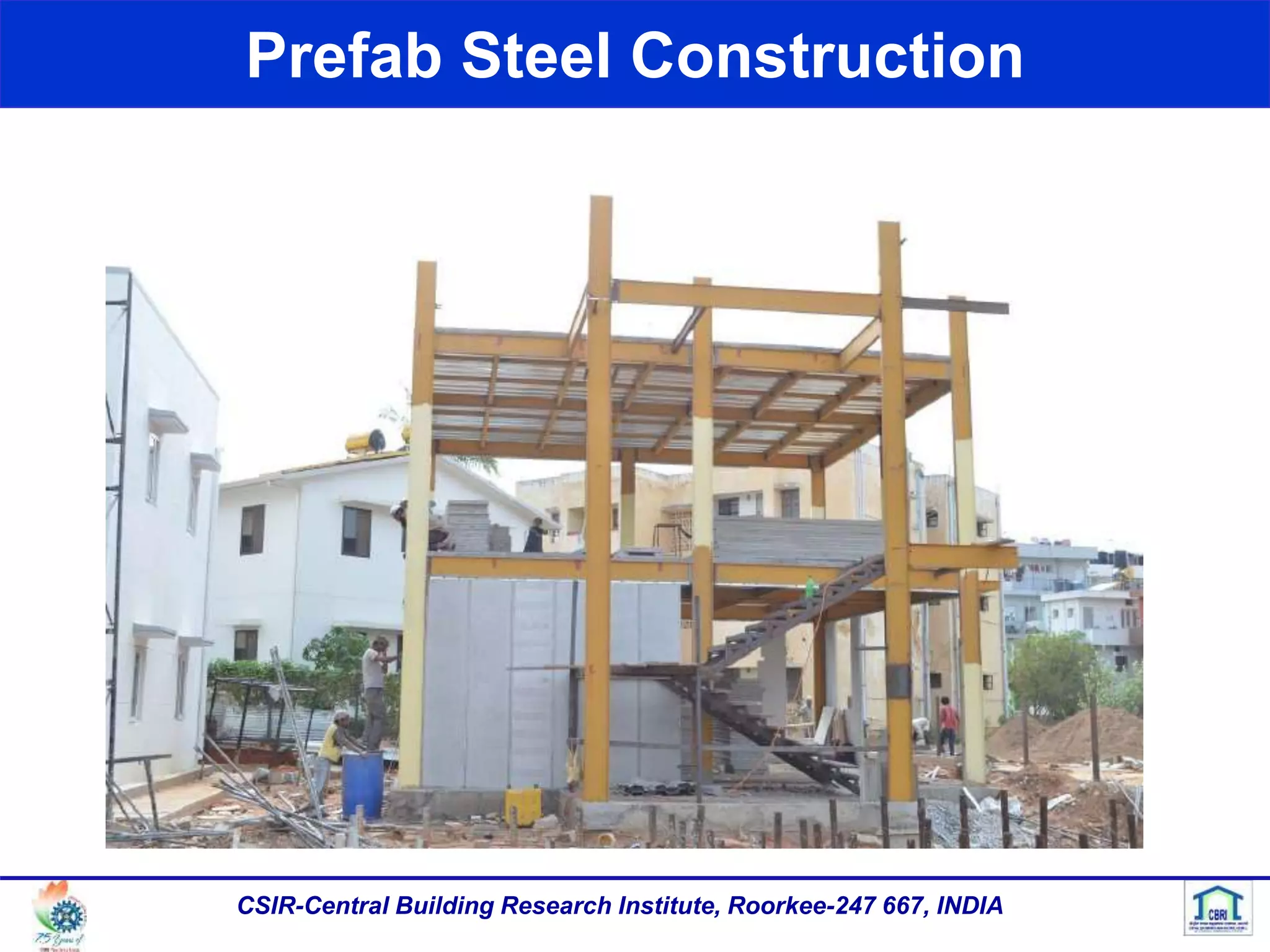
  • #28 Factory Made Fast Track Modular Building System comprises of prefabricated steel structure with different walling components The Speed Floor System is a suspended concrete flooring system using a roll formed steel joist as an integral part of the final concrete and steel composite floor
  • #29 Industrialized 3-S system (Cellular Light Weight Concrete Slabs & Precast Columns) Suitable for construction of high rise buildings resisting seismic and wind induced lateral loads along with gravity loads
  • #32 Work is not affected by weather delays related to excessive cold, heat, rain, snow, etc.
  • #33 Computerization in production process permits a high degree of customization, at an affordable cost; Quality control and factory sealing and design can ensure high energy efficiency
  • #37 All walls, floors, slabs, columns, beams, stairs, together with door and window openings are cast-in-place monolithically using appropriate grade of concrete in one operation. easy handling with minimum labour & without use of any equipment.
  • #39 Used since 1972 , is based on factory mass manufactured structural prefab components. Concrete hollow column shell used which is grouted with appropriate grade of in situ concrete. Autoclaved Aerated Concrete (AAC) slabs used as floor / roof slabs. Joints are filled with reinforced screed concrete (minimum 40 mm thick) of M20 grade minimum. RCC screed is laid over entire area of slab before flooring / water proofing.
  • #41 Based on factory made galvanized light gauge steel components. System is produced by cold forming method. Assembly is done using special types of screws and bolts. Fast construction and better durability.
  • #42 It is a factory produced panel system for the construction of low rise buildings upto G+3 and as filler walls in high rise RCC and steel frame buildings. In this technique, a core of undulated polystyrene is covered with interconnected zinc coated welded wire mesh on both sided reinforcement and shortcrete concrete.
  • #43 Glass Fibre Reinforced Gypsum (GFRG) Panel also known as Rapidwall is made-up of calcined gypsum plaster, reinforced with glass fibers. The panel was originally developed by GFRG Building System Australia and used since 1990 in Australia for mass scale building construction. The panel, manufactured to a thickness of 124mm under carefully controlled conditions to a length of 12m and height of 3m, contains cavities that may be unfilled, partially filled or fully filled with reinforced concrete as per structural requirement.
  • #44 Waffle-Crete Building System consists of large, structural, ribbed panels of reinforced precast concrete, bolted together and the joints between the panels are caulked to form the walls, floor and pitched or flat roofs of buildings. The surface of each panel consists of 51 mm thick slab or skin, stiffened with the ribs around the perimeter and across the panel, giving an overall panel thickness of 152 mm or 203 mm.