Kolli Rajesh M.City Planning, B.Arch
kollirajesh888@gmail.com
The Whale (Netherland)
Typology: High Density Mixed use (Residence,
accommodation)
Location: Amsterdam, Netherlands
Program: 150 social housing, 64 private housing to
rent, 1,100 business accommodation, 179 parking
spaces.
Size: 35,800 sq. m
CONTEXT
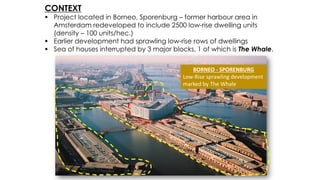
 Project located in Borneo, Sporenburg – former harbour area in
Amsterdam redeveloped to include 2500 low-rise dwelling units
(density – 100 units/hec.)
 Earlier development had sprawling low-rise rows of dwellings
 Sea of houses interrupted by 3 major blocks, 1 of which is The Whale.
BORNEO - SPORENBURG
Low-Rise sprawling development
marked by The Whale
FEATURES
• Central open green
space
• Business area on
ground
• Car park underneath
• Building raised from
bottom
• Creates a kind-of
semi public open
space in the mid.
• Sunlight is said to
pierce through the
bottom cavity
• Each point provides
different view of city
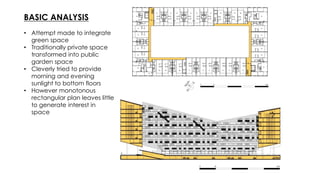
BASIC ANALYSIS
• Attempt made to integrate
green space
• Traditionally private space
transformed into public
garden space
• Cleverly tried to provide
morning and evening
sunlight to bottom floors
• However monotonous
rectangular plan leaves little
to generate interest in
space
REFERENCES
 https://architizer.com/projects/the-whale/
 http://www.mascontext.com/issues/4-living-winter-09/case-study-4-the-
whale/
 http://www.smartcitiesdive.com/ex/sustainablecitiescollective/10-
principles-making-high-density-%E2%80%A66/94.Developaordable
EXAMPLE TAKEN: Guiyang Riverside, China
KEY FACTORS:
• High Density as a relative factor
• City Typology/ Climate
• FSI
• Example taken (Containing NATURE OF CITY)
• High Density large scale development in context of Vijayawada.
High-Density, Mixed-Use Developments on the Guiyang Riverside, China
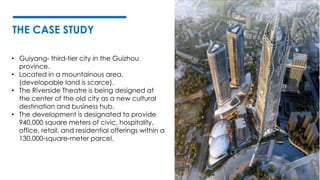
THE CASE STUDY
• Guiyang- third-tier city in the Guizhou
province.
• Located in a mountainous area,
(developable land is scarce).
• The Riverside Theatre is being designed at
the center of the old city as a new cultural
destination and business hub.
• The development is designated to provide
940,000 square meters of civic, hospitality,
office, retail, and residential offerings within a
130,000-square-meter parcel.
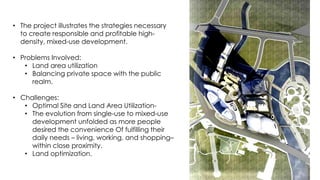
• The project illustrates the strategies necessary
to create responsible and profitable high-
density, mixed-use development.
• Problems Involved:
• Land area utilization
• Balancing private space with the public
realm.
• Challenges:
• Optimal Site and Land Area Utilization-
• The evolution from single-use to mixed-use
development unfolded as more people
desired the convenience Of fulfilling their
daily needs – living, working, and shopping–
within close proximity.
• Land optimization.
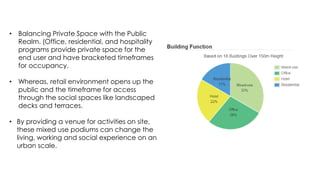
• Balancing Private Space with the Public
Realm. (Office, residential, and hospitality
programs provide private space for the
end user and have bracketed timeframes
for occupancy.
• Whereas, retail environment opens up the
public and the timeframe for access
through the social spaces like landscaped
decks and terraces.
• By providing a venue for activities on site,
these mixed use podiums can change the
living, working and social experience on an
urban scale.
1. Recognizing the merger of iconic high- rise development architecture with the place making
aspects of urban design, planning, retail design, interiors, graphics and landscape architecture
disciplines.
2. Understanding the unique needs of the project. As in, :
• Urban & city context.
• Balancing market and development goals, as well as aspirations of city leaders and the
developers.
• Multidimensional traffic and transit solutions: metro, taxi, bus, car and bicycles must be
considered in the strategy.
• Climate and weather impacts on the site (in the case of the Guiyang project, a riverfront
resiliency strategy for flooding)
3. Capturing the total value opportunity of the retail podium of the infill:
• Developing a horizontal and vertical anchoring strategy.
• Creating an urban fabric of open and closed spaces.
• Creating a dynamic urban district, rather than just a shopping mall in the city.
• Taking a hospitality approach to design, in order to create a lifestyle-oriented environment that
allows users to enjoy and dwell in the space.
SUMMARY OF FINDINGS
4. Addressing the unique needs of all functions of the infill:
• Dedicated address for residential, office and cultural uses.
• Rooftop or public green spaces associated with each use, including parks and open space,
pools, sports amenities, and health clubs.
5. Addressing regulatory needs for sunlight and climate:
• Sun angle and shadow casting (this is of particular significance in China).
• Wind and natural ventilation.
• Wind and climate on structural loading and curtain wall design.
6. Addressing the code and regulatory requirements of the municipality, including, but not limited to:
• Fire codes and fire access.
• Building face requirements.
• Land-use planning (especially with multiple uses).
• FAR.
• Land coverage and green space.
• Parking.
• Civil protection requirements.
References:
• http://global.ctbuh.org/resources/papers/download/2418-high-density-mixed-use-developments-
and-the-guiyang-riverside-theatre-project.pdf
• https://www.skyscrapercenter.com/city/guiyang
Thank You
Kolli Rajesh M.City Planning, B.Arch
kollirajesh888@gmail.com

High Density and Large Scale Mixed Use

  • 1.
    Kolli Rajesh M.CityPlanning, B.Arch kollirajesh888@gmail.com
  • 17.
    The Whale (Netherland) Typology:High Density Mixed use (Residence, accommodation) Location: Amsterdam, Netherlands Program: 150 social housing, 64 private housing to rent, 1,100 business accommodation, 179 parking spaces. Size: 35,800 sq. m
  • 18.
    CONTEXT  Project locatedin Borneo, Sporenburg – former harbour area in Amsterdam redeveloped to include 2500 low-rise dwelling units (density – 100 units/hec.)  Earlier development had sprawling low-rise rows of dwellings  Sea of houses interrupted by 3 major blocks, 1 of which is The Whale. BORNEO - SPORENBURG Low-Rise sprawling development marked by The Whale
  • 19.
    FEATURES • Central opengreen space • Business area on ground • Car park underneath • Building raised from bottom • Creates a kind-of semi public open space in the mid. • Sunlight is said to pierce through the bottom cavity • Each point provides different view of city
  • 20.
    BASIC ANALYSIS • Attemptmade to integrate green space • Traditionally private space transformed into public garden space • Cleverly tried to provide morning and evening sunlight to bottom floors • However monotonous rectangular plan leaves little to generate interest in space
  • 21.
    REFERENCES  https://architizer.com/projects/the-whale/  http://www.mascontext.com/issues/4-living-winter-09/case-study-4-the- whale/ http://www.smartcitiesdive.com/ex/sustainablecitiescollective/10- principles-making-high-density-%E2%80%A66/94.Developaordable
  • 23.
    EXAMPLE TAKEN: GuiyangRiverside, China KEY FACTORS: • High Density as a relative factor • City Typology/ Climate • FSI • Example taken (Containing NATURE OF CITY) • High Density large scale development in context of Vijayawada. High-Density, Mixed-Use Developments on the Guiyang Riverside, China
  • 24.
    THE CASE STUDY •Guiyang- third-tier city in the Guizhou province. • Located in a mountainous area, (developable land is scarce). • The Riverside Theatre is being designed at the center of the old city as a new cultural destination and business hub. • The development is designated to provide 940,000 square meters of civic, hospitality, office, retail, and residential offerings within a 130,000-square-meter parcel.
  • 25.
    • The projectillustrates the strategies necessary to create responsible and profitable high- density, mixed-use development. • Problems Involved: • Land area utilization • Balancing private space with the public realm. • Challenges: • Optimal Site and Land Area Utilization- • The evolution from single-use to mixed-use development unfolded as more people desired the convenience Of fulfilling their daily needs – living, working, and shopping– within close proximity. • Land optimization.
  • 26.
    • Balancing PrivateSpace with the Public Realm. (Office, residential, and hospitality programs provide private space for the end user and have bracketed timeframes for occupancy. • Whereas, retail environment opens up the public and the timeframe for access through the social spaces like landscaped decks and terraces. • By providing a venue for activities on site, these mixed use podiums can change the living, working and social experience on an urban scale.
  • 28.
    1. Recognizing themerger of iconic high- rise development architecture with the place making aspects of urban design, planning, retail design, interiors, graphics and landscape architecture disciplines. 2. Understanding the unique needs of the project. As in, : • Urban & city context. • Balancing market and development goals, as well as aspirations of city leaders and the developers. • Multidimensional traffic and transit solutions: metro, taxi, bus, car and bicycles must be considered in the strategy. • Climate and weather impacts on the site (in the case of the Guiyang project, a riverfront resiliency strategy for flooding) 3. Capturing the total value opportunity of the retail podium of the infill: • Developing a horizontal and vertical anchoring strategy. • Creating an urban fabric of open and closed spaces. • Creating a dynamic urban district, rather than just a shopping mall in the city. • Taking a hospitality approach to design, in order to create a lifestyle-oriented environment that allows users to enjoy and dwell in the space. SUMMARY OF FINDINGS
  • 29.
    4. Addressing theunique needs of all functions of the infill: • Dedicated address for residential, office and cultural uses. • Rooftop or public green spaces associated with each use, including parks and open space, pools, sports amenities, and health clubs. 5. Addressing regulatory needs for sunlight and climate: • Sun angle and shadow casting (this is of particular significance in China). • Wind and natural ventilation. • Wind and climate on structural loading and curtain wall design. 6. Addressing the code and regulatory requirements of the municipality, including, but not limited to: • Fire codes and fire access. • Building face requirements. • Land-use planning (especially with multiple uses). • FAR. • Land coverage and green space. • Parking. • Civil protection requirements. References: • http://global.ctbuh.org/resources/papers/download/2418-high-density-mixed-use-developments- and-the-guiyang-riverside-theatre-project.pdf • https://www.skyscrapercenter.com/city/guiyang
  • 42.
    Thank You Kolli RajeshM.City Planning, B.Arch kollirajesh888@gmail.com