Low Cost Construction
By : Nischay .N ,
B.E(Civil)., M.Tech., IGBC-AP.
INTRODUCTION
• Low cost housing refers to houses that are
inexpensive to build. IT doesn't mean that the
houses will be inexpensive to live in.
• The goal of low-cost housing is to save money while
also maintaining buildings quality.
• Following Properties Reduces Cost of Construction:
• Locally available materials .
• Improved skills and technology.
• Without sacrificing the strength, performance and
life of the structure.
Factors affecting construction cost
• Building Cost : The building construction cost can be divided
into two parts namely:
Building material cost .
Labor cost .
• Size : The smaller the project in terms of scope or the number
of square feet, the more it will cost per square foot.
• Type : Different types of project have different levels of
complexity and detail.
• Special Construction
• Project accessibility
• Labor Rates
• Material Costs
• General Economic Pressures
• Time of Year
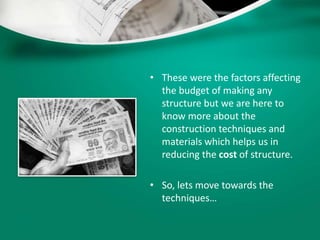
• These were the factors affecting
the budget of making any
structure but we are here to
know more about the
construction techniques and
materials which helps us in
reducing the cost of structure.
• So, lets move towards the
techniques…
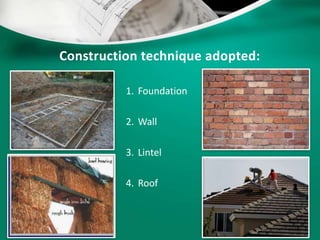
Construction technique adopted:
1. Foundation
2. Wall
3. Lintel
4. Roof
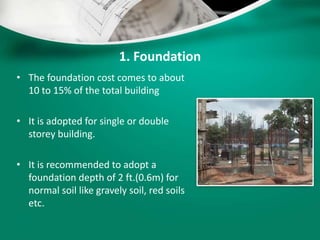
1. Foundation
• The foundation cost comes to about
10 to 15% of the total building
• It is adopted for single or double
storey building.
• It is recommended to adopt a
foundation depth of 2 ft.(0.6m) for
normal soil like gravely soil, red soils
etc.
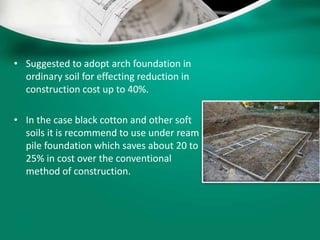
• Suggested to adopt arch foundation in
ordinary soil for effecting reduction in
construction cost up to 40%.
• In the case black cotton and other soft
soils it is recommend to use under ream
pile foundation which saves about 20 to
25% in cost over the conventional
method of construction.
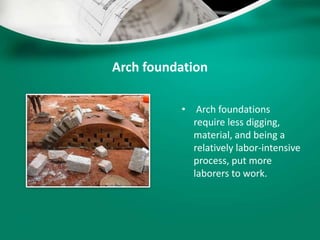
Arch foundation
• Arch foundations
require less digging,
material, and being a
relatively labor-intensive
process, put more
laborers to work.
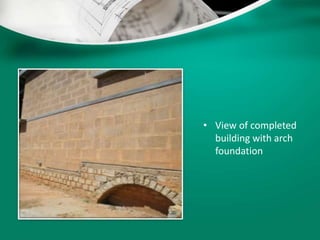
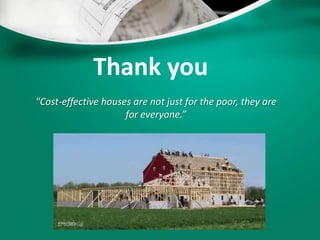
• View of completed
building with arch
foundation
• Wall thickness of 6 to 9″ is
recommended for adoption in
the construction of walls all-
round the building and 41/2 ”
for inside walls.
• It is suggested to use burnt
bricks which are immersed in
water for 24 hours and then
shall be used for the walls.
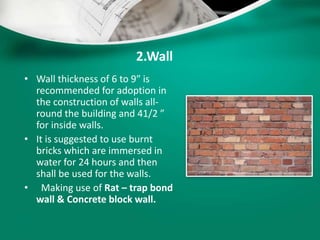
• Making use of Rat – trap bond
wall & Concrete block wall.
2.Wall
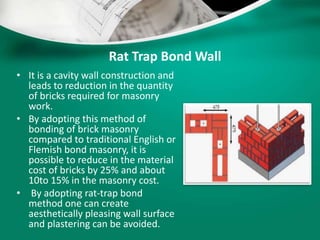
Rat Trap Bond Wall
• It is a cavity wall construction and
leads to reduction in the quantity
of bricks required for masonry
work.
• By adopting this method of
bonding of brick masonry
compared to traditional English or
Flemish bond masonry, it is
possible to reduce in the material
cost of bricks by 25% and about
10to 15% in the masonry cost.
• By adopting rat-trap bond
method one can create
aesthetically pleasing wall surface
and plastering can be avoided.
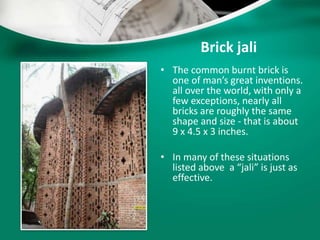
Brick jali
• The common burnt brick is
one of man’s great inventions.
all over the world, with only a
few exceptions, nearly all
bricks are roughly the same
shape and size - that is about
9 x 4.5 x 3 inches.
• In many of these situations
listed above a “jali” is just as
effective.
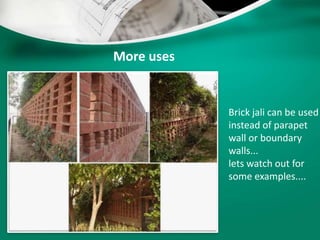
More uses
Brick jali can be used
instead of parapet
wall or boundary
walls...
lets watch out for
some examples....
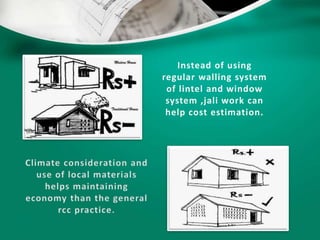
Instead of using
regular walling system
of lintel and window
system ,jali work can
help cost estimation.
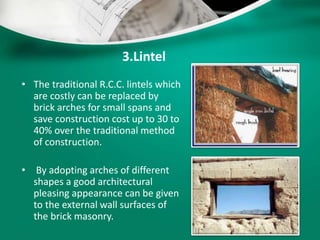
3.Lintel
• The traditional R.C.C. lintels which
are costly can be replaced by
brick arches for small spans and
save construction cost up to 30 to
40% over the traditional method
of construction.
• By adopting arches of different
shapes a good architectural
pleasing appearance can be given
to the external wall surfaces of
the brick masonry.
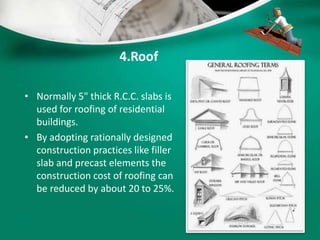
• Normally 5" thick R.C.C. slabs is
used for roofing of residential
buildings.
• By adopting rationally designed
construction practices like filler
slab and precast elements the
construction cost of roofing can
be reduced by about 20 to 25%.
4.Roof
Filler slabs
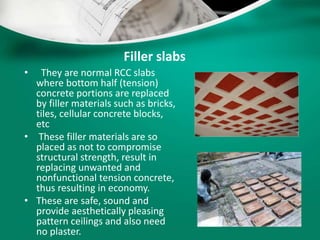
• They are normal RCC slabs
where bottom half (tension)
concrete portions are replaced
by filler materials such as bricks,
tiles, cellular concrete blocks,
etc
• These filler materials are so
placed as not to compromise
structural strength, result in
replacing unwanted and
nonfunctional tension concrete,
thus resulting in economy.
• These are safe, sound and
provide aesthetically pleasing
pattern ceilings and also need
no plaster.
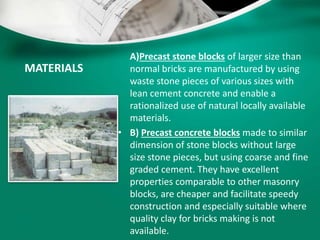
A)Precast stone blocks of larger size than
normal bricks are manufactured by using
waste stone pieces of various sizes with
lean cement concrete and enable a
rationalized use of natural locally available
materials.
• B) Precast concrete blocks made to similar
dimension of stone blocks without large
size stone pieces, but using coarse and fine
graded cement. They have excellent
properties comparable to other masonry
blocks, are cheaper and facilitate speedy
construction and especially suitable where
quality clay for bricks making is not
available.
MATERIALS
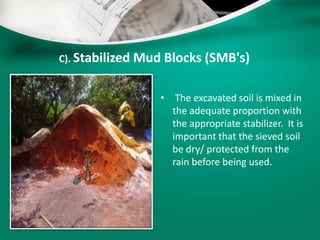
C). Stabilized Mud Blocks (SMB's)
• The excavated soil is mixed in
the adequate proportion with
the appropriate stabilizer. It is
important that the sieved soil
be dry/ protected from the
rain before being used.
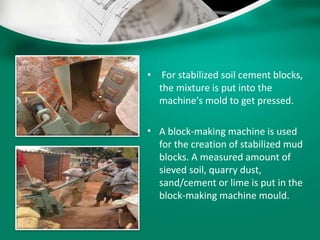
• For stabilized soil cement blocks,
the mixture is put into the
machine's mold to get pressed.
• A block-making machine is used
for the creation of stabilized mud
blocks. A measured amount of
sieved soil, quarry dust,
sand/cement or lime is put in the
block-making machine mould.
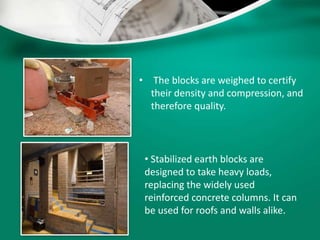
• The blocks are weighed to certify
their density and compression, and
therefore quality.
• Stabilized earth blocks are
designed to take heavy loads,
replacing the widely used
reinforced concrete columns. It can
be used for roofs and walls alike.
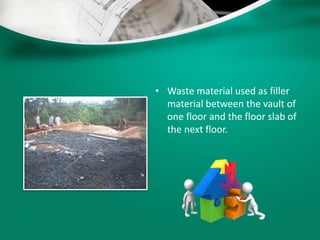
• Waste material used as filler
material between the vault of
one floor and the floor slab of
the next floor.
People who are working on this !!
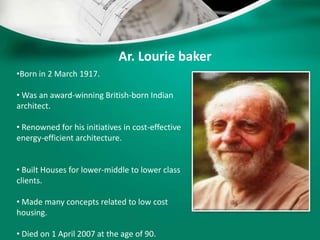
Ar. Lourie baker
S Vishwanath
Chitra Vishwanath
Ar. Lourie baker
•Born in 2 March 1917.
• Was an award-winning British-born Indian
architect.
• Renowned for his initiatives in cost-effective
energy-efficient architecture.
• Built Houses for lower-middle to lower class
clients.
• Made many concepts related to low cost
housing.
• Died on 1 April 2007 at the age of 90.
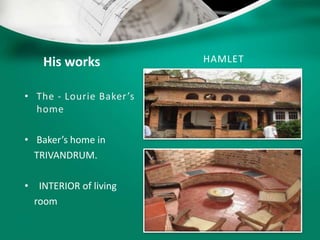
His works
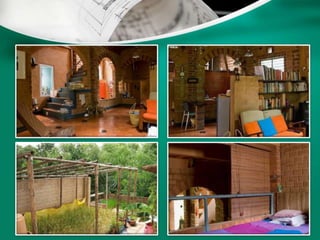
• The - Lourie Baker’s
home
• Baker’s home in
TRIVANDRUM.
• INTERIOR of living
room
HAMLET
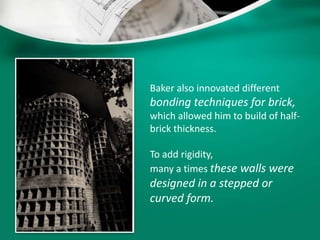
Baker also innovated different
bonding techniques for brick,
which allowed him to build of half-
brick thickness.
To add rigidity,
many a times these walls were
designed in a stepped or
curved form.
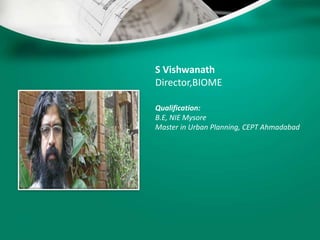
S Vishwanath
Director,BIOME
Qualification:
B.E, NIE Mysore
Master in Urban Planning, CEPT Ahmadabad
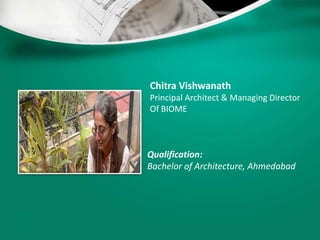
Qualification:
Bachelor of Architecture, Ahmedabad
Chitra Vishwanath
Principal Architect & Managing Director
Of BIOME
Cost-effective building materials and construction
technologies Research and development bodies in
India are
Central Building Research Institute (CBRI),
Structural Engineering Research Centre (SERC),
Centre for Application of Science and Technology to
Rural Areas (CASTRA),
Regional Research Laboratories (RRL),
National Environmental Engineering Research
Institute (NEERI)
Thank you
"Cost-effective houses are not just for the poor, they are
for everyone.”

Cost effective construction tech PPT

  • 1.
    Low Cost Construction By: Nischay .N , B.E(Civil)., M.Tech., IGBC-AP.
  • 2.
    INTRODUCTION • Low costhousing refers to houses that are inexpensive to build. IT doesn't mean that the houses will be inexpensive to live in. • The goal of low-cost housing is to save money while also maintaining buildings quality. • Following Properties Reduces Cost of Construction: • Locally available materials . • Improved skills and technology. • Without sacrificing the strength, performance and life of the structure.
  • 3.
    Factors affecting constructioncost • Building Cost : The building construction cost can be divided into two parts namely: Building material cost . Labor cost . • Size : The smaller the project in terms of scope or the number of square feet, the more it will cost per square foot. • Type : Different types of project have different levels of complexity and detail.
  • 4.
    • Special Construction •Project accessibility • Labor Rates • Material Costs • General Economic Pressures • Time of Year
  • 5.
    • These werethe factors affecting the budget of making any structure but we are here to know more about the construction techniques and materials which helps us in reducing the cost of structure. • So, lets move towards the techniques…
  • 6.
    Construction technique adopted: 1.Foundation 2. Wall 3. Lintel 4. Roof
  • 7.
    1. Foundation • Thefoundation cost comes to about 10 to 15% of the total building • It is adopted for single or double storey building. • It is recommended to adopt a foundation depth of 2 ft.(0.6m) for normal soil like gravely soil, red soils etc.
  • 8.
    • Suggested toadopt arch foundation in ordinary soil for effecting reduction in construction cost up to 40%. • In the case black cotton and other soft soils it is recommend to use under ream pile foundation which saves about 20 to 25% in cost over the conventional method of construction.
  • 9.
    Arch foundation • Archfoundations require less digging, material, and being a relatively labor-intensive process, put more laborers to work.
  • 10.
    • View ofcompleted building with arch foundation
  • 11.
    • Wall thicknessof 6 to 9″ is recommended for adoption in the construction of walls all- round the building and 41/2 ” for inside walls. • It is suggested to use burnt bricks which are immersed in water for 24 hours and then shall be used for the walls. • Making use of Rat – trap bond wall & Concrete block wall. 2.Wall
  • 12.
    Rat Trap BondWall • It is a cavity wall construction and leads to reduction in the quantity of bricks required for masonry work. • By adopting this method of bonding of brick masonry compared to traditional English or Flemish bond masonry, it is possible to reduce in the material cost of bricks by 25% and about 10to 15% in the masonry cost. • By adopting rat-trap bond method one can create aesthetically pleasing wall surface and plastering can be avoided.
  • 13.
    Brick jali • Thecommon burnt brick is one of man’s great inventions. all over the world, with only a few exceptions, nearly all bricks are roughly the same shape and size - that is about 9 x 4.5 x 3 inches. • In many of these situations listed above a “jali” is just as effective.
  • 14.
    More uses Brick jalican be used instead of parapet wall or boundary walls... lets watch out for some examples....
  • 15.
    Instead of using regularwalling system of lintel and window system ,jali work can help cost estimation.
  • 16.
    3.Lintel • The traditionalR.C.C. lintels which are costly can be replaced by brick arches for small spans and save construction cost up to 30 to 40% over the traditional method of construction. • By adopting arches of different shapes a good architectural pleasing appearance can be given to the external wall surfaces of the brick masonry.
  • 17.
    • Normally 5"thick R.C.C. slabs is used for roofing of residential buildings. • By adopting rationally designed construction practices like filler slab and precast elements the construction cost of roofing can be reduced by about 20 to 25%. 4.Roof
  • 18.
    Filler slabs • Theyare normal RCC slabs where bottom half (tension) concrete portions are replaced by filler materials such as bricks, tiles, cellular concrete blocks, etc • These filler materials are so placed as not to compromise structural strength, result in replacing unwanted and nonfunctional tension concrete, thus resulting in economy. • These are safe, sound and provide aesthetically pleasing pattern ceilings and also need no plaster.
  • 19.
    A)Precast stone blocksof larger size than normal bricks are manufactured by using waste stone pieces of various sizes with lean cement concrete and enable a rationalized use of natural locally available materials. • B) Precast concrete blocks made to similar dimension of stone blocks without large size stone pieces, but using coarse and fine graded cement. They have excellent properties comparable to other masonry blocks, are cheaper and facilitate speedy construction and especially suitable where quality clay for bricks making is not available. MATERIALS
  • 20.
    C). Stabilized MudBlocks (SMB's) • The excavated soil is mixed in the adequate proportion with the appropriate stabilizer. It is important that the sieved soil be dry/ protected from the rain before being used.
  • 21.
    • For stabilizedsoil cement blocks, the mixture is put into the machine's mold to get pressed. • A block-making machine is used for the creation of stabilized mud blocks. A measured amount of sieved soil, quarry dust, sand/cement or lime is put in the block-making machine mould.
  • 22.
    • The blocksare weighed to certify their density and compression, and therefore quality. • Stabilized earth blocks are designed to take heavy loads, replacing the widely used reinforced concrete columns. It can be used for roofs and walls alike.
  • 23.
    • Waste materialused as filler material between the vault of one floor and the floor slab of the next floor.
  • 24.
    People who areworking on this !! Ar. Lourie baker S Vishwanath Chitra Vishwanath
  • 25.
    Ar. Lourie baker •Bornin 2 March 1917. • Was an award-winning British-born Indian architect. • Renowned for his initiatives in cost-effective energy-efficient architecture. • Built Houses for lower-middle to lower class clients. • Made many concepts related to low cost housing. • Died on 1 April 2007 at the age of 90.
  • 26.
    His works • The- Lourie Baker’s home • Baker’s home in TRIVANDRUM. • INTERIOR of living room HAMLET
  • 27.
    Baker also innovateddifferent bonding techniques for brick, which allowed him to build of half- brick thickness. To add rigidity, many a times these walls were designed in a stepped or curved form.
  • 28.
    S Vishwanath Director,BIOME Qualification: B.E, NIEMysore Master in Urban Planning, CEPT Ahmadabad
  • 29.
    Qualification: Bachelor of Architecture,Ahmedabad Chitra Vishwanath Principal Architect & Managing Director Of BIOME
  • 31.
    Cost-effective building materialsand construction technologies Research and development bodies in India are Central Building Research Institute (CBRI), Structural Engineering Research Centre (SERC), Centre for Application of Science and Technology to Rural Areas (CASTRA), Regional Research Laboratories (RRL), National Environmental Engineering Research Institute (NEERI)
  • 32.
    Thank you "Cost-effective housesare not just for the poor, they are for everyone.”