Anti-Urbanization: An implicit
development policy
Kolli Rajesh M. City Planning, B.Arch
Kollirajesh888@gmail.com
Dynamics of
Settlement Systems
Anti-Urbanization
Anti-Urbanization: An implicit development policy ( Amaresh Mohan Kolli Rajesh Pinaki Ranjan Biswas) 02/15
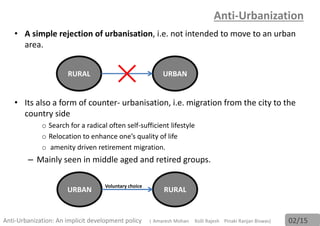
• A simple rejection of urbanisation, i.e. not intended to move to an urban
area.
• Its also a form of counter- urbanisation, i.e. migration from the city to the
country side
o Search for a radical often self-sufficient lifestyle
o Relocation to enhance one’s quality of life
o amenity driven retirement migration.
– Mainly seen in middle aged and retired groups.
URBANRURAL
RURALURBAN
Voluntary choice
• A Policy is a set of government statements and actions that are designed
to influence the behavior of the people in order to achieve a desired
outcome.
• Direct or Explicit – government actions taken for the purpose of affecting
a demographic outcome , e.g., migration laws
• Indirect or Implicit – government actions that only have indirectly some
demographic effects, e.g., promoting female education
– suggested though not directly expressed
Implict Policy
Anti-Urbanization: An implicit development policy ( Amaresh Mohan Kolli Rajesh Pinaki Ranjan Biswas) 03/15
Direct - Implict
Anti-Urbanization: An implicit development policy ( Amaresh Mohan Kolli Rajesh Pinaki Ranjan Biswas) 04/15
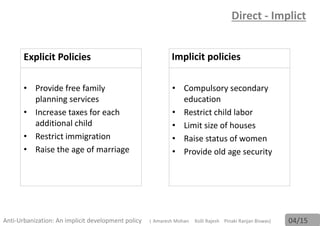
Explicit Policies
• Provide free family
planning services
• Increase taxes for each
additional child
• Restrict immigration
• Raise the age of marriage
Implicit policies
• Compulsory secondary
education
• Restrict child labor
• Limit size of houses
• Raise status of women
• Provide old age security
Antiurbanization: An implicit development policy ( Amaresh Mohan Kolli Rajesh Pinaki Ranjan Biswas) 05/15
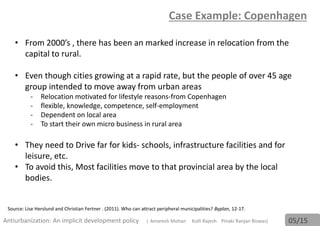
• From 2000’s , there has been an marked increase in relocation from the
capital to rural.
• Even though cities growing at a rapid rate, but the people of over 45 age
group intended to move away from urban areas
- Relocation motivated for lifestyle reasons-from Copenhagen
- flexible, knowledge, competence, self-employment
- Dependent on local area
- To start their own micro business in rural area
• They need to Drive far for kids- schools, infrastructure facilities and for
leisure, etc.
• To avoid this, Most facilities move to that provincial area by the local
bodies.
Case Example: Copenhagen
Source: Lise Herslund and Christian Fertner . (2011). Who can attract peripheral municipalities? Byplan, 12-17.
Antiurbanization: An implicit development policy ( Amaresh Mohan Kolli Rajesh Pinaki Ranjan Biswas) 06/15
Case Example: Copenhagen
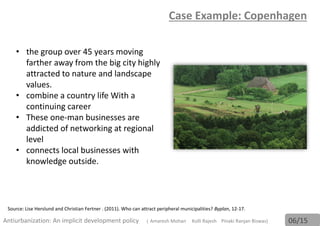
• the group over 45 years moving
farther away from the big city highly
attracted to nature and landscape
values.
• combine a country life With a
continuing career
• These one-man businesses are
addicted of networking at regional
level
• connects local businesses with
knowledge outside.
Source: Lise Herslund and Christian Fertner . (2011). Who can attract peripheral municipalities? Byplan, 12-17.
Antiurbanization: An implicit development policy ( Amaresh Mohan Kolli Rajesh Pinaki Ranjan Biswas) 07/15
• Turkey has urbanized at an extremely from 1940’s to 1980’s.
• This unforeseen increase in migrated population from rural to urban led to
serious problems in urban areas.
• So, the policymakers tried to control this by making policies which are
beneficiary for rural development.
Case Example: Turkey
0
10
20
30
40
50
60
1935 1950 1960 1970 1975 1980 1990 2000 2010 2018
%ofurbanpopulation
Year
Source: Levine, N. (1980). Anti-urbanization: An Implicit Development Policy in Turkey. The Journal of Developing Areas, 513-538.
Antiurbanization: An implicit development policy ( Amaresh Mohan Kolli Rajesh Pinaki Ranjan Biswas) 08/15
• They made policies to improve medical (short term rather than long
term), education, etc..
Health Policy:
• Initially the distribution of doctors were very uneven. The three largest
provinces- Istanbul, Ankara, and Izmir had 67% of all the doctors in
Turkey, 44 provinces had fewer than 100 doctors in each province.
• In 1961 the Mother-Child Health Program was made the main health
priority. In terms of establishing medical infrastructure, there has been
some success.
• For example, 30% of the hospitals and 48 %of hospital beds were
located in the 3 largest provinces in 1965, but by 1972 these figures had
dropped to 22% and 44%.
Case Example: Turkey
Source: Levine, N. (1980). Anti-urbanization: An Implicit Development Policy in Turkey. The Journal of Developing Areas, 513-538.
• In 1966, approximately 47% of the Ministry of Health and Social Welfare's
annual budget was spent on hospital facilities, almost all on personnel
salary.
• By 1972, it did not have enough resources to appoint doctors to make a
socialized medical system.
• This policy had benefitted the rural people for a short time, rather than a
long term.
Antiurbanization: An implicit development policy ( Amaresh Mohan Kolli Rajesh Pinaki Ranjan Biswas) 09/15
Case Example: Turkey
Source: Levine, N. (1980). Anti-urbanization: An Implicit Development Policy in Turkey. The Journal of Developing Areas, 513-538.
Antiurbanization: An implicit development policy ( Amaresh Mohan Kolli Rajesh Pinaki Ranjan Biswas) 10/15
Education Policy:
• On the beginning of the Republic a two-tier education policies were
introduced. Village people were never expected to have higher aspirations
or to need broader intellectual and scientific knowledge.
• From the 1930s onward, the growth of rural primary school attendance
was rapid. Unlike the doctors and the health services, teachers could be
made to go to the rural areas (because they were public employees and
"cheaper").
• The expansion of primary education increased aspirations, consequently,
has increased pressure for secondary & technical education, primarily
through middle class rather than through formal government policy.
Case Example: Turkey
Source: Levine, N. (1980). Anti-urbanization: An Implicit Development Policy in Turkey. The Journal of Developing Areas, 513-538.
Antiurbanization: An implicit development policy ( Amaresh Mohan Kolli Rajesh Pinaki Ranjan Biswas) 11/15
• People with educational skills would migrate to use those skills.
• So, this policy failed in preventing migration to urban area.
• Many students who enrolled in secondary schools from rural areas find
extremely difficult to compete with students from big cities.
• Later the job market was very poor in urban area. So there was no job
guarantee for the technical educated people.
• So, this policy had created negative impact on urbanization.
• So they invested more government funds go into agricultural research than
any other research area.
Case Example: Turkey
Source: Levine, N. (1980). Anti-urbanization: An Implicit Development Policy in Turkey. The Journal of Developing Areas, 513-538.
Antiurbanization: An implicit development policy ( Amaresh Mohan Kolli Rajesh Pinaki Ranjan Biswas) 12/15
• RURBAN mission, a policy of Government of India which aims to provide
urban amenities in the rural areas.
• Though it is not an implicit policy it helps in reducing rural-urban
migration.
• SJGSY-1999, To help the self-help groups formed by women of the rural
areas to develop their economic condition through subsidized loans from
the banks, to do household industrial works and also skill development
programs are conducted among the rural women.
• MGNREGA-2005: Mahatma Gandhi National Rural Employment Act. was
taken into account to provide 100 days job guarantees to the unskilled
rural population.
• These policies might act as an Implicit Development in rural areas which
supports towards Anti-Urbanization.
In India
• As in India, most cities are too small and thus do not fully avail of the
benefits of urbanization, as India’s urbanization rate is slower than the rest
of Asia. At 28%, India’s urbanization rate is lower than China’s (over 40%)
and Korea’s (over 75%).
• In part, this is may be due to an anti-urbanization bias in policy as well as
in public perception both in rural and urban areas.
• Policies such as the Rural Employment Guarantee Act, the non-taxation of
agricultural income, and especially the relatively poor state of municipal
governance, and the meagre investment in urban infrastructure, illustrate
the anti-urban bent in policy.
• These gains in the rural areas may prevents the realization of the gains
from urbanization.
Antiurbanization: An implicit development policy ( Amaresh Mohan Kolli Rajesh Pinaki Ranjan Biswas) 13/15
Conclusion
• Levine, N. (1980). Anti-urbanization: An Implicit Development Policy in Turkey. The
Journal of Developing Areas, 513-538.
• Lise Byskov Herslund, Christian Fertner. (2010). Anti-urbanization as Development
Chance for Rural Areas. Managing the Rural Urban Interface (pp. 1-72). Copenhagen:
University of Copenhagen.
• Lise Herslund and Christian Fertner . (2011). Who can attract peripheral municipalities?
Byplan, 12-17.
• Poddar, T. (2007, August 16). India's Urbanization Bonus. Livemint, p. 3.
Antiurbanization: An implicit development policy ( Amaresh Mohan Kolli Rajesh Pinaki Ranjan Biswas) 14/15
References
Thank You
Anti-Urbanization: An implicit development policy
15/15
Kolli Rajesh M. City Planning, B.Arch
Kollirajesh888@gmail.com

Anti urbanization - an implicit development policy

  • 1.
    Anti-Urbanization: An implicit developmentpolicy Kolli Rajesh M. City Planning, B.Arch Kollirajesh888@gmail.com Dynamics of Settlement Systems
  • 2.
    Anti-Urbanization Anti-Urbanization: An implicitdevelopment policy ( Amaresh Mohan Kolli Rajesh Pinaki Ranjan Biswas) 02/15 • A simple rejection of urbanisation, i.e. not intended to move to an urban area. • Its also a form of counter- urbanisation, i.e. migration from the city to the country side o Search for a radical often self-sufficient lifestyle o Relocation to enhance one’s quality of life o amenity driven retirement migration. – Mainly seen in middle aged and retired groups. URBANRURAL RURALURBAN Voluntary choice
  • 3.
    • A Policyis a set of government statements and actions that are designed to influence the behavior of the people in order to achieve a desired outcome. • Direct or Explicit – government actions taken for the purpose of affecting a demographic outcome , e.g., migration laws • Indirect or Implicit – government actions that only have indirectly some demographic effects, e.g., promoting female education – suggested though not directly expressed Implict Policy Anti-Urbanization: An implicit development policy ( Amaresh Mohan Kolli Rajesh Pinaki Ranjan Biswas) 03/15
  • 4.
    Direct - Implict Anti-Urbanization:An implicit development policy ( Amaresh Mohan Kolli Rajesh Pinaki Ranjan Biswas) 04/15 Explicit Policies • Provide free family planning services • Increase taxes for each additional child • Restrict immigration • Raise the age of marriage Implicit policies • Compulsory secondary education • Restrict child labor • Limit size of houses • Raise status of women • Provide old age security
  • 5.
    Antiurbanization: An implicitdevelopment policy ( Amaresh Mohan Kolli Rajesh Pinaki Ranjan Biswas) 05/15 • From 2000’s , there has been an marked increase in relocation from the capital to rural. • Even though cities growing at a rapid rate, but the people of over 45 age group intended to move away from urban areas - Relocation motivated for lifestyle reasons-from Copenhagen - flexible, knowledge, competence, self-employment - Dependent on local area - To start their own micro business in rural area • They need to Drive far for kids- schools, infrastructure facilities and for leisure, etc. • To avoid this, Most facilities move to that provincial area by the local bodies. Case Example: Copenhagen Source: Lise Herslund and Christian Fertner . (2011). Who can attract peripheral municipalities? Byplan, 12-17.
  • 6.
    Antiurbanization: An implicitdevelopment policy ( Amaresh Mohan Kolli Rajesh Pinaki Ranjan Biswas) 06/15 Case Example: Copenhagen • the group over 45 years moving farther away from the big city highly attracted to nature and landscape values. • combine a country life With a continuing career • These one-man businesses are addicted of networking at regional level • connects local businesses with knowledge outside. Source: Lise Herslund and Christian Fertner . (2011). Who can attract peripheral municipalities? Byplan, 12-17.
  • 7.
    Antiurbanization: An implicitdevelopment policy ( Amaresh Mohan Kolli Rajesh Pinaki Ranjan Biswas) 07/15 • Turkey has urbanized at an extremely from 1940’s to 1980’s. • This unforeseen increase in migrated population from rural to urban led to serious problems in urban areas. • So, the policymakers tried to control this by making policies which are beneficiary for rural development. Case Example: Turkey 0 10 20 30 40 50 60 1935 1950 1960 1970 1975 1980 1990 2000 2010 2018 %ofurbanpopulation Year Source: Levine, N. (1980). Anti-urbanization: An Implicit Development Policy in Turkey. The Journal of Developing Areas, 513-538.
  • 8.
    Antiurbanization: An implicitdevelopment policy ( Amaresh Mohan Kolli Rajesh Pinaki Ranjan Biswas) 08/15 • They made policies to improve medical (short term rather than long term), education, etc.. Health Policy: • Initially the distribution of doctors were very uneven. The three largest provinces- Istanbul, Ankara, and Izmir had 67% of all the doctors in Turkey, 44 provinces had fewer than 100 doctors in each province. • In 1961 the Mother-Child Health Program was made the main health priority. In terms of establishing medical infrastructure, there has been some success. • For example, 30% of the hospitals and 48 %of hospital beds were located in the 3 largest provinces in 1965, but by 1972 these figures had dropped to 22% and 44%. Case Example: Turkey Source: Levine, N. (1980). Anti-urbanization: An Implicit Development Policy in Turkey. The Journal of Developing Areas, 513-538.
  • 9.
    • In 1966,approximately 47% of the Ministry of Health and Social Welfare's annual budget was spent on hospital facilities, almost all on personnel salary. • By 1972, it did not have enough resources to appoint doctors to make a socialized medical system. • This policy had benefitted the rural people for a short time, rather than a long term. Antiurbanization: An implicit development policy ( Amaresh Mohan Kolli Rajesh Pinaki Ranjan Biswas) 09/15 Case Example: Turkey Source: Levine, N. (1980). Anti-urbanization: An Implicit Development Policy in Turkey. The Journal of Developing Areas, 513-538.
  • 10.
    Antiurbanization: An implicitdevelopment policy ( Amaresh Mohan Kolli Rajesh Pinaki Ranjan Biswas) 10/15 Education Policy: • On the beginning of the Republic a two-tier education policies were introduced. Village people were never expected to have higher aspirations or to need broader intellectual and scientific knowledge. • From the 1930s onward, the growth of rural primary school attendance was rapid. Unlike the doctors and the health services, teachers could be made to go to the rural areas (because they were public employees and "cheaper"). • The expansion of primary education increased aspirations, consequently, has increased pressure for secondary & technical education, primarily through middle class rather than through formal government policy. Case Example: Turkey Source: Levine, N. (1980). Anti-urbanization: An Implicit Development Policy in Turkey. The Journal of Developing Areas, 513-538.
  • 11.
    Antiurbanization: An implicitdevelopment policy ( Amaresh Mohan Kolli Rajesh Pinaki Ranjan Biswas) 11/15 • People with educational skills would migrate to use those skills. • So, this policy failed in preventing migration to urban area. • Many students who enrolled in secondary schools from rural areas find extremely difficult to compete with students from big cities. • Later the job market was very poor in urban area. So there was no job guarantee for the technical educated people. • So, this policy had created negative impact on urbanization. • So they invested more government funds go into agricultural research than any other research area. Case Example: Turkey Source: Levine, N. (1980). Anti-urbanization: An Implicit Development Policy in Turkey. The Journal of Developing Areas, 513-538.
  • 12.
    Antiurbanization: An implicitdevelopment policy ( Amaresh Mohan Kolli Rajesh Pinaki Ranjan Biswas) 12/15 • RURBAN mission, a policy of Government of India which aims to provide urban amenities in the rural areas. • Though it is not an implicit policy it helps in reducing rural-urban migration. • SJGSY-1999, To help the self-help groups formed by women of the rural areas to develop their economic condition through subsidized loans from the banks, to do household industrial works and also skill development programs are conducted among the rural women. • MGNREGA-2005: Mahatma Gandhi National Rural Employment Act. was taken into account to provide 100 days job guarantees to the unskilled rural population. • These policies might act as an Implicit Development in rural areas which supports towards Anti-Urbanization. In India
  • 13.
    • As inIndia, most cities are too small and thus do not fully avail of the benefits of urbanization, as India’s urbanization rate is slower than the rest of Asia. At 28%, India’s urbanization rate is lower than China’s (over 40%) and Korea’s (over 75%). • In part, this is may be due to an anti-urbanization bias in policy as well as in public perception both in rural and urban areas. • Policies such as the Rural Employment Guarantee Act, the non-taxation of agricultural income, and especially the relatively poor state of municipal governance, and the meagre investment in urban infrastructure, illustrate the anti-urban bent in policy. • These gains in the rural areas may prevents the realization of the gains from urbanization. Antiurbanization: An implicit development policy ( Amaresh Mohan Kolli Rajesh Pinaki Ranjan Biswas) 13/15 Conclusion
  • 14.
    • Levine, N.(1980). Anti-urbanization: An Implicit Development Policy in Turkey. The Journal of Developing Areas, 513-538. • Lise Byskov Herslund, Christian Fertner. (2010). Anti-urbanization as Development Chance for Rural Areas. Managing the Rural Urban Interface (pp. 1-72). Copenhagen: University of Copenhagen. • Lise Herslund and Christian Fertner . (2011). Who can attract peripheral municipalities? Byplan, 12-17. • Poddar, T. (2007, August 16). India's Urbanization Bonus. Livemint, p. 3. Antiurbanization: An implicit development policy ( Amaresh Mohan Kolli Rajesh Pinaki Ranjan Biswas) 14/15 References
  • 15.
    Thank You Anti-Urbanization: Animplicit development policy 15/15 Kolli Rajesh M. City Planning, B.Arch Kollirajesh888@gmail.com