C o st Efficient Construction (CoTM5282 )
C H A P T E R FO U R
CO N S T RU C T I O N M AT E R I A L S FO R
CO S T E F F I C I E N T CO N S T RU C T I O N
1.1. INTRODUCTION
Building materials accounts for nearly 60 to 65% of the cost of
house construction.
With the constant rise in the cost of traditional building materials
and with the poor affordability of large segments of our
population:
the cost of an adequate house is increasingly going beyond the
affordable limits of more than 30-35% of our population lying in the
lower income segments
CHAPTER FOUR
CONSTRUCTION MATERIALS FOR
COST EFFICIENT CONSTRUCTION
Selection of cost efficient construction material
 Manufacturing of CECM
 Environmental friendly
 Improved technologies for production
 Reduction in waste generation
 Use of recycled waste as a construction material
 Waste produced can be used for the material in a cheaper cost
 Use of natural low cost material
 Natural materials are sustainable and environment friendly
 Materials like stone wood, bamboo, sand… require less embodied energy
 Use of natural low cost material
 Natural materials are sustainable and environment friendly
 Materials like stone wood, bamboo, sand… require less embodied energy
 Use of local construction materials
 Reduced transportation dependence
 Suitable for local environment
 Low cost building materials do not mean sub-standard materials,
but the materials:
 Available/developed locally,
 Cutting the transportation charges and
 Manufactured applying civil engineering know-how for better
service and economy.
Con…
1. Traditional material
2. Conventional material
The various building materials available can be divided
into two types and they are;
1. Traditional material
 These materials serve the basic needs of the majority of the
population.
 These have very useful properties; however, there is a scope to
modify these through appropriate changes in the process of
production as well as in the techniques of application, so that
these are made structurally and functionally acceptable
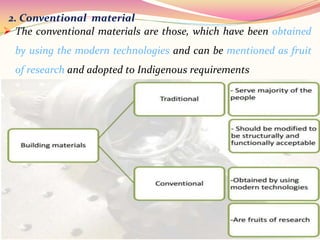
 The conventional materials are those, which have been obtained
by using the modern technologies and can be mentioned as fruit
of research and adopted to Indigenous requirements
2. Conventional material
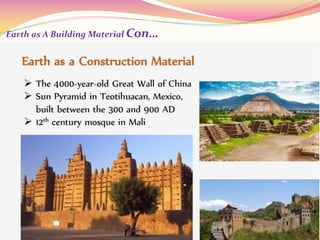
3.2.1. Earth as A Building Material
 Earth construction techniques have been known for over 9000
years.
 Today, one third of the human population resides in earthen
houses; in developing countries this figure is more than one half.
 It has proven impossible to fulfil the immense requirements for
shelter in the developing countries with industrial building
materials, i.e. brick, concrete and steel, nor with industrialized
construction techniques, requirements for shelter can be met only
by using local building materials and relying on do-it-yourself
construction techniques.
 17 % of the “world cultural heritage” is built with earth Statistics
From UNESCO.
3.2. Alternative Construction Materials
Earth as A Building Material Con…
A. Mud:
 During post earthquake reconstruction, mud houses are most
effective since they are environmental friendly, cool in summer and
warm in winter.
 Mud is only a material available everywhere in abundance free of
and is being used as building material from centuries.
 But such types of houses are temporary in nature, prone to erosion
by heavy rains
 The strength of mud is improved by adding cement, lime, bitumen
or fibers and it also becomes resistant to water, its main enemy
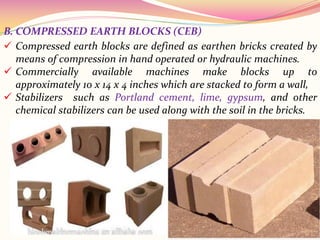
B. COMPRESSED EARTH BLOCKS (CEB)
 Compressed earth blocks are defined as earthen bricks created by
means of compression in hand operated or hydraulic machines.
 Commercially available machines make blocks up to
approximately 10 x 14 x 4 inches which are stacked to form a wall,
 Stabilizers such as Portland cement, lime, gypsum, and other
chemical stabilizers can be used along with the soil in the bricks.
3.2.2. FERRO CEMENT
 Ferro cement is a composite material made up of cement mortar
and reinforcement in the form of layer of mesh.
 A composite material is a formed that behaves differently from
reinforced concrete.
 There is some similarity between the reinforced concrete and Ferro
cement materials; differences are there, indicating that Ferro
cement requires a separate study to establish its structural
performances.
 Ferro cement, a thin element, is used as a building construction as
well as a repair material (VARMA, 2015)
MATRIX FERRO CEMENT
 The matrix of Ferro cement is usually cement mortar,
consisting of cement, sand, water and additive.
 The matrix should have some or all of the following requirements,
depending on the use of the structure, high compressive
strength, impermeability, and hardness, resistance to
chemical attack, low shrinkage, and workability.
Reinforcement for Ferro cement
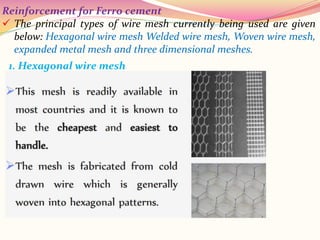
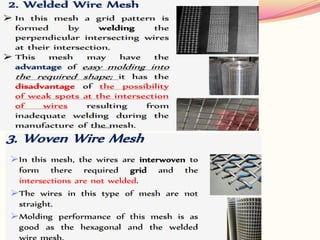
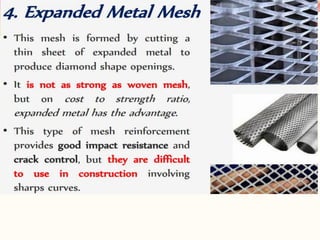
 The principal types of wire mesh currently being used are given
below: Hexagonal wire mesh Welded wire mesh, Woven wire mesh,
expanded metal mesh and three dimensional meshes.
1. Hexagonal wire mesh
PROPERTIES OF FERROCEMNT COMPOSITE
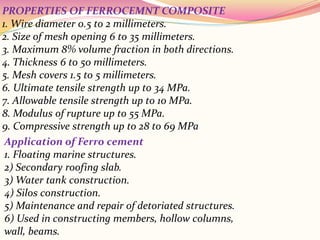
1. Wire diameter 0.5 to 2 millimeters.
2. Size of mesh opening 6 to 35 millimeters.
3. Maximum 8% volume fraction in both directions.
4. Thickness 6 to 50 millimeters.
5. Mesh covers 1.5 to 5 millimeters.
6. Ultimate tensile strength up to 34 MPa.
7. Allowable tensile strength up to 10 MPa.
8. Modulus of rupture up to 55 MPa.
9. Compressive strength up to 28 to 69 MPa
Application of Ferro cement
1. Floating marine structures.
2) Secondary roofing slab.
3) Water tank construction.
4) Silos construction.
5) Maintenance and repair of detoriated structures.
6) Used in constructing members, hollow columns,
wall, beams.
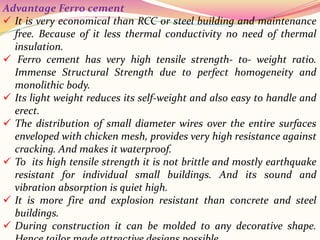
Advantage Ferro cement
 It is very economical than RCC or steel building and maintenance
free. Because of it less thermal conductivity no need of thermal
insulation.
 Ferro cement has very high tensile strength- to- weight ratio.
Immense Structural Strength due to perfect homogeneity and
monolithic body.
 Its light weight reduces its self-weight and also easy to handle and
erect.
 The distribution of small diameter wires over the entire surfaces
enveloped with chicken mesh, provides very high resistance against
cracking. And makes it waterproof.
 To its high tensile strength it is not brittle and mostly earthquake
resistant for individual small buildings. And its sound and
vibration absorption is quiet high.
 It is more fire and explosion resistant than concrete and steel
buildings.
 During construction it can be molded to any decorative shape.
Disadvantage Ferro cemnt
 It is labor intensive in nature.
 The quality and application of mortar are critical and excellent
skills required.
 The rusting of reinforcement is a problem if rust proof steels like
stainless steel aren’t used.
 Due to the dry mixture of concrete being applied the chances
for air voids is relatively high.
3.2.3. Cement and Concrete Substitutes
 With 1m3 produced per year per capita, concrete is the most widely
used material in the world and accounts for 5‐8% of man‐made
CO2 emissions.
 It is possible to reduce its environmental impact by substituting
cement with supplementary cementiteous materials (SCM’s) like
fly ash, slag, silica fume and natural pozzolana.
 Investigations have shown that fly ash produced as an industrial
waste from thermal power stations can safely replace up to 20
percent by weight of normal Portland cement.
3.2.4. Wood/Timber Substitutes
 Continuing dependence on conventional building materials like
burnt clay bricks, cement, steel and primary timbers from natural
forests is neither possible nor desirable without detriment to
environment
 Timber for building construction is divided into two categories:
o primary and secondary timber species
Primary timbers:
o slow-grown,
 Aesthetically appealing hardwoods
 Have considerable natural resistance to biological attack,
moisture movement and distortion.
 They are expensive and in short supply
Secondary timbers:
 Are mainly fast-grown species
 Low natural durability
3.2.5. Inter-locking Blocks
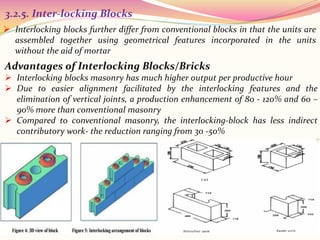
 Interlocking blocks further differ from conventional blocks in that the units are
assembled together using geometrical features incorporated in the units
without the aid of mortar
Advantages of Interlocking Blocks/Bricks
 Interlocking blocks masonry has much higher output per productive hour
 Due to easier alignment facilitated by the interlocking features and the
elimination of vertical joints, a production enhancement of 80 - 120% and 60 –
90% more than conventional masonry
 Compared to conventional masonry, the interlocking-block has less indirect
contributory work- the reduction ranging from 30 -50%
The three methods of concrete block making considered are
summarized below.
Option 1 - Automated mass production
 This is :
 A capital intensive manufacture,
 Low labor option,
 Based on modern high speed concrete block manufacturing
equipment
 Requires a reliable electricity supply, access to gas or oil supplies.
3.2.6. Concrete Block
Option 2 - Mechanically assisted manual production
 It:
 Is labor intensive multiple-unit manufacture assisted by "low
technology-low capital investment“ equipment which has been
designed to reduce the manufacturing costs.
 Requires minimum capital input.
 Does not require an electricity supply or access to gas or oil
supplies
3.2.6. Concrete Block Con …
Option 3 - Manual single concrete block mould
 This is:
 labor intensive manufacture,
 based on manually mixing bagged cement and locally quarried
sand and aggregate.
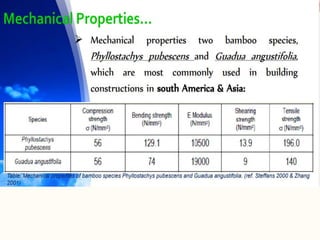
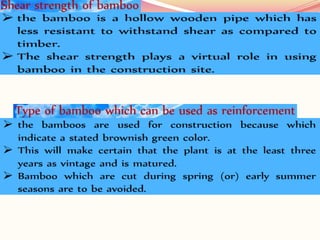
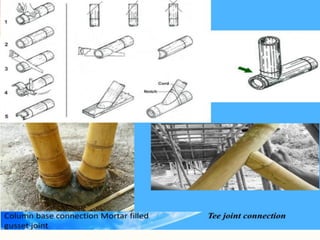
 Bamboo has been used as a building material since the beginning
of human civilization.
 Throughout the world it is estimated that more than a billion
people live in bamboo houses.
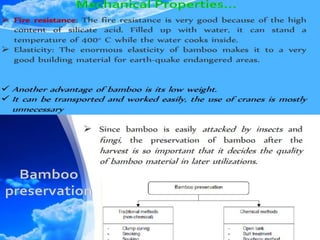
 Bamboo buildings are cheap, easy to construct and durable
provided they are treated and used properly.
 Bamboo’s circular form and hollow sections make it a light
building material, which is easy to handle, transport and store.
 In each of its nodes, the bamboo culm has a dividing wall that
maintains strength and prevents rupturing when bent.
 Bamboo is a woody perennial evergreen plant in the grass family
Poaceae, subfamily Bambuso ideae,
 There are more than ninety genera and 1200 different species of
Bamboo in the world
3.2.7. Bamboo(Vegetable Steel)
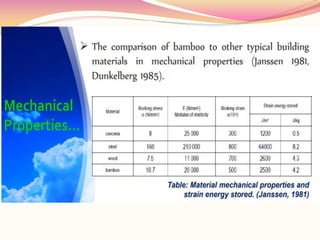
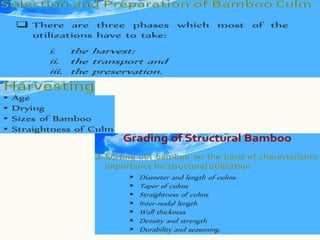
 Bamboo is one of the best structural materials available in
abundance.
 There are many advantages to using bamboo in construction:
 It is a highly functional,
 It is beautiful,
 It is earthquake-indifferent material.
 It occurs in many sizes, many degrees of hardness, and many
 grades of color
 It occupies a wide range of habitats.
 It is possible to build multiple-storey buildings with bamboo.
 Whereas trees must be replanted when they are harvested,
bamboo roots sprout up again quickly
 its high tensile strength and very good weight to strength ratio.
3.2.7. Bamboo(Vegetable Steel) Con…
 Bamboo grows in most climates in tropical and subtropical regions
where demands for cheap and affordable shelters are high.
 Africa has about 43 species of bamboo. Forty of these species are
mainly distributed in Madagascar while the remaining three
species are found in mainland Africa.
 Ethiopia has the largest bamboo resource in Africa, belonging to
twomain indigenous species namely;
i. Yushania Alpina (highland bamboo) and
ii. Oxytenanthera abyssinica (lowland bamboo)
Growth of Bamboo
 The concept of pre-cast (also known as “prefabricated”)
construction includes those buildings where the majority of
structural components are standardized and produced in plants in
a location away from the building, and then transported to the site
for assembly
3.3. Prefabrication for Cost Efficiency
 These components are manufactured by industrial methods based
on mass production in order to build a large number of buildings
in a short time at low cost
Depending on the load-bearing structure, pre-cast systems divided
into
 Large-panel systems
 Frame systems
 Slab-column systems with walls
 Mixed systems
3.3. Prefabrication for Cost Efficiency con . . .
COST EFFECIENT CHAP 4 ppt.pdf

COST EFFECIENT CHAP 4 ppt.pdf

  • 1.
    C o stEfficient Construction (CoTM5282 ) C H A P T E R FO U R CO N S T RU C T I O N M AT E R I A L S FO R CO S T E F F I C I E N T CO N S T RU C T I O N
  • 2.
    1.1. INTRODUCTION Building materialsaccounts for nearly 60 to 65% of the cost of house construction. With the constant rise in the cost of traditional building materials and with the poor affordability of large segments of our population: the cost of an adequate house is increasingly going beyond the affordable limits of more than 30-35% of our population lying in the lower income segments CHAPTER FOUR CONSTRUCTION MATERIALS FOR COST EFFICIENT CONSTRUCTION

  • 3.
    Selection of costefficient construction material  Manufacturing of CECM  Environmental friendly  Improved technologies for production  Reduction in waste generation  Use of recycled waste as a construction material  Waste produced can be used for the material in a cheaper cost  Use of natural low cost material  Natural materials are sustainable and environment friendly  Materials like stone wood, bamboo, sand… require less embodied energy  Use of natural low cost material  Natural materials are sustainable and environment friendly  Materials like stone wood, bamboo, sand… require less embodied energy  Use of local construction materials  Reduced transportation dependence  Suitable for local environment
  • 4.
     Low costbuilding materials do not mean sub-standard materials, but the materials:  Available/developed locally,  Cutting the transportation charges and  Manufactured applying civil engineering know-how for better service and economy. Con…
  • 5.
    1. Traditional material 2.Conventional material The various building materials available can be divided into two types and they are; 1. Traditional material  These materials serve the basic needs of the majority of the population.  These have very useful properties; however, there is a scope to modify these through appropriate changes in the process of production as well as in the techniques of application, so that these are made structurally and functionally acceptable
  • 6.
     The conventionalmaterials are those, which have been obtained by using the modern technologies and can be mentioned as fruit of research and adopted to Indigenous requirements 2. Conventional material
  • 7.
    3.2.1. Earth asA Building Material  Earth construction techniques have been known for over 9000 years.  Today, one third of the human population resides in earthen houses; in developing countries this figure is more than one half.  It has proven impossible to fulfil the immense requirements for shelter in the developing countries with industrial building materials, i.e. brick, concrete and steel, nor with industrialized construction techniques, requirements for shelter can be met only by using local building materials and relying on do-it-yourself construction techniques.  17 % of the “world cultural heritage” is built with earth Statistics From UNESCO. 3.2. Alternative Construction Materials
  • 8.
    Earth as ABuilding Material Con…
  • 9.
    A. Mud:  Duringpost earthquake reconstruction, mud houses are most effective since they are environmental friendly, cool in summer and warm in winter.  Mud is only a material available everywhere in abundance free of and is being used as building material from centuries.  But such types of houses are temporary in nature, prone to erosion by heavy rains  The strength of mud is improved by adding cement, lime, bitumen or fibers and it also becomes resistant to water, its main enemy
  • 10.
    B. COMPRESSED EARTHBLOCKS (CEB)  Compressed earth blocks are defined as earthen bricks created by means of compression in hand operated or hydraulic machines.  Commercially available machines make blocks up to approximately 10 x 14 x 4 inches which are stacked to form a wall,  Stabilizers such as Portland cement, lime, gypsum, and other chemical stabilizers can be used along with the soil in the bricks.
  • 13.
    3.2.2. FERRO CEMENT Ferro cement is a composite material made up of cement mortar and reinforcement in the form of layer of mesh.  A composite material is a formed that behaves differently from reinforced concrete.  There is some similarity between the reinforced concrete and Ferro cement materials; differences are there, indicating that Ferro cement requires a separate study to establish its structural performances.  Ferro cement, a thin element, is used as a building construction as well as a repair material (VARMA, 2015)
  • 14.
    MATRIX FERRO CEMENT The matrix of Ferro cement is usually cement mortar, consisting of cement, sand, water and additive.  The matrix should have some or all of the following requirements, depending on the use of the structure, high compressive strength, impermeability, and hardness, resistance to chemical attack, low shrinkage, and workability.
  • 15.
    Reinforcement for Ferrocement  The principal types of wire mesh currently being used are given below: Hexagonal wire mesh Welded wire mesh, Woven wire mesh, expanded metal mesh and three dimensional meshes. 1. Hexagonal wire mesh
  • 18.
    PROPERTIES OF FERROCEMNTCOMPOSITE 1. Wire diameter 0.5 to 2 millimeters. 2. Size of mesh opening 6 to 35 millimeters. 3. Maximum 8% volume fraction in both directions. 4. Thickness 6 to 50 millimeters. 5. Mesh covers 1.5 to 5 millimeters. 6. Ultimate tensile strength up to 34 MPa. 7. Allowable tensile strength up to 10 MPa. 8. Modulus of rupture up to 55 MPa. 9. Compressive strength up to 28 to 69 MPa Application of Ferro cement 1. Floating marine structures. 2) Secondary roofing slab. 3) Water tank construction. 4) Silos construction. 5) Maintenance and repair of detoriated structures. 6) Used in constructing members, hollow columns, wall, beams.
  • 19.
    Advantage Ferro cement It is very economical than RCC or steel building and maintenance free. Because of it less thermal conductivity no need of thermal insulation.  Ferro cement has very high tensile strength- to- weight ratio. Immense Structural Strength due to perfect homogeneity and monolithic body.  Its light weight reduces its self-weight and also easy to handle and erect.  The distribution of small diameter wires over the entire surfaces enveloped with chicken mesh, provides very high resistance against cracking. And makes it waterproof.  To its high tensile strength it is not brittle and mostly earthquake resistant for individual small buildings. And its sound and vibration absorption is quiet high.  It is more fire and explosion resistant than concrete and steel buildings.  During construction it can be molded to any decorative shape.
  • 20.
    Disadvantage Ferro cemnt It is labor intensive in nature.  The quality and application of mortar are critical and excellent skills required.  The rusting of reinforcement is a problem if rust proof steels like stainless steel aren’t used.  Due to the dry mixture of concrete being applied the chances for air voids is relatively high.
  • 21.
    3.2.3. Cement andConcrete Substitutes  With 1m3 produced per year per capita, concrete is the most widely used material in the world and accounts for 5‐8% of man‐made CO2 emissions.  It is possible to reduce its environmental impact by substituting cement with supplementary cementiteous materials (SCM’s) like fly ash, slag, silica fume and natural pozzolana.  Investigations have shown that fly ash produced as an industrial waste from thermal power stations can safely replace up to 20 percent by weight of normal Portland cement.
  • 22.
    3.2.4. Wood/Timber Substitutes Continuing dependence on conventional building materials like burnt clay bricks, cement, steel and primary timbers from natural forests is neither possible nor desirable without detriment to environment  Timber for building construction is divided into two categories: o primary and secondary timber species Primary timbers: o slow-grown,  Aesthetically appealing hardwoods  Have considerable natural resistance to biological attack, moisture movement and distortion.  They are expensive and in short supply Secondary timbers:  Are mainly fast-grown species  Low natural durability
  • 23.
    3.2.5. Inter-locking Blocks Interlocking blocks further differ from conventional blocks in that the units are assembled together using geometrical features incorporated in the units without the aid of mortar Advantages of Interlocking Blocks/Bricks  Interlocking blocks masonry has much higher output per productive hour  Due to easier alignment facilitated by the interlocking features and the elimination of vertical joints, a production enhancement of 80 - 120% and 60 – 90% more than conventional masonry  Compared to conventional masonry, the interlocking-block has less indirect contributory work- the reduction ranging from 30 -50%
  • 24.
    The three methodsof concrete block making considered are summarized below. Option 1 - Automated mass production  This is :  A capital intensive manufacture,  Low labor option,  Based on modern high speed concrete block manufacturing equipment  Requires a reliable electricity supply, access to gas or oil supplies. 3.2.6. Concrete Block
  • 25.
    Option 2 -Mechanically assisted manual production  It:  Is labor intensive multiple-unit manufacture assisted by "low technology-low capital investment“ equipment which has been designed to reduce the manufacturing costs.  Requires minimum capital input.  Does not require an electricity supply or access to gas or oil supplies 3.2.6. Concrete Block Con … Option 3 - Manual single concrete block mould  This is:  labor intensive manufacture,  based on manually mixing bagged cement and locally quarried sand and aggregate.
  • 26.
     Bamboo hasbeen used as a building material since the beginning of human civilization.  Throughout the world it is estimated that more than a billion people live in bamboo houses.  Bamboo buildings are cheap, easy to construct and durable provided they are treated and used properly.  Bamboo’s circular form and hollow sections make it a light building material, which is easy to handle, transport and store.  In each of its nodes, the bamboo culm has a dividing wall that maintains strength and prevents rupturing when bent.  Bamboo is a woody perennial evergreen plant in the grass family Poaceae, subfamily Bambuso ideae,  There are more than ninety genera and 1200 different species of Bamboo in the world 3.2.7. Bamboo(Vegetable Steel)
  • 27.
     Bamboo isone of the best structural materials available in abundance.  There are many advantages to using bamboo in construction:  It is a highly functional,  It is beautiful,  It is earthquake-indifferent material.  It occurs in many sizes, many degrees of hardness, and many  grades of color  It occupies a wide range of habitats.  It is possible to build multiple-storey buildings with bamboo.  Whereas trees must be replanted when they are harvested, bamboo roots sprout up again quickly  its high tensile strength and very good weight to strength ratio. 3.2.7. Bamboo(Vegetable Steel) Con…
  • 28.
     Bamboo growsin most climates in tropical and subtropical regions where demands for cheap and affordable shelters are high.  Africa has about 43 species of bamboo. Forty of these species are mainly distributed in Madagascar while the remaining three species are found in mainland Africa.  Ethiopia has the largest bamboo resource in Africa, belonging to twomain indigenous species namely; i. Yushania Alpina (highland bamboo) and ii. Oxytenanthera abyssinica (lowland bamboo) Growth of Bamboo
  • 40.
     The conceptof pre-cast (also known as “prefabricated”) construction includes those buildings where the majority of structural components are standardized and produced in plants in a location away from the building, and then transported to the site for assembly 3.3. Prefabrication for Cost Efficiency  These components are manufactured by industrial methods based on mass production in order to build a large number of buildings in a short time at low cost
  • 41.
    Depending on theload-bearing structure, pre-cast systems divided into  Large-panel systems  Frame systems  Slab-column systems with walls  Mixed systems 3.3. Prefabrication for Cost Efficiency con . . .