Decision making for
selection of material for
constructing
“Green Building”
Green technology
GREEN TECHNOLOGY
Technology that has the
potential to significantly
improve environmental
performance relative to
other technology
SECTORS OF GREEN
TECHNOLOGY
 Agriculture.
 Energy.
 Buildings.
 Transportation.
 Water and waste
management.
WHAT ARE GREEN
BUILDINGS
“Green” Buildings are high
performance structures that
also meet certain standards
for reducing natural resource
consumption
 Green” or “Sustainable” buildings are
characterized by:
 efficient management of energy
and water resources
 management of material resources
and waste
 restoration and protection of
environmental quality
 enhancement and protection of
health and indoor environmental
quality
 reinforcement of natural systems
BENEFITS OF GREEN
BUILDINGS
 Environmental benefits.
 Social benefits.
 Economic benefits.
GREEN BUILDING MATERIAL
Green building materials are
composed of renewable,
rather than nonrenewable
resources. Green materials are
environmentally responsible
because impacts are
considered over the life of the
product
DECISION MAKING
STEPS
Problem Recognition
Information Gathering
Principles for Judging Alternatives
Brainstorm and Analyze different choices
Evaluation of Alternatives
Select the best option
Execute the decision
Evaluate the results
PROBLEM RECOGNITION
PROBLEM RECOGNITION
Problem recognition is the most
important step in order to make
the best decision of construction
material for green buildings.
PROBLEM RECOGNITION
 The major problem is the choice
of the construction material
that creates less pollution, less
disruption of ecosystem, less
consumption of energy.
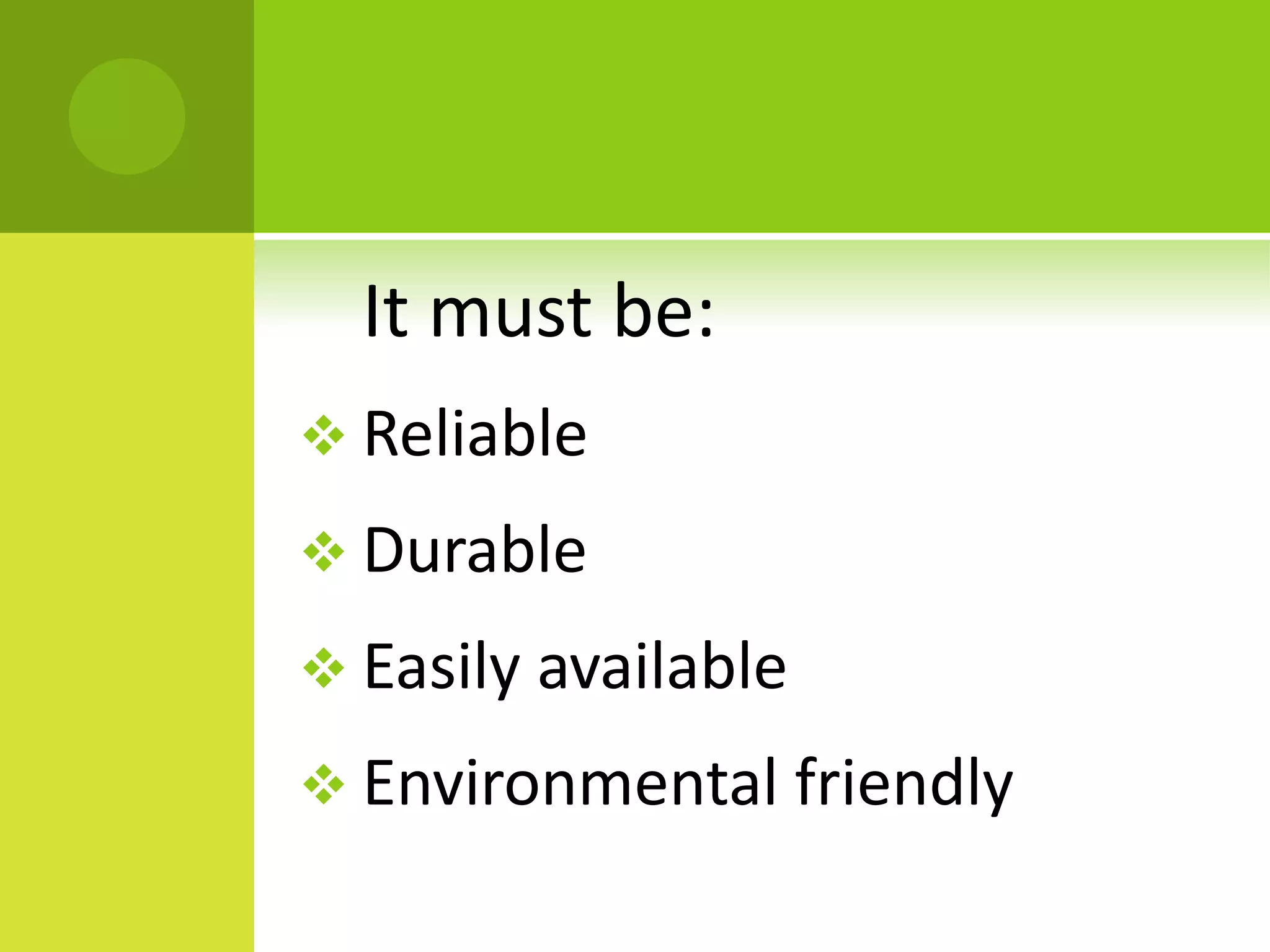
It must be:
 Reliable
 Durable
 Easily available
 Environmental friendly
The decision of the selection of
such material often involves:
 Multiple criteria.
 Multiple stakeholders.
 Quantifying multiple criteria in
monetary terms.
 Attractive alternative with
significant quantitative analysis
INFORMATION GATHERING
 Selection of suitable green building
material options can be influenced and
determined by numerous preconditions,
factors and considerations.
 For such purpose adequate information
related to the essential factors or
variables effecting the decisions in the
choice of materials is collected and
gathered.
In this stage, wide range of research and
information is reviewed to:
 Examine impacts of current procedures used
for selecting locally-sourced or recycled
building materials on overall performance of
buildings.
 Identify gaps and problems with previous
research in the area of material-selection tools
or systems developed for green buildings.
 Learn from strengths and weaknesses of the
expert systems, especially developed to
manage the material-selection process.
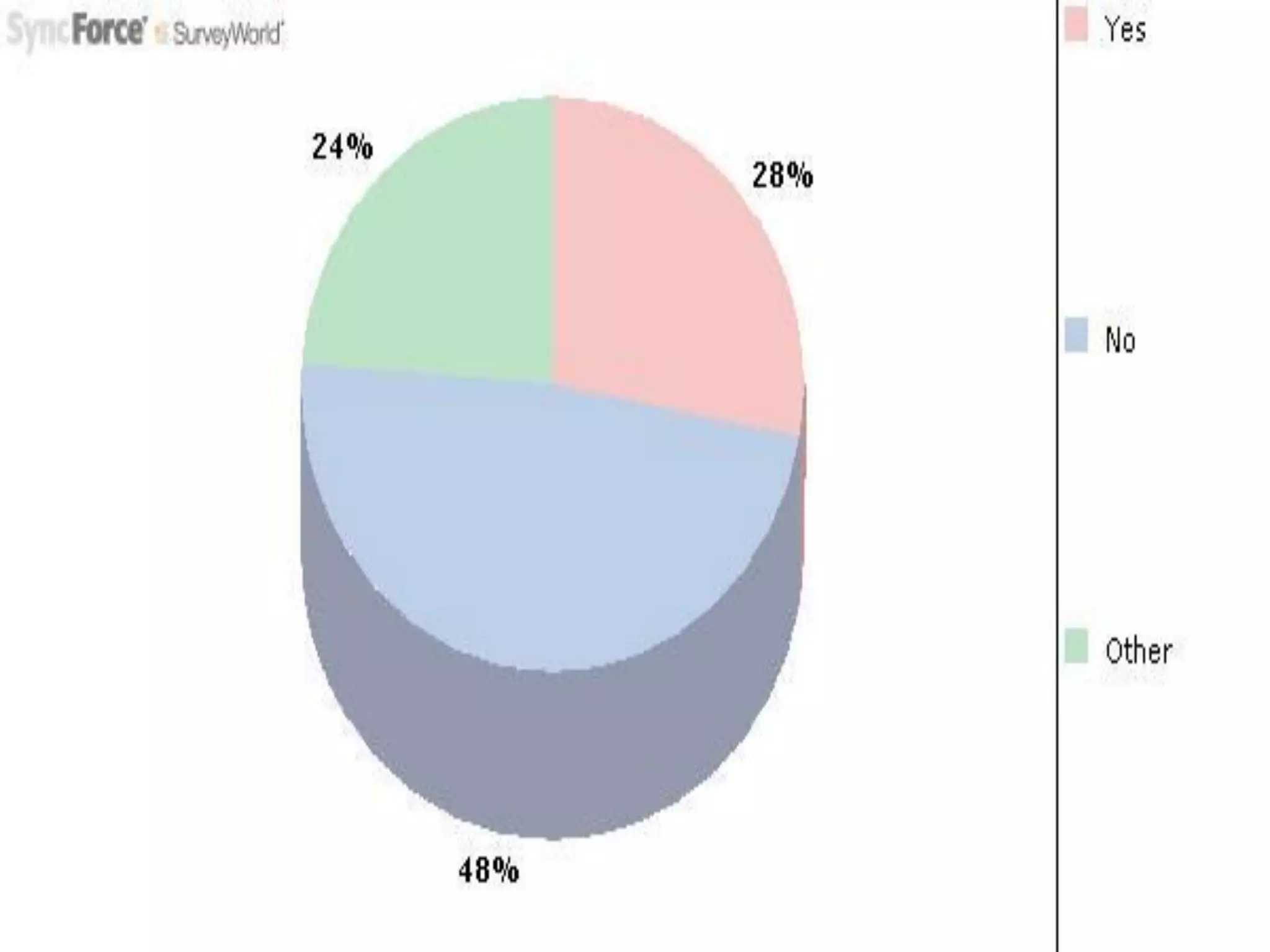
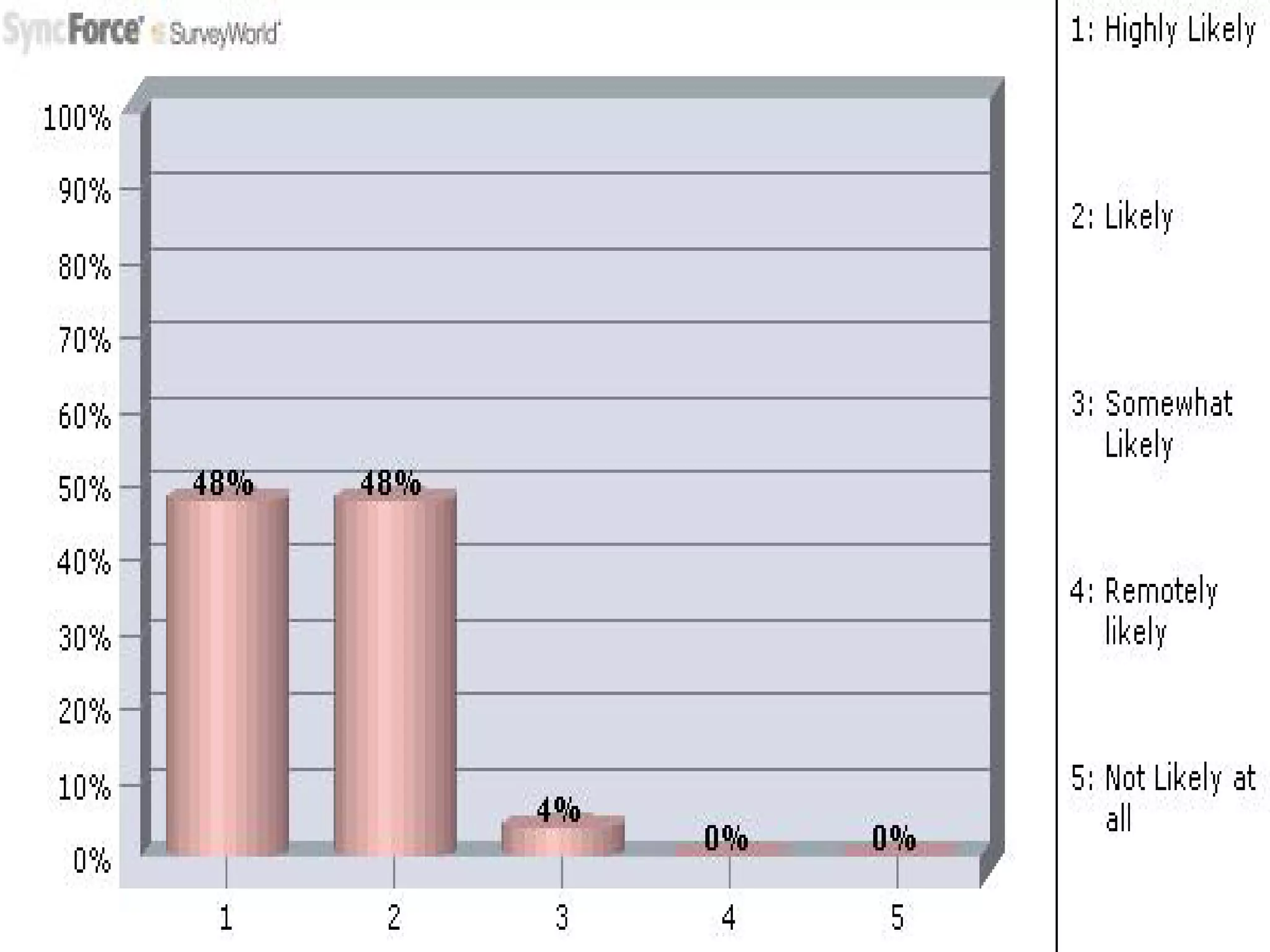
GRAPH SHOWING EXTENT OF
PARTICIPANTS’ AWARENESS OF EXISTING
SYSTEMS FOR GREEN BUILDING MATERIAL
INFORMATION GATHERING
For assessing building material
sustainability the information regarding
the following framework of factors is
collected:
 Information regarding the general site
factors is collected.
 The concerned Environmental and
health factors are determined.
 The sensorial factors are taken into
consideration.
 The related socio cultural factors
are analyzed.
 The cost and economic value of
the material is evaluated.
 The technical factors are also
considered in the selection of
material.
VARIANCE OF INTEREST IN THE
USE LOCAL AND RECYCLED
BUILDING MATERIAL OPTIONS
PRINCIPLES FOR JUDGING
THE ALTERNATIVES
PRINCIPLES FOR JUDGING
THE ALTERNATIVES
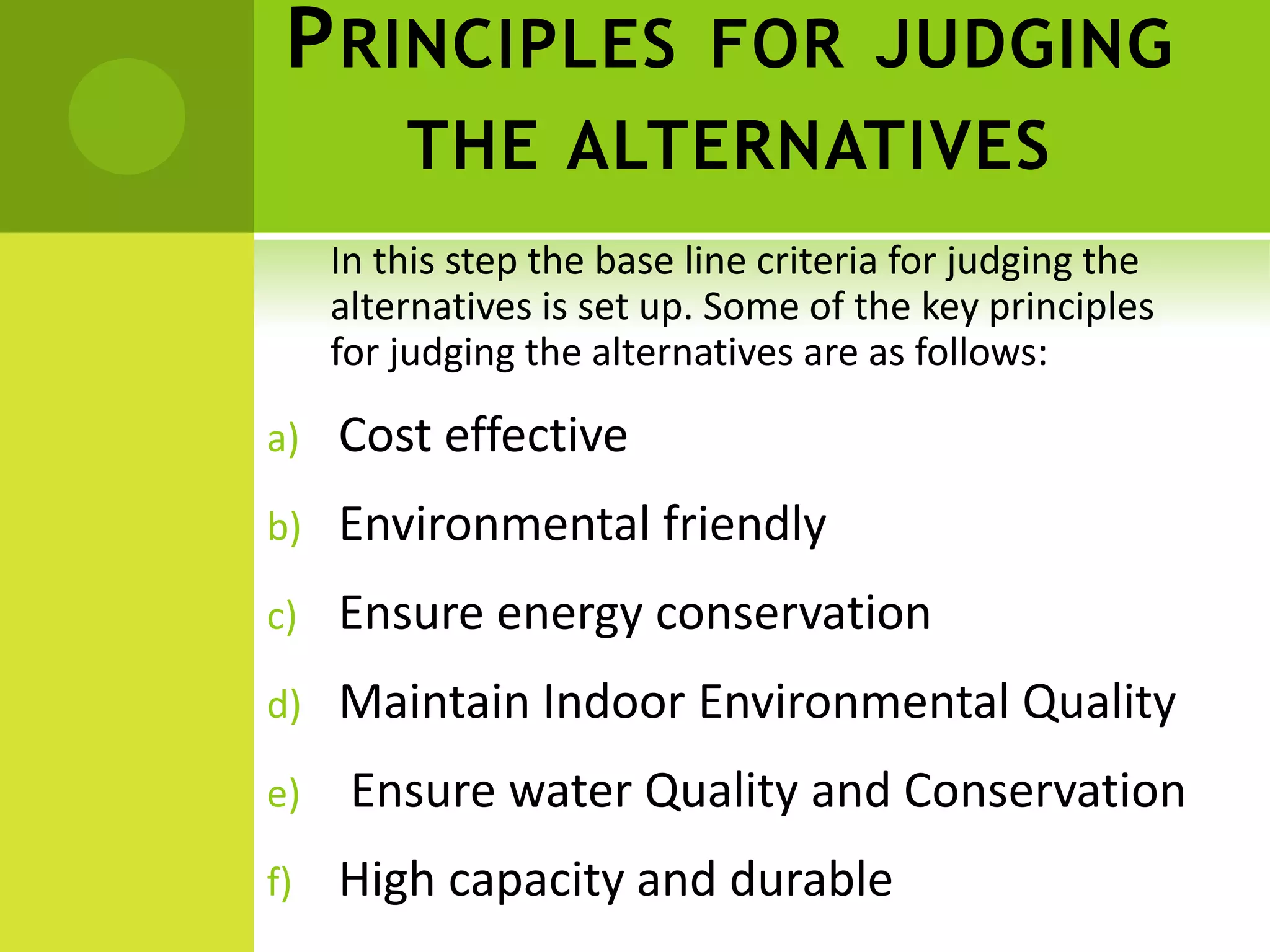
In this step the base line criteria for judging the
alternatives is set up. Some of the key principles
for judging the alternatives are as follows:
a) Cost effective
b) Environmental friendly
c) Ensure energy conservation
d) Maintain Indoor Environmental Quality
e) Ensure water Quality and Conservation
f) High capacity and durable
BRAINSTORMING
BRAINSTORMING
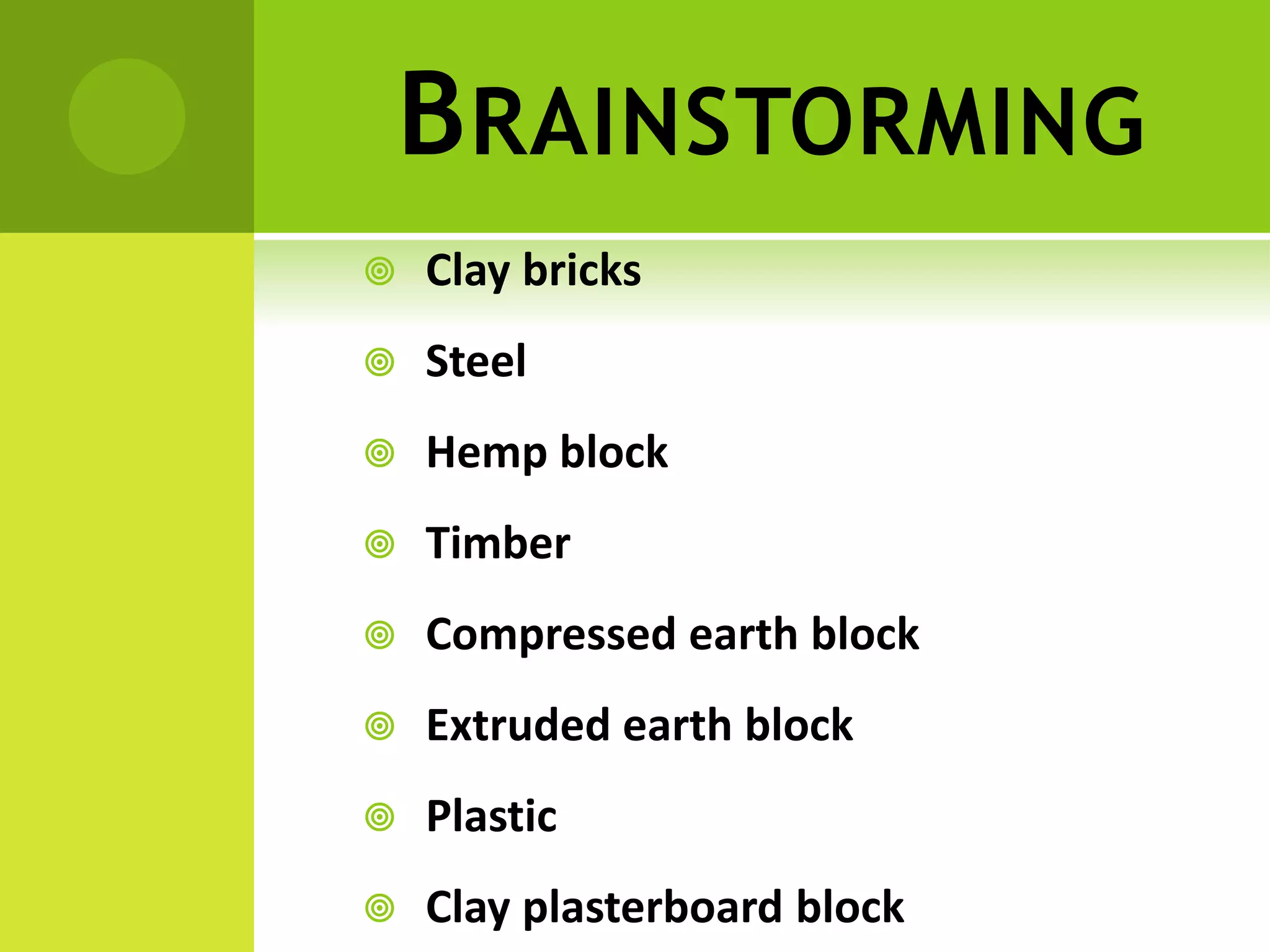
 Clay bricks
 Steel
 Hemp block
 Timber
 Compressed earth block
 Extruded earth block
 Plastic
 Clay plasterboard block
EVALUATION OF ALTERNATIVES
EVALUATION OF
ALTERNATIVES
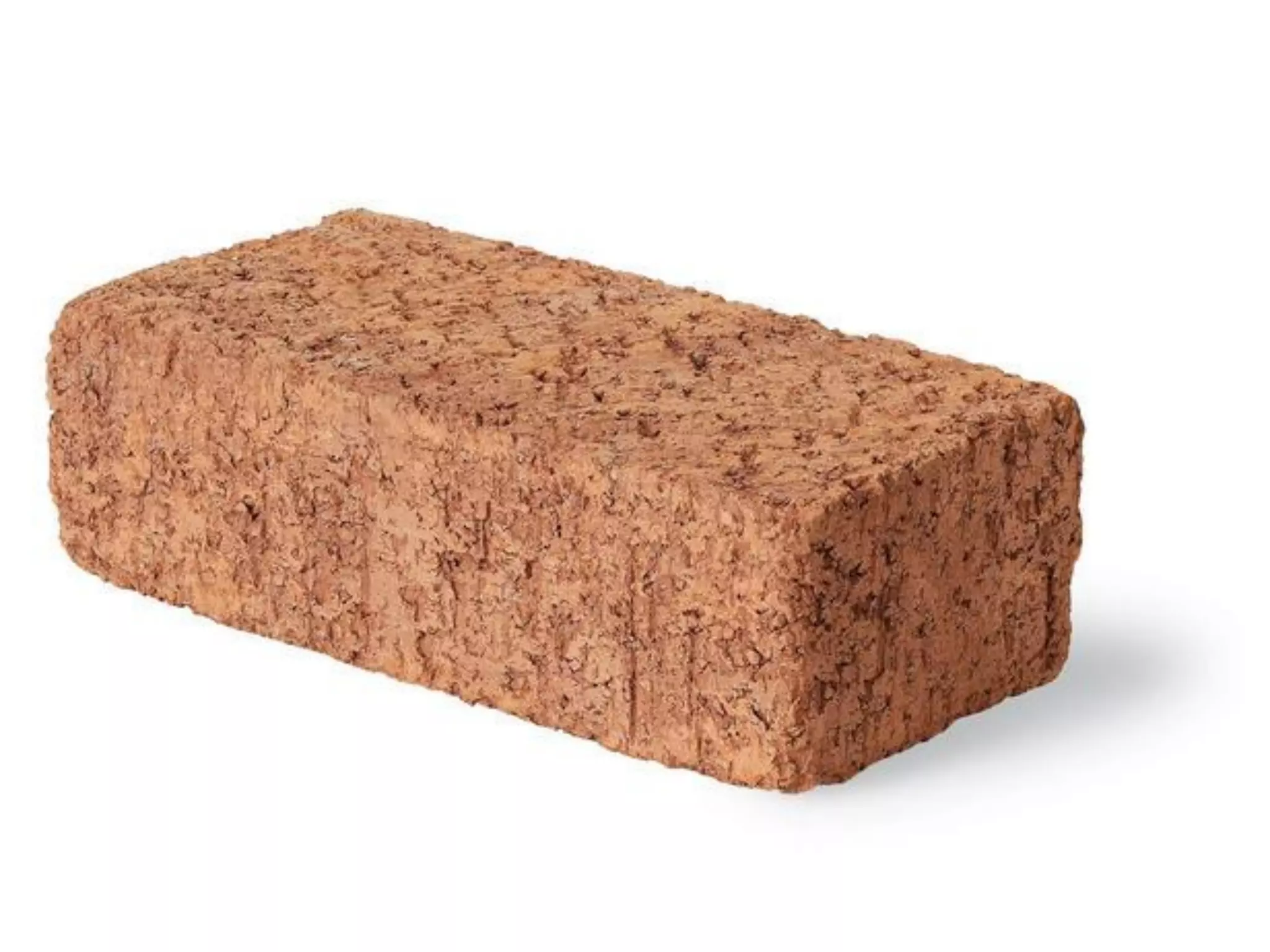
Clay bricks
 This is an unfired clay brick,
commonly used in cobwork.
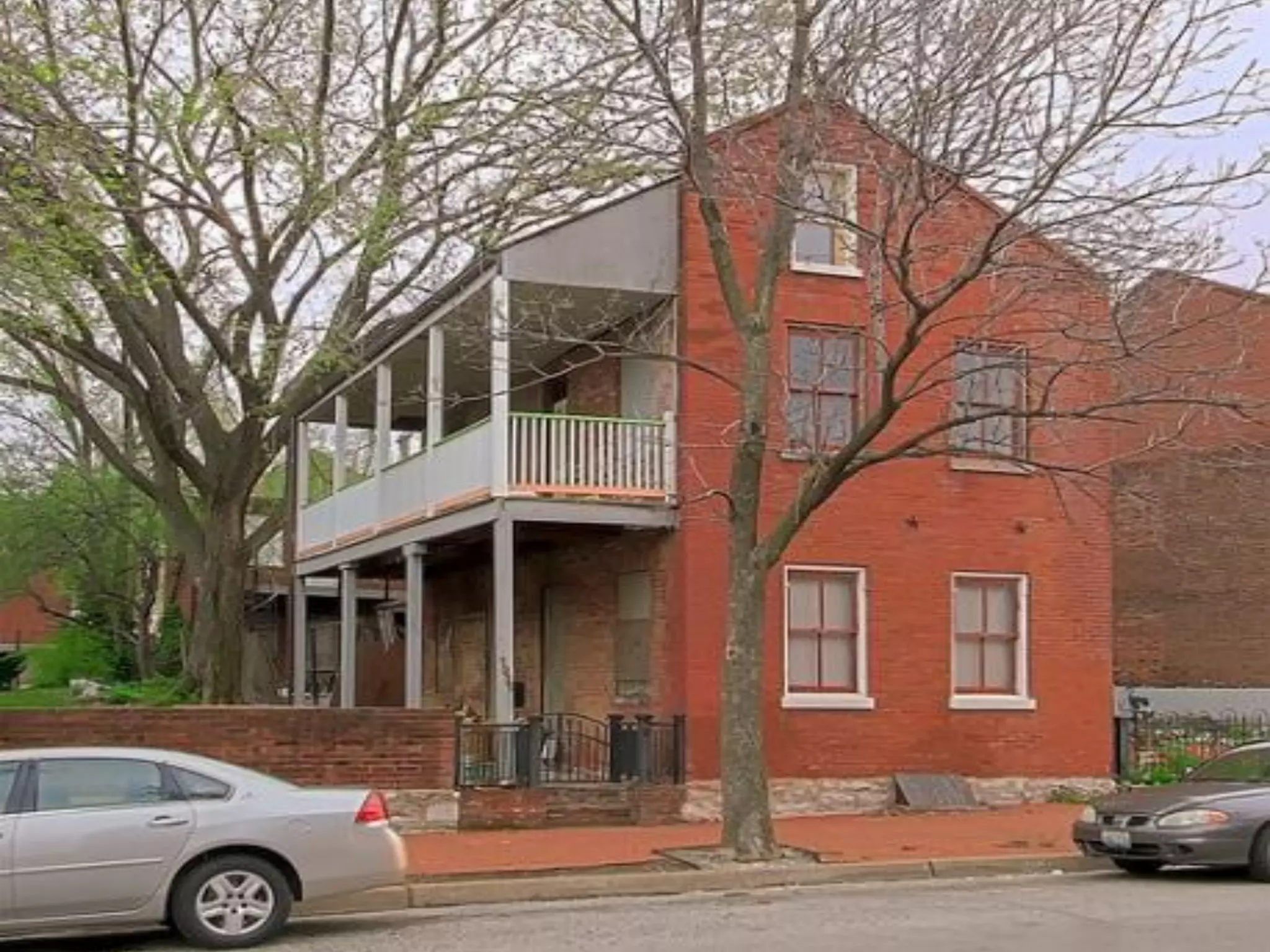
 They can be used for non-
loadbearing walls or infills in
lumber-frame constructions.
PROS
Clay bricks
Fireproof
Resistant to seismic activity
Inexpensive.
CONS
 Extreme weather may cause
degradation of the surface due to frost
damage
 Services of a qualified structural
engineer may be required.
 Brick adds a lot of weight to the
foundation.
 Lower tensile strength
STEEL
Steel
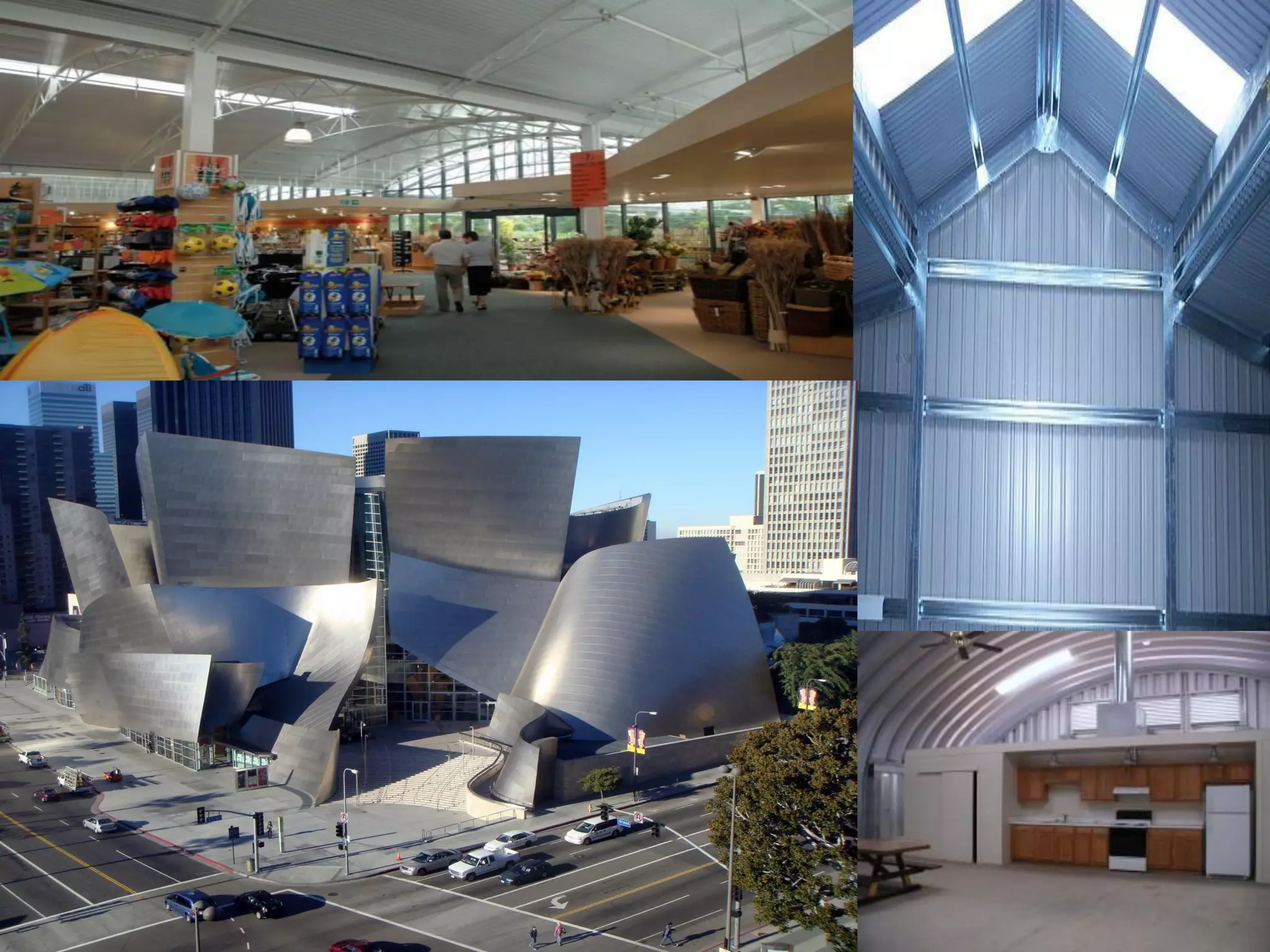
 A steel building is a metal structure
fabricated with steel for the internal
support and for exterior cladding.
 Steel buildings are used for a variety
of purposes including storage, work
spaces and living accommodation.
PROS
 Steel is a "green" product as
it is 100% recyclable
 Design flexibility
 Easy to Install
CONS
 Heat conductivity
 Steel conducts heat 310 times
more efficiently than wood.
 Subjected to corrosion
 Faulty design leads to the
corrosion of iron and steel in
buildings.
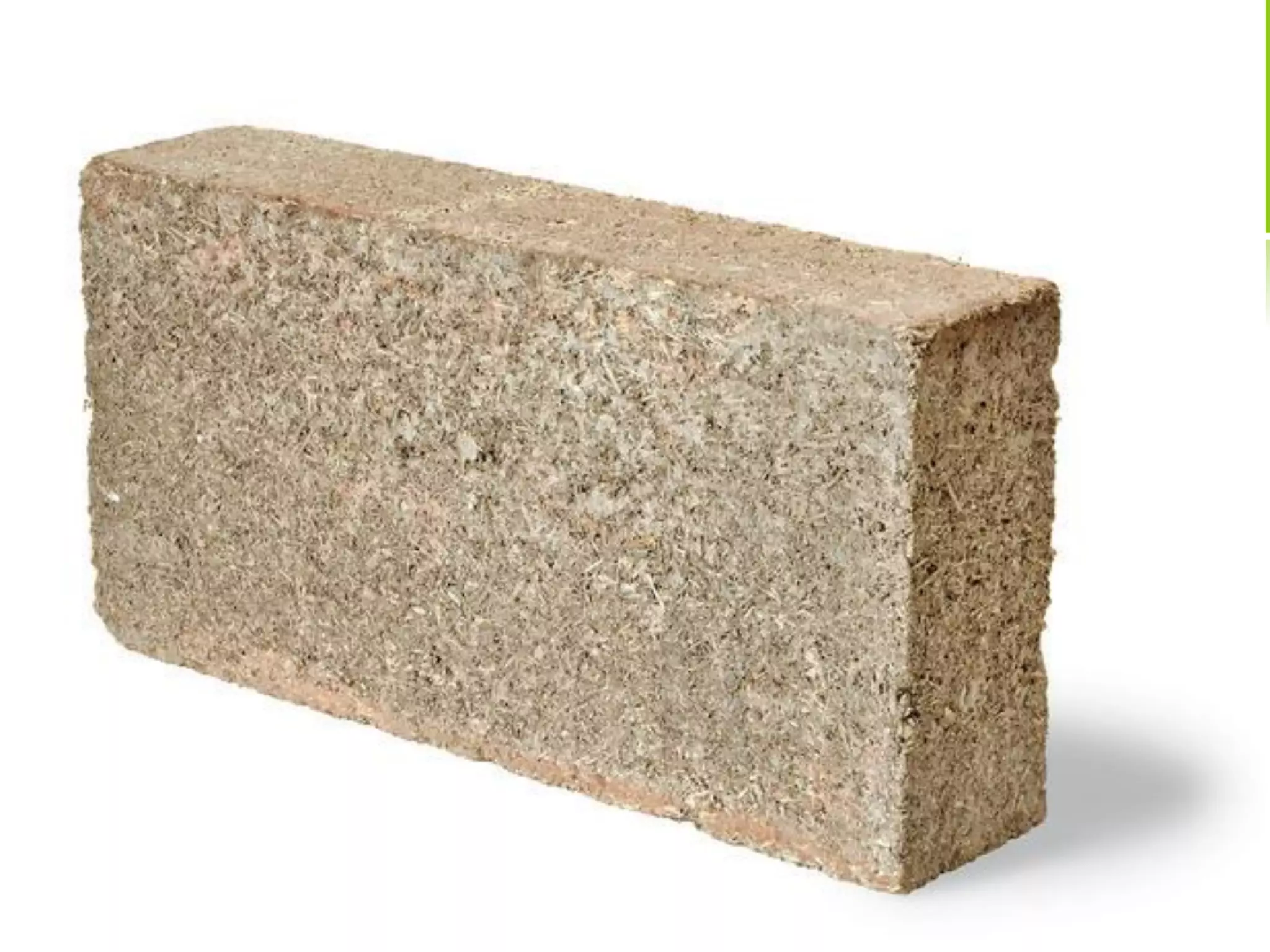
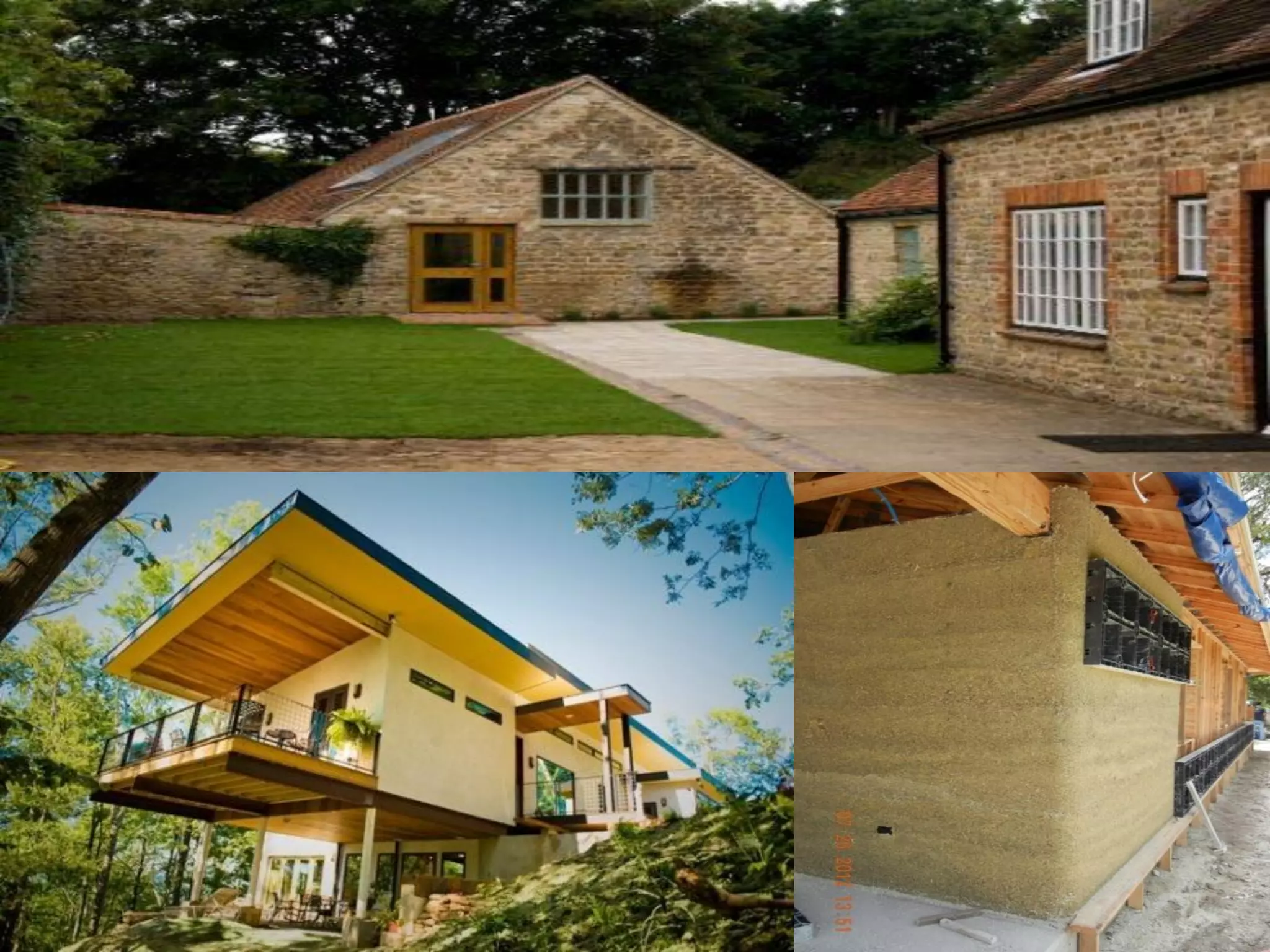
HEMP BLOCK
 Hemp block
Hempcrete is a bio-composite
base material consists of fibers
from the hemp plant mixed
with sand and lime.
PROS
 Lightweight cementitious material
 Best insulating material
 weighing about a 7th or 8th of the weight
of concrete.
 Repellent to white ants and fire ants
 Discouraging the growth of mold
 Renewable Resource
 Rapid growth of fiber without fertilizer
CONS
 It’s carbon negative because it
sequesters carbon when used as a
building material.
 it’s not loadbearing
 A frame is required to carry the loads
 Transportation Cost
 Environmental cost
 Environmental footprints
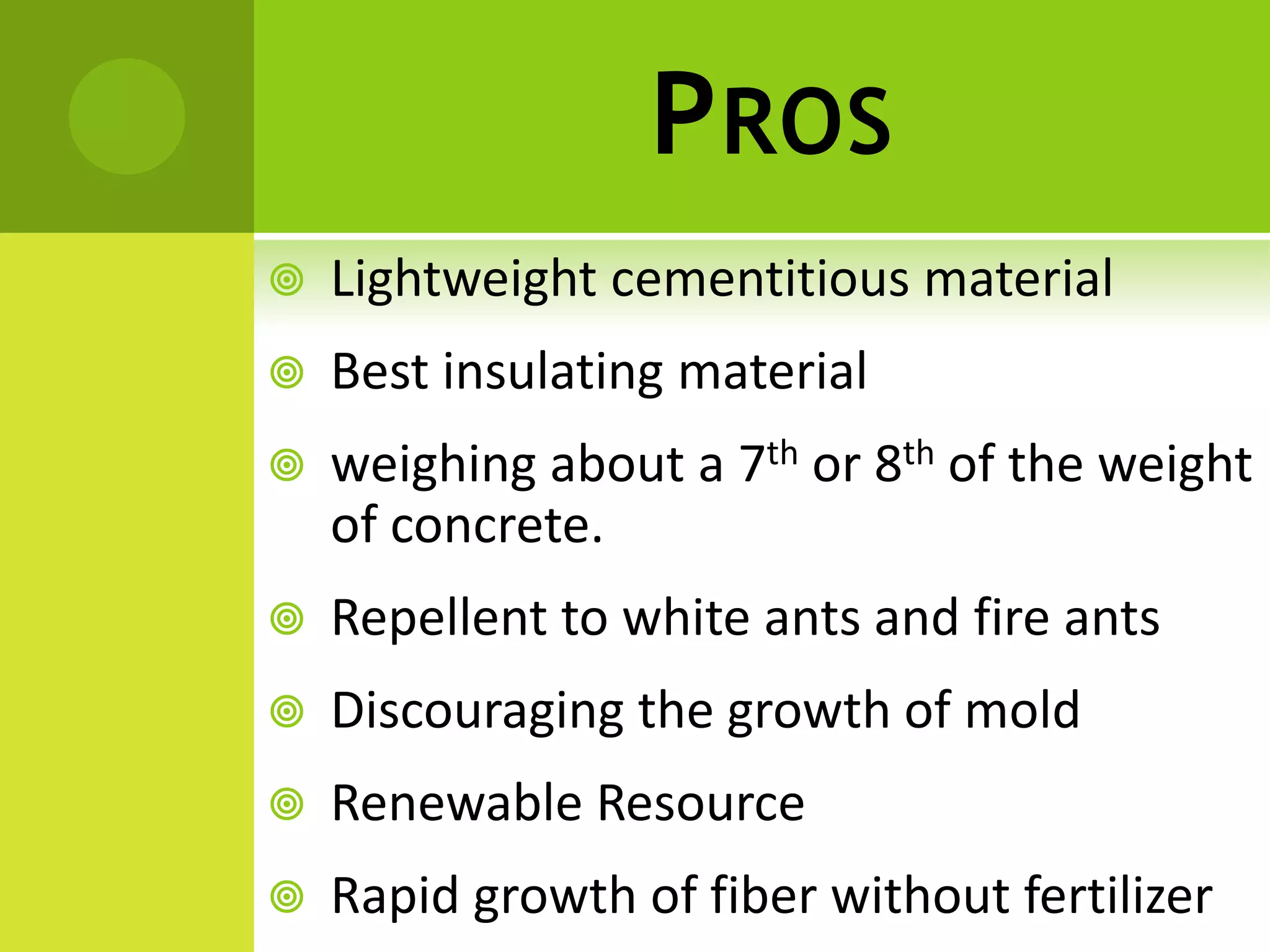
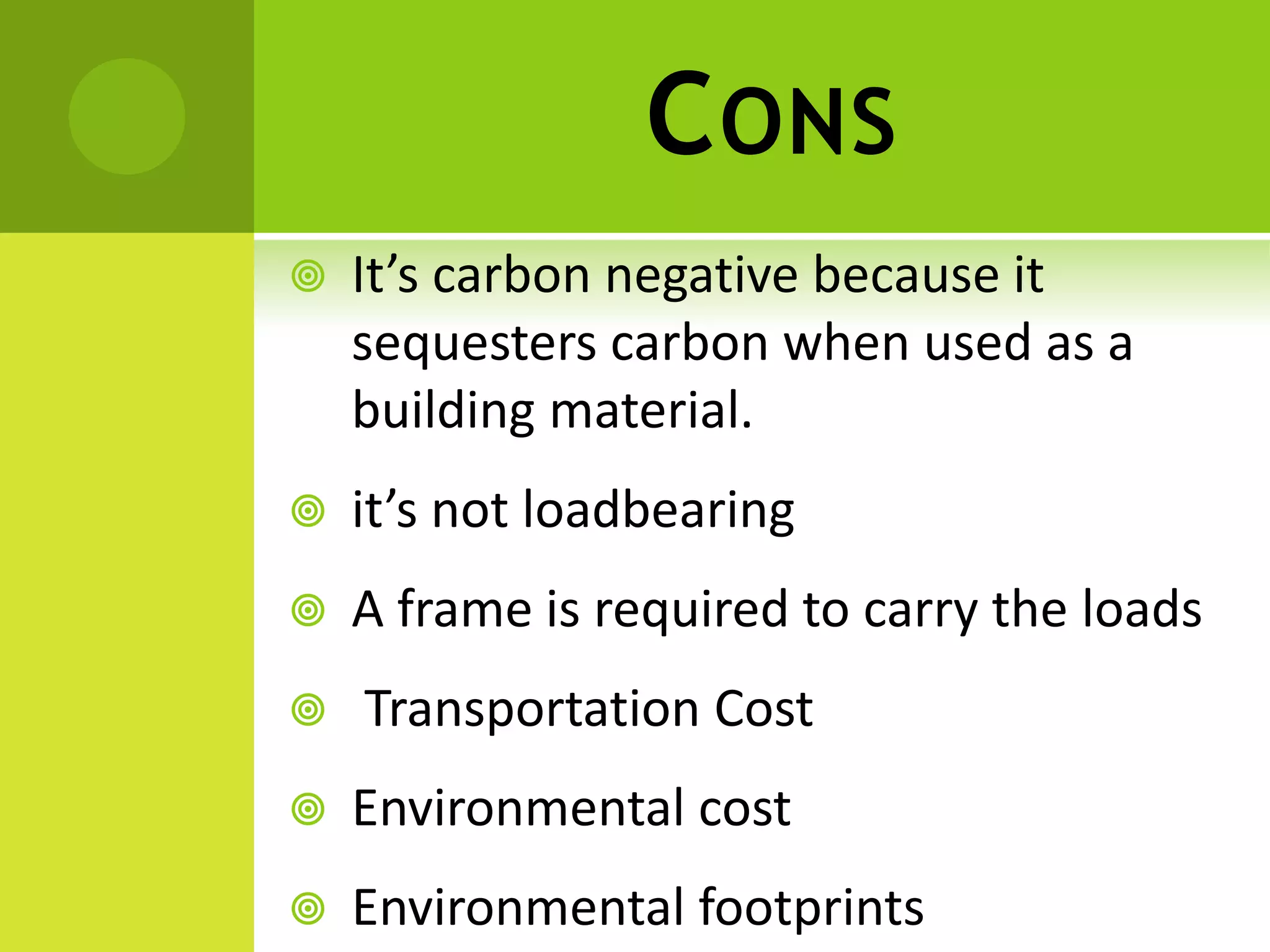
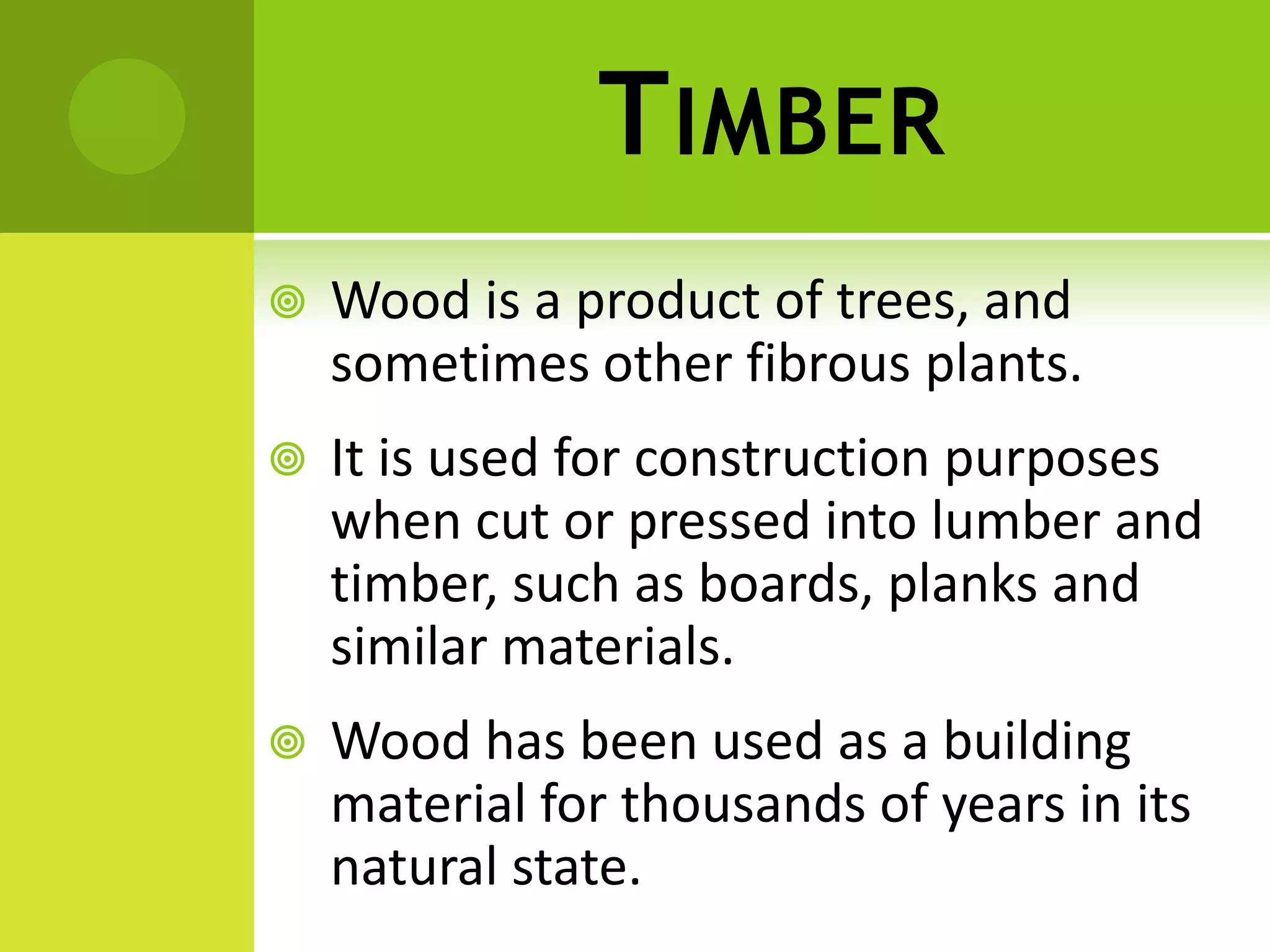
TIMBER
 Wood is a product of trees, and
sometimes other fibrous plants.
 It is used for construction purposes
when cut or pressed into lumber and
timber, such as boards, planks and
similar materials.
 Wood has been used as a building
material for thousands of years in its
natural state.
PROS
 Used to make floors, walls,
supports and roof frames
 High Strength
 Easy to work with
 Versatile
 Potentially renewable
 Biodegradable
CONS
 Some timber is non-
renewable
 Treated with toxic chemicals
 Causes deforestation
 It is not Eco-friendly
COMPRESSED EARTH
BLOCK
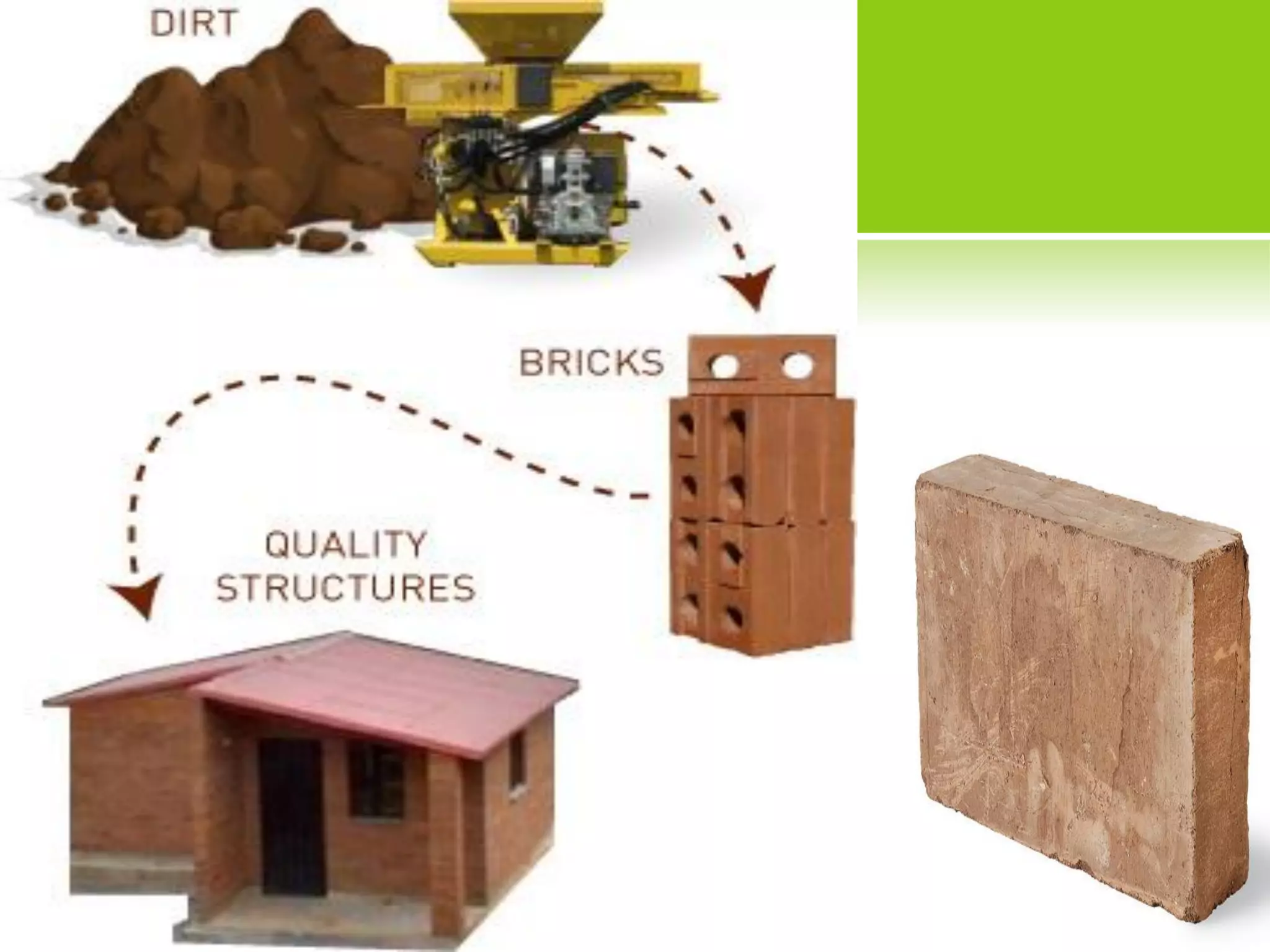
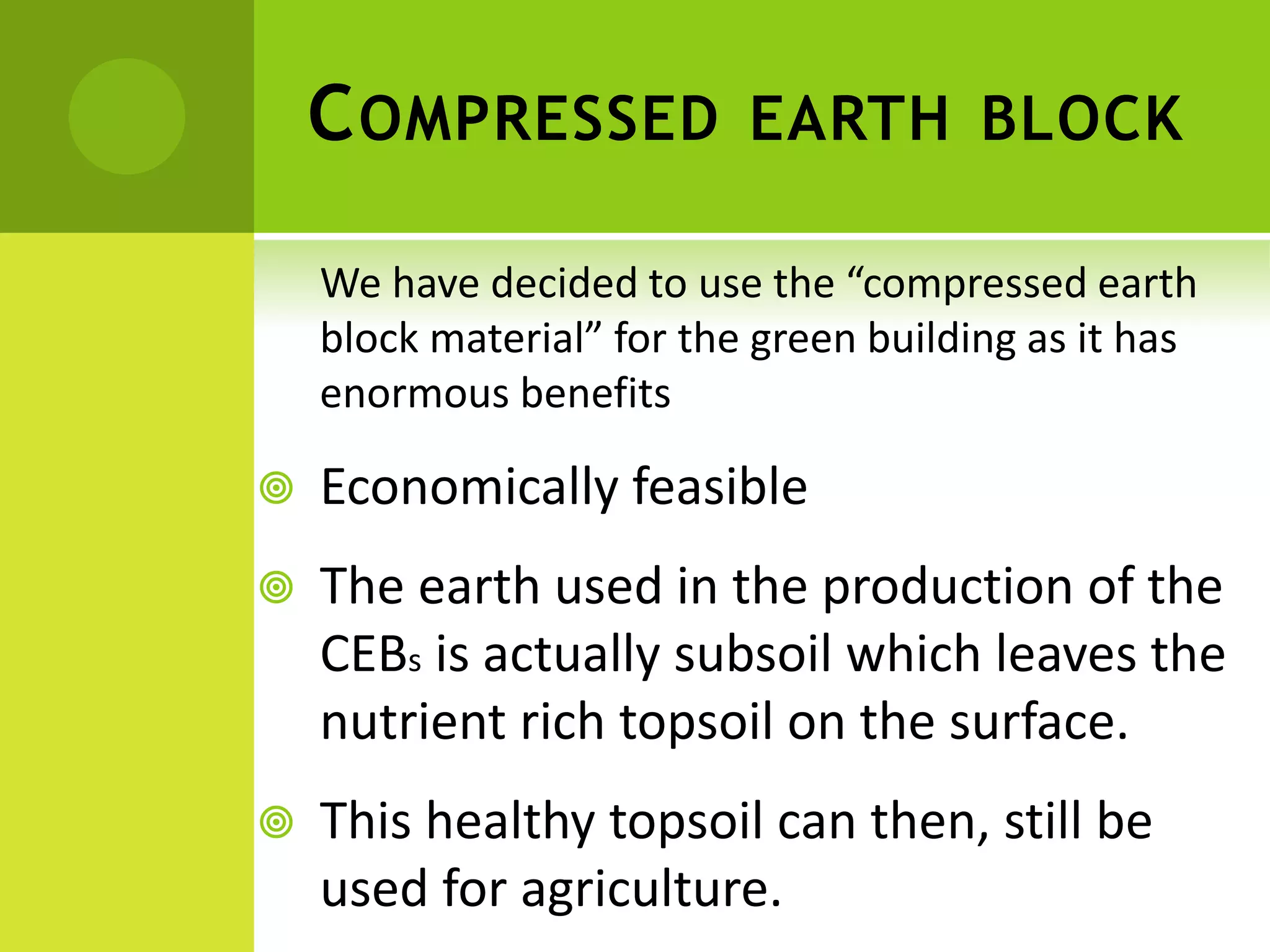
Compressed earth block
 A compressed block out of an appropriate mix
of:
a. Dry inorganic soil
b. Non-expansive clay
c. Aggregate
d. Cement
 Traditional blocks of this nature, such as
adobe blocks, were sun-dried, but modern
versions are mechanically compressed.
PROS
 Provide a source of employment
 Non-toxic protection
 Don’t off gas VOCs
 Sound resistant
 Fire resistant
 Insect resistant
 Mold resistant
 Highly affordable.
 Proven durability.
 Little waste generated.
 Material re-use.
CONS
 Slower to build with, when
compared to wood construction.
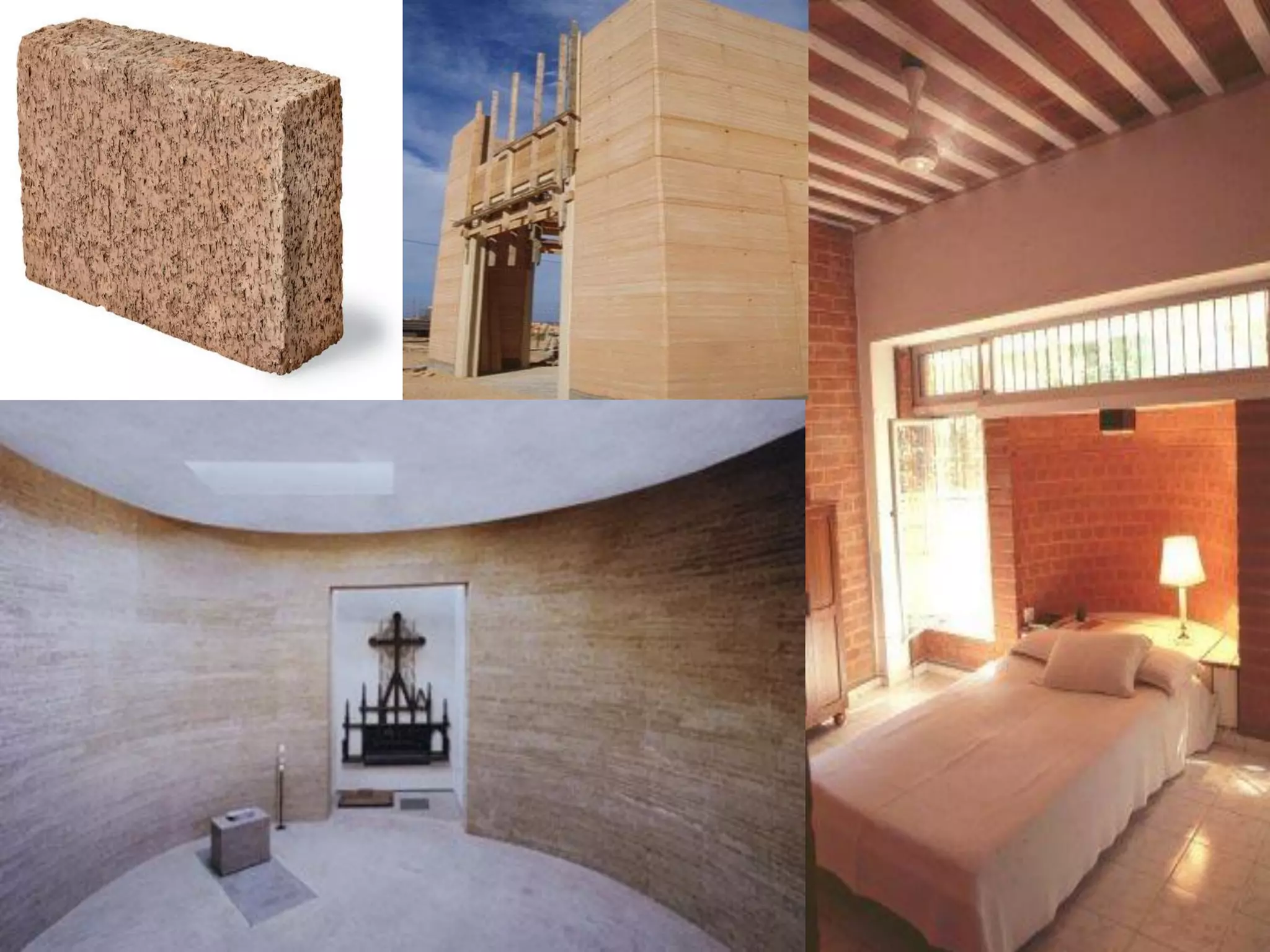
EXTRUDED EARTH BLOCK
 Extruded earth block
Theses are the unfired molded
blocks, "extruded," into a
continuous length in a machine,
and then cut into smaller
blocks.
PROS
 They can be use as an internal
partition walls
 They prove to be good acoustic
wall structure
CONS
 Unfired blocks degrade to mud
when immersed in water
 The soil required for Extruded earth
is much sandier than the one for
fired earth
 Thus the soil is more abrasive and
the machines get damaged at a
much faster rate
 They are not cost effective
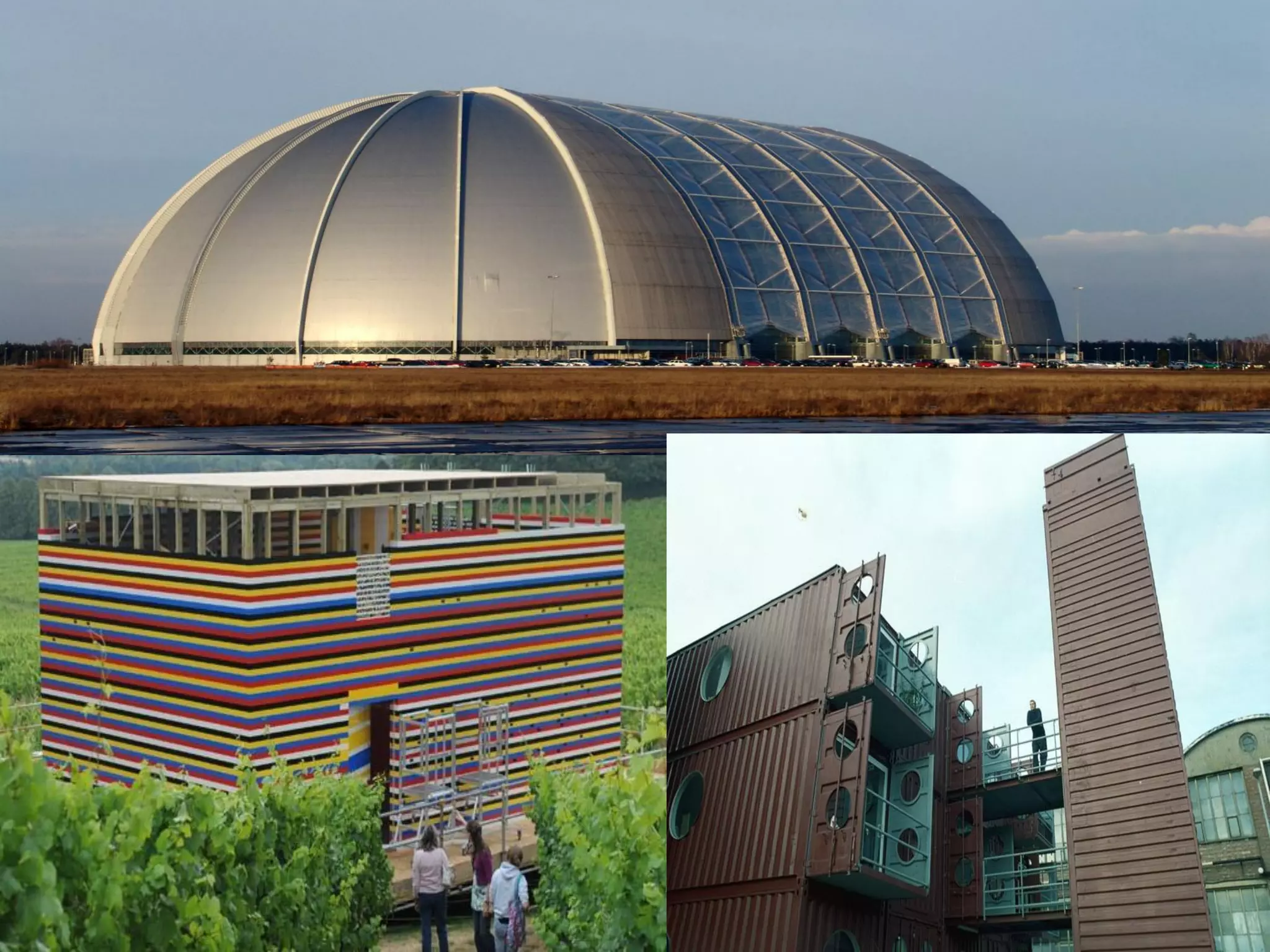
PLASTIC
 It is a product of synthetic materials
derived from petrochemicals.
 Polymers being used in
construction industry such as:
1. Polyethylene
2. Polypropylene
3. Polyvinyl Chloride
PROS
 Use to make window frames,
water pipes, floor & wall
coverings etc.
 Light weight
 Highly durable
 Resistant to damp, water and
pests
CONS
 Made from non-renewable resources
 Intensive energy required to produce it
 Highly polluting material
 Off gas VOC’S
 can not be easily degraded and
decomposed
CLAY PLASTERBOARD
BLOCK
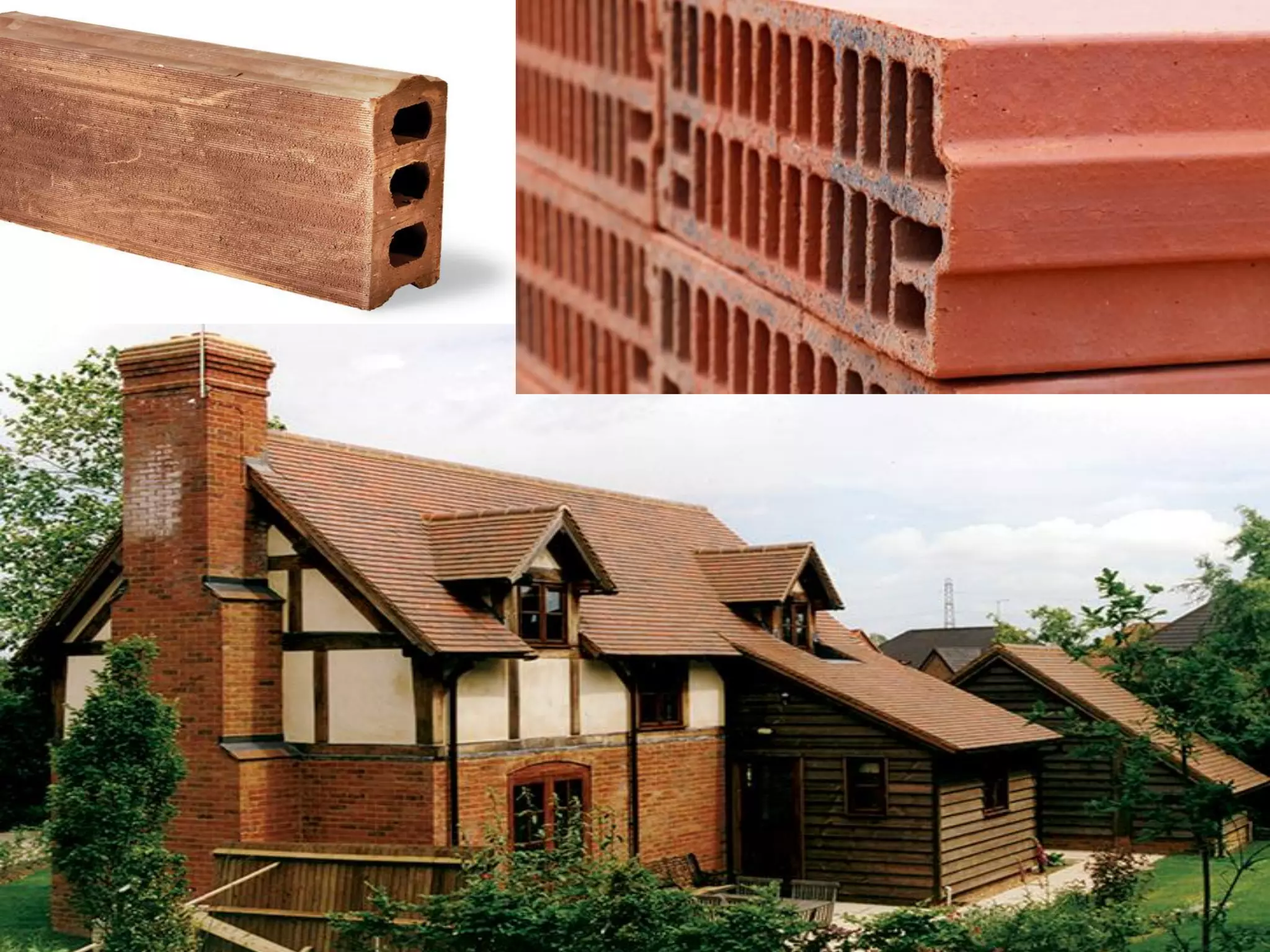
 Clay plasterboard block
It has been made from :
a. Un-fired clay
b. Recycled Dry-wall
 It use in the flat orientation for greater
loadbearing strength.
PROS
Health benefits
High breathability
Low environmental impact
Cost Effective
 Clay plasters regulate relative interior
humidity between 40% to 70%.
 By keeping RH between 40% to 70%
research has shown that the likelihood
for airborne infectious bacteria and
virus to survive is the lowest.
 Keeping RH between 40 to 60% also
prevents building materials from off
gassing toxins, such as formaldehyde.
Highly Sustainable products
as:
a. 100% bio-degradable
b. 100% recyclable
c. 100% reusable
CONS
 It may contains toxic chemicals
 It may contains glass fibers
 Expensive
 Difficult to Repair
 Plaster also changes color slightly as it
ages.
SELECTION OF BEST
ALTERNATIVE
COMPRESSED EARTH BLOCK
We have decided to use the “compressed earth
block material” for the green building as it has
enormous benefits
 Economically feasible
 The earth used in the production of the
CEBs is actually subsoil which leaves the
nutrient rich topsoil on the surface.
 This healthy topsoil can then, still be
used for agriculture.
EXECUTE THE DECISION
 Once the Compressed earth block
material is decided to use as a green
building material, we have to execute it
by following a sequence of activities like
taking approval from Environmental
Protection Agency & For execution, we
involve the NGO SECTOR, public
participation and the other relevant sub-
ordinates.
EVALUATE THE RESULT
Compressed Earth Block has been selected
because of the following reasons:
 CEBs use a uniform building
component size.
 Rapid construction & No need of
pre-heating before use.
 High compressive strength can
easily hold a roof
 They provide durable and
weather resistant construction
 Unskilled labor can be hired for
construction
 Environmentally viable.
REFERENCES
 Ogunkah. I., Yang. J. (2012) Investigating factors affecting
material selection. Buildings. 1-32
 Heerwagen. H. J. (2000). Green buildings. Building
research and information. 28 (5). 353-367.
 http://www.americanlimetechnology.com/what-is-
hempcrete/
 http://www.diynetwork.com/home-improvement/all-
about-green-building-materials/index.html
 http://www.readersdigest.com.au/types-of-building-
materials
Decision making for selection of material for constructing  “Green Building” ; Green  technology

Decision making for selection of material for constructing “Green Building” ; Green technology

  • 2.
    Decision making for selectionof material for constructing “Green Building” Green technology
  • 3.
    GREEN TECHNOLOGY Technology thathas the potential to significantly improve environmental performance relative to other technology
  • 4.
    SECTORS OF GREEN TECHNOLOGY Agriculture.  Energy.  Buildings.  Transportation.  Water and waste management.
  • 5.
    WHAT ARE GREEN BUILDINGS “Green”Buildings are high performance structures that also meet certain standards for reducing natural resource consumption
  • 6.
     Green” or“Sustainable” buildings are characterized by:  efficient management of energy and water resources  management of material resources and waste  restoration and protection of environmental quality  enhancement and protection of health and indoor environmental quality  reinforcement of natural systems
  • 7.
    BENEFITS OF GREEN BUILDINGS Environmental benefits.  Social benefits.  Economic benefits.
  • 8.
    GREEN BUILDING MATERIAL Greenbuilding materials are composed of renewable, rather than nonrenewable resources. Green materials are environmentally responsible because impacts are considered over the life of the product
  • 9.
    DECISION MAKING STEPS Problem Recognition InformationGathering Principles for Judging Alternatives Brainstorm and Analyze different choices Evaluation of Alternatives Select the best option Execute the decision Evaluate the results
  • 10.
  • 11.
    PROBLEM RECOGNITION Problem recognitionis the most important step in order to make the best decision of construction material for green buildings.
  • 12.
    PROBLEM RECOGNITION  Themajor problem is the choice of the construction material that creates less pollution, less disruption of ecosystem, less consumption of energy.
  • 13.
    It must be: Reliable  Durable  Easily available  Environmental friendly
  • 14.
    The decision ofthe selection of such material often involves:  Multiple criteria.  Multiple stakeholders.  Quantifying multiple criteria in monetary terms.  Attractive alternative with significant quantitative analysis
  • 15.
  • 16.
    INFORMATION GATHERING  Selectionof suitable green building material options can be influenced and determined by numerous preconditions, factors and considerations.  For such purpose adequate information related to the essential factors or variables effecting the decisions in the choice of materials is collected and gathered.
  • 17.
    In this stage,wide range of research and information is reviewed to:  Examine impacts of current procedures used for selecting locally-sourced or recycled building materials on overall performance of buildings.  Identify gaps and problems with previous research in the area of material-selection tools or systems developed for green buildings.  Learn from strengths and weaknesses of the expert systems, especially developed to manage the material-selection process.
  • 18.
    GRAPH SHOWING EXTENTOF PARTICIPANTS’ AWARENESS OF EXISTING SYSTEMS FOR GREEN BUILDING MATERIAL
  • 20.
    INFORMATION GATHERING For assessingbuilding material sustainability the information regarding the following framework of factors is collected:  Information regarding the general site factors is collected.  The concerned Environmental and health factors are determined.  The sensorial factors are taken into consideration.
  • 21.
     The relatedsocio cultural factors are analyzed.  The cost and economic value of the material is evaluated.  The technical factors are also considered in the selection of material.
  • 22.
    VARIANCE OF INTERESTIN THE USE LOCAL AND RECYCLED BUILDING MATERIAL OPTIONS
  • 24.
  • 25.
    PRINCIPLES FOR JUDGING THEALTERNATIVES In this step the base line criteria for judging the alternatives is set up. Some of the key principles for judging the alternatives are as follows: a) Cost effective b) Environmental friendly c) Ensure energy conservation d) Maintain Indoor Environmental Quality e) Ensure water Quality and Conservation f) High capacity and durable
  • 26.
  • 27.
    BRAINSTORMING  Clay bricks Steel  Hemp block  Timber  Compressed earth block  Extruded earth block  Plastic  Clay plasterboard block
  • 28.
  • 29.
    EVALUATION OF ALTERNATIVES Clay bricks This is an unfired clay brick, commonly used in cobwork.  They can be used for non- loadbearing walls or infills in lumber-frame constructions.
  • 32.
    PROS Clay bricks Fireproof Resistant toseismic activity Inexpensive.
  • 33.
    CONS  Extreme weathermay cause degradation of the surface due to frost damage  Services of a qualified structural engineer may be required.  Brick adds a lot of weight to the foundation.  Lower tensile strength
  • 34.
    STEEL Steel  A steelbuilding is a metal structure fabricated with steel for the internal support and for exterior cladding.  Steel buildings are used for a variety of purposes including storage, work spaces and living accommodation.
  • 36.
    PROS  Steel isa "green" product as it is 100% recyclable  Design flexibility  Easy to Install
  • 37.
    CONS  Heat conductivity Steel conducts heat 310 times more efficiently than wood.  Subjected to corrosion  Faulty design leads to the corrosion of iron and steel in buildings.
  • 38.
    HEMP BLOCK  Hempblock Hempcrete is a bio-composite base material consists of fibers from the hemp plant mixed with sand and lime.
  • 41.
    PROS  Lightweight cementitiousmaterial  Best insulating material  weighing about a 7th or 8th of the weight of concrete.  Repellent to white ants and fire ants  Discouraging the growth of mold  Renewable Resource  Rapid growth of fiber without fertilizer
  • 42.
    CONS  It’s carbonnegative because it sequesters carbon when used as a building material.  it’s not loadbearing  A frame is required to carry the loads  Transportation Cost  Environmental cost  Environmental footprints
  • 43.
    TIMBER  Wood isa product of trees, and sometimes other fibrous plants.  It is used for construction purposes when cut or pressed into lumber and timber, such as boards, planks and similar materials.  Wood has been used as a building material for thousands of years in its natural state.
  • 45.
    PROS  Used tomake floors, walls, supports and roof frames  High Strength  Easy to work with  Versatile  Potentially renewable  Biodegradable
  • 46.
    CONS  Some timberis non- renewable  Treated with toxic chemicals  Causes deforestation  It is not Eco-friendly
  • 47.
    COMPRESSED EARTH BLOCK Compressed earthblock  A compressed block out of an appropriate mix of: a. Dry inorganic soil b. Non-expansive clay c. Aggregate d. Cement  Traditional blocks of this nature, such as adobe blocks, were sun-dried, but modern versions are mechanically compressed.
  • 49.
    PROS  Provide asource of employment  Non-toxic protection  Don’t off gas VOCs  Sound resistant  Fire resistant  Insect resistant  Mold resistant
  • 50.
     Highly affordable. Proven durability.  Little waste generated.  Material re-use.
  • 51.
    CONS  Slower tobuild with, when compared to wood construction.
  • 52.
    EXTRUDED EARTH BLOCK Extruded earth block Theses are the unfired molded blocks, "extruded," into a continuous length in a machine, and then cut into smaller blocks.
  • 54.
    PROS  They canbe use as an internal partition walls  They prove to be good acoustic wall structure
  • 55.
    CONS  Unfired blocksdegrade to mud when immersed in water  The soil required for Extruded earth is much sandier than the one for fired earth
  • 56.
     Thus thesoil is more abrasive and the machines get damaged at a much faster rate  They are not cost effective
  • 57.
    PLASTIC  It isa product of synthetic materials derived from petrochemicals.  Polymers being used in construction industry such as: 1. Polyethylene 2. Polypropylene 3. Polyvinyl Chloride
  • 59.
    PROS  Use tomake window frames, water pipes, floor & wall coverings etc.  Light weight  Highly durable  Resistant to damp, water and pests
  • 60.
    CONS  Made fromnon-renewable resources  Intensive energy required to produce it  Highly polluting material  Off gas VOC’S  can not be easily degraded and decomposed
  • 61.
    CLAY PLASTERBOARD BLOCK  Clayplasterboard block It has been made from : a. Un-fired clay b. Recycled Dry-wall  It use in the flat orientation for greater loadbearing strength.
  • 63.
    PROS Health benefits High breathability Lowenvironmental impact Cost Effective
  • 64.
     Clay plastersregulate relative interior humidity between 40% to 70%.  By keeping RH between 40% to 70% research has shown that the likelihood for airborne infectious bacteria and virus to survive is the lowest.  Keeping RH between 40 to 60% also prevents building materials from off gassing toxins, such as formaldehyde.
  • 65.
    Highly Sustainable products as: a.100% bio-degradable b. 100% recyclable c. 100% reusable
  • 66.
    CONS  It maycontains toxic chemicals  It may contains glass fibers  Expensive  Difficult to Repair  Plaster also changes color slightly as it ages.
  • 67.
  • 68.
    COMPRESSED EARTH BLOCK Wehave decided to use the “compressed earth block material” for the green building as it has enormous benefits  Economically feasible  The earth used in the production of the CEBs is actually subsoil which leaves the nutrient rich topsoil on the surface.  This healthy topsoil can then, still be used for agriculture.
  • 70.
  • 71.
    EXECUTE THE DECISION Once the Compressed earth block material is decided to use as a green building material, we have to execute it by following a sequence of activities like taking approval from Environmental Protection Agency & For execution, we involve the NGO SECTOR, public participation and the other relevant sub- ordinates.
  • 72.
  • 73.
    Compressed Earth Blockhas been selected because of the following reasons:  CEBs use a uniform building component size.  Rapid construction & No need of pre-heating before use.  High compressive strength can easily hold a roof
  • 74.
     They providedurable and weather resistant construction  Unskilled labor can be hired for construction  Environmentally viable.
  • 75.
    REFERENCES  Ogunkah. I.,Yang. J. (2012) Investigating factors affecting material selection. Buildings. 1-32  Heerwagen. H. J. (2000). Green buildings. Building research and information. 28 (5). 353-367.  http://www.americanlimetechnology.com/what-is- hempcrete/  http://www.diynetwork.com/home-improvement/all- about-green-building-materials/index.html  http://www.readersdigest.com.au/types-of-building- materials