GOVERNMENT POLYTECHNIC PEN
LOW COST HOUSING MATERIALS
Guide by-: Presented by-:
Prof.N.S.Gawand PREETI SANTOSH PATIL
CONTENT
 INTRODUCTION
 INFORMATION ABOUT LOW COST HOUSING
 NATURAL MATERIALS :- BAMBOO
EARTH
STRAW
FIBRE CEMENT CONCRETE
BAGASSE
 MAN MADE MATERIALS :- FLY ASH
AEROCON PANELS
FERRO CEMENT
CEMENT CONCRETE HOLLOW BLOCKS
RICE HUSKS
 FUTURE SCOPE
 CONCLUSION
INTRODUCTION
Low cost housing is a new concept which deals with
effective budgeting and following of the techniques which help in
reducing the cost of construction through the use of locally
available materials along with the improve skill and technology
without sacrificing the strength, performance and life of the
structure.
INFORMATION ON LOW COST HOUSING
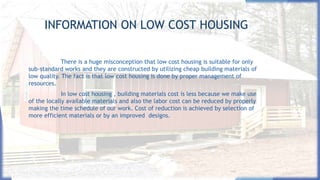
There is a huge misconception that low cost housing is suitable for only
sub-standard works and they are constructed by utilizing cheap building materials of
low quality. The fact is that low cost housing is done by proper management of
resources.
In low cost housing , building materials cost is less because we make use
of the locally available materials and also the labor cost can be reduced by properly
making the time schedule of our work. Cost of reduction is achieved by selection of
more efficient materials or by an improved designs.
INFORMATION ON LOW COST HOUSING
There is a huge misconception that low cost housing is suitable for only
sub-standard works and they are constructed by utilizing cheap building
materials of low quality. The fact is that low cost housing is done by proper
management of resources.
In low cost housing , building materials cost is less because we make
use of the locally available materials and also the labor cost can be reduced by
properly making the time schedule of our work. Cost of reduction is achieved by
selection of more efficient materials or by an improved designs.
NATURAL MATERIALS
 BAMBOO
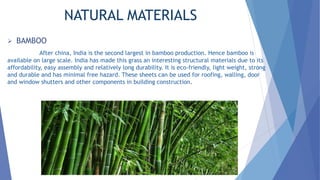
After china, India is the second largest in bamboo production. Hence bamboo is
available on large scale. India has made this grass an interesting structural materials due to its
affordability, easy assembly and relatively long durability. It is eco-friendly, light weight, strong
and durable and has minimal free hazard. These sheets can be used for roofing, walling, door
and window shutters and other components in building construction.
EARTH
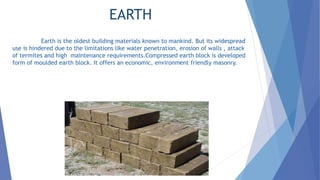
Earth is the oldest building materials known to mankind. But its widespread
use is hindered due to the limitations like water penetration, erosion of walls , attack
of termites and high maintenance requirements.Compressed earth block is developed
form of moulded earth block. It offers an economic, environment friendly masonry.
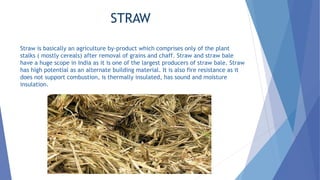
STRAW
Straw is basically an agriculture by-product which comprises only of the plant
stalks ( mostly cereals) after removal of grains and chaff. Straw and straw bale
have a huge scope in India as it is one of the largest producers of straw bale. Straw
has high potential as an alternate building material. It is also fire resistance as it
does not support combustion, is thermally insulated, has sound and moisture
insulation.
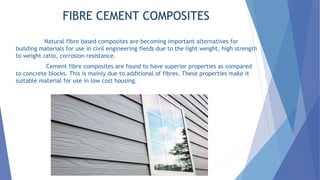
FIBRE CEMENT COMPOSITES
Natural fibre based composites are becoming important alternatives for
building materials for use in civil engineering fields due to the light weight, high strength
to weight ratio, corrosion resistance.
Cement fibre composites are found to have superior properties as compared
to concrete blocks. This is mainly due to additional of fibres. These properties make it
suitable material for use in low cost housing.
MAN-MADE MATERIALS
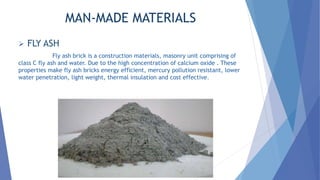
 FLY ASH
Fly ash brick is a construction materials, masonry unit comprising of
class C fly ash and water. Due to the high concentration of calcium oxide . These
properties make fly ash bricks energy efficient, mercury pollution resistant, lower
water penetration, light weight, thermal insulation and cost effective.
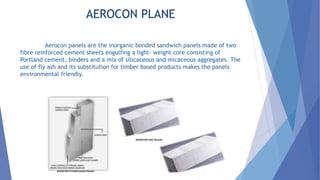
AEROCON PLANE
Aerocon panels are the inorganic bonded sandwich panels made of two
fibre reinforced cement sheets engulfing a light- weight core consisting of
Portland cement, binders and a mix of silicaceous and micaceous aggregates. The
use of fly ash and its substitution for timber based products makes the panels
environmental friendly.
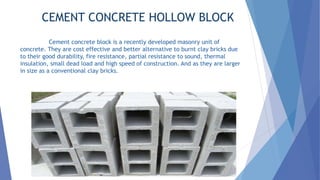
CEMENT CONCRETE HOLLOW BLOCK
Cement concrete block is a recently developed masonry unit of
concrete. They are cost effective and better alternative to burnt clay bricks due
to their good durability, fire resistance, partial resistance to sound, thermal
insulation, small dead load and high speed of construction. And as they are larger
in size as a conventional clay bricks.
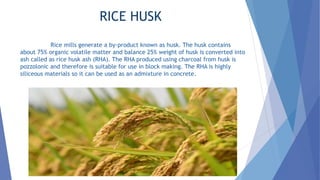
RICE HUSK
Rice mills generate a by-product known as husk. The husk contains
about 75% organic volatile matter and balance 25% weight of husk is converted into
ash called as rice husk ash (RHA). The RHA produced using charcoal from husk is
pozzolonic and therefore is suitable for use in block making. The RHA is highly
siliceous materials so it can be used as an admixture in concrete.
FERRO-CEMENT
Ferro-cement can be defined as a thin walled versatile high strength
cement based composite material. It possesses the property of completely
homogeneous material. It can be used for pre-cast toilet unit, water tank, cycle
sheds etc. As it is pre-casted and then manufactured, it can play a major role during
post disasters housing requirement which is economical and easy to build.
FUTURE SCOPE
In future use of durable, attractive and environmentally responsible
low cost housing materials will be a key element of any high performance
building. Due to great boom in construction industry there is a growing demand
for traditional building materials like steel, stone, brick and cement. Over a
period of time there is a rise in shortage of building materials which increases
the cost of materials. The low cost housing materials are cheaper and also
provide strength to the building. Hence low cost housing is beneficial for human
beings.
CONCLUSION
In this study, alternate construction materials were studied and the
potential of these materials to be used as alternate building material is brought
out. Depending on the availability of the materials in a particular region, these
materials can be selected as transportation consists of approximately 30% of
total construction budget. There have been several attempts at local level to
make use of bamboo, mud or natural fibers, but it still lacks scientific precisely
and proper techniques to be used precisely.
THANK YOU!

LOW COST HOUSING

  • 1.
    GOVERNMENT POLYTECHNIC PEN LOWCOST HOUSING MATERIALS Guide by-: Presented by-: Prof.N.S.Gawand PREETI SANTOSH PATIL
  • 2.
    CONTENT  INTRODUCTION  INFORMATIONABOUT LOW COST HOUSING  NATURAL MATERIALS :- BAMBOO EARTH STRAW FIBRE CEMENT CONCRETE BAGASSE  MAN MADE MATERIALS :- FLY ASH AEROCON PANELS FERRO CEMENT CEMENT CONCRETE HOLLOW BLOCKS RICE HUSKS  FUTURE SCOPE  CONCLUSION
  • 3.
    INTRODUCTION Low cost housingis a new concept which deals with effective budgeting and following of the techniques which help in reducing the cost of construction through the use of locally available materials along with the improve skill and technology without sacrificing the strength, performance and life of the structure.
  • 4.
    INFORMATION ON LOWCOST HOUSING There is a huge misconception that low cost housing is suitable for only sub-standard works and they are constructed by utilizing cheap building materials of low quality. The fact is that low cost housing is done by proper management of resources. In low cost housing , building materials cost is less because we make use of the locally available materials and also the labor cost can be reduced by properly making the time schedule of our work. Cost of reduction is achieved by selection of more efficient materials or by an improved designs.
  • 5.
    INFORMATION ON LOWCOST HOUSING There is a huge misconception that low cost housing is suitable for only sub-standard works and they are constructed by utilizing cheap building materials of low quality. The fact is that low cost housing is done by proper management of resources. In low cost housing , building materials cost is less because we make use of the locally available materials and also the labor cost can be reduced by properly making the time schedule of our work. Cost of reduction is achieved by selection of more efficient materials or by an improved designs.
  • 6.
    NATURAL MATERIALS  BAMBOO Afterchina, India is the second largest in bamboo production. Hence bamboo is available on large scale. India has made this grass an interesting structural materials due to its affordability, easy assembly and relatively long durability. It is eco-friendly, light weight, strong and durable and has minimal free hazard. These sheets can be used for roofing, walling, door and window shutters and other components in building construction.
  • 7.
    EARTH Earth is theoldest building materials known to mankind. But its widespread use is hindered due to the limitations like water penetration, erosion of walls , attack of termites and high maintenance requirements.Compressed earth block is developed form of moulded earth block. It offers an economic, environment friendly masonry.
  • 8.
    STRAW Straw is basicallyan agriculture by-product which comprises only of the plant stalks ( mostly cereals) after removal of grains and chaff. Straw and straw bale have a huge scope in India as it is one of the largest producers of straw bale. Straw has high potential as an alternate building material. It is also fire resistance as it does not support combustion, is thermally insulated, has sound and moisture insulation.
  • 9.
    FIBRE CEMENT COMPOSITES Naturalfibre based composites are becoming important alternatives for building materials for use in civil engineering fields due to the light weight, high strength to weight ratio, corrosion resistance. Cement fibre composites are found to have superior properties as compared to concrete blocks. This is mainly due to additional of fibres. These properties make it suitable material for use in low cost housing.
  • 10.
    MAN-MADE MATERIALS  FLYASH Fly ash brick is a construction materials, masonry unit comprising of class C fly ash and water. Due to the high concentration of calcium oxide . These properties make fly ash bricks energy efficient, mercury pollution resistant, lower water penetration, light weight, thermal insulation and cost effective.
  • 11.
    AEROCON PLANE Aerocon panelsare the inorganic bonded sandwich panels made of two fibre reinforced cement sheets engulfing a light- weight core consisting of Portland cement, binders and a mix of silicaceous and micaceous aggregates. The use of fly ash and its substitution for timber based products makes the panels environmental friendly.
  • 12.
    CEMENT CONCRETE HOLLOWBLOCK Cement concrete block is a recently developed masonry unit of concrete. They are cost effective and better alternative to burnt clay bricks due to their good durability, fire resistance, partial resistance to sound, thermal insulation, small dead load and high speed of construction. And as they are larger in size as a conventional clay bricks.
  • 13.
    RICE HUSK Rice millsgenerate a by-product known as husk. The husk contains about 75% organic volatile matter and balance 25% weight of husk is converted into ash called as rice husk ash (RHA). The RHA produced using charcoal from husk is pozzolonic and therefore is suitable for use in block making. The RHA is highly siliceous materials so it can be used as an admixture in concrete.
  • 14.
    FERRO-CEMENT Ferro-cement can bedefined as a thin walled versatile high strength cement based composite material. It possesses the property of completely homogeneous material. It can be used for pre-cast toilet unit, water tank, cycle sheds etc. As it is pre-casted and then manufactured, it can play a major role during post disasters housing requirement which is economical and easy to build.
  • 15.
    FUTURE SCOPE In futureuse of durable, attractive and environmentally responsible low cost housing materials will be a key element of any high performance building. Due to great boom in construction industry there is a growing demand for traditional building materials like steel, stone, brick and cement. Over a period of time there is a rise in shortage of building materials which increases the cost of materials. The low cost housing materials are cheaper and also provide strength to the building. Hence low cost housing is beneficial for human beings.
  • 16.
    CONCLUSION In this study,alternate construction materials were studied and the potential of these materials to be used as alternate building material is brought out. Depending on the availability of the materials in a particular region, these materials can be selected as transportation consists of approximately 30% of total construction budget. There have been several attempts at local level to make use of bamboo, mud or natural fibers, but it still lacks scientific precisely and proper techniques to be used precisely.
  • 17.