Bicol University
Institute of Design and Architecture
ABT 5 - Alternative Construction Systems
Name of Student: Basilan, Angel Mariane M.
Course & Block: BS Architecture - 4E
Activity 1: Alternative Construction Methods
The building industry is undergoing a transformation due to alternative
construction methods that bring forth novel materials and techniques aimed at
improving efficiency, sustainability, and adaptability. These methods frequently utilize
advanced materials, each offering specific advantages for contemporary construction
endeavors. Presented below are ten examples of alternative construction methods,
emphasizing their materials and supplemented with descriptions of their
characteristics, accompanied by images and illustrations.
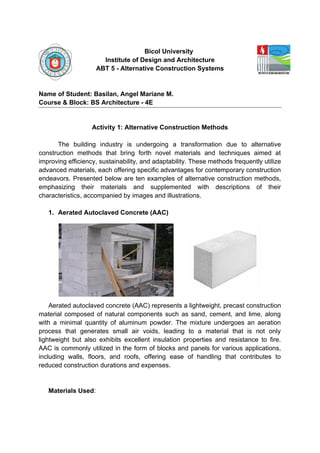
1. Aerated Autoclaved Concrete (AAC)
Aerated autoclaved concrete (AAC) represents a lightweight, precast construction
material composed of natural components such as sand, cement, and lime, along
with a minimal quantity of aluminum powder. The mixture undergoes an aeration
process that generates small air voids, leading to a material that is not only
lightweight but also exhibits excellent insulation properties and resistance to fire.
AAC is commonly utilized in the form of blocks and panels for various applications,
including walls, floors, and roofs, offering ease of handling that contributes to
reduced construction durations and expenses.
Materials Used:
● Fly Ash: A byproduct of coal combustion, used as a key ingredient in AAC
to enhance its sustainability.
● Cement: Acts as a binder to hold the mixture together.
● Lime: Used to react with the aluminum powder, creating the aeration
process.
● Gypsum: Added to the mix to improve the material’s workability.
● Aluminum Powder: Reacts with lime in the mixture to create the aeration
and expand the concrete.
2. Earthbag Construction
Earthbag construction is a method that utilizes polypropylene or burlap
bags filled with soil or other appropriate materials, which are then stacked to
create walls and compacted for stability. Typically, these walls are coated with
plaster or a similar finish to enhance durability. This construction technique is
remarkably sustainable, as it relies on locally sourced materials and is ideal for
creating disaster-resistant and affordable housing solutions. Furthermore,
earthbag construction offers a high degree of adaptability, permitting innovative
and curved design possibilities.
Materials Used:
● Soil: Typically a mix of clay, sand, and sometimes cement for stabilization.
● Polypropylene or Burlap Bags: Used to hold the soil mixture, forming the
structural elements of the walls.
● Barbed Wire: Laid between courses of bags to provide additional stability and
prevent slipping.
● Cement or Lime Plaster: Used to coat the walls and protect them from
erosion and moisture.
3. Modular Construction
Modular construction entails the pre-manufacturing of building sections,
referred to as modules, within a factory setting characterized by controlled
environmental conditions. These modules, which may include fully equipped
rooms, are subsequently transported to the site of construction where they are
assembled to form a complete structure. This technique notably accelerates the
construction timeline, enhances quality assurance, and reduces material waste.
Furthermore, it exhibits a high degree of flexibility, rendering it appropriate for a
wide array of building types, encompassing both residential and commercial
projects.
Materials Used:
● Prefabricated Panels: Made from materials like steel, concrete, or wood,
depending on the building's requirements.
● Steel Frames: Used for structural support and to provide durability.
● Concrete Slabs: Precast concrete is often used for floors, foundations, and
walls.
● Insulation: Materials like foam or fiberglass are pre-installed in wall panels to
enhance energy efficiency.
● Gypsum Boards: Commonly used for interior walls and ceilings, providing a
finished surface that can be painted or wallpapered.
4. 3D Printed Construction
The application of 3D printing technology in construction involves the use of
large-scale 3D printers to fabricate building elements or complete structures
through a methodical layering of materials based on digital models. This
technique facilitates swift construction processes, lowers labor expenses, and
enables the creation of intricate and tailored designs. The materials employed
can range from traditional concrete to advanced formulations such as
geopolymer, which offer enhanced sustainability. This innovative approach has
been implemented for the construction of residences, commercial buildings, and
even bridge structures.
Materials Used:
● Concrete: A specially formulated mix that can be extruded through a 3D
printer.
● Geopolymer: A more sustainable alternative to traditional concrete, often
used in 3D printing.
● Reinforcement Fibers: Often added to the concrete mix to increase strength
and durability.
5. Rammed Earth Construction
Rammed earth construction entails the compression of a blend of soil, sand,
gravel, and occasional stabilizers such as cement within formwork to produce
robust walls. This technique is environmentally sustainable, utilizing natural and
locally available materials, and offers exceptional thermal mass, aiding in the
stabilization of indoor temperatures. Structures built with rammed earth are
resilient and exhibit a unique, earthy visual quality.
Materials Used:
● Earth Mixture: Usually a blend of sand, gravel, and clay.
● Cement or Lime: Optional stabilizers to enhance strength and durability.
● Natural Fibers: Sometimes added to the mix for reinforcement.
6. Cross-Laminated Timber (CLT)
Cross-laminated timber (CLT) is a composite wood material produced by
arranging layers of timber at perpendicular orientations and adhering them with
adhesives. This process results in substantial, robust, and stable panels suitable
for use in various structural components such as walls, floors, and roofs. CLT is
recognized for its environmental benefits, utilizing renewable timber sources and
presenting a reduced carbon footprint relative to conventional construction
materials. Furthermore, the use of CLT in construction accelerates the building
process, minimizes labor expenses, and allows for the erection of structures
reaching heights of 10 stories and beyond.
Materials Used:
● Engineered Wood Panels: Typically made from softwood species like
spruce, pine, or fir.
● Adhesives: Non-toxic, formaldehyde-free adhesives are used to bond the
layers of wood.
7. Insulated Concrete Forms (ICFs)
Insulated concrete forms (ICFs) are composite building elements comprising
hollow blocks or panels constructed from expanded polystyrene (EPS). These
units are assembled in a stacked configuration and subsequently filled with
concrete. This construction method results in structures that are not only energy-
efficient but also robust and long-lasting. ICFs are frequently employed in the
construction of foundations, walls, and basements for both residential and
commercial structures, providing superior thermal insulation and heightened
resilience against natural disasters.
Materials Used:
● Expanded Polystyrene (EPS): Forms the insulating layers of the blocks or
panels.
● Concrete: Poured into the hollow forms to create solid, reinforced walls.
● Rebar: Reinforcement bars are used to strengthen the concrete structure.
8. Structural Insulated Panels (SIPs)
Structural insulated panels (SIPs) are pre assembled construction
elements that feature an insulating foam core situated between two structural
faces, typically made of oriented strand board (OSB). These panels provide
exceptional thermal efficiency, leading to decreased energy expenditures and
accelerated construction schedules. SIPs can be utilized in the construction of
walls, roofs, and floors and are widely favored in both residential and light
commercial building projects.
Materials Used:
● Oriented Strand Board (OSB): Used as the facing material for its
strength and durability.
● Polystyrene or Polyurethane Foam Core: Provides insulation and
structural integrity.
9. Bamboo Construction
Bamboo has gained significant traction as a preferred building material owing
to its fast growth rate, durability, and environmentally sustainable properties. It
can serve as the main structural component in residential and small-scale
constructions, frequently utilized alongside other materials such as concrete or
steel to enhance structural integrity. Predominantly found in tropical areas,
bamboo construction is esteemed for its versatility, ability to withstand
earthquakes, and minimal ecological footprint.
Material Used:
● Bamboo: Used for structural elements, scaffolding, and as a finishing
material
10.Living Walls
Living Walls represent a cutting-edge approach to green infrastructure,
seamlessly incorporating flora into the exteriors of buildings and converting
vertical surfaces into thriving, verdant gardens. This innovative system consists of
a framework that supports a diverse array of plants, which can be either
prefabricated modules or bespoke constructions. Living walls serve dual
purposes, enhancing visual appeal and functionality, while also delivering a wide
range of ecological benefits.
Materials Used in Living Walls:
● Waterproof Membrane: Protects the building structure from water damage.
● Root Barrier: Prevents plant roots from penetrating the building’s facade.
● Irrigation and Drainage System: Delivers water and nutrients while
preventing water accumulation.
● Growing Medium: A lightweight, specially formulated substrate that supports
plant growth.
● Plants: A variety of species selected for their ability to thrive in vertical
conditions, such as perennials, ferns, and succulents.
Resources:
● What is Modular Construction - Benefits of Modular Construction. (2024,
February 21). Modular Building Institute. https://www.modular.org/what-is-
modular-construction/
● Bertram, N., Fuchs, S., Mischke, J., Palter, R., Strube, G., & Woetzel, L.
(2019). Modular construction: From projects to products. In McKinsey &
Company.
https://www.mckinsey.com/capabilities/operations/our-insights/modular-
construction-from-projects-to-products
● WoodWorks - Wood Product Council. (2024, July 15). Mass Timber
Construction - WoodWorks | Wood Products Council. WoodWorks | Wood
Products Council. https://www.woodworks.org/learn/mass-timber-clt/
● Think Wood. (2024, January 2). Cross Laminated Timber (CLT) Design +
Construction - Think Wood. https://www.thinkwood.com/mass-timber/cross-
laminated-timber-clt
● 3D #printing will transform #architecture forever - here’s how. (2023,
December 23). World Economic Forum.
https://www.weforum.org/agenda/2023/04/3d-printing-promises-to-transform-
architecture-forever-and-create-forms-that-blow-today-s-buildings-out-of-the-
water/
● What are SIPs?. (n.d.). https://www.sips.org/what-are-sips
● ICF Basics for Commercial Contractors | ICF Builder Magazine. (n.d.).
https://www.icfmag.com/2018/11/icf-basics-for-commercial-contractors/
● Emma. (2024, January 23). A guide to rammed Earth construction - first in
architecture. First In Architecture.
https://www.firstinarchitecture.co.uk/rammed-earth-construction/
● World Bamboo Organization | News & Events | UN Report Highlights
Bamboo’s role in the shift to Bio-Based Building Materials. (n.d.).
https://worldbamboo.net/news-and-events/world-bamboo-day/un-report-
highlights-bamboos-role-in-the-shift-to-bio-based-building-materials
● Dejong, J. (2024, May 6). Basic Guide to Earth Bag Construction — dejong
architecture | Bringing excellence to every project | Alberta, Canada. Dejong
Architecture. https://www.dejongarchitecture.ca/research/earth-bag-
construction
●

Alternative Construction methods 12345.docx

  • 1.
    Bicol University Institute ofDesign and Architecture ABT 5 - Alternative Construction Systems Name of Student: Basilan, Angel Mariane M. Course & Block: BS Architecture - 4E Activity 1: Alternative Construction Methods The building industry is undergoing a transformation due to alternative construction methods that bring forth novel materials and techniques aimed at improving efficiency, sustainability, and adaptability. These methods frequently utilize advanced materials, each offering specific advantages for contemporary construction endeavors. Presented below are ten examples of alternative construction methods, emphasizing their materials and supplemented with descriptions of their characteristics, accompanied by images and illustrations. 1. Aerated Autoclaved Concrete (AAC) Aerated autoclaved concrete (AAC) represents a lightweight, precast construction material composed of natural components such as sand, cement, and lime, along with a minimal quantity of aluminum powder. The mixture undergoes an aeration process that generates small air voids, leading to a material that is not only lightweight but also exhibits excellent insulation properties and resistance to fire. AAC is commonly utilized in the form of blocks and panels for various applications, including walls, floors, and roofs, offering ease of handling that contributes to reduced construction durations and expenses. Materials Used:
  • 2.
    ● Fly Ash:A byproduct of coal combustion, used as a key ingredient in AAC to enhance its sustainability. ● Cement: Acts as a binder to hold the mixture together. ● Lime: Used to react with the aluminum powder, creating the aeration process. ● Gypsum: Added to the mix to improve the material’s workability. ● Aluminum Powder: Reacts with lime in the mixture to create the aeration and expand the concrete. 2. Earthbag Construction Earthbag construction is a method that utilizes polypropylene or burlap bags filled with soil or other appropriate materials, which are then stacked to create walls and compacted for stability. Typically, these walls are coated with plaster or a similar finish to enhance durability. This construction technique is remarkably sustainable, as it relies on locally sourced materials and is ideal for creating disaster-resistant and affordable housing solutions. Furthermore, earthbag construction offers a high degree of adaptability, permitting innovative and curved design possibilities. Materials Used: ● Soil: Typically a mix of clay, sand, and sometimes cement for stabilization. ● Polypropylene or Burlap Bags: Used to hold the soil mixture, forming the structural elements of the walls. ● Barbed Wire: Laid between courses of bags to provide additional stability and prevent slipping.
  • 3.
    ● Cement orLime Plaster: Used to coat the walls and protect them from erosion and moisture. 3. Modular Construction Modular construction entails the pre-manufacturing of building sections, referred to as modules, within a factory setting characterized by controlled environmental conditions. These modules, which may include fully equipped rooms, are subsequently transported to the site of construction where they are assembled to form a complete structure. This technique notably accelerates the construction timeline, enhances quality assurance, and reduces material waste. Furthermore, it exhibits a high degree of flexibility, rendering it appropriate for a wide array of building types, encompassing both residential and commercial projects. Materials Used: ● Prefabricated Panels: Made from materials like steel, concrete, or wood, depending on the building's requirements.
  • 4.
    ● Steel Frames:Used for structural support and to provide durability. ● Concrete Slabs: Precast concrete is often used for floors, foundations, and walls. ● Insulation: Materials like foam or fiberglass are pre-installed in wall panels to enhance energy efficiency. ● Gypsum Boards: Commonly used for interior walls and ceilings, providing a finished surface that can be painted or wallpapered. 4. 3D Printed Construction The application of 3D printing technology in construction involves the use of large-scale 3D printers to fabricate building elements or complete structures through a methodical layering of materials based on digital models. This technique facilitates swift construction processes, lowers labor expenses, and enables the creation of intricate and tailored designs. The materials employed can range from traditional concrete to advanced formulations such as geopolymer, which offer enhanced sustainability. This innovative approach has been implemented for the construction of residences, commercial buildings, and even bridge structures. Materials Used: ● Concrete: A specially formulated mix that can be extruded through a 3D printer. ● Geopolymer: A more sustainable alternative to traditional concrete, often used in 3D printing. ● Reinforcement Fibers: Often added to the concrete mix to increase strength and durability.
  • 5.
    5. Rammed EarthConstruction Rammed earth construction entails the compression of a blend of soil, sand, gravel, and occasional stabilizers such as cement within formwork to produce robust walls. This technique is environmentally sustainable, utilizing natural and locally available materials, and offers exceptional thermal mass, aiding in the stabilization of indoor temperatures. Structures built with rammed earth are resilient and exhibit a unique, earthy visual quality. Materials Used: ● Earth Mixture: Usually a blend of sand, gravel, and clay. ● Cement or Lime: Optional stabilizers to enhance strength and durability. ● Natural Fibers: Sometimes added to the mix for reinforcement. 6. Cross-Laminated Timber (CLT) Cross-laminated timber (CLT) is a composite wood material produced by arranging layers of timber at perpendicular orientations and adhering them with adhesives. This process results in substantial, robust, and stable panels suitable for use in various structural components such as walls, floors, and roofs. CLT is recognized for its environmental benefits, utilizing renewable timber sources and presenting a reduced carbon footprint relative to conventional construction
  • 6.
    materials. Furthermore, theuse of CLT in construction accelerates the building process, minimizes labor expenses, and allows for the erection of structures reaching heights of 10 stories and beyond. Materials Used: ● Engineered Wood Panels: Typically made from softwood species like spruce, pine, or fir. ● Adhesives: Non-toxic, formaldehyde-free adhesives are used to bond the layers of wood. 7. Insulated Concrete Forms (ICFs) Insulated concrete forms (ICFs) are composite building elements comprising hollow blocks or panels constructed from expanded polystyrene (EPS). These units are assembled in a stacked configuration and subsequently filled with concrete. This construction method results in structures that are not only energy- efficient but also robust and long-lasting. ICFs are frequently employed in the construction of foundations, walls, and basements for both residential and commercial structures, providing superior thermal insulation and heightened resilience against natural disasters.
  • 7.
    Materials Used: ● ExpandedPolystyrene (EPS): Forms the insulating layers of the blocks or panels. ● Concrete: Poured into the hollow forms to create solid, reinforced walls. ● Rebar: Reinforcement bars are used to strengthen the concrete structure. 8. Structural Insulated Panels (SIPs) Structural insulated panels (SIPs) are pre assembled construction elements that feature an insulating foam core situated between two structural faces, typically made of oriented strand board (OSB). These panels provide exceptional thermal efficiency, leading to decreased energy expenditures and accelerated construction schedules. SIPs can be utilized in the construction of walls, roofs, and floors and are widely favored in both residential and light commercial building projects. Materials Used: ● Oriented Strand Board (OSB): Used as the facing material for its strength and durability. ● Polystyrene or Polyurethane Foam Core: Provides insulation and structural integrity.
  • 8.
    9. Bamboo Construction Bamboohas gained significant traction as a preferred building material owing to its fast growth rate, durability, and environmentally sustainable properties. It can serve as the main structural component in residential and small-scale constructions, frequently utilized alongside other materials such as concrete or steel to enhance structural integrity. Predominantly found in tropical areas, bamboo construction is esteemed for its versatility, ability to withstand earthquakes, and minimal ecological footprint. Material Used: ● Bamboo: Used for structural elements, scaffolding, and as a finishing material 10.Living Walls
  • 9.
    Living Walls representa cutting-edge approach to green infrastructure, seamlessly incorporating flora into the exteriors of buildings and converting vertical surfaces into thriving, verdant gardens. This innovative system consists of a framework that supports a diverse array of plants, which can be either prefabricated modules or bespoke constructions. Living walls serve dual purposes, enhancing visual appeal and functionality, while also delivering a wide range of ecological benefits. Materials Used in Living Walls: ● Waterproof Membrane: Protects the building structure from water damage. ● Root Barrier: Prevents plant roots from penetrating the building’s facade. ● Irrigation and Drainage System: Delivers water and nutrients while preventing water accumulation. ● Growing Medium: A lightweight, specially formulated substrate that supports plant growth. ● Plants: A variety of species selected for their ability to thrive in vertical conditions, such as perennials, ferns, and succulents. Resources: ● What is Modular Construction - Benefits of Modular Construction. (2024, February 21). Modular Building Institute. https://www.modular.org/what-is- modular-construction/ ● Bertram, N., Fuchs, S., Mischke, J., Palter, R., Strube, G., & Woetzel, L. (2019). Modular construction: From projects to products. In McKinsey & Company. https://www.mckinsey.com/capabilities/operations/our-insights/modular- construction-from-projects-to-products ● WoodWorks - Wood Product Council. (2024, July 15). Mass Timber Construction - WoodWorks | Wood Products Council. WoodWorks | Wood Products Council. https://www.woodworks.org/learn/mass-timber-clt/
  • 10.
    ● Think Wood.(2024, January 2). Cross Laminated Timber (CLT) Design + Construction - Think Wood. https://www.thinkwood.com/mass-timber/cross- laminated-timber-clt ● 3D #printing will transform #architecture forever - here’s how. (2023, December 23). World Economic Forum. https://www.weforum.org/agenda/2023/04/3d-printing-promises-to-transform- architecture-forever-and-create-forms-that-blow-today-s-buildings-out-of-the- water/ ● What are SIPs?. (n.d.). https://www.sips.org/what-are-sips ● ICF Basics for Commercial Contractors | ICF Builder Magazine. (n.d.). https://www.icfmag.com/2018/11/icf-basics-for-commercial-contractors/ ● Emma. (2024, January 23). A guide to rammed Earth construction - first in architecture. First In Architecture. https://www.firstinarchitecture.co.uk/rammed-earth-construction/ ● World Bamboo Organization | News & Events | UN Report Highlights Bamboo’s role in the shift to Bio-Based Building Materials. (n.d.). https://worldbamboo.net/news-and-events/world-bamboo-day/un-report- highlights-bamboos-role-in-the-shift-to-bio-based-building-materials ● Dejong, J. (2024, May 6). Basic Guide to Earth Bag Construction — dejong architecture | Bringing excellence to every project | Alberta, Canada. Dejong Architecture. https://www.dejongarchitecture.ca/research/earth-bag- construction ●