Submitted by:
Aakash Dev
Civil Department
Shri Vaishnav Institute of
Technology and Science Indore
Email:
dev.aakash1794@gmail.com
Key Features
 Inexpensive to build
 Save money while also maintaining building
quality
 Not sacrificing the strength, performance and life
of the structure
 Takes less time in building in comparison to the
conventional ones
 Use of resources while not harming the
environment
 Final result should be affordable for most people
Why do we need low cost
houses?
 Growing population day by day
 Affordable housing for BPL people
 We need a solution that is fast
 Easy to build
 Fulfills the needs of conventional houses
 Our country aims that in our near future each and
every individual has his/her shelter for his family
and to fulfill this need we definitely need some
immediate plans
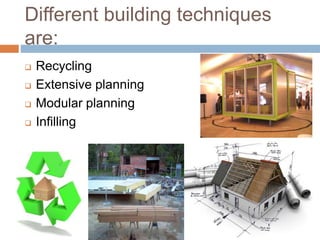
Different building techniques
are:
 Recycling
 Extensive planning
 Modular planning
 Infilling
Recycling
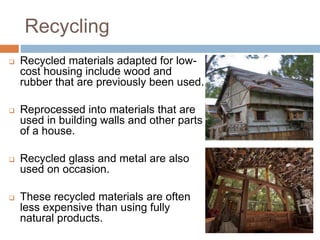
 Recycled materials adapted for low-
cost housing include wood and
rubber that are previously been used.
 Reprocessed into materials that are
used in building walls and other parts
of a house.
 Recycled glass and metal are also
used on occasion.
 These recycled materials are often
less expensive than using fully
natural products.
Extensive planning
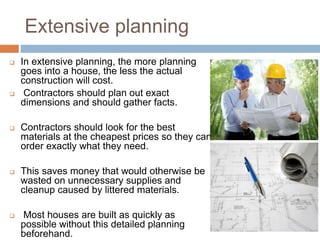
 In extensive planning, the more planning
goes into a house, the less the actual
construction will cost.
 Contractors should plan out exact
dimensions and should gather facts.
 Contractors should look for the best
materials at the cheapest prices so they can
order exactly what they need.
 This saves money that would otherwise be
wasted on unnecessary supplies and
cleanup caused by littered materials.
 Most houses are built as quickly as
possible without this detailed planning
beforehand.
Modular planning
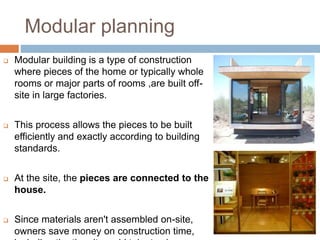
 Modular building is a type of construction
where pieces of the home or typically whole
rooms or major parts of rooms ,are built off-
site in large factories.
 This process allows the pieces to be built
efficiently and exactly according to building
standards.
 At the site, the pieces are connected to the
house.
 Since materials aren't assembled on-site,
owners save money on construction time,
Infilling
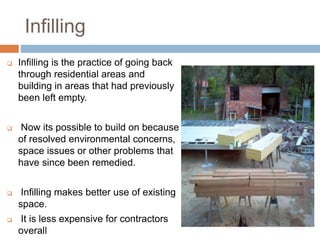
 Infilling is the practice of going back
through residential areas and
building in areas that had previously
been left empty.
 Now its possible to build on because
of resolved environmental concerns,
space issues or other problems that
have since been remedied.
 Infilling makes better use of existing
space.
 It is less expensive for contractors
overall
Techniques to reduce cost from
area
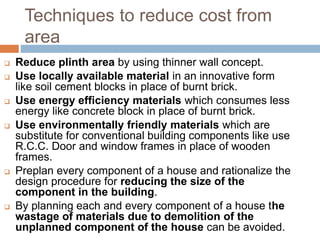
 Reduce plinth area by using thinner wall concept.
 Use locally available material in an innovative form
like soil cement blocks in place of burnt brick.
 Use energy efficiency materials which consumes less
energy like concrete block in place of burnt brick.
 Use environmentally friendly materials which are
substitute for conventional building components like use
R.C.C. Door and window frames in place of wooden
frames.
 Preplan every component of a house and rationalize the
design procedure for reducing the size of the
component in the building.
 By planning each and every component of a house the
wastage of materials due to demolition of the
unplanned component of the house can be avoided.
Construction technique adopted
 Foundation
 Wall
 Lintel
 Roof
Foundation
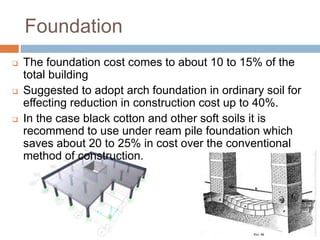
 The foundation cost comes to about 10 to 15% of the
total building
 Suggested to adopt arch foundation in ordinary soil for
effecting reduction in construction cost up to 40%.
 In the case black cotton and other soft soils it is
recommend to use under ream pile foundation which
saves about 20 to 25% in cost over the conventional
method of construction.
wall
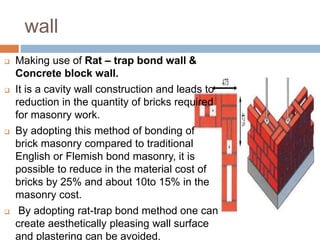
 Making use of Rat – trap bond wall &
Concrete block wall.
 It is a cavity wall construction and leads to
reduction in the quantity of bricks required
for masonry work.
 By adopting this method of bonding of
brick masonry compared to traditional
English or Flemish bond masonry, it is
possible to reduce in the material cost of
bricks by 25% and about 10to 15% in the
masonry cost.
 By adopting rat-trap bond method one can
create aesthetically pleasing wall surface
and plastering can be avoided.
Concrete block walling
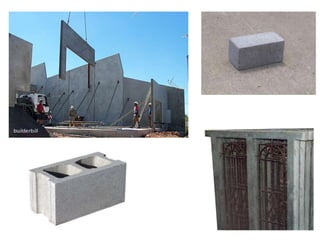
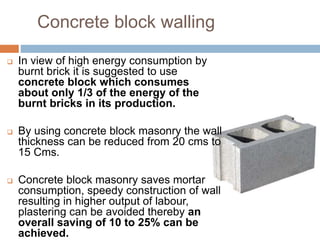
 In view of high energy consumption by
burnt brick it is suggested to use
concrete block which consumes
about only 1/3 of the energy of the
burnt bricks in its production.
 By using concrete block masonry the wall
thickness can be reduced from 20 cms to
15 Cms.
 Concrete block masonry saves mortar
consumption, speedy construction of wall
resulting in higher output of labour,
plastering can be avoided thereby an
overall saving of 10 to 25% can be
achieved.
Lintel
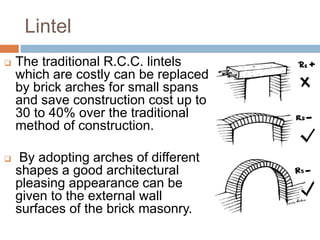
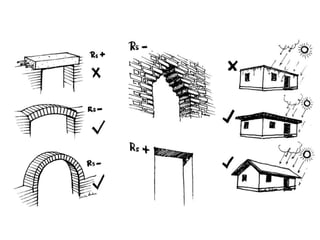
 The traditional R.C.C. lintels
which are costly can be replaced
by brick arches for small spans
and save construction cost up to
30 to 40% over the traditional
method of construction.
 By adopting arches of different
shapes a good architectural
pleasing appearance can be
given to the external wall
surfaces of the brick masonry.
Roof
 Normally 5" thick R.C.C. slabs is used for roofing of
residential buildings.
 By adopting rationally designed construction practices like
filler slab and precast elements the construction cost of
roofing can be reduced by about 20 to 25%.
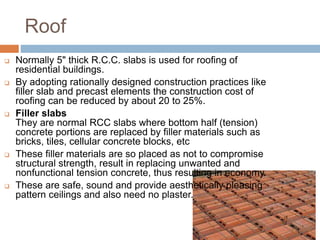
 Filler slabs
They are normal RCC slabs where bottom half (tension)
concrete portions are replaced by filler materials such as
bricks, tiles, cellular concrete blocks, etc
 These filler materials are so placed as not to compromise
structural strength, result in replacing unwanted and
nonfunctional tension concrete, thus resulting in economy.
 These are safe, sound and provide aesthetically pleasing
pattern ceilings and also need no plaster.
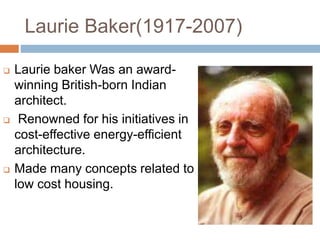
Laurie Baker(1917-2007)
 Laurie baker Was an award-
winning British-born Indian
architect.
 Renowned for his initiatives in
cost-effective energy-efficient
architecture.
 Made many concepts related to
low cost housing.
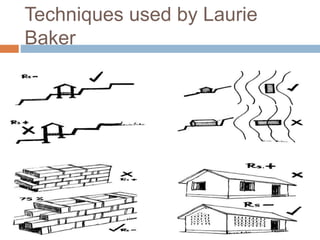
Techniques used by Laurie
Baker
The Hamlet Laurie bakers
home
 This is Baker’s home in Trivandrum built on a plot of land
along the slope of a rocky hill, with limited access to water.
 Baker’s genius has created a wonderful home for his family.
 Material used from unconventional sources.
 Electricity wiring is not concealed.
 According to Baker, fans and lamps can be avoided as in
India there is sunlight all round the year, which also means
that if water is stored in the southern part of the house, hot
water can be made available.
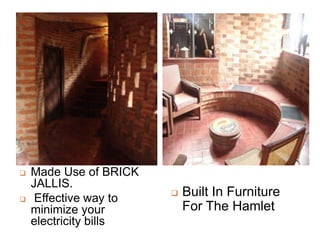
 Made Use of BRICK
JALLIS.
 Effective way to
minimize your
electricity bills
 Built In Furniture
For The Hamlet
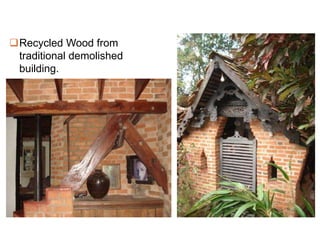
Recycled Wood from
traditional demolished
building.
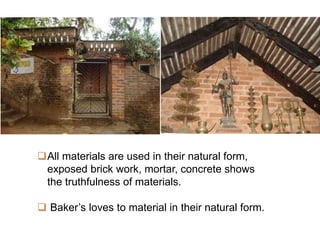
All materials are used in their natural form,
exposed brick work, mortar, concrete shows
the truthfulness of materials.
 Baker’s loves to material in their natural form.
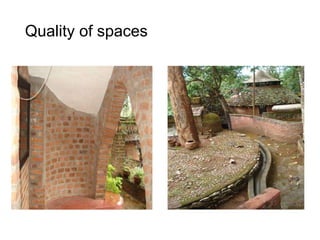
Quality of spaces
Major plans progressing at present in
India
•Affordable Housing
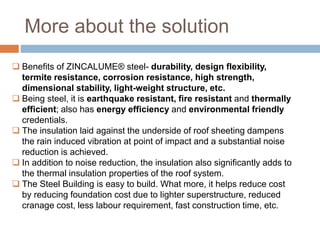
Affordable housing
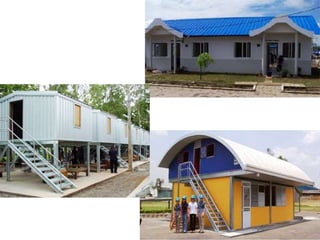
Demand for housing in India is literally going through the
roof. To cater to the increasing demand, Tata BlueScope
Steel supplies affordable housing solution - a Complete
Solution to the customer right from Conceptualization-
Design-Manufacturing- Supply.
Thus, using light guage structure (LGS) along with world
class ZINCALUME® steel and COLORBOND® steel, Tata
BlueScope Steel provides all benefits of a conventional
house in a very short span of time.
More about the solution
 Benefits of ZINCALUME® steel- durability, design flexibility,
termite resistance, corrosion resistance, high strength,
dimensional stability, light-weight structure, etc.
 Being steel, it is earthquake resistant, fire resistant and thermally
efficient; also has energy efficiency and environmental friendly
credentials.
 The insulation laid against the underside of roof sheeting dampens
the rain induced vibration at point of impact and a substantial noise
reduction is achieved.
 In addition to noise reduction, the insulation also significantly adds to
the thermal insulation properties of the roof system.
 The Steel Building is easy to build. What more, it helps reduce cost
by reducing foundation cost due to lighter superstructure, reduced
cranage cost, less labour requirement, fast construction time, etc.
To counter the various problems, optimum residential
buildings have to be built in huge numbers, not only to
prevent the expansion of slums and chawls, but also for its
eradication.
This solution provides steel houses that can be erected in a
very short span of time and which have all features
equivalent to or better than conventional houses.
These LGS houses have been tested and are in use in
various countries such as the USA, China, Malaysia,
Vietnam, Indonesia, etc. to name a few.
NGOs, Government Agencies, Corporates and Individuals
involved in Rehabilitation/ Relief works can make use of
our affordable housing solutions.
Benefit to society
IIT Madras-The 6.5 lakh home
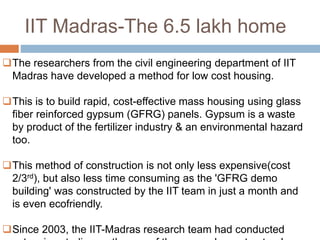
The researchers from the civil engineering department of IIT
Madras have developed a method for low cost housing.
This is to build rapid, cost-effective mass housing using glass
fiber reinforced gypsum (GFRG) panels. Gypsum is a waste
by product of the fertilizer industry & an environmental hazard
too.
This method of construction is not only less expensive(cost
2/3rd), but also less time consuming as the 'GFRG demo
building' was constructed by the IIT team in just a month and
is even ecofriendly.
Since 2003, the IIT-Madras research team had conducted
How its made ?
These panels, originally developed by RBS Australia, were
intended as wall panels ('Rapidwall') suitable for rapid erection of
walls in buildings to carry gravity loads.
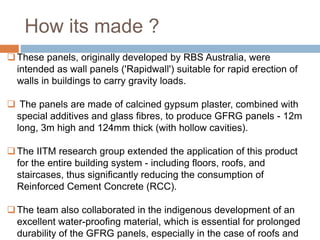
 The panels are made of calcined gypsum plaster, combined with
special additives and glass fibres, to produce GFRG panels - 12m
long, 3m high and 124mm thick (with hollow cavities).
The IITM research group extended the application of this product
for the entire building system - including floors, roofs, and
staircases, thus significantly reducing the consumption of
Reinforced Cement Concrete (RCC).
The team also collaborated in the indigenous development of an
excellent water-proofing material, which is essential for prolonged
durability of the GFRG panels, especially in the case of roofs and
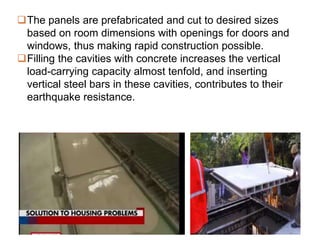
The panels are prefabricated and cut to desired sizes
based on room dimensions with openings for doors and
windows, thus making rapid construction possible.
Filling the cavities with concrete increases the vertical
load-carrying capacity almost tenfold, and inserting
vertical steel bars in these cavities, contributes to their
earthquake resistance.
Advantages over conventional
buildings:
High speed of construction
Less built-up area for the same carpet area.
Less embodied energy and carbon footprint:
significant reduction in use of cement, sand, steel
and water; recycling of industrial waste gypsum.
Lower cost of structure: savings in materials; no
plastering.
Lower building weight (panels weigh only 43 kg/m2),
contributing to savings in foundation and reduction in
design for earthquake forces, particularly in multi-
storeyed construction.
Buildings up to 8-10 storeys can be designed using
this load-bearing system, without the need for beams
and columns.
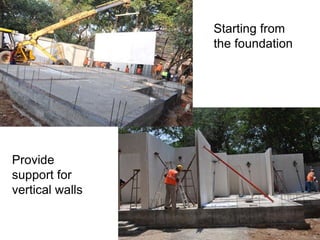
Starting from
the foundation
Provide
support for
vertical walls
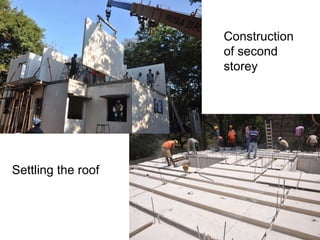
Construction
of second
storey
Settling the roof
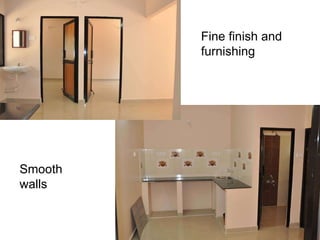
Fine finish and
furnishing
Smooth
walls
Conclusion
 There is a strict need at present in India for
building cheap and affordable houses
 It is the key to nations development ,to provide
proper shelter to its citizens
 The growing population in urban areas have led to
a strict shortage in land, congested traffic and
housing shortfall
 This has also led to the hike in prices which
makes it impossible for common people to have
their own houses
 Thus there is a immediate need for construction of
Bibliography
 Google search
 Wiki
 Times of India
 NDTV
 Tata BlueScope steel
 Slide share
Thank You….

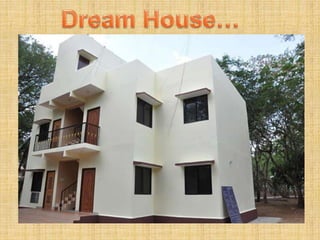
Low cost housing India

  • 2.
    Submitted by: Aakash Dev CivilDepartment Shri Vaishnav Institute of Technology and Science Indore Email: dev.aakash1794@gmail.com
  • 3.
    Key Features  Inexpensiveto build  Save money while also maintaining building quality  Not sacrificing the strength, performance and life of the structure  Takes less time in building in comparison to the conventional ones  Use of resources while not harming the environment  Final result should be affordable for most people
  • 4.
    Why do weneed low cost houses?  Growing population day by day  Affordable housing for BPL people  We need a solution that is fast  Easy to build  Fulfills the needs of conventional houses  Our country aims that in our near future each and every individual has his/her shelter for his family and to fulfill this need we definitely need some immediate plans
  • 5.
    Different building techniques are: Recycling  Extensive planning  Modular planning  Infilling
  • 6.
    Recycling  Recycled materialsadapted for low- cost housing include wood and rubber that are previously been used.  Reprocessed into materials that are used in building walls and other parts of a house.  Recycled glass and metal are also used on occasion.  These recycled materials are often less expensive than using fully natural products.
  • 7.
    Extensive planning  Inextensive planning, the more planning goes into a house, the less the actual construction will cost.  Contractors should plan out exact dimensions and should gather facts.  Contractors should look for the best materials at the cheapest prices so they can order exactly what they need.  This saves money that would otherwise be wasted on unnecessary supplies and cleanup caused by littered materials.  Most houses are built as quickly as possible without this detailed planning beforehand.
  • 8.
    Modular planning  Modularbuilding is a type of construction where pieces of the home or typically whole rooms or major parts of rooms ,are built off- site in large factories.  This process allows the pieces to be built efficiently and exactly according to building standards.  At the site, the pieces are connected to the house.  Since materials aren't assembled on-site, owners save money on construction time,
  • 9.
    Infilling  Infilling isthe practice of going back through residential areas and building in areas that had previously been left empty.  Now its possible to build on because of resolved environmental concerns, space issues or other problems that have since been remedied.  Infilling makes better use of existing space.  It is less expensive for contractors overall
  • 10.
    Techniques to reducecost from area  Reduce plinth area by using thinner wall concept.  Use locally available material in an innovative form like soil cement blocks in place of burnt brick.  Use energy efficiency materials which consumes less energy like concrete block in place of burnt brick.  Use environmentally friendly materials which are substitute for conventional building components like use R.C.C. Door and window frames in place of wooden frames.  Preplan every component of a house and rationalize the design procedure for reducing the size of the component in the building.  By planning each and every component of a house the wastage of materials due to demolition of the unplanned component of the house can be avoided.
  • 12.
    Construction technique adopted Foundation  Wall  Lintel  Roof
  • 13.
    Foundation  The foundationcost comes to about 10 to 15% of the total building  Suggested to adopt arch foundation in ordinary soil for effecting reduction in construction cost up to 40%.  In the case black cotton and other soft soils it is recommend to use under ream pile foundation which saves about 20 to 25% in cost over the conventional method of construction.
  • 14.
    wall  Making useof Rat – trap bond wall & Concrete block wall.  It is a cavity wall construction and leads to reduction in the quantity of bricks required for masonry work.  By adopting this method of bonding of brick masonry compared to traditional English or Flemish bond masonry, it is possible to reduce in the material cost of bricks by 25% and about 10to 15% in the masonry cost.  By adopting rat-trap bond method one can create aesthetically pleasing wall surface and plastering can be avoided.
  • 15.
    Concrete block walling In view of high energy consumption by burnt brick it is suggested to use concrete block which consumes about only 1/3 of the energy of the burnt bricks in its production.  By using concrete block masonry the wall thickness can be reduced from 20 cms to 15 Cms.  Concrete block masonry saves mortar consumption, speedy construction of wall resulting in higher output of labour, plastering can be avoided thereby an overall saving of 10 to 25% can be achieved.
  • 16.
    Lintel  The traditionalR.C.C. lintels which are costly can be replaced by brick arches for small spans and save construction cost up to 30 to 40% over the traditional method of construction.  By adopting arches of different shapes a good architectural pleasing appearance can be given to the external wall surfaces of the brick masonry.
  • 17.
    Roof  Normally 5"thick R.C.C. slabs is used for roofing of residential buildings.  By adopting rationally designed construction practices like filler slab and precast elements the construction cost of roofing can be reduced by about 20 to 25%.  Filler slabs They are normal RCC slabs where bottom half (tension) concrete portions are replaced by filler materials such as bricks, tiles, cellular concrete blocks, etc  These filler materials are so placed as not to compromise structural strength, result in replacing unwanted and nonfunctional tension concrete, thus resulting in economy.  These are safe, sound and provide aesthetically pleasing pattern ceilings and also need no plaster.
  • 18.
    Laurie Baker(1917-2007)  Lauriebaker Was an award- winning British-born Indian architect.  Renowned for his initiatives in cost-effective energy-efficient architecture.  Made many concepts related to low cost housing.
  • 20.
    Techniques used byLaurie Baker
  • 21.
    The Hamlet Lauriebakers home  This is Baker’s home in Trivandrum built on a plot of land along the slope of a rocky hill, with limited access to water.  Baker’s genius has created a wonderful home for his family.  Material used from unconventional sources.  Electricity wiring is not concealed.  According to Baker, fans and lamps can be avoided as in India there is sunlight all round the year, which also means that if water is stored in the southern part of the house, hot water can be made available.
  • 22.
     Made Useof BRICK JALLIS.  Effective way to minimize your electricity bills  Built In Furniture For The Hamlet
  • 23.
  • 24.
    All materials areused in their natural form, exposed brick work, mortar, concrete shows the truthfulness of materials.  Baker’s loves to material in their natural form.
  • 25.
  • 26.
    Major plans progressingat present in India
  • 28.
    •Affordable Housing Affordable housing Demandfor housing in India is literally going through the roof. To cater to the increasing demand, Tata BlueScope Steel supplies affordable housing solution - a Complete Solution to the customer right from Conceptualization- Design-Manufacturing- Supply. Thus, using light guage structure (LGS) along with world class ZINCALUME® steel and COLORBOND® steel, Tata BlueScope Steel provides all benefits of a conventional house in a very short span of time.
  • 29.
    More about thesolution  Benefits of ZINCALUME® steel- durability, design flexibility, termite resistance, corrosion resistance, high strength, dimensional stability, light-weight structure, etc.  Being steel, it is earthquake resistant, fire resistant and thermally efficient; also has energy efficiency and environmental friendly credentials.  The insulation laid against the underside of roof sheeting dampens the rain induced vibration at point of impact and a substantial noise reduction is achieved.  In addition to noise reduction, the insulation also significantly adds to the thermal insulation properties of the roof system.  The Steel Building is easy to build. What more, it helps reduce cost by reducing foundation cost due to lighter superstructure, reduced cranage cost, less labour requirement, fast construction time, etc.
  • 30.
    To counter thevarious problems, optimum residential buildings have to be built in huge numbers, not only to prevent the expansion of slums and chawls, but also for its eradication. This solution provides steel houses that can be erected in a very short span of time and which have all features equivalent to or better than conventional houses. These LGS houses have been tested and are in use in various countries such as the USA, China, Malaysia, Vietnam, Indonesia, etc. to name a few. NGOs, Government Agencies, Corporates and Individuals involved in Rehabilitation/ Relief works can make use of our affordable housing solutions. Benefit to society
  • 32.
    IIT Madras-The 6.5lakh home The researchers from the civil engineering department of IIT Madras have developed a method for low cost housing. This is to build rapid, cost-effective mass housing using glass fiber reinforced gypsum (GFRG) panels. Gypsum is a waste by product of the fertilizer industry & an environmental hazard too. This method of construction is not only less expensive(cost 2/3rd), but also less time consuming as the 'GFRG demo building' was constructed by the IIT team in just a month and is even ecofriendly. Since 2003, the IIT-Madras research team had conducted
  • 33.
    How its made? These panels, originally developed by RBS Australia, were intended as wall panels ('Rapidwall') suitable for rapid erection of walls in buildings to carry gravity loads.  The panels are made of calcined gypsum plaster, combined with special additives and glass fibres, to produce GFRG panels - 12m long, 3m high and 124mm thick (with hollow cavities). The IITM research group extended the application of this product for the entire building system - including floors, roofs, and staircases, thus significantly reducing the consumption of Reinforced Cement Concrete (RCC). The team also collaborated in the indigenous development of an excellent water-proofing material, which is essential for prolonged durability of the GFRG panels, especially in the case of roofs and
  • 34.
    The panels areprefabricated and cut to desired sizes based on room dimensions with openings for doors and windows, thus making rapid construction possible. Filling the cavities with concrete increases the vertical load-carrying capacity almost tenfold, and inserting vertical steel bars in these cavities, contributes to their earthquake resistance.
  • 35.
    Advantages over conventional buildings: Highspeed of construction Less built-up area for the same carpet area. Less embodied energy and carbon footprint: significant reduction in use of cement, sand, steel and water; recycling of industrial waste gypsum. Lower cost of structure: savings in materials; no plastering. Lower building weight (panels weigh only 43 kg/m2), contributing to savings in foundation and reduction in design for earthquake forces, particularly in multi- storeyed construction. Buildings up to 8-10 storeys can be designed using this load-bearing system, without the need for beams and columns.
  • 36.
  • 37.
  • 38.
  • 40.
    Conclusion  There isa strict need at present in India for building cheap and affordable houses  It is the key to nations development ,to provide proper shelter to its citizens  The growing population in urban areas have led to a strict shortage in land, congested traffic and housing shortfall  This has also led to the hike in prices which makes it impossible for common people to have their own houses  Thus there is a immediate need for construction of
  • 41.
    Bibliography  Google search Wiki  Times of India  NDTV  Tata BlueScope steel  Slide share
  • 42.