Alphabet Soup:
Choosing Among DC, QDC,
MARC, MARCXML, and MODS
Jenn Riley
IU Metadata Librarian
DLP Brown Bag Series
February 25, 2005
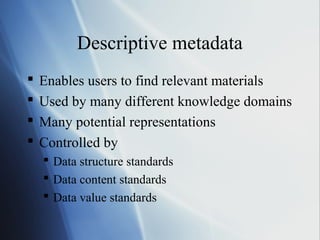
Descriptive metadata
 Enables users to find relevant materials
 Used by many different knowledge domains
 Many potential representations
 Controlled by
 Data structure standards
 Data content standards
 Data value standards
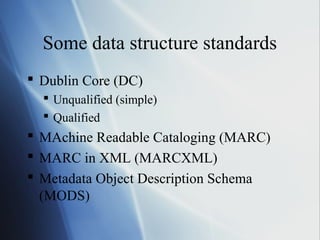
Some data structure standards
 Dublin Core (DC)
 Unqualified (simple)
 Qualified
 MAchine Readable Cataloging (MARC)
 MARC in XML (MARCXML)
 Metadata Object Description Schema
(MODS)
How do I pick one?
 Genre of materials being described
 Format of materials being described
 Nature of holding institution
 Robustness needed for the given materials and users
 What others in the community are doing
 Describing original vs. digitized item
 Mechanisms for providing relationships between records
 Plan for interoperability, including repeatability of
elements
 Formats supported by your delivery software
 More information on handout
Dublin Core (DC)
 15-element set
 National and international standard
 2001: Released as ANSI/NISO Z39.85
 2003: Released as ISO 15836
 Maintained by the Dublin Core Metadata Initiative
(DCMI)
 Other players
 DCMI Working Groups
 DC Usage Board
DCMI mission
 The mission of DCMI is to make it easier to
find resources using the Internet through the
following activities:
 Developing metadata standards for discovery
across domains,
 Defining frameworks for the interoperation of
metadata sets, and,
 Facilitating the development of community- or
disciplinary-specific metadata sets that are
consistent with items 1 and 2
DC Principles
 “Core” across all knowledge domains
 No element required
 All elements repeatable
 1:1 principle
DC encodings
 HTML <meta>
 XML
 RDF
 [Spreadsheets]
 [Databases]
Content/value standards for DC
 None required
 Some elements recommend a content
or value standard as a best practice
 Relation
 Source
 Subject
 Type
 Coverage
 Date
 Format
 Language
 Identifier
Some limitations of DC
 Can’t indicate a main title vs. other
subordinate titles
 No method for specifying creator roles
 W3CDTF format can’t indicate date ranges
or uncertainty
 Can’t by itself provide robust record
relationships
Good times to use DC
 Cross-collection searching
 Cross-domain discovery
 Metadata sharing
 Describing some types of simple resources
 Metadata creation by novices
DC
[record]
QDC
[record]
[collection]
MARC
[record]
[collection]
MARCXML
[record]
MODS
[record]
[collection]
Record
format
XML
RDF
(X)HTML
Field labels Text
Reliance on
AACR
None
Common
method of
creation
By novices,
by specialists,
and by
derivation
Qualified Dublin Core (QDC)
 Adds some increased specificity to Unqualified
Dublin Core
 Same governance structure as DC
 Same encodings as DC
 Same content/value standards as DC
 Listed in DMCI Terms
 Additional principles
 Extensibility
 Dumb-down principle
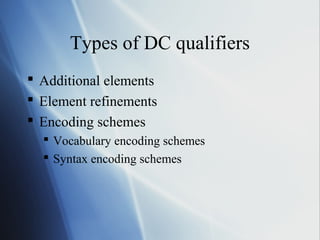
Types of DC qualifiers
 Additional elements
 Element refinements
 Encoding schemes
 Vocabulary encoding schemes
 Syntax encoding schemes
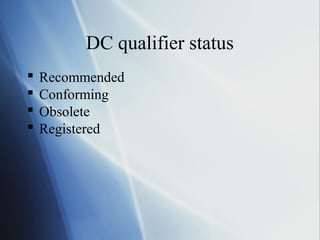
DC qualifier status
 Recommended
 Conforming
 Obsolete
 Registered
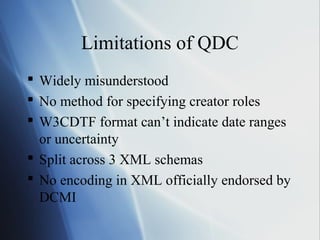
Limitations of QDC
 Widely misunderstood
 No method for specifying creator roles
 W3CDTF format can’t indicate date ranges
or uncertainty
 Split across 3 XML schemas
 No encoding in XML officially endorsed by
DCMI
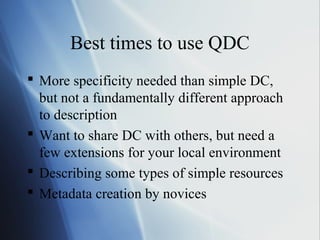
Best times to use QDC
 More specificity needed than simple DC,
but not a fundamentally different approach
to description
 Want to share DC with others, but need a
few extensions for your local environment
 Describing some types of simple resources
 Metadata creation by novices
DC
[record]
QDC
[record]
[collection]
MARC
[record]
[collection]
MARCXML
[record]
MODS
[record]
[collection]
Record
format
XML
RDF
(X)HTML
XML
RDF
(X)HTML
Field labels Text Text
Reliance on
AACR
None None
Common
method of
creation
By novices,
by specialists,
and by
derivation
By novices,
by specialists,
and by
derivation
MAchine Readable Cataloging
(MARC)
 Format for the records in IUCAT and other
OPACs
 Used for library metadata since 1960s
 Adopted as national standard in 1971
 Adopted as international standard in 1973
 Maintained by:
 Network Development and MARC Standards Office at
the Library of Congress
 Standards and the Support Office at the National
Library of Canada
More about MARC
 Actually a family of MARC standards throughout
the world
 U.S. & Canada use MARC21
 Structured as a binary interchange format
 ANSI/NISO Z39.2
 ISO 2709
 Field names
 Numeric fields
 Alphabetic subfields
Content/value standards for MARC
 None required by the format itself
 But US record creation practice relies
heavily on:
 AACR2r
 ISBD
 LCNAF
 LCSH
Limitations of MARC
 Use of all its potential is time-consuming
 OPACs don’t make full use of all possible
data
 OPACs virtually the only systems to use
MARC data
 Requires highly-trained staff to create
 Local practice differs greatly
Good times to use MARC
 Integration with other records in OPAC
 Resources are like those traditionally found
in library catalogs
 Maximum compatibility with other libraries
is needed
 Have expert catalogers for metadata
creation
DC
[record]
QDC
[record]
[collection]
MARC
[record]
[collection]
MARCXML
[record]
MODS
[record]
[collection]
Record
format
XML
RDF
(X)HTML
XML
RDF
(X)HTML
ISO 2709
[ANSI
Z39.2]
Field labels Text Text Numeric
Reliance on
AACR
None None Strong
Common
method of
creation
By novices,
by specialists,
and by
derivation
By novices,
by specialists,
and by
derivation
By
specialists
MARC in XML (MARCXML)
 Copies the exact structure of MARC21 in
an XML syntax
 Numeric fields
 Alphabetic subfields
 Implicit assumption that content/value
standards are the same as in MARC
Limitations of MARCXML
 Not appropriate for direct data entry
 Extremely verbose syntax
 Full content validation requires tools
external to XML Schema conformance
Best times to use MARCXML
 As a transition format between a MARC record
and another XML-encoded metadata format
 Materials lend themselves to library-type
description
 Need more robustness than DC offers
 Want XML representation to store within larger
digital object but need lossless conversion to
MARC
DC
[record]
QDC
[record]
[collection]
MARC
[record]
[collection]
MARCXML
[record]
MODS
[record]
[collection]
Record
format
XML
RDF
(X)HTML
XML
RDF
(X)HTML
ISO 2709
[ANSI
Z39.2]
XML
Field labels Text Text Numeric Numeric
Reliance on
AACR
None None Strong Strong
Common
method of
creation
By novices,
by specialists,
and by
derivation
By novices,
by specialists,
and by
derivation
By
specialists
By derivation
Metadata Object Description
Schema (MODS)
 Developed and managed by the Library of
Congress Network Development and
MARC Standards Office
 First released for trial use June 2002
 MODS 3.0 released December 2003
 “Schema for a bibliographic element set
that may be used for a variety of purposes,
and particularly for library applications.”
Differences between MODS and
MARC
 MODS is “MARC-like” but intended to be
simpler
 Textual tag names
 Encoded in XML
 Some specific changes
 Some regrouping of elements
 Removes some elements
 Adds some elements
Content/value standards for MODS
 Many elements indicate a given
content/value standard should be used
 Generally follows MARC/AACR2/ISBD
conventions
 But not all enforced by the MODS XML
schema
 Authority attribute available on many
elements
Limitations of MODS
 No lossless round-trip conversion from and
to MARC
 Still largely implemented by library
community only
 Some semantics of MARC lost
Good times to use MODS
 Materials lend themselves to library-type
description
 Want to reach both library and non-library
audiences
 Need more robustness than DC offers
 Want XML representation to store within
larger digital object
DC
[record]
QDC
[record]
[collection]
MARC
[record]
[collection]
MARCXML
[record]
MODS
[record]
[collection]
Record
format
XML
RDF
(X)HTML
XML
RDF
(X)HTML
ISO 2709
[ANSI
Z39.2]
XML XML
Field labels Text Text Numeric Numeric Text
Reliance on
AACR
None None Strong Strong Implied
Common
method of
creation
By novices,
by specialists,
and by
derivation
By novices,
by specialists,
and by
derivation
By
specialists
By derivation
By specialists
and by
derivation
Mapping between metadata formats
 Also called “crosswalking”
 To create “views” of metadata for specific
purposes
 Mapping from robust format to more
general format is common
 Mapping from general format to more
robust format is ineffective
Types of mapping logic
 Mapping the complete contents of one field to
another
 Splitting multiple values in a single local field into
multiple fields in the target schema
 Translating anomalous local practices into a more
generally useful value
 Splitting data in one field into two or more fields
 Transforming data values
 Boilerplate values to include in output schema
Common mapping pitfalls
 Cramming in too much information
 Leaving in trailing punctuation
 Missing context of records
 Meaningless placeholder data
ALWAYS remember the purpose of the
metadata you are creating!
No, really, which one do I pick?
 It depends. Sorry.
 Be as robust as you can afford
 Plan for future uses of the metadata you
create
 Leverage existing expertise as much as
possible
 Focus on content and value standards as
much as possible
More information
 Dublin Core
 DC Element Set version 1.1
 DCMI Metadata Terms
 MODS
 MARC
 MARCXML
Questions?
 Jenn Riley, Metadata Librarian, IU Digital
Library Program: jenlrile@indiana.edu
 These presentation slides:
<http://www.dlib.indiana.edu/~jenlrile/presentations/bbspr05/descMDBB/>

Alphabet Soup: Choosing Among DC, QDC, MARC, MARCXML, and MODS

  • 1.
    Alphabet Soup: Choosing AmongDC, QDC, MARC, MARCXML, and MODS Jenn Riley IU Metadata Librarian DLP Brown Bag Series February 25, 2005
  • 2.
    Descriptive metadata  Enablesusers to find relevant materials  Used by many different knowledge domains  Many potential representations  Controlled by  Data structure standards  Data content standards  Data value standards
  • 3.
    Some data structurestandards  Dublin Core (DC)  Unqualified (simple)  Qualified  MAchine Readable Cataloging (MARC)  MARC in XML (MARCXML)  Metadata Object Description Schema (MODS)
  • 4.
    How do Ipick one?  Genre of materials being described  Format of materials being described  Nature of holding institution  Robustness needed for the given materials and users  What others in the community are doing  Describing original vs. digitized item  Mechanisms for providing relationships between records  Plan for interoperability, including repeatability of elements  Formats supported by your delivery software  More information on handout
  • 5.
    Dublin Core (DC) 15-element set  National and international standard  2001: Released as ANSI/NISO Z39.85  2003: Released as ISO 15836  Maintained by the Dublin Core Metadata Initiative (DCMI)  Other players  DCMI Working Groups  DC Usage Board
  • 6.
    DCMI mission  Themission of DCMI is to make it easier to find resources using the Internet through the following activities:  Developing metadata standards for discovery across domains,  Defining frameworks for the interoperation of metadata sets, and,  Facilitating the development of community- or disciplinary-specific metadata sets that are consistent with items 1 and 2
  • 7.
    DC Principles  “Core”across all knowledge domains  No element required  All elements repeatable  1:1 principle
  • 8.
    DC encodings  HTML<meta>  XML  RDF  [Spreadsheets]  [Databases]
  • 9.
    Content/value standards forDC  None required  Some elements recommend a content or value standard as a best practice  Relation  Source  Subject  Type  Coverage  Date  Format  Language  Identifier
  • 10.
    Some limitations ofDC  Can’t indicate a main title vs. other subordinate titles  No method for specifying creator roles  W3CDTF format can’t indicate date ranges or uncertainty  Can’t by itself provide robust record relationships
  • 11.
    Good times touse DC  Cross-collection searching  Cross-domain discovery  Metadata sharing  Describing some types of simple resources  Metadata creation by novices
  • 12.
  • 13.
    Qualified Dublin Core(QDC)  Adds some increased specificity to Unqualified Dublin Core  Same governance structure as DC  Same encodings as DC  Same content/value standards as DC  Listed in DMCI Terms  Additional principles  Extensibility  Dumb-down principle
  • 14.
    Types of DCqualifiers  Additional elements  Element refinements  Encoding schemes  Vocabulary encoding schemes  Syntax encoding schemes
  • 15.
    DC qualifier status Recommended  Conforming  Obsolete  Registered
  • 16.
    Limitations of QDC Widely misunderstood  No method for specifying creator roles  W3CDTF format can’t indicate date ranges or uncertainty  Split across 3 XML schemas  No encoding in XML officially endorsed by DCMI
  • 17.
    Best times touse QDC  More specificity needed than simple DC, but not a fundamentally different approach to description  Want to share DC with others, but need a few extensions for your local environment  Describing some types of simple resources  Metadata creation by novices
  • 18.
    DC [record] QDC [record] [collection] MARC [record] [collection] MARCXML [record] MODS [record] [collection] Record format XML RDF (X)HTML XML RDF (X)HTML Field labels TextText Reliance on AACR None None Common method of creation By novices, by specialists, and by derivation By novices, by specialists, and by derivation
  • 19.
    MAchine Readable Cataloging (MARC) Format for the records in IUCAT and other OPACs  Used for library metadata since 1960s  Adopted as national standard in 1971  Adopted as international standard in 1973  Maintained by:  Network Development and MARC Standards Office at the Library of Congress  Standards and the Support Office at the National Library of Canada
  • 20.
    More about MARC Actually a family of MARC standards throughout the world  U.S. & Canada use MARC21  Structured as a binary interchange format  ANSI/NISO Z39.2  ISO 2709  Field names  Numeric fields  Alphabetic subfields
  • 21.
    Content/value standards forMARC  None required by the format itself  But US record creation practice relies heavily on:  AACR2r  ISBD  LCNAF  LCSH
  • 22.
    Limitations of MARC Use of all its potential is time-consuming  OPACs don’t make full use of all possible data  OPACs virtually the only systems to use MARC data  Requires highly-trained staff to create  Local practice differs greatly
  • 23.
    Good times touse MARC  Integration with other records in OPAC  Resources are like those traditionally found in library catalogs  Maximum compatibility with other libraries is needed  Have expert catalogers for metadata creation
  • 24.
    DC [record] QDC [record] [collection] MARC [record] [collection] MARCXML [record] MODS [record] [collection] Record format XML RDF (X)HTML XML RDF (X)HTML ISO 2709 [ANSI Z39.2] Field labelsText Text Numeric Reliance on AACR None None Strong Common method of creation By novices, by specialists, and by derivation By novices, by specialists, and by derivation By specialists
  • 25.
    MARC in XML(MARCXML)  Copies the exact structure of MARC21 in an XML syntax  Numeric fields  Alphabetic subfields  Implicit assumption that content/value standards are the same as in MARC
  • 26.
    Limitations of MARCXML Not appropriate for direct data entry  Extremely verbose syntax  Full content validation requires tools external to XML Schema conformance
  • 27.
    Best times touse MARCXML  As a transition format between a MARC record and another XML-encoded metadata format  Materials lend themselves to library-type description  Need more robustness than DC offers  Want XML representation to store within larger digital object but need lossless conversion to MARC
  • 28.
    DC [record] QDC [record] [collection] MARC [record] [collection] MARCXML [record] MODS [record] [collection] Record format XML RDF (X)HTML XML RDF (X)HTML ISO 2709 [ANSI Z39.2] XML Field labelsText Text Numeric Numeric Reliance on AACR None None Strong Strong Common method of creation By novices, by specialists, and by derivation By novices, by specialists, and by derivation By specialists By derivation
  • 29.
    Metadata Object Description Schema(MODS)  Developed and managed by the Library of Congress Network Development and MARC Standards Office  First released for trial use June 2002  MODS 3.0 released December 2003  “Schema for a bibliographic element set that may be used for a variety of purposes, and particularly for library applications.”
  • 30.
    Differences between MODSand MARC  MODS is “MARC-like” but intended to be simpler  Textual tag names  Encoded in XML  Some specific changes  Some regrouping of elements  Removes some elements  Adds some elements
  • 31.
    Content/value standards forMODS  Many elements indicate a given content/value standard should be used  Generally follows MARC/AACR2/ISBD conventions  But not all enforced by the MODS XML schema  Authority attribute available on many elements
  • 32.
    Limitations of MODS No lossless round-trip conversion from and to MARC  Still largely implemented by library community only  Some semantics of MARC lost
  • 33.
    Good times touse MODS  Materials lend themselves to library-type description  Want to reach both library and non-library audiences  Need more robustness than DC offers  Want XML representation to store within larger digital object
  • 34.
    DC [record] QDC [record] [collection] MARC [record] [collection] MARCXML [record] MODS [record] [collection] Record format XML RDF (X)HTML XML RDF (X)HTML ISO 2709 [ANSI Z39.2] XML XML Fieldlabels Text Text Numeric Numeric Text Reliance on AACR None None Strong Strong Implied Common method of creation By novices, by specialists, and by derivation By novices, by specialists, and by derivation By specialists By derivation By specialists and by derivation
  • 35.
    Mapping between metadataformats  Also called “crosswalking”  To create “views” of metadata for specific purposes  Mapping from robust format to more general format is common  Mapping from general format to more robust format is ineffective
  • 36.
    Types of mappinglogic  Mapping the complete contents of one field to another  Splitting multiple values in a single local field into multiple fields in the target schema  Translating anomalous local practices into a more generally useful value  Splitting data in one field into two or more fields  Transforming data values  Boilerplate values to include in output schema
  • 37.
    Common mapping pitfalls Cramming in too much information  Leaving in trailing punctuation  Missing context of records  Meaningless placeholder data ALWAYS remember the purpose of the metadata you are creating!
  • 38.
    No, really, whichone do I pick?  It depends. Sorry.  Be as robust as you can afford  Plan for future uses of the metadata you create  Leverage existing expertise as much as possible  Focus on content and value standards as much as possible
  • 39.
    More information  DublinCore  DC Element Set version 1.1  DCMI Metadata Terms  MODS  MARC  MARCXML
  • 40.
    Questions?  Jenn Riley,Metadata Librarian, IU Digital Library Program: jenlrile@indiana.edu  These presentation slides: <http://www.dlib.indiana.edu/~jenlrile/presentations/bbspr05/descMDBB/>

Editor's Notes

  • #14 Extensibility: via Application Profiles and local qualifiers. Local qualifiers maybe not kosher but there are no metadata police. Usually.
  • #16 Recommended: Elements, Element Refinements, and DCMI-maintained Vocabulary Terms (e.g., member terms of the DCMI Type Vocabulary) useful for resource discovery across domains. Conforming: Elements, Element Refinements and Application Profiles may be assigned a status of conforming. Elements and Element Refinements assigned a status of conforming are those for which an implementation community has a demonstrated need and which conform to the grammar of Elements and Element Refinements, though without necessarily meeting the stricter criteria of usefulness across domains or usefulness for resource discovery. Obsolete: For Elements and Element Refinements that have been superseded, deprecated, or rendered obsolete. Such terms will remain in the registry for use in interpreting legacy metadata. Registered: Used for Vocabulary Encoding Schemes and language translations for which the DCMI provides information but not necessarily a specific recommendation.