Metadata for Managing
             Scientific Research Data
                      NISO/DCMI Webinar:
                              August 22, 2012


Jane Greenberg, Professor and Director of
the SILS Metadata Research Center
janeg@email.unc.edu
Overview
▪   Why should we care?
▪   What is data?
▪   What is metadata‘s role w.r.t data?
▪   Selected metadata standards
▪   Challenges, opportunities, and jumping in
▪   Concluding comments
▪   Q&A
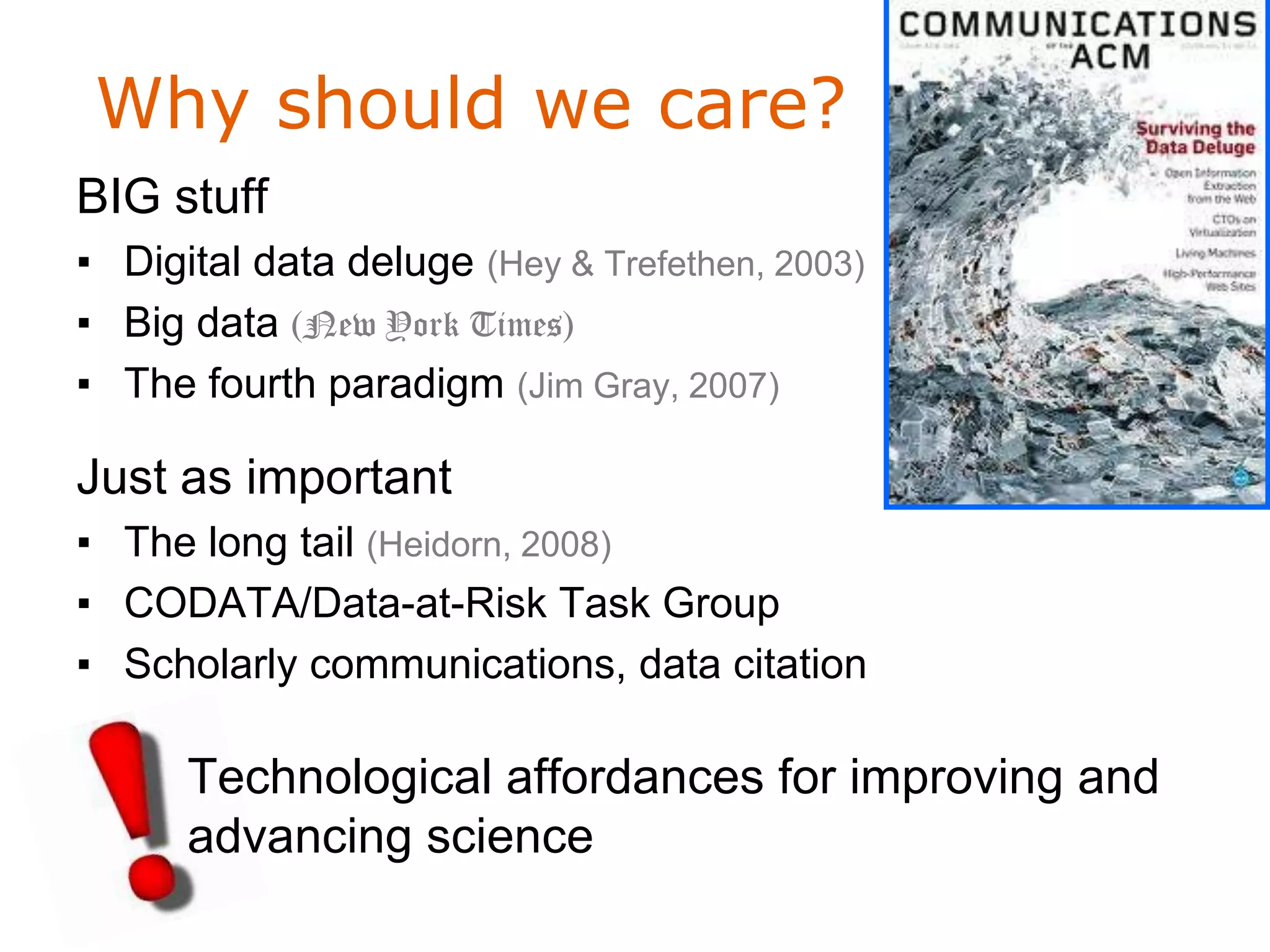
Why should we care?
BIG stuff
▪ Digital data deluge (Hey & Trefethen, 2003)
▪ Big data (New York Times)
                                                2008
▪ The fourth paradigm (Jim Gray, 2007)

Just as important
▪ The long tail (Heidorn, 2008)
▪ CODATA/Data-at-Risk Task Group
▪ Scholarly communications, data citation

      Technological affordances for improving and
      advancing science
Cultural shift toward data sharing
▪ National and international policies
  – US NSF and NIH [1, 2]
  – OECD (Organisation for Economic Co-operation and
    Development) [3]
  – INSPIRE Infrastructure for Spatial Information in the European
    Community EU Commission [4]
  – UK Medical Research Council [5]

             Dryad ―enables scientists to validate
             published findings, explore new analysis
             methodologies, repurpose data for research
             questions unanticipated by the original
             authors, and perform synthetic studies.‖
             (http://datadryad.org/)
Overview
▪ Why should we care?

▪ What is data?
▪   What is metadata‘s role w.r.t data?
▪   Selected metadata standards
▪   Challenges, opportunities, and jumping in
▪   Concluding comments
▪   Q&A
Data
▪ No single agreed upon definition
▪ One person‘s data is another person‘s
  information
▪ Data often implies the ―raw‖ stuff lacking
  context
   – Scholarly context, written assessment
▪ ―Essence of science‖ (Greenberg, et al, 2009)
▪ What is science?
   – The Archaeology Data Service (ADS)
     archaeologydataservice.ac.uk
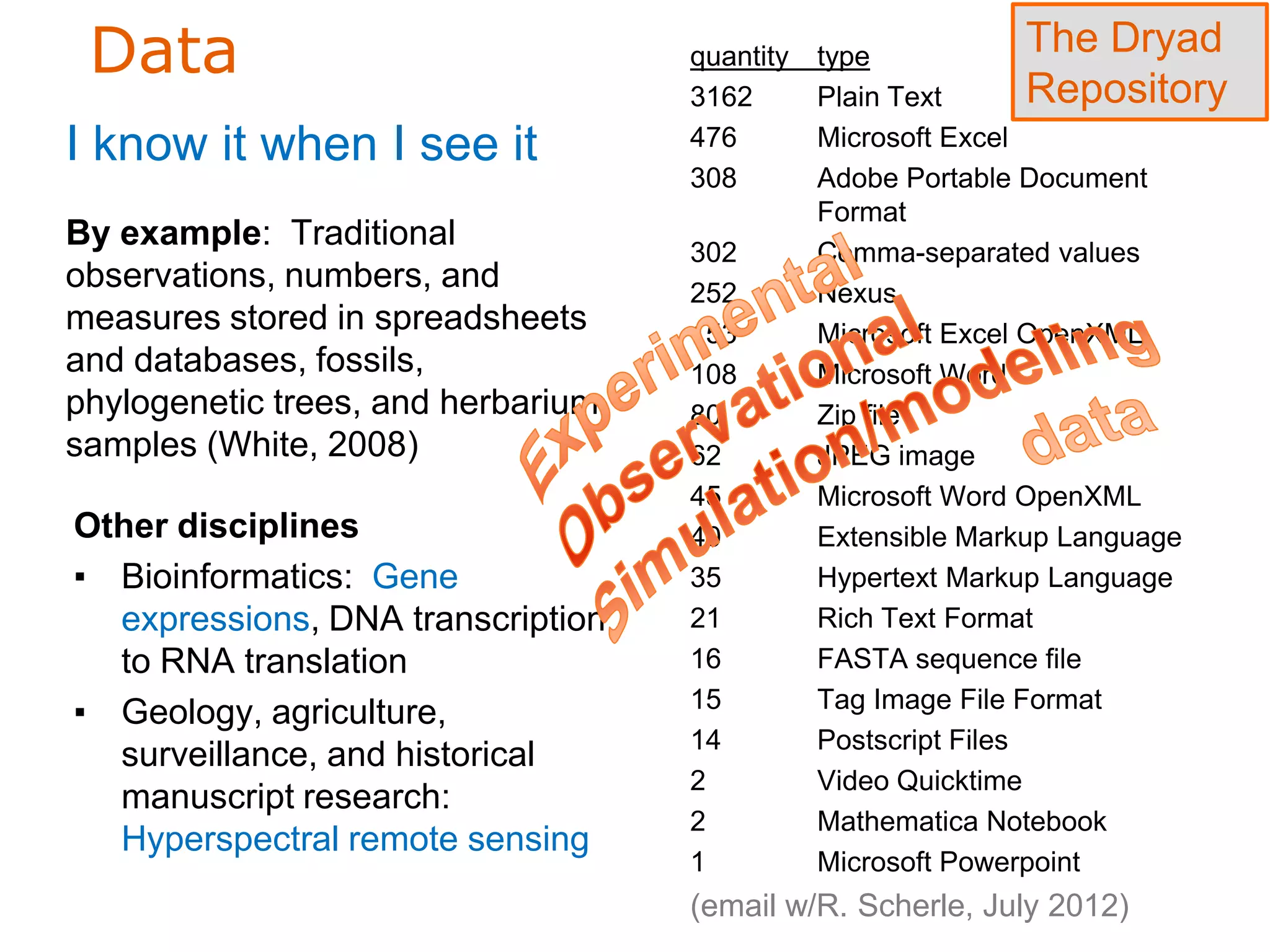
Data                               quantity   type             The Dryad
                                                                Repository
                                    3162       Plain Text
I know it when I see it             476        Microsoft Excel
                                    308        Adobe Portable Document
                                               Format
By example: Traditional             302        Comma-separated values
observations, numbers, and          252        Nexus
measures stored in spreadsheets     153        Microsoft Excel OpenXML
and databases, fossils,             108        Microsoft Word
phylogenetic trees, and herbarium   80         Zip file
samples (White, 2008)               62         JPEG image
                                    45         Microsoft Word OpenXML
Other disciplines                   40         Extensible Markup Language
▪ Bioinformatics: Gene              35         Hypertext Markup Language
  expressions, DNA transcription    21         Rich Text Format
  to RNA translation                16         FASTA sequence file
                                    15         Tag Image File Format
▪ Geology, agriculture,
                                    14         Postscript Files
  surveillance, and historical
                                    2          Video Quicktime
  manuscript research:
                                    2          Mathematica Notebook
  Hyperspectral remote sensing
                                    1          Microsoft Powerpoint
                                    (email w/R. Scherle, July 2012)
Overview
▪ Why should we care?
▪ What is data?

▪ What is metadata‘s role w.r.t data?
▪   Selected metadata standards
▪   Challenges, opportunities, and jumping in
▪   Concluding comments
▪   Q&A
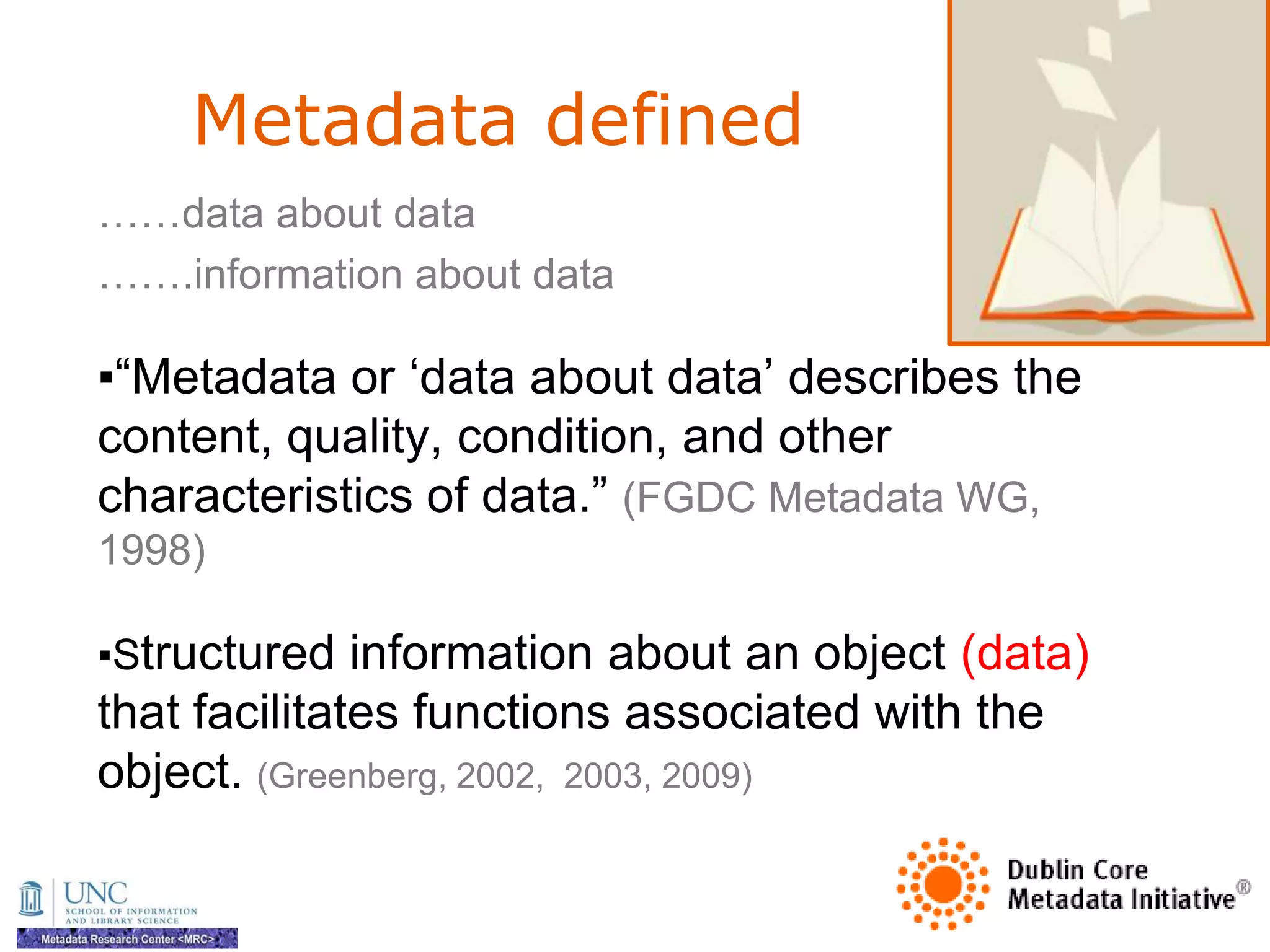
Metadata defined
……data about data
…….information about data

▪―Metadata or ‗data about data‘ describes the
content, quality, condition, and other
characteristics of data.‖ (FGDC Metadata WG,
1998)

▪Structured information about an object (data)
that facilitates functions associated with the
object. (Greenberg, 2002, 2003, 2009)
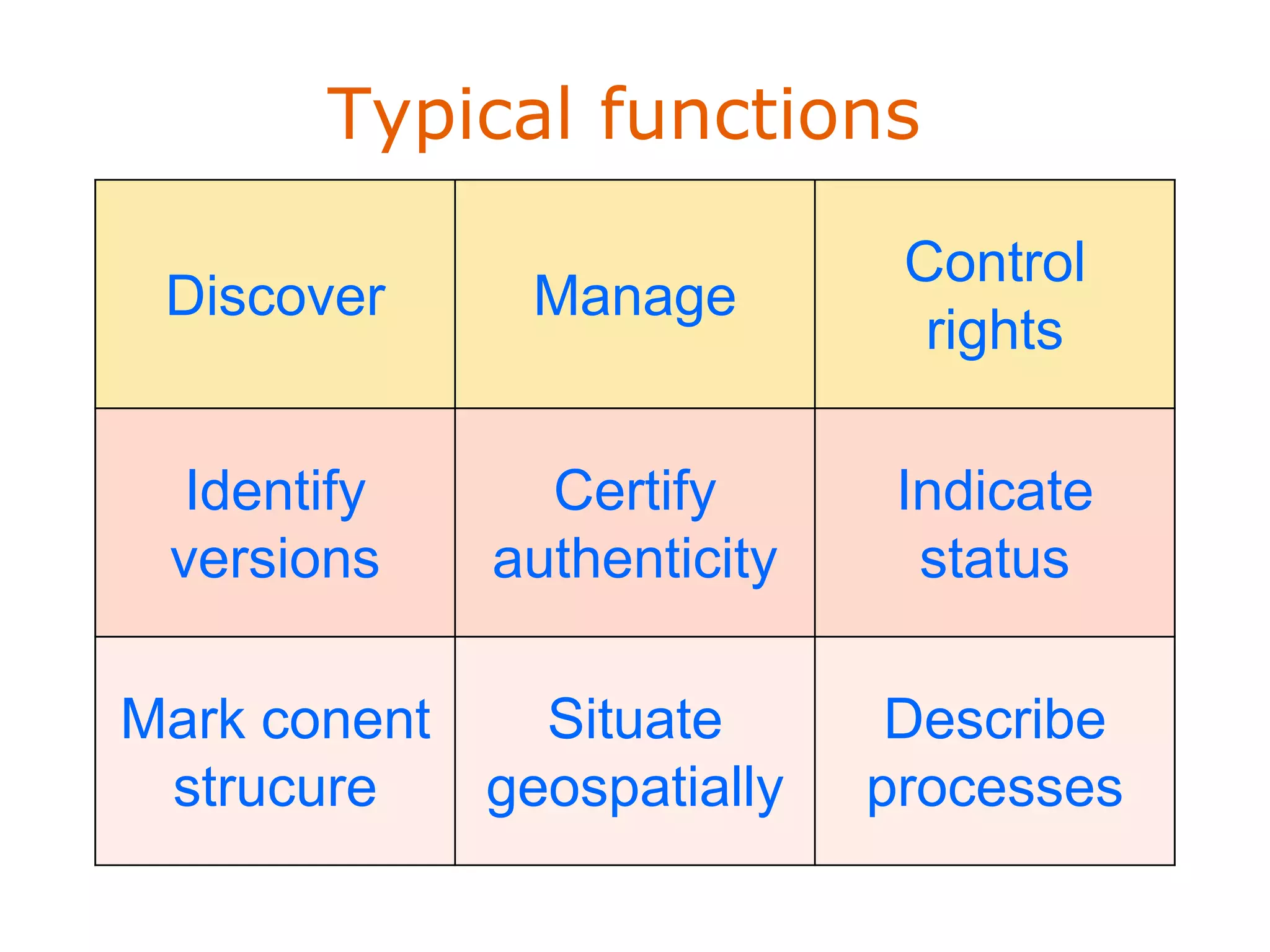
Typical functions

                             Control
 Discover     Manage
                              rights

  Identify     Certify       Indicate
 versions    authenticity     status

Mark conent   Situate        Describe
 strucure   geospatially    processes
Overview
▪ Why should we care?
▪ What is data?
▪ What is metadata‘s role w.r.t data?

▪ Selected metadata standards
▪ Challenges, opportunities, and jumping in
▪ Concluding comments
▪ Q&A
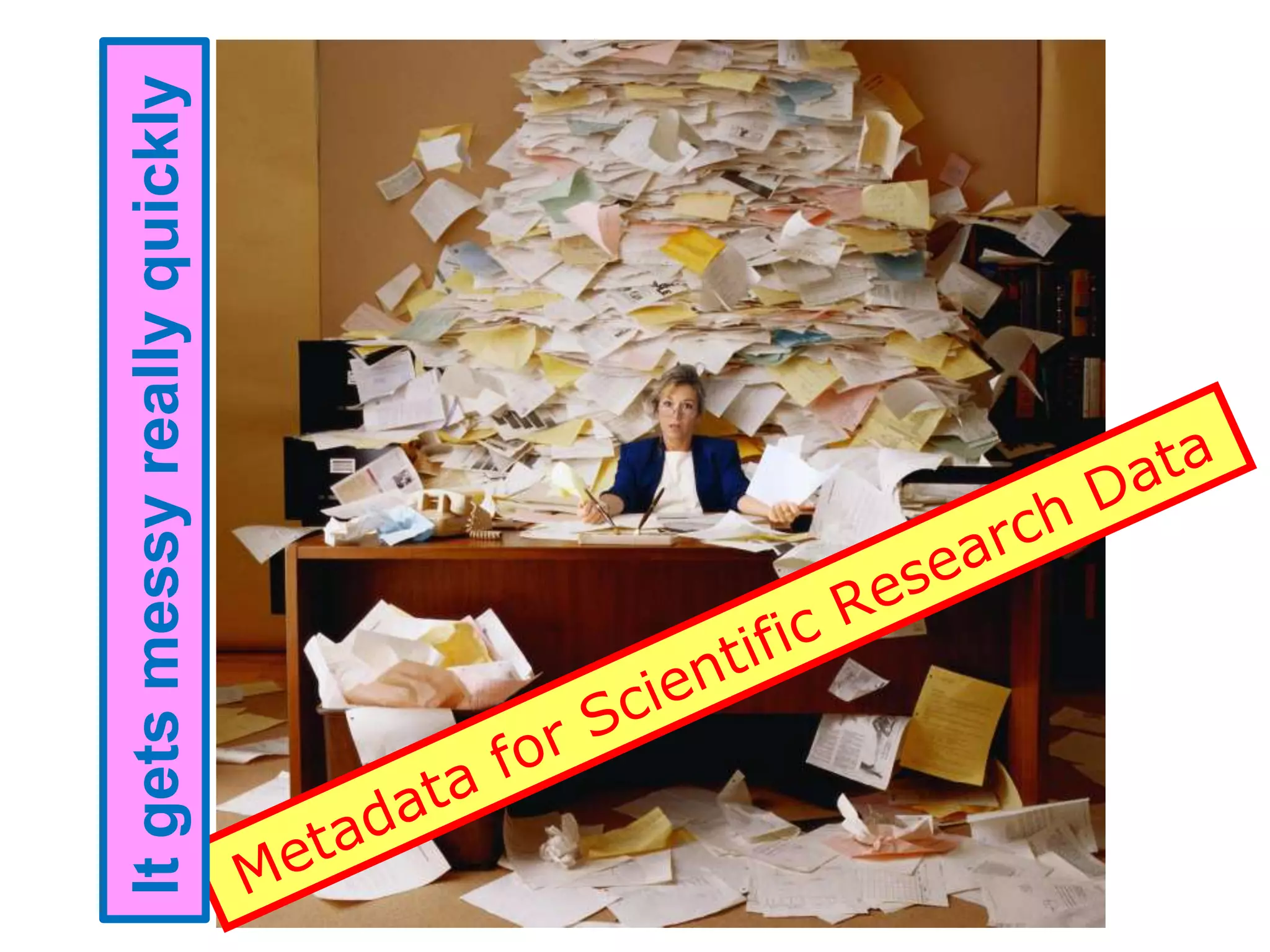
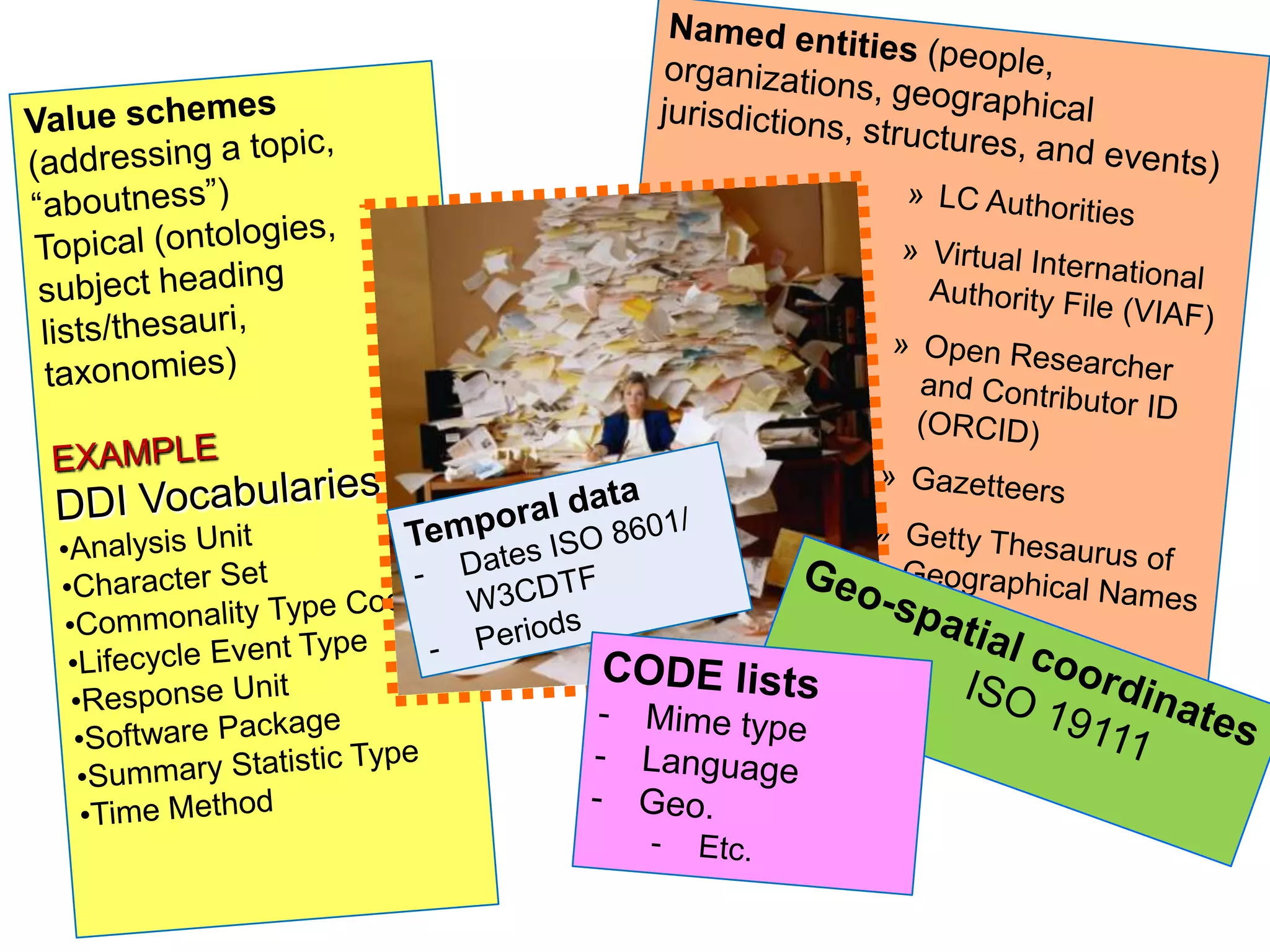
It gets messy really quickly
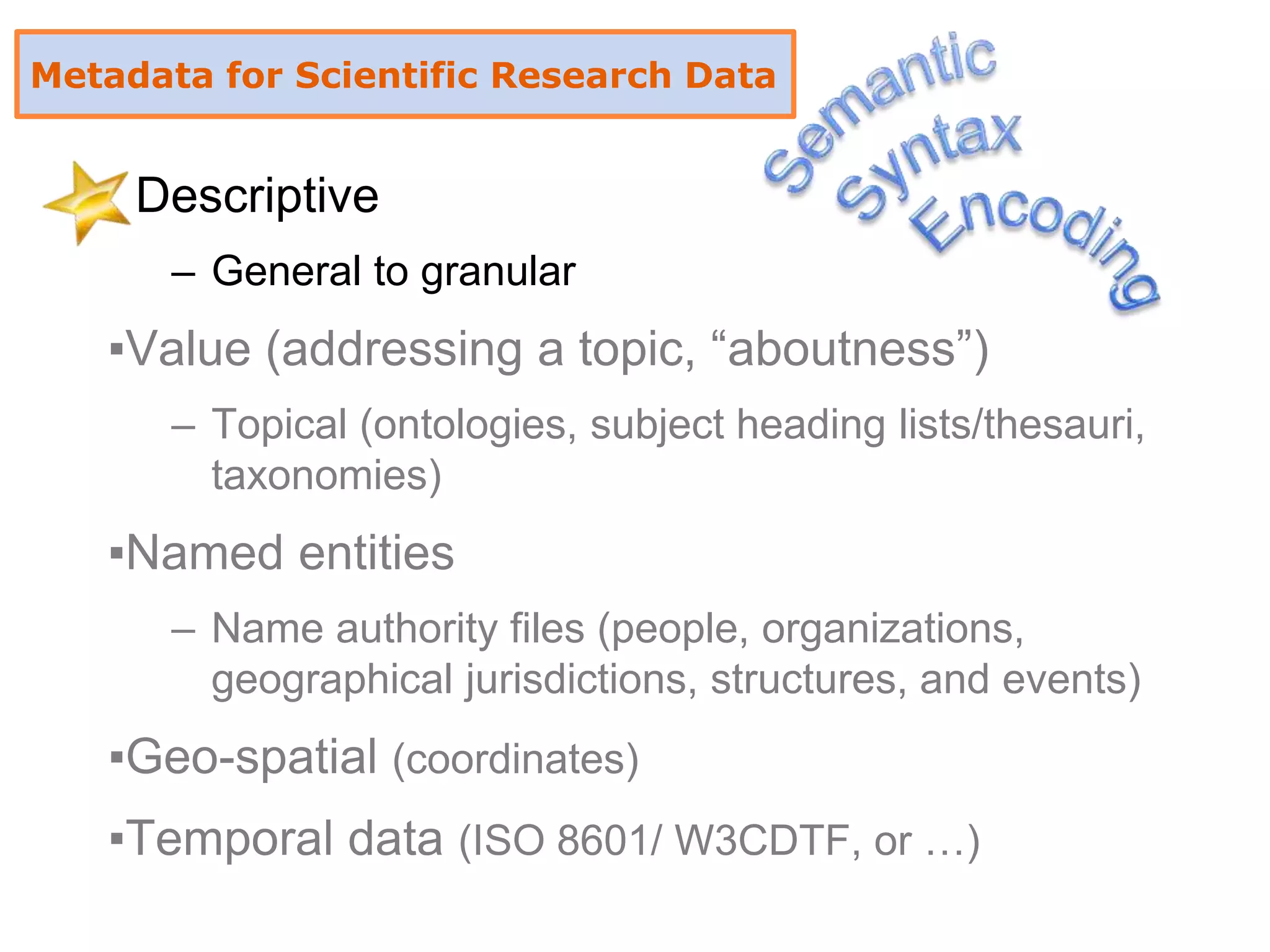
Metadata for Scientific Research Data


     Descriptive
       – General to granular
   ▪Value (addressing a topic, ―aboutness‖)
       – Topical (ontologies, subject heading lists/thesauri,
         taxonomies)
   ▪Named entities
       – Name authority files (people, organizations,
         geographical jurisdictions, structures, and events)
   ▪Geo-spatial (coordinates)
   ▪Temporal data (ISO 8601/ W3CDTF, or …)
Given the messiness…

―I cannot tell you exactly what metadata
standards, vocabularies, etc. to use…‖
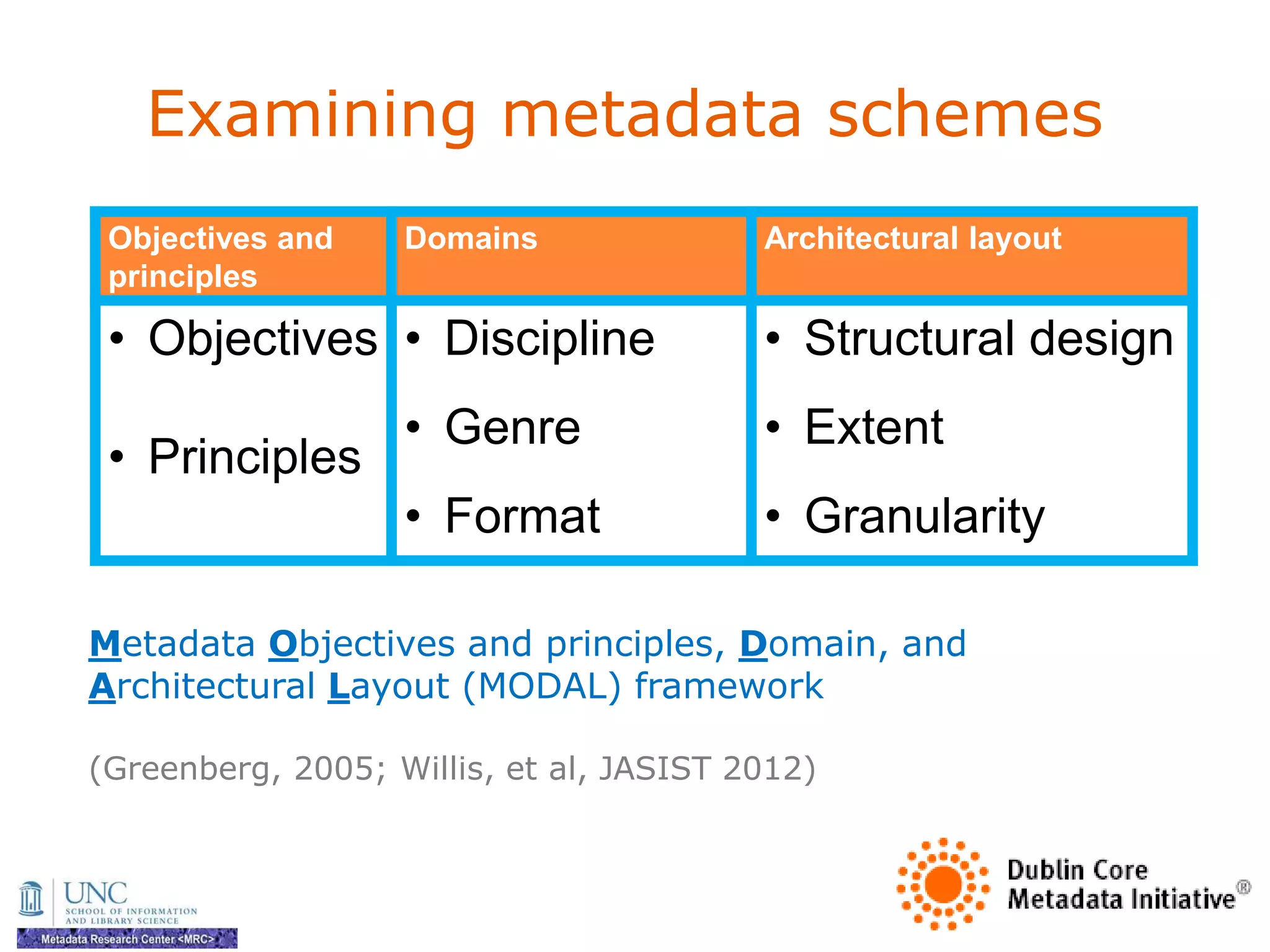
Examining metadata schemes
 Objectives and    Domains               Architectural layout
 principles

 • Objectives • Discipline               • Structural design
                   • Genre               • Extent
 • Principles
                   • Format              • Granularity

Metadata Objectives and principles, Domain, and
Architectural Layout (MODAL) framework

(Greenberg, 2005; Willis, et al, JASIST 2012)
Objectives and    Domains           Architectural
Simple          principles                          layout
schemes
[6]             • Interoperability • Multi-         • Primarily flat
                • Easy to            disciplinary   • Minimal with
                  generate,        • Any genre or     means to
                  lower barrier      format           extend
                  to produce                        • General (not
                                                      granular)
Dublin Core
Metadata
Element Set
(DCMES)
ver.1.1
US MARC         • Need training                     • Primarily flat
bibliographic                                       • Extensible
format
DataCite                                            • Primarily flat
Dublin Core
    Application
    Profile-
    Dryad [7]



DataCite example, ver.2.2 [8]
National Institute for
Environmental Studies and
Center for Climate System
Research Japan
US MARC bibliographic
format: World Ocean
Circulation Experiment global
data (Moss Landing Marine
Labs and the Monterey Bay
Aquarium Research Institute
Library) [9]
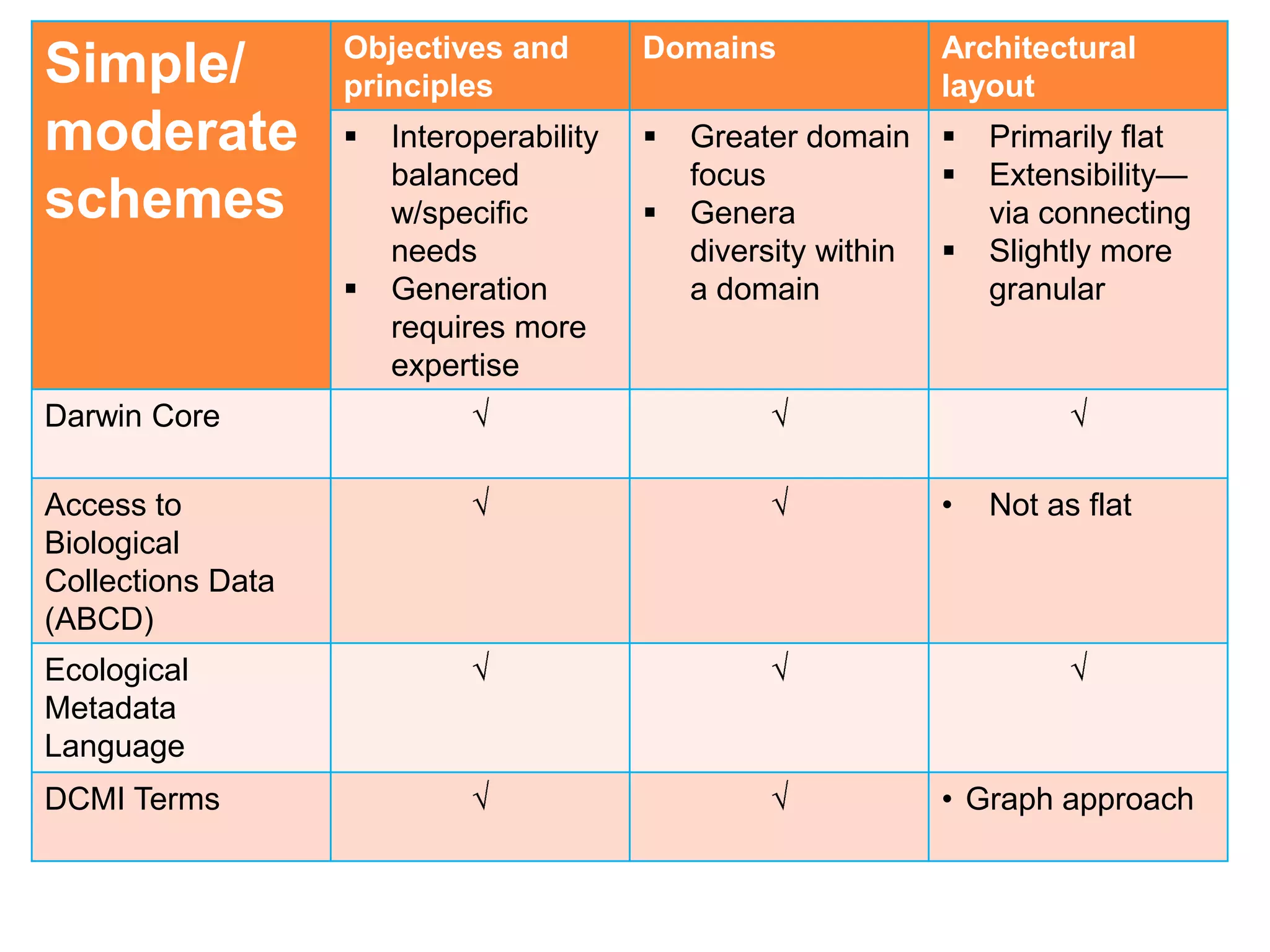
Objectives and         Domains              Architectural
Simple/            principles                                  layout
moderate              Interoperability      Greater domain      Primarily flat
                       balanced               focus               Extensibility—
schemes                w/specific            Genera               via connecting
                       needs                  diversity within    Slightly more
                      Generation             a domain             granular
                       requires more
                       expertise
Darwin Core

Access to                                                      •   Not as flat
Biological
Collections Data
(ABCD)
Ecological
Metadata
Language
DCMI Terms                                                     • Graph approach
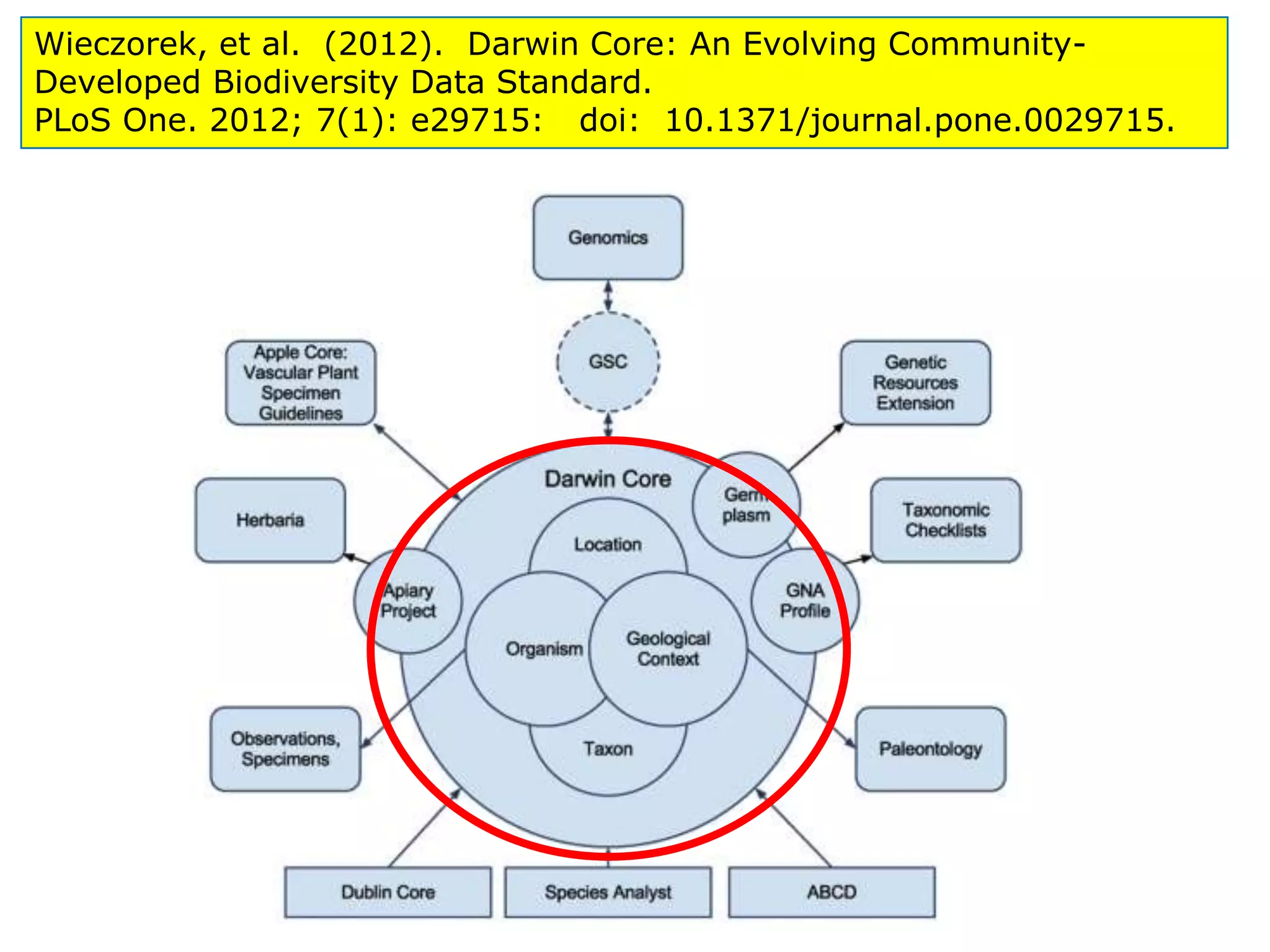
Wieczorek, et al. (2012). Darwin Core: An Evolving Community-
Developed Biodiversity Data Standard.
PLoS One. 2012; 7(1): e29715: doi: 10.1371/journal.pone.0029715.
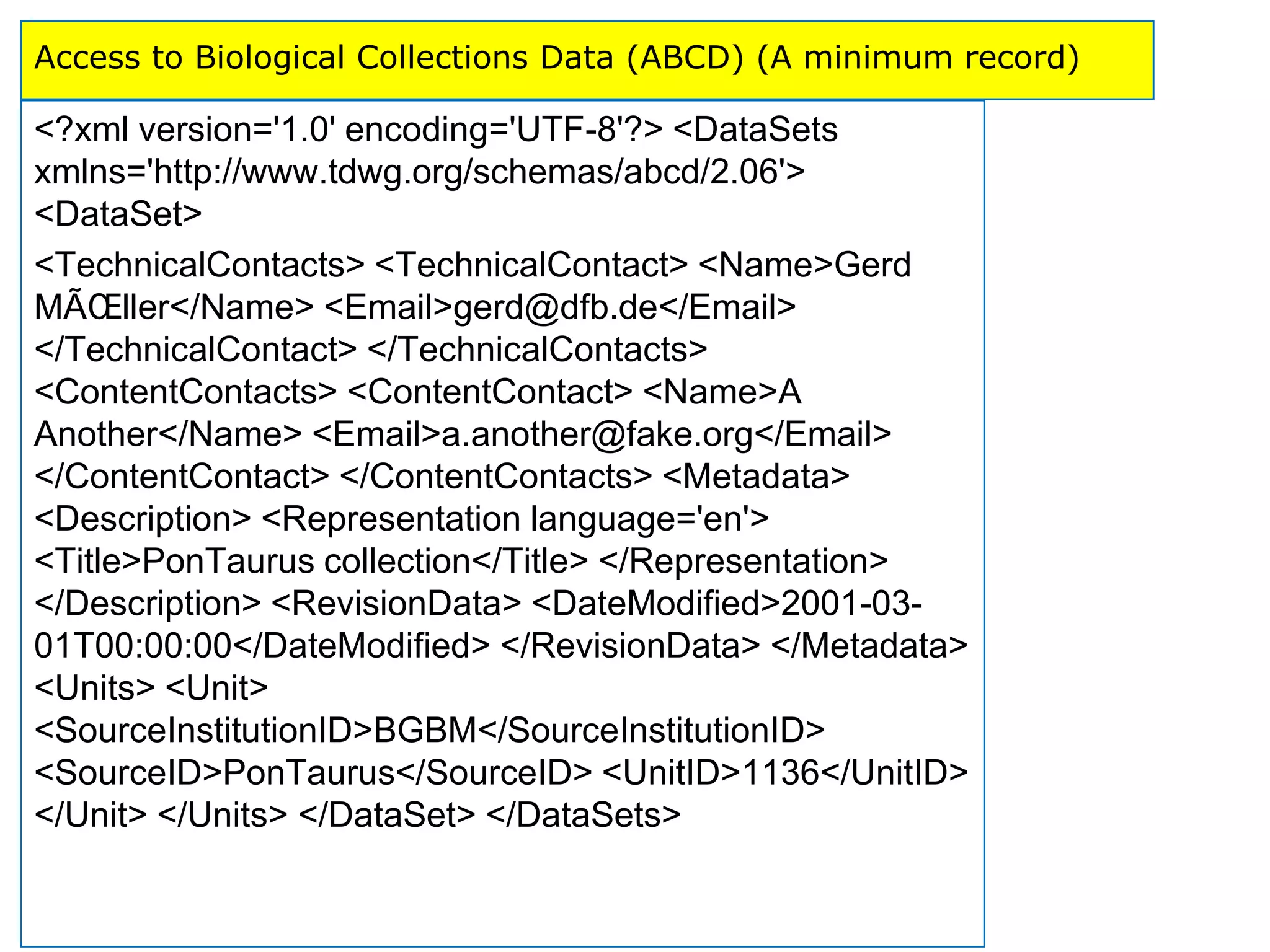
Access to Biological Collections Data (ABCD) (A minimum record)

<?xml version='1.0' encoding='UTF-8'?> <DataSets
xmlns='http://www.tdwg.org/schemas/abcd/2.06'>
<DataSet>
<TechnicalContacts> <TechnicalContact> <Name>Gerd
MÃŒller</Name> <Email>gerd@dfb.de</Email>
</TechnicalContact> </TechnicalContacts>
<ContentContacts> <ContentContact> <Name>A
Another</Name> <Email>a.another@fake.org</Email>
</ContentContact> </ContentContacts> <Metadata>
<Description> <Representation language='en'>
<Title>PonTaurus collection</Title> </Representation>
</Description> <RevisionData> <DateModified>2001-03-
01T00:00:00</DateModified> </RevisionData> </Metadata>
<Units> <Unit>
<SourceInstitutionID>BGBM</SourceInstitutionID>
<SourceID>PonTaurus</SourceID> <UnitID>1136</UnitID>
</Unit> </Units> </DataSet> </DataSets>
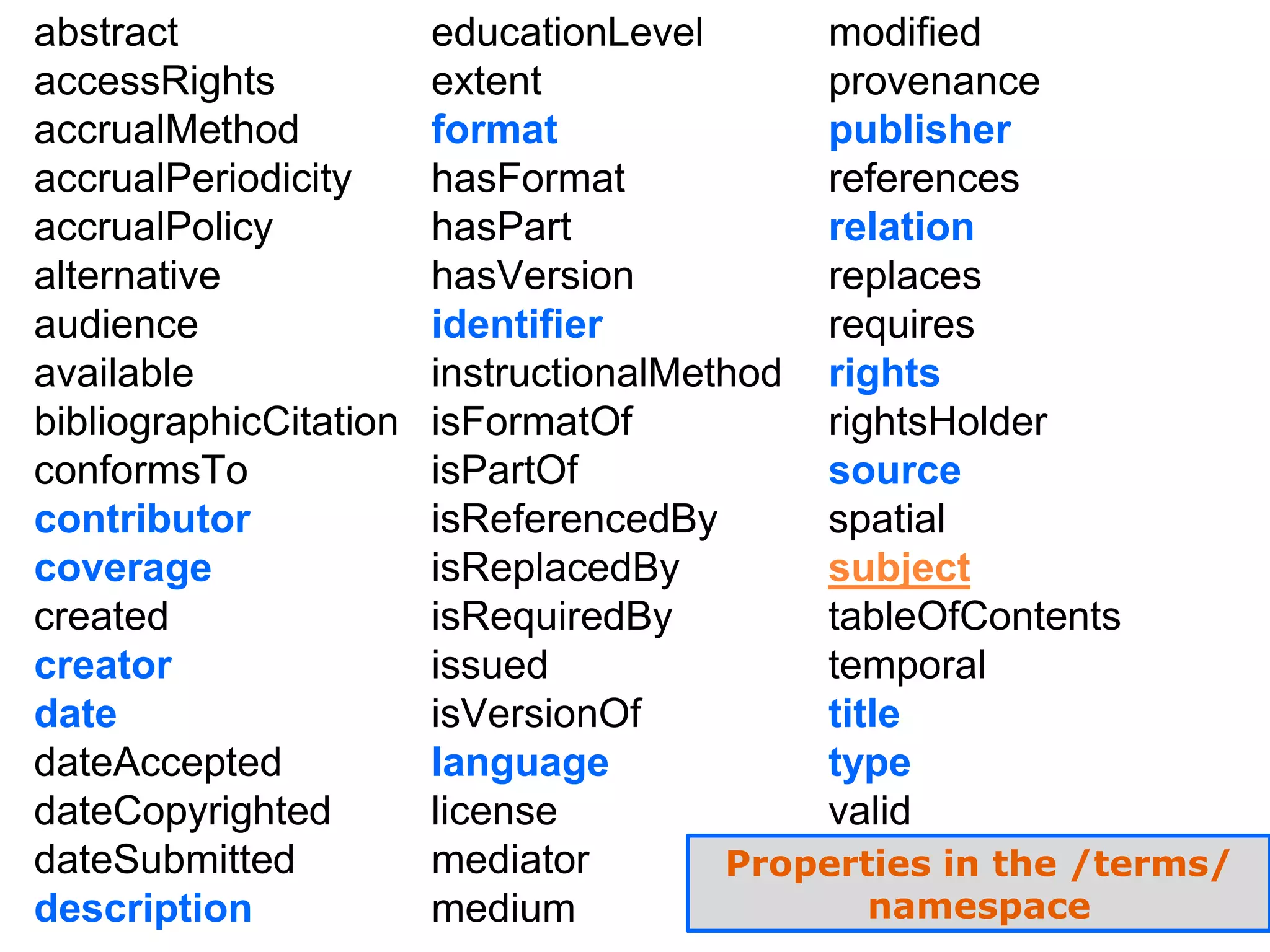
abstract                educationLevel      modified
accessRights            extent              provenance
accrualMethod           format              publisher
accrualPeriodicity      hasFormat           references
accrualPolicy           hasPart             relation
alternative             hasVersion          replaces
audience                identifier          requires
available               instructionalMethod rights
bibliographicCitation   isFormatOf          rightsHolder
conformsTo              isPartOf            source
contributor             isReferencedBy      spatial
coverage                isReplacedBy        subject
created                 isRequiredBy        tableOfContents
creator                 issued              temporal
date                    isVersionOf         title
dateAccepted            language            type
dateCopyrighted         license             valid
dateSubmitted           mediator        Properties in the /terms/
description             medium                 namespace
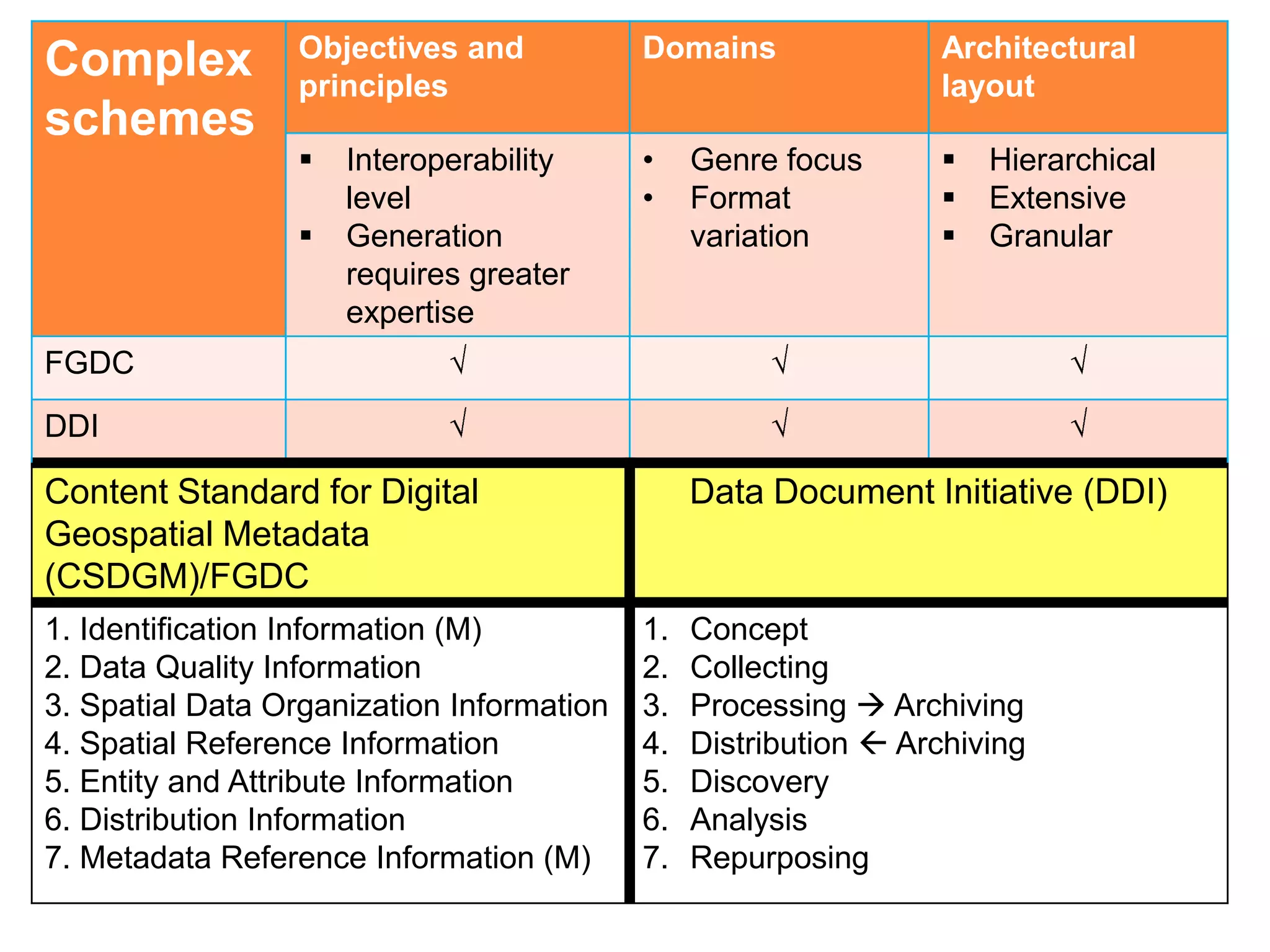
Objectives and           Domains               Architectural
Complex           principles                                     layout
schemes
                     Interoperability     •    Genre focus         Hierarchical
                      level                •    Format              Extensive
                     Generation                variation           Granular
                      requires greater
                      expertise
FGDC
DDI

Content Standard for Digital                    Data Document Initiative (DDI)
Geospatial Metadata
(CSDGM)/FGDC
1. Identification Information (M)          1.   Concept
2. Data Quality Information                2.   Collecting
3. Spatial Data Organization Information   3.   Processing  Archiving
4. Spatial Reference Information           4.   Distribution  Archiving
5. Entity and Attribute Information        5.   Discovery
6. Distribution Information                6.   Analysis
7. Metadata Reference Information (M)      7.   Repurposing
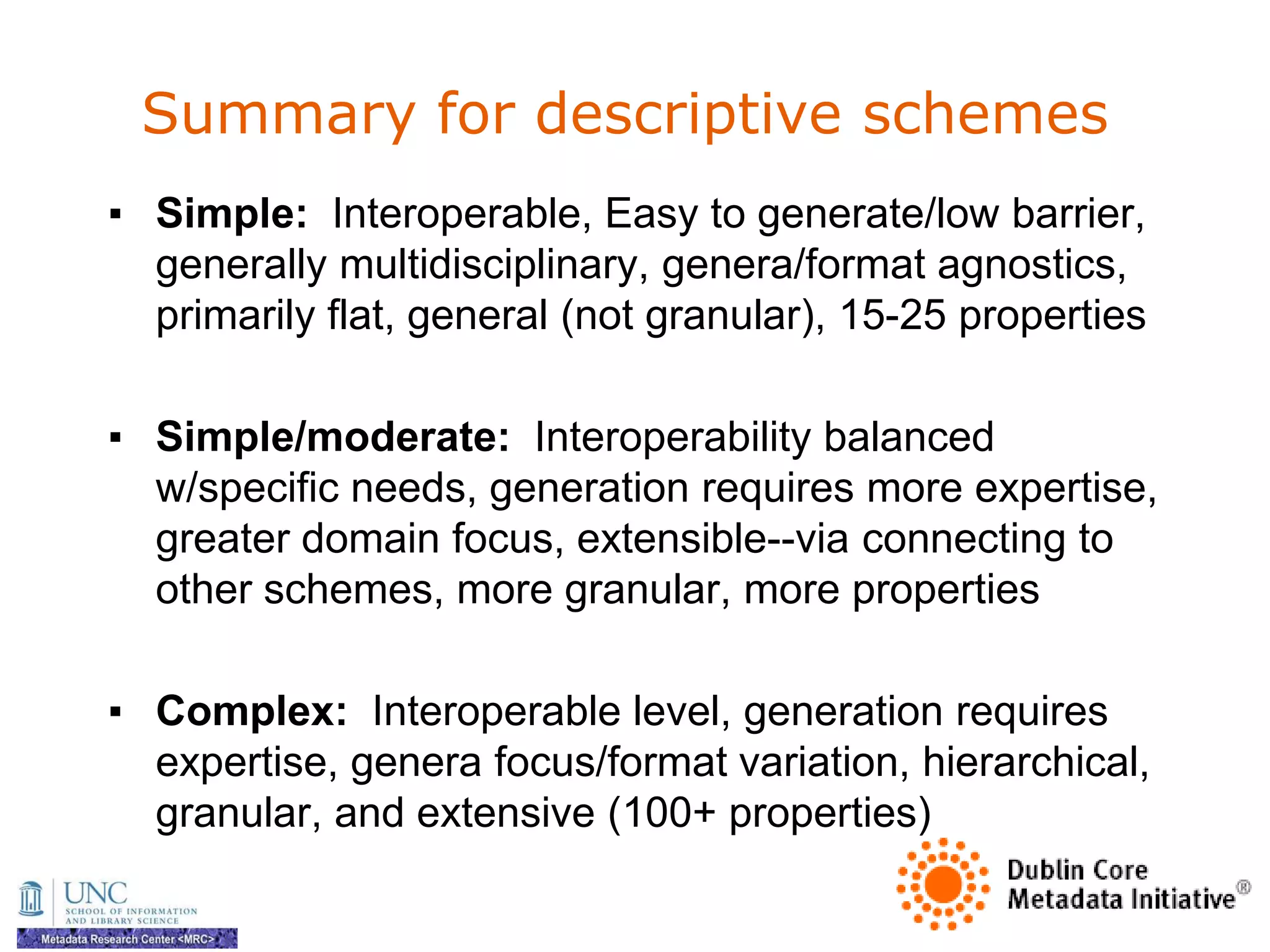
Summary for descriptive schemes
▪ Simple: Interoperable, Easy to generate/low barrier,
  generally multidisciplinary, genera/format agnostics,
  primarily flat, general (not granular), 15-25 properties

▪ Simple/moderate: Interoperability balanced
  w/specific needs, generation requires more expertise,
  greater domain focus, extensible--via connecting to
  other schemes, more granular, more properties

▪ Complex: Interoperable level, generation requires
  expertise, genera focus/format variation, hierarchical,
  granular, and extensive (100+ properties)
Overview
▪   Why should we care?
▪   What is data?
▪   What is metadata‘s role w.r.t data?
▪   Selected metadata standards
▪ Challenges, opportunities, and jumping in
▪ Concluding comments
▪ Q&A
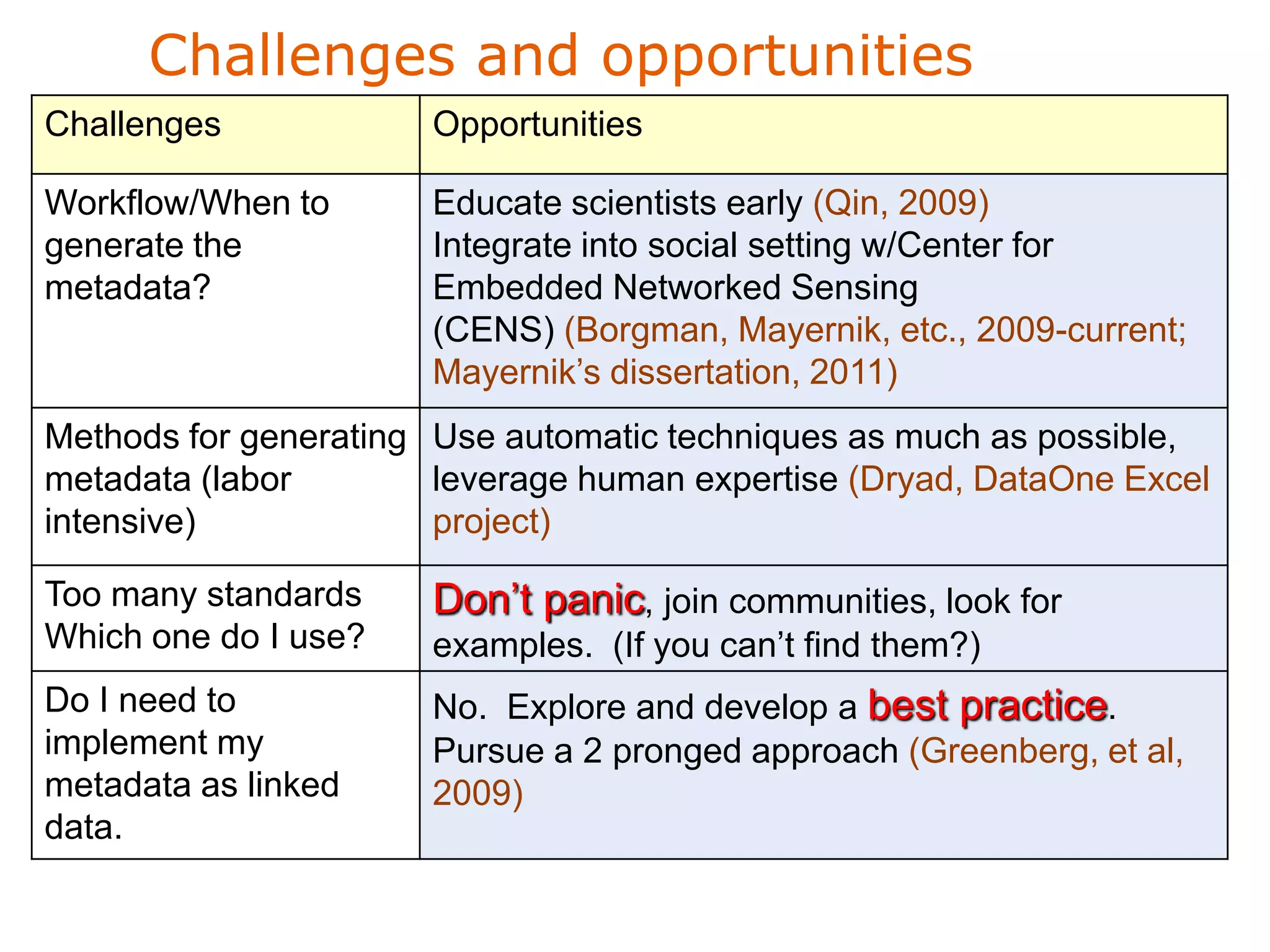
Challenges and opportunities
Challenges            Opportunities

Workflow/When to  Educate scientists early (Qin, 2009)
   ▪ Stop
generate the here Integrate into social setting w/Center for
metadata?         Embedded Networked Sensing
                  (CENS) (Borgman, Mayernik, etc., 2009-current;
                  Mayernik‘s dissertation, 2011)
Methods for generating Use automatic techniques as much as possible,
metadata (labor        leverage human expertise (Dryad, DataOne Excel
intensive)             project)

Too many standards    Don‘t panic, join communities, look for
Which one do I use?   examples. (If you can‘t find them?)
Do I need to          No. Explore and develop a best practice.
implement my          Pursue a 2 pronged approach (Greenberg, et al,
metadata as linked    2009)
data.
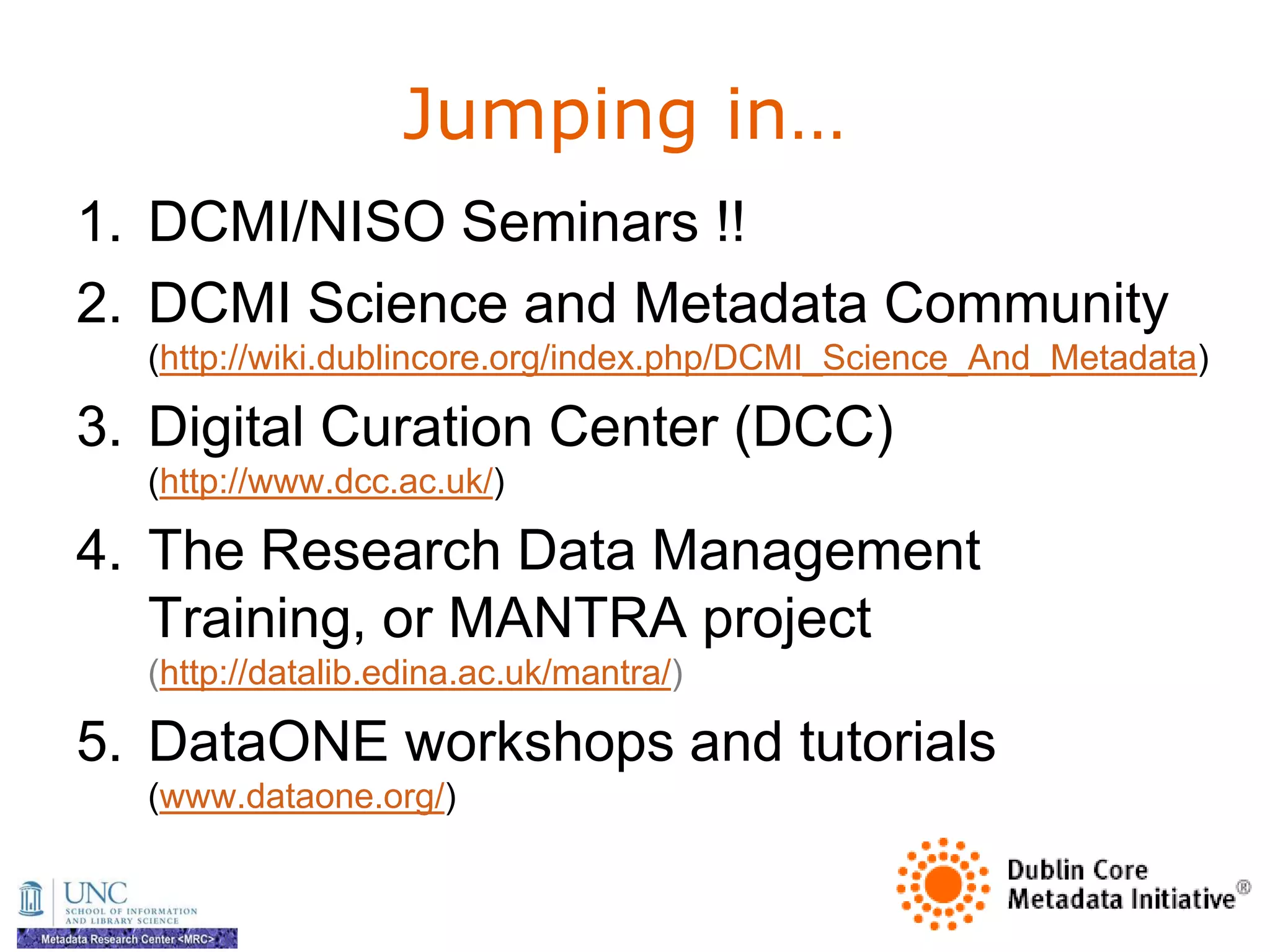
Jumping in…
1. DCMI/NISO Seminars !!
2. DCMI Science and Metadata Community
  (http://wiki.dublincore.org/index.php/DCMI_Science_And_Metadata)

3. Digital Curation Center (DCC)
  (http://www.dcc.ac.uk/)

4. The Research Data Management
   Training, or MANTRA project
  (http://datalib.edina.ac.uk/mantra/)

5. DataONE workshops and tutorials
  (www.dataone.org/)
Overview
▪   Why should we care?
▪   What is data?
▪   What is metadata‘s role w.r.t data?
▪   Selected metadata standards
▪   Challenges, opportunities, and jumping in
▪ Concluding comments
▪ Q&A
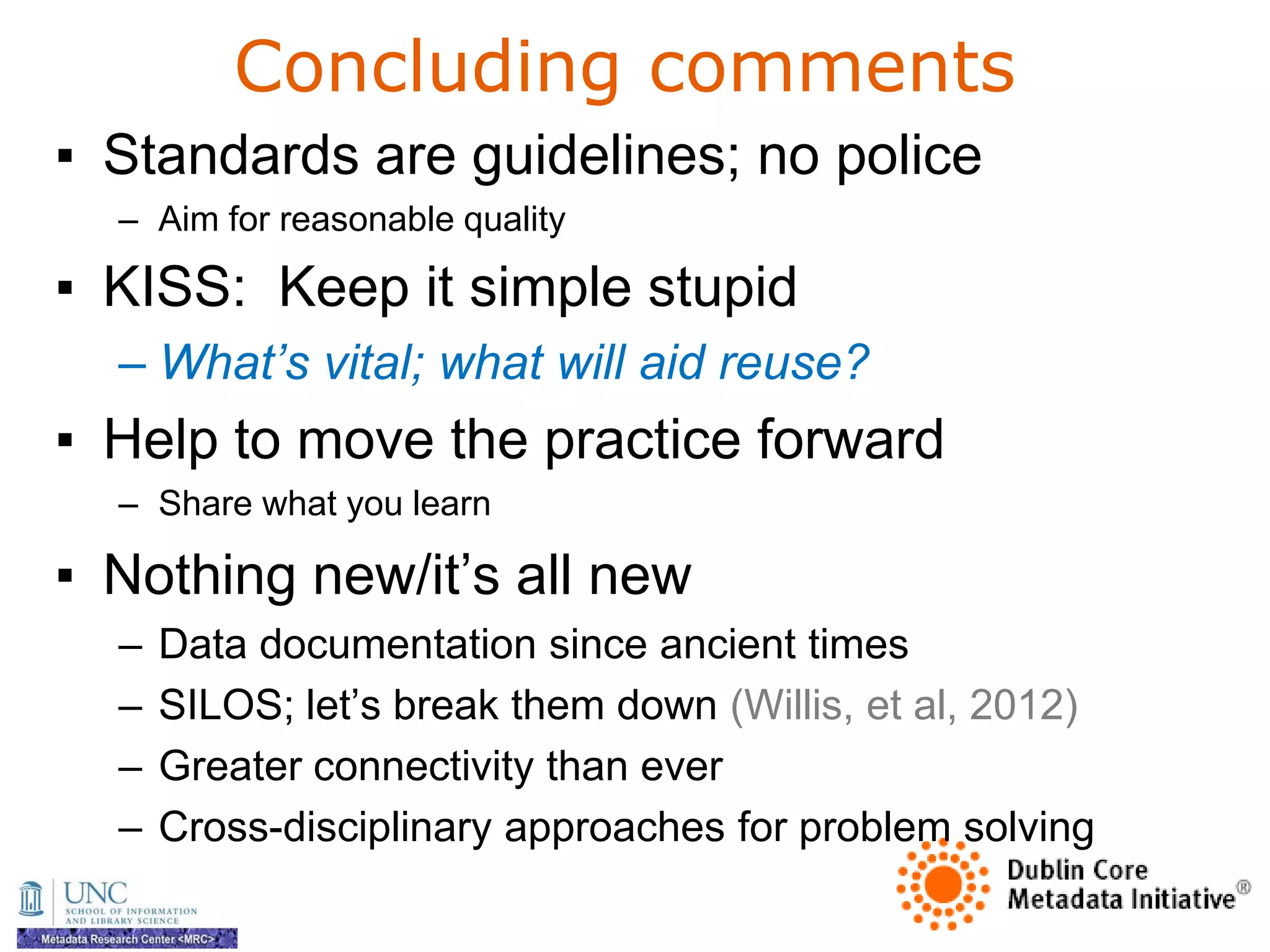
Concluding comments
▪ Standards are guidelines; no police
  – Aim for reasonable quality

▪ KISS: Keep it simple stupid
  – What’s vital; what will aid reuse?
▪ Help to move the practice forward
  – Share what you learn

▪ Nothing new/it‘s all new
  –   Data documentation since ancient times
  –   SILOS; let‘s break them down (Willis, et al, 2012)
  –   Greater connectivity than ever
  –   Cross-disciplinary approaches for problem solving
Overview
▪   Why should we care?
▪   What is data?
▪   What is metadata‘s role w.r.t data?
▪   Selected metadata standards
▪   Challenges, opportunities, and jumping in
▪   Concluding comments

▪ Q&A
Footnotes
[1] NSF Data Sharing Policy: http://www.nsf.gov/bfa/dias/policy/dmp.jsp.
[2] NIH Data Sharing Policy: http://grants.nih.gov/grants/policy/data_sharing/.
[3] ORGANISATION FOR ECONOMIC CO-OPERATION AND DEVELOPMENT/Data and
Metadata Reporting and Presentation Handbook: http://www.oecd.org/std/37671574.pdf.
[4] The INSPIRE Infrastructure for Spatial Information in the European Community):
http://inspire.ec.europa.eu/index.cfm/pageid/48. directive released 15 May 2007 and will be
implemented in various stages, with full implementation required by 2019, and aims to create a
European Union (EU) spatial data infrastructure.
[5] UK medical research council:
http://www.mrc.ac.uk/Ourresearch/Ethicsresearchguidance/datasharing/index.html.
[6] The DCMI Glossary (scroll down for ―schema‖ entry):
http://dublincore.org/documents/usageguide/glossary.shtml#schema.
[7] Dublin Core Example: Data from: Divergence time estimation using fossils as terminal taxa
and the origins of Lissamphibia (Dryad repository):
http://datadryad.org/resource/doi:10.5061/dryad.8120?show=full.
[8] National Institute for Environmental Studies and Center for Climate System Research
Japan—animation data (DataCite): http://schema.datacite.org/meta/kernel-
2.2/example/datacite-metadata-sample-v2.2.xml.
[9] US MARC bibliographic format: World Ocean Circulation Experiment global data (Moss
Landing Marine Labs and the Monterey Bay Aquarium Research Institute Library):
http://mlml.kohalibrary.com/cgi-bin/koha/opac-detail.pl?biblionumber=9282.

NISO/DCMI Webinar: Metadata for Managing Scientific Research Data

  • 1.
    Metadata for Managing Scientific Research Data NISO/DCMI Webinar: August 22, 2012 Jane Greenberg, Professor and Director of the SILS Metadata Research Center janeg@email.unc.edu
  • 2.
    Overview ▪ Why should we care? ▪ What is data? ▪ What is metadata‘s role w.r.t data? ▪ Selected metadata standards ▪ Challenges, opportunities, and jumping in ▪ Concluding comments ▪ Q&A
  • 3.
    Why should wecare? BIG stuff ▪ Digital data deluge (Hey & Trefethen, 2003) ▪ Big data (New York Times) 2008 ▪ The fourth paradigm (Jim Gray, 2007) Just as important ▪ The long tail (Heidorn, 2008) ▪ CODATA/Data-at-Risk Task Group ▪ Scholarly communications, data citation Technological affordances for improving and advancing science
  • 4.
    Cultural shift towarddata sharing ▪ National and international policies – US NSF and NIH [1, 2] – OECD (Organisation for Economic Co-operation and Development) [3] – INSPIRE Infrastructure for Spatial Information in the European Community EU Commission [4] – UK Medical Research Council [5] Dryad ―enables scientists to validate published findings, explore new analysis methodologies, repurpose data for research questions unanticipated by the original authors, and perform synthetic studies.‖ (http://datadryad.org/)
  • 5.
    Overview ▪ Why shouldwe care? ▪ What is data? ▪ What is metadata‘s role w.r.t data? ▪ Selected metadata standards ▪ Challenges, opportunities, and jumping in ▪ Concluding comments ▪ Q&A
  • 6.
    Data ▪ No singleagreed upon definition ▪ One person‘s data is another person‘s information ▪ Data often implies the ―raw‖ stuff lacking context – Scholarly context, written assessment ▪ ―Essence of science‖ (Greenberg, et al, 2009) ▪ What is science? – The Archaeology Data Service (ADS) archaeologydataservice.ac.uk
  • 7.
    Data quantity type The Dryad Repository 3162 Plain Text I know it when I see it 476 Microsoft Excel 308 Adobe Portable Document Format By example: Traditional 302 Comma-separated values observations, numbers, and 252 Nexus measures stored in spreadsheets 153 Microsoft Excel OpenXML and databases, fossils, 108 Microsoft Word phylogenetic trees, and herbarium 80 Zip file samples (White, 2008) 62 JPEG image 45 Microsoft Word OpenXML Other disciplines 40 Extensible Markup Language ▪ Bioinformatics: Gene 35 Hypertext Markup Language expressions, DNA transcription 21 Rich Text Format to RNA translation 16 FASTA sequence file 15 Tag Image File Format ▪ Geology, agriculture, 14 Postscript Files surveillance, and historical 2 Video Quicktime manuscript research: 2 Mathematica Notebook Hyperspectral remote sensing 1 Microsoft Powerpoint (email w/R. Scherle, July 2012)
  • 8.
    Overview ▪ Why shouldwe care? ▪ What is data? ▪ What is metadata‘s role w.r.t data? ▪ Selected metadata standards ▪ Challenges, opportunities, and jumping in ▪ Concluding comments ▪ Q&A
  • 9.
    Metadata defined ……data aboutdata …….information about data ▪―Metadata or ‗data about data‘ describes the content, quality, condition, and other characteristics of data.‖ (FGDC Metadata WG, 1998) ▪Structured information about an object (data) that facilitates functions associated with the object. (Greenberg, 2002, 2003, 2009)
  • 10.
    Typical functions Control Discover Manage rights Identify Certify Indicate versions authenticity status Mark conent Situate Describe strucure geospatially processes
  • 11.
    Overview ▪ Why shouldwe care? ▪ What is data? ▪ What is metadata‘s role w.r.t data? ▪ Selected metadata standards ▪ Challenges, opportunities, and jumping in ▪ Concluding comments ▪ Q&A
  • 12.
    It gets messyreally quickly
  • 13.
    Metadata for ScientificResearch Data Descriptive – General to granular ▪Value (addressing a topic, ―aboutness‖) – Topical (ontologies, subject heading lists/thesauri, taxonomies) ▪Named entities – Name authority files (people, organizations, geographical jurisdictions, structures, and events) ▪Geo-spatial (coordinates) ▪Temporal data (ISO 8601/ W3CDTF, or …)
  • 14.
    Given the messiness… ―Icannot tell you exactly what metadata standards, vocabularies, etc. to use…‖
  • 15.
    Examining metadata schemes Objectives and Domains Architectural layout principles • Objectives • Discipline • Structural design • Genre • Extent • Principles • Format • Granularity Metadata Objectives and principles, Domain, and Architectural Layout (MODAL) framework (Greenberg, 2005; Willis, et al, JASIST 2012)
  • 16.
    Objectives and Domains Architectural Simple principles layout schemes [6] • Interoperability • Multi- • Primarily flat • Easy to disciplinary • Minimal with generate, • Any genre or means to lower barrier format extend to produce • General (not granular) Dublin Core Metadata Element Set (DCMES) ver.1.1 US MARC • Need training • Primarily flat bibliographic • Extensible format DataCite • Primarily flat
  • 17.
    Dublin Core Application Profile- Dryad [7] 
  • 18.
    DataCite example, ver.2.2[8] National Institute for Environmental Studies and Center for Climate System Research Japan
  • 19.
    US MARC bibliographic format:World Ocean Circulation Experiment global data (Moss Landing Marine Labs and the Monterey Bay Aquarium Research Institute Library) [9]
  • 20.
    Objectives and Domains Architectural Simple/ principles layout moderate  Interoperability  Greater domain  Primarily flat balanced focus  Extensibility— schemes w/specific  Genera via connecting needs diversity within  Slightly more  Generation a domain granular requires more expertise Darwin Core Access to • Not as flat Biological Collections Data (ABCD) Ecological Metadata Language DCMI Terms • Graph approach
  • 21.
    Wieczorek, et al.(2012). Darwin Core: An Evolving Community- Developed Biodiversity Data Standard. PLoS One. 2012; 7(1): e29715: doi: 10.1371/journal.pone.0029715.
  • 22.
    Access to BiologicalCollections Data (ABCD) (A minimum record) <?xml version='1.0' encoding='UTF-8'?> <DataSets xmlns='http://www.tdwg.org/schemas/abcd/2.06'> <DataSet> <TechnicalContacts> <TechnicalContact> <Name>Gerd MÃŒller</Name> <Email>gerd@dfb.de</Email> </TechnicalContact> </TechnicalContacts> <ContentContacts> <ContentContact> <Name>A Another</Name> <Email>a.another@fake.org</Email> </ContentContact> </ContentContacts> <Metadata> <Description> <Representation language='en'> <Title>PonTaurus collection</Title> </Representation> </Description> <RevisionData> <DateModified>2001-03- 01T00:00:00</DateModified> </RevisionData> </Metadata> <Units> <Unit> <SourceInstitutionID>BGBM</SourceInstitutionID> <SourceID>PonTaurus</SourceID> <UnitID>1136</UnitID> </Unit> </Units> </DataSet> </DataSets>
  • 23.
    abstract educationLevel modified accessRights extent provenance accrualMethod format publisher accrualPeriodicity hasFormat references accrualPolicy hasPart relation alternative hasVersion replaces audience identifier requires available instructionalMethod rights bibliographicCitation isFormatOf rightsHolder conformsTo isPartOf source contributor isReferencedBy spatial coverage isReplacedBy subject created isRequiredBy tableOfContents creator issued temporal date isVersionOf title dateAccepted language type dateCopyrighted license valid dateSubmitted mediator Properties in the /terms/ description medium namespace
  • 24.
    Objectives and Domains Architectural Complex principles layout schemes  Interoperability • Genre focus  Hierarchical level • Format  Extensive  Generation variation  Granular requires greater expertise FGDC DDI Content Standard for Digital Data Document Initiative (DDI) Geospatial Metadata (CSDGM)/FGDC 1. Identification Information (M) 1. Concept 2. Data Quality Information 2. Collecting 3. Spatial Data Organization Information 3. Processing  Archiving 4. Spatial Reference Information 4. Distribution  Archiving 5. Entity and Attribute Information 5. Discovery 6. Distribution Information 6. Analysis 7. Metadata Reference Information (M) 7. Repurposing
  • 25.
    Summary for descriptiveschemes ▪ Simple: Interoperable, Easy to generate/low barrier, generally multidisciplinary, genera/format agnostics, primarily flat, general (not granular), 15-25 properties ▪ Simple/moderate: Interoperability balanced w/specific needs, generation requires more expertise, greater domain focus, extensible--via connecting to other schemes, more granular, more properties ▪ Complex: Interoperable level, generation requires expertise, genera focus/format variation, hierarchical, granular, and extensive (100+ properties)
  • 27.
    Overview ▪ Why should we care? ▪ What is data? ▪ What is metadata‘s role w.r.t data? ▪ Selected metadata standards ▪ Challenges, opportunities, and jumping in ▪ Concluding comments ▪ Q&A
  • 28.
    Challenges and opportunities Challenges Opportunities Workflow/When to Educate scientists early (Qin, 2009) ▪ Stop generate the here Integrate into social setting w/Center for metadata? Embedded Networked Sensing (CENS) (Borgman, Mayernik, etc., 2009-current; Mayernik‘s dissertation, 2011) Methods for generating Use automatic techniques as much as possible, metadata (labor leverage human expertise (Dryad, DataOne Excel intensive) project) Too many standards Don‘t panic, join communities, look for Which one do I use? examples. (If you can‘t find them?) Do I need to No. Explore and develop a best practice. implement my Pursue a 2 pronged approach (Greenberg, et al, metadata as linked 2009) data.
  • 29.
    Jumping in… 1. DCMI/NISOSeminars !! 2. DCMI Science and Metadata Community (http://wiki.dublincore.org/index.php/DCMI_Science_And_Metadata) 3. Digital Curation Center (DCC) (http://www.dcc.ac.uk/) 4. The Research Data Management Training, or MANTRA project (http://datalib.edina.ac.uk/mantra/) 5. DataONE workshops and tutorials (www.dataone.org/)
  • 30.
    Overview ▪ Why should we care? ▪ What is data? ▪ What is metadata‘s role w.r.t data? ▪ Selected metadata standards ▪ Challenges, opportunities, and jumping in ▪ Concluding comments ▪ Q&A
  • 31.
    Concluding comments ▪ Standardsare guidelines; no police – Aim for reasonable quality ▪ KISS: Keep it simple stupid – What’s vital; what will aid reuse? ▪ Help to move the practice forward – Share what you learn ▪ Nothing new/it‘s all new – Data documentation since ancient times – SILOS; let‘s break them down (Willis, et al, 2012) – Greater connectivity than ever – Cross-disciplinary approaches for problem solving
  • 32.
    Overview ▪ Why should we care? ▪ What is data? ▪ What is metadata‘s role w.r.t data? ▪ Selected metadata standards ▪ Challenges, opportunities, and jumping in ▪ Concluding comments ▪ Q&A
  • 33.
    Footnotes [1] NSF DataSharing Policy: http://www.nsf.gov/bfa/dias/policy/dmp.jsp. [2] NIH Data Sharing Policy: http://grants.nih.gov/grants/policy/data_sharing/. [3] ORGANISATION FOR ECONOMIC CO-OPERATION AND DEVELOPMENT/Data and Metadata Reporting and Presentation Handbook: http://www.oecd.org/std/37671574.pdf. [4] The INSPIRE Infrastructure for Spatial Information in the European Community): http://inspire.ec.europa.eu/index.cfm/pageid/48. directive released 15 May 2007 and will be implemented in various stages, with full implementation required by 2019, and aims to create a European Union (EU) spatial data infrastructure. [5] UK medical research council: http://www.mrc.ac.uk/Ourresearch/Ethicsresearchguidance/datasharing/index.html. [6] The DCMI Glossary (scroll down for ―schema‖ entry): http://dublincore.org/documents/usageguide/glossary.shtml#schema. [7] Dublin Core Example: Data from: Divergence time estimation using fossils as terminal taxa and the origins of Lissamphibia (Dryad repository): http://datadryad.org/resource/doi:10.5061/dryad.8120?show=full. [8] National Institute for Environmental Studies and Center for Climate System Research Japan—animation data (DataCite): http://schema.datacite.org/meta/kernel- 2.2/example/datacite-metadata-sample-v2.2.xml. [9] US MARC bibliographic format: World Ocean Circulation Experiment global data (Moss Landing Marine Labs and the Monterey Bay Aquarium Research Institute Library): http://mlml.kohalibrary.com/cgi-bin/koha/opac-detail.pl?biblionumber=9282.