4/19/2006 DLP Brown Bag Series Spring 2006 1
Making Interoperability Easier:
Creating Shareable Metadata
Jenn Riley
Metadata Librarian
IU Digital Library Program
4/19/2006 DLP Brown Bag Series Spring 20062
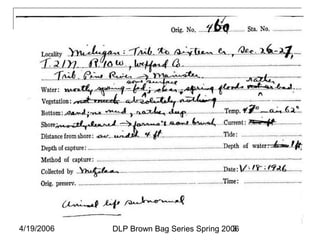
What does this record describe?
identifier: http://name.university.edu/IC-FISH3IC-
X0802]1004_112
publisher: Museum of Zoology, Fish Field Notes
format: jpeg
rights: These pages may be freely searched and
displayed. Permission must be received for
subsequent distribution in print or electronically.
type: image
subject: 1926-05-18; 1926; 0812; 18; Trib. to Sixteen Cr.
Trib. Pine River, Manistee R.; JAM26-460; 05;
1926/05/18; R10W; S26; S27; T21N
language: UND
source: Michigan 1926 Metzelaar, 1926--1926;
description: Flora and Fauna of the Great Lakes Region
Dublin Core record retrieved
via the OAI Protocol
4/19/2006 DLP Brown Bag Series Spring 20063
4/19/2006 DLP Brown Bag Series Spring 20064
Why share metadata?
 Benefits to users
 One-stop searching
 Aggregation of subject-specific resources
 Benefits to institutions
 Increased exposure for collections
 Broader user base
 Bringing together of distributed collections
Don’t expect users will know about your
collection and remember to visit it.
4/19/2006 DLP Brown Bag Series Spring 20065
Types of aggregations
 “Traditional” aggregations
 WorldCat
 RLG Cultural Materials
 CIC Metadata Portal
 Newly emerging aggregations
 A9
4/19/2006 DLP Brown Bag Series Spring 20066
Finding the right balance
 Metadata providers know the materials
 Document encoding schemes and controlled
vocabularies
 Document practices
 Ensure record validity
 Aggregators have the processing power
 Format conversion
 Reconcile known vocabularies
 Normalize data
 Batch metadata enhancement
4/19/2006 DLP Brown Bag Series Spring 20067
Shareable metadata defined
 Promotes search interoperability - “the ability to
perform a search over diverse sets of metadata
records and obtain meaningful results” (Priscilla
Caplan)
 Is human understandable outside of its local
context
 Is useful outside of its local context
 Preferably is machine processable
4/19/2006 DLP Brown Bag Series Spring 20068
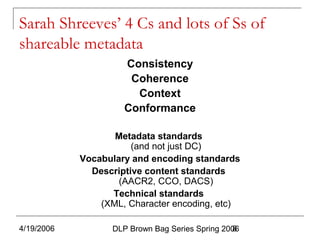
Sarah Shreeves’ 4 Cs and lots of Ss of
shareable metadata
Consistency
Coherence
Context
Conformance
Metadata standards
(and not just DC)
Vocabulary and encoding standards
Descriptive content standards
(AACR2, CCO, DACS)
Technical standards
(XML, Character encoding, etc)
4/19/2006 DLP Brown Bag Series Spring 20069
Appropriate representation of the resource
through shareable metadata
 Metadata as a view of the resource
 Standards promote interoperability
 Appropriate formats
 Appropriate content
 Appropriate context
4/19/2006 DLP Brown Bag Series Spring 200610
Metadata as a view of the resource
 There is no monolithic, one-size-fits-all
metadata record
 Metadata for the same thing is different
depending on use and audience
 Affected by format, content, and context
 Harry Potter as represented by…
 a public library
 an online bookstore
 a fan site
4/19/2006 DLP Brown Bag Series Spring 200611
Choice of vocabularies as a view
 Names
 LCNAF: Michelangelo Buonarroti, 1475-1564
 ULAN: Buonarroti, Michelangelo
 Places
 LCSH: Jakarta (Indonesia)
 TGN: Jakarta
 Subjects
 LCSH: Neo-impressionism (Art)
 AAT: Pointillism
4/19/2006 DLP Brown Bag Series Spring 200612
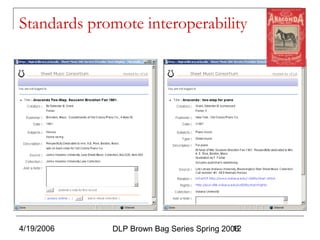
Standards promote interoperability
4/19/2006 DLP Brown Bag Series Spring 200613
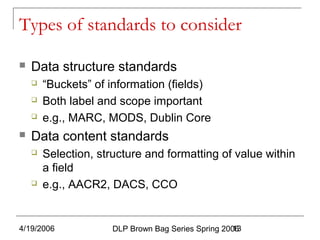
Types of standards to consider
 Data structure standards
 “Buckets” of information (fields)
 Both label and scope important
 e.g., MARC, MODS, Dublin Core
 Data content standards
 Selection, structure and formatting of value within
a field
 e.g., AACR2, DACS, CCO
4/19/2006 DLP Brown Bag Series Spring 200614
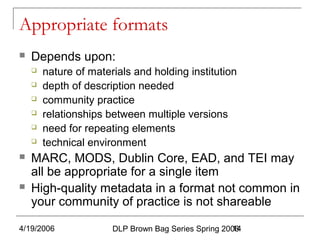
Appropriate formats
 Depends upon:
 nature of materials and holding institution
 depth of description needed
 community practice
 relationships between multiple versions
 need for repeating elements
 technical environment
 MARC, MODS, Dublin Core, EAD, and TEI may
all be appropriate for a single item
 High-quality metadata in a format not common in
your community of practice is not shareable
4/19/2006 DLP Brown Bag Series Spring 200615
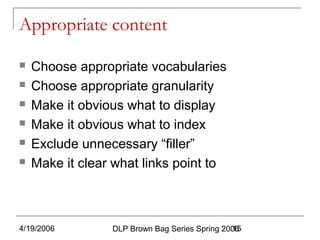
Appropriate content
 Choose appropriate vocabularies
 Choose appropriate granularity
 Make it obvious what to display
 Make it obvious what to index
 Exclude unnecessary “filler”
 Make it clear what links point to
4/19/2006 DLP Brown Bag Series Spring 200616
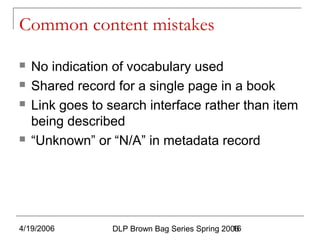
Common content mistakes
 No indication of vocabulary used
 Shared record for a single page in a book
 Link goes to search interface rather than item
being described
 “Unknown” or “N/A” in metadata record
4/19/2006 DLP Brown Bag Series Spring 200617
Appropriate context
 Thinking about shareability
 Explicitly include information assumed locally
 Exclude information only used locally
 Current safe assumptions
 Users discover material through shared record
 User then delivered to your environment for full
context
 Context driven by intended use
4/19/2006 DLP Brown Bag Series Spring 200618
Common context mistakes
 Leaving out information that applies to an
entire collection (“On a horse”)
 Location information lacking parent institution
 Geographic information lacking higher-level
jurisdiction
 Inclusion of administrative metadata
4/19/2006 DLP Brown Bag Series Spring 200619
Communication
 Metadata providers can learn from
aggregators
 Aggregators can learn from metadata
providers
 Providing supplemental information to make
records more intelligible
4/19/2006 DLP Brown Bag Series Spring 200620
Metadata providers can learn from
aggregators
 Crosswalking methods and rules
 Information to include and exclude
 Choice of standards
 metadata formats
 vocabularies
 Where to spend normalization effort
 Future priorities [example]
4/19/2006 DLP Brown Bag Series Spring 200621
Aggregators can learn from metadata
providers
 Where to spend normalization effort
 Context, importance, and primary uses of
resources shared
 Variety of resource types and descriptive
practices encountered
 Local, robust metadata formats
4/19/2006 DLP Brown Bag Series Spring 200622
Providing supplemental information to
make records more intelligible
 Method for creating shared records
 Vocabularies and content standards used in
shared records
 Record updating practices and schedules
 Accrual practices and schedules
 Existence of analytical or supplementary
materials
 Provenance of materials
4/19/2006 DLP Brown Bag Series Spring 200623
Before you share…
 Check your metadata
 Appropriate view?
 Consistent?
 Context provided?
 Does the aggregator have what they need?
 Documented?
Can a stranger tell you what the record
describes?
4/19/2006 DLP Brown Bag Series Spring 200624
Final thoughts
 Creating shareable metadata requires
thinking outside of your local box
 Creating shareable metadata will require
more work on your part
 Creating shareable metadata is no longer an
option, it’s a requirement
4/19/2006 DLP Brown Bag Series Spring 200625
For more information
 Stay tuned for a potential IMLS-funded
shareable metadata training program
 jenlrile@indiana.edu
 These presentation slides:
<http://www.dlib.indiana.edu/~jenlrile/presentations/bbspr06/shareableMetadata/>
Thanks to Sarah Shreeves of UIUC for
collaboration on this research.

Making Interoperability Easier: Creating Shareable Metadata

  • 1.
    4/19/2006 DLP BrownBag Series Spring 2006 1 Making Interoperability Easier: Creating Shareable Metadata Jenn Riley Metadata Librarian IU Digital Library Program
  • 2.
    4/19/2006 DLP BrownBag Series Spring 20062 What does this record describe? identifier: http://name.university.edu/IC-FISH3IC- X0802]1004_112 publisher: Museum of Zoology, Fish Field Notes format: jpeg rights: These pages may be freely searched and displayed. Permission must be received for subsequent distribution in print or electronically. type: image subject: 1926-05-18; 1926; 0812; 18; Trib. to Sixteen Cr. Trib. Pine River, Manistee R.; JAM26-460; 05; 1926/05/18; R10W; S26; S27; T21N language: UND source: Michigan 1926 Metzelaar, 1926--1926; description: Flora and Fauna of the Great Lakes Region Dublin Core record retrieved via the OAI Protocol
  • 3.
    4/19/2006 DLP BrownBag Series Spring 20063
  • 4.
    4/19/2006 DLP BrownBag Series Spring 20064 Why share metadata?  Benefits to users  One-stop searching  Aggregation of subject-specific resources  Benefits to institutions  Increased exposure for collections  Broader user base  Bringing together of distributed collections Don’t expect users will know about your collection and remember to visit it.
  • 5.
    4/19/2006 DLP BrownBag Series Spring 20065 Types of aggregations  “Traditional” aggregations  WorldCat  RLG Cultural Materials  CIC Metadata Portal  Newly emerging aggregations  A9
  • 6.
    4/19/2006 DLP BrownBag Series Spring 20066 Finding the right balance  Metadata providers know the materials  Document encoding schemes and controlled vocabularies  Document practices  Ensure record validity  Aggregators have the processing power  Format conversion  Reconcile known vocabularies  Normalize data  Batch metadata enhancement
  • 7.
    4/19/2006 DLP BrownBag Series Spring 20067 Shareable metadata defined  Promotes search interoperability - “the ability to perform a search over diverse sets of metadata records and obtain meaningful results” (Priscilla Caplan)  Is human understandable outside of its local context  Is useful outside of its local context  Preferably is machine processable
  • 8.
    4/19/2006 DLP BrownBag Series Spring 20068 Sarah Shreeves’ 4 Cs and lots of Ss of shareable metadata Consistency Coherence Context Conformance Metadata standards (and not just DC) Vocabulary and encoding standards Descriptive content standards (AACR2, CCO, DACS) Technical standards (XML, Character encoding, etc)
  • 9.
    4/19/2006 DLP BrownBag Series Spring 20069 Appropriate representation of the resource through shareable metadata  Metadata as a view of the resource  Standards promote interoperability  Appropriate formats  Appropriate content  Appropriate context
  • 10.
    4/19/2006 DLP BrownBag Series Spring 200610 Metadata as a view of the resource  There is no monolithic, one-size-fits-all metadata record  Metadata for the same thing is different depending on use and audience  Affected by format, content, and context  Harry Potter as represented by…  a public library  an online bookstore  a fan site
  • 11.
    4/19/2006 DLP BrownBag Series Spring 200611 Choice of vocabularies as a view  Names  LCNAF: Michelangelo Buonarroti, 1475-1564  ULAN: Buonarroti, Michelangelo  Places  LCSH: Jakarta (Indonesia)  TGN: Jakarta  Subjects  LCSH: Neo-impressionism (Art)  AAT: Pointillism
  • 12.
    4/19/2006 DLP BrownBag Series Spring 200612 Standards promote interoperability
  • 13.
    4/19/2006 DLP BrownBag Series Spring 200613 Types of standards to consider  Data structure standards  “Buckets” of information (fields)  Both label and scope important  e.g., MARC, MODS, Dublin Core  Data content standards  Selection, structure and formatting of value within a field  e.g., AACR2, DACS, CCO
  • 14.
    4/19/2006 DLP BrownBag Series Spring 200614 Appropriate formats  Depends upon:  nature of materials and holding institution  depth of description needed  community practice  relationships between multiple versions  need for repeating elements  technical environment  MARC, MODS, Dublin Core, EAD, and TEI may all be appropriate for a single item  High-quality metadata in a format not common in your community of practice is not shareable
  • 15.
    4/19/2006 DLP BrownBag Series Spring 200615 Appropriate content  Choose appropriate vocabularies  Choose appropriate granularity  Make it obvious what to display  Make it obvious what to index  Exclude unnecessary “filler”  Make it clear what links point to
  • 16.
    4/19/2006 DLP BrownBag Series Spring 200616 Common content mistakes  No indication of vocabulary used  Shared record for a single page in a book  Link goes to search interface rather than item being described  “Unknown” or “N/A” in metadata record
  • 17.
    4/19/2006 DLP BrownBag Series Spring 200617 Appropriate context  Thinking about shareability  Explicitly include information assumed locally  Exclude information only used locally  Current safe assumptions  Users discover material through shared record  User then delivered to your environment for full context  Context driven by intended use
  • 18.
    4/19/2006 DLP BrownBag Series Spring 200618 Common context mistakes  Leaving out information that applies to an entire collection (“On a horse”)  Location information lacking parent institution  Geographic information lacking higher-level jurisdiction  Inclusion of administrative metadata
  • 19.
    4/19/2006 DLP BrownBag Series Spring 200619 Communication  Metadata providers can learn from aggregators  Aggregators can learn from metadata providers  Providing supplemental information to make records more intelligible
  • 20.
    4/19/2006 DLP BrownBag Series Spring 200620 Metadata providers can learn from aggregators  Crosswalking methods and rules  Information to include and exclude  Choice of standards  metadata formats  vocabularies  Where to spend normalization effort  Future priorities [example]
  • 21.
    4/19/2006 DLP BrownBag Series Spring 200621 Aggregators can learn from metadata providers  Where to spend normalization effort  Context, importance, and primary uses of resources shared  Variety of resource types and descriptive practices encountered  Local, robust metadata formats
  • 22.
    4/19/2006 DLP BrownBag Series Spring 200622 Providing supplemental information to make records more intelligible  Method for creating shared records  Vocabularies and content standards used in shared records  Record updating practices and schedules  Accrual practices and schedules  Existence of analytical or supplementary materials  Provenance of materials
  • 23.
    4/19/2006 DLP BrownBag Series Spring 200623 Before you share…  Check your metadata  Appropriate view?  Consistent?  Context provided?  Does the aggregator have what they need?  Documented? Can a stranger tell you what the record describes?
  • 24.
    4/19/2006 DLP BrownBag Series Spring 200624 Final thoughts  Creating shareable metadata requires thinking outside of your local box  Creating shareable metadata will require more work on your part  Creating shareable metadata is no longer an option, it’s a requirement
  • 25.
    4/19/2006 DLP BrownBag Series Spring 200625 For more information  Stay tuned for a potential IMLS-funded shareable metadata training program  jenlrile@indiana.edu  These presentation slides: <http://www.dlib.indiana.edu/~jenlrile/presentations/bbspr06/shareableMetadata/> Thanks to Sarah Shreeves of UIUC for collaboration on this research.