ISO – 2709
(Bibliographic Format;ISO 2709
Dr.P.PADMA
Assistant
Professor
DOLIS
Introduction
• Bibliographical information plays an important role information retrieval
for the research community particularly in the field of science and
technology. But during the bibliographical information exchange certain
problems arise and more when the information interchange is on magnetic
tape or CD-ROM. Different international organisations such as
UNESCO/PGI, UNISIST, ICSU, IFLA, ISO have taken many steps
towards the standardisation of bibliographic exchange formats. The
process of standardisation follows a set of codes given by International
Standard Organisation (ISO).
Contd..
• ISO is International Organization for Standardization.
ISO 2709 is an international format for information
interchange It is the world’s largest developer and
publisher of international standards. It is developed in
23 February 1947. They give world-class specifications
for products, services and systems to unsure quality,
safety and efficiency. International standards make
thing work. They are instrumental in facilitating
international trade
What are Bibliographic Formats
They are the formats which are
used to describe the arrangement
or structure of computer readable
record of bibliographic data.
Bibliographic data commonly
contain
Fields: Different fields in a
bibliographic data are title,
name of author, subject,
edition, publication data,
physical description of the
book, Standard
numbers(ISBN,ISSN etc.)
Bibliographic
levels
Monograph: An item that issued as a
single physical piece. Ex. a book,
thesis, report etc.
Analytic: An item which is a part of a
parent item. Ex. a chapter from a book,
article from a journal etc.
Serials: A publication issued
periodically. Ex. journals, magazines etc.
Collection: An item issued in two or
more physical pieces.Ex multivolumed
encyclopaedia.
International
Bibliographic
Formats
ISO 2709
UNIMARC
MARC 21
CCF
History and development of ISO
It was first created as ANSI/NISO Standard Z39.2, one of the first standards
for information technology and called Information Interchange Format.
Developed by Henriette Avram in late 1960’s. First version was published in
1973. Revised and Second edition was published in 1981. Latest version in
ISO 2709:2008. 1946, delegates from 25 countries met in London and
decided to create a new international organization, of which the object would
be "to facilitate the international coordination and unification of industrial
standards". The new organization, ISO, officially began operations on 23
February 1947, in Geneva, Switzerland
What are
Standards?
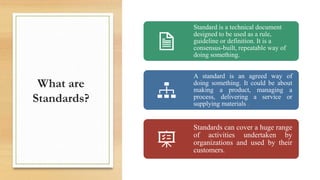
Standard is a technical document
designed to be used as a rule,
guideline or definition. It is a
consensus-built, repeatable way of
doing something.
A standard is an agreed way of
doing something. It could be about
making a product, managing a
process, delivering a service or
supplying materials .
Standards can cover a huge range
of activities undertaken by
organizations and used by their
customers.
What is Standard Organization?
• A standards organization, standards body, standards developing organization
(SDO), or standards setting organization (SSO) is an organization whose primary
activities are developing, coordinating, promulgating, revising, amending, reissuing,
interpreting, or otherwise producing technical standards that are intended to address
the needs of some relatively wide base of affected adopters.
• Standards organizations can be classified by their role, position, and the extent of
their influence on the local, national, regional, and global standardization arena
Major purpose of
Standardization
To permit exchange of bibliographic records
between groups of libraries and abstracting and
indexing service.
To permit a bibliographic agency to manipulate
bibliographic records received from both
libraries and abstracting and indexing services.
To serve as the basis of a format for an agency’s
own bibliographic database by providing a list of
useful data elements.
To assist the development of individual system.
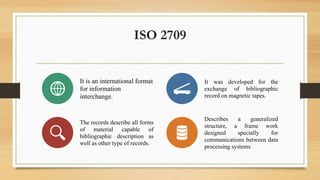
ISO 2709
It is an international format
for information
interchange.
It was developed for the
exchange of bibliographic
record on magnetic tapes.
The records describe all forms
of material capable of
bibliographic description as
well as other type of records.
Describes a generalized
structure, a frame work
designed specially for
communications between data
processing systems
Objectives OF ISO 2709
• To permit the exchange of bibliographic records
between groups of libraries and abstracting and
indexing Services.
• To permit a bibliographic agency to manipulate
bibliographic records received from both libraries
and abstracting and indexing services.
• To serve as the basis of a format for an agency’s
own bibliographic database by providing a list of
useful data elements.
• To assist the development of individual systems
Structure of Bibliographic Record
The general structure of a bibliographic record
consists of four major parts:
• Record label
• Directory
• Data fields
• Record separator
BASIC STRUCTURE
Record label
• This area of the record contains general information which
may be needed in processing the record, constituted
according to the provision of IS0 2709.
• Record label Contains data that identify to the system,
the type of record contains necessary for the processing
of the record . The first 24 characters of the record. This
is the only portion of the record that is fixed in length.
The record label includes the record length and the base
address of the data contained in the record. It also has
data elements that indicate how many characters are
used for indicators and subfield identifiers.
Contd…
Directory
• Contains ‘Content designator’ for each data field
followed by an indication of the position in the
record where the data relating to that field and the
length of the field. If a field is repeated, it has two
entries in the directory, one for each appearance.
• The directory provides the entry positions to the
fields in the record, along with the field tags. A
directory entry has five parts and cannot exceed
nine characters in length.
Contd..
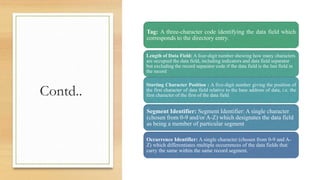
Tag: A three-character code identifying the data field which
corresponds to the directory entry.
Length of Data Field: A four-digit number showing how many characters
are occupied the data field, including indicators and data field separator
but excluding the record separator code if the data field is the last field in
the record
Starting Character Position : A five-digit number giving the position of
the first character of data field relative to the base address of data, i.e. the
first character of the first of the data field
Segment Identifier: Segment Identifier: A single character
(chosen from 0-9 and/or A-Z) which designates the data field
as being a member of particular segment
Occurrence Identifier: A single character (chosen from 0-9 and A-
Z) which differentiates multiple occurrences of the data fields that
carry the same within the same record segment.
Data fields (Variable fields)
• A string containing all field and subfield data in the record
Data Field
• A variable length portion of the particular category of data
associated with one entry in the directory. A data field may
contain one or more sub field.
• The last components are the form and content of the data
elements, varies according to the ‘cataloguing rules’ used
as well as according to the way the different data element
prescribed by the rules and divided up and separately
identified by the format.
Data Field Structure
• Indictors - 3characters
• Subfield Identifier - 2characters
• Subfield -Variables
• Field Separator - 1 character
Record separator
• The record separator is the final character of
the record. It follows the field separator of the
final data field of the record. This will always
be a single character.
Content
Designator
Represented in most bibliographic
formats by , Indicators, & Subfield
codes
Different agencies have theirs own
content designators
It is possible to convert the content
designators automatically in order to
convert data from one format to
another
Tags
Three digit numeric value used as identifier known as tag.
Indicators: Indicators, where they are used, appear at the
beginning of each field in the data portion of the record.
Subfield Codes
Subfield Identifier
A characters preceding with a subfield code. For example, ‘$’
sign is used as subfield identifier in UNIMARC.
Subfield Code
A character preceding and identifying a subfield. For example,
subfield ‘a’ is title proper in the ‘title and statement of
responsibility’
Scope
• This International Standard describes a generalized
structure, a framework designed especially for
communications between data processing systems and
not for use as a processing format within systems
• As an ISO 2709 based MARC 21 Format for
Bibliographic Data is designed to be a carrier for
bibliographic information about printed and manuscript
textual materials, computer files, maps, music,
continuing resources, visual materials, and mixed
materials
Advantages OF ISO 2709
• It provides a small number of mandatory data elements, which
are recognized by all sectors of the information community as
essential in order to identify an item.
• It gives mandatory data elements that are sufficiently flexible
to accommodate varying descriptive practices.
• It also provides a number of optional elements, which may be
useful to describe an item according to practices of the agency,
which creates the record.
• It provides a mechanism for linking records and segments of
records without imposing on the originating agency any
uniform practice regarding the treatment of related groups of
records or data elements.
Conclusion
• During the last 25+ years, a radical change has occurred in the mechanism for transfer of
bibliographic data. The current situation is both success and failure; success, because
millions of records structured according to IS0 2709 are now available for exchange.
Some national formats, for example UNIMARC, have become virtually international. IS0
2709 will remain as a universally recognised standard for MARC. MARC is a set of
codes defining the data dements of a record in automated systems. It is estimated that
MARC and other exchange formats will continue for some time. As long as organisations
wish to exchange record or derive bibliographic data from central agencies, and until
computer technologists devise cost effective and relatively simple ways of transferring
bibliographic data in different formats between systems, exchange formats remain
necessary.

ISO 2709.pptx

  • 1.
    ISO – 2709 (BibliographicFormat;ISO 2709 Dr.P.PADMA Assistant Professor DOLIS
  • 2.
    Introduction • Bibliographical informationplays an important role information retrieval for the research community particularly in the field of science and technology. But during the bibliographical information exchange certain problems arise and more when the information interchange is on magnetic tape or CD-ROM. Different international organisations such as UNESCO/PGI, UNISIST, ICSU, IFLA, ISO have taken many steps towards the standardisation of bibliographic exchange formats. The process of standardisation follows a set of codes given by International Standard Organisation (ISO).
  • 3.
    Contd.. • ISO isInternational Organization for Standardization. ISO 2709 is an international format for information interchange It is the world’s largest developer and publisher of international standards. It is developed in 23 February 1947. They give world-class specifications for products, services and systems to unsure quality, safety and efficiency. International standards make thing work. They are instrumental in facilitating international trade
  • 4.
    What are BibliographicFormats They are the formats which are used to describe the arrangement or structure of computer readable record of bibliographic data. Bibliographic data commonly contain Fields: Different fields in a bibliographic data are title, name of author, subject, edition, publication data, physical description of the book, Standard numbers(ISBN,ISSN etc.)
  • 5.
    Bibliographic levels Monograph: An itemthat issued as a single physical piece. Ex. a book, thesis, report etc. Analytic: An item which is a part of a parent item. Ex. a chapter from a book, article from a journal etc. Serials: A publication issued periodically. Ex. journals, magazines etc. Collection: An item issued in two or more physical pieces.Ex multivolumed encyclopaedia.
  • 6.
  • 7.
    History and developmentof ISO It was first created as ANSI/NISO Standard Z39.2, one of the first standards for information technology and called Information Interchange Format. Developed by Henriette Avram in late 1960’s. First version was published in 1973. Revised and Second edition was published in 1981. Latest version in ISO 2709:2008. 1946, delegates from 25 countries met in London and decided to create a new international organization, of which the object would be "to facilitate the international coordination and unification of industrial standards". The new organization, ISO, officially began operations on 23 February 1947, in Geneva, Switzerland
  • 8.
    What are Standards? Standard isa technical document designed to be used as a rule, guideline or definition. It is a consensus-built, repeatable way of doing something. A standard is an agreed way of doing something. It could be about making a product, managing a process, delivering a service or supplying materials . Standards can cover a huge range of activities undertaken by organizations and used by their customers.
  • 9.
    What is StandardOrganization? • A standards organization, standards body, standards developing organization (SDO), or standards setting organization (SSO) is an organization whose primary activities are developing, coordinating, promulgating, revising, amending, reissuing, interpreting, or otherwise producing technical standards that are intended to address the needs of some relatively wide base of affected adopters. • Standards organizations can be classified by their role, position, and the extent of their influence on the local, national, regional, and global standardization arena
  • 10.
    Major purpose of Standardization Topermit exchange of bibliographic records between groups of libraries and abstracting and indexing service. To permit a bibliographic agency to manipulate bibliographic records received from both libraries and abstracting and indexing services. To serve as the basis of a format for an agency’s own bibliographic database by providing a list of useful data elements. To assist the development of individual system.
  • 11.
    ISO 2709 It isan international format for information interchange. It was developed for the exchange of bibliographic record on magnetic tapes. The records describe all forms of material capable of bibliographic description as well as other type of records. Describes a generalized structure, a frame work designed specially for communications between data processing systems
  • 12.
    Objectives OF ISO2709 • To permit the exchange of bibliographic records between groups of libraries and abstracting and indexing Services. • To permit a bibliographic agency to manipulate bibliographic records received from both libraries and abstracting and indexing services. • To serve as the basis of a format for an agency’s own bibliographic database by providing a list of useful data elements. • To assist the development of individual systems
  • 13.
    Structure of BibliographicRecord The general structure of a bibliographic record consists of four major parts: • Record label • Directory • Data fields • Record separator
  • 14.
    BASIC STRUCTURE Record label •This area of the record contains general information which may be needed in processing the record, constituted according to the provision of IS0 2709. • Record label Contains data that identify to the system, the type of record contains necessary for the processing of the record . The first 24 characters of the record. This is the only portion of the record that is fixed in length. The record label includes the record length and the base address of the data contained in the record. It also has data elements that indicate how many characters are used for indicators and subfield identifiers.
  • 15.
    Contd… Directory • Contains ‘Contentdesignator’ for each data field followed by an indication of the position in the record where the data relating to that field and the length of the field. If a field is repeated, it has two entries in the directory, one for each appearance. • The directory provides the entry positions to the fields in the record, along with the field tags. A directory entry has five parts and cannot exceed nine characters in length.
  • 16.
    Contd.. Tag: A three-charactercode identifying the data field which corresponds to the directory entry. Length of Data Field: A four-digit number showing how many characters are occupied the data field, including indicators and data field separator but excluding the record separator code if the data field is the last field in the record Starting Character Position : A five-digit number giving the position of the first character of data field relative to the base address of data, i.e. the first character of the first of the data field Segment Identifier: Segment Identifier: A single character (chosen from 0-9 and/or A-Z) which designates the data field as being a member of particular segment Occurrence Identifier: A single character (chosen from 0-9 and A- Z) which differentiates multiple occurrences of the data fields that carry the same within the same record segment.
  • 17.
    Data fields (Variablefields) • A string containing all field and subfield data in the record Data Field • A variable length portion of the particular category of data associated with one entry in the directory. A data field may contain one or more sub field. • The last components are the form and content of the data elements, varies according to the ‘cataloguing rules’ used as well as according to the way the different data element prescribed by the rules and divided up and separately identified by the format. Data Field Structure • Indictors - 3characters • Subfield Identifier - 2characters • Subfield -Variables • Field Separator - 1 character
  • 18.
    Record separator • Therecord separator is the final character of the record. It follows the field separator of the final data field of the record. This will always be a single character.
  • 19.
    Content Designator Represented in mostbibliographic formats by , Indicators, & Subfield codes Different agencies have theirs own content designators It is possible to convert the content designators automatically in order to convert data from one format to another
  • 20.
    Tags Three digit numericvalue used as identifier known as tag. Indicators: Indicators, where they are used, appear at the beginning of each field in the data portion of the record. Subfield Codes Subfield Identifier A characters preceding with a subfield code. For example, ‘$’ sign is used as subfield identifier in UNIMARC. Subfield Code A character preceding and identifying a subfield. For example, subfield ‘a’ is title proper in the ‘title and statement of responsibility’
  • 21.
    Scope • This InternationalStandard describes a generalized structure, a framework designed especially for communications between data processing systems and not for use as a processing format within systems • As an ISO 2709 based MARC 21 Format for Bibliographic Data is designed to be a carrier for bibliographic information about printed and manuscript textual materials, computer files, maps, music, continuing resources, visual materials, and mixed materials
  • 22.
    Advantages OF ISO2709 • It provides a small number of mandatory data elements, which are recognized by all sectors of the information community as essential in order to identify an item. • It gives mandatory data elements that are sufficiently flexible to accommodate varying descriptive practices. • It also provides a number of optional elements, which may be useful to describe an item according to practices of the agency, which creates the record. • It provides a mechanism for linking records and segments of records without imposing on the originating agency any uniform practice regarding the treatment of related groups of records or data elements.
  • 23.
    Conclusion • During thelast 25+ years, a radical change has occurred in the mechanism for transfer of bibliographic data. The current situation is both success and failure; success, because millions of records structured according to IS0 2709 are now available for exchange. Some national formats, for example UNIMARC, have become virtually international. IS0 2709 will remain as a universally recognised standard for MARC. MARC is a set of codes defining the data dements of a record in automated systems. It is estimated that MARC and other exchange formats will continue for some time. As long as organisations wish to exchange record or derive bibliographic data from central agencies, and until computer technologists devise cost effective and relatively simple ways of transferring bibliographic data in different formats between systems, exchange formats remain necessary.