JENN RILEY
METADATA LIBRARIAN
DIGITAL LIBRARY PROGRAM
DL BROWN BAG SERIES
FEBRUARY 11, 2009
Dublin Core Metadata Initiative
Abstract Model
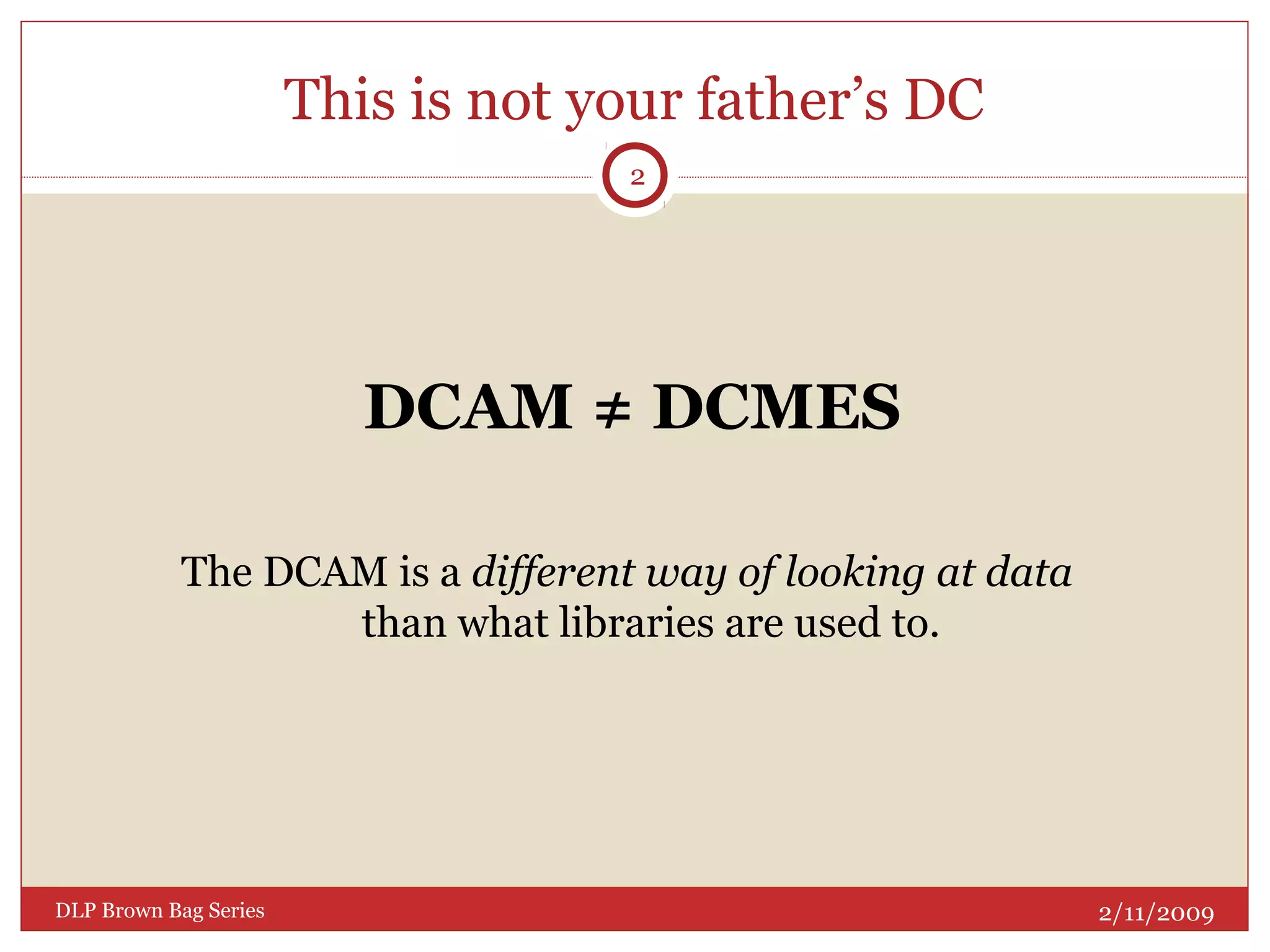
This is not your father’s DC
DCAM ≠ DCMES
The DCAM is a different way of looking at data
than what libraries are used to.
2/11/2009DLP Brown Bag Series
2
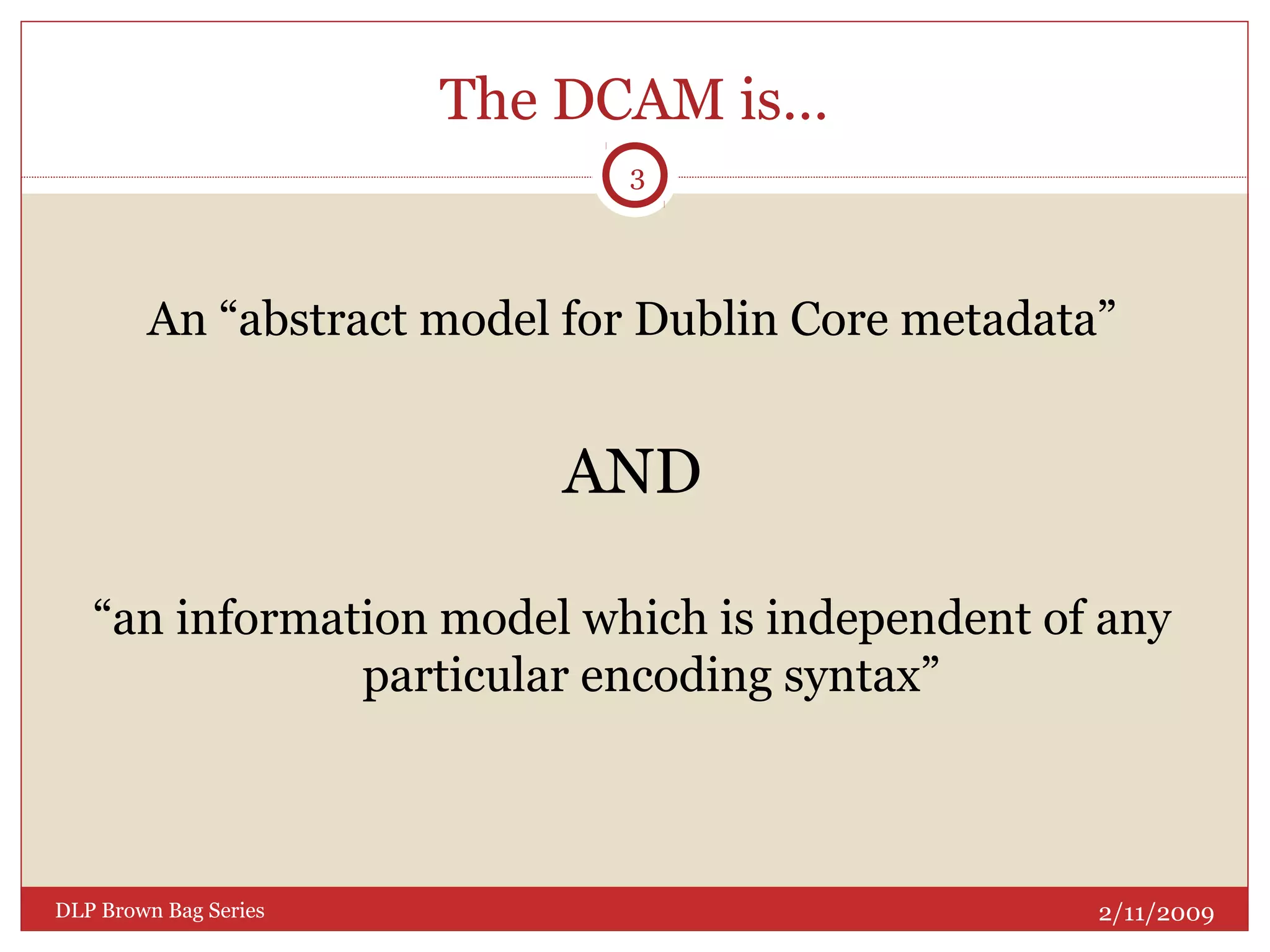
The DCAM is…
An “abstract model for Dublin Core metadata”
AND
“an information model which is independent of any
particular encoding syntax”
2/11/2009
3
DLP Brown Bag Series
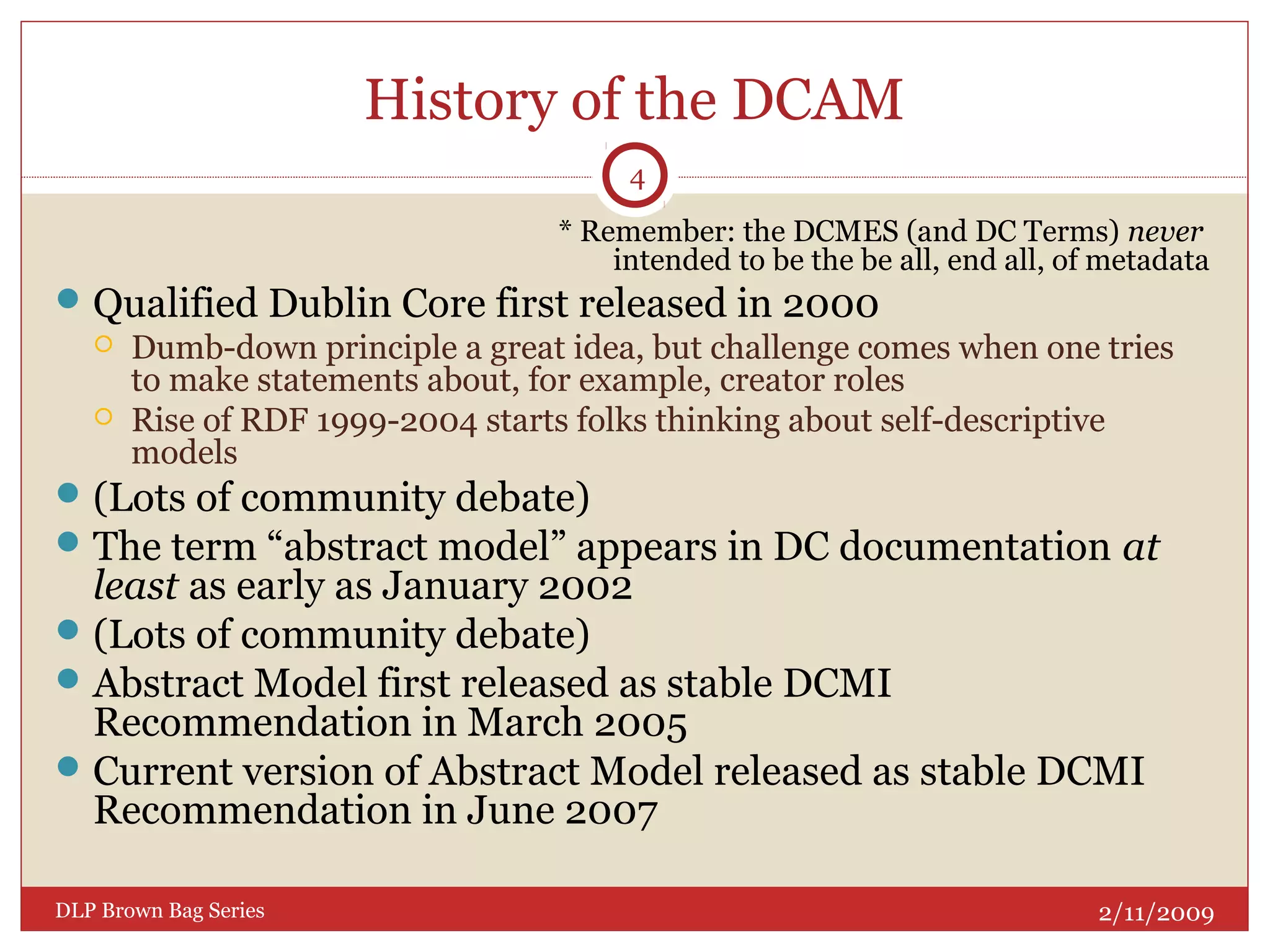
History of the DCAM
* Remember: the DCMES (and DC Terms) never
intended to be the be all, end all, of metadata
Qualified Dublin Core first released in 2000
 Dumb-down principle a great idea, but challenge comes when one tries
to make statements about, for example, creator roles
 Rise of RDF 1999-2004 starts folks thinking about self-descriptive
models
(Lots of community debate)
The term “abstract model” appears in DC documentation at
least as early as January 2002
(Lots of community debate)
Abstract Model first released as stable DCMI
Recommendation in March 2005
Current version of Abstract Model released as stable DCMI
Recommendation in June 2007
2/11/2009DLP Brown Bag Series
4
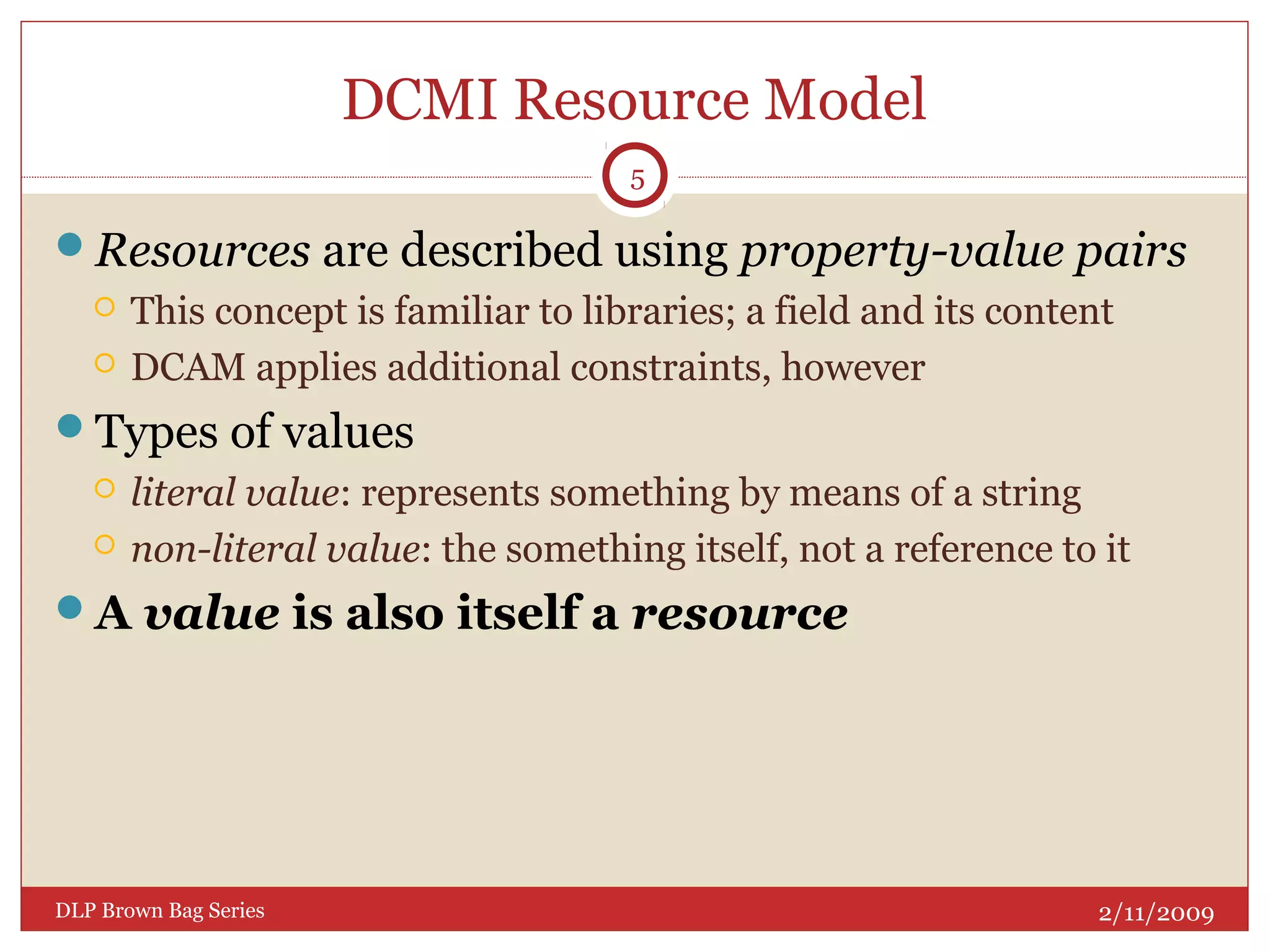
DCMI Resource Model
Resources are described using property-value pairs
 This concept is familiar to libraries; a field and its content
 DCAM applies additional constraints, however
Types of values
 literal value: represents something by means of a string
 non-literal value: the something itself, not a reference to it
A value is also itself a resource
2/11/2009DLP Brown Bag Series
5
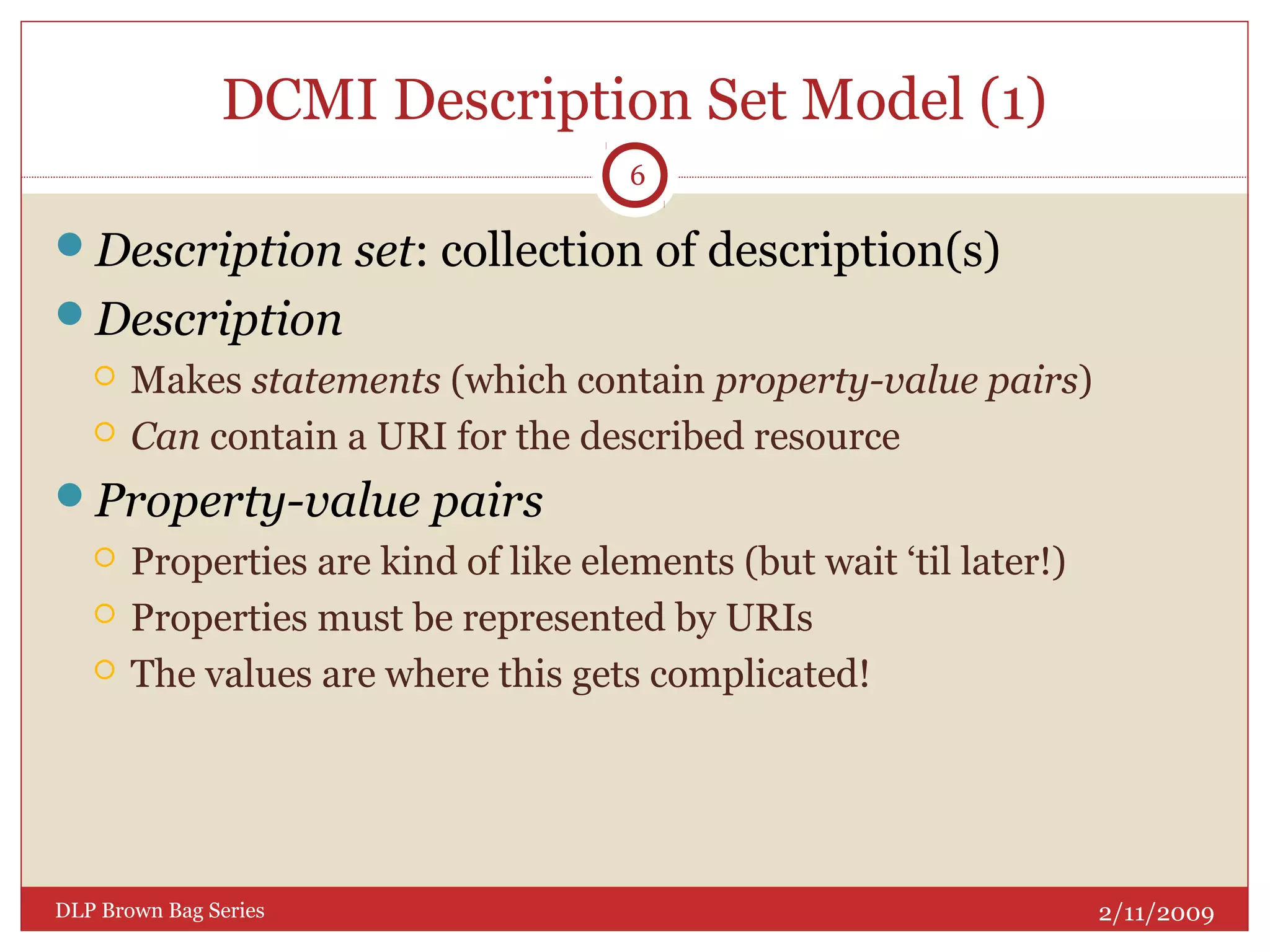
DCMI Description Set Model (1)
Description set: collection of description(s)
Description
 Makes statements (which contain property-value pairs)
 Can contain a URI for the described resource
Property-value pairs
 Properties are kind of like elements (but wait ‘til later!)
 Properties must be represented by URIs
 The values are where this gets complicated!
2/11/2009DLP Brown Bag Series
6
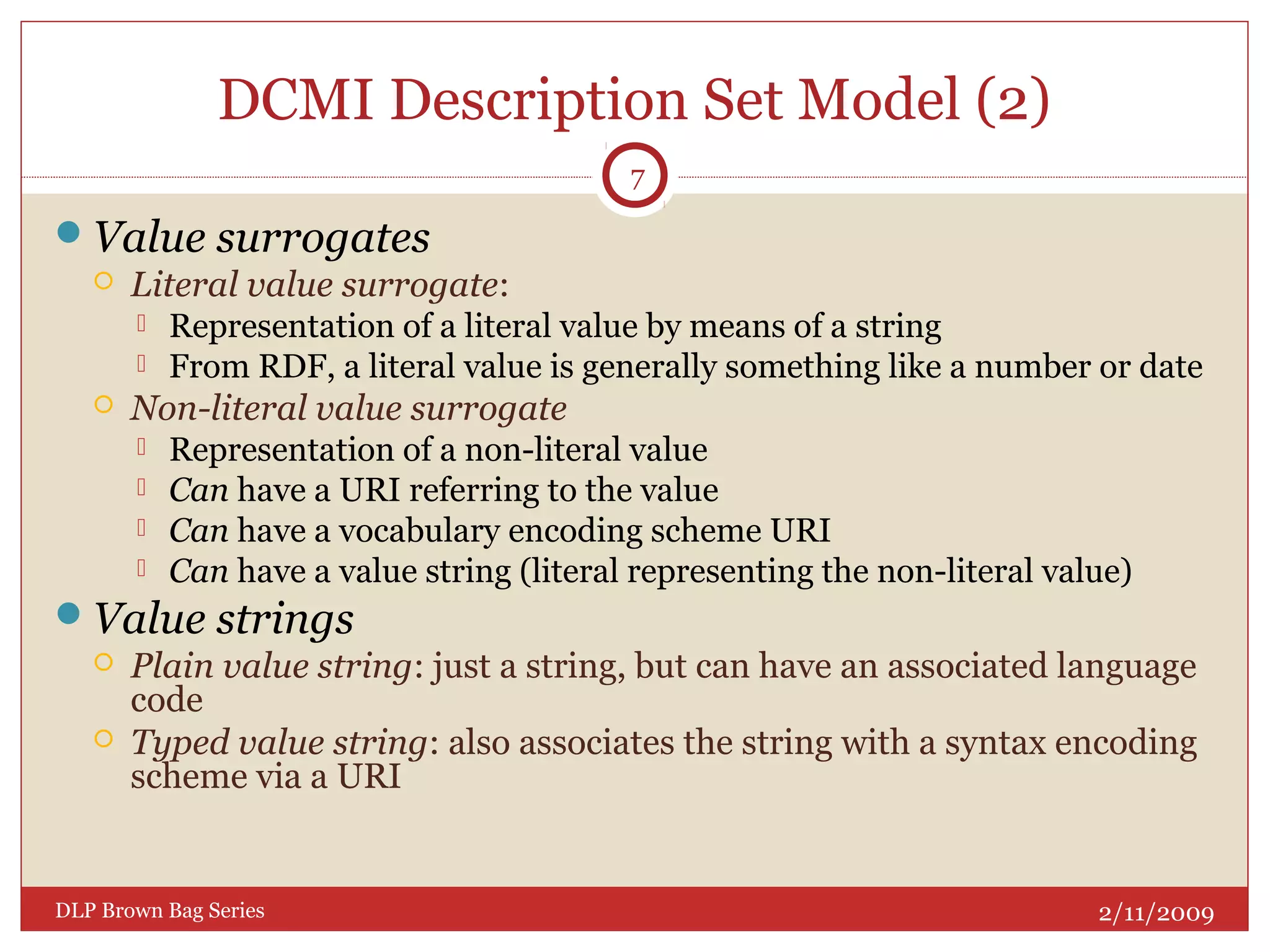
DCMI Description Set Model (2)
Value surrogates
 Literal value surrogate:
 Representation of a literal value by means of a string
 From RDF, a literal value is generally something like a number or date
 Non-literal value surrogate
 Representation of a non-literal value
 Can have a URI referring to the value
 Can have a vocabulary encoding scheme URI
 Can have a value string (literal representing the non-literal value)
Value strings
 Plain value string: just a string, but can have an associated language
code
 Typed value string: also associates the string with a syntax encoding
scheme via a URI
2/11/2009DLP Brown Bag Series
7
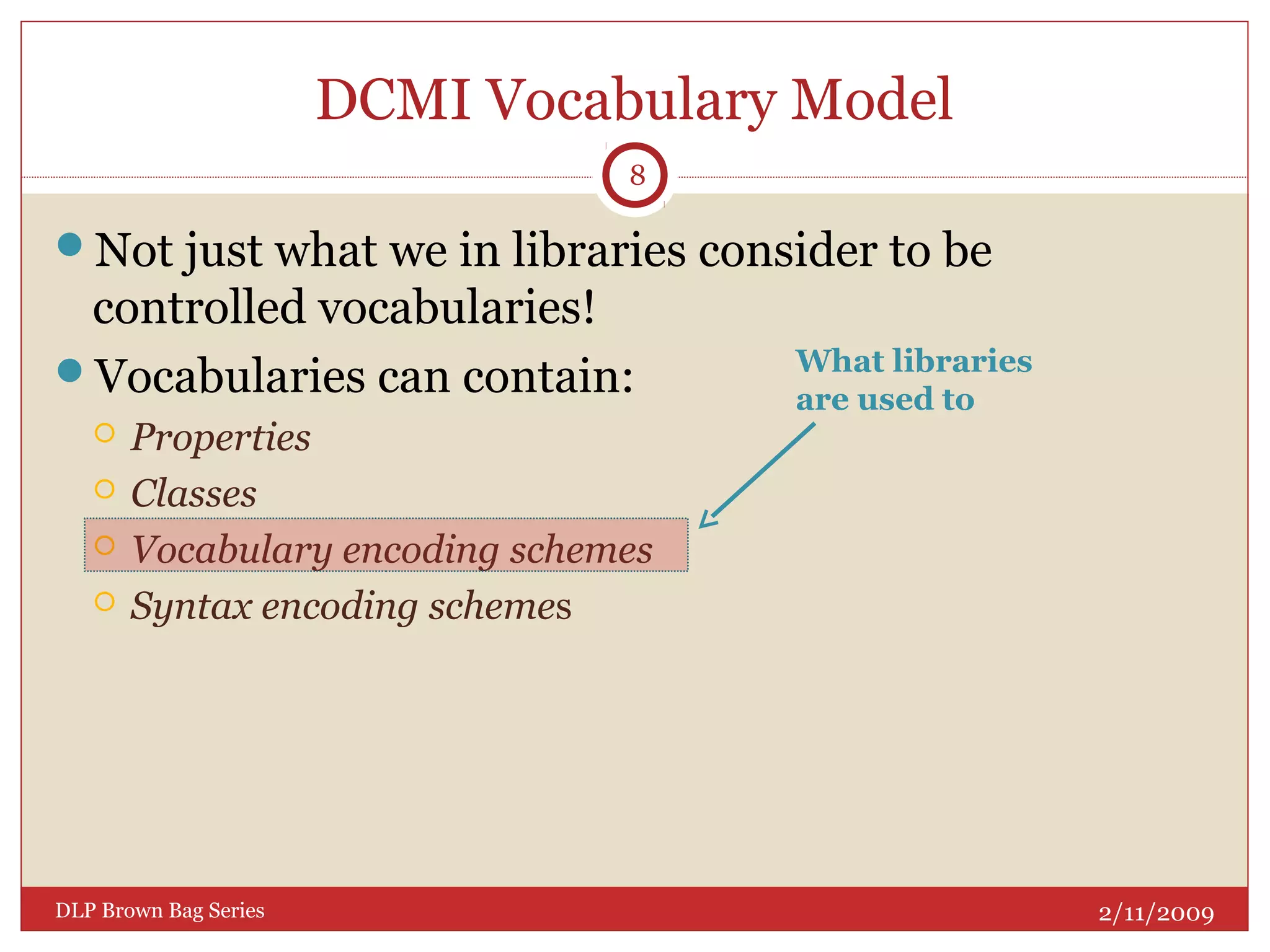
DCMI Vocabulary Model
Not just what we in libraries consider to be
controlled vocabularies!
Vocabularies can contain:
 Properties
 Classes
 Vocabulary encoding schemes
 Syntax encoding schemes
2/11/2009DLP Brown Bag Series
8
What libraries
are used to
DC encodings
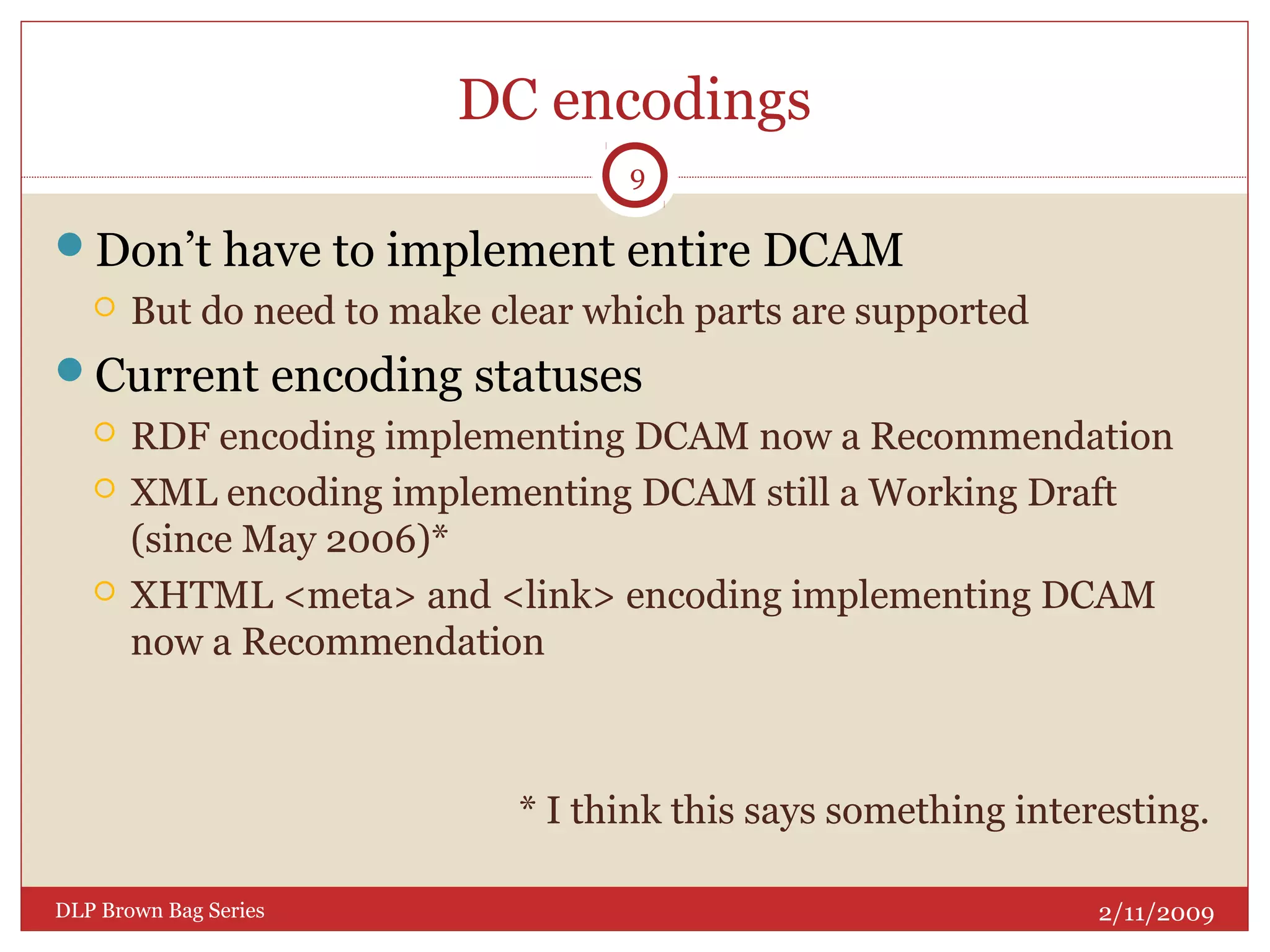
Don’t have to implement entire DCAM
 But do need to make clear which parts are supported
Current encoding statuses
 RDF encoding implementing DCAM now a Recommendation
 XML encoding implementing DCAM still a Working Draft
(since May 2006)*
 XHTML <meta> and <link> encoding implementing DCAM
now a Recommendation
* I think this says something interesting.
2/11/2009DLP Brown Bag Series
9
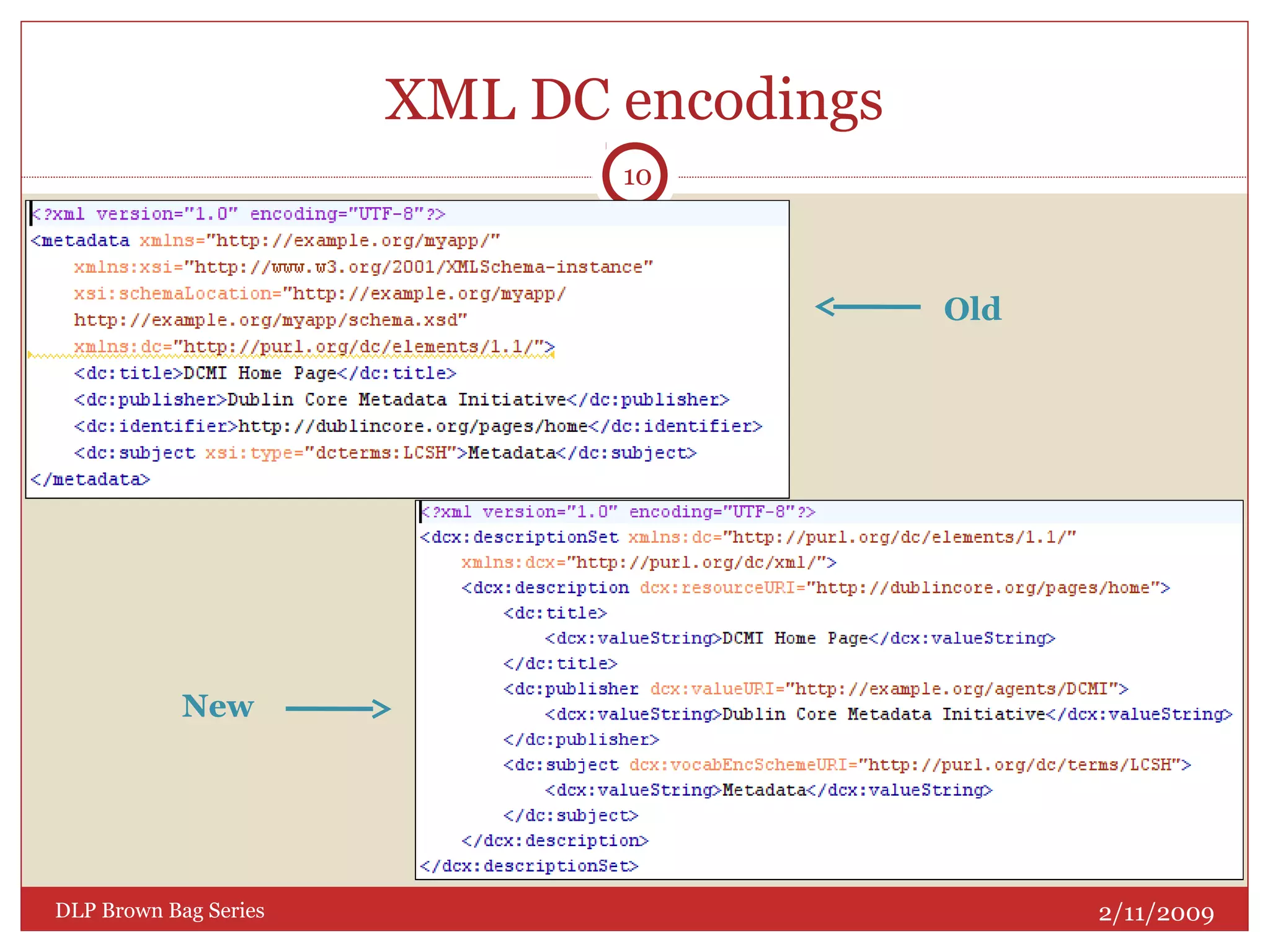
XML DC encodings
2/11/2009DLP Brown Bag Series
10
Old
New
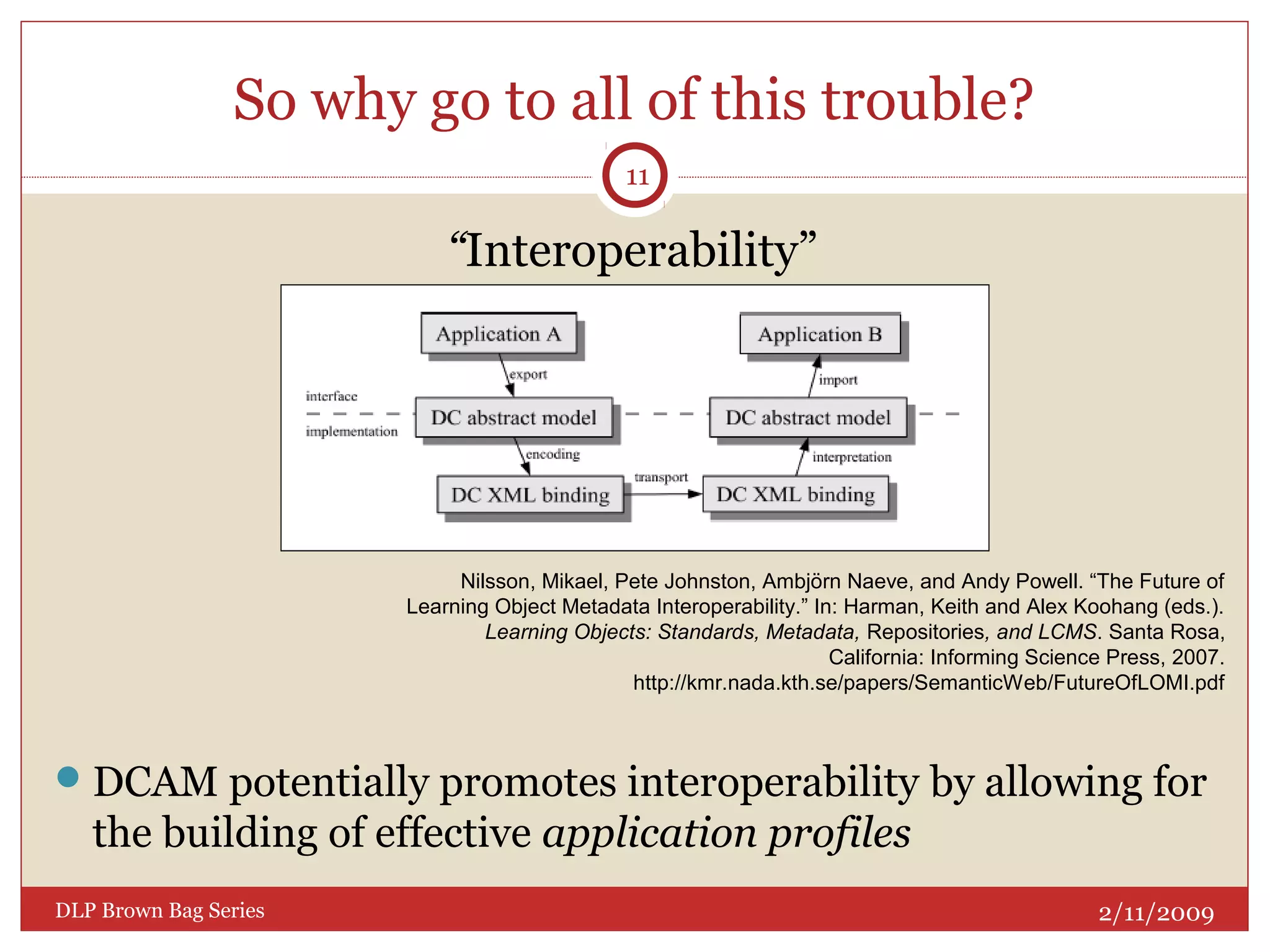
So why go to all of this trouble?
“Interoperability”
DCAM potentially promotes interoperability by allowing for
the building of effective application profiles
2/11/2009DLP Brown Bag Series
11
Nilsson, Mikael, Pete Johnston, Ambjörn Naeve, and Andy Powell. “The Future of
Learning Object Metadata Interoperability.” In: Harman, Keith and Alex Koohang (eds.).
Learning Objects: Standards, Metadata, Repositories, and LCMS. Santa Rosa,
California: Informing Science Press, 2007.
http://kmr.nada.kth.se/papers/SemanticWeb/FutureOfLOMI.pdf
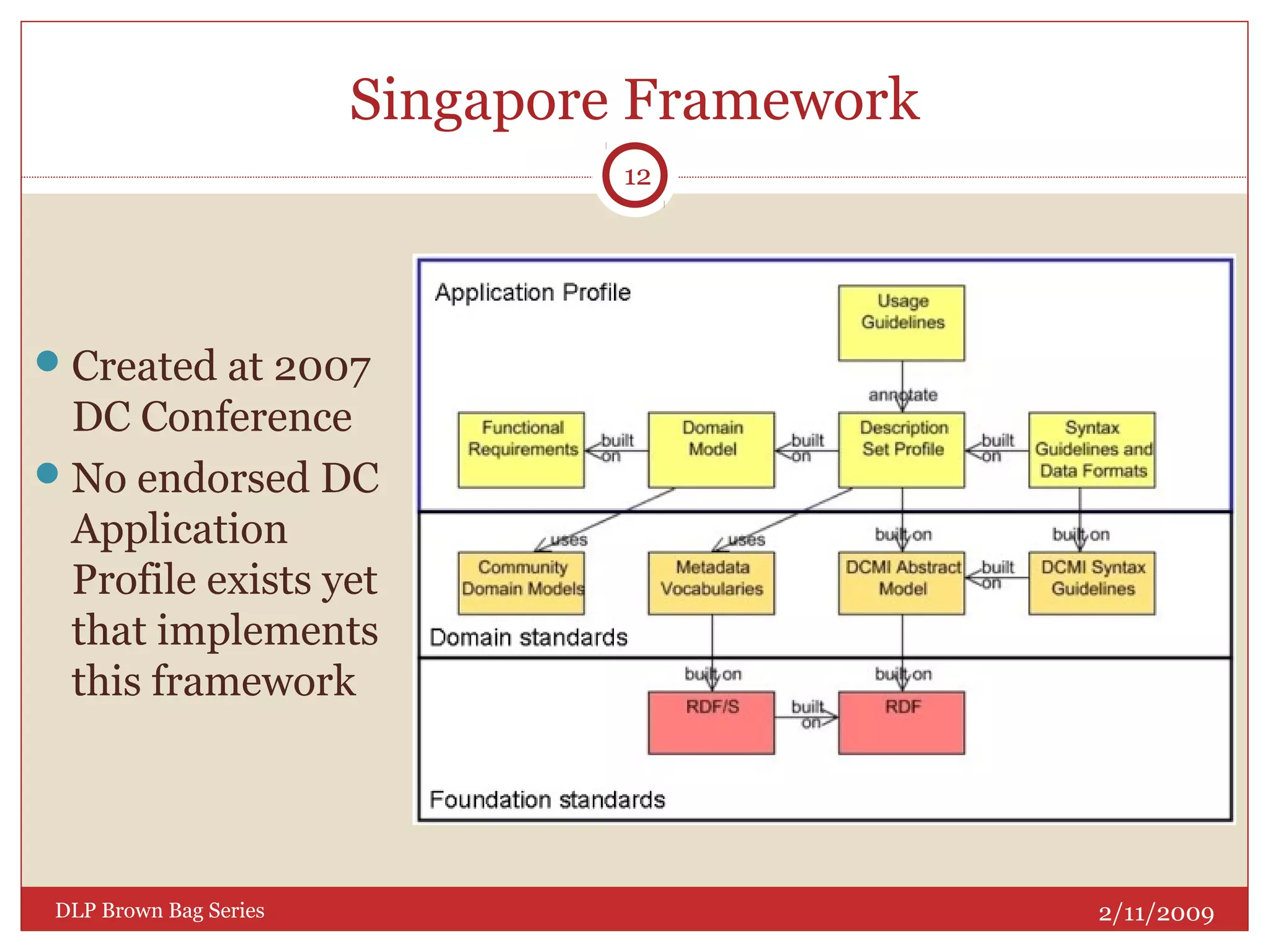
Singapore Framework
Created at 2007
DC Conference
No endorsed DC
Application
Profile exists yet
that implements
this framework
2/11/2009DLP Brown Bag Series
12
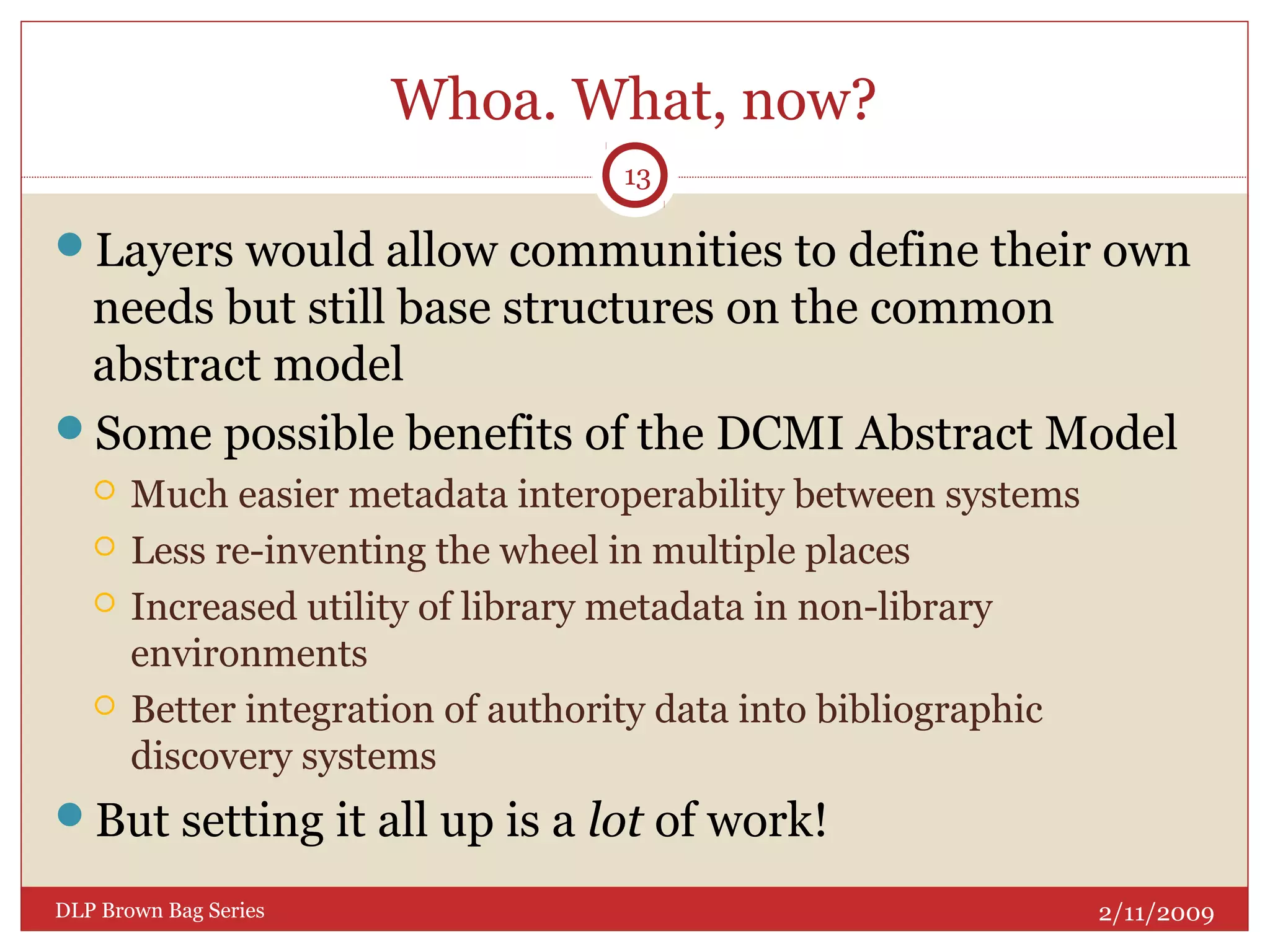
Whoa. What, now?
Layers would allow communities to define their own
needs but still base structures on the common
abstract model
Some possible benefits of the DCMI Abstract Model
 Much easier metadata interoperability between systems
 Less re-inventing the wheel in multiple places
 Increased utility of library metadata in non-library
environments
 Better integration of authority data into bibliographic
discovery systems
But setting it all up is a lot of work!
2/11/2009DLP Brown Bag Series
13
Is this really going to work?
I’m afraid I don’t know.
2/11/2009DLP Brown Bag Series
14
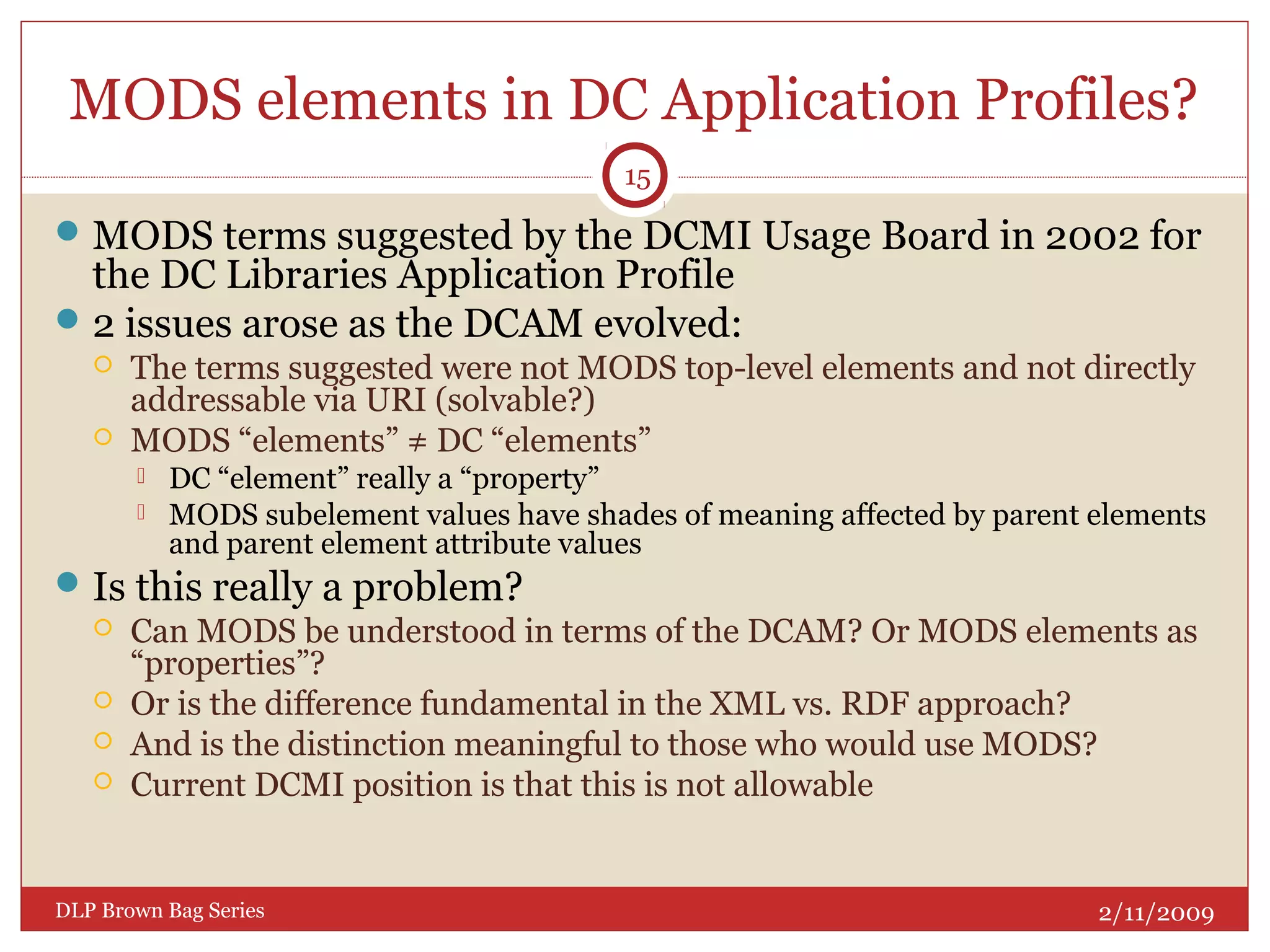
MODS elements in DC Application Profiles?
MODS terms suggested by the DCMI Usage Board in 2002 for
the DC Libraries Application Profile
2 issues arose as the DCAM evolved:
 The terms suggested were not MODS top-level elements and not directly
addressable via URI (solvable?)
 MODS “elements” ≠ DC “elements”
 DC “element” really a “property”
 MODS subelement values have shades of meaning affected by parent elements
and parent element attribute values
Is this really a problem?
 Can MODS be understood in terms of the DCAM? Or MODS elements as
“properties”?
 Or is the difference fundamental in the XML vs. RDF approach?
 And is the distinction meaningful to those who would use MODS?
 Current DCMI position is that this is not allowable
2/11/2009DLP Brown Bag Series
15
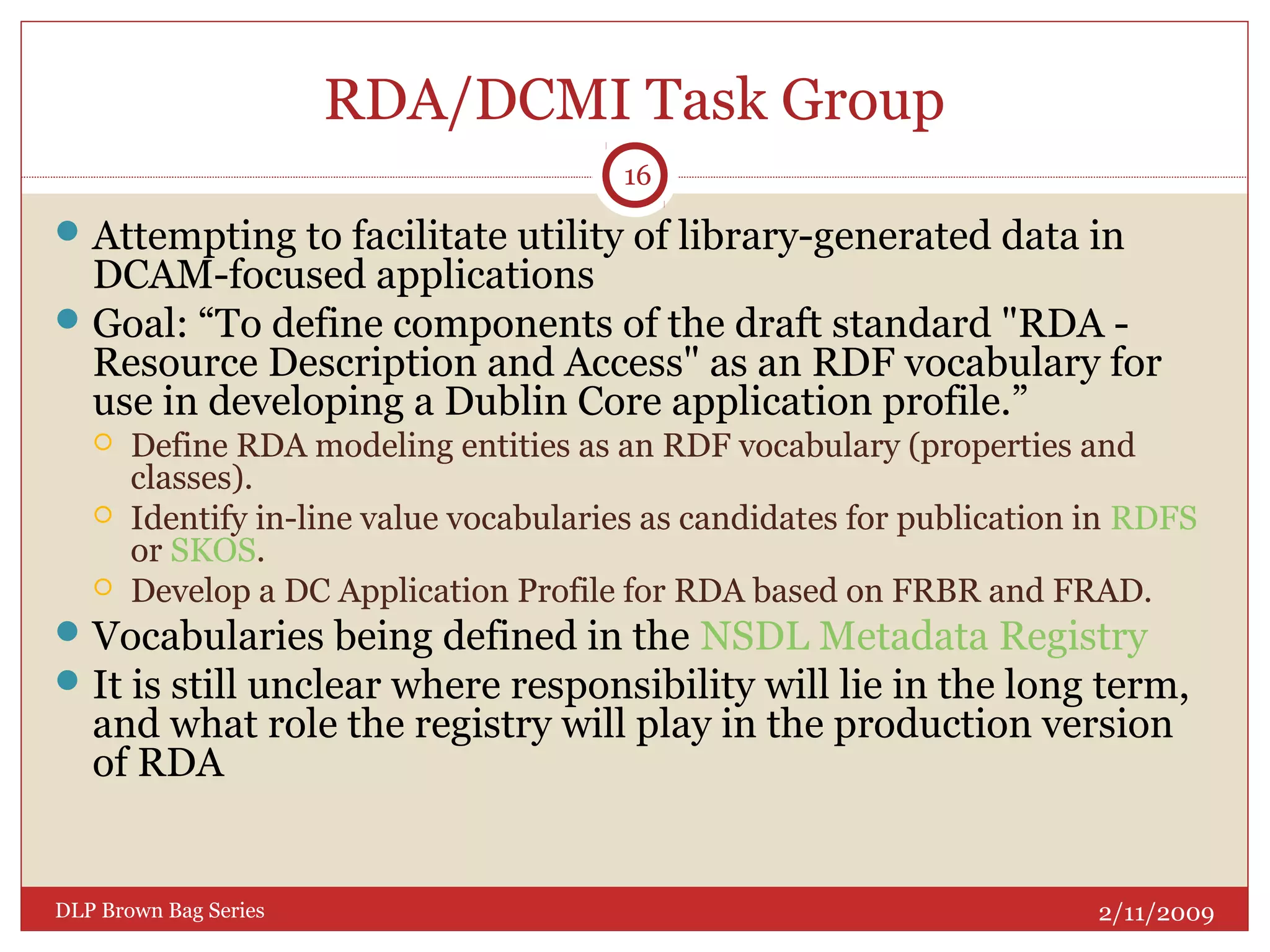
RDA/DCMI Task Group
Attempting to facilitate utility of library-generated data in
DCAM-focused applications
Goal: “To define components of the draft standard "RDA -
Resource Description and Access" as an RDF vocabulary for
use in developing a Dublin Core application profile.”
 Define RDA modeling entities as an RDF vocabulary (properties and
classes).
 Identify in-line value vocabularies as candidates for publication in RDFS
or SKOS.
 Develop a DC Application Profile for RDA based on FRBR and FRAD.
Vocabularies being defined in the NSDL Metadata Registry
It is still unclear where responsibility will lie in the long term,
and what role the registry will play in the production version
of RDA
2/11/2009DLP Brown Bag Series
16
Should libraries care about this?
Yes, if just to be aware
 Because this could be the prevailing model in the future
 Although that’s far from clear right now
It depends, on…
 How RDA and the RDA/DCMI vocabulary registry are received
 How quickly metadata creation systems in libraries develop
infrastructure to support making these distinctions
 If we can overcome the terminological challenges currently
separating the two communities
 How effective mashups of library and non-library data are in the
short- and medium-term, sparking interest in this area
 How quickly Semantic Web-style applications emerge that can make
good use of this data
 How the balance between intelligence in data and intelligence in
applications goes over the next few years
2/11/2009DLP Brown Bag Series
17
Do you have one? Can I borrow it?
2/11/2009DLP Brown Bag Series
18
Thank you!
Questions?
For more information:
 DCMI Abstract Model home page:
<http://dublincore.org/documents/abstract-model/>
 These presentation slides:
<http://www.dlib.indiana.edu/~jenlrile/presentations/bbspr09/dcam/dcmi-am.ppt>
 Today’s handout:
<http://www.dlib.indiana.edu/~jenlrile/presentations/bbspr09/dcam/handout.pdf>
 jenlrile@indiana.edu
2/11/2009DLP Brown Bag Series
19

Dublin Core Metadata Initiative Abstract Model

  • 1.
    JENN RILEY METADATA LIBRARIAN DIGITALLIBRARY PROGRAM DL BROWN BAG SERIES FEBRUARY 11, 2009 Dublin Core Metadata Initiative Abstract Model
  • 2.
    This is notyour father’s DC DCAM ≠ DCMES The DCAM is a different way of looking at data than what libraries are used to. 2/11/2009DLP Brown Bag Series 2
  • 3.
    The DCAM is… An“abstract model for Dublin Core metadata” AND “an information model which is independent of any particular encoding syntax” 2/11/2009 3 DLP Brown Bag Series
  • 4.
    History of theDCAM * Remember: the DCMES (and DC Terms) never intended to be the be all, end all, of metadata Qualified Dublin Core first released in 2000  Dumb-down principle a great idea, but challenge comes when one tries to make statements about, for example, creator roles  Rise of RDF 1999-2004 starts folks thinking about self-descriptive models (Lots of community debate) The term “abstract model” appears in DC documentation at least as early as January 2002 (Lots of community debate) Abstract Model first released as stable DCMI Recommendation in March 2005 Current version of Abstract Model released as stable DCMI Recommendation in June 2007 2/11/2009DLP Brown Bag Series 4
  • 5.
    DCMI Resource Model Resourcesare described using property-value pairs  This concept is familiar to libraries; a field and its content  DCAM applies additional constraints, however Types of values  literal value: represents something by means of a string  non-literal value: the something itself, not a reference to it A value is also itself a resource 2/11/2009DLP Brown Bag Series 5
  • 6.
    DCMI Description SetModel (1) Description set: collection of description(s) Description  Makes statements (which contain property-value pairs)  Can contain a URI for the described resource Property-value pairs  Properties are kind of like elements (but wait ‘til later!)  Properties must be represented by URIs  The values are where this gets complicated! 2/11/2009DLP Brown Bag Series 6
  • 7.
    DCMI Description SetModel (2) Value surrogates  Literal value surrogate:  Representation of a literal value by means of a string  From RDF, a literal value is generally something like a number or date  Non-literal value surrogate  Representation of a non-literal value  Can have a URI referring to the value  Can have a vocabulary encoding scheme URI  Can have a value string (literal representing the non-literal value) Value strings  Plain value string: just a string, but can have an associated language code  Typed value string: also associates the string with a syntax encoding scheme via a URI 2/11/2009DLP Brown Bag Series 7
  • 8.
    DCMI Vocabulary Model Notjust what we in libraries consider to be controlled vocabularies! Vocabularies can contain:  Properties  Classes  Vocabulary encoding schemes  Syntax encoding schemes 2/11/2009DLP Brown Bag Series 8 What libraries are used to
  • 9.
    DC encodings Don’t haveto implement entire DCAM  But do need to make clear which parts are supported Current encoding statuses  RDF encoding implementing DCAM now a Recommendation  XML encoding implementing DCAM still a Working Draft (since May 2006)*  XHTML <meta> and <link> encoding implementing DCAM now a Recommendation * I think this says something interesting. 2/11/2009DLP Brown Bag Series 9
  • 10.
    XML DC encodings 2/11/2009DLPBrown Bag Series 10 Old New
  • 11.
    So why goto all of this trouble? “Interoperability” DCAM potentially promotes interoperability by allowing for the building of effective application profiles 2/11/2009DLP Brown Bag Series 11 Nilsson, Mikael, Pete Johnston, Ambjörn Naeve, and Andy Powell. “The Future of Learning Object Metadata Interoperability.” In: Harman, Keith and Alex Koohang (eds.). Learning Objects: Standards, Metadata, Repositories, and LCMS. Santa Rosa, California: Informing Science Press, 2007. http://kmr.nada.kth.se/papers/SemanticWeb/FutureOfLOMI.pdf
  • 12.
    Singapore Framework Created at2007 DC Conference No endorsed DC Application Profile exists yet that implements this framework 2/11/2009DLP Brown Bag Series 12
  • 13.
    Whoa. What, now? Layerswould allow communities to define their own needs but still base structures on the common abstract model Some possible benefits of the DCMI Abstract Model  Much easier metadata interoperability between systems  Less re-inventing the wheel in multiple places  Increased utility of library metadata in non-library environments  Better integration of authority data into bibliographic discovery systems But setting it all up is a lot of work! 2/11/2009DLP Brown Bag Series 13
  • 14.
    Is this reallygoing to work? I’m afraid I don’t know. 2/11/2009DLP Brown Bag Series 14
  • 15.
    MODS elements inDC Application Profiles? MODS terms suggested by the DCMI Usage Board in 2002 for the DC Libraries Application Profile 2 issues arose as the DCAM evolved:  The terms suggested were not MODS top-level elements and not directly addressable via URI (solvable?)  MODS “elements” ≠ DC “elements”  DC “element” really a “property”  MODS subelement values have shades of meaning affected by parent elements and parent element attribute values Is this really a problem?  Can MODS be understood in terms of the DCAM? Or MODS elements as “properties”?  Or is the difference fundamental in the XML vs. RDF approach?  And is the distinction meaningful to those who would use MODS?  Current DCMI position is that this is not allowable 2/11/2009DLP Brown Bag Series 15
  • 16.
    RDA/DCMI Task Group Attemptingto facilitate utility of library-generated data in DCAM-focused applications Goal: “To define components of the draft standard "RDA - Resource Description and Access" as an RDF vocabulary for use in developing a Dublin Core application profile.”  Define RDA modeling entities as an RDF vocabulary (properties and classes).  Identify in-line value vocabularies as candidates for publication in RDFS or SKOS.  Develop a DC Application Profile for RDA based on FRBR and FRAD. Vocabularies being defined in the NSDL Metadata Registry It is still unclear where responsibility will lie in the long term, and what role the registry will play in the production version of RDA 2/11/2009DLP Brown Bag Series 16
  • 17.
    Should libraries careabout this? Yes, if just to be aware  Because this could be the prevailing model in the future  Although that’s far from clear right now It depends, on…  How RDA and the RDA/DCMI vocabulary registry are received  How quickly metadata creation systems in libraries develop infrastructure to support making these distinctions  If we can overcome the terminological challenges currently separating the two communities  How effective mashups of library and non-library data are in the short- and medium-term, sparking interest in this area  How quickly Semantic Web-style applications emerge that can make good use of this data  How the balance between intelligence in data and intelligence in applications goes over the next few years 2/11/2009DLP Brown Bag Series 17
  • 18.
    Do you haveone? Can I borrow it? 2/11/2009DLP Brown Bag Series 18
  • 19.
    Thank you! Questions? For moreinformation:  DCMI Abstract Model home page: <http://dublincore.org/documents/abstract-model/>  These presentation slides: <http://www.dlib.indiana.edu/~jenlrile/presentations/bbspr09/dcam/dcmi-am.ppt>  Today’s handout: <http://www.dlib.indiana.edu/~jenlrile/presentations/bbspr09/dcam/handout.pdf>  jenlrile@indiana.edu 2/11/2009DLP Brown Bag Series 19