M.l.i.sc 3rd sem 
Central university of Gujarat
Page 2 
 What is standards 
Why use existing standards 
 what is Metadata 
Why is Metadata Important 
 Types of metadata 
 Examples of metadata standards 
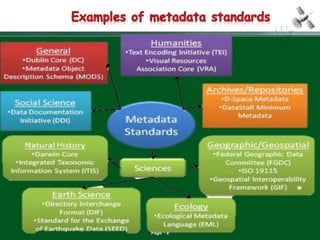
 dublin core ,MARC ,EAD ,MODS ,RDF 
MITS.
Page 3 
A standard is a document that provides requirements, specifications, guidelines or characteristics that can be used consistently to ensure that materials, products, processes and services are fit for their purpose.
Page 4 
Cost saving 
Access to help and advice 
Usability 
Resource discovery 
Sustainability
Page 5 
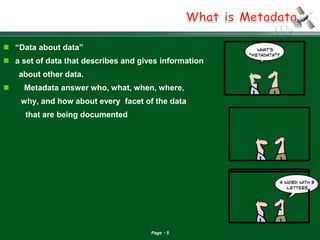
―Data about data‖ 
a set of data that describes and gives information 
about other data. 
 Metadata answer who, what, when, where, 
why, and how about every facet of the data 
that are being documented
Page 6 
Increased accessibility 
Ability for different systems to talk to one 
another 
Expanding use 
Multi-versioning 
Preservation 
Cost considerations
Page 7 
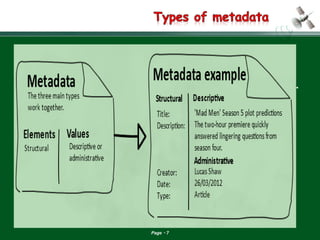
5 types of metadata: 
Descriptive – Title, author, topic, etc. 
Administrative – Record number, record date, etc. 
Technical – File size, software needed, etc. 
Rights – Copyright ownership, etc. 
Management – typically by/for owning agency 
(Price paid, circulation restrictions, etc.)
Page 8
Page 9 
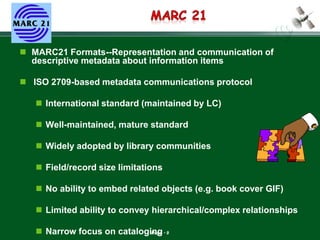
MARC21 Formats--Representation and communication of descriptive metadata about information items 
ISO 2709-based metadata communications protocol 
International standard (maintained by LC) 
Well-maintained, mature standard 
Widely adopted by library communities 
Field/record size limitations 
No ability to embed related objects (e.g. book cover GIF) 
Limited ability to convey hierarchical/complex relationships 
Narrow focus on cataloging
Page 10 
MODS (Metadata Object Description Standard)—XML markup language for selected data from MARC21 records as well as original resource description 
Richer than Dublin Core; library-oriented XML metadata schema 
 Can accommodate AACR2 standards 
Maintenance agency: Library of Congress 
Well-suited as a metadata format for OAI harvesting 
MARC21 readily converts to MODS; however, cannot readily do a reverse conversion of MODS to MARC21 
Community best practice guidelines would enhance usefulness
Page 11 
EAD (Encoded Archival Description)—XML markup design for encoded finding aids using Standard Generalized Markup Language 
EAD header carries metadata for finding aid 
Standard maintained by LC along with SAA 
suited for archival description 
Provides simple or complex mark-up design to support varying levels of indexing 
Needs help at the item level
Page 12 
Dublin Core – Metadata element set (for description of digital objects) 
Maintenance agency: Dublin Core Metadata Initiative (DCMI) hosted by OCLC Research 
Achieve international standardization (ISO 15836) 
Intended for use by both non-catalogers and specialists 
No MARC tags used with Dublin Core metadata 
Worldwide adoption (DCMES translated into 20+ languages) 
No consistency across different projects using Dublin Core 
Documentation for Dublin Core not well-defined
Page 13 
Metadata Encoding and Transmission Standard (METS) 
A standard ―shell‖ for encoding data essential for retrieving, preserving, and serving up digital resources 
Six modules define descriptive, administrative, structural, rights and other metadata 
Some parts of a METS object may be external (e.g., a MODS record for the descriptive metadata) 
Maintenance agency: Library of Congress
Page 14 
Resource Description Format (RDF) 
RDF provides interoperability between applications that exchange machine-understandable information on the Web 
Designed to convey metadata for machine consumption (raw RDF is not very human-readable) 
A subject of debate (typically RDF vs. XML)! 
Fundamental building block of RDF is the triple (subject + predicate + object) 
Maintained by the W3C; RDF specification under revision
Page 15 
!
16 
Thank You !!!

Metadata Standards

  • 1.
    M.l.i.sc 3rd sem Central university of Gujarat
  • 2.
    Page 2 What is standards Why use existing standards  what is Metadata Why is Metadata Important  Types of metadata  Examples of metadata standards  dublin core ,MARC ,EAD ,MODS ,RDF MITS.
  • 3.
    Page 3 Astandard is a document that provides requirements, specifications, guidelines or characteristics that can be used consistently to ensure that materials, products, processes and services are fit for their purpose.
  • 4.
    Page 4 Costsaving Access to help and advice Usability Resource discovery Sustainability
  • 5.
    Page 5 ―Dataabout data‖ a set of data that describes and gives information about other data.  Metadata answer who, what, when, where, why, and how about every facet of the data that are being documented
  • 6.
    Page 6 Increasedaccessibility Ability for different systems to talk to one another Expanding use Multi-versioning Preservation Cost considerations
  • 7.
    Page 7 5types of metadata: Descriptive – Title, author, topic, etc. Administrative – Record number, record date, etc. Technical – File size, software needed, etc. Rights – Copyright ownership, etc. Management – typically by/for owning agency (Price paid, circulation restrictions, etc.)
  • 8.
  • 9.
    Page 9 MARC21Formats--Representation and communication of descriptive metadata about information items ISO 2709-based metadata communications protocol International standard (maintained by LC) Well-maintained, mature standard Widely adopted by library communities Field/record size limitations No ability to embed related objects (e.g. book cover GIF) Limited ability to convey hierarchical/complex relationships Narrow focus on cataloging
  • 10.
    Page 10 MODS(Metadata Object Description Standard)—XML markup language for selected data from MARC21 records as well as original resource description Richer than Dublin Core; library-oriented XML metadata schema  Can accommodate AACR2 standards Maintenance agency: Library of Congress Well-suited as a metadata format for OAI harvesting MARC21 readily converts to MODS; however, cannot readily do a reverse conversion of MODS to MARC21 Community best practice guidelines would enhance usefulness
  • 11.
    Page 11 EAD(Encoded Archival Description)—XML markup design for encoded finding aids using Standard Generalized Markup Language EAD header carries metadata for finding aid Standard maintained by LC along with SAA suited for archival description Provides simple or complex mark-up design to support varying levels of indexing Needs help at the item level
  • 12.
    Page 12 DublinCore – Metadata element set (for description of digital objects) Maintenance agency: Dublin Core Metadata Initiative (DCMI) hosted by OCLC Research Achieve international standardization (ISO 15836) Intended for use by both non-catalogers and specialists No MARC tags used with Dublin Core metadata Worldwide adoption (DCMES translated into 20+ languages) No consistency across different projects using Dublin Core Documentation for Dublin Core not well-defined
  • 13.
    Page 13 MetadataEncoding and Transmission Standard (METS) A standard ―shell‖ for encoding data essential for retrieving, preserving, and serving up digital resources Six modules define descriptive, administrative, structural, rights and other metadata Some parts of a METS object may be external (e.g., a MODS record for the descriptive metadata) Maintenance agency: Library of Congress
  • 14.
    Page 14 ResourceDescription Format (RDF) RDF provides interoperability between applications that exchange machine-understandable information on the Web Designed to convey metadata for machine consumption (raw RDF is not very human-readable) A subject of debate (typically RDF vs. XML)! Fundamental building block of RDF is the triple (subject + predicate + object) Maintained by the W3C; RDF specification under revision
  • 15.
  • 16.