Dspace
Aparna S.
Dspace
• Dspace is an open source repository software package.
• For creating open access repositories
• For scholarly and /or published digital content
Dspace
 History
• DSpace, a joint development effort by Hewlett Packard and MIT begun in 2002.
• Fedora Commons led by Sandy Payette and DSpace Foundation led by Michele
Kimpton
• Both non-profit organizations joined to become DuraSpace(2009)
• VIVO, an open source web application for sharing and discovering information about
researchers, their publications, collaborators, and interests, was the first project by
DuraSpace(2014).
• DuraSpace and LYRASIS merged in July 2019.
• Currently the DSpace software and user community receives leadership and
guidance from LYRASIS(parent company).
Dspace
Features:
– Largest community of users and developers worldwide
– Free open source software
– Completely customizable to fit user needs
– Granular group based access control, allowing setting permissions down
to the level of individual files
– Used by government, Educational, Private and commercial
institutions
– Can be installed out of box
– Can be manage and preserve all type of digital contents
– Apache SOLR based search for metadata and full text contents
– UTF-8 Support
– Interface available in 22 languages optimized for Google Scholar
indexing
– Integration with BASE, CORE, OpenAIRE, Unpaywall and WorldCat.
Dspace
• Technical aspects
• constructed with Java web applications, many programs, and an associated
metadata store.
• DSpace holdings are made available primarily via a web interface
• DSpace software runs on Linux, Solaris, Unix, Ubuntu and Windows. It can also
be installed on OS X
• Linux is by far the most common OS for Dspace
• The metadata, including access and configuration information, is stored in
a relational database and supports the use of PostgreSQL and Oracle database.
• More recent versions of DSpace also support faceted search and browse
functionality using Apache Solr
• Dspace 7.0 latest version- new (Angular-base) User Interface, which brings
together the best of both the JSPUI and XMLUI worlds.
• This new UI is also backed by a brand new REST API (still support OAI-PMH,
SWORD (v1 or v2) and RDF), which opens all data and features to the web,
allowing DSpace to integrate or interact with external systems/services like
never before.
• New Javascript-based frontend, built on Angular.io , UI customizable via HTML
and CSS (Sass) and Bootstrap.
Dspace
• DuraSpace is providing
– Technical leadership
• Face-to-face, IRC and teleconference developer meetings
• User Group meetings
• Regular software releases
– Sustainability planning
• Annual strategic planning
• Quarterly business review
• Financial planning, forecasting and review
– Fundraising
• Annual membership campaign
• Registered Service Provider Program
• Corporate Sponsorship Program
– Community development
• User Group Meeting
• Online and face-to-face training and web seminars
• Project governance
• International collaboration and partnerships
Dspace
DuraSpace is providing
– Marketing and communications
• Member Newsletter
• DSpace, Fedora and VIVO email list
• Twitter, LinkedIn, Pinterest, YouTube, Rebel Mouse
• DuraSpace web sites
• DuraSpace Digest
– collaborations and strategic partnerships
• The Digital Preservation Network (DPN)
• Academic Preservation Trust (APTrust)
• euroCRIS
• The SHared Access Research Ecosystem (SHARE)
• National Digital Stewardship Alliance (NDSA)
• International Conference on Open Repositories (OR)
• Hydra Project
– administration to the DSpace, Fedora and VIVO projects.
Dspace
• Duraspace services
– DspaceDirect
• Dspace Direct can be used to preserve and provide access to academic faculty and
student papers, projects, and research making content easily searchable by end users
and easily managed by content curators.
• a quick, cost effective fully-hosted service
– DuraCloud
• Simple , flexible, secure, fully hosted, open source, easy to use, budget friendly pricing,
smart preservation tools for safety and security.
• lightweight features that enable digital preservation, data access, and data sharing
– ArchivesDirect
• for creating standards-based digital preservation content packages that are archived in
secure long-term storage.
• The LYRASIS and Artefactual hosted Archives Direct service will no longer be offered
under one contract effective June 1, 2020.
• Separating "Archives Direct" into two service agreements, gives clients increased
understanding of the terms for each service.
Dspace
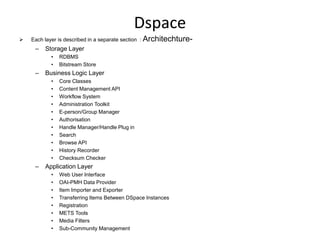
 Each layer is described in a separate section : Architechture-
– Storage Layer
• RDBMS
• Bitstream Store
– Business Logic Layer
• Core Classes
• Content Management API
• Workflow System
• Administration Toolkit
• E-person/Group Manager
• Authorisation
• Handle Manager/Handle Plug in
• Search
• Browse API
• History Recorder
• Checksum Checker
– Application Layer
• Web User Interface
• OAI-PMH Data Provider
• Item Importer and Exporter
• Transferring Items Between DSpace Instances
• Registration
• METS Tools
• Media Filters
• Sub-Community Management
Dspace
 Directory
– Installation directory, referred to as [dspace], is the location
where DSpace is installed Dspace directory. It is where all the
DSpace configuration files, command line scripts, documentation
and web apps are installed to.
– Source directory, referred to as [dspace-source]: This is the
location where the DSpace release distribution is unzipped into.
– Web deployment directory: This is the directory that contains
your DSpace web application(s).
Dspace
 Members
– Platinum members- $20000 and more- Texas University,
University of Minnesota
– Gold members-$10000- University of cambridge, University of
Toranto
– Silver members-$5000-University of Hongkong, University of
uottawa
– Bronze members-$2500-The princeton University library, The
world Bank
– Copper members-$1000-University Tampa, East Carolina
University
– Supporter-$500-University ULM
DSpace Members are leaders from university, research, library
organizations, and others, who have made a financial
commitment to our open source projects.
Reference:
• https://www.researchgate.net/publication/271523902_Open_source_software_An_ins
titutional_digital_repository_system_with_special_reference_to_DSpace_software_in
_digital_libraries_-_an_introduction_Review_paper accessed on 13 sept,2021.
• https://duraspace.org/ accessed on 13 sept,2021.
• https://www.dspace.com/accessed on 12 sept,2021.
• http://www.dspace.org/accessed on 11sept,2021

Dspace software

  • 1.
  • 2.
    Dspace • Dspace isan open source repository software package. • For creating open access repositories • For scholarly and /or published digital content
  • 3.
    Dspace  History • DSpace,a joint development effort by Hewlett Packard and MIT begun in 2002. • Fedora Commons led by Sandy Payette and DSpace Foundation led by Michele Kimpton • Both non-profit organizations joined to become DuraSpace(2009) • VIVO, an open source web application for sharing and discovering information about researchers, their publications, collaborators, and interests, was the first project by DuraSpace(2014). • DuraSpace and LYRASIS merged in July 2019. • Currently the DSpace software and user community receives leadership and guidance from LYRASIS(parent company).
  • 4.
    Dspace Features: – Largest communityof users and developers worldwide – Free open source software – Completely customizable to fit user needs – Granular group based access control, allowing setting permissions down to the level of individual files – Used by government, Educational, Private and commercial institutions – Can be installed out of box – Can be manage and preserve all type of digital contents – Apache SOLR based search for metadata and full text contents – UTF-8 Support – Interface available in 22 languages optimized for Google Scholar indexing – Integration with BASE, CORE, OpenAIRE, Unpaywall and WorldCat.
  • 5.
    Dspace • Technical aspects •constructed with Java web applications, many programs, and an associated metadata store. • DSpace holdings are made available primarily via a web interface • DSpace software runs on Linux, Solaris, Unix, Ubuntu and Windows. It can also be installed on OS X • Linux is by far the most common OS for Dspace • The metadata, including access and configuration information, is stored in a relational database and supports the use of PostgreSQL and Oracle database. • More recent versions of DSpace also support faceted search and browse functionality using Apache Solr • Dspace 7.0 latest version- new (Angular-base) User Interface, which brings together the best of both the JSPUI and XMLUI worlds. • This new UI is also backed by a brand new REST API (still support OAI-PMH, SWORD (v1 or v2) and RDF), which opens all data and features to the web, allowing DSpace to integrate or interact with external systems/services like never before. • New Javascript-based frontend, built on Angular.io , UI customizable via HTML and CSS (Sass) and Bootstrap.
  • 6.
    Dspace • DuraSpace isproviding – Technical leadership • Face-to-face, IRC and teleconference developer meetings • User Group meetings • Regular software releases – Sustainability planning • Annual strategic planning • Quarterly business review • Financial planning, forecasting and review – Fundraising • Annual membership campaign • Registered Service Provider Program • Corporate Sponsorship Program – Community development • User Group Meeting • Online and face-to-face training and web seminars • Project governance • International collaboration and partnerships
  • 7.
    Dspace DuraSpace is providing –Marketing and communications • Member Newsletter • DSpace, Fedora and VIVO email list • Twitter, LinkedIn, Pinterest, YouTube, Rebel Mouse • DuraSpace web sites • DuraSpace Digest – collaborations and strategic partnerships • The Digital Preservation Network (DPN) • Academic Preservation Trust (APTrust) • euroCRIS • The SHared Access Research Ecosystem (SHARE) • National Digital Stewardship Alliance (NDSA) • International Conference on Open Repositories (OR) • Hydra Project – administration to the DSpace, Fedora and VIVO projects.
  • 8.
    Dspace • Duraspace services –DspaceDirect • Dspace Direct can be used to preserve and provide access to academic faculty and student papers, projects, and research making content easily searchable by end users and easily managed by content curators. • a quick, cost effective fully-hosted service – DuraCloud • Simple , flexible, secure, fully hosted, open source, easy to use, budget friendly pricing, smart preservation tools for safety and security. • lightweight features that enable digital preservation, data access, and data sharing – ArchivesDirect • for creating standards-based digital preservation content packages that are archived in secure long-term storage. • The LYRASIS and Artefactual hosted Archives Direct service will no longer be offered under one contract effective June 1, 2020. • Separating "Archives Direct" into two service agreements, gives clients increased understanding of the terms for each service.
  • 9.
    Dspace  Each layeris described in a separate section : Architechture- – Storage Layer • RDBMS • Bitstream Store – Business Logic Layer • Core Classes • Content Management API • Workflow System • Administration Toolkit • E-person/Group Manager • Authorisation • Handle Manager/Handle Plug in • Search • Browse API • History Recorder • Checksum Checker – Application Layer • Web User Interface • OAI-PMH Data Provider • Item Importer and Exporter • Transferring Items Between DSpace Instances • Registration • METS Tools • Media Filters • Sub-Community Management
  • 10.
    Dspace  Directory – Installationdirectory, referred to as [dspace], is the location where DSpace is installed Dspace directory. It is where all the DSpace configuration files, command line scripts, documentation and web apps are installed to. – Source directory, referred to as [dspace-source]: This is the location where the DSpace release distribution is unzipped into. – Web deployment directory: This is the directory that contains your DSpace web application(s).
  • 11.
    Dspace  Members – Platinummembers- $20000 and more- Texas University, University of Minnesota – Gold members-$10000- University of cambridge, University of Toranto – Silver members-$5000-University of Hongkong, University of uottawa – Bronze members-$2500-The princeton University library, The world Bank – Copper members-$1000-University Tampa, East Carolina University – Supporter-$500-University ULM DSpace Members are leaders from university, research, library organizations, and others, who have made a financial commitment to our open source projects.
  • 12.
    Reference: • https://www.researchgate.net/publication/271523902_Open_source_software_An_ins titutional_digital_repository_system_with_special_reference_to_DSpace_software_in _digital_libraries_-_an_introduction_Review_paper accessedon 13 sept,2021. • https://duraspace.org/ accessed on 13 sept,2021. • https://www.dspace.com/accessed on 12 sept,2021. • http://www.dspace.org/accessed on 11sept,2021