Overview of Presentation
• Introduction
• History
• Why MARC 21/Need of MARC
21
• Characteristics
• Design principle for MARC 21
• MARC 21 Documentation
• MARC 21Record System
• MARC 21 Communication
formats
• MARC 21 Format for
Bibliographic Data
• Component of bibliographic
record
• Communication Standard
• Mapping of MARC 21
• MARC 21 Translation
• Maintenance Agency
• MARC 21 Regulation
• Advantage of MARC 21
• Problems with MARC 21
• Future of MARC 21
• Conclusion
• References
Introduction
• MARC is the acronym for MAchine-Readable
Cataloging.
• ā€œMachine-readableā€ means that one particular
type of machine, a computer, can read and
interpret the data in the cataloging record.
• ā€œCataloging recordā€ means a bibliographic record,
or the information traditionally shown on a
catalog card.
• It provides the mechanism by which computers
exchange, use, and interpret bibliographic
information, and its data elements .
...contd
• Standards for exchanging Catalogue Records.
• Standard for the description of the digital format of any
item.
• Enables computers to interpret the information found
in a traditional cataloging record by way of data, or
ā€œsignpostsā€ placed before each field of bibliographic
information
• 21 is the latest version and refers to the 21st century.
• Institutions do not store ā€œMARC 21ā€, as it is a
communication format
• It is the foundation of most library catalogs used today.
History
• Libraries had shared cataloging information long before the advent of
computers.
• Computer Scientist Henriette Avram who worked in Library of Congress
created MARC in 1960s so that records can be shared among libraries.
• It defines a data format that emerged from a Library of Congress-led
initiative that began nearly forty years ago.
• Originally the Library of Congress program was called LC MARC.
• 1968 – LC and BNB* together form MARC II, aiming to be an Anglo-
American format
• In 1980s it became USMARC
• 1968-98 – Over 50 MARC formats developed worldwide
• 1994-97 - the USMARC and CAN/MARC user communities worked to
eliminate all remaining differences in there two already similar formats.
*BNB(British National Bibliography carried out its own studies separate from LC between 1950s -60s :-UKMARC
....contd
(Journey from MARC to MARC 21)
• Compatibility had been a feature of the development process for
both formats for many years.
• In 1997 and early 1998,updates to the formats were issued that
made the format specifications identical.
• MARC 21 is not a new format. It is a continuation of both USMARC
and CAN/MARC, publish the formats in a single edition in early
1999 under a new name: MARC 21.
• The name both points to the moving towards 21st century and
suggests the international character of the format, which is
appropriate and important given its expanding worldwide use.
• The Library of Congress and the National Library of Canada
announced the new name MARC 21 to the harmonized USMARC
and CAN/MARC formats in early 1999.
....contd.
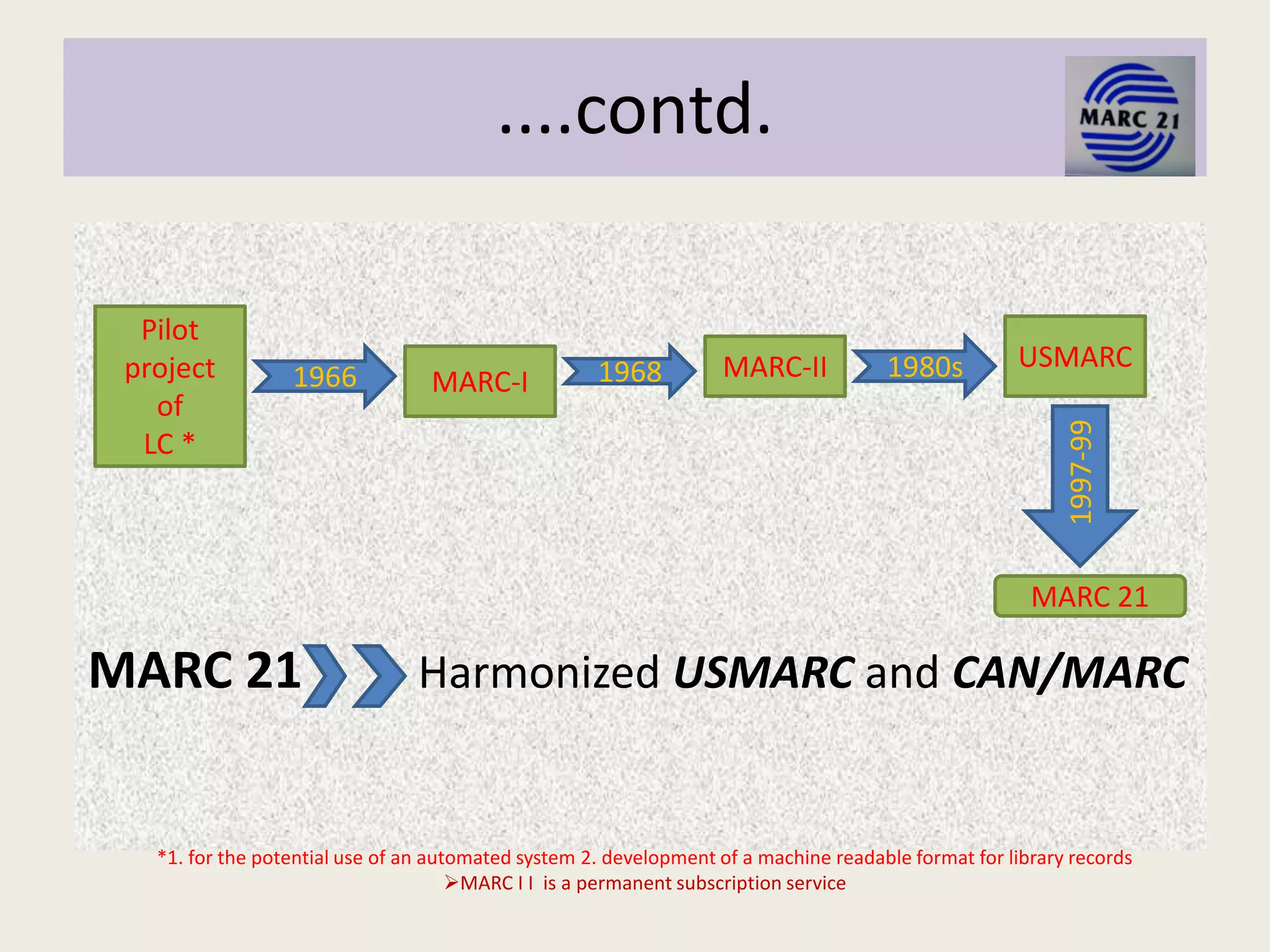
MARC 21 Harmonized USMARC and CAN/MARC
Pilot
project
of
LC *
1966 MARC-I 1968 MARC-II 1980s
MARC 21
USMARC
1997-99
*1. for the potential use of an automated system 2. development of a machine readable format for library records
MARC I I is a permanent subscription service
Why MARC 21 ?
 To fulfil the need of uniform record format(structure) to
meet the paradigm shift taking place in Libraries from...
• Own collection to Library without walls*
• In sourcing to Out sourcing
• Local reach to Global reach**
• One medium to Multiple media***
 made shared cataloguing a reality
 The MARC record acts as a uniform record structure for the
representation of disparate information types, including
manuscripts, archives, cartographic material, musical
scores, serial, Sound recording and so on.
*Union Catalogue **Trans-border data flow of information ***Non-book materials
...contd..
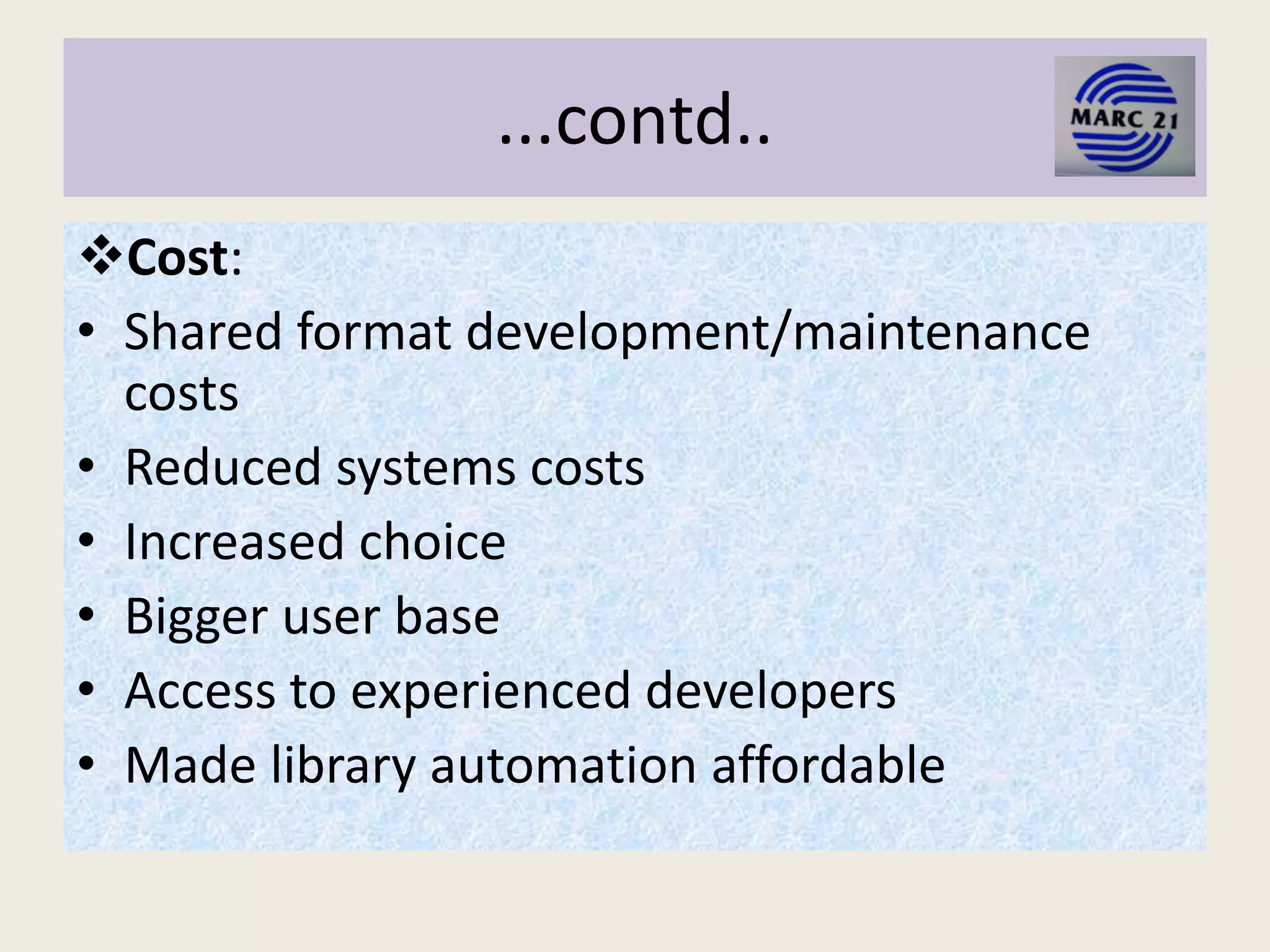
Cost:
• Shared format development/maintenance
costs
• Reduced systems costs
• Increased choice
• Bigger user base
• Access to experienced developers
• Made library automation affordable
Characteristics
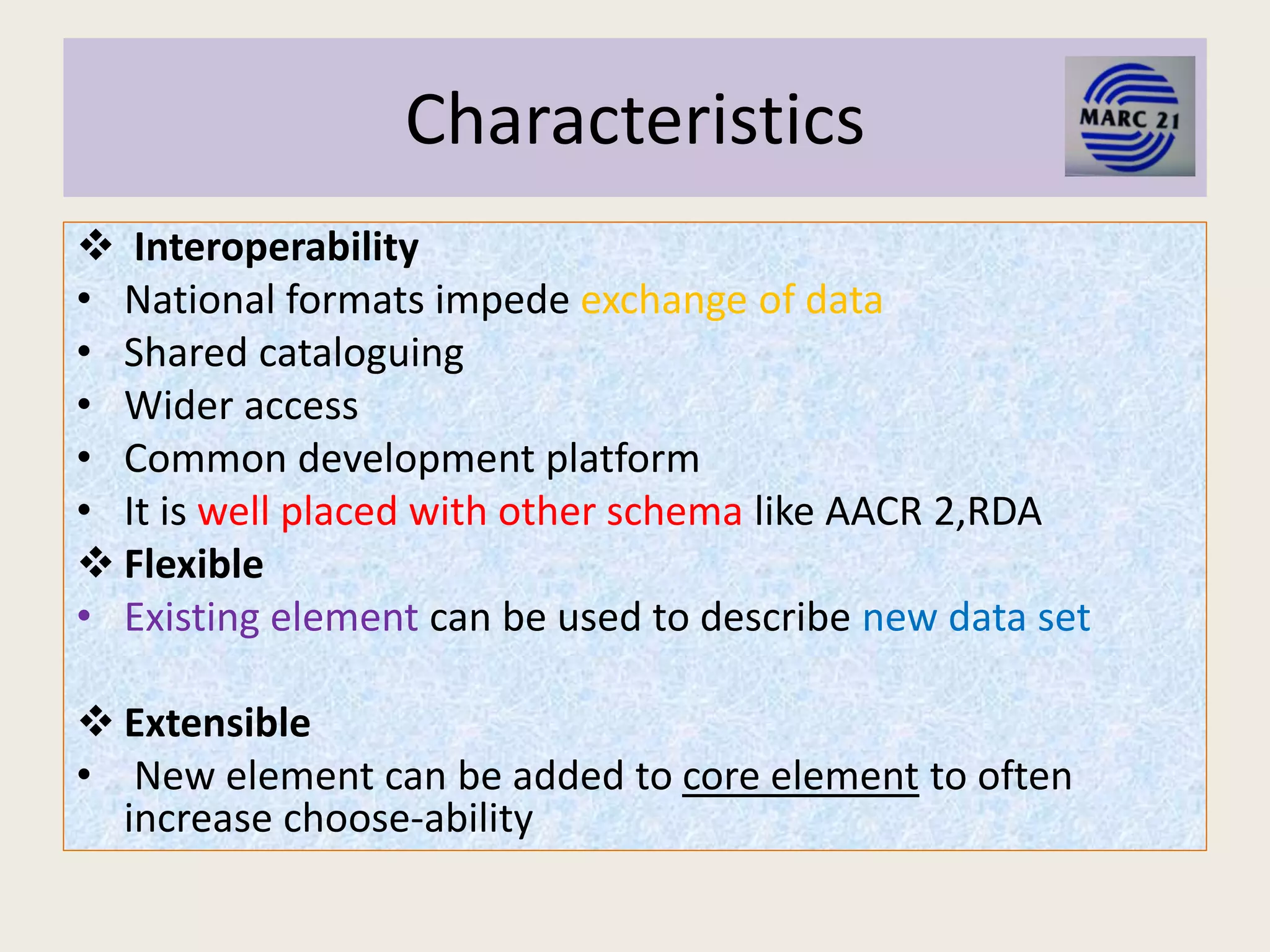
 Interoperability
• National formats impede exchange of data
• Shared cataloguing
• Wider access
• Common development platform
• It is well placed with other schema like AACR 2,RDA
 Flexible
• Existing element can be used to describe new data set
 Extensible
• New element can be added to core element to often
increase choose-ability
...contd
• Example of extensible character :-Addition of
the new field which is used in MARC 21 when
using metadata standard
 336 – Content type
 337 –Media type
338 – Carrier type
MARC 21 Documentation
• MARC Standards Page has links to both
extensive documentation on MARC 21,
including both the full and concise formats,
code and field lists,
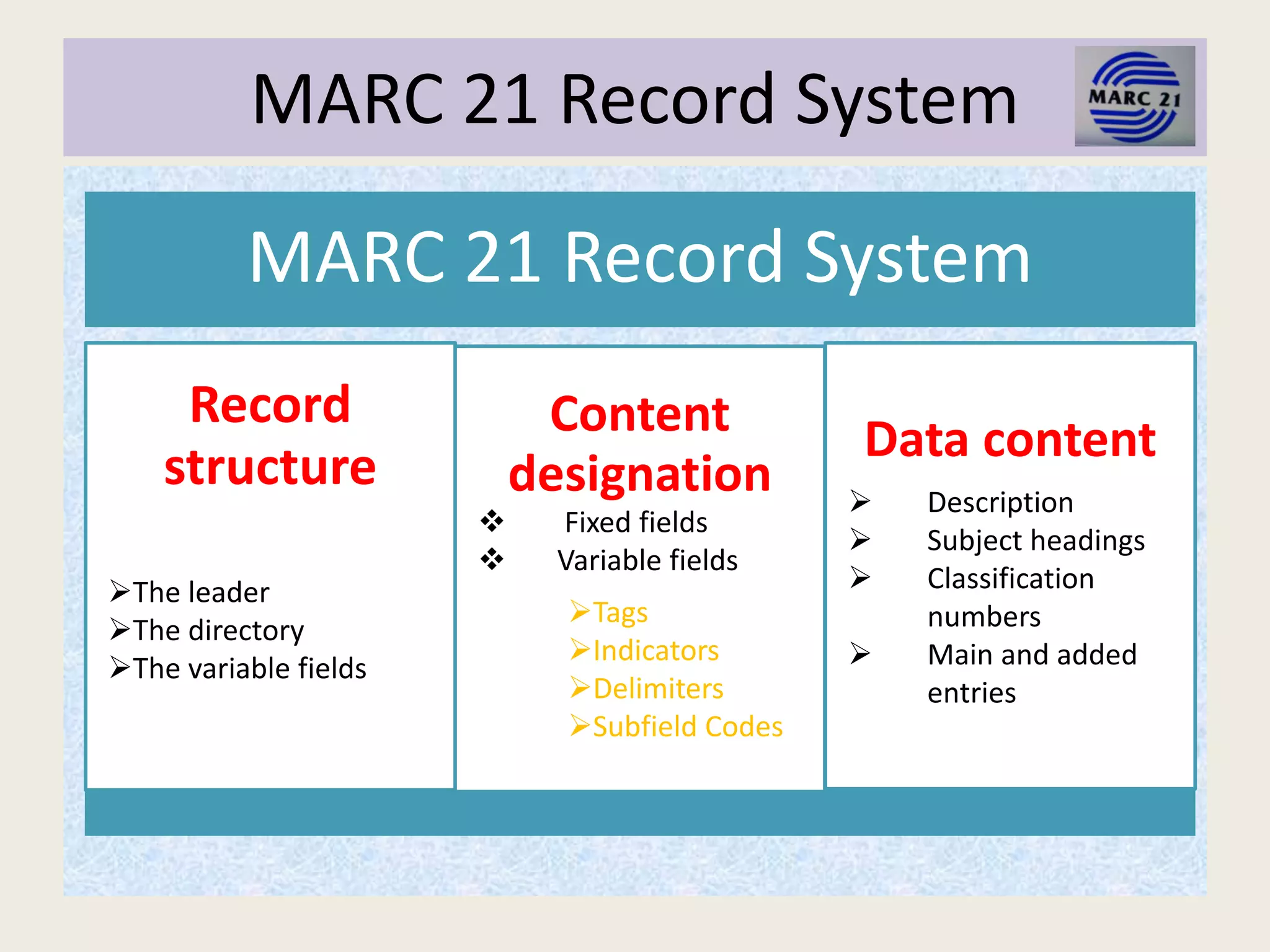
MARC 21 Record System
Record
structure
Content
designation
Data content
The leader
The directory
The variable fields
 Fixed fields
 Variable fields
Tags
Indicators
Delimiters
Subfield Codes
 Description
 Subject headings
 Classification
numbers
 Main and added
entries
Record Structure
• Design principles for MARC 21
• MARC 21 format is a set of codes and content designators
defined for encoding a particular type of machine-readable
record.
• The record structure is an implementation of the
international standard format for Information exchange(ISO
2709) and its American counterpart, Bibliographic
Information Interchange (ANSI/NISO Z39.2)
• The MARC Record structure consist of three main
component:-
 The leader
 The directory
 The variable fields
Content Designation
 The codes and conventions established explicitly to identify
and further characterize the data elements within a record
 It supports the sorting of data only to a limited extent.
 The MARC 21 formats provide for using content
designation, to specify recommended display constants
 Variable fields Contain specific pieces of information
identified by:
 Tags
 Indicators
 Delimiters
 Subfield Codes
Field
Field :-
• Each bibliographic record is divided logically into fields.
• There is a field for the author, a field for title
information and so on.
• These fields are subdivided into one or more
ā€œsubfieldsā€. They are represented by 3-digit tags.
• Many tag field has equip the possibility and
responsibility to use subfield to encode additional
information
 The subfield data designated and interpreted by man.
Subfield codes
• Single letters or digits indicate what type of
information is in a subfield
• Subfield are smaller piece of information
• You can have more than one subfield
Tags
 A tag :-
• Each field is associated with 3-digit number called a ā€œtagā€.
• A tag identifies the field --the kind of data-- That follows.
• MARC 21 formats use only numeric tags.
• The tag stored in the directory entry for the field, not in the field
itself.
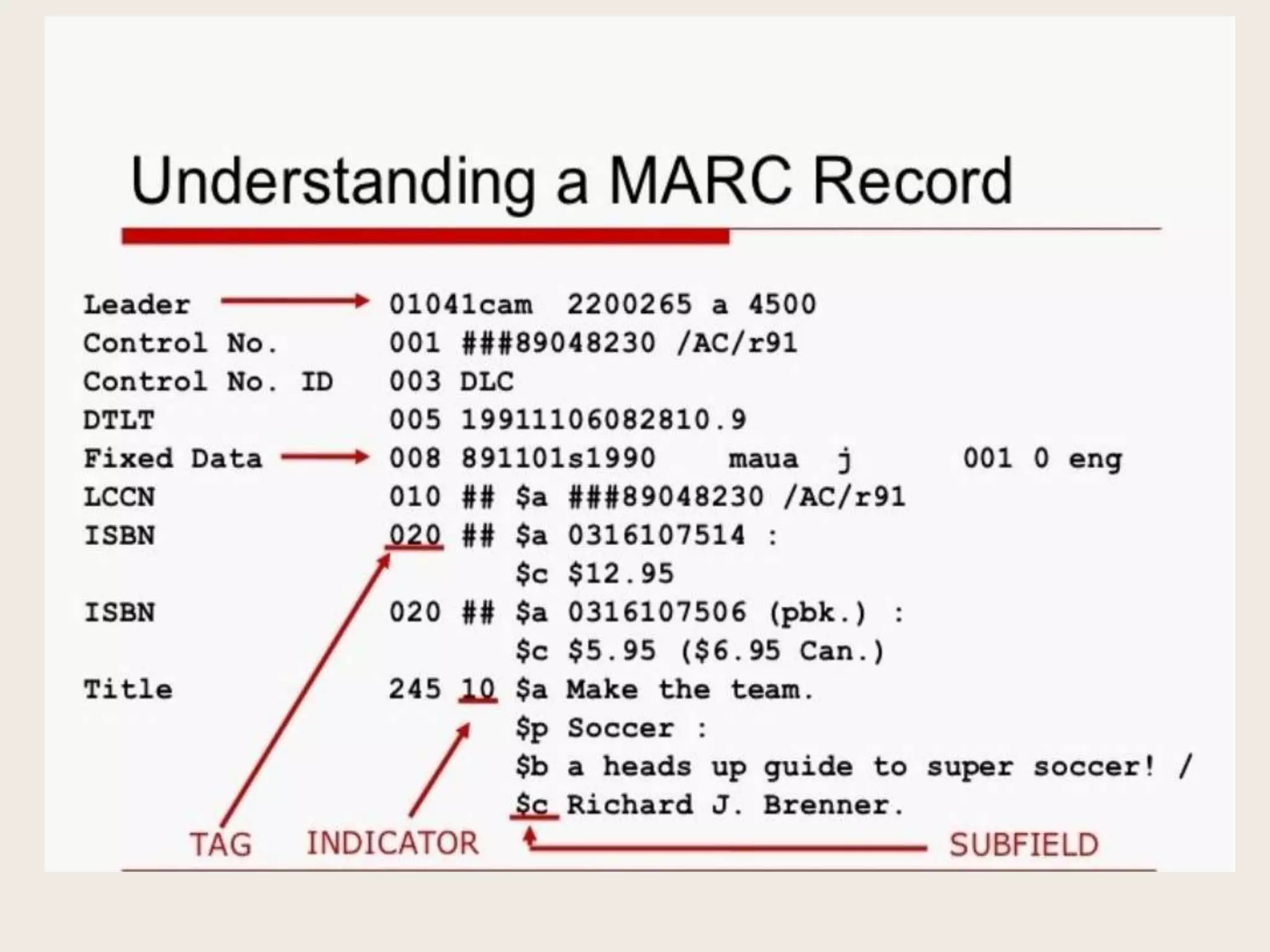
• Here the number 100 is the tag
100 1# Sa Pirsig, Robert M.
 Variable field tags are defined in blocks according to the first
character of the tag, which with some exceptions, identifies the
general function of the field’s data within a record.
• The type of information in the field is identified by the remainder of
the tag.
• The meaning of these blocks depends upon the type of record.
Indicators
 Indicators :-
• Digits or blanks that give the computer instructions or
information about the data contained in the field
• Two character positions follow each tag(with the
exception of fields 001 through 009).
• One or both of these character positions may be used
for indicators.
• When an indicators position is not used, that indicator
is referred to as ā€œundefinedā€ and the position is left
blank
• It is the convention to represent a blank, or undefined,
indicator position by the character ā€œ#ā€
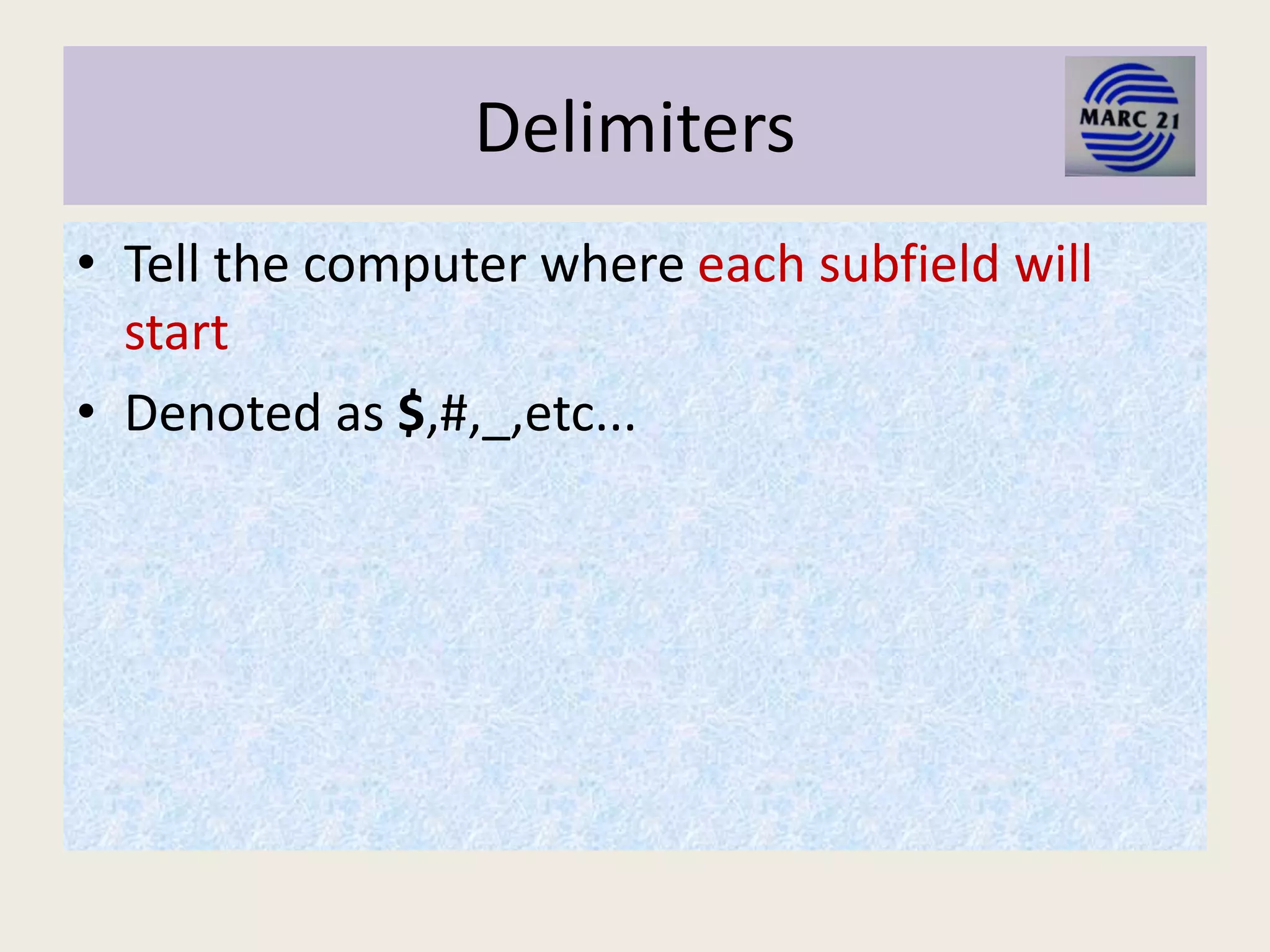
Delimiters
• Tell the computer where each subfield will
start
• Denoted as $,#,_,etc...
Example to describe the
design principle for MARC
21
 245 10 $a Once upon a
town: $b the miracle of the
North Platte Canteen/ $c Bob
Greene
• 245 = Title and statement of
responsibility
• 10 = Author main entry; no
non-filing characters
• a= title proper
b= remainder of title
c= statement of responsibility
245 Tag ( 3 digit nos.)
10 Indicator (2 digit
nos.)
$ Delimiters ( 1 digit)
a
b Subfield codes
c
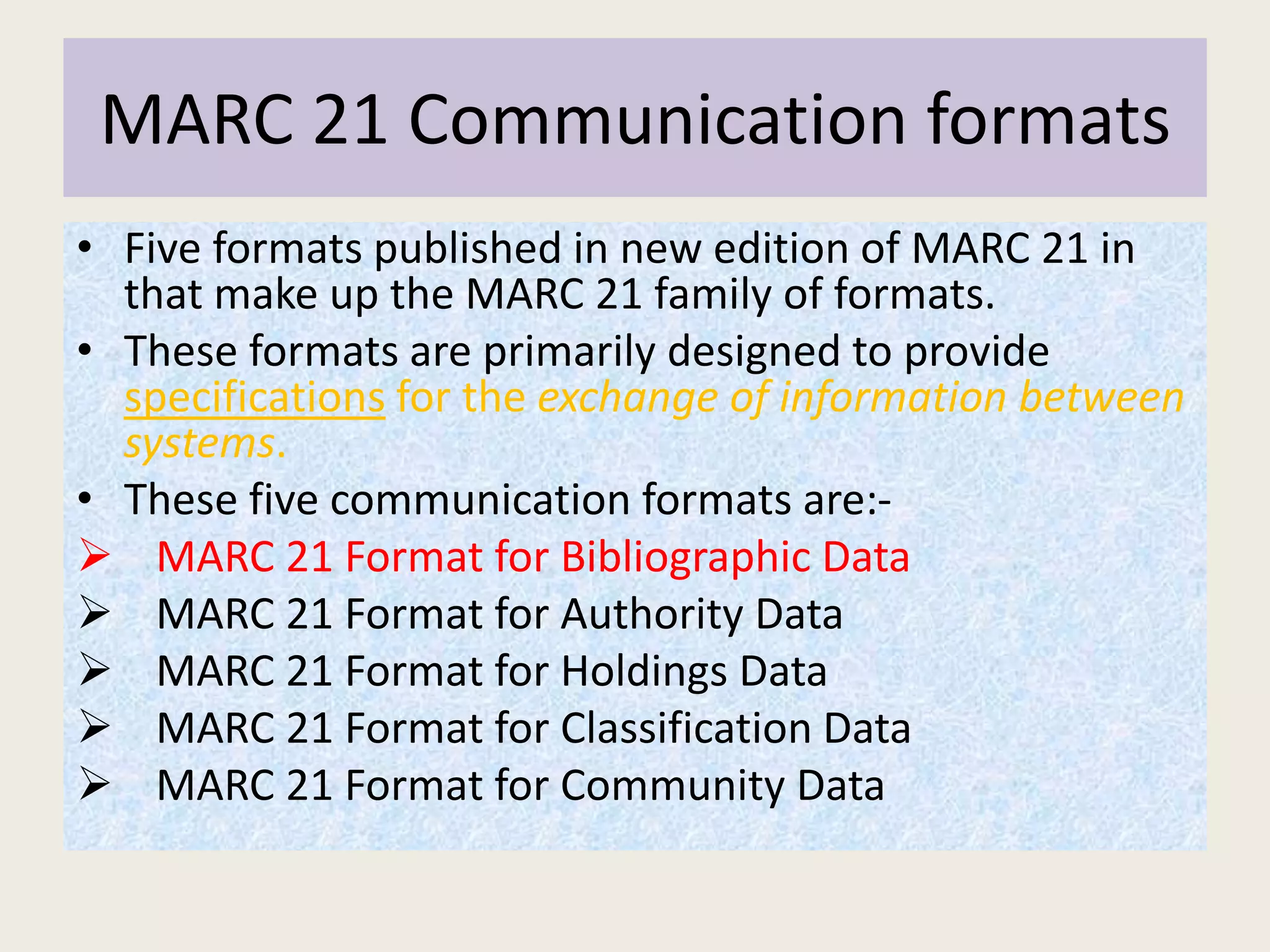
MARC 21 Communication formats
• Five formats published in new edition of MARC 21 in
that make up the MARC 21 family of formats.
• These formats are primarily designed to provide
specifications for the exchange of information between
systems.
• These five communication formats are:-
 MARC 21 Format for Bibliographic Data
 MARC 21 Format for Authority Data
 MARC 21 Format for Holdings Data
 MARC 21 Format for Classification Data
 MARC 21 Format for Community Data
MARC 21 record models
 Bibliographic record
• Describes all facets of the
resource
• Stand alone, can represent
an item
• Distinguished from all types
of MARC records by specific
codes in Leader
 Holdings record
• Detail on physical location,
holdings, and condition
• Can be partially embedded
in bibliographic record
 Authority record
• Assists in maintaining
consistency across
bibliographic records
• Provides reference structure
that helps catalog users
• But not essential for
exchange of bibliographic
description since
bibliographic records can
stand alone
MARC 21 Formats for Bibliographic
Data
It is designed to be a
carrier for bibliographic
information about ...
• Printed and manuscript
textual materials (BK)
• Continuing resources*(CR)
• Computer files(CF)
• Maps (MP)
• Music(MU)
• Visual materials(VM)
• Mixed materials**(MX)
Bibliographic data
commonly includes...
• Titles
• Names
• Subjects
• Notes
• Publication data
• Information about the
physical description of an
item.
•Prior to 2002, Continuing resources(CR) were referred to as Serials(SE)
**Prior to 1994, Mixed materials were referred to as Archival and Manuscript material(AM)
Full version Vs. Concise Version
(MARC 21 Formats for Bibliographic Data)
ļ¶ā€œFullā€ bibliographic
format
 Contains detailed
descriptions of every
data elements, along
with examples, input
conventions, and
history sections.
ļ¶ā€œConciseā€ bibliographic
format
 Contains abridged
descriptions of every
data element, along
with examples.
MARC 21 online publication provides access to both the full and concise version
Screenshot of Online publication
Component of bibliographic record
 Leader –
 Data elements that primarily provide information for the
processing of the record.
 The data elements contain numbers or coded values and
are identified by relative character position.
 The leader is fixed in length at 24 character positions
beginning from 00 to 23
 The leader is the first field of a MARC record.
 String: ʘʘ8ʘ2cam__22ʘʘ241_a_4500
 Position: ʘ12.......6.......................18......24
 ā€˜a’ position 6 – record is for a book or printed serial
 ā€˜a’ position 18 – AACR2 (current cataloging rule followed)
...contd...(Directory)
 Directory-
 A series of entries that contain the tag, length, and
starting location of each variable field within a record.
 Each entry is 12 character positions in length
 The directory begins in character position 24 of the
record and ends with a field terminator.
 Examples
Tag Field length Starting character position
Entry 1 001 0013 00000
Entry 2 003 0004 00013
Entry 3 005 0017 00017
...contd..(Variable fields)
 Variable fields :-
 Into which we enter our bibliographic information
 follow the leader and the directory in the record and consist
of control fields and data fields.
 Control fields precede data fields in the record and are
arranged in the same sequence as the corresponding entries
in the directory.
CONTROL FIELD DATA FIELD
assigned tags beginning with two
zeroes
Contain
•Data
•Field terminator
assigned tags beginning with ASCII
numeric characters other than two
zeroes
Contain
•Indicator
•Subfield code
•Data
•Field terminator
MARC record with... Leader, Directory,
Variable data field highlighted
• 00802cam##2200241#a#4500001001300000003
000400013005001700017008004100034020001
800075040001800093043001200111050002600
123082001500149100001800164245004200182
260003500224300002100259650002400280650
002600304650003300330856010600363856009
100469@##2006040204@DLC@2000609181422
42.0@060210s2006####nyu###########000#1#
eng##@##$a9780385336642@##$aDLC$cDLC$d
DLC@##$asp@00$aPS3601.R345$bc46#2006#00
$a813/.6#222#1@$aArana,#Marie.@10$acellop
hane#:$ba#novel
L D FT CNF FT CF_1 FT .... CF_n FT DF_1 FT .... DF_n FT RT
Communication Standards
ISO 2709 –Bibliographic information Exchange
• ISO= International Organisation for
standardization
• http://www.iso.ch
ANSI Z39.2- Bibliographic information
interchange
• ANSI=American National Standards Institute
• http://www.ansi.org
Standards established for exchange of MARC
records by floppy diskette, FTP
MARC 21 Mapping to other
meta data standards
MARC 21 has been mapped to the following
meta data standards :-
• MODS (Metadata Object Description Schema)
• Dublin Core (DC)
• RDA
• MARC Character sets to UCS/ Unicode
• Digital Geospatial metadata
MARC 21 Translation
 MARC 21 Translations page contain a list of
documents that are either direct translations or
close adaptations of MARC 21 formats and other
MARC documentation
• Where applicable, information regarding
difference between the translation and MARC 21
is provided.
• The formats are listed alphabetically by the
language of each translation and include full
bibliographic citations and contact information.
Maintenance Agency
Following offices maintain the MARC 21 Formats :-
 The Network development and MARC Standards office
at the Library of Congress (USA).
 The Standards and the support office at the Library
and Archives Canada.
Input for the development is provided by MARC 21
users from around the world.
Frequency of updates:- Two times per year
-Spring
-Fall
MARC Regulation
(Who review and revise Contents)
 Two groups review and revise MARC 21 Content:-
 MARC Advisory Committee
- represents national libraries, vendors and
bibliographic utilities
- discusses proposals for changes or additions
 MARBI (Machine Readable Form of Bibliographic
Information) Committee
- Committee of the ALA (ALCTS,LITA and RUSA)
- assures that all types of expertise are considered
Advantages of MARC 21
• Easily duplicated and standardized (other lang.)
• Can carry data formulated by different cataloging
rules and conventions
• Transmits data from one system to another
• Allow libraries to share authority data that is
predictable and reliable
• Can be formatted for any type of library
• Improves ease, efficiency and cooperation
Problems with MARC 21
• Not enough focus on electronic resources
• Too complex
• Redundant data (fixed Vs. Variable fields)
• Lack of explicit hierarchical levels
• Controlled values embedded in the standard
• Limitation of available fields, subfields,
indicator values, etc.
• English language and western oriented
The future of MARC 21
 Streamlining MARC 21 into the future :-
 Take advantage of XML
 Develop simpler(but compatible) alternatives
 Allow for interoperability with different XML metadata schemas
 Provide continuity with current data
 partnering with the new technologies
 Challenges to MARC 21 by the followings:-
• LC’S BIBFRAME (Bibliographic Data)
• W3C’s RDF (Linked Data)
 There is strong support in the library world to adapt and improve
the MARC 21 system, rather than switch systems completely
Conclusion
 MARC 21 is not a cataloguing standard, it is a
Communication standard and a framework for
exchanging catalogue records
MARC 21 = USMARC + CAN/MARC
MARC 21 developed in 1997-98 & 1st published in 1999
as named MARC 21
MARC 21 record acts as a uniform record structure for
the representation of disparate information types
MARC 21 may appear difficult at first, but with
knowledge and use, it will begin to make sense. As you
become more familiar with MARC, the simpler it will
become.
References
• http://www.loc.gov/marc/
• https://www.loc.gov/cds/PDFdownloads/marc
accessed on 27.07.2017
• https://www.loc.gov/marc/bibliographic/bdin
tro.html accessed on 28.07.2017
• http://icweb.loc.gov/marc accessed on
28.07.2017
Marc 21

Marc 21

  • 2.
    Overview of Presentation •Introduction • History • Why MARC 21/Need of MARC 21 • Characteristics • Design principle for MARC 21 • MARC 21 Documentation • MARC 21Record System • MARC 21 Communication formats • MARC 21 Format for Bibliographic Data • Component of bibliographic record • Communication Standard • Mapping of MARC 21 • MARC 21 Translation • Maintenance Agency • MARC 21 Regulation • Advantage of MARC 21 • Problems with MARC 21 • Future of MARC 21 • Conclusion • References
  • 3.
    Introduction • MARC isthe acronym for MAchine-Readable Cataloging. • ā€œMachine-readableā€ means that one particular type of machine, a computer, can read and interpret the data in the cataloging record. • ā€œCataloging recordā€ means a bibliographic record, or the information traditionally shown on a catalog card. • It provides the mechanism by which computers exchange, use, and interpret bibliographic information, and its data elements .
  • 4.
    ...contd • Standards forexchanging Catalogue Records. • Standard for the description of the digital format of any item. • Enables computers to interpret the information found in a traditional cataloging record by way of data, or ā€œsignpostsā€ placed before each field of bibliographic information • 21 is the latest version and refers to the 21st century. • Institutions do not store ā€œMARC 21ā€, as it is a communication format • It is the foundation of most library catalogs used today.
  • 5.
    History • Libraries hadshared cataloging information long before the advent of computers. • Computer Scientist Henriette Avram who worked in Library of Congress created MARC in 1960s so that records can be shared among libraries. • It defines a data format that emerged from a Library of Congress-led initiative that began nearly forty years ago. • Originally the Library of Congress program was called LC MARC. • 1968 – LC and BNB* together form MARC II, aiming to be an Anglo- American format • In 1980s it became USMARC • 1968-98 – Over 50 MARC formats developed worldwide • 1994-97 - the USMARC and CAN/MARC user communities worked to eliminate all remaining differences in there two already similar formats. *BNB(British National Bibliography carried out its own studies separate from LC between 1950s -60s :-UKMARC
  • 6.
    ....contd (Journey from MARCto MARC 21) • Compatibility had been a feature of the development process for both formats for many years. • In 1997 and early 1998,updates to the formats were issued that made the format specifications identical. • MARC 21 is not a new format. It is a continuation of both USMARC and CAN/MARC, publish the formats in a single edition in early 1999 under a new name: MARC 21. • The name both points to the moving towards 21st century and suggests the international character of the format, which is appropriate and important given its expanding worldwide use. • The Library of Congress and the National Library of Canada announced the new name MARC 21 to the harmonized USMARC and CAN/MARC formats in early 1999.
  • 7.
    ....contd. MARC 21 HarmonizedUSMARC and CAN/MARC Pilot project of LC * 1966 MARC-I 1968 MARC-II 1980s MARC 21 USMARC 1997-99 *1. for the potential use of an automated system 2. development of a machine readable format for library records MARC I I is a permanent subscription service
  • 8.
    Why MARC 21?  To fulfil the need of uniform record format(structure) to meet the paradigm shift taking place in Libraries from... • Own collection to Library without walls* • In sourcing to Out sourcing • Local reach to Global reach** • One medium to Multiple media***  made shared cataloguing a reality  The MARC record acts as a uniform record structure for the representation of disparate information types, including manuscripts, archives, cartographic material, musical scores, serial, Sound recording and so on. *Union Catalogue **Trans-border data flow of information ***Non-book materials
  • 9.
    ...contd.. Cost: • Shared formatdevelopment/maintenance costs • Reduced systems costs • Increased choice • Bigger user base • Access to experienced developers • Made library automation affordable
  • 10.
    Characteristics  Interoperability • Nationalformats impede exchange of data • Shared cataloguing • Wider access • Common development platform • It is well placed with other schema like AACR 2,RDA  Flexible • Existing element can be used to describe new data set  Extensible • New element can be added to core element to often increase choose-ability
  • 11.
    ...contd • Example ofextensible character :-Addition of the new field which is used in MARC 21 when using metadata standard  336 – Content type  337 –Media type 338 – Carrier type
  • 12.
    MARC 21 Documentation •MARC Standards Page has links to both extensive documentation on MARC 21, including both the full and concise formats, code and field lists,
  • 13.
    MARC 21 RecordSystem MARC 21 Record System Record structure Content designation Data content The leader The directory The variable fields  Fixed fields  Variable fields Tags Indicators Delimiters Subfield Codes  Description  Subject headings  Classification numbers  Main and added entries
  • 14.
    Record Structure • Designprinciples for MARC 21 • MARC 21 format is a set of codes and content designators defined for encoding a particular type of machine-readable record. • The record structure is an implementation of the international standard format for Information exchange(ISO 2709) and its American counterpart, Bibliographic Information Interchange (ANSI/NISO Z39.2) • The MARC Record structure consist of three main component:-  The leader  The directory  The variable fields
  • 15.
    Content Designation  Thecodes and conventions established explicitly to identify and further characterize the data elements within a record  It supports the sorting of data only to a limited extent.  The MARC 21 formats provide for using content designation, to specify recommended display constants  Variable fields Contain specific pieces of information identified by:  Tags  Indicators  Delimiters  Subfield Codes
  • 16.
    Field Field :- • Eachbibliographic record is divided logically into fields. • There is a field for the author, a field for title information and so on. • These fields are subdivided into one or more ā€œsubfieldsā€. They are represented by 3-digit tags. • Many tag field has equip the possibility and responsibility to use subfield to encode additional information  The subfield data designated and interpreted by man.
  • 17.
    Subfield codes • Singleletters or digits indicate what type of information is in a subfield • Subfield are smaller piece of information • You can have more than one subfield
  • 18.
    Tags  A tag:- • Each field is associated with 3-digit number called a ā€œtagā€. • A tag identifies the field --the kind of data-- That follows. • MARC 21 formats use only numeric tags. • The tag stored in the directory entry for the field, not in the field itself. • Here the number 100 is the tag 100 1# Sa Pirsig, Robert M.  Variable field tags are defined in blocks according to the first character of the tag, which with some exceptions, identifies the general function of the field’s data within a record. • The type of information in the field is identified by the remainder of the tag. • The meaning of these blocks depends upon the type of record.
  • 19.
    Indicators  Indicators :- •Digits or blanks that give the computer instructions or information about the data contained in the field • Two character positions follow each tag(with the exception of fields 001 through 009). • One or both of these character positions may be used for indicators. • When an indicators position is not used, that indicator is referred to as ā€œundefinedā€ and the position is left blank • It is the convention to represent a blank, or undefined, indicator position by the character ā€œ#ā€
  • 20.
    Delimiters • Tell thecomputer where each subfield will start • Denoted as $,#,_,etc...
  • 21.
    Example to describethe design principle for MARC 21  245 10 $a Once upon a town: $b the miracle of the North Platte Canteen/ $c Bob Greene • 245 = Title and statement of responsibility • 10 = Author main entry; no non-filing characters • a= title proper b= remainder of title c= statement of responsibility 245 Tag ( 3 digit nos.) 10 Indicator (2 digit nos.) $ Delimiters ( 1 digit) a b Subfield codes c
  • 23.
    MARC 21 Communicationformats • Five formats published in new edition of MARC 21 in that make up the MARC 21 family of formats. • These formats are primarily designed to provide specifications for the exchange of information between systems. • These five communication formats are:-  MARC 21 Format for Bibliographic Data  MARC 21 Format for Authority Data  MARC 21 Format for Holdings Data  MARC 21 Format for Classification Data  MARC 21 Format for Community Data
  • 24.
    MARC 21 recordmodels  Bibliographic record • Describes all facets of the resource • Stand alone, can represent an item • Distinguished from all types of MARC records by specific codes in Leader  Holdings record • Detail on physical location, holdings, and condition • Can be partially embedded in bibliographic record  Authority record • Assists in maintaining consistency across bibliographic records • Provides reference structure that helps catalog users • But not essential for exchange of bibliographic description since bibliographic records can stand alone
  • 25.
    MARC 21 Formatsfor Bibliographic Data It is designed to be a carrier for bibliographic information about ... • Printed and manuscript textual materials (BK) • Continuing resources*(CR) • Computer files(CF) • Maps (MP) • Music(MU) • Visual materials(VM) • Mixed materials**(MX) Bibliographic data commonly includes... • Titles • Names • Subjects • Notes • Publication data • Information about the physical description of an item. •Prior to 2002, Continuing resources(CR) were referred to as Serials(SE) **Prior to 1994, Mixed materials were referred to as Archival and Manuscript material(AM)
  • 26.
    Full version Vs.Concise Version (MARC 21 Formats for Bibliographic Data) ļ¶ā€œFullā€ bibliographic format  Contains detailed descriptions of every data elements, along with examples, input conventions, and history sections. ļ¶ā€œConciseā€ bibliographic format  Contains abridged descriptions of every data element, along with examples. MARC 21 online publication provides access to both the full and concise version
  • 27.
  • 28.
    Component of bibliographicrecord  Leader –  Data elements that primarily provide information for the processing of the record.  The data elements contain numbers or coded values and are identified by relative character position.  The leader is fixed in length at 24 character positions beginning from 00 to 23  The leader is the first field of a MARC record.  String: ʘʘ8ʘ2cam__22ʘʘ241_a_4500  Position: ʘ12.......6.......................18......24  ā€˜a’ position 6 – record is for a book or printed serial  ā€˜a’ position 18 – AACR2 (current cataloging rule followed)
  • 29.
    ...contd...(Directory)  Directory-  Aseries of entries that contain the tag, length, and starting location of each variable field within a record.  Each entry is 12 character positions in length  The directory begins in character position 24 of the record and ends with a field terminator.  Examples Tag Field length Starting character position Entry 1 001 0013 00000 Entry 2 003 0004 00013 Entry 3 005 0017 00017
  • 30.
    ...contd..(Variable fields)  Variablefields :-  Into which we enter our bibliographic information  follow the leader and the directory in the record and consist of control fields and data fields.  Control fields precede data fields in the record and are arranged in the same sequence as the corresponding entries in the directory. CONTROL FIELD DATA FIELD assigned tags beginning with two zeroes Contain •Data •Field terminator assigned tags beginning with ASCII numeric characters other than two zeroes Contain •Indicator •Subfield code •Data •Field terminator
  • 31.
    MARC record with...Leader, Directory, Variable data field highlighted • 00802cam##2200241#a#4500001001300000003 000400013005001700017008004100034020001 800075040001800093043001200111050002600 123082001500149100001800164245004200182 260003500224300002100259650002400280650 002600304650003300330856010600363856009 100469@##2006040204@DLC@2000609181422 42.0@060210s2006####nyu###########000#1# eng##@##$a9780385336642@##$aDLC$cDLC$d DLC@##$asp@00$aPS3601.R345$bc46#2006#00 $a813/.6#222#1@$aArana,#Marie.@10$acellop hane#:$ba#novel L D FT CNF FT CF_1 FT .... CF_n FT DF_1 FT .... DF_n FT RT
  • 32.
    Communication Standards ISO 2709–Bibliographic information Exchange • ISO= International Organisation for standardization • http://www.iso.ch ANSI Z39.2- Bibliographic information interchange • ANSI=American National Standards Institute • http://www.ansi.org Standards established for exchange of MARC records by floppy diskette, FTP
  • 33.
    MARC 21 Mappingto other meta data standards MARC 21 has been mapped to the following meta data standards :- • MODS (Metadata Object Description Schema) • Dublin Core (DC) • RDA • MARC Character sets to UCS/ Unicode • Digital Geospatial metadata
  • 34.
    MARC 21 Translation MARC 21 Translations page contain a list of documents that are either direct translations or close adaptations of MARC 21 formats and other MARC documentation • Where applicable, information regarding difference between the translation and MARC 21 is provided. • The formats are listed alphabetically by the language of each translation and include full bibliographic citations and contact information.
  • 35.
    Maintenance Agency Following officesmaintain the MARC 21 Formats :-  The Network development and MARC Standards office at the Library of Congress (USA).  The Standards and the support office at the Library and Archives Canada. Input for the development is provided by MARC 21 users from around the world. Frequency of updates:- Two times per year -Spring -Fall
  • 36.
    MARC Regulation (Who reviewand revise Contents)  Two groups review and revise MARC 21 Content:-  MARC Advisory Committee - represents national libraries, vendors and bibliographic utilities - discusses proposals for changes or additions  MARBI (Machine Readable Form of Bibliographic Information) Committee - Committee of the ALA (ALCTS,LITA and RUSA) - assures that all types of expertise are considered
  • 37.
    Advantages of MARC21 • Easily duplicated and standardized (other lang.) • Can carry data formulated by different cataloging rules and conventions • Transmits data from one system to another • Allow libraries to share authority data that is predictable and reliable • Can be formatted for any type of library • Improves ease, efficiency and cooperation
  • 38.
    Problems with MARC21 • Not enough focus on electronic resources • Too complex • Redundant data (fixed Vs. Variable fields) • Lack of explicit hierarchical levels • Controlled values embedded in the standard • Limitation of available fields, subfields, indicator values, etc. • English language and western oriented
  • 39.
    The future ofMARC 21  Streamlining MARC 21 into the future :-  Take advantage of XML  Develop simpler(but compatible) alternatives  Allow for interoperability with different XML metadata schemas  Provide continuity with current data  partnering with the new technologies  Challenges to MARC 21 by the followings:- • LC’S BIBFRAME (Bibliographic Data) • W3C’s RDF (Linked Data)  There is strong support in the library world to adapt and improve the MARC 21 system, rather than switch systems completely
  • 40.
    Conclusion  MARC 21is not a cataloguing standard, it is a Communication standard and a framework for exchanging catalogue records MARC 21 = USMARC + CAN/MARC MARC 21 developed in 1997-98 & 1st published in 1999 as named MARC 21 MARC 21 record acts as a uniform record structure for the representation of disparate information types MARC 21 may appear difficult at first, but with knowledge and use, it will begin to make sense. As you become more familiar with MARC, the simpler it will become.
  • 41.
    References • http://www.loc.gov/marc/ • https://www.loc.gov/cds/PDFdownloads/marc accessedon 27.07.2017 • https://www.loc.gov/marc/bibliographic/bdin tro.html accessed on 28.07.2017 • http://icweb.loc.gov/marc accessed on 28.07.2017