10/15/11LIS 4010 October 18, 2011Assignment A4Group: Rebecca, Max, Johnny, Holly, Jayna, and Jules Archives Standards: EAD, DACS, and MARC
10/15/11A Brief Refresher on Archives Archives preserve unique records of value that document organizational or personal activities.
Records can be in a variety of formats (text, images, etc.)
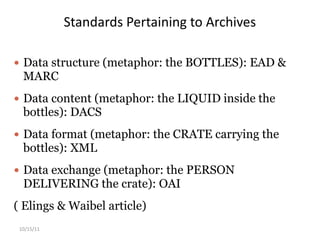
Records are generally arranged and described in groups, not at the item level.10/15/11Standards Pertaining to Archives Data structure (metaphor: the BOTTLES): EAD & MARC
Data content (metaphor: the LIQUID inside the bottles): DACS
Data format (metaphor: the CRATE carrying the bottles): XML
Data exchange (metaphor: the PERSON DELIVERING the crate): OAI( Elings & Waibel article)
10/15/11EAD (Encoded Archival Description)EAD is used for encoding finding aids so that they may be displayed on the Web. (Taylor & Joudrey, p. 11-13)
It does not prescribe content – that's left to content standards (DACS)10/15/11EAD - HistoryEAD began with a project at the University of California at Berkeley in 1993. (EAD Version 2002, Official Site)
Daniel Pitti was the principal investigator behind the EAD project. He wanted EAD to be able to: present extensive and interrelated descriptive information found in archival finding aids, and preserve the hierarchical relationships existing between different levels of description. (EAD Version 2002, Official Site) Alphabet Soup: EAD, XML, DTD, SchemaEAD is encoded in XML using SGML/XML DTD or an XML schema.XML defines structure and not style, making it extremely flexible.DTD (Document Type Definition) and schema are basically “rules” for the structure in an XML document.Schema can go further in defining contents and semantics.10/15/11
10/15/11DTDs (Document Type Definitions)Define, with their own notations, the structure of a particular type of document Gives advance notice of what names and structures can be used in a particular document type, so that all documents that belong to a particular type will be alike Can be thought of as like a template for a particular type of document Example
10/15/11SchemasAre richer forms of DTDs
Define the contents and semantics of documents, in addition to their structure    (Taylor & Joudrey, p. 145 – 151)Example
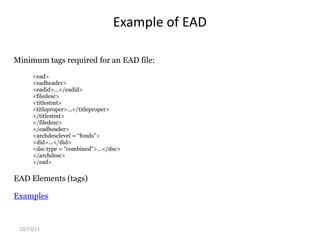
10/15/11Example of EAD Minimum tags required for an EAD file:	<ead><eadheader><eadid>...</eadid><filedesc><titlestmt><titleproper>...</titleproper></titlestmt></filedesc></eadheader><archdesclevel = “fonds”><did>...</did><dsc type = “combined”>...</dsc></archdesc></ead>EAD Elements (tags)Examples
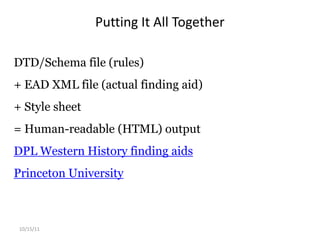
10/15/11Putting It All Together DTD/Schema file (rules) + EAD XML file (actual finding aid)+ Style sheet= Human-readable (HTML) outputDPL Western History finding aidsPrinceton University
EAD – Advantages Advantages:Allows for effective searching, display, retrieval, and display of information found in archival finding aidsThe official site of EAD Version 2002 offers a tag library, complete with detailed descriptions of elements. There is a lot of documentation on EAD DTDs and schemas,  offering many examples and crosswalks. Significance: new users unfamiliar with EAD have some assistance in implementing it; easier for one user to pick up where a previous user left off (From: http://works.bepress.com/cgi/viewcontent.cgi?article…)
EAD – Disadvantages Disadvantages:International use of EAD: non-English speakers are basically expected to understand and apply a standard that is English-oriented Solution: create versions of it for other languagesExample: HyTime architectural form processing, which allows language-specific versions of EAD that can be mapped to the English version Content standards for EAD are not agreed uponSignificance: affects interoperability Popular toolsets for use on EAD are difficult to use (From: http://www.dlib.org/dlib/november99/11pitti.htm& http://works.bepress.com/cgi/viewcontent.cgi?article…)
ResourcesRequired textbook: Taylor, A.G., & Joudrey, G.N. (2008). The Organization of Information. 3rd ed. Englewood, CO: Libraries Unlimited. Articles: Elings, M. W., & Waibel, G. (2007). Metadata for all: Descriptive standards and metadata-sharing across libraries, archives, and museums. First Monday 12 (3).Online resources:http://www.loc.gov/ead/ (EAD Version 2002, Official Site)http://www.dlib.org/dlib/november99/11pitti.htmhttp://works.bepress.com/cgi/viewcontent.cgi?article…http://library.syr.edu/digital/guides/marac/marac.ppt
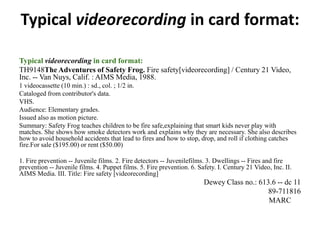
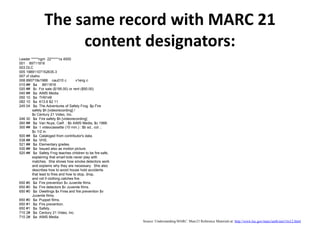
MARC: Machine-Readable Cataloging RecordThe MARC formats are standards for the representation and communication of bibliographic and related information in machine-readable form.Machine-Readable means that a computer can read and interpret the data in the cataloging record.Cataloging Record means a bibliographic record.  This is traditionally the information shown on a catalog card.  The record includes but is not limited to: a description of the itemmain entry and added entriessubject headingsthe classification or call number. Source: Understanding MARC Bibliographic: Machine Readable Cataloging at: http://www.loc.gov/marc/umb/
OriginsThe original MARC format was developed at the Library of Congress in the mid-1960’s.
USMARC, originally known as "LCMARC," is the U.S. implementation of the generic standard for the construction of communication formats.
Other countries developed their own MARC formats such as CAN/MARC and UKMARC
After having discussions and making minor changes to both formats that accommodated USMARC and CAN/MARC users' specific needs, the USMARC and CAN/MARC (Canadian MARC) formats were “harmonized” into MARC 21 in 1997.
In 2002, the Library of Congress developed the MARC-XML schema as an alternative record structure, allowing MARC records to be represented in XML.Source: Standards for Archival Description: A Handbook at: http://www.archivists.org/catalog/stds99/index.htmlMARC21 FAQ at: http://www.loc.gov/marc/faq.htmlWikipedia: MARC Standards at: http://en.wikipedia.org/wiki/MARC_standards
Cross Domain through Content StandardsThe concept behind a MARC record for Archival use dates back to the early 70’s when the Library of Congress issued a series of individual MARC formats for different kinds of materials.
The primary standards used for the exchange of information about archives and manuscripts are:
USMARC Format for Archival and Manuscripts Control (USMARC AMC)
Archives, Personal Papers, and Manuscripts: A Cataloging Manual for Archives, Historical Societies, and Manuscript Libraries (APPM)..
In 1977 the SAA (Society of American Archivists) created NISTF (National Information Systems Task Force) which advocated for a common format for archival information.  The final version of the AMC format was made available to the public in 1985.
APPM is a standard for developing a catalog of archival materials, principally at the collection level, with consistent descriptions and access points that can be integrated into bibliographic catalogs constructed using Anglo-American Cataloguing Rules.  It was first published by the Library of Congress in 1983.Sources: Standards for Archival Description: A Handbook at: http://www.archivists.org/catalog/stds99/index.htmlA Glossary of Archival and Records Terminology at: http://www.archivists.org/glossary/index.asp
StrengthsMARC’s greatest strength is that it is an established, proven format with proven interoperability with libraries and other institutions.
There are several robust software systems that support creating and managing MARC records.
Connection to well defined content standards such as AACR2 and APPM.Source: Scurlock Photographs Cataloging Analysis www.adammathes.com/academic/archives/eadscurlock.html

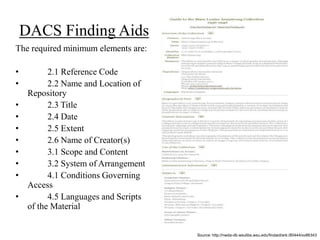
EAD, MARC and DACS

  • 1.
    10/15/11LIS 4010 October18, 2011Assignment A4Group: Rebecca, Max, Johnny, Holly, Jayna, and Jules Archives Standards: EAD, DACS, and MARC
  • 2.
    10/15/11A Brief Refresheron Archives Archives preserve unique records of value that document organizational or personal activities.
  • 3.
    Records can bein a variety of formats (text, images, etc.)
  • 4.
    Records are generallyarranged and described in groups, not at the item level.10/15/11Standards Pertaining to Archives Data structure (metaphor: the BOTTLES): EAD & MARC
  • 5.
    Data content (metaphor:the LIQUID inside the bottles): DACS
  • 6.
    Data format (metaphor:the CRATE carrying the bottles): XML
  • 7.
    Data exchange (metaphor:the PERSON DELIVERING the crate): OAI( Elings & Waibel article)
  • 8.
    10/15/11EAD (Encoded ArchivalDescription)EAD is used for encoding finding aids so that they may be displayed on the Web. (Taylor & Joudrey, p. 11-13)
  • 9.
    It does notprescribe content – that's left to content standards (DACS)10/15/11EAD - HistoryEAD began with a project at the University of California at Berkeley in 1993. (EAD Version 2002, Official Site)
  • 10.
    Daniel Pitti wasthe principal investigator behind the EAD project. He wanted EAD to be able to: present extensive and interrelated descriptive information found in archival finding aids, and preserve the hierarchical relationships existing between different levels of description. (EAD Version 2002, Official Site) Alphabet Soup: EAD, XML, DTD, SchemaEAD is encoded in XML using SGML/XML DTD or an XML schema.XML defines structure and not style, making it extremely flexible.DTD (Document Type Definition) and schema are basically “rules” for the structure in an XML document.Schema can go further in defining contents and semantics.10/15/11
  • 11.
    10/15/11DTDs (Document TypeDefinitions)Define, with their own notations, the structure of a particular type of document Gives advance notice of what names and structures can be used in a particular document type, so that all documents that belong to a particular type will be alike Can be thought of as like a template for a particular type of document Example
  • 12.
  • 13.
    Define the contentsand semantics of documents, in addition to their structure (Taylor & Joudrey, p. 145 – 151)Example
  • 14.
    10/15/11Example of EADMinimum tags required for an EAD file: <ead><eadheader><eadid>...</eadid><filedesc><titlestmt><titleproper>...</titleproper></titlestmt></filedesc></eadheader><archdesclevel = “fonds”><did>...</did><dsc type = “combined”>...</dsc></archdesc></ead>EAD Elements (tags)Examples
  • 15.
    10/15/11Putting It AllTogether DTD/Schema file (rules) + EAD XML file (actual finding aid)+ Style sheet= Human-readable (HTML) outputDPL Western History finding aidsPrinceton University
  • 16.
    EAD – AdvantagesAdvantages:Allows for effective searching, display, retrieval, and display of information found in archival finding aidsThe official site of EAD Version 2002 offers a tag library, complete with detailed descriptions of elements. There is a lot of documentation on EAD DTDs and schemas, offering many examples and crosswalks. Significance: new users unfamiliar with EAD have some assistance in implementing it; easier for one user to pick up where a previous user left off (From: http://works.bepress.com/cgi/viewcontent.cgi?article…)
  • 17.
    EAD – DisadvantagesDisadvantages:International use of EAD: non-English speakers are basically expected to understand and apply a standard that is English-oriented Solution: create versions of it for other languagesExample: HyTime architectural form processing, which allows language-specific versions of EAD that can be mapped to the English version Content standards for EAD are not agreed uponSignificance: affects interoperability Popular toolsets for use on EAD are difficult to use (From: http://www.dlib.org/dlib/november99/11pitti.htm& http://works.bepress.com/cgi/viewcontent.cgi?article…)
  • 18.
    ResourcesRequired textbook: Taylor,A.G., & Joudrey, G.N. (2008). The Organization of Information. 3rd ed. Englewood, CO: Libraries Unlimited. Articles: Elings, M. W., & Waibel, G. (2007). Metadata for all: Descriptive standards and metadata-sharing across libraries, archives, and museums. First Monday 12 (3).Online resources:http://www.loc.gov/ead/ (EAD Version 2002, Official Site)http://www.dlib.org/dlib/november99/11pitti.htmhttp://works.bepress.com/cgi/viewcontent.cgi?article…http://library.syr.edu/digital/guides/marac/marac.ppt
  • 19.
    MARC: Machine-Readable CatalogingRecordThe MARC formats are standards for the representation and communication of bibliographic and related information in machine-readable form.Machine-Readable means that a computer can read and interpret the data in the cataloging record.Cataloging Record means a bibliographic record. This is traditionally the information shown on a catalog card. The record includes but is not limited to: a description of the itemmain entry and added entriessubject headingsthe classification or call number. Source: Understanding MARC Bibliographic: Machine Readable Cataloging at: http://www.loc.gov/marc/umb/
  • 20.
    OriginsThe original MARCformat was developed at the Library of Congress in the mid-1960’s.
  • 21.
    USMARC, originally knownas "LCMARC," is the U.S. implementation of the generic standard for the construction of communication formats.
  • 22.
    Other countries developedtheir own MARC formats such as CAN/MARC and UKMARC
  • 23.
    After having discussionsand making minor changes to both formats that accommodated USMARC and CAN/MARC users' specific needs, the USMARC and CAN/MARC (Canadian MARC) formats were “harmonized” into MARC 21 in 1997.
  • 24.
    In 2002, theLibrary of Congress developed the MARC-XML schema as an alternative record structure, allowing MARC records to be represented in XML.Source: Standards for Archival Description: A Handbook at: http://www.archivists.org/catalog/stds99/index.htmlMARC21 FAQ at: http://www.loc.gov/marc/faq.htmlWikipedia: MARC Standards at: http://en.wikipedia.org/wiki/MARC_standards
  • 25.
    Cross Domain throughContent StandardsThe concept behind a MARC record for Archival use dates back to the early 70’s when the Library of Congress issued a series of individual MARC formats for different kinds of materials.
  • 26.
    The primary standardsused for the exchange of information about archives and manuscripts are:
  • 27.
    USMARC Format forArchival and Manuscripts Control (USMARC AMC)
  • 28.
    Archives, Personal Papers,and Manuscripts: A Cataloging Manual for Archives, Historical Societies, and Manuscript Libraries (APPM)..
  • 29.
    In 1977 theSAA (Society of American Archivists) created NISTF (National Information Systems Task Force) which advocated for a common format for archival information. The final version of the AMC format was made available to the public in 1985.
  • 30.
    APPM is astandard for developing a catalog of archival materials, principally at the collection level, with consistent descriptions and access points that can be integrated into bibliographic catalogs constructed using Anglo-American Cataloguing Rules. It was first published by the Library of Congress in 1983.Sources: Standards for Archival Description: A Handbook at: http://www.archivists.org/catalog/stds99/index.htmlA Glossary of Archival and Records Terminology at: http://www.archivists.org/glossary/index.asp
  • 31.
    StrengthsMARC’s greatest strengthis that it is an established, proven format with proven interoperability with libraries and other institutions.
  • 32.
    There are severalrobust software systems that support creating and managing MARC records.
  • 33.
    Connection to welldefined content standards such as AACR2 and APPM.Source: Scurlock Photographs Cataloging Analysis www.adammathes.com/academic/archives/eadscurlock.html

Editor's Notes

  • #17 MARC was originally a library standard but by expanding on the standard and customizing it to their uses the Archives community has moved it across domains.The primary standards used for the exchange of information about archives and manuscripts are the structure provided in the USMARC Format for Archival and Manuscripts Control (USMARC AMC) the associated cataloging rules provided in Archives, Personal Papers, and Manuscripts: A Cataloging Manual for Archives, Historical Societies, and Manuscript Libraries (APPM).
  • #19 Last strength and first weakness are the same.
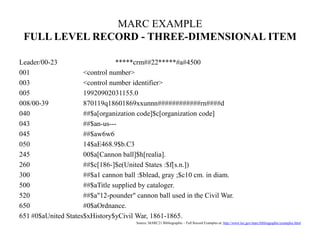
  • #23 This example can be identified as a record for a three-dimensional artifact or naturally occurring object by code r in Leader/06. Noteworthy MARC data elements in this example include the cataloger-supplied data in field 245 (Title Statement) and field 260 (Publication, Distribution, etc. (Imprint)), with the supporting note in field 500 and summary note in field 520.