Thermodynamics of ideal solution
Dr.P.GOVINDARAJ
Associate Professor & Head , Department of Chemistry
SAIVA BHANU KSHATRIYA COLLEGE
ARUPPUKOTTAI - 626101
Virudhunagar District, Tamil Nadu, India
Thermodynamics of ideal solution
Solution
Solvent + Solute = Solution
(large amount) (small amount)
Mole fraction
Let n1 moles of solvent and n2 moles of solute present in the solution
Total number of moles = n1 + n2
Mole fraction of solute =
n1
n1+n2
= 𝑥1
Mole fraction of solvent =
n2
n1+n2
= 𝑥2
Total mole fraction of the solution =
n1
n1+n2
+
n2
n1+n2
=
n1+n2
n1+n2
= 1
Types of solution
1. Solid in liquid solution Ex: NaCl solution
(solute) (solvent)
2. Liquid in liquid solution Ex: dil HCl
(solute) (solvent)
3. Gas in liquid solution Ex: Soda drinks
(solute) (solvent)
Ideal solution
Let A liquid + B liquid → Solution
• The above solution is ideal solution if the solution obey Raoult’s law
at all conditions
Thermodynamics of ideal solution
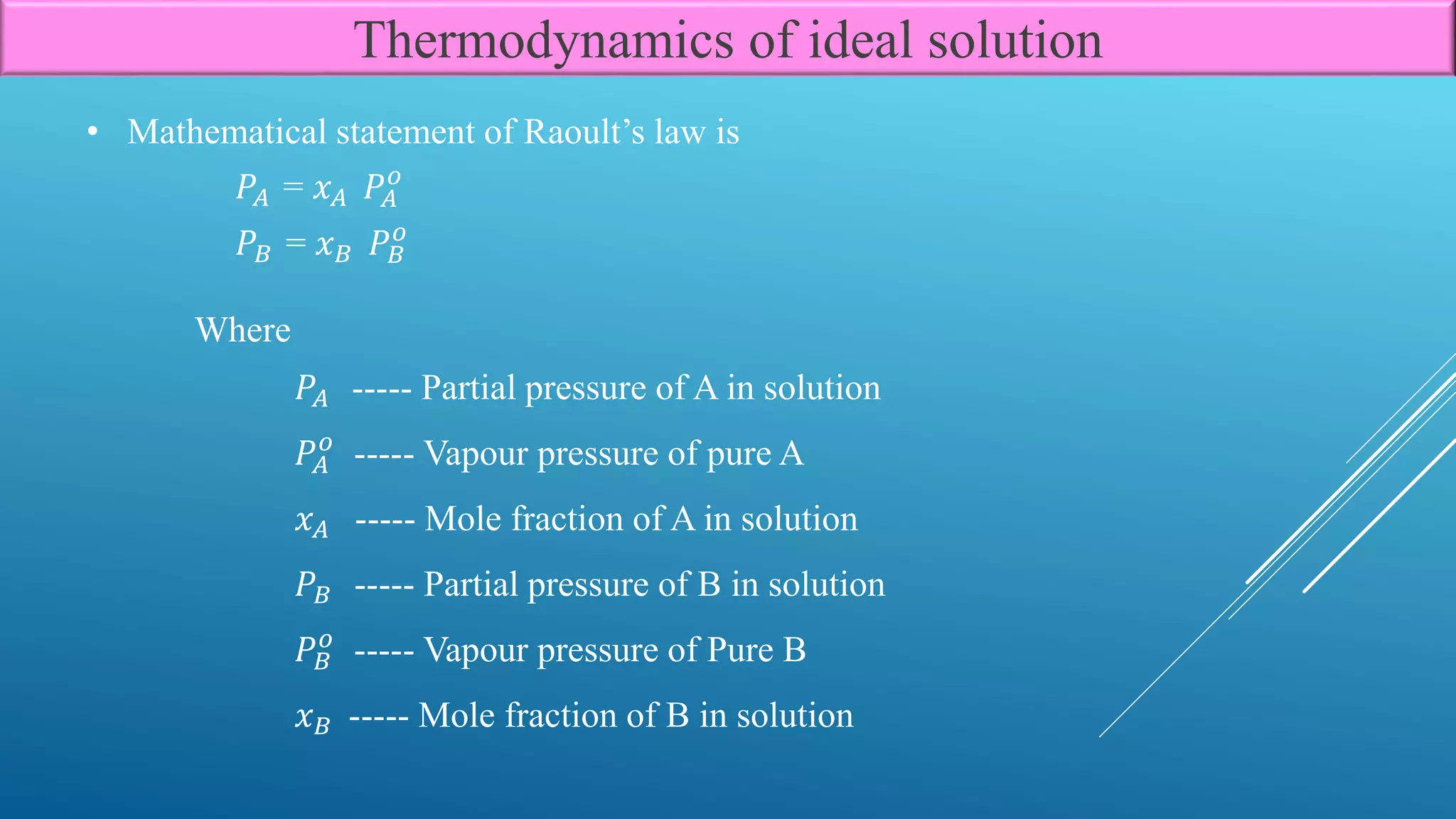
• Mathematical statement of Raoult’s law is
𝑃𝐴 = 𝑥 𝐴 𝑃𝐴
𝑜
𝑃𝐵 = 𝑥 𝐵 𝑃𝐵
𝑜
Where
𝑃𝐴 ----- Partial pressure of A in solution
𝑃𝐴
𝑜
----- Vapour pressure of pure A
𝑥 𝐴 ----- Mole fraction of A in solution
𝑃𝐵 ----- Partial pressure of B in solution
𝑃𝐵
𝑜
----- Vapour pressure of Pure B
𝑥 𝐵 ----- Mole fraction of B in solution
Thermodynamics of ideal solution
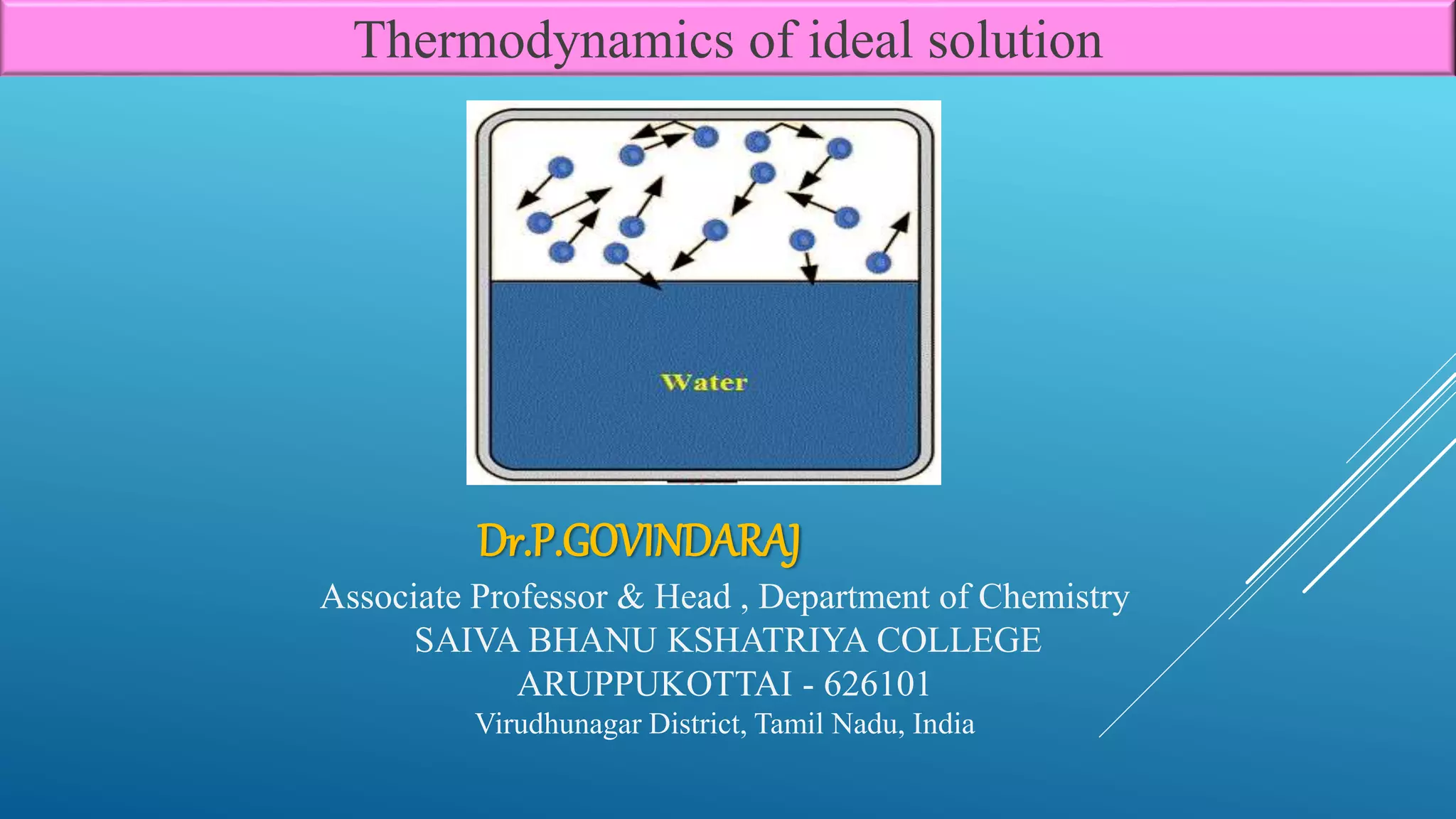
It is the pressure of the vapour which is equilibrium with its liquid state
Vapour pressure
Thermodynamics of ideal solution
Vapour
Liquid
Liquid ⇌ Vapour
Change of free energy of mixing for an ideal solution
• Consider a formation of solution
nAA + nB B Solution
(∆G) mixing = (Free energy of solution) – (Sum of free energies of the pure A and B)
= G solution – (GA + GB ) --------(1)
• Since G = (n1μ1 + n2μ2), equation (1) becomes
(∆G) mixing = (nA μA + nB μB) – (nA μ 𝐴
𝑜
+ nB μ 𝐵
𝑜
)
(∆G) mixing = nA (μA – μ 𝐴
𝑜
) + nB (μB – μ 𝐵
𝑜
) ---------(2)
Thermodynamics of ideal solution
• The change in free energy for the formation of solution by mixing nA moles of A and
nB moles of B is
where
μA and μB are the Chemical potential of A and B in solution
μ 𝐴
𝑜
and μ 𝐵
𝑜
are the Chemical potential of pure A and pure B
• Substitute μ = μo + RT ln a in equation (2)
(∆G) mixing = nA (μ 𝐴
𝑜
+ RT ln aA – μ 𝐴
𝑜
) + nB (μ 𝐵
𝑜
+ RTln aB – μ 𝐵
𝑜
)
(∆G) mixing = nA RT ln aA + nB RT ln aB ---------(3)
• For an ideal solution, the activity of each component (aA & aB )is equal to its mole fraction
Thermodynamics of ideal solution
i.e., aA = 𝑥A & aB = 𝑥 B
• So, the equation (3) becomes
(∆G) mixing = nA RT ln 𝑥A + nB RT ln 𝑥B ---------(4)
• If the solution contains more than two components, equation (4) becomes
(∆G) mixing = nA RT ln 𝑥A + nB RT ln 𝑥B + nC RT ln 𝑥C + …..
(∆G) mixing = RT ni ln 𝑥i
Enthalpy change of mixing for an ideal solution
• The change in free energy for the formation of solution by mixing nA moles of A and
nB moles of B is
(∆G) mixing = nA RT ln 𝑥A + nB RT ln 𝑥B
where 𝑥A and 𝑥A are the mole fraction of A and B in solution
(∆G) mixing = T(nA R ln 𝑥A + nB R ln 𝑥B )
(∆G) mixing
𝑇
= (nA R ln 𝑥A + nB R ln 𝑥B )
Thermodynamics of ideal solution
• At constant pressure
(∆G) mixing
𝑇 p = (nA Rln xA + nB Rln xB ) -------(1)
• Differentiate equation (1) w.r.t Temperature
𝜕{∆Gmixing /𝑇}
𝜕𝑇 p = 0 ------(2)
𝑇
𝜕(∆G) mixing
𝜕𝑇 p− (∆G) mixing
𝑇2 = 0 ------(3)
• We know that the Gibbs- Helmholtz equation is
∆G - ∆H = 𝑇
𝜕(∆G)
𝜕𝑇 p ------(4)
Thermodynamics of ideal solution
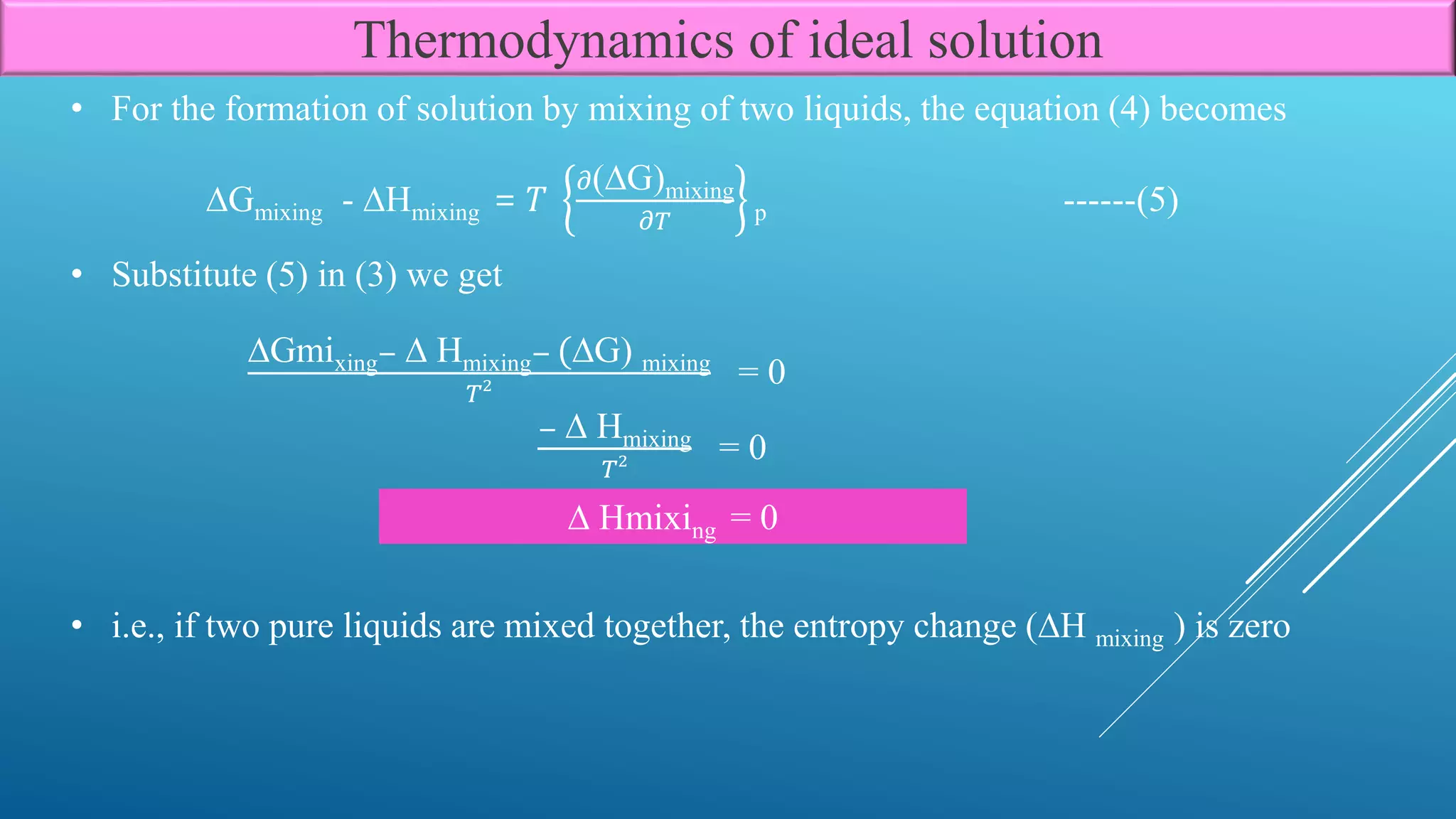
• Substitute (5) in (3) we get
∆Gmixing− ∆ Hmixing− (∆G) mixing
𝑇2 = 0
− ∆ Hmixing
𝑇2 = 0
∆ Hmixing = 0
• i.e., if two pure liquids are mixed together, the entropy change (∆H mixing ) is zero
Thermodynamics of ideal solution
∆Gmixing - ∆Hmixing = 𝑇
𝜕(∆G)mixing
𝜕𝑇 p ------(5)
• For the formation of solution by mixing of two liquids, the equation (4) becomes
• Since ∆H mixing = 0 for ideal solution, equation (2) becomes
∆G mixing = - T∆S mixing ------(3)
• Substitute ∆G mixing = nA RT ln 𝑥 A + nB RT ln 𝑥 B in equation (3) we get
nA RT ln 𝑥 A + nB RT ln 𝑥 B = - T∆S mixing
- (nA R ln 𝑥 A + nB R ln 𝑥 B ) = ∆S mixing
• For more than two components
∆S mixing = - (nA R ln 𝑥 A + nB R ln 𝑥 B + nC R ln 𝑥 C +… )
∆S mixing = - R niln𝑥i
Thermodynamics of ideal solution
Entropy change of mixing for an ideal solution
• As per the second law of thermodynamics the relation between ∆G , ∆H , ∆S is
∆G = ∆H - T∆S ------(1)
• For mixing of two liquids for making ideal solution, equation (1) becomes
∆G mixing = ∆H mixing - T∆S mixing ------(2)
THANK YOU

Ideal solution

  • 1.
    Thermodynamics of idealsolution Dr.P.GOVINDARAJ Associate Professor & Head , Department of Chemistry SAIVA BHANU KSHATRIYA COLLEGE ARUPPUKOTTAI - 626101 Virudhunagar District, Tamil Nadu, India
  • 2.
    Thermodynamics of idealsolution Solution Solvent + Solute = Solution (large amount) (small amount) Mole fraction Let n1 moles of solvent and n2 moles of solute present in the solution Total number of moles = n1 + n2 Mole fraction of solute = n1 n1+n2 = 𝑥1 Mole fraction of solvent = n2 n1+n2 = 𝑥2 Total mole fraction of the solution = n1 n1+n2 + n2 n1+n2 = n1+n2 n1+n2 = 1
  • 3.
    Types of solution 1.Solid in liquid solution Ex: NaCl solution (solute) (solvent) 2. Liquid in liquid solution Ex: dil HCl (solute) (solvent) 3. Gas in liquid solution Ex: Soda drinks (solute) (solvent) Ideal solution Let A liquid + B liquid → Solution • The above solution is ideal solution if the solution obey Raoult’s law at all conditions Thermodynamics of ideal solution
  • 4.
    • Mathematical statementof Raoult’s law is 𝑃𝐴 = 𝑥 𝐴 𝑃𝐴 𝑜 𝑃𝐵 = 𝑥 𝐵 𝑃𝐵 𝑜 Where 𝑃𝐴 ----- Partial pressure of A in solution 𝑃𝐴 𝑜 ----- Vapour pressure of pure A 𝑥 𝐴 ----- Mole fraction of A in solution 𝑃𝐵 ----- Partial pressure of B in solution 𝑃𝐵 𝑜 ----- Vapour pressure of Pure B 𝑥 𝐵 ----- Mole fraction of B in solution Thermodynamics of ideal solution
  • 5.
    It is thepressure of the vapour which is equilibrium with its liquid state Vapour pressure Thermodynamics of ideal solution Vapour Liquid Liquid ⇌ Vapour
  • 6.
    Change of freeenergy of mixing for an ideal solution • Consider a formation of solution nAA + nB B Solution (∆G) mixing = (Free energy of solution) – (Sum of free energies of the pure A and B) = G solution – (GA + GB ) --------(1) • Since G = (n1μ1 + n2μ2), equation (1) becomes (∆G) mixing = (nA μA + nB μB) – (nA μ 𝐴 𝑜 + nB μ 𝐵 𝑜 ) (∆G) mixing = nA (μA – μ 𝐴 𝑜 ) + nB (μB – μ 𝐵 𝑜 ) ---------(2) Thermodynamics of ideal solution • The change in free energy for the formation of solution by mixing nA moles of A and nB moles of B is
  • 7.
    where μA and μBare the Chemical potential of A and B in solution μ 𝐴 𝑜 and μ 𝐵 𝑜 are the Chemical potential of pure A and pure B • Substitute μ = μo + RT ln a in equation (2) (∆G) mixing = nA (μ 𝐴 𝑜 + RT ln aA – μ 𝐴 𝑜 ) + nB (μ 𝐵 𝑜 + RTln aB – μ 𝐵 𝑜 ) (∆G) mixing = nA RT ln aA + nB RT ln aB ---------(3) • For an ideal solution, the activity of each component (aA & aB )is equal to its mole fraction Thermodynamics of ideal solution i.e., aA = 𝑥A & aB = 𝑥 B
  • 8.
    • So, theequation (3) becomes (∆G) mixing = nA RT ln 𝑥A + nB RT ln 𝑥B ---------(4) • If the solution contains more than two components, equation (4) becomes (∆G) mixing = nA RT ln 𝑥A + nB RT ln 𝑥B + nC RT ln 𝑥C + ….. (∆G) mixing = RT ni ln 𝑥i Enthalpy change of mixing for an ideal solution • The change in free energy for the formation of solution by mixing nA moles of A and nB moles of B is (∆G) mixing = nA RT ln 𝑥A + nB RT ln 𝑥B where 𝑥A and 𝑥A are the mole fraction of A and B in solution (∆G) mixing = T(nA R ln 𝑥A + nB R ln 𝑥B ) (∆G) mixing 𝑇 = (nA R ln 𝑥A + nB R ln 𝑥B ) Thermodynamics of ideal solution
  • 9.
    • At constantpressure (∆G) mixing 𝑇 p = (nA Rln xA + nB Rln xB ) -------(1) • Differentiate equation (1) w.r.t Temperature 𝜕{∆Gmixing /𝑇} 𝜕𝑇 p = 0 ------(2) 𝑇 𝜕(∆G) mixing 𝜕𝑇 p− (∆G) mixing 𝑇2 = 0 ------(3) • We know that the Gibbs- Helmholtz equation is ∆G - ∆H = 𝑇 𝜕(∆G) 𝜕𝑇 p ------(4) Thermodynamics of ideal solution
  • 10.
    • Substitute (5)in (3) we get ∆Gmixing− ∆ Hmixing− (∆G) mixing 𝑇2 = 0 − ∆ Hmixing 𝑇2 = 0 ∆ Hmixing = 0 • i.e., if two pure liquids are mixed together, the entropy change (∆H mixing ) is zero Thermodynamics of ideal solution ∆Gmixing - ∆Hmixing = 𝑇 𝜕(∆G)mixing 𝜕𝑇 p ------(5) • For the formation of solution by mixing of two liquids, the equation (4) becomes
  • 11.
    • Since ∆Hmixing = 0 for ideal solution, equation (2) becomes ∆G mixing = - T∆S mixing ------(3) • Substitute ∆G mixing = nA RT ln 𝑥 A + nB RT ln 𝑥 B in equation (3) we get nA RT ln 𝑥 A + nB RT ln 𝑥 B = - T∆S mixing - (nA R ln 𝑥 A + nB R ln 𝑥 B ) = ∆S mixing • For more than two components ∆S mixing = - (nA R ln 𝑥 A + nB R ln 𝑥 B + nC R ln 𝑥 C +… ) ∆S mixing = - R niln𝑥i Thermodynamics of ideal solution Entropy change of mixing for an ideal solution • As per the second law of thermodynamics the relation between ∆G , ∆H , ∆S is ∆G = ∆H - T∆S ------(1) • For mixing of two liquids for making ideal solution, equation (1) becomes ∆G mixing = ∆H mixing - T∆S mixing ------(2)
  • 12.