
9/12/2015
1
For My Non Muslim Students :
Respect and make your parents happy always
& GOOD MORNING
For My Muslim Students:
Perform compulsory prayers and remember Allah always
9/12/2015
2
ALKALI AGGREGATE
REACTION
INTRODUCTION
 Can cause severe deterioration of a structure
by expansion of the concrete.
 ASR is only one form of the expansive alkali
aggregate reaction.
 There are other forms of this type of expansive
reactivity.
 But ASR is much more widespread and
generally proceeds at a relatively rapid rate.
9/12/2015
3
Most common reaction of ASR is that between
the active silica constituents of the aggregate
and the alkalis in cement
It results in the formation of an alkali-silicate
gel, either in planes of weakness or pores in
the aggregate (where reactive silica is present)
or on the surface of the aggregate particles.
In the latter case, a characteristic altered
surface zone is formed.
This may destroy the bond between aggregate
and the surrounding hydrated cement paste.
 The gel is of the ‘unlimited swelling’ type.
 It imbibes water, expands and therefore exerts
internal pressures, which can then crack the
concrete.
 Because of ASR is internal, chemical and
expansive, the most direct and visible external
evidence of ASR is cracking.
 The long term implication of the apparently
superficial surface cracking is the loss of
strength, particularly, the bending strength and
its elastic modulus.
9/12/2015
4
 In almost all concrete construction, there’s
enough moisture within the concrete to initiate
the reaction; but external sources of water are
required to continue the reaction and for it to
cause serious damage.
 So, depending on the climatic condition, ASR
can start and stop and can continue for a very
long time until the alkalies or the reactive
aggregate are exhausted.
Damage Due To ASR
 Because of the nature of the expansive
reaction, and the internal stresses it creates,
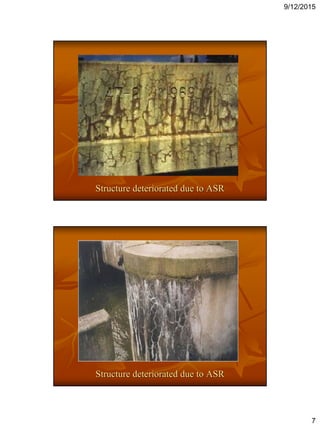
cracking due to ASR in concrete is random and
very irregular.
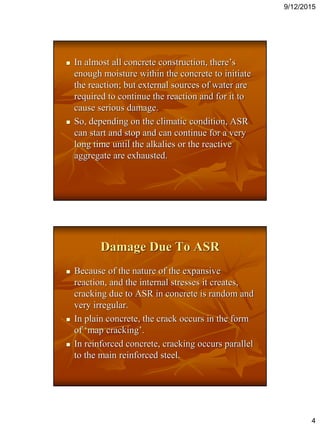
 In plain concrete, the crack occurs in the form
of ‘map cracking’.
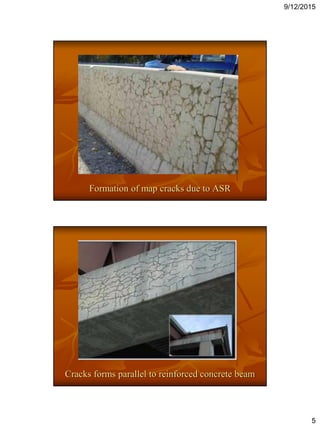
 In reinforced concrete, cracking occurs parallel
to the main reinforced steel.
9/12/2015
5
Formation of map cracks due to ASR
Cracks forms parallel to reinforced concrete beam
9/12/2015
6
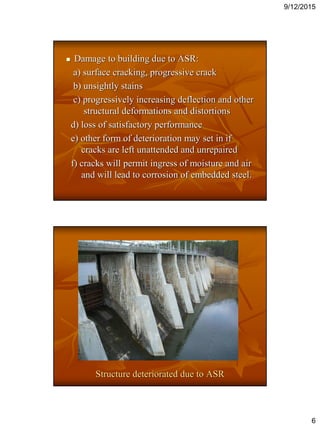
 Damage to building due to ASR:
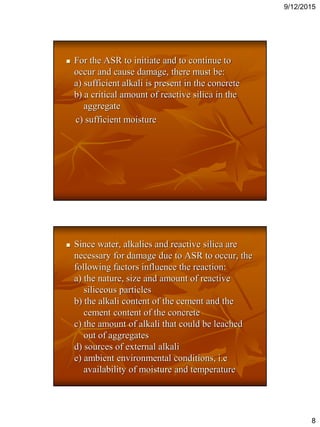
a) surface cracking, progressive crack
b) unsightly stains
c) progressively increasing deflection and other
structural deformations and distortions
d) loss of satisfactory performance
e) other form of deterioration may set in if
cracks are left unattended and unrepaired
f) cracks will permit ingress of moisture and air
and will lead to corrosion of embedded steel.
Structure deteriorated due to ASR
9/12/2015
7
Structure deteriorated due to ASR
9/12/2015
8
 For the ASR to initiate and to continue to
occur and cause damage, there must be:
a) sufficient alkali is present in the concrete
b) a critical amount of reactive silica in the
aggregate
c) sufficient moisture
 Since water, alkalies and reactive silica are
necessary for damage due to ASR to occur, the
following factors influence the reaction:
a) the nature, size and amount of reactive
siliceous particles
b) the alkali content of the cement and the
cement content of the concrete
c) the amount of alkali that could be leached
out of aggregates
d) sources of external alkali
e) ambient environmental conditions, i.e
availability of moisture and temperature
9/12/2015
9
How ASR increase???
 Increasing the alkali content of the cement
 Increasing the fineness of the cement
 Increasing the availability of moisture
 Increasing the temperature
 Increasing the alternations of getting and
drying all
How to control ASR?
a) Use of non-reactive aggregate
b) Use of low-alkali cement
c) Incorporation of pozzolanic or mineral
admixtures

Alkali aggregate reaction

  • 1.
    9/12/2015 1 For My NonMuslim Students : Respect and make your parents happy always & GOOD MORNING For My Muslim Students: Perform compulsory prayers and remember Allah always
  • 2.
    9/12/2015 2 ALKALI AGGREGATE REACTION INTRODUCTION  Cancause severe deterioration of a structure by expansion of the concrete.  ASR is only one form of the expansive alkali aggregate reaction.  There are other forms of this type of expansive reactivity.  But ASR is much more widespread and generally proceeds at a relatively rapid rate.
  • 3.
    9/12/2015 3 Most common reactionof ASR is that between the active silica constituents of the aggregate and the alkalis in cement It results in the formation of an alkali-silicate gel, either in planes of weakness or pores in the aggregate (where reactive silica is present) or on the surface of the aggregate particles. In the latter case, a characteristic altered surface zone is formed. This may destroy the bond between aggregate and the surrounding hydrated cement paste.  The gel is of the ‘unlimited swelling’ type.  It imbibes water, expands and therefore exerts internal pressures, which can then crack the concrete.  Because of ASR is internal, chemical and expansive, the most direct and visible external evidence of ASR is cracking.  The long term implication of the apparently superficial surface cracking is the loss of strength, particularly, the bending strength and its elastic modulus.
  • 4.
    9/12/2015 4  In almostall concrete construction, there’s enough moisture within the concrete to initiate the reaction; but external sources of water are required to continue the reaction and for it to cause serious damage.  So, depending on the climatic condition, ASR can start and stop and can continue for a very long time until the alkalies or the reactive aggregate are exhausted. Damage Due To ASR  Because of the nature of the expansive reaction, and the internal stresses it creates, cracking due to ASR in concrete is random and very irregular.  In plain concrete, the crack occurs in the form of ‘map cracking’.  In reinforced concrete, cracking occurs parallel to the main reinforced steel.
  • 5.
    9/12/2015 5 Formation of mapcracks due to ASR Cracks forms parallel to reinforced concrete beam
  • 6.
    9/12/2015 6  Damage tobuilding due to ASR: a) surface cracking, progressive crack b) unsightly stains c) progressively increasing deflection and other structural deformations and distortions d) loss of satisfactory performance e) other form of deterioration may set in if cracks are left unattended and unrepaired f) cracks will permit ingress of moisture and air and will lead to corrosion of embedded steel. Structure deteriorated due to ASR
  • 7.
    9/12/2015 7 Structure deteriorated dueto ASR Structure deteriorated due to ASR
  • 8.
    9/12/2015 8  For theASR to initiate and to continue to occur and cause damage, there must be: a) sufficient alkali is present in the concrete b) a critical amount of reactive silica in the aggregate c) sufficient moisture  Since water, alkalies and reactive silica are necessary for damage due to ASR to occur, the following factors influence the reaction: a) the nature, size and amount of reactive siliceous particles b) the alkali content of the cement and the cement content of the concrete c) the amount of alkali that could be leached out of aggregates d) sources of external alkali e) ambient environmental conditions, i.e availability of moisture and temperature
  • 9.
    9/12/2015 9 How ASR increase??? Increasing the alkali content of the cement  Increasing the fineness of the cement  Increasing the availability of moisture  Increasing the temperature  Increasing the alternations of getting and drying all How to control ASR? a) Use of non-reactive aggregate b) Use of low-alkali cement c) Incorporation of pozzolanic or mineral admixtures