
DEPARTMENT OF
CIVIL ENGINEERING
5CE5-14: REPAIR AND
REHABILITATION OF STRUCTURES
Introduction: Objective, scope
Deterioration of Concrete Structures
Er. Ramprasad Kumawat
M.Tech
OBJECTIVE
• To get the knowledge on quality of concrete,
durability aspects, causes of deterioration,
assessment of distressed structures, repairing
of structures and demolition procedures.
scop
• Repairs and rehabilitation engineering being a
specialized field calls for skills and abilities far
beyond the construction engineering and has to
be a balance amid advanced technology and
trends, management, feasibility and economy
Deterioration of Concrete Structures
• Penetrability of concrete permeability,
sorptivity, diffusion.
• Physical processes- abrasion, erosion.
• Chemical- carbonation, chloride and sulfate
attack.
• Alkali – Aggregate Reaction.
• Corrosion- mechanism.
Deterioration of Concrete Structures
• Cement concrete is the most extensively used
material for construction of different types of
structures/components such as buildings, bridges
and shell roofs and also for precast products such
as pipes, poles, sleepers etc…
• Too much emphasis is placed on concrete
compressive strength rather than on
environmental factors, which are known to affect
concrete durability.
• This is one of the main reasons for serious
deterioration of concrete structures.
Penetrability of concrete permeability
• Permeability of concrete is defined as the
property that controls the rate of flow of fluids
into a porous solid. It largely depends on the size
of pores, connectivity of pores, and how tortuous
the path is for the permeating fluid.
• The pores relevant to permeability are those with
a minimum diameter of 120 or 160mm, and they
have to be connected.
• Isolated pores, pores filled with water, and pores
with a narrow entrance and irrelevant to
permeability.
Factors Influencing Concrete
Permeability
• There are three major factors that influence the
permeability of concrete :
• 1. Water to Cement ratio
• 2. Compaction of Concrete
• 3. Curing of Concrete
• 4. Other Factors
1. Water to Cement ratio
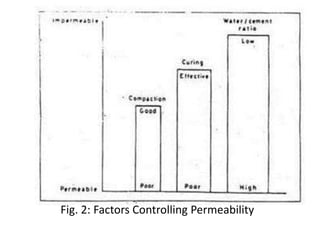
• Water to cement ratio influences concrete
permeability to a great extent. The higher the
w/c ratio the greater the concrete permeability.
In this case, not only does sizable free water
remain in concrete after completion of cement
hydration but also particles of cement and
aggregate would not be as compact as in the
case of low water to cement ratio.
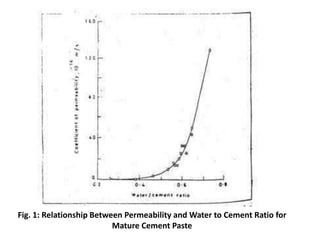
• Fig.1 explains the relationship between water
to cement ratio and concrete permeability.
Typically, at a water cement ratio of around
0.4, permeability is practically nil.
• Finally, super plasticizer with mixture allows
the use of low water to cement ratio, so
concrete with low permeability can be
produced with the use of super plasticizer.
Fig. 1: Relationship Between Permeability and Water to Cement Ratio for
Mature Cement Paste
2. Compaction of Concrete
• When concrete is adequately compacted, air-
voids and trapped bleed water in concrete are
eliminated. As a result, pores and more
importantly interconnected pores are avoided
and eventually concrete permeability is
declined.
• Therefore, it is crucial to select and use proper
and suitable compaction equipment during
concrete placement and supervise the work to
achieve the desired compaction.
3. Curing of Concrete
• It is obvious that curing of concrete
substantially influences the permeability of
concrete. Sufficient curing allows proper
cement hydration. Subsequently, pores in
concrete would be filled with hydration
product.
Fig. 2: Factors Controlling Permeability
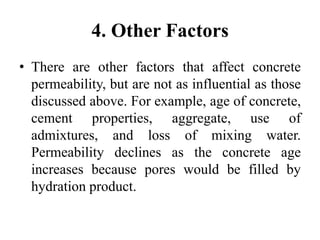
4. Other Factors
• There are other factors that affect concrete
permeability, but are not as influential as those
discussed above. For example, age of concrete,
cement properties, aggregate, use of
admixtures, and loss of mixing water.
Permeability declines as the concrete age
increases because pores would be filled by
hydration product.
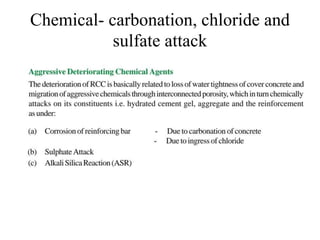
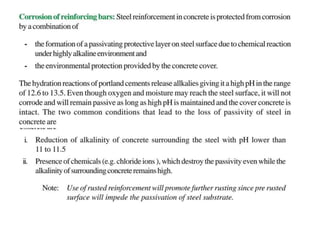
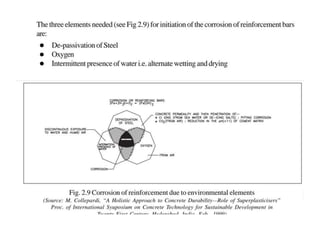
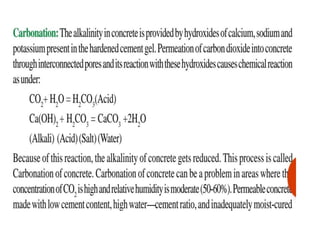
Chemical- carbonation, chloride and
sulfate attack
Physical processes- Abrasion, erosion
• Abrasion is a process of erosion which occurs
when material being transported wears away at
a surface over time.
• It is the process of friction caused by scuffing,
scratching, wearing down, marring, and
rubbing away of materials.
• The intensity of abrasion depends on
the hardness, concentration, velocity and mass
of the moving particles.
• Abrasion generally occurs four ways.
1. Glaciation slowly grinds rocks picked up by
ice against rock surfaces.
2. Solid objects transported in river channels
make abrasive surface contact with the bed and
walls.
3. Objects transported in waves breaking on
coastlines cause abrasion.
4. Abrasion can be caused by wind
transporting sand or small stones against
surface rocks.
• Thanks!
• Gmail :- ramkumawat001@gmail.com

Deterioration of Concrete Structures

  • 1.
    DEPARTMENT OF CIVIL ENGINEERING 5CE5-14:REPAIR AND REHABILITATION OF STRUCTURES Introduction: Objective, scope Deterioration of Concrete Structures Er. Ramprasad Kumawat M.Tech
  • 2.
    OBJECTIVE • To getthe knowledge on quality of concrete, durability aspects, causes of deterioration, assessment of distressed structures, repairing of structures and demolition procedures.
  • 3.
    scop • Repairs andrehabilitation engineering being a specialized field calls for skills and abilities far beyond the construction engineering and has to be a balance amid advanced technology and trends, management, feasibility and economy
  • 4.
    Deterioration of ConcreteStructures • Penetrability of concrete permeability, sorptivity, diffusion. • Physical processes- abrasion, erosion. • Chemical- carbonation, chloride and sulfate attack. • Alkali – Aggregate Reaction. • Corrosion- mechanism.
  • 5.
    Deterioration of ConcreteStructures • Cement concrete is the most extensively used material for construction of different types of structures/components such as buildings, bridges and shell roofs and also for precast products such as pipes, poles, sleepers etc… • Too much emphasis is placed on concrete compressive strength rather than on environmental factors, which are known to affect concrete durability. • This is one of the main reasons for serious deterioration of concrete structures.
  • 6.
    Penetrability of concretepermeability • Permeability of concrete is defined as the property that controls the rate of flow of fluids into a porous solid. It largely depends on the size of pores, connectivity of pores, and how tortuous the path is for the permeating fluid. • The pores relevant to permeability are those with a minimum diameter of 120 or 160mm, and they have to be connected. • Isolated pores, pores filled with water, and pores with a narrow entrance and irrelevant to permeability.
  • 7.
    Factors Influencing Concrete Permeability •There are three major factors that influence the permeability of concrete : • 1. Water to Cement ratio • 2. Compaction of Concrete • 3. Curing of Concrete • 4. Other Factors
  • 8.
    1. Water toCement ratio • Water to cement ratio influences concrete permeability to a great extent. The higher the w/c ratio the greater the concrete permeability. In this case, not only does sizable free water remain in concrete after completion of cement hydration but also particles of cement and aggregate would not be as compact as in the case of low water to cement ratio.
  • 9.
    • Fig.1 explainsthe relationship between water to cement ratio and concrete permeability. Typically, at a water cement ratio of around 0.4, permeability is practically nil. • Finally, super plasticizer with mixture allows the use of low water to cement ratio, so concrete with low permeability can be produced with the use of super plasticizer.
  • 10.
    Fig. 1: RelationshipBetween Permeability and Water to Cement Ratio for Mature Cement Paste
  • 11.
    2. Compaction ofConcrete • When concrete is adequately compacted, air- voids and trapped bleed water in concrete are eliminated. As a result, pores and more importantly interconnected pores are avoided and eventually concrete permeability is declined. • Therefore, it is crucial to select and use proper and suitable compaction equipment during concrete placement and supervise the work to achieve the desired compaction.
  • 12.
    3. Curing ofConcrete • It is obvious that curing of concrete substantially influences the permeability of concrete. Sufficient curing allows proper cement hydration. Subsequently, pores in concrete would be filled with hydration product.
  • 13.
    Fig. 2: FactorsControlling Permeability
  • 14.
    4. Other Factors •There are other factors that affect concrete permeability, but are not as influential as those discussed above. For example, age of concrete, cement properties, aggregate, use of admixtures, and loss of mixing water. Permeability declines as the concrete age increases because pores would be filled by hydration product.
  • 17.
  • 30.
    Physical processes- Abrasion,erosion • Abrasion is a process of erosion which occurs when material being transported wears away at a surface over time. • It is the process of friction caused by scuffing, scratching, wearing down, marring, and rubbing away of materials. • The intensity of abrasion depends on the hardness, concentration, velocity and mass of the moving particles.
  • 31.
    • Abrasion generallyoccurs four ways. 1. Glaciation slowly grinds rocks picked up by ice against rock surfaces. 2. Solid objects transported in river channels make abrasive surface contact with the bed and walls. 3. Objects transported in waves breaking on coastlines cause abrasion. 4. Abrasion can be caused by wind transporting sand or small stones against surface rocks.
  • 32.
    • Thanks! • Gmail:- ramkumawat001@gmail.com