9/12/2015
1
For My Non Muslim Students :
Respect and make your parents happy always
GOOD MORNING
For My Muslim Students:
Adhere To The Rules of Allah and You Will Be Successful In Everything
9/12/2015
2
INTRODUCTION
 Most frequent form of chemical attack are due
to sulphates, sea water & natural acidic water.
 Concrete permeability is the single most
important factor that influences its durability.
 Chemical attack of concrete occurs by way of
decomposition of the products of hydration
and formation of new compound, which if
soluble, maybe leached out and if not soluble,
maybe disruptive in situ.
SULPHATE ATTACK
9/12/2015
3
INTRODUCTION
 Sulphate attack is one of the most important
causes of concrete deterioration.
 Soilds salts don’t attack concrete but when
present in solution, they can react with the
hydrated cement paste.
 Soluble sulfate (Na, Ca and Mg) is common in
mining operations, chemical and paper milling
industries.
 Sodium and calcium most common sulfate in
soils, water and industrial processes.
 Sulfates react chemically with cement paste’s
hydrated lime and hydrated calcium aluminate.
 When salts are in solution they can diffuse into
the pores of concrete and react with hardened
cement paste.
 The formation of gypsum and ettringite
expands, pressurizes and disrupts the paste
result in surface scaling, disintegration and
mass deterioration.
 Causing cracking and spalling of concrete due
to expansion.
9/12/2015
4
 Calcium sulphate reacts with the Calcium
aluminate hydrate in the concrete to form
calcium sulphoaluminate knowns as ettringite.
 Magnesium sulphate attacks calcium silicate
hydrate and Calcium aluminate hydrate.
 The critical consequence of the attack by
magnesium sulphate is the destruction of
C-S-H.
 Sodium sulphate attacks also the calcium
hydroxide in the concrete to give calcium
sulphate
 It is seen as progressive cracking and spalling
and a characteristic whitish appearance.
 Can be prevented by using sulphate resisting
cement or adding pozzolanic ash as partial
cement replacement material
9/12/2015
5
 The effect of sulphate attack:
a) disruptive expansion and cracking
b) loss of strength of concrete due to the loss
of cohesion in the hydrated cement paste
& loss of adhesion between it and aggregate
c) Concrete has a characteristic whitish
appearance
d)Damage usually start at edges and corner
and is followed by progressive cracking and
spalling which reduce the concrete to a
friable or even soft state.
Cracks formation because of sulphate attack
9/12/2015
6
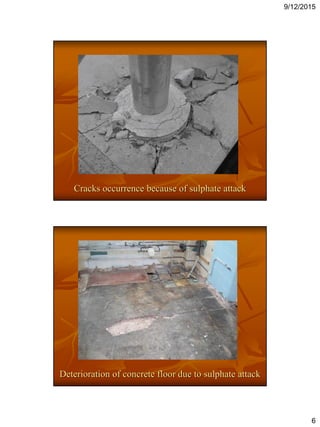
Cracks occurrence because of sulphate attack
Deterioration of concrete floor due to sulphate attack
9/12/2015
7
Deterioration of concrete due to sulphate attack
Sulphate attacked fence post
9/12/2015
8
 Among the preventive measures that can be
taken:
a) Minimize C3A content in cement by using
Sulphate Resisting Portland Cement
b)Use of blended cement consisting pozzolanic
material to reduce the quantity of Ca(OH)2
c)Use of dense concrete with low permeability
concrete as possible
d)Application of high pressure steam curing
for concrete
 Resistance of concrete to sulfate attack can be
tested in the lab by storing specimens in a
solution of sodium or magnesium sulfate.
 Alternate wetting and drying accelerates the
damage due to the crystallization salts in the
pores of the concrete
 The effect of exposure can be estimated by
a) the loss in strength of the specimen
b) its expansion (normally mortar bar)
c) its loss of mass
d) can even be assessed visually
9/12/2015
9
SEA WATER ATTACK
INTRODUCTION
 Marine structures (dry dock and jetties,
breakwaters and tidal barriers, offshore
floating docks and drilling platforms, etc..)
 Sea water contains large amounts of chlorides
as well as sulphates which attack concrete
 The type and severity of attack on concrete in
a marine environment depend on the exposure
conditions.
9/12/2015
10
 Concrete exposed to sea water can be
subjected to various chemical and physical
action such as
a) chemical attack
b) chloride - induced corrosion of steel
reinforcement
c) freeze – thaw attack
d) salt weathering
 The presence and intensity of these various
forms of attack depend on the location of the
concrete with respect to the sea level.
Deterioration of concrete due to sea water attack
9/12/2015
11
Cracked and spalled marine bridge piling
Deterioration of concrete due to sea water attack
9/12/2015
12
Chloride-induced corrosion
Chloride induced spalling
9/12/2015
13
Chemical Composition of Sea Water
 The ion concentrations of Na and Cl are the
highest and the ion concentrations of Mg and SO
are sufficient to provide aggressive action on
cement hydration products.
 The dissolved CO2 in sea water forming
carbonic acid which will attack the cement
matrix, causing leaching of calcium from
hydrated cement paste.
 Crystallization of salts in the pores of concrete
can result in its disruption due to the pressure
exerted by the salt crystals.
3 different exposure zones
 Submerged zone
Is the part of the structure kept continuously
under water
 Splash zone
Is the part of the structure subjected to
repeated wetting and drying by sea water
 Atmospheric zone
Is the part of the structure above the splash
zone
9/12/2015
14
Deterioration of concrete in splash zone
 Concrete between the tide marks, subjected to
alternate wetting and drying, is severely
attacked, especially in tropical climates.
 Concrete above the water level is subject to
capillary action and can be in the splash zone.
 Permanently immersed concrete is attacked
least.
 Products of sea water, gypsum and calcium
sulphoaluminate are leached out by sea water
and this effectively inhibits expansion and
deterioration due to this form of attack.
9/12/2015
15
ACID ATTACK
INTRODUCTION
 Acids can come from sources external to the
concrete such as the earth surrounding a concrete
structure, groundwater, rainwater, and pollutants
in the air.
 Portland cement concrete being highly alkaline
is not resistant to attack by strong acids.
 Concrete can be attacked by liquids with a pH
value below 6.5, but the attack is severe at a pH
below 5.5; below 4.5 the attack is very severe.
9/12/2015
16
 The most vulnerable cement hydrate is
Ca(OH)2 but C-S-H can also be attacked.
 Acids can attack and leach away the calcium
compounds of cement paste formed in concrete
through the hydration process, as well as the
calcium in calcareous aggregate.
 The salts produced which then be leached
away would cause a loss of volume and
cohesion of the paste.
 Acid attack weakens the concrete structurally
and reduces its durability and service life.
 Acid rain that consists mainly of sulphuric acid
and nitric acid and has a pH value between 4 to
4.5, may cause surface weathering of concrete.
 Concrete in sewage and wastewater treatment
plants are among the structure that tend to
deteriorate because of sulfuric acid attack.
 If become severe, it would result in corrosion
of reinforcing steel.
 Sulphuric acid is produced in sewers by a
complex chain of microbiological and
gas/liquid solubility stages which occur as the
sewage travels through the sewerage system.
9/12/2015
17
 However, the severity of deterioration depends
on on the concentration of sulfuric acid, this in
turn being a function of both the specific
location within the plant and also the time over
which the concrete is exposed to elevated
concentrations of acid.
 Normally, the hardened cement paste is
gradually dissolved and progressive
deterioration of concrete take place.
Deterioration of sewerage concrete due to acid attack
9/12/2015
18
Deterioration of silo due to acid attack
Formation of gypsum in wastewater treatment plant
9/12/2015
19
Concrete bridge pylons corroded due to acid attack.
Corrosion of floodgate resulting from acid attack
9/12/2015
20
Corrosion of floodgate due to acid attack
Concrete structure affected due to acid attack
9/12/2015
21
 Among the methods that can be applied to
improve the concrete resistance to acids are:
a) choosing the right concrete composition to
make it as impermeable as possible
b) isolating it from the environment by using a
suitable coating
c) proper curing of concrete
d) use of blended cement which include
pozzolanic material

Chemical attack

  • 1.
    9/12/2015 1 For My NonMuslim Students : Respect and make your parents happy always GOOD MORNING For My Muslim Students: Adhere To The Rules of Allah and You Will Be Successful In Everything
  • 2.
    9/12/2015 2 INTRODUCTION  Most frequentform of chemical attack are due to sulphates, sea water & natural acidic water.  Concrete permeability is the single most important factor that influences its durability.  Chemical attack of concrete occurs by way of decomposition of the products of hydration and formation of new compound, which if soluble, maybe leached out and if not soluble, maybe disruptive in situ. SULPHATE ATTACK
  • 3.
    9/12/2015 3 INTRODUCTION  Sulphate attackis one of the most important causes of concrete deterioration.  Soilds salts don’t attack concrete but when present in solution, they can react with the hydrated cement paste.  Soluble sulfate (Na, Ca and Mg) is common in mining operations, chemical and paper milling industries.  Sodium and calcium most common sulfate in soils, water and industrial processes.  Sulfates react chemically with cement paste’s hydrated lime and hydrated calcium aluminate.  When salts are in solution they can diffuse into the pores of concrete and react with hardened cement paste.  The formation of gypsum and ettringite expands, pressurizes and disrupts the paste result in surface scaling, disintegration and mass deterioration.  Causing cracking and spalling of concrete due to expansion.
  • 4.
    9/12/2015 4  Calcium sulphatereacts with the Calcium aluminate hydrate in the concrete to form calcium sulphoaluminate knowns as ettringite.  Magnesium sulphate attacks calcium silicate hydrate and Calcium aluminate hydrate.  The critical consequence of the attack by magnesium sulphate is the destruction of C-S-H.  Sodium sulphate attacks also the calcium hydroxide in the concrete to give calcium sulphate  It is seen as progressive cracking and spalling and a characteristic whitish appearance.  Can be prevented by using sulphate resisting cement or adding pozzolanic ash as partial cement replacement material
  • 5.
    9/12/2015 5  The effectof sulphate attack: a) disruptive expansion and cracking b) loss of strength of concrete due to the loss of cohesion in the hydrated cement paste & loss of adhesion between it and aggregate c) Concrete has a characteristic whitish appearance d)Damage usually start at edges and corner and is followed by progressive cracking and spalling which reduce the concrete to a friable or even soft state. Cracks formation because of sulphate attack
  • 6.
    9/12/2015 6 Cracks occurrence becauseof sulphate attack Deterioration of concrete floor due to sulphate attack
  • 7.
    9/12/2015 7 Deterioration of concretedue to sulphate attack Sulphate attacked fence post
  • 8.
    9/12/2015 8  Among thepreventive measures that can be taken: a) Minimize C3A content in cement by using Sulphate Resisting Portland Cement b)Use of blended cement consisting pozzolanic material to reduce the quantity of Ca(OH)2 c)Use of dense concrete with low permeability concrete as possible d)Application of high pressure steam curing for concrete  Resistance of concrete to sulfate attack can be tested in the lab by storing specimens in a solution of sodium or magnesium sulfate.  Alternate wetting and drying accelerates the damage due to the crystallization salts in the pores of the concrete  The effect of exposure can be estimated by a) the loss in strength of the specimen b) its expansion (normally mortar bar) c) its loss of mass d) can even be assessed visually
  • 9.
    9/12/2015 9 SEA WATER ATTACK INTRODUCTION Marine structures (dry dock and jetties, breakwaters and tidal barriers, offshore floating docks and drilling platforms, etc..)  Sea water contains large amounts of chlorides as well as sulphates which attack concrete  The type and severity of attack on concrete in a marine environment depend on the exposure conditions.
  • 10.
    9/12/2015 10  Concrete exposedto sea water can be subjected to various chemical and physical action such as a) chemical attack b) chloride - induced corrosion of steel reinforcement c) freeze – thaw attack d) salt weathering  The presence and intensity of these various forms of attack depend on the location of the concrete with respect to the sea level. Deterioration of concrete due to sea water attack
  • 11.
    9/12/2015 11 Cracked and spalledmarine bridge piling Deterioration of concrete due to sea water attack
  • 12.
  • 13.
    9/12/2015 13 Chemical Composition ofSea Water  The ion concentrations of Na and Cl are the highest and the ion concentrations of Mg and SO are sufficient to provide aggressive action on cement hydration products.  The dissolved CO2 in sea water forming carbonic acid which will attack the cement matrix, causing leaching of calcium from hydrated cement paste.  Crystallization of salts in the pores of concrete can result in its disruption due to the pressure exerted by the salt crystals. 3 different exposure zones  Submerged zone Is the part of the structure kept continuously under water  Splash zone Is the part of the structure subjected to repeated wetting and drying by sea water  Atmospheric zone Is the part of the structure above the splash zone
  • 14.
    9/12/2015 14 Deterioration of concretein splash zone  Concrete between the tide marks, subjected to alternate wetting and drying, is severely attacked, especially in tropical climates.  Concrete above the water level is subject to capillary action and can be in the splash zone.  Permanently immersed concrete is attacked least.  Products of sea water, gypsum and calcium sulphoaluminate are leached out by sea water and this effectively inhibits expansion and deterioration due to this form of attack.
  • 15.
    9/12/2015 15 ACID ATTACK INTRODUCTION  Acidscan come from sources external to the concrete such as the earth surrounding a concrete structure, groundwater, rainwater, and pollutants in the air.  Portland cement concrete being highly alkaline is not resistant to attack by strong acids.  Concrete can be attacked by liquids with a pH value below 6.5, but the attack is severe at a pH below 5.5; below 4.5 the attack is very severe.
  • 16.
    9/12/2015 16  The mostvulnerable cement hydrate is Ca(OH)2 but C-S-H can also be attacked.  Acids can attack and leach away the calcium compounds of cement paste formed in concrete through the hydration process, as well as the calcium in calcareous aggregate.  The salts produced which then be leached away would cause a loss of volume and cohesion of the paste.  Acid attack weakens the concrete structurally and reduces its durability and service life.  Acid rain that consists mainly of sulphuric acid and nitric acid and has a pH value between 4 to 4.5, may cause surface weathering of concrete.  Concrete in sewage and wastewater treatment plants are among the structure that tend to deteriorate because of sulfuric acid attack.  If become severe, it would result in corrosion of reinforcing steel.  Sulphuric acid is produced in sewers by a complex chain of microbiological and gas/liquid solubility stages which occur as the sewage travels through the sewerage system.
  • 17.
    9/12/2015 17  However, theseverity of deterioration depends on on the concentration of sulfuric acid, this in turn being a function of both the specific location within the plant and also the time over which the concrete is exposed to elevated concentrations of acid.  Normally, the hardened cement paste is gradually dissolved and progressive deterioration of concrete take place. Deterioration of sewerage concrete due to acid attack
  • 18.
    9/12/2015 18 Deterioration of silodue to acid attack Formation of gypsum in wastewater treatment plant
  • 19.
    9/12/2015 19 Concrete bridge pylonscorroded due to acid attack. Corrosion of floodgate resulting from acid attack
  • 20.
    9/12/2015 20 Corrosion of floodgatedue to acid attack Concrete structure affected due to acid attack
  • 21.
    9/12/2015 21  Among themethods that can be applied to improve the concrete resistance to acids are: a) choosing the right concrete composition to make it as impermeable as possible b) isolating it from the environment by using a suitable coating c) proper curing of concrete d) use of blended cement which include pozzolanic material