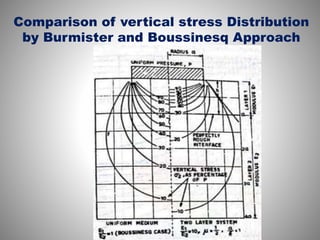
Donald Burmister developed the two-layer theory in 1943 to model flexible pavement systems. The theory considers the pavement as an elastic layer resting on a semi-infinite elastic subgrade. It assumes the layers are homogeneous, isotropic, and linearly elastic. Stress and deflection at the surface decrease with increasing modulus ratio between the top layer and subgrade. Burmister provided charts to calculate the deflection factor based on modulus ratio and depth ratio, which can then be used to compute surface deflection. The two-layer theory models how layers above the subgrade reduce stress and deflections compared to considering just a single subgrade layer.