For My Non Muslim Students :
“Do Not Disorderly In Your Affairs & Do Not Be Chaotic In Your Life”
REMINDER FOR MY MUSLIM STUDENTS
LIGHTWEIGHT CONCRETE
a) Lightweight aggregate concrete
b) Aerated concrete
c) No fines concrete
INTRODUCTION
 Lightweight concrete is concrete with an air
dried unit weight not exceeding 1850kg/m3
 Aerated concrete, no fines concrete and
lightweight aggregate concrete can be
categorized as lightweight concrete.
 There is another type of concrete that can be
classified lightweight concrete that is structural
lightweight concrete.
 The primary advantage of lightweight concrete
is its low density, which reduces the loads on
foundation and supporting structures to two-
thirds or less.
 The engineering properties of lightweight
concretes depend to a large extent on the
materials used in mix design.
 Among the benefits of using lightweight
concrete are:
a) it exhibits relatively high thermal insulating
value
b) it compressive strength is low compared to
normal weight concrete of similar mix
proportions
c)it has higher drying shrinkage and higher
creep than normal weight concrete
d)Its modulus of elasticity is lower compared
normal weight concrete.|
e)It has higher absorption
Aerated Concrete
 Well known among contractor in Europe due
to it lightness and versatility compared to
normal concrete.
 It consists of cement or sand mortar with gas
being introduced inside this mix either
chemically or by using foaming agents.
 Can be used for structural or non-structural
purpose
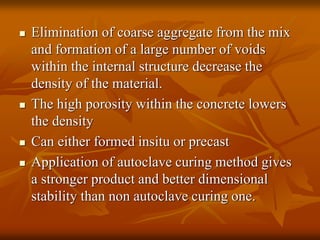
 Elimination of coarse aggregate from the mix
and formation of a large number of voids
within the internal structure decrease the
density of the material.
 The high porosity within the concrete lowers
the density
 Can either formed insitu or precast
 Application of autoclave curing method gives
a stronger product and better dimensional
stability than non autoclave curing one.
ADVANTAGE OF AUTOCLAVE
CURING
 At least doubling the compressive strength
 Improving long-term drying shrinkage
 Having insulation property similar to timber
but much greater fire resistance.
 Providing low thermal conductivity of about
10 times lower than normal concrete
 Giving an attractive light gray or near white
color, although it may be covered in buildings
or structures.
 The drawbacks of non autoclave aerated
concrete compared to normal concrete in terms
of lower strength, higher moisture content and
higher shrinkage can be solved.
Types of Aerated concrete
Based on the method formation, it can be divided
to two types that is:
 Gas concrete or also known as aerated concrete
- Produced using gas-forming materials
(Aluminium powder, hydrogen peroxide etc)
 Foamed concrete
- Produced using foaming agent
Gas Concrete
 It is a mixture of very fine aggregates, water,
and cement with final addition of pore-forming
chemical that produces air-voids within the
aqueous mix at atmospheric pressure, causing
it to expand to certain extent depending on the
amount of gas produced inside the structure.
 Aluminium powder is the most commonly
used aerating agent in gas concrete production
Gas concrete
Density and Strength
 Various density from 300 to 1800kg/m3 in
comparison with 2300 kg/m3 for conventional
concrete.
 Lower strength & density than normal concrete
 Increase in density lead to strength
improvement of the aerated concrete
 Properties of this concrete differ according to
the mix proportions and the manufacturing
methods
Advantages
 Low density lead to more economical design
 Save material utilization and reduce cost
 Can be cut and sawn like timber
 Versatile, easier renovation work can be done
 Non-combustible, fire resistance
 Good sound insulation
 Contribute to low construction cost and
simpler construction task in a shorter period.
 Applicable for non - structural purpose
Autoclaved aerated concrete block is light
Autoclaved aerated concrete block can be cut
GAS OR AERATED CONCRETE
MAKING PROCESS
Materials Used
SAND
CEMENT
Aluminium Powder
Superplasticizer
Mix All Materials Uniformly Before Adding Water Finally
Slurry Mixture Poured Into The Mould
Slurry Mixture Begin To Expand
Mixture Expand Due To Reaction of Gas Foaming Agent
Overflowed Aerated Concrete Was Trimmed
Aerated Concrete After Being Trimmed
Specimen covered with gunny sack for 24 hours
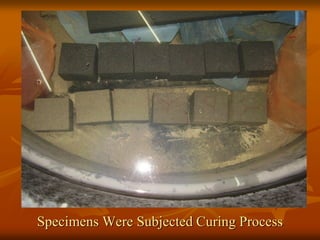
Specimens Were Subjected Curing Process
Voids can be seen on the surface of aerated concrete
Making Of Aerated Concrete
 Use cement with good quality, so that cement
particles are able to react as expected in the mix.
 Water or aggregates containing impurities need
to be avoided
 Any kind of fine aggregate passing 75 µm BS
sieve is allowed such as finely ground natural
fine aggregate, fine lightweight aggregate, raw
PFA, ground slag, burnt shales and others with
sometimes fine aggregate (5mm down) is added.
Mixing Procedure
 Dry mix all the ingredient & add water finally.
 Aluminium powder in the mix would react
with hydroxide of calcium or alkalis from the
cement producing hydrogen bubbles, and that
will expand the mix.
 The mixture would begin to rise and fill out
the mold once the hydrogen gas is set free to
eventually create pores in the mix.
 Basically, the formation of air bubbles causes
the concrete to be lightweight.
Application
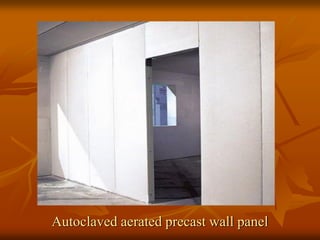
 Autoclaved aerated concrete (AAC) blocks,
wall panels of various sizes
Autoclaved aerated blocks
Autoclaved aerated block walls
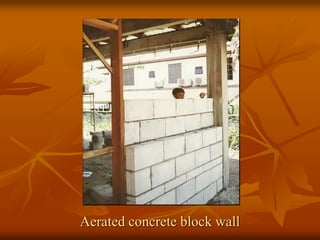
Aerated concrete block wall
Autoclaved aerated precast wall panel
Some part of the structures constructed using AAC
Aerated Conrete In Malaysia
 Still new in Malaysian construction industry
 Mostly, this material has been imported from
other countries to be used here and expensive.
 However, Malaysian researchers try to reduce
cost by integrating industrial waste as one of the
mixing ingredient of this material.
FOAMED CONCRETE
 It’s a mortar mix containing air voids produced
by adding foaming agents which plays the role
of creating pores within the concrete without
chemically reacting with the cement.
 Detergents, resin soap, glue resins and saponin
are some of the foaming agents used.
 It is a highly workable, low-density material
which can incorporate up to 50% entrained air.
Foam generator to produce stable foam
Foam
Foam generator to produce stable foam
Advantages
 This concrete which produced from the mix of
cement, fine sand and prefoamed foam has a
low density such as 400 - 1600kg/m3 .
 It is generally self-leveling, self-compacting
and may be pumped.
 Cost saving, fast completion and easy
application compared to steel and timber.
 Foamed concrete is characterized by its low
compressive strength and high insulation
against heat and sound.
Making of Foamed Concrete
 Determine the required parameter such as
density and compressive strength.
 Then, make a cement slurry or a sandcement
slurry that is appropriate for the mix design.
 The cement used for the slurry is usually Type
1 Portland Cement although other cements can
be used.
 Other ingredients such as Pulverized Fuel Ash
(PFA) can also be used.
 The w/c ratio of the slurry is usually between
0.5 and 0.6.
 The mortar slurry is then transported to site,
and the foam is added there, and not at the
batching plant.
 The foam is made from a concentrated
Foaming Agent using foam generator.
 The bubbles are stable and able to resist the
physical and chemical forces imposed during
mixing, placing & hardening of the foamed
concrete
Application
 Widely used in civil engineering work
 Can be used in almost every parts of building
from the superstructure to the substructure,
including wall panels and roofing.
 Any conventional panels or masonry units
used for load and non-load bearing walls using
normal concrete can be replaced directly by
foamed concrete panels and units.
 Very low density foamed concrete can be used
as thermal and sound insulation panels,
filtering media and floating blocks for fishery
purposes.
 Foamed concrete is ideal for filling redundant
voids such as disused fuel tanks, sewer
systems, pipelines, and culverts - particularly
where access is difficult.
 Can be used for house, foundations and fire
protection, utilizing its high thermal insulation
capacity to geotechnical, highway, bridge
abutment and backfill uses
 Foamed concrete can also be used to cast
elements for architectural purposes, pottery,
void filling, foundation raising and swimming
pool.
 In highway construction, foamed concrete can
be applied as soil filling for sub-base, bridge
abutments and bridge embankment.
 It is a recognised medium for the reinstatement
of temporary road trenches.
Foamed Concrete Block
Foamed oncrete being used for the road sub - base
Various shape of foamed concrete
Foamed concrete panel
Do not live in the nightmares of former times or under the shade of what you
have missed. Save yourself from the ghostly apparition of the past.

Aerated concrete

  • 1.
    For My NonMuslim Students : “Do Not Disorderly In Your Affairs & Do Not Be Chaotic In Your Life”
  • 2.
    REMINDER FOR MYMUSLIM STUDENTS
  • 3.
    LIGHTWEIGHT CONCRETE a) Lightweightaggregate concrete b) Aerated concrete c) No fines concrete
  • 4.
    INTRODUCTION  Lightweight concreteis concrete with an air dried unit weight not exceeding 1850kg/m3  Aerated concrete, no fines concrete and lightweight aggregate concrete can be categorized as lightweight concrete.  There is another type of concrete that can be classified lightweight concrete that is structural lightweight concrete.
  • 5.
     The primaryadvantage of lightweight concrete is its low density, which reduces the loads on foundation and supporting structures to two- thirds or less.  The engineering properties of lightweight concretes depend to a large extent on the materials used in mix design.
  • 6.
     Among thebenefits of using lightweight concrete are: a) it exhibits relatively high thermal insulating value b) it compressive strength is low compared to normal weight concrete of similar mix proportions c)it has higher drying shrinkage and higher creep than normal weight concrete d)Its modulus of elasticity is lower compared normal weight concrete.| e)It has higher absorption
  • 7.
    Aerated Concrete  Wellknown among contractor in Europe due to it lightness and versatility compared to normal concrete.  It consists of cement or sand mortar with gas being introduced inside this mix either chemically or by using foaming agents.  Can be used for structural or non-structural purpose
  • 8.
     Elimination ofcoarse aggregate from the mix and formation of a large number of voids within the internal structure decrease the density of the material.  The high porosity within the concrete lowers the density  Can either formed insitu or precast  Application of autoclave curing method gives a stronger product and better dimensional stability than non autoclave curing one.
  • 9.
    ADVANTAGE OF AUTOCLAVE CURING At least doubling the compressive strength  Improving long-term drying shrinkage  Having insulation property similar to timber but much greater fire resistance.  Providing low thermal conductivity of about 10 times lower than normal concrete  Giving an attractive light gray or near white color, although it may be covered in buildings or structures.
  • 10.
     The drawbacksof non autoclave aerated concrete compared to normal concrete in terms of lower strength, higher moisture content and higher shrinkage can be solved.
  • 11.
    Types of Aeratedconcrete Based on the method formation, it can be divided to two types that is:  Gas concrete or also known as aerated concrete - Produced using gas-forming materials (Aluminium powder, hydrogen peroxide etc)  Foamed concrete - Produced using foaming agent
  • 12.
    Gas Concrete  Itis a mixture of very fine aggregates, water, and cement with final addition of pore-forming chemical that produces air-voids within the aqueous mix at atmospheric pressure, causing it to expand to certain extent depending on the amount of gas produced inside the structure.  Aluminium powder is the most commonly used aerating agent in gas concrete production
  • 13.
  • 14.
    Density and Strength Various density from 300 to 1800kg/m3 in comparison with 2300 kg/m3 for conventional concrete.  Lower strength & density than normal concrete  Increase in density lead to strength improvement of the aerated concrete  Properties of this concrete differ according to the mix proportions and the manufacturing methods
  • 15.
    Advantages  Low densitylead to more economical design  Save material utilization and reduce cost  Can be cut and sawn like timber  Versatile, easier renovation work can be done  Non-combustible, fire resistance  Good sound insulation  Contribute to low construction cost and simpler construction task in a shorter period.  Applicable for non - structural purpose
  • 16.
  • 17.
  • 18.
    GAS OR AERATEDCONCRETE MAKING PROCESS
  • 19.
  • 20.
    Mix All MaterialsUniformly Before Adding Water Finally
  • 21.
    Slurry Mixture PouredInto The Mould
  • 22.
  • 23.
    Mixture Expand DueTo Reaction of Gas Foaming Agent
  • 24.
  • 25.
  • 26.
    Specimen covered withgunny sack for 24 hours
  • 27.
  • 28.
    Voids can beseen on the surface of aerated concrete
  • 29.
    Voids can beseen on the surface of aerated concrete
  • 30.
    Making Of AeratedConcrete  Use cement with good quality, so that cement particles are able to react as expected in the mix.  Water or aggregates containing impurities need to be avoided  Any kind of fine aggregate passing 75 µm BS sieve is allowed such as finely ground natural fine aggregate, fine lightweight aggregate, raw PFA, ground slag, burnt shales and others with sometimes fine aggregate (5mm down) is added.
  • 31.
    Mixing Procedure  Drymix all the ingredient & add water finally.  Aluminium powder in the mix would react with hydroxide of calcium or alkalis from the cement producing hydrogen bubbles, and that will expand the mix.  The mixture would begin to rise and fill out the mold once the hydrogen gas is set free to eventually create pores in the mix.  Basically, the formation of air bubbles causes the concrete to be lightweight.
  • 32.
    Application  Autoclaved aeratedconcrete (AAC) blocks, wall panels of various sizes
  • 33.
  • 34.
  • 35.
  • 36.
  • 37.
  • 38.
    Some part ofthe structures constructed using AAC
  • 39.
    Aerated Conrete InMalaysia  Still new in Malaysian construction industry  Mostly, this material has been imported from other countries to be used here and expensive.  However, Malaysian researchers try to reduce cost by integrating industrial waste as one of the mixing ingredient of this material.
  • 40.
    FOAMED CONCRETE  It’sa mortar mix containing air voids produced by adding foaming agents which plays the role of creating pores within the concrete without chemically reacting with the cement.  Detergents, resin soap, glue resins and saponin are some of the foaming agents used.  It is a highly workable, low-density material which can incorporate up to 50% entrained air.
  • 41.
    Foam generator toproduce stable foam
  • 42.
  • 43.
    Foam generator toproduce stable foam
  • 44.
    Advantages  This concretewhich produced from the mix of cement, fine sand and prefoamed foam has a low density such as 400 - 1600kg/m3 .  It is generally self-leveling, self-compacting and may be pumped.  Cost saving, fast completion and easy application compared to steel and timber.  Foamed concrete is characterized by its low compressive strength and high insulation against heat and sound.
  • 45.
    Making of FoamedConcrete  Determine the required parameter such as density and compressive strength.  Then, make a cement slurry or a sandcement slurry that is appropriate for the mix design.  The cement used for the slurry is usually Type 1 Portland Cement although other cements can be used.  Other ingredients such as Pulverized Fuel Ash (PFA) can also be used.
  • 46.
     The w/cratio of the slurry is usually between 0.5 and 0.6.  The mortar slurry is then transported to site, and the foam is added there, and not at the batching plant.  The foam is made from a concentrated Foaming Agent using foam generator.  The bubbles are stable and able to resist the physical and chemical forces imposed during mixing, placing & hardening of the foamed concrete
  • 47.
    Application  Widely usedin civil engineering work  Can be used in almost every parts of building from the superstructure to the substructure, including wall panels and roofing.  Any conventional panels or masonry units used for load and non-load bearing walls using normal concrete can be replaced directly by foamed concrete panels and units.
  • 48.
     Very lowdensity foamed concrete can be used as thermal and sound insulation panels, filtering media and floating blocks for fishery purposes.  Foamed concrete is ideal for filling redundant voids such as disused fuel tanks, sewer systems, pipelines, and culverts - particularly where access is difficult.  Can be used for house, foundations and fire protection, utilizing its high thermal insulation capacity to geotechnical, highway, bridge abutment and backfill uses
  • 49.
     Foamed concretecan also be used to cast elements for architectural purposes, pottery, void filling, foundation raising and swimming pool.  In highway construction, foamed concrete can be applied as soil filling for sub-base, bridge abutments and bridge embankment.  It is a recognised medium for the reinstatement of temporary road trenches.
  • 50.
  • 51.
    Foamed oncrete beingused for the road sub - base
  • 52.
    Various shape offoamed concrete
  • 53.
  • 54.
    Do not livein the nightmares of former times or under the shade of what you have missed. Save yourself from the ghostly apparition of the past.