C
O
N
C
T
E
R
E
T
E
C
H
N
O
L
O
G
NIKUL R. GOPANI
SIR B.P.T.I COLLEGE
CIVIL ENGINEERING
GUIDED BY.
Prof. P.D.GOHIL
Prof. P.H.MEGHANI
MIX DESIGN
CONTENT
WHAT IS MIX DESIGN ?
GRADE OF CONCRETE.
FACTORS INFLUENCING THE CHOICE OF MIX
DESIGN.
METHODS OF CONCRETE MIX DESIGN
MIX DESIGN BY I.S. METHOD.
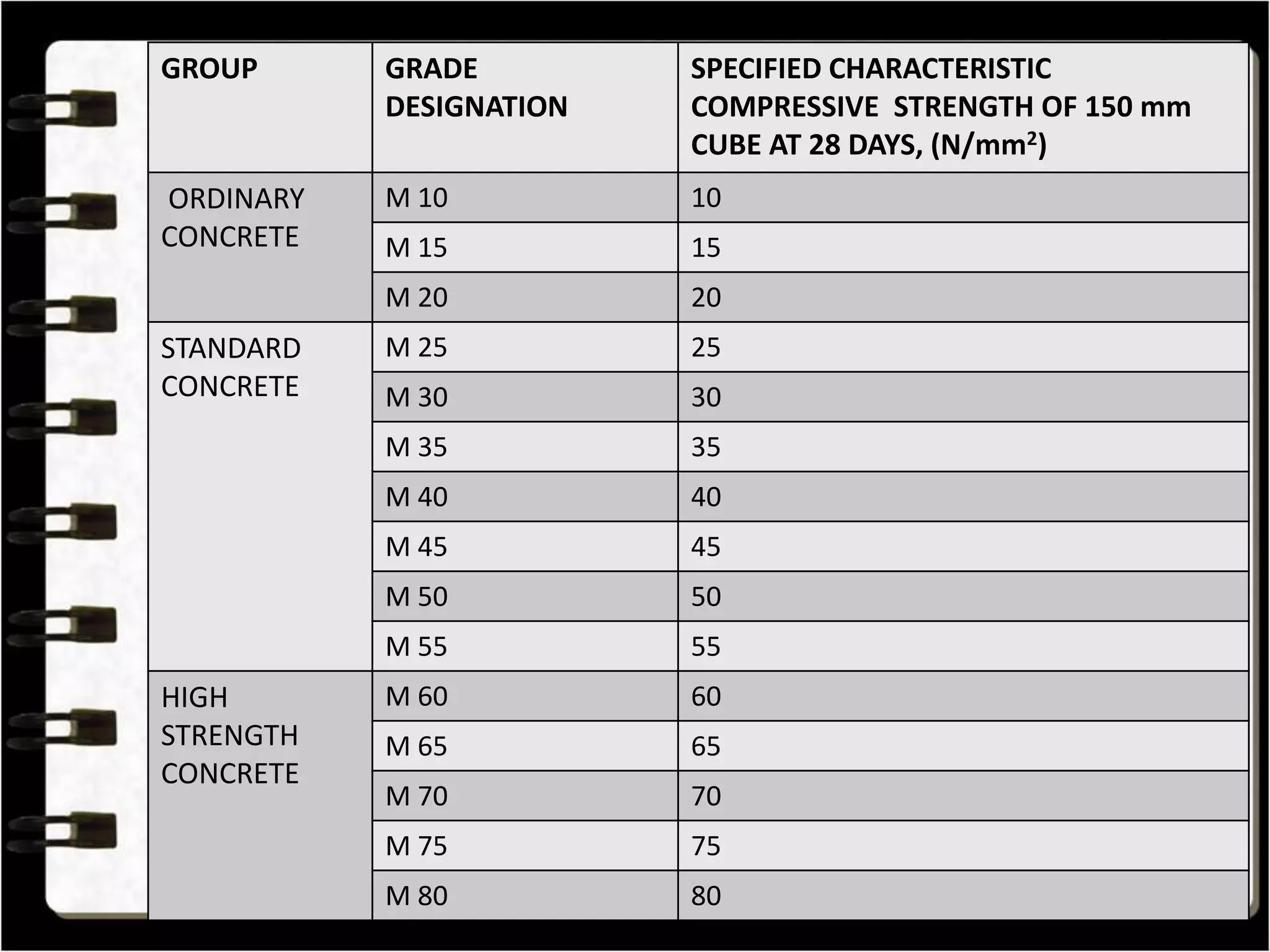
MIX DESIGN
 The process of selecting suitable ingredients of
concrete and determining their relative quantities
with the objective of producing a concrete of the
required strength, durability, workability and
economically as possible, is termed the concrete mix
design.
The characteristic strength of concrete (fck) is
defined as the strength of concrete below
which not more than 5% of the test result are
expected to fall.
What is M 20 ?
M refers to MIX.
20 refers to characteristic compressive
strength of cube (150mm*150mmm*150mm)
at 28 days in N/mm2.
GRADE OF CONCRETE
GROUP GRADE
DESIGNATION
SPECIFIED CHARACTERISTIC
COMPRESSIVE STRENGTH OF 150 mm
CUBE AT 28 DAYS, (N/mm2)
ORDINARY
CONCRETE
M 10 10
M 15 15
M 20 20
STANDARD
CONCRETE
M 25 25
M 30 30
M 35 35
M 40 40
M 45 45
M 50 50
M 55 55
HIGH
STRENGTH
CONCRETE
M 60 60
M 65 65
M 70 70
M 75 75
M 80 80
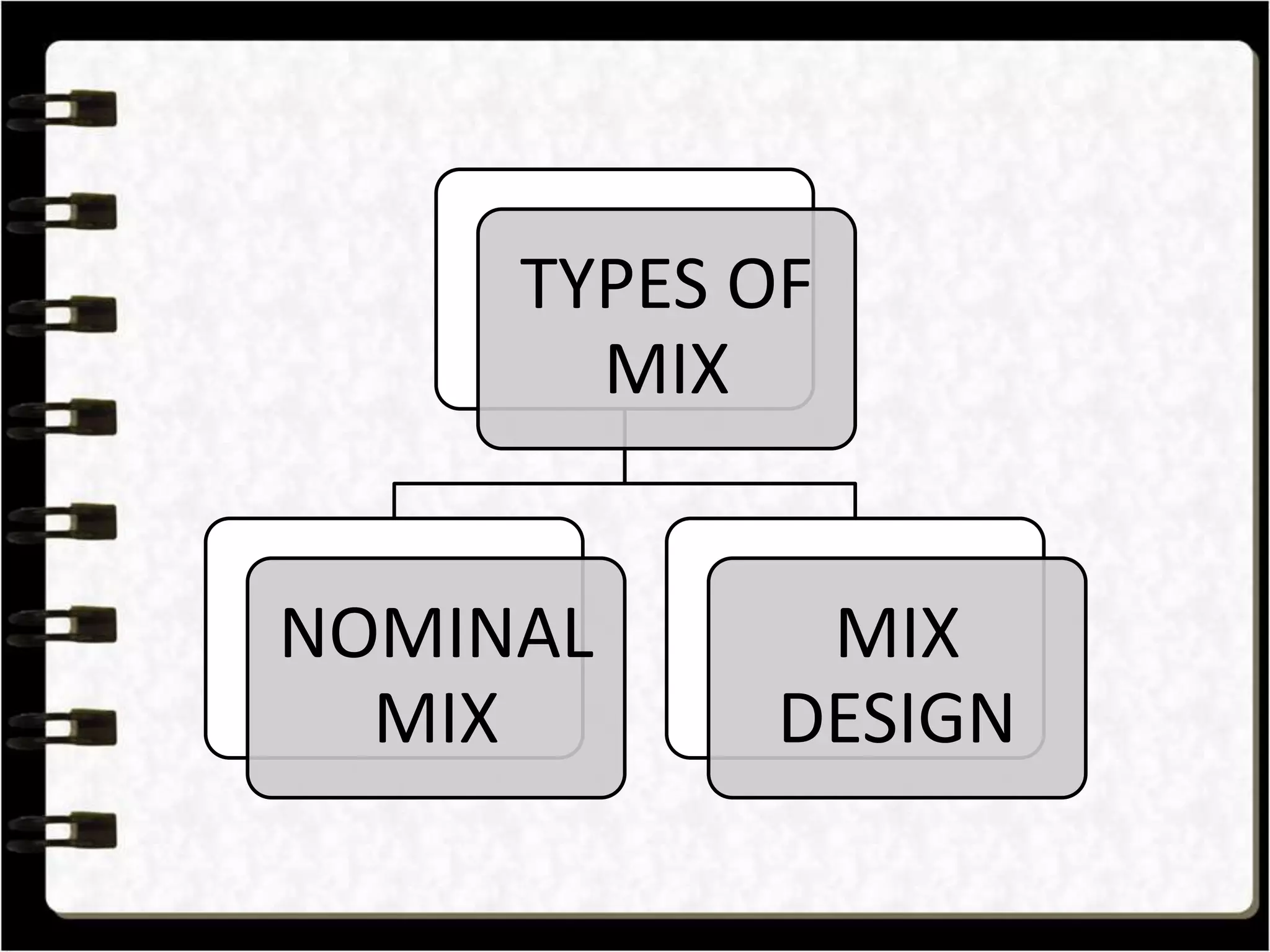
TYPES OF
MIX
NOMINAL
MIX
MIX
DESIGN
NOMINAL MIX CONCRETE
The Wide use of concrete as construction
material has led to the use of mixes of fixed
proportions, which ensure adequate strength.
These mixes are called NOMINAL MIXES.
Nominal mix concrete may be used for grade
M 5, M 7.5, M 10, M 15, and M 20. The
proportion of material for nominal mix shall be
in accordance with Table-9 of IS : 456-2000.
GREDE OF CONCRETE PROPORTION
CEMENT : F.A : C.A
M 5 1 : 5 : 10
M 7.5 1 : 4 : 8
M 10 1 : 3 : 6
M 15 1 : 2 : 4
M 20 1 : 1.5 : 3
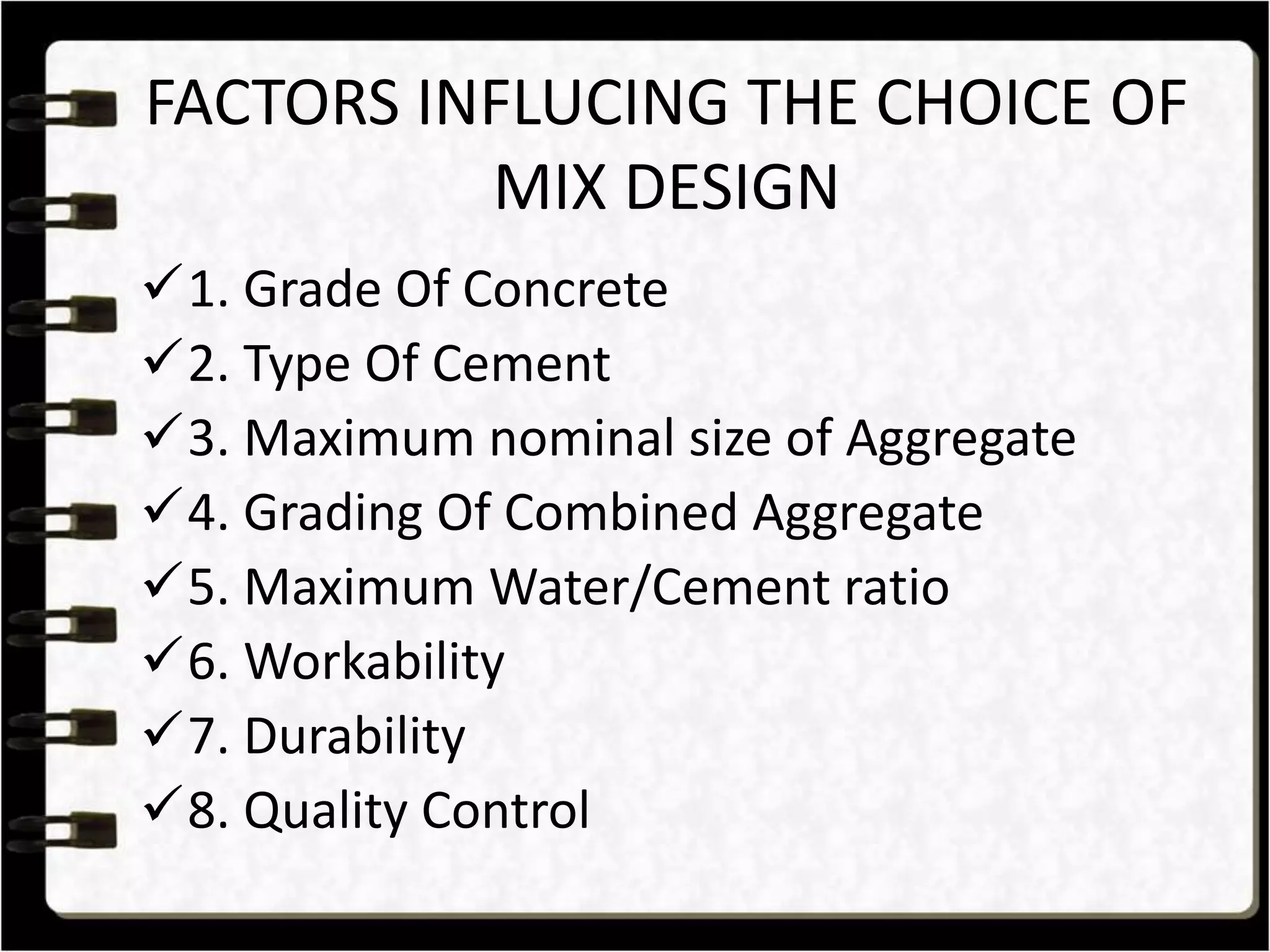
FACTORS INFLUENCING THE CHOICE
OF MIX DESIGN
1. Grade Of Concrete
2. Type Of Cement
3. Maximum nominal size of Aggregate
4. Grading Of Combined Aggregate
5. Maximum Water/Cement ratio
6. Workability
7. Durability
8. Quality Control
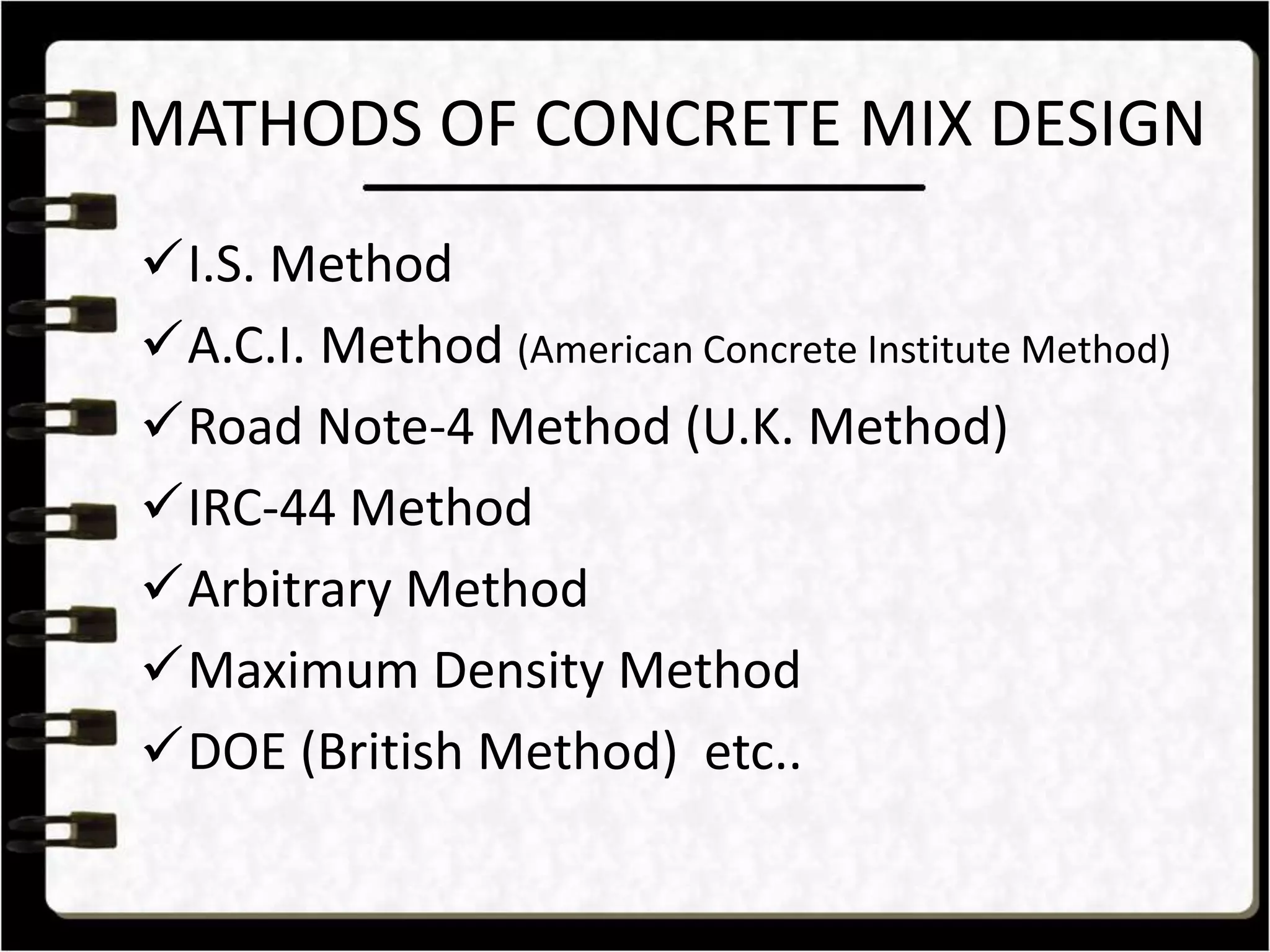
METHODS OF CONCRETE MIX DESIGN
I.S. Method
A.C.I. Method (American Concrete Institute Method)
Road Note-4 Method (U.K. Method)
IRC-44 Method
Arbitrary Method
Maximum Density Method
DOE (British Method) etc..
I.S. METHOD
TARGET MEAN STRENGTH
SELECTION OF W/C RATIO
DETERMINATION OF WATER CONTENT
CALCUATION OF CEMENT CONTENT
CALCULATION OF MASS OF FINE AGGREGATE
AND COARSE AGGREGATE
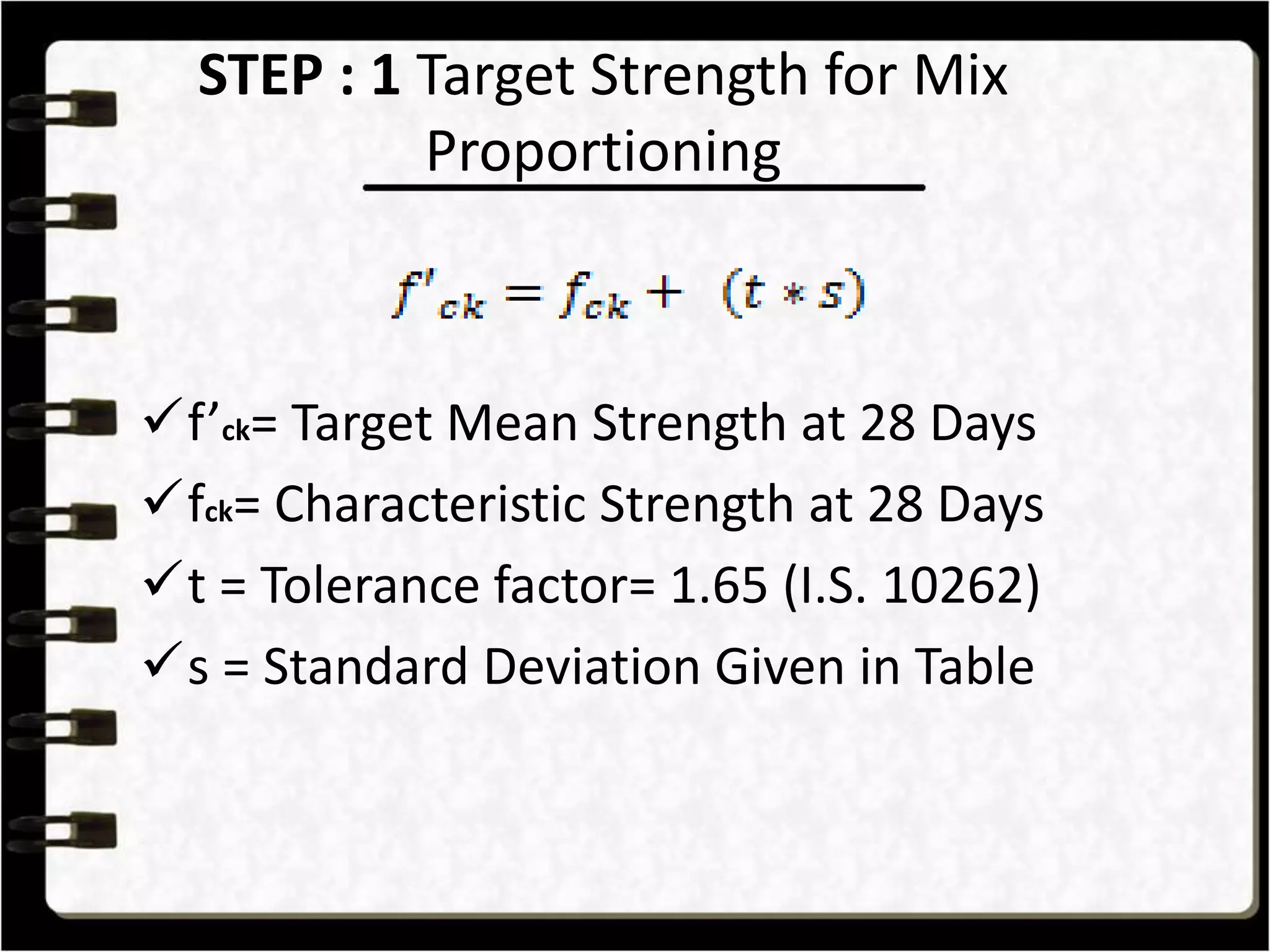
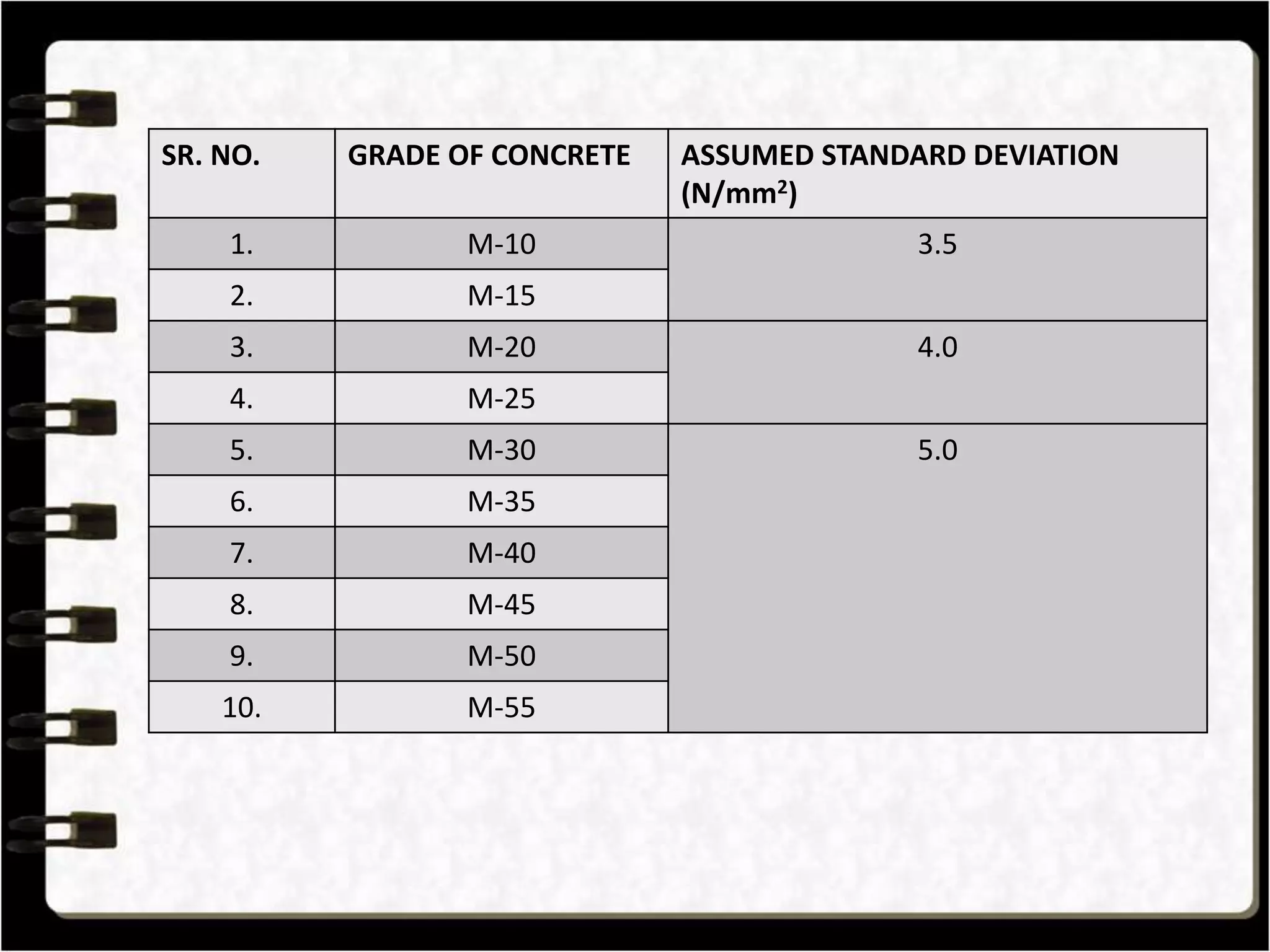
STEP : 1 Target Strength for Mix
Proportioning
f’ck= Target Mean Strength at 28 Days
fck= Characteristic Strength at 28 Days
t = Tolerance factor= 1.65 (I.S. 10262)
s = Standard Deviation Given in Table
SR. NO. GRADE OF CONCRETE ASSUMED STANDARD DEVIATION
(N/mm2)
1. M-10 3.5
2. M-15
3. M-20 4.0
4. M-25
5. M-30 5.0
6. M-35
7. M-40
8. M-45
9. M-50
10. M-55
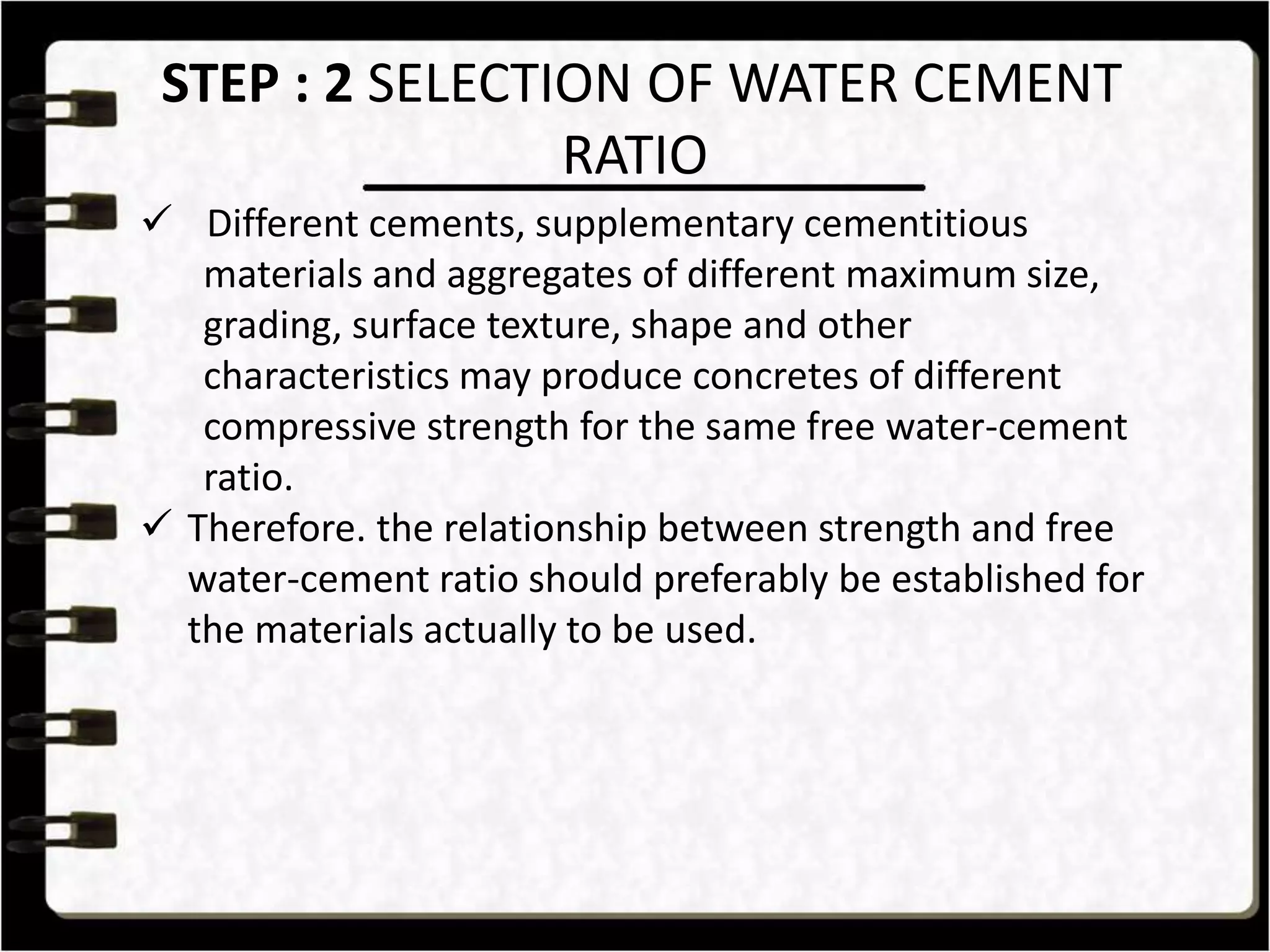
STEP : 2 SELECTION OF WATER CEMENT
RATIO
 Different cements, supplementary cementitious
materials and aggregates of different maximum size,
grading, surface texture, shape and other
characteristics may produce concretes of different
compressive strength for the same free water-cement
ratio.
 Therefore. the relationship between strength and free
water-cement ratio should preferably be established for
the materials actually to be used.
• I.S : 456-2000, TABLE 5
SR. NO. EXPOSURE MAXIMUM FREE W/C
RATIO
1. MILD 0.55
2. MODERATE 0.50
3. SEVERE 0.45
4. VERY SEVERE 0.45
5. EXTREME 0.40
STEP : 3 WATER CONTENT
SR.
NO.
NOMINAL MAXIMUN
SIZE OF AGGREGATE
(mm)
MAXIMUN WATER
CONTENT (Kg)
1 10 208
2 20 168
3 40 165
NOTE - These quantities of mixing water are for use in computing cementitious
material contents for trial batches.
SLUMP DEDUCTIONS FOR MORE THAN 50mm SUMP.
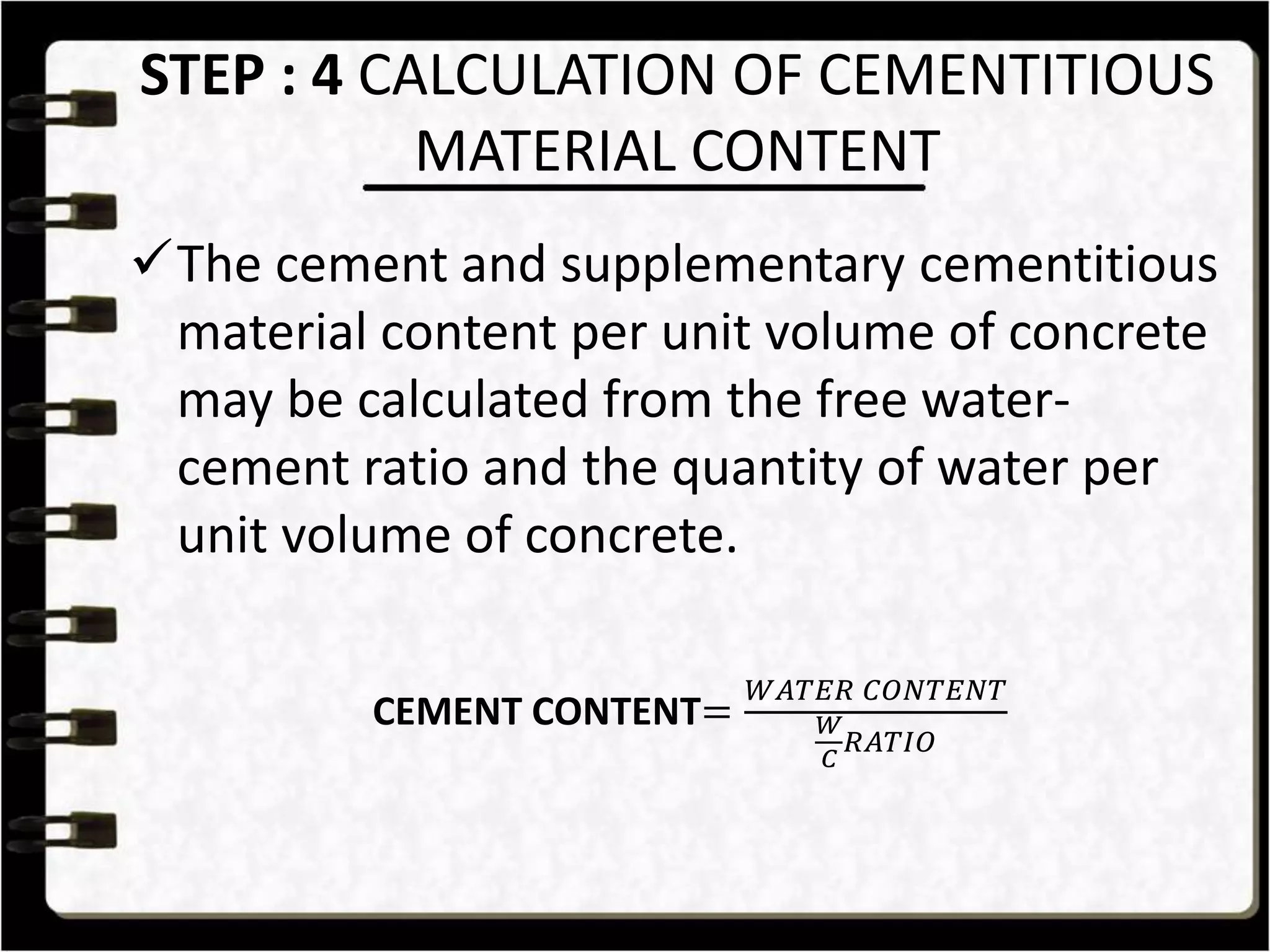
STEP : 4 CALCULATION OF CEMENTITIOUS
MATERIAL CONTENT
The cement and supplementary cementitious
material content per unit volume of concrete
may be calculated from the free water-
cement ratio and the quantity of water per
unit volume of concrete.
CEMENT CONTENT=
𝑊𝐴𝑇𝐸𝑅 𝐶𝑂𝑁𝑇𝐸𝑁𝑇
𝑊
𝐶
𝑅𝐴𝑇𝐼𝑂
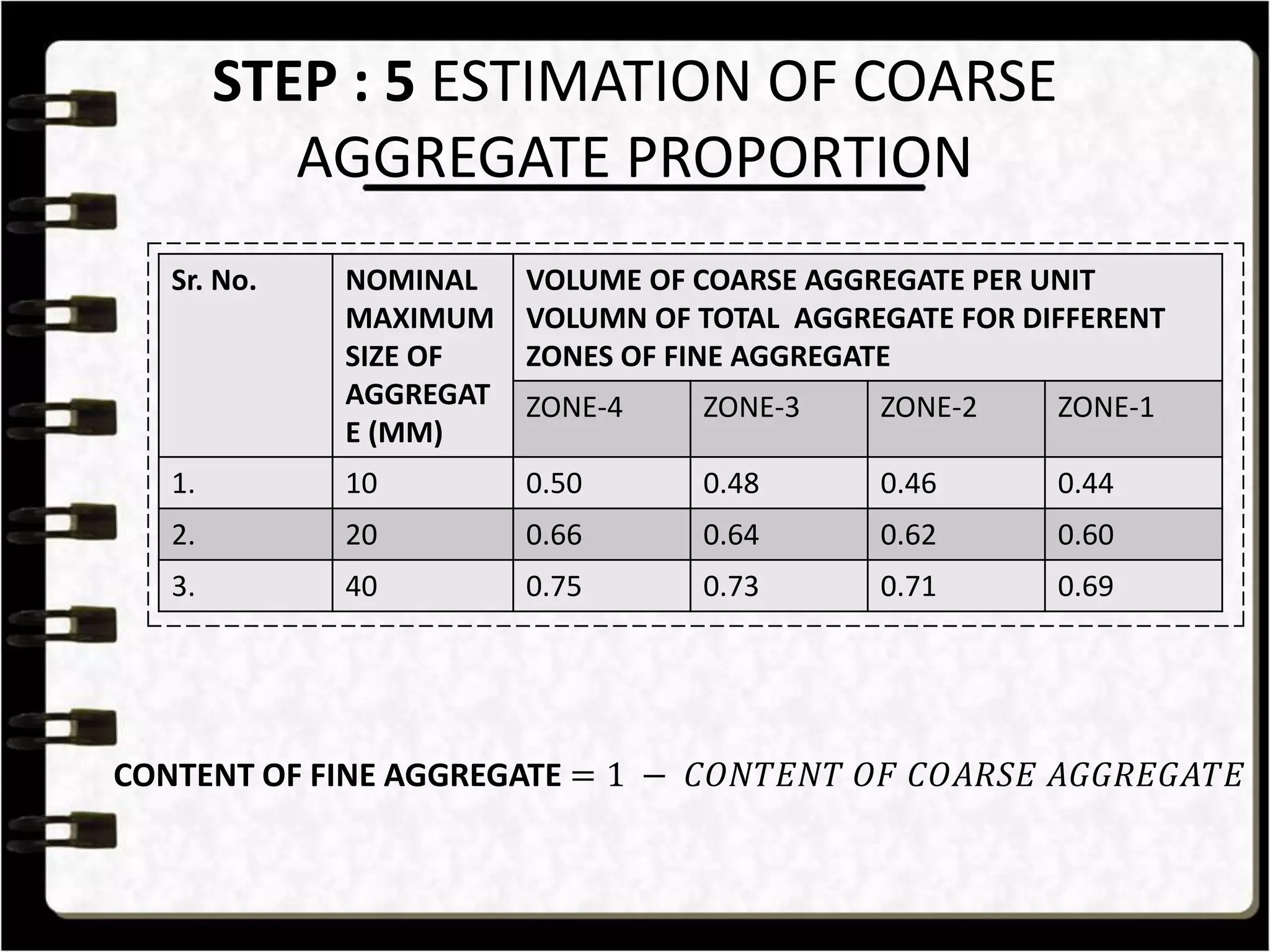
STEP : 5 ESTIMATION OF COARSE
AGGREGATE PROPORTION
Sr. No. NOMINAL
MAXIMUM
SIZE OF
AGGREGAT
E (MM)
VOLUME OF COARSE AGGREGATE PER UNIT
VOLUMN OF TOTAL AGGREGATE FOR DIFFERENT
ZONES OF FINE AGGREGATE
ZONE-4 ZONE-3 ZONE-2 ZONE-1
1. 10 0.50 0.48 0.46 0.44
2. 20 0.66 0.64 0.62 0.60
3. 40 0.75 0.73 0.71 0.69
CONTENT OF FINE AGGREGATE = 1 − 𝐶𝑂𝑁𝑇𝐸𝑁𝑇 𝑂𝐹 𝐶𝑂𝐴𝑅𝑆𝐸 𝐴𝐺𝐺𝑅𝐸𝐺𝐴𝑇𝐸
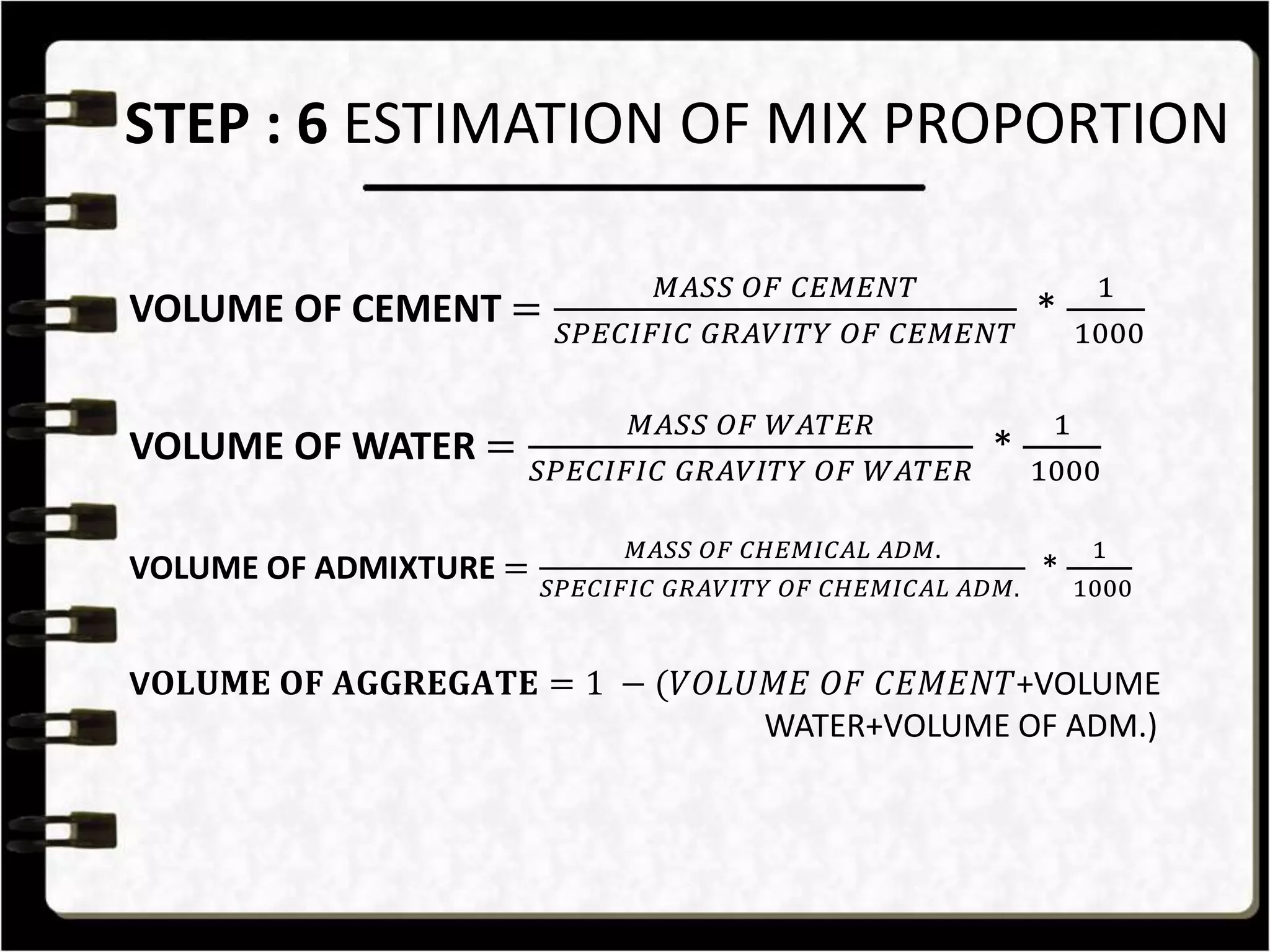
STEP : 6 ESTIMATION OF MIX PROPORTION
VOLUME OF CEMENT =
𝑀𝐴𝑆𝑆 𝑂𝐹 𝐶𝐸𝑀𝐸𝑁𝑇
𝑆𝑃𝐸𝐶𝐼𝐹𝐼𝐶 𝐺𝑅𝐴𝑉𝐼𝑇𝑌 𝑂𝐹 𝐶𝐸𝑀𝐸𝑁𝑇
*
1
1000
VOLUME OF WATER =
𝑀𝐴𝑆𝑆 𝑂𝐹 𝑊𝐴𝑇𝐸𝑅
𝑆𝑃𝐸𝐶𝐼𝐹𝐼𝐶 𝐺𝑅𝐴𝑉𝐼𝑇𝑌 𝑂𝐹 𝑊𝐴𝑇𝐸𝑅
*
1
1000
VOLUME OF ADMIXTURE =
𝑀𝐴𝑆𝑆 𝑂𝐹 𝐶𝐻𝐸𝑀𝐼𝐶𝐴𝐿 𝐴𝐷𝑀.
𝑆𝑃𝐸𝐶𝐼𝐹𝐼𝐶 𝐺𝑅𝐴𝑉𝐼𝑇𝑌 𝑂𝐹 𝐶𝐻𝐸𝑀𝐼𝐶𝐴𝐿 𝐴𝐷𝑀.
*
1
1000
V𝐎𝐋𝐔𝐌𝐄 𝐎𝐅 𝐀𝐆𝐆𝐑𝐄𝐆𝐀𝐓𝐄 = 1 − (𝑉𝑂𝐿𝑈𝑀𝐸 𝑂𝐹 𝐶𝐸𝑀𝐸𝑁𝑇+VOLUME
WATER+VOLUME OF ADM.)
MASS 𝑂𝐹 𝐶. 𝐴. = 𝑉𝑎 ∗ 𝑉𝑂𝐿𝑈𝑀𝐸 𝑂𝐹 𝐶. 𝐴 ∗ sp. GRACITY OF C. A.∗ 1000
MASS 𝑂𝐹 𝐹. 𝐴. = 𝑉𝑎 ∗ 𝑉𝑂𝐿𝑈𝑀𝐸 𝑂𝐹 𝐹. 𝐴 ∗ sp. GRACITY OF F. A.∗ 1000
• THANK YOU….

CONCRETE MIX DESIGN

  • 1.
    C O N C T E R E T E C H N O L O G NIKUL R. GOPANI SIRB.P.T.I COLLEGE CIVIL ENGINEERING GUIDED BY. Prof. P.D.GOHIL Prof. P.H.MEGHANI MIX DESIGN
  • 2.
    CONTENT WHAT IS MIXDESIGN ? GRADE OF CONCRETE. FACTORS INFLUENCING THE CHOICE OF MIX DESIGN. METHODS OF CONCRETE MIX DESIGN MIX DESIGN BY I.S. METHOD.
  • 3.
    MIX DESIGN  Theprocess of selecting suitable ingredients of concrete and determining their relative quantities with the objective of producing a concrete of the required strength, durability, workability and economically as possible, is termed the concrete mix design.
  • 4.
    The characteristic strengthof concrete (fck) is defined as the strength of concrete below which not more than 5% of the test result are expected to fall. What is M 20 ? M refers to MIX. 20 refers to characteristic compressive strength of cube (150mm*150mmm*150mm) at 28 days in N/mm2. GRADE OF CONCRETE
  • 5.
    GROUP GRADE DESIGNATION SPECIFIED CHARACTERISTIC COMPRESSIVESTRENGTH OF 150 mm CUBE AT 28 DAYS, (N/mm2) ORDINARY CONCRETE M 10 10 M 15 15 M 20 20 STANDARD CONCRETE M 25 25 M 30 30 M 35 35 M 40 40 M 45 45 M 50 50 M 55 55 HIGH STRENGTH CONCRETE M 60 60 M 65 65 M 70 70 M 75 75 M 80 80
  • 6.
  • 7.
    NOMINAL MIX CONCRETE TheWide use of concrete as construction material has led to the use of mixes of fixed proportions, which ensure adequate strength. These mixes are called NOMINAL MIXES. Nominal mix concrete may be used for grade M 5, M 7.5, M 10, M 15, and M 20. The proportion of material for nominal mix shall be in accordance with Table-9 of IS : 456-2000.
  • 8.
    GREDE OF CONCRETEPROPORTION CEMENT : F.A : C.A M 5 1 : 5 : 10 M 7.5 1 : 4 : 8 M 10 1 : 3 : 6 M 15 1 : 2 : 4 M 20 1 : 1.5 : 3
  • 9.
    FACTORS INFLUENCING THECHOICE OF MIX DESIGN 1. Grade Of Concrete 2. Type Of Cement 3. Maximum nominal size of Aggregate 4. Grading Of Combined Aggregate 5. Maximum Water/Cement ratio 6. Workability 7. Durability 8. Quality Control
  • 10.
    METHODS OF CONCRETEMIX DESIGN I.S. Method A.C.I. Method (American Concrete Institute Method) Road Note-4 Method (U.K. Method) IRC-44 Method Arbitrary Method Maximum Density Method DOE (British Method) etc..
  • 11.
    I.S. METHOD TARGET MEANSTRENGTH SELECTION OF W/C RATIO DETERMINATION OF WATER CONTENT CALCUATION OF CEMENT CONTENT CALCULATION OF MASS OF FINE AGGREGATE AND COARSE AGGREGATE
  • 12.
    STEP : 1Target Strength for Mix Proportioning f’ck= Target Mean Strength at 28 Days fck= Characteristic Strength at 28 Days t = Tolerance factor= 1.65 (I.S. 10262) s = Standard Deviation Given in Table
  • 13.
    SR. NO. GRADEOF CONCRETE ASSUMED STANDARD DEVIATION (N/mm2) 1. M-10 3.5 2. M-15 3. M-20 4.0 4. M-25 5. M-30 5.0 6. M-35 7. M-40 8. M-45 9. M-50 10. M-55
  • 14.
    STEP : 2SELECTION OF WATER CEMENT RATIO  Different cements, supplementary cementitious materials and aggregates of different maximum size, grading, surface texture, shape and other characteristics may produce concretes of different compressive strength for the same free water-cement ratio.  Therefore. the relationship between strength and free water-cement ratio should preferably be established for the materials actually to be used.
  • 15.
    • I.S :456-2000, TABLE 5 SR. NO. EXPOSURE MAXIMUM FREE W/C RATIO 1. MILD 0.55 2. MODERATE 0.50 3. SEVERE 0.45 4. VERY SEVERE 0.45 5. EXTREME 0.40
  • 16.
    STEP : 3WATER CONTENT SR. NO. NOMINAL MAXIMUN SIZE OF AGGREGATE (mm) MAXIMUN WATER CONTENT (Kg) 1 10 208 2 20 168 3 40 165 NOTE - These quantities of mixing water are for use in computing cementitious material contents for trial batches. SLUMP DEDUCTIONS FOR MORE THAN 50mm SUMP.
  • 17.
    STEP : 4CALCULATION OF CEMENTITIOUS MATERIAL CONTENT The cement and supplementary cementitious material content per unit volume of concrete may be calculated from the free water- cement ratio and the quantity of water per unit volume of concrete. CEMENT CONTENT= 𝑊𝐴𝑇𝐸𝑅 𝐶𝑂𝑁𝑇𝐸𝑁𝑇 𝑊 𝐶 𝑅𝐴𝑇𝐼𝑂
  • 18.
    STEP : 5ESTIMATION OF COARSE AGGREGATE PROPORTION Sr. No. NOMINAL MAXIMUM SIZE OF AGGREGAT E (MM) VOLUME OF COARSE AGGREGATE PER UNIT VOLUMN OF TOTAL AGGREGATE FOR DIFFERENT ZONES OF FINE AGGREGATE ZONE-4 ZONE-3 ZONE-2 ZONE-1 1. 10 0.50 0.48 0.46 0.44 2. 20 0.66 0.64 0.62 0.60 3. 40 0.75 0.73 0.71 0.69 CONTENT OF FINE AGGREGATE = 1 − 𝐶𝑂𝑁𝑇𝐸𝑁𝑇 𝑂𝐹 𝐶𝑂𝐴𝑅𝑆𝐸 𝐴𝐺𝐺𝑅𝐸𝐺𝐴𝑇𝐸
  • 19.
    STEP : 6ESTIMATION OF MIX PROPORTION VOLUME OF CEMENT = 𝑀𝐴𝑆𝑆 𝑂𝐹 𝐶𝐸𝑀𝐸𝑁𝑇 𝑆𝑃𝐸𝐶𝐼𝐹𝐼𝐶 𝐺𝑅𝐴𝑉𝐼𝑇𝑌 𝑂𝐹 𝐶𝐸𝑀𝐸𝑁𝑇 * 1 1000 VOLUME OF WATER = 𝑀𝐴𝑆𝑆 𝑂𝐹 𝑊𝐴𝑇𝐸𝑅 𝑆𝑃𝐸𝐶𝐼𝐹𝐼𝐶 𝐺𝑅𝐴𝑉𝐼𝑇𝑌 𝑂𝐹 𝑊𝐴𝑇𝐸𝑅 * 1 1000 VOLUME OF ADMIXTURE = 𝑀𝐴𝑆𝑆 𝑂𝐹 𝐶𝐻𝐸𝑀𝐼𝐶𝐴𝐿 𝐴𝐷𝑀. 𝑆𝑃𝐸𝐶𝐼𝐹𝐼𝐶 𝐺𝑅𝐴𝑉𝐼𝑇𝑌 𝑂𝐹 𝐶𝐻𝐸𝑀𝐼𝐶𝐴𝐿 𝐴𝐷𝑀. * 1 1000 V𝐎𝐋𝐔𝐌𝐄 𝐎𝐅 𝐀𝐆𝐆𝐑𝐄𝐆𝐀𝐓𝐄 = 1 − (𝑉𝑂𝐿𝑈𝑀𝐸 𝑂𝐹 𝐶𝐸𝑀𝐸𝑁𝑇+VOLUME WATER+VOLUME OF ADM.)
  • 20.
    MASS 𝑂𝐹 𝐶.𝐴. = 𝑉𝑎 ∗ 𝑉𝑂𝐿𝑈𝑀𝐸 𝑂𝐹 𝐶. 𝐴 ∗ sp. GRACITY OF C. A.∗ 1000 MASS 𝑂𝐹 𝐹. 𝐴. = 𝑉𝑎 ∗ 𝑉𝑂𝐿𝑈𝑀𝐸 𝑂𝐹 𝐹. 𝐴 ∗ sp. GRACITY OF F. A.∗ 1000
  • 21.