

Reproduction is a fundamental feature of
living organisms which involves the
transmission of genetic material from

one generation to the next ensuring the
survival of species over long periods of
time.
LIFE SPAN
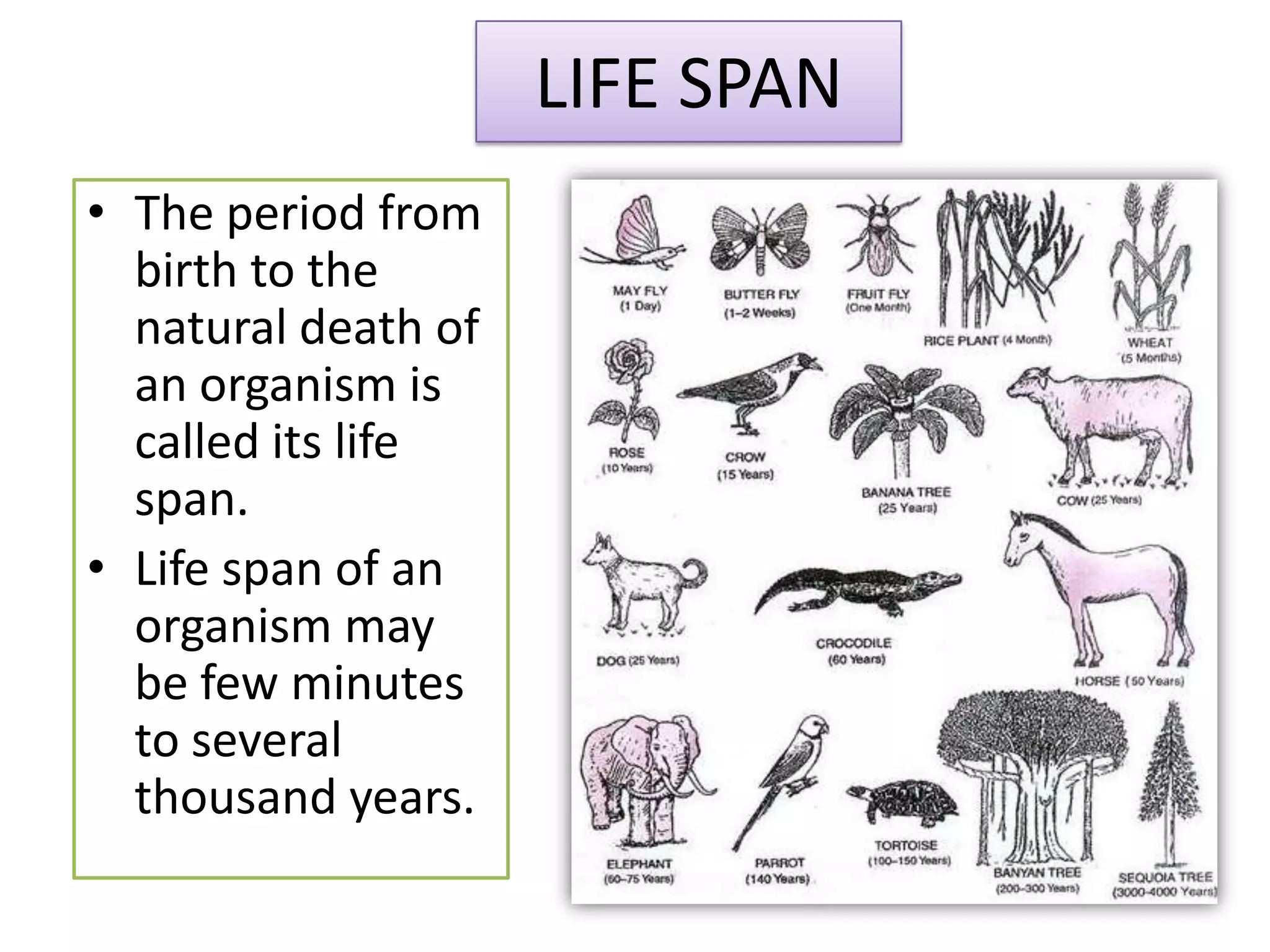
• The period from
birth to the
natural death of
an organism is
called its life
span.
• Life span of an
organism may
be few minutes
to several
thousand years.
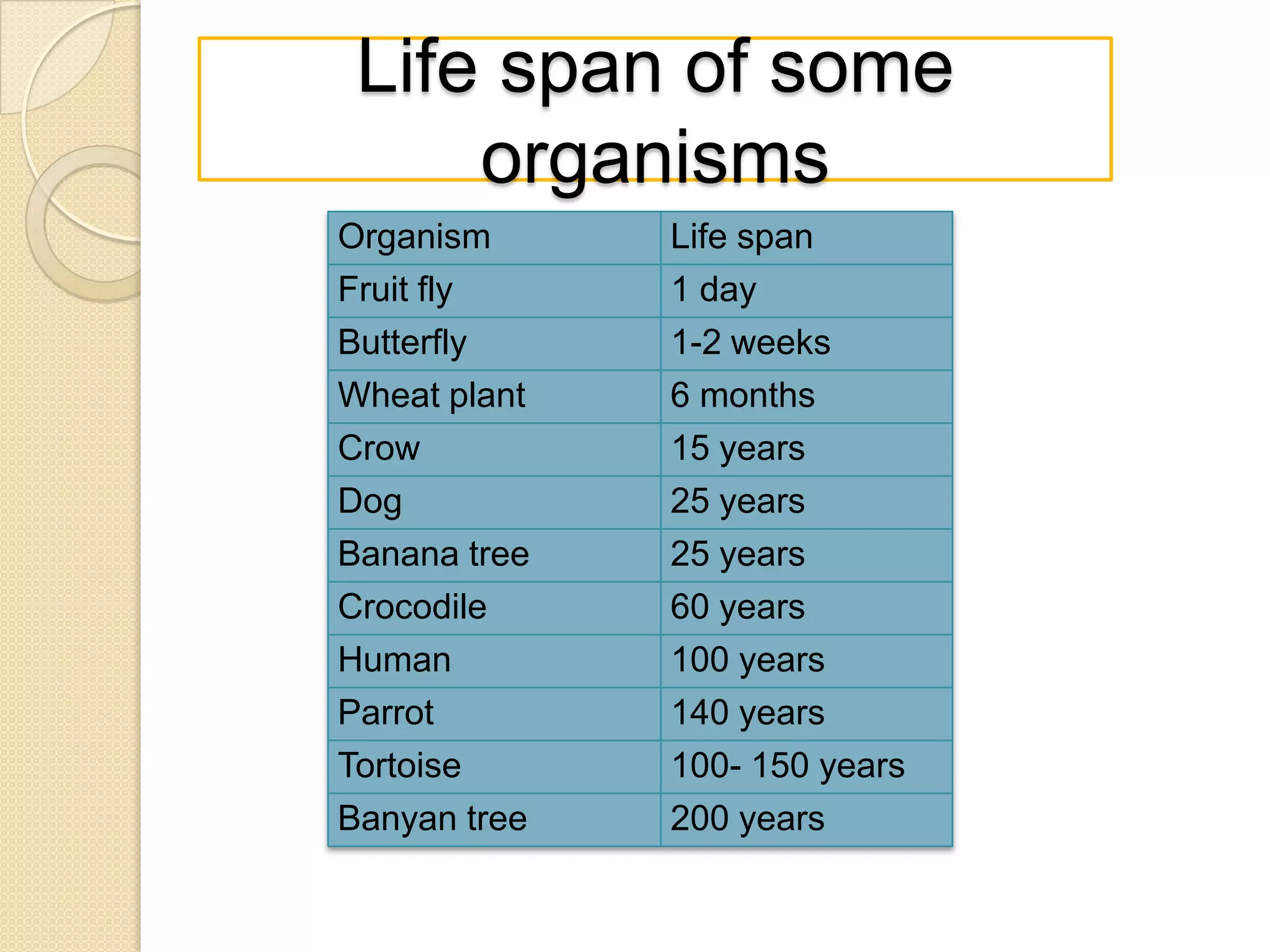
Life span of some
organisms
Organism
Fruit fly
Butterfly
Wheat plant
Crow
Dog
Banana tree
Crocodile
Human
Parrot
Tortoise
Banyan tree

Life span
1 day
1-2 weeks
6 months
15 years
25 years
25 years
60 years
100 years
140 years
100- 150 years
200 years
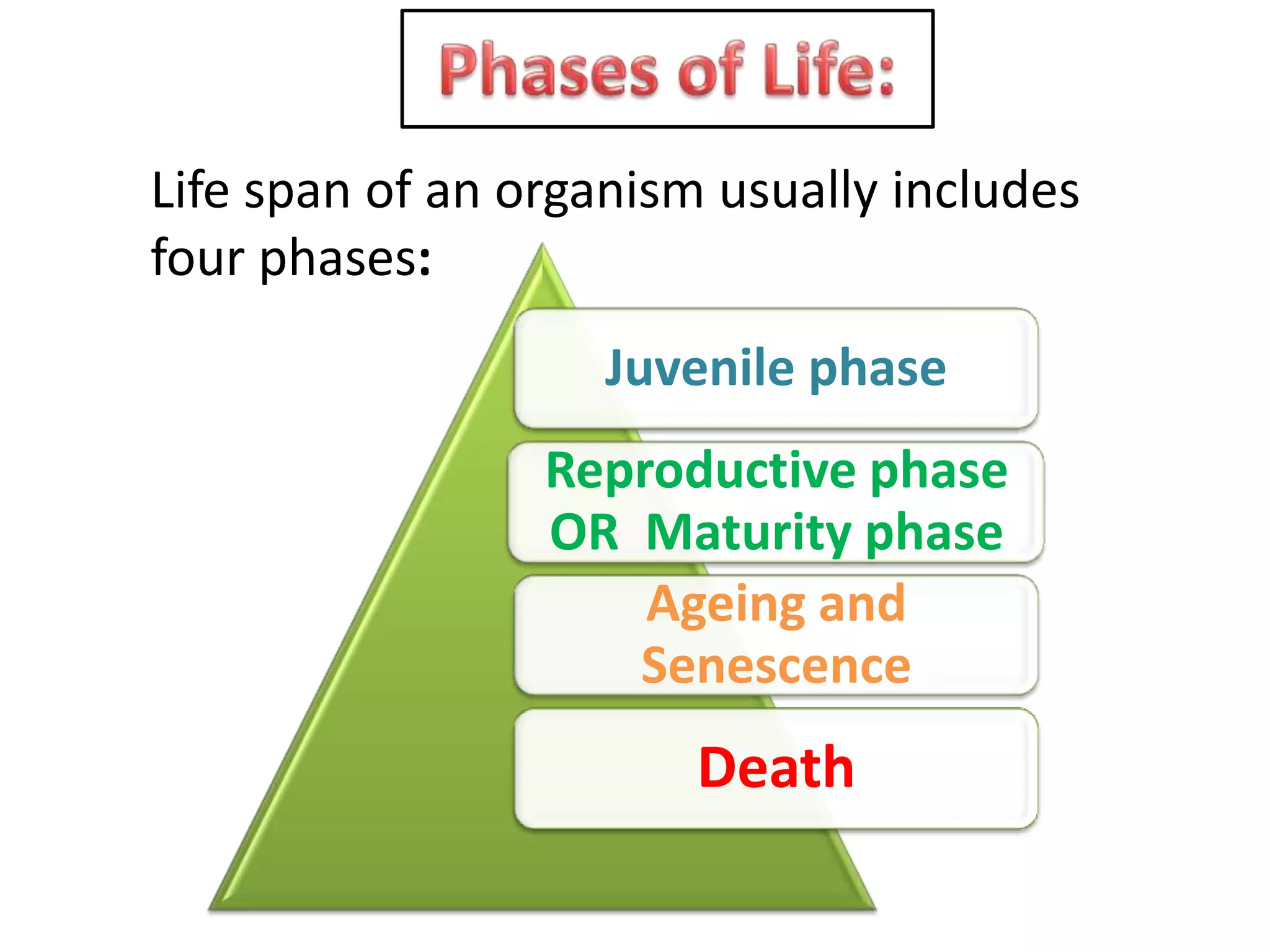
Life span of an organism usually includes
four phases:

Juvenile phase
Reproductive phase
OR Maturity phase
Ageing and
Senescence

Death
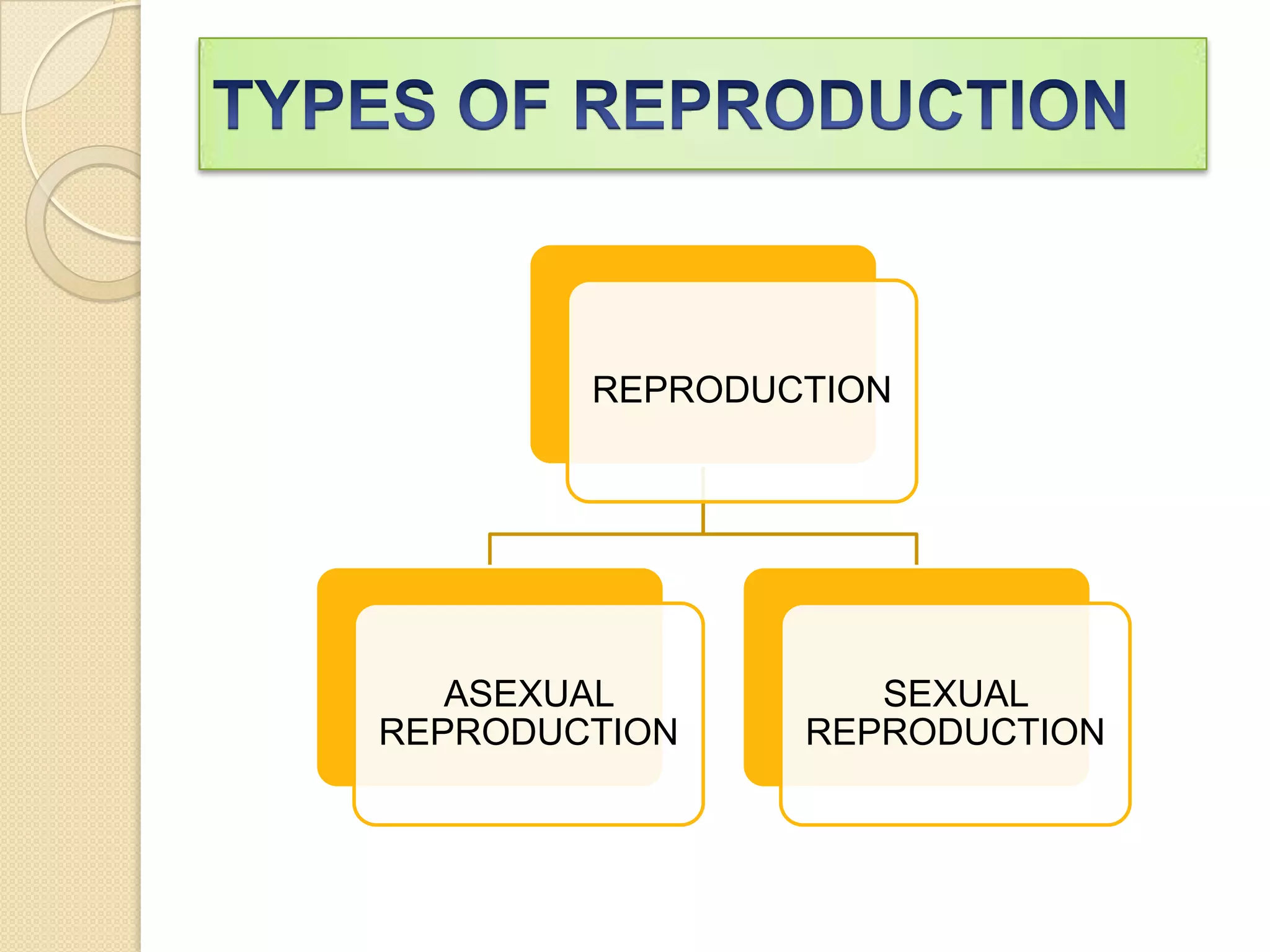
REPRODUCTION

ASEXUAL
REPRODUCTION

SEXUAL
REPRODUCTION
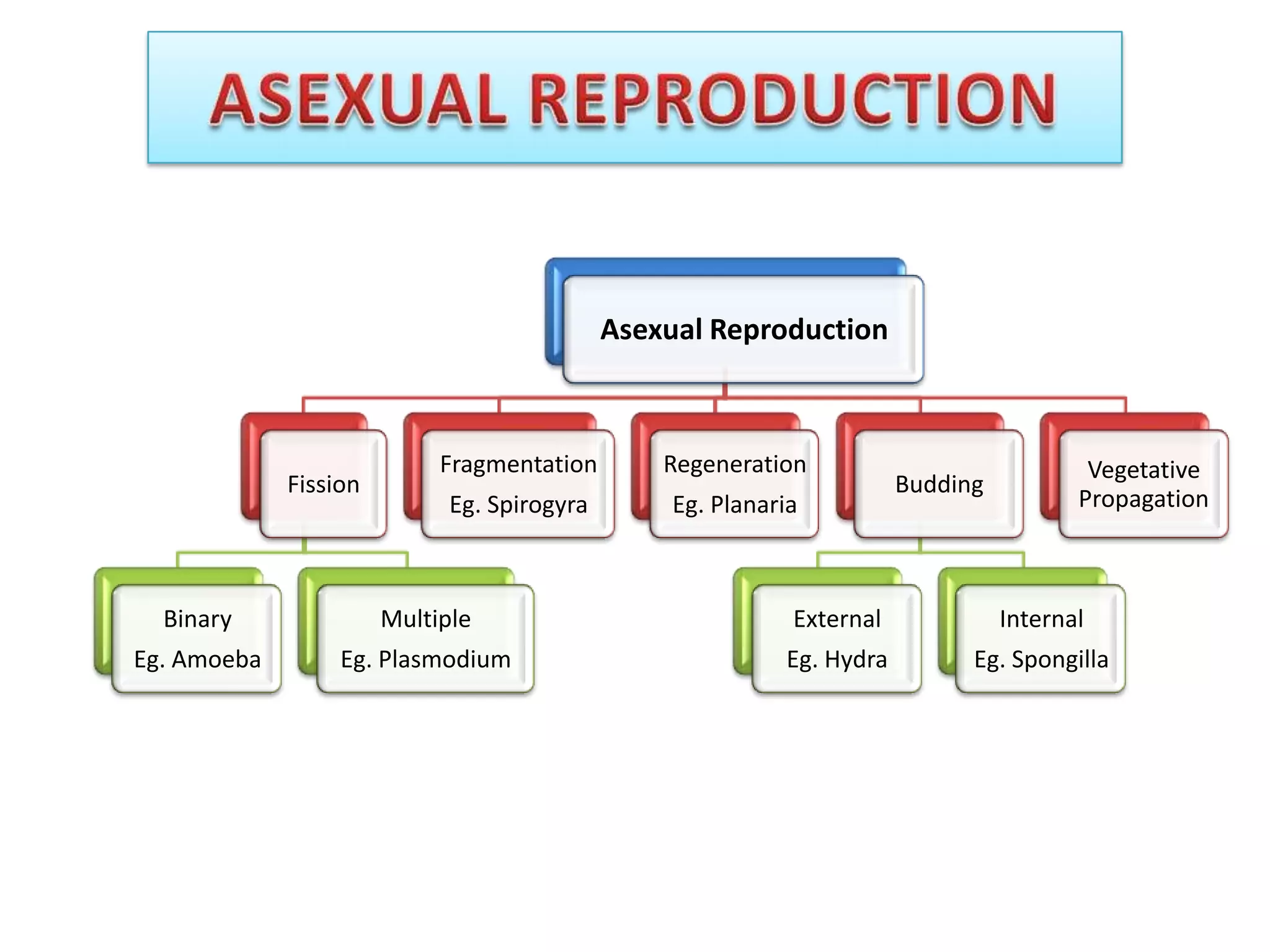
Asexual Reproduction

Fission

Fragmentation

Regeneration

Eg. Spirogyra

Eg. Planaria

Budding

Vegetative
Propagation

Binary

Multiple

External

Internal

Eg. Amoeba

Eg. Plasmodium

Eg. Hydra

Eg. Spongilla
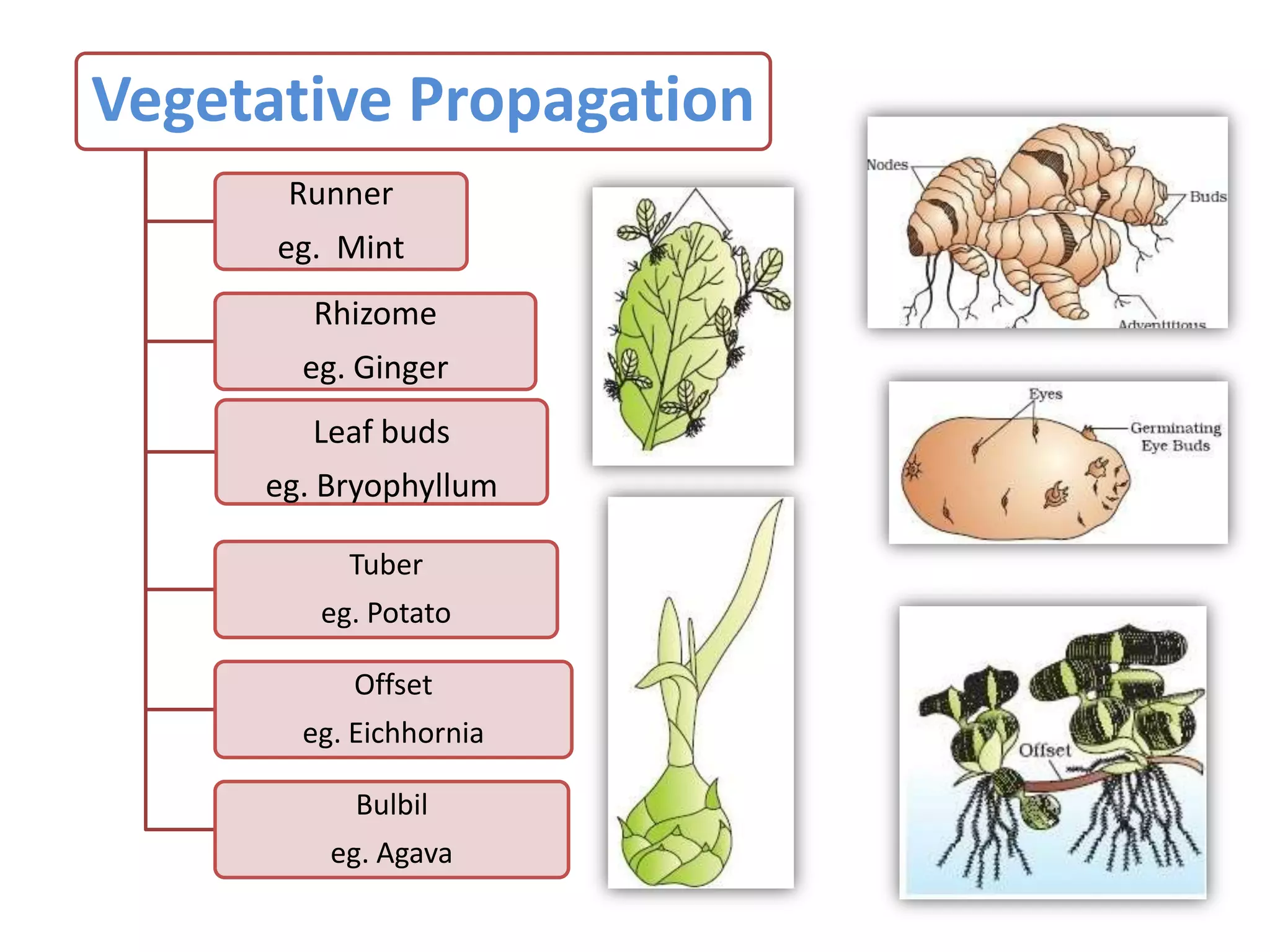
Vegetative Propagation
Runner
eg. Mint
Rhizome
eg. Ginger
Leaf buds
eg. Bryophyllum
Tuber
eg. Potato

Offset
eg. Eichhornia
Bulbil
eg. Agava
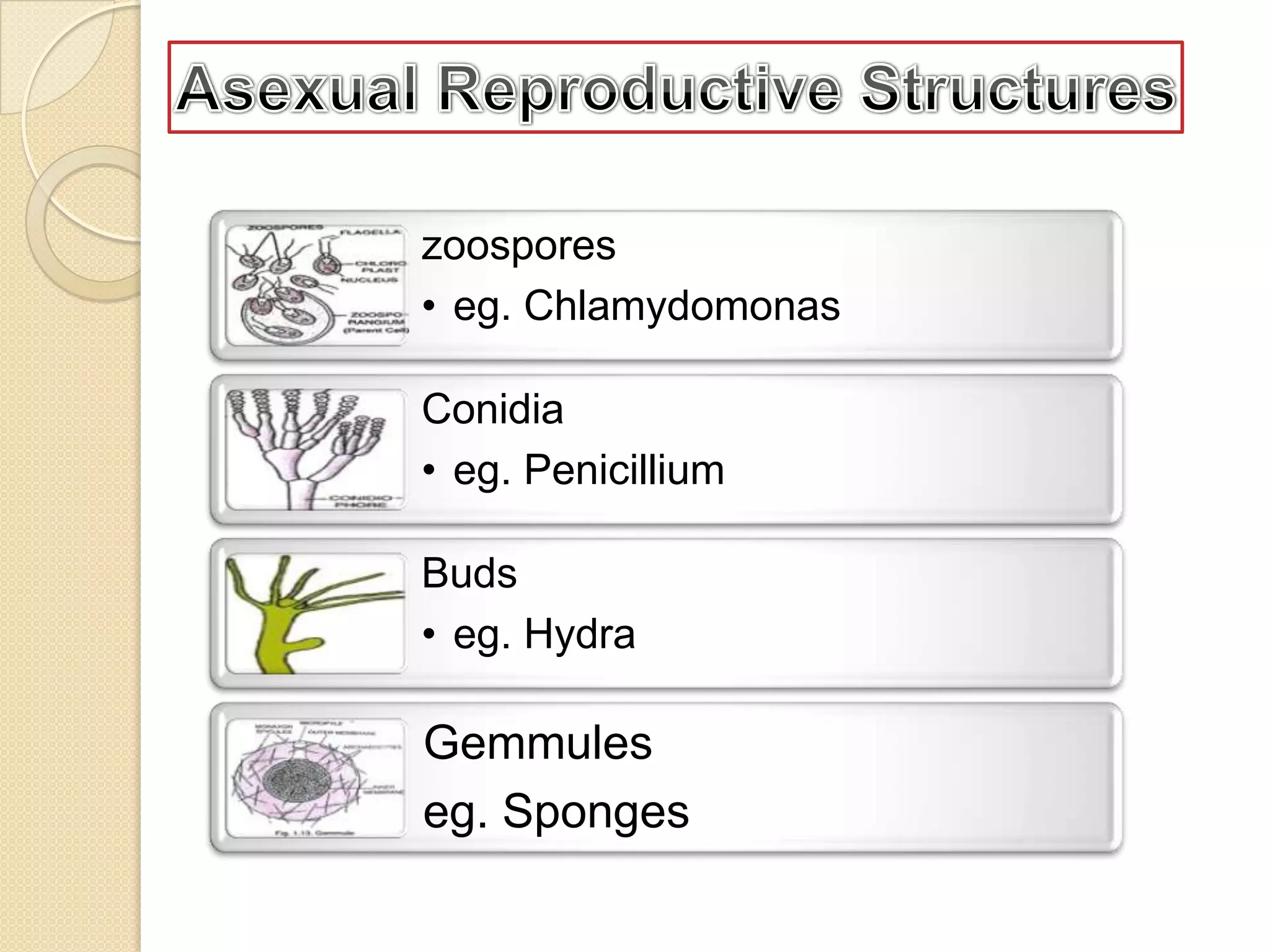
zoospores
• eg. Chlamydomonas

Conidia
• eg. Penicillium
Buds
• eg. Hydra

Gemmules
eg. Sponges
SEXUAL
REPRODUCTION
Sexual reproduction involves
formation of the male and female
gametes, either by the same individual
or by different individuals of the
opposite sex.
 These gametes fuse to form the
zygote which develops to form the
new organism.

Reproduction in Flowering
Plants
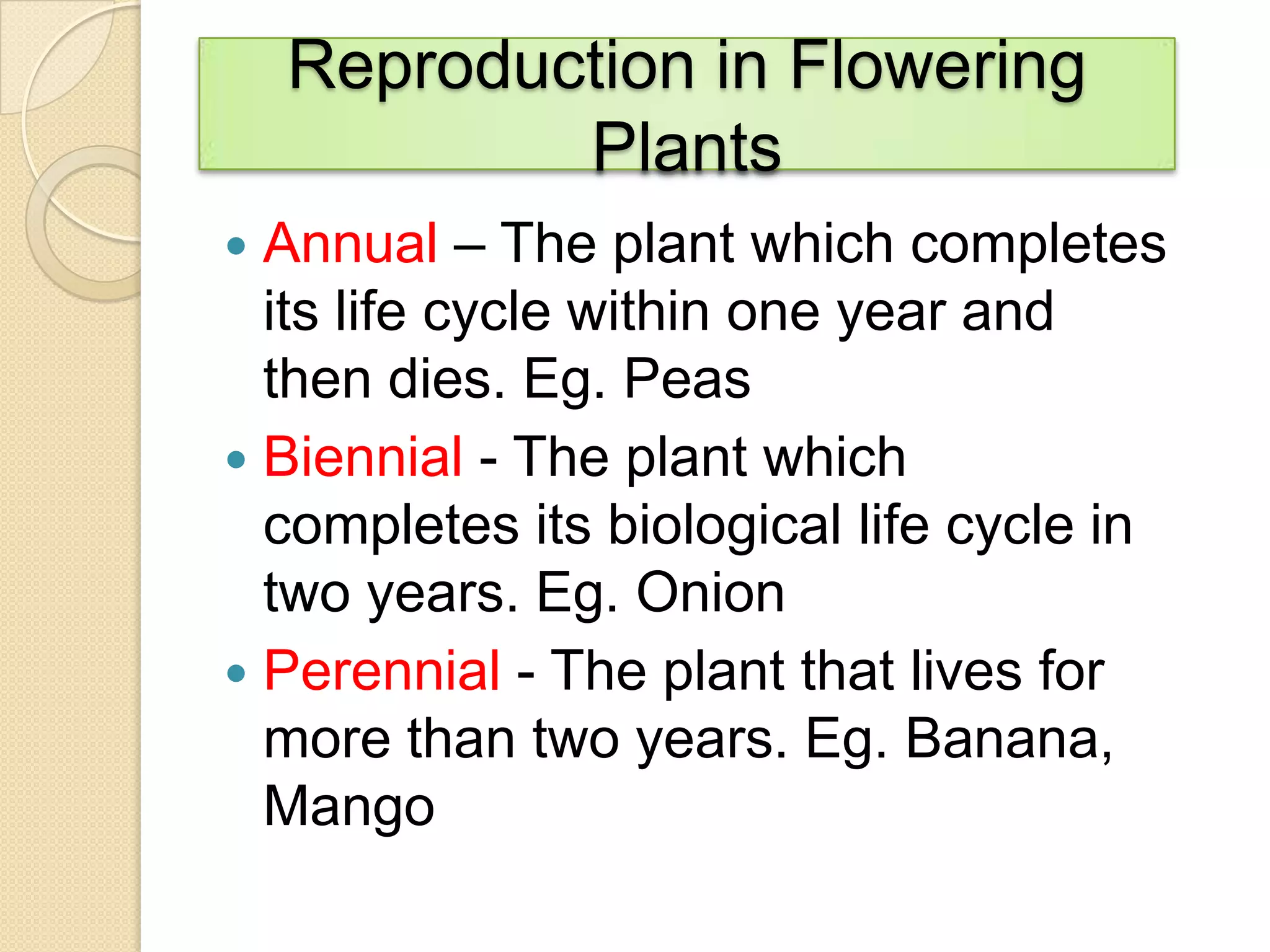
Annual – The plant which completes
its life cycle within one year and
then dies. Eg. Peas
 Biennial - The plant which
completes its biological life cycle in
two years. Eg. Onion
 Perennial - The plant that lives for
more than two years. Eg. Banana,
Mango

Unusual phenomenon of some flowering Plants
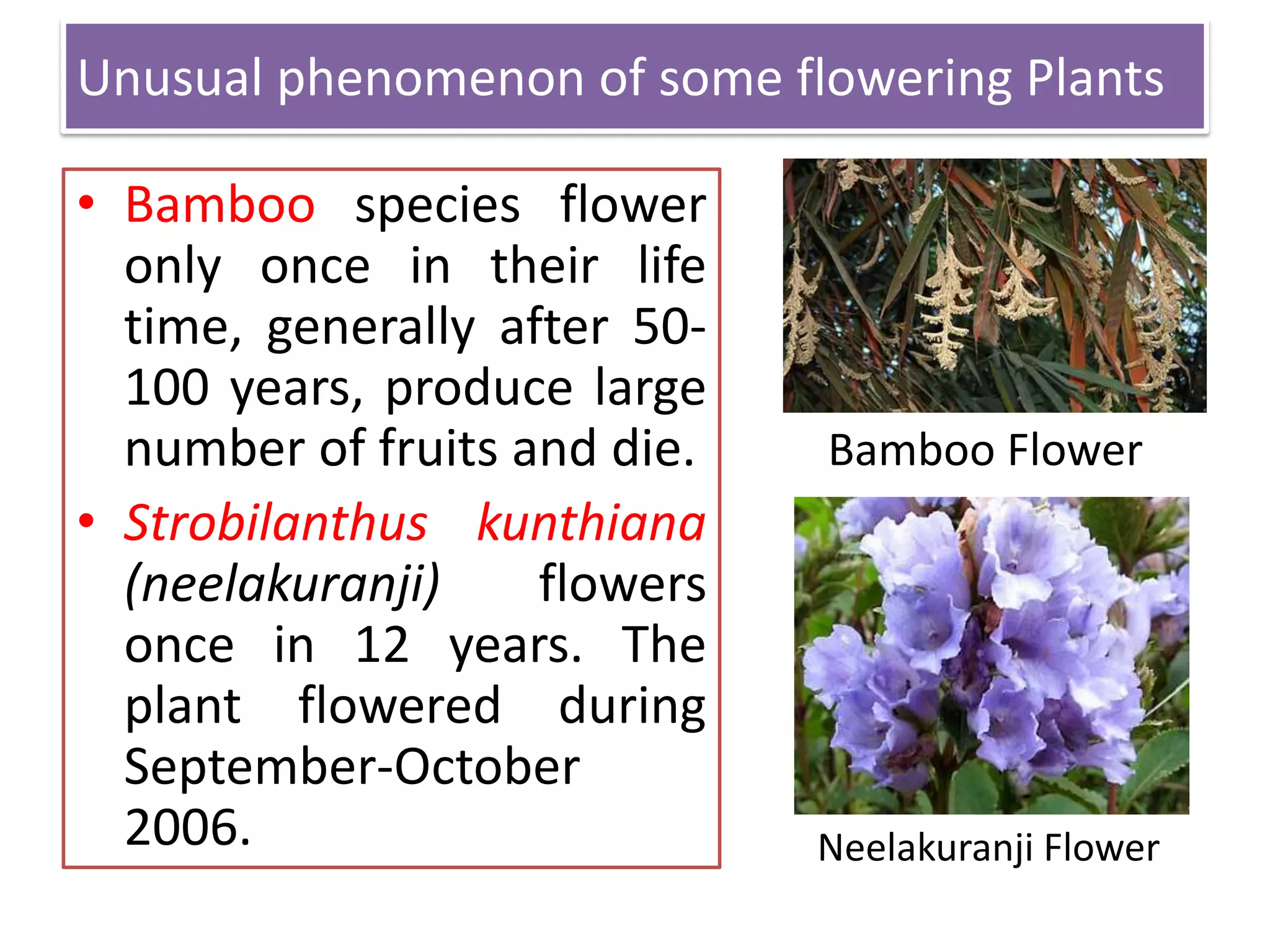
• Bamboo species flower
only once in their life
time, generally after 50100 years, produce large
number of fruits and die.
• Strobilanthus kunthiana
(neelakuranji)
flowers
once in 12 years. The
plant flowered during
September-October
2006.

Bamboo Flower

Neelakuranji Flower
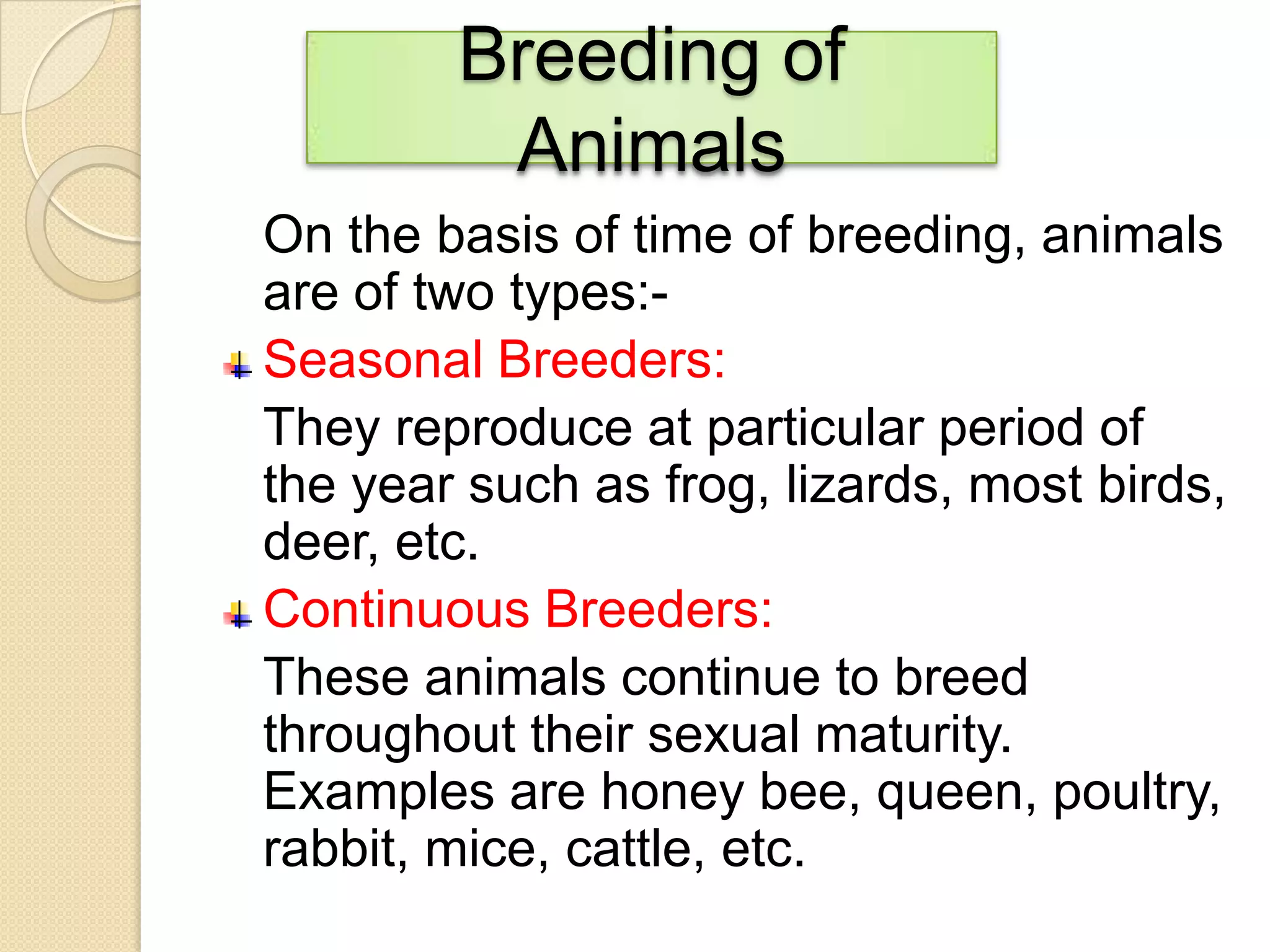
Breeding of
Animals
On the basis of time of breeding, animals
are of two types:Seasonal Breeders:
They reproduce at particular period of
the year such as frog, lizards, most birds,
deer, etc.
Continuous Breeders:
These animals continue to breed
throughout their sexual maturity.
Examples are honey bee, queen, poultry,
rabbit, mice, cattle, etc.
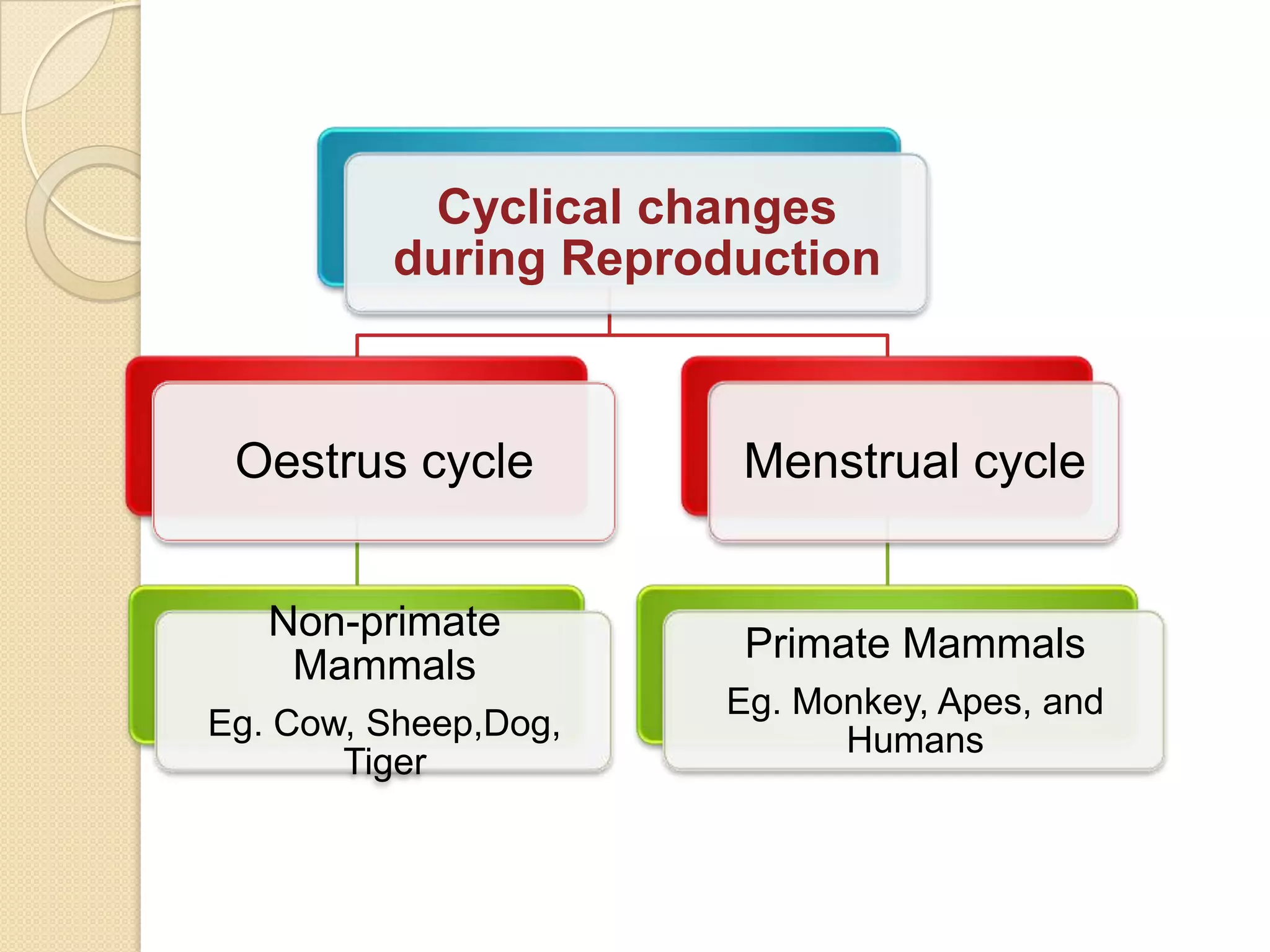
Cyclical changes
during Reproduction

Oestrus cycle

Menstrual cycle

Non-primate
Mammals

Primate Mammals

Eg. Cow, Sheep,Dog,
Tiger

Eg. Monkey, Apes, and
Humans
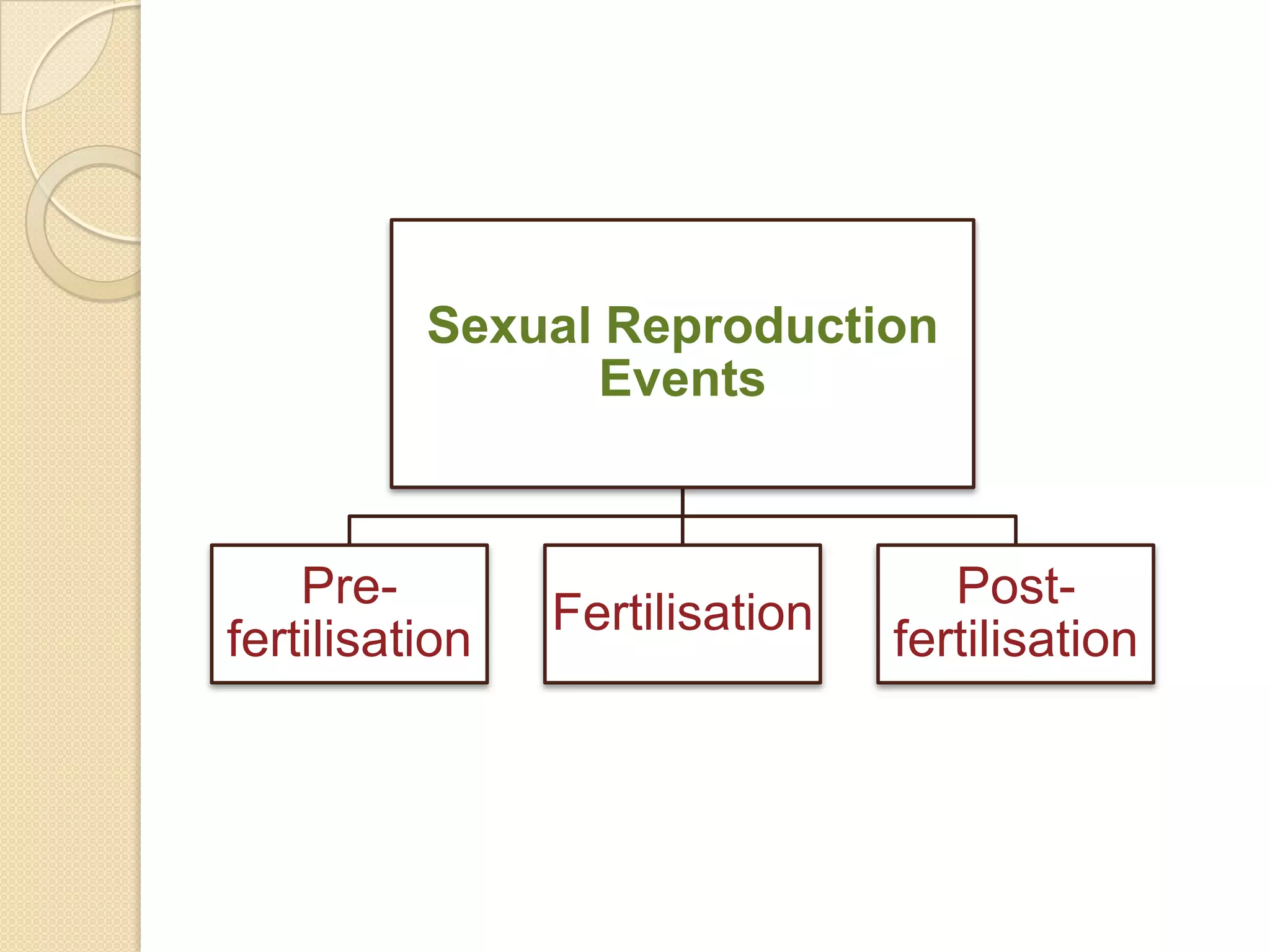
Sexual Reproduction
Events

Prefertilisation

Fertilisation

Postfertilisation
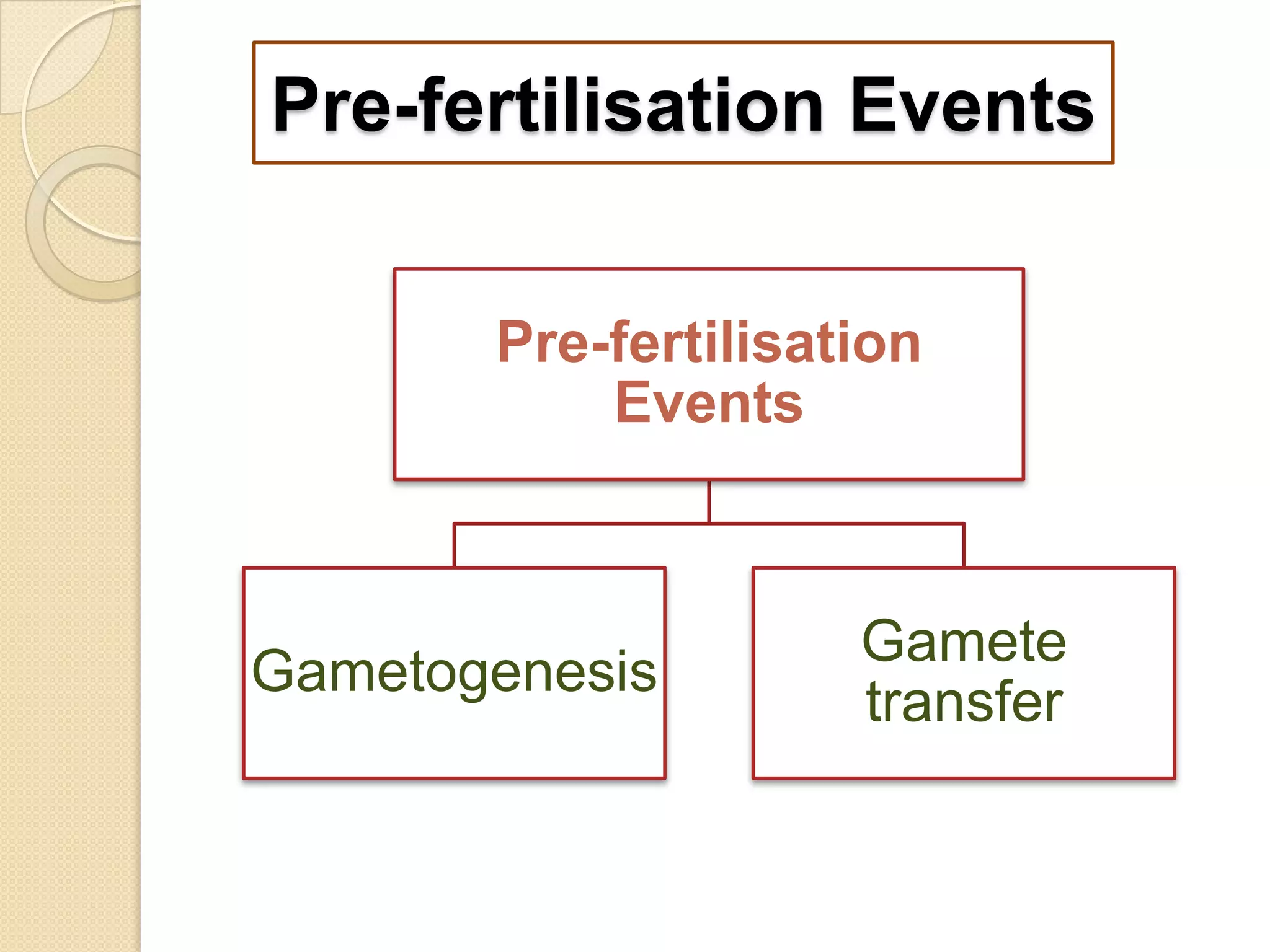
Pre-fertilisation Events
Pre-fertilisation
Events

Gametogenesis

Gamete
transfer
Gametogenesis
Gametogenesis - The process of
formation of male and female gametes.
Gametes may be :
i) Homogametes or isogametes- the
two gametes similar in appearance ,can
not categorise into male and female
gametes. eg. Cladophora
ii) Heterogametes - two morphologically
distinct gametes .
 Male gamete is called antherozoid or
sperm.
 Female gamete is called the egg or
ovum. eg. Fucus, Human being
Sexuality in Organisms









Homothallic and monoecious - terms used to
describe bisexual condition of plant.
Heterothallic and dioecious - terms used to
describe unisexual condition of plant.
Staminate - unisexual male flower bearing
stamens
Pistillate - unisexual female flower bearing
stamens.
Monoecious - both male and female flowers
may be present on the same individual. Eg.
cucurbits and coconuts
Dioecious - both male and female flowers
may be present on separate individuals. Eg.
papaya and date palm
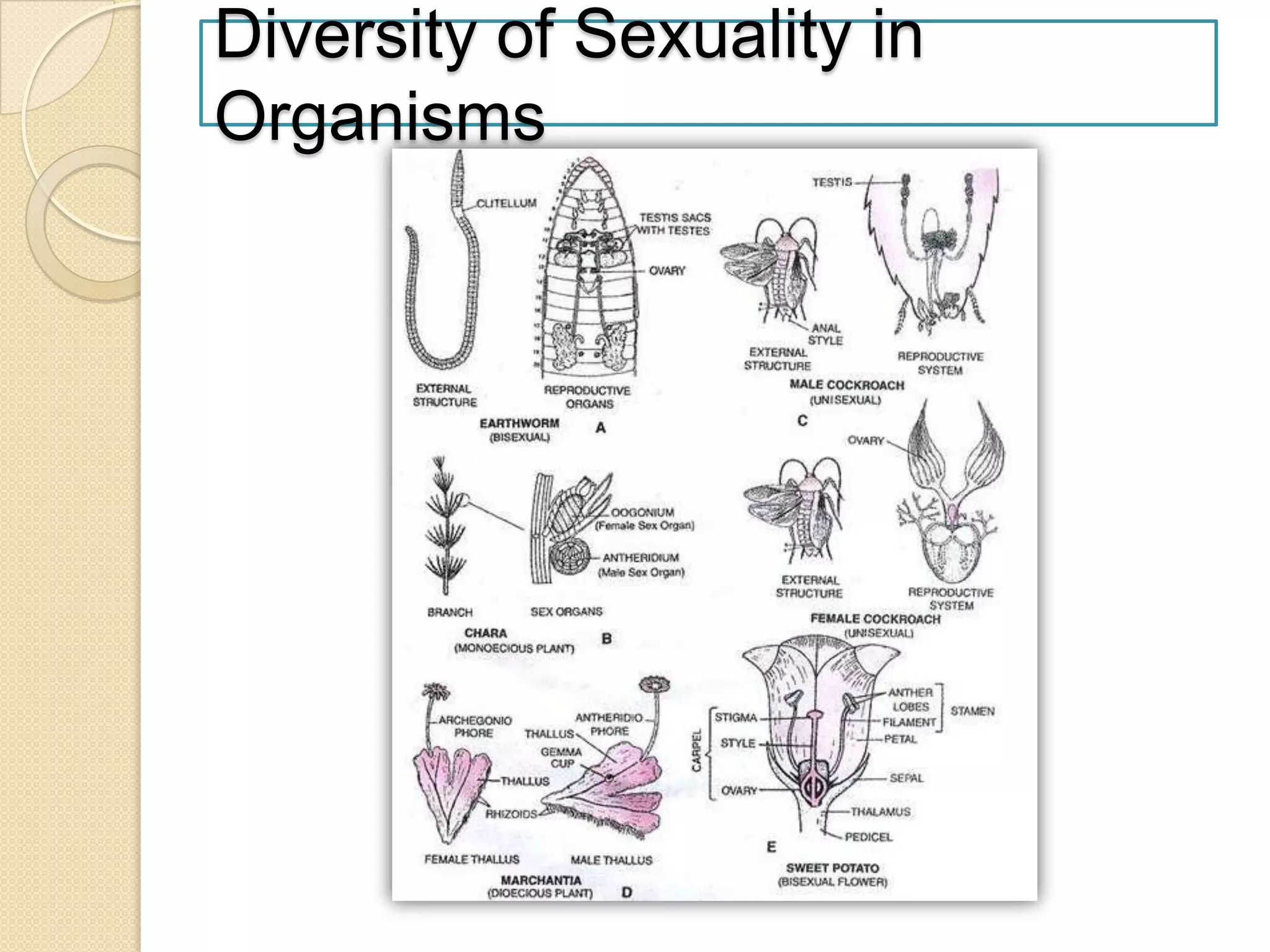
Diversity of Sexuality in
Organisms
Cell division during Gamete
Formation
Parental body of organisms like monera,
fungi, algae and bryophytes is haploid.
They produce gametes by mitotic
division.
 Parental body of organisms like
pteridophytes, gymnosperms,
angiosperms and most of the animals
including human beings is diploid. They
produce gametes by meiotic cell division.
 In diploid organisms, specialised cells
called meiocytes (gamete mother cell)
undergo meiosis.

Gamete Transfer
In majority organisms male gamete is
motile where as female is stationary.
 Exceptions , a few fungi and algae both
types of gametes are motile.
 A medium is required through which the
male gametes move.
 In algae, bryophytes and pteridophytes,
water is the medium for gamete transfer.
 To compensate loss of male gametes
during transport, the number of male
gametes produced is several thousand
times the number of female gametes
produced.

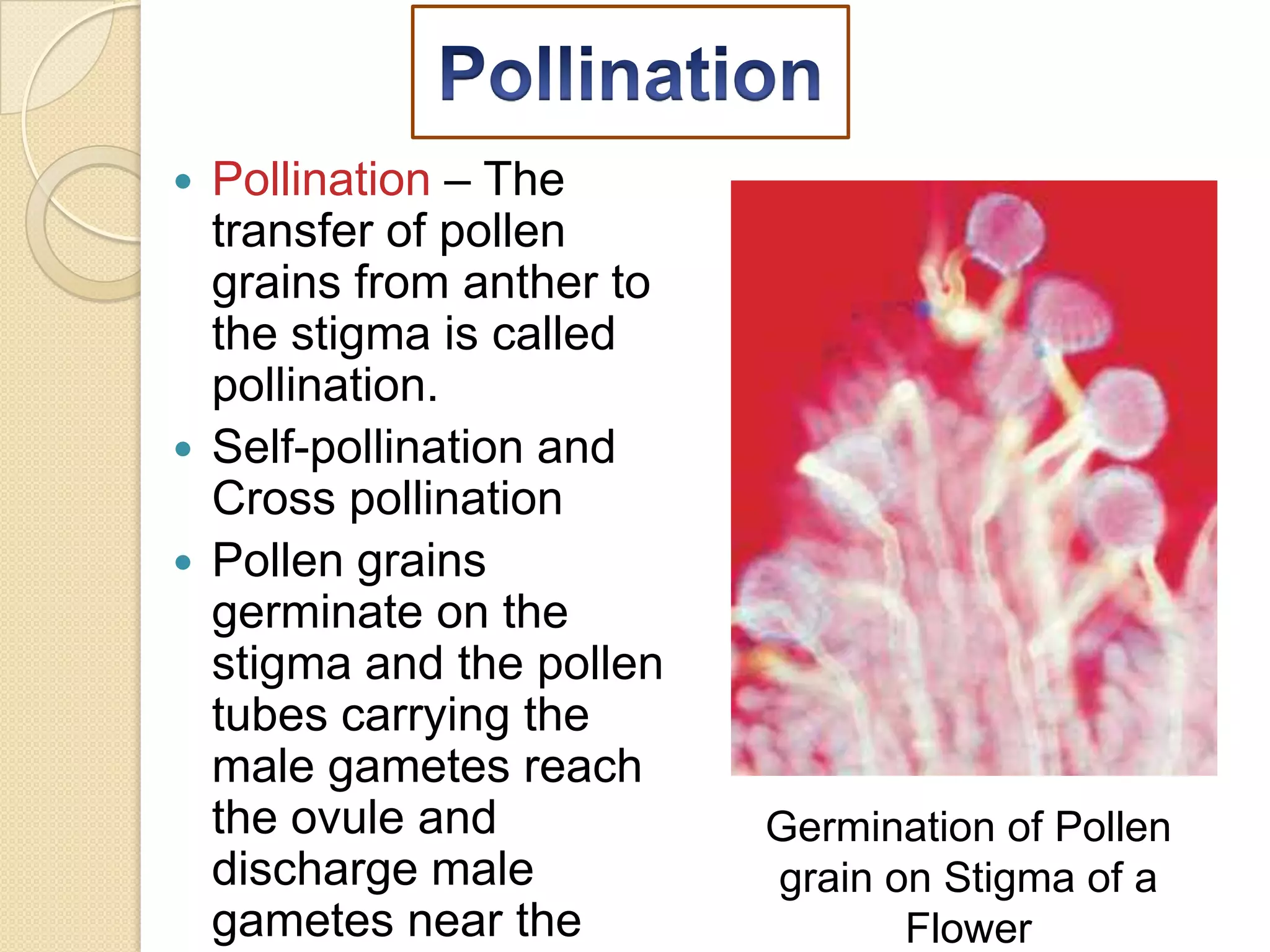
Pollination – The
transfer of pollen
grains from anther to
the stigma is called
pollination.
 Self-pollination and
Cross pollination
 Pollen grains
germinate on the
stigma and the pollen
tubes carrying the
male gametes reach
the ovule and
discharge male
gametes near the


Germination of Pollen
grain on Stigma of a
Flower
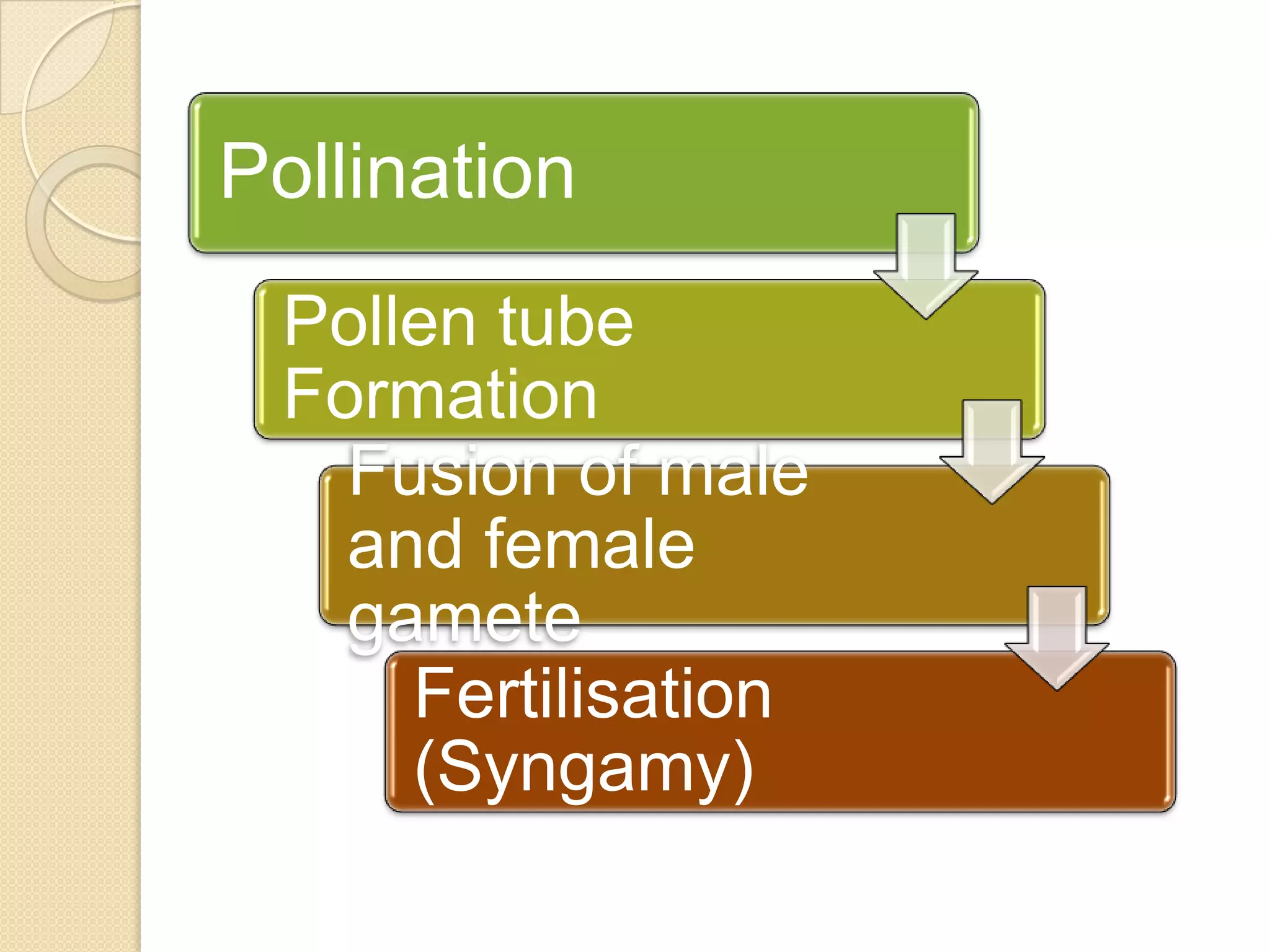
Pollination
Pollen tube
Formation
Fusion of male
and female
gamete
Fertilisation
(Syngamy)
FERTILISATION
Fertilisation results the formation of
diploid zygote.
 Parthenogenesis - Some female
gametes undergo the development of
new organisms without fertilisation.
This phenomenon is called
parthenogenesis.
 Eg. Rotifers, Honey bees, and Turkey
birds

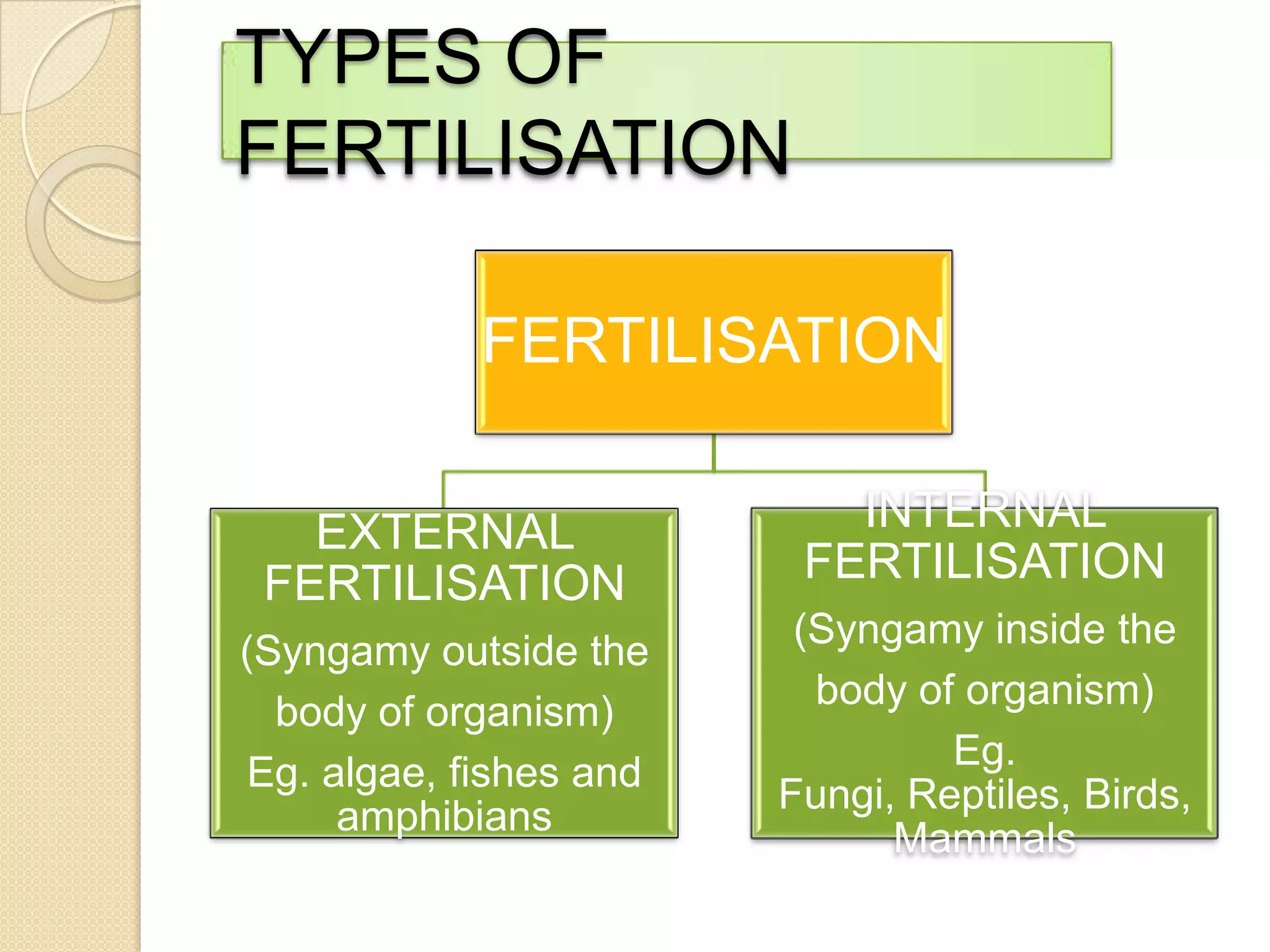
TYPES OF
FERTILISATION
FERTILISATION
EXTERNAL
FERTILISATION

INTERNAL
FERTILISATION

(Syngamy outside the
body of organism)
Eg. algae, fishes and
amphibians

(Syngamy inside the
body of organism)
Eg. Fungi, Reptiles,
Birds, Mammals
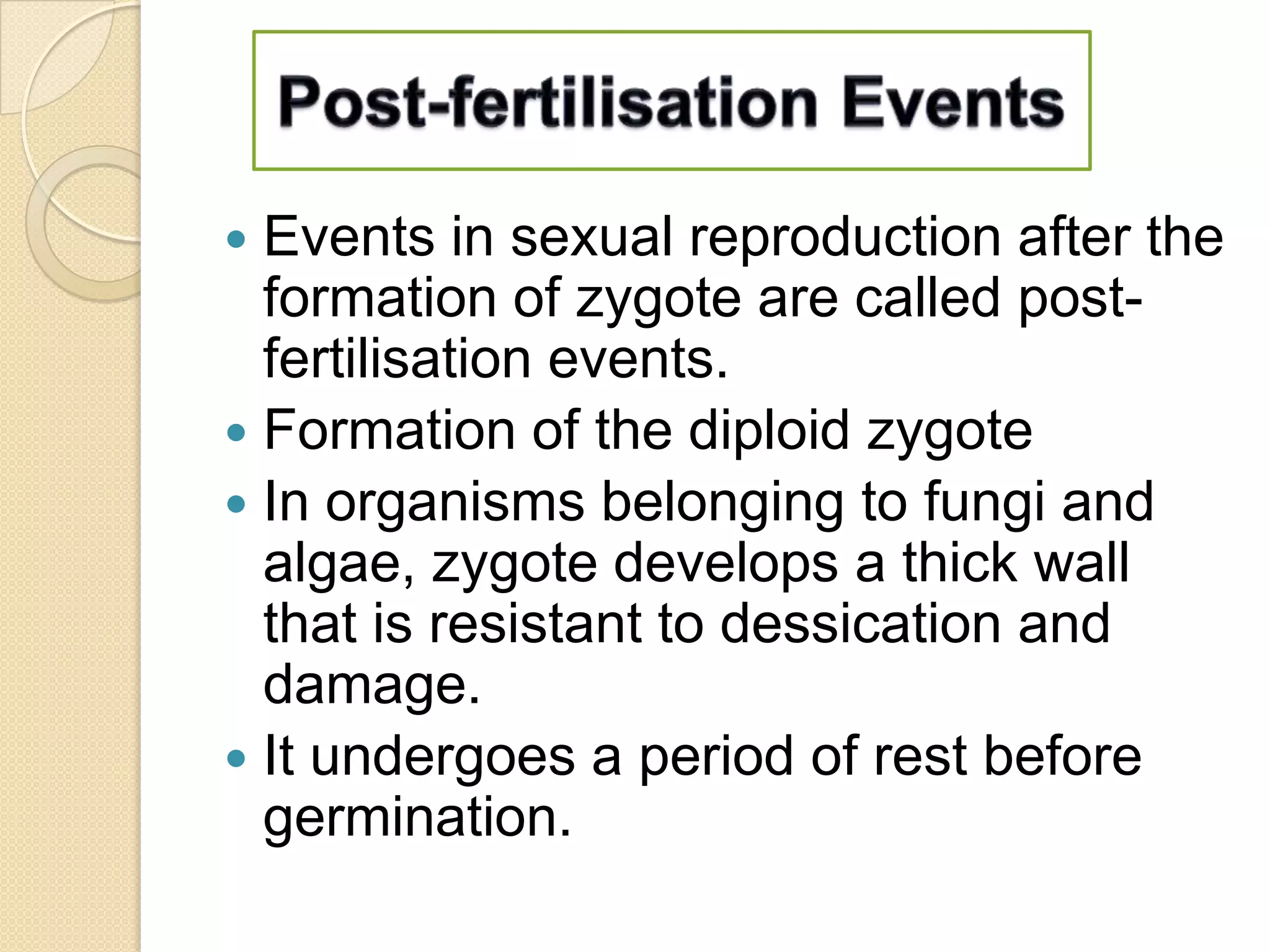
Events in sexual reproduction after the
formation of zygote are called postfertilisation events.
 Formation of the diploid zygote
 In organisms belonging to fungi and
algae, zygote develops a thick wall
that is resistant to dessication and
damage.
 It undergoes a period of rest before
germination.

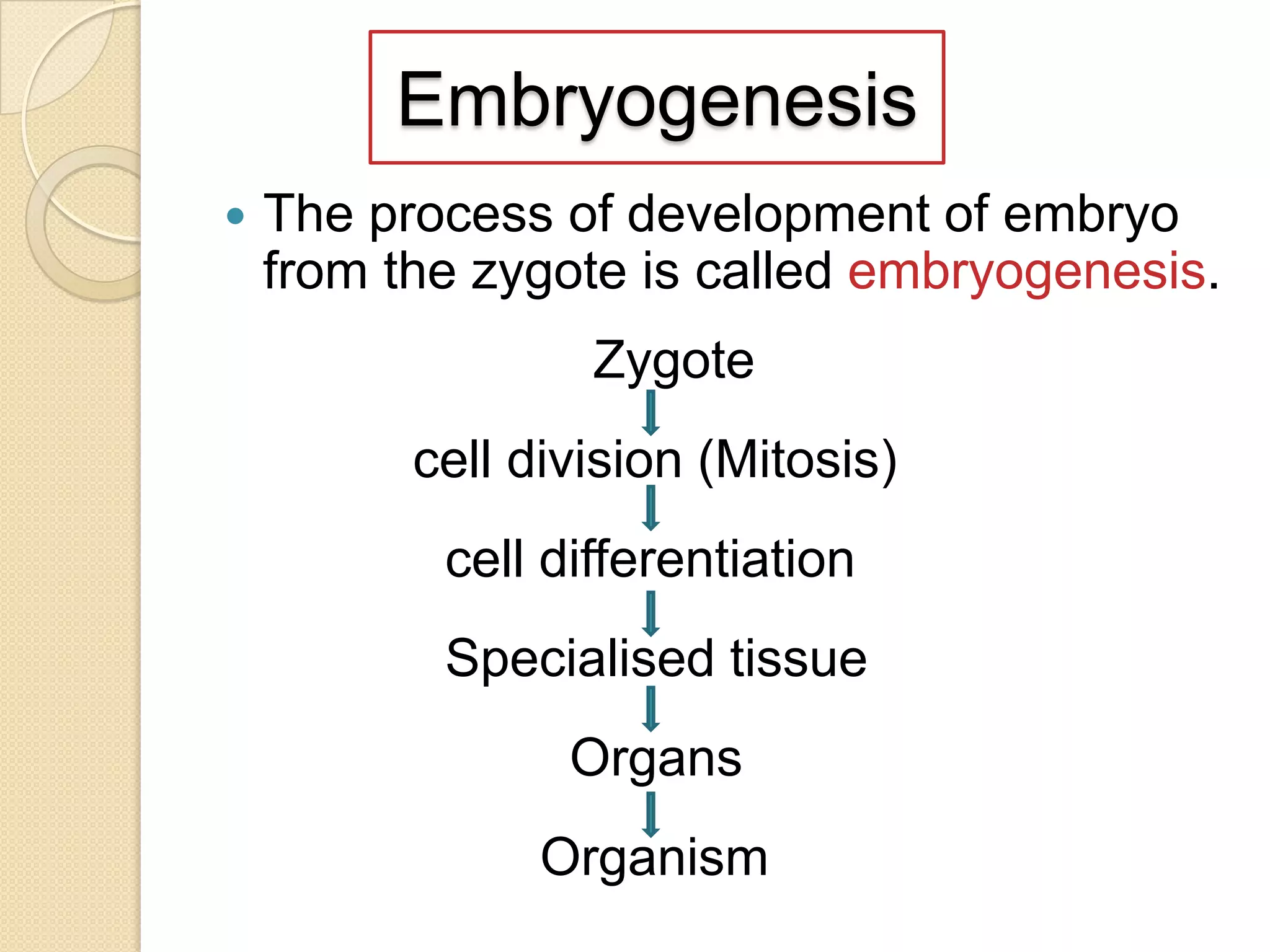
Embryogenesis


The process of development of embryo
from the zygote is called embryogenesis.

Zygote
cell division (Mitosis)

cell differentiation
Specialised tissue
Organs
Organism
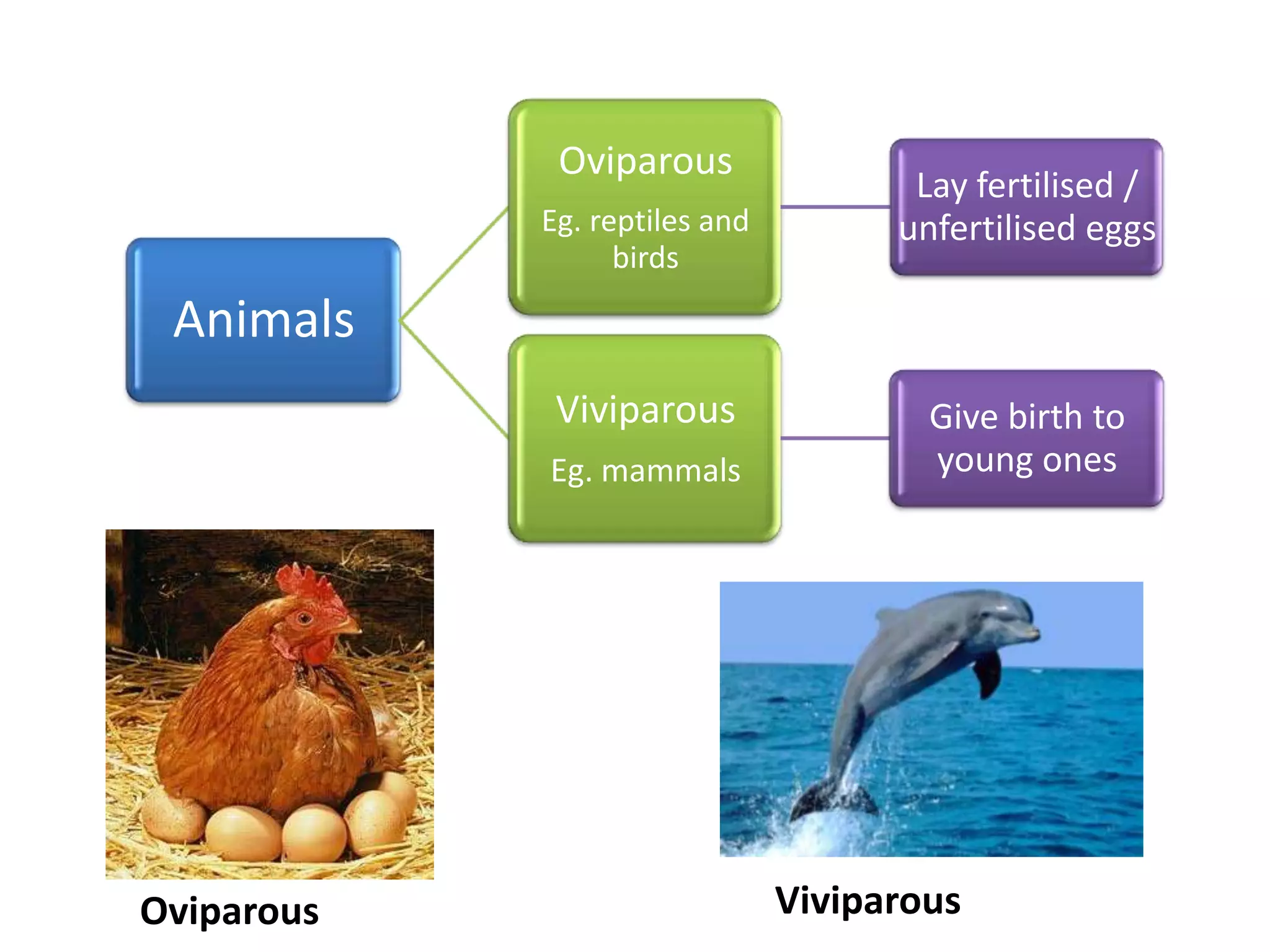
Oviparous
Eg. reptiles and
birds

Lay fertilised /
unfertilised eggs

Animals
Viviparous
Eg. mammals

Oviparous

Give birth to
young ones

Viviparous
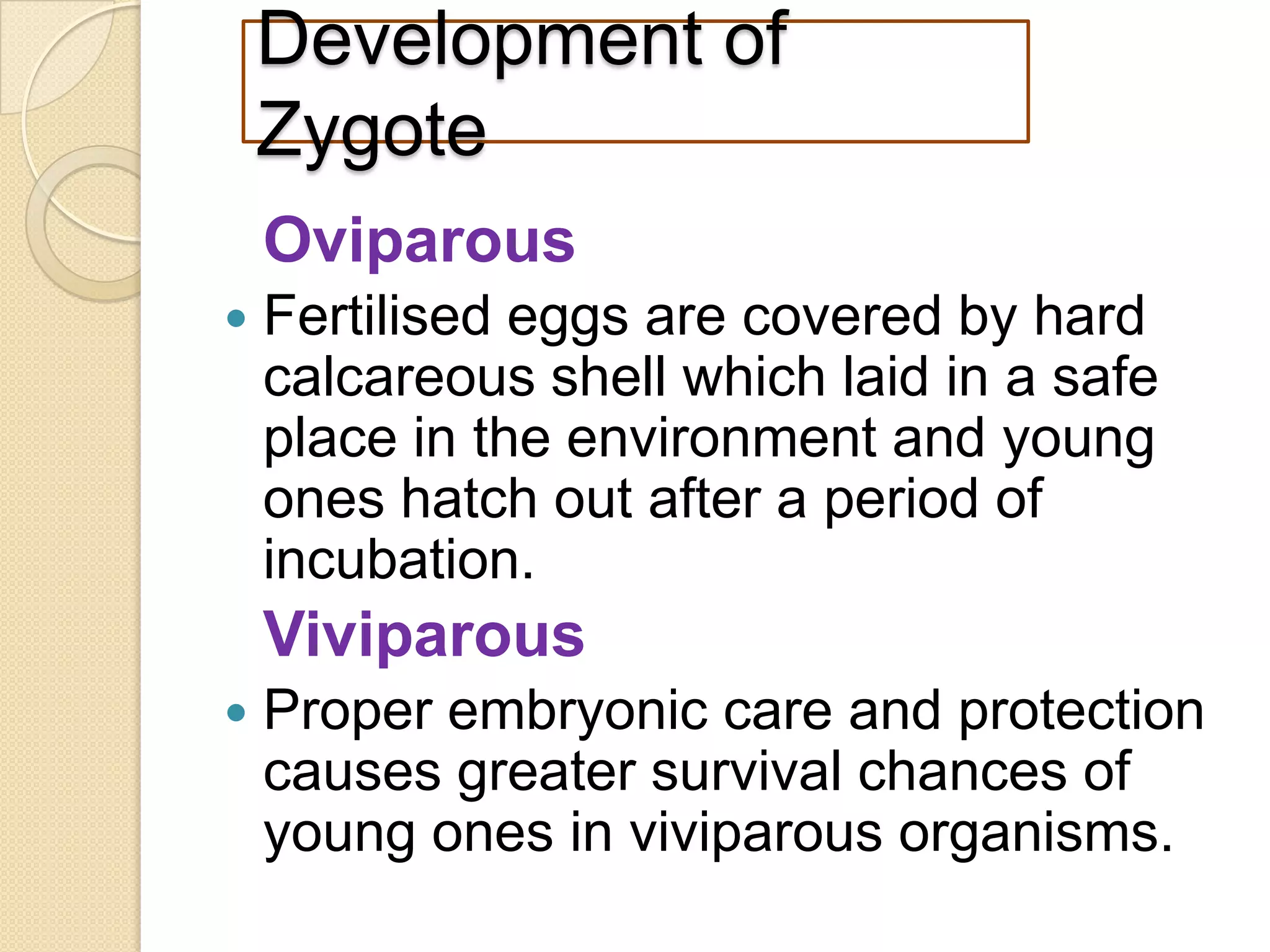
Development of
Zygote
Oviparous


Fertilised eggs are covered by hard
calcareous shell which laid in a safe
place in the environment and young
ones hatch out after a period of
incubation.

Viviparous


Proper embryonic care and protection
causes greater survival chances of
young ones in viviparous organisms.
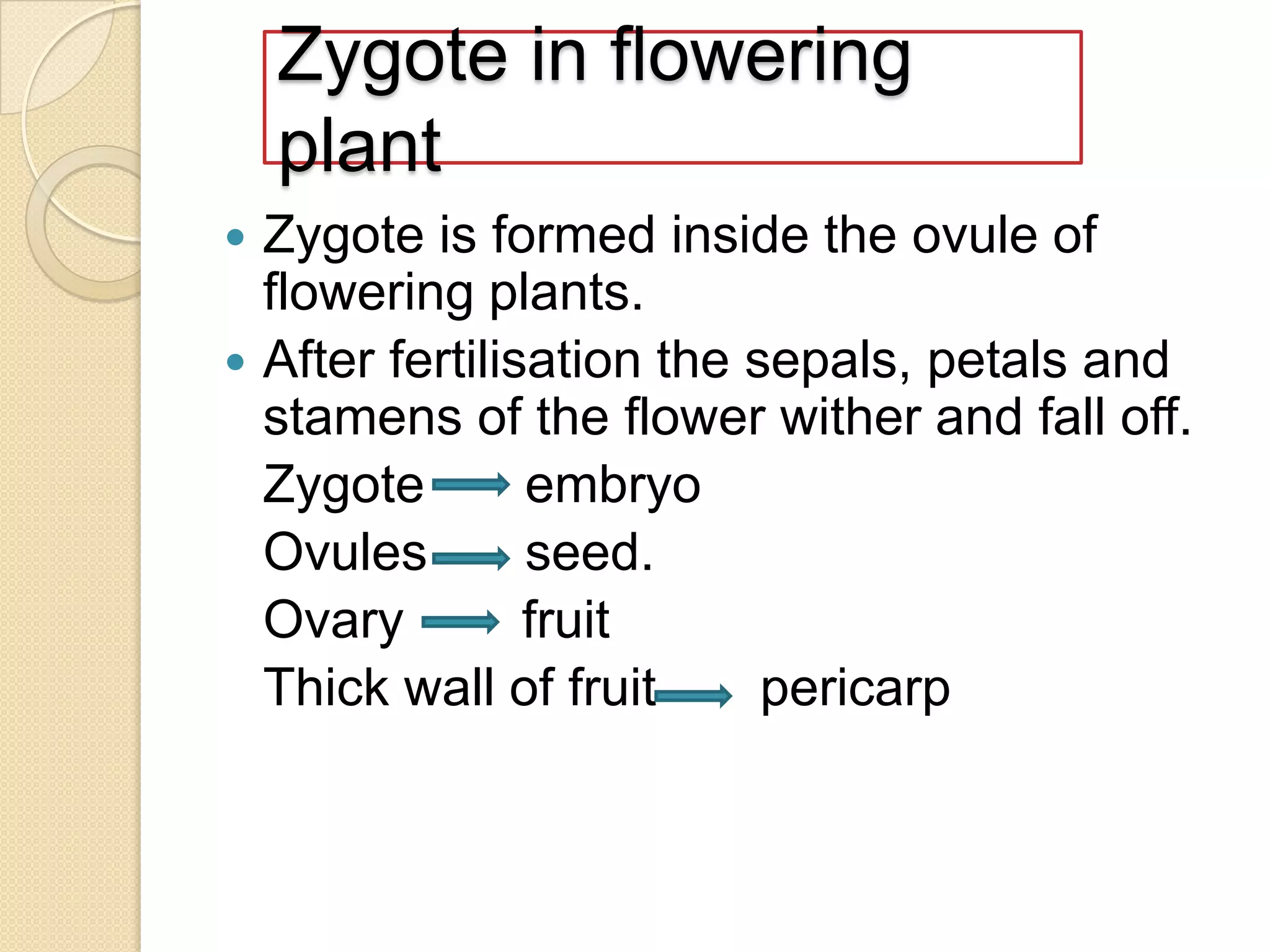
Zygote in flowering
plant



Zygote is formed inside the ovule of
flowering plants.
After fertilisation the sepals, petals and
stamens of the flower wither and fall off.
Zygote
embryo
Ovules
seed.
Ovary
fruit
Thick wall of fruit
pericarp

Reproduction in organisms

  • 2.
     Reproduction is afundamental feature of living organisms which involves the transmission of genetic material from one generation to the next ensuring the survival of species over long periods of time.
  • 3.
    LIFE SPAN • Theperiod from birth to the natural death of an organism is called its life span. • Life span of an organism may be few minutes to several thousand years.
  • 4.
    Life span ofsome organisms Organism Fruit fly Butterfly Wheat plant Crow Dog Banana tree Crocodile Human Parrot Tortoise Banyan tree Life span 1 day 1-2 weeks 6 months 15 years 25 years 25 years 60 years 100 years 140 years 100- 150 years 200 years
  • 5.
    Life span ofan organism usually includes four phases: Juvenile phase Reproductive phase OR Maturity phase Ageing and Senescence Death
  • 6.
  • 7.
    Asexual Reproduction Fission Fragmentation Regeneration Eg. Spirogyra Eg.Planaria Budding Vegetative Propagation Binary Multiple External Internal Eg. Amoeba Eg. Plasmodium Eg. Hydra Eg. Spongilla
  • 8.
    Vegetative Propagation Runner eg. Mint Rhizome eg.Ginger Leaf buds eg. Bryophyllum Tuber eg. Potato Offset eg. Eichhornia Bulbil eg. Agava
  • 9.
    zoospores • eg. Chlamydomonas Conidia •eg. Penicillium Buds • eg. Hydra Gemmules eg. Sponges
  • 10.
    SEXUAL REPRODUCTION Sexual reproduction involves formationof the male and female gametes, either by the same individual or by different individuals of the opposite sex.  These gametes fuse to form the zygote which develops to form the new organism. 
  • 11.
    Reproduction in Flowering Plants Annual– The plant which completes its life cycle within one year and then dies. Eg. Peas  Biennial - The plant which completes its biological life cycle in two years. Eg. Onion  Perennial - The plant that lives for more than two years. Eg. Banana, Mango 
  • 12.
    Unusual phenomenon ofsome flowering Plants • Bamboo species flower only once in their life time, generally after 50100 years, produce large number of fruits and die. • Strobilanthus kunthiana (neelakuranji) flowers once in 12 years. The plant flowered during September-October 2006. Bamboo Flower Neelakuranji Flower
  • 13.
    Breeding of Animals On thebasis of time of breeding, animals are of two types:Seasonal Breeders: They reproduce at particular period of the year such as frog, lizards, most birds, deer, etc. Continuous Breeders: These animals continue to breed throughout their sexual maturity. Examples are honey bee, queen, poultry, rabbit, mice, cattle, etc.
  • 14.
    Cyclical changes during Reproduction Oestruscycle Menstrual cycle Non-primate Mammals Primate Mammals Eg. Cow, Sheep,Dog, Tiger Eg. Monkey, Apes, and Humans
  • 15.
  • 16.
  • 17.
    Gametogenesis Gametogenesis - Theprocess of formation of male and female gametes. Gametes may be : i) Homogametes or isogametes- the two gametes similar in appearance ,can not categorise into male and female gametes. eg. Cladophora ii) Heterogametes - two morphologically distinct gametes .  Male gamete is called antherozoid or sperm.  Female gamete is called the egg or ovum. eg. Fucus, Human being
  • 18.
    Sexuality in Organisms       Homothallicand monoecious - terms used to describe bisexual condition of plant. Heterothallic and dioecious - terms used to describe unisexual condition of plant. Staminate - unisexual male flower bearing stamens Pistillate - unisexual female flower bearing stamens. Monoecious - both male and female flowers may be present on the same individual. Eg. cucurbits and coconuts Dioecious - both male and female flowers may be present on separate individuals. Eg. papaya and date palm
  • 19.
  • 20.
    Cell division duringGamete Formation Parental body of organisms like monera, fungi, algae and bryophytes is haploid. They produce gametes by mitotic division.  Parental body of organisms like pteridophytes, gymnosperms, angiosperms and most of the animals including human beings is diploid. They produce gametes by meiotic cell division.  In diploid organisms, specialised cells called meiocytes (gamete mother cell) undergo meiosis. 
  • 21.
    Gamete Transfer In majorityorganisms male gamete is motile where as female is stationary.  Exceptions , a few fungi and algae both types of gametes are motile.  A medium is required through which the male gametes move.  In algae, bryophytes and pteridophytes, water is the medium for gamete transfer.  To compensate loss of male gametes during transport, the number of male gametes produced is several thousand times the number of female gametes produced. 
  • 22.
    Pollination – The transferof pollen grains from anther to the stigma is called pollination.  Self-pollination and Cross pollination  Pollen grains germinate on the stigma and the pollen tubes carrying the male gametes reach the ovule and discharge male gametes near the  Germination of Pollen grain on Stigma of a Flower
  • 23.
    Pollination Pollen tube Formation Fusion ofmale and female gamete Fertilisation (Syngamy)
  • 24.
    FERTILISATION Fertilisation results theformation of diploid zygote.  Parthenogenesis - Some female gametes undergo the development of new organisms without fertilisation. This phenomenon is called parthenogenesis.  Eg. Rotifers, Honey bees, and Turkey birds 
  • 25.
    TYPES OF FERTILISATION FERTILISATION EXTERNAL FERTILISATION INTERNAL FERTILISATION (Syngamy outsidethe body of organism) Eg. algae, fishes and amphibians (Syngamy inside the body of organism) Eg. Fungi, Reptiles, Birds, Mammals
  • 26.
    Events in sexualreproduction after the formation of zygote are called postfertilisation events.  Formation of the diploid zygote  In organisms belonging to fungi and algae, zygote develops a thick wall that is resistant to dessication and damage.  It undergoes a period of rest before germination. 
  • 27.
    Embryogenesis  The process ofdevelopment of embryo from the zygote is called embryogenesis. Zygote cell division (Mitosis) cell differentiation Specialised tissue Organs Organism
  • 28.
    Oviparous Eg. reptiles and birds Layfertilised / unfertilised eggs Animals Viviparous Eg. mammals Oviparous Give birth to young ones Viviparous
  • 29.
    Development of Zygote Oviparous  Fertilised eggsare covered by hard calcareous shell which laid in a safe place in the environment and young ones hatch out after a period of incubation. Viviparous  Proper embryonic care and protection causes greater survival chances of young ones in viviparous organisms.
  • 30.
    Zygote in flowering plant   Zygoteis formed inside the ovule of flowering plants. After fertilisation the sepals, petals and stamens of the flower wither and fall off. Zygote embryo Ovules seed. Ovary fruit Thick wall of fruit pericarp