Topic- Cell wall Composition and
Nutrition of fungi
Msc I Sem .(Botany)
 Introduction
 Character of Fungi
 Cell wall composition
 Nutrition
 Economic importance of fungi
 The word ‘fungus’ has been taken from Latin,which
means mushroom.
 The study of fungi is called Mycology.
 Their plant body consists mostly of a thallus, made of
Hyphae, Which together constitute Mycelium.
 The Scientist who is concerned with fungi is called
Mycologist.
 At present, about 5,100 genera and more than
50,000 species of fungi are known.
 They grow in a variety of habitiats and show much
diversity in their form, structure , physiological
processes and methods of Reprodction.
 There are cosmopolitan in distribution and can occur in any habitat
where life is possible.
 Some fungi occur in fresh or marine water other are terrestrial and still
others are air borne.
 Many species are parasitic, infecting plants, animals and human beings.
 The plant body of fungi typically consists of branch and filamentous
Hyphae, which form are net-like structure, known as Mycelium.
 The hyphae are asepotate and coenocytic or septate and uninucleate and
multinucleate.
 Fungi are entirely devoid of chlorophyll but carotenoids are Normally
present.
 The hyphae are homo or heterokaryotic haploid ,dikaryotic or diploid.
 It is heterotrophic organism .
 It is unicellular .
 Lack of chlorophyll hense it can not photosynthesize.
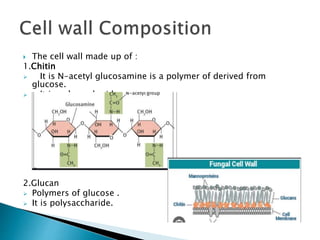
 The cell wall made up of :
1.Chitin
 It is N-acetyl glucosamine is a polymer of derived from
glucose.
 It is polysaccharide .
2.Glucan
 Polymers of glucose .
 It is polysaccharide.
 Saprophytes
these fungi are grow on rotten organic –rotten fruits,vegetables ,pickles
jams etc.
Ex.- Mucor, Rhizopus, penicillium and Aspergillus.
 Parasite
 These fungi are found on living hosts from which they obtain their
Nutrition.
 These types of fungi are very harmful and cause various types of
diseases in plants.
 These fungi can be divided into the following types-
a. Obligate parasite -
 These fungi spend there lives on living Nutrient only and attack only
living host .
Ex.-cytopus,puccinia etc.
b. Facultative parasite
 Some parasitic fungi usually spend there lives on living hosts, but when
necessary, they spend their lives as saprophytes for some time.
Ex :- Taphrina, deformans, etc.
c. Facultative Saprophytes –
 Some parasitic fungi spend there lives as saprophytes but due to
circumstances, these fungi starts living like parasites on a suitable
host.
Ex :- Pythium, Fusarium, etc.
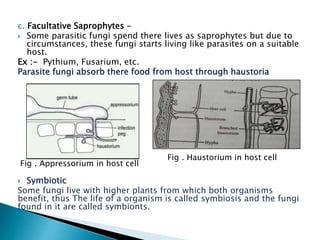
Parasite fungi absorb there food from host through haustoria
 Symbiotic
Some fungi live with higher plants from which both organisms
benefit, thus The life of a organism is called symbiosis and the fungi
found in it are called symbionts.
Fig . Appressorium in host cell
Fig . Haustorium in host cell
 food-
 About 2000 species of fungi are directly or indirectly used as food in different
countries of the World
 Ex : - agaricus silvicola, Morchella concina.
 As medicinal – Important medicine producing fungi are as follows
a. Vitamin producing fungi :- many fungi are rich in Vitamin it contain vitamin B-
complex
b. Production of antibiotic :- fungi produce different kinds of antibiotics which are
used in the treatment of different diseases
 Ex :- Penicillin-pencillium notatwm
 Nitrogen fixation – Many fungus like Rhodotorula increase the soil fertility by
nitrogen fixation
 In industry –
a. In bakery industry : yeast are use in bakery to produce spongy breads
wine-yeast
Chemicals-Aspergillus Niger
Cheese -Penicillium Roqueforti
THANK YOU

Fungi cell wall composition and nutrition

  • 1.
    Topic- Cell wallComposition and Nutrition of fungi Msc I Sem .(Botany)
  • 2.
     Introduction  Characterof Fungi  Cell wall composition  Nutrition  Economic importance of fungi
  • 3.
     The word‘fungus’ has been taken from Latin,which means mushroom.  The study of fungi is called Mycology.  Their plant body consists mostly of a thallus, made of Hyphae, Which together constitute Mycelium.  The Scientist who is concerned with fungi is called Mycologist.  At present, about 5,100 genera and more than 50,000 species of fungi are known.  They grow in a variety of habitiats and show much diversity in their form, structure , physiological processes and methods of Reprodction.
  • 4.
     There arecosmopolitan in distribution and can occur in any habitat where life is possible.  Some fungi occur in fresh or marine water other are terrestrial and still others are air borne.  Many species are parasitic, infecting plants, animals and human beings.  The plant body of fungi typically consists of branch and filamentous Hyphae, which form are net-like structure, known as Mycelium.  The hyphae are asepotate and coenocytic or septate and uninucleate and multinucleate.  Fungi are entirely devoid of chlorophyll but carotenoids are Normally present.  The hyphae are homo or heterokaryotic haploid ,dikaryotic or diploid.  It is heterotrophic organism .  It is unicellular .  Lack of chlorophyll hense it can not photosynthesize.
  • 5.
     The cellwall made up of : 1.Chitin  It is N-acetyl glucosamine is a polymer of derived from glucose.  It is polysaccharide . 2.Glucan  Polymers of glucose .  It is polysaccharide.
  • 6.
     Saprophytes these fungiare grow on rotten organic –rotten fruits,vegetables ,pickles jams etc. Ex.- Mucor, Rhizopus, penicillium and Aspergillus.  Parasite  These fungi are found on living hosts from which they obtain their Nutrition.  These types of fungi are very harmful and cause various types of diseases in plants.  These fungi can be divided into the following types- a. Obligate parasite -  These fungi spend there lives on living Nutrient only and attack only living host . Ex.-cytopus,puccinia etc. b. Facultative parasite  Some parasitic fungi usually spend there lives on living hosts, but when necessary, they spend their lives as saprophytes for some time. Ex :- Taphrina, deformans, etc.
  • 7.
    c. Facultative Saprophytes–  Some parasitic fungi spend there lives as saprophytes but due to circumstances, these fungi starts living like parasites on a suitable host. Ex :- Pythium, Fusarium, etc. Parasite fungi absorb there food from host through haustoria  Symbiotic Some fungi live with higher plants from which both organisms benefit, thus The life of a organism is called symbiosis and the fungi found in it are called symbionts. Fig . Appressorium in host cell Fig . Haustorium in host cell
  • 8.
     food-  About2000 species of fungi are directly or indirectly used as food in different countries of the World  Ex : - agaricus silvicola, Morchella concina.  As medicinal – Important medicine producing fungi are as follows a. Vitamin producing fungi :- many fungi are rich in Vitamin it contain vitamin B- complex b. Production of antibiotic :- fungi produce different kinds of antibiotics which are used in the treatment of different diseases  Ex :- Penicillin-pencillium notatwm  Nitrogen fixation – Many fungus like Rhodotorula increase the soil fertility by nitrogen fixation  In industry – a. In bakery industry : yeast are use in bakery to produce spongy breads wine-yeast Chemicals-Aspergillus Niger Cheese -Penicillium Roqueforti
  • 9.