SIEMENS
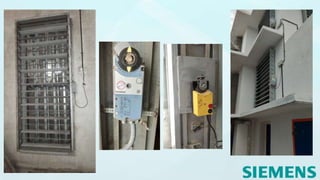
Air damper actuators
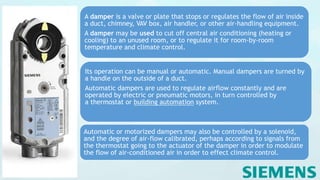
A damper is a valve or plate that stops or regulates the flow of air inside
a duct, chimney, VAV box, air handler, or other air-handling equipment.
A damper may be used to cut off central air conditioning (heating or
cooling) to an unused room, or to regulate it for room-by-room
temperature and climate control.
Its operation can be manual or automatic. Manual dampers are turned by
a handle on the outside of a duct.
Automatic dampers are used to regulate airflow constantly and are
operated by electric or pneumatic motors, in turn controlled by
a thermostat or building automation system.
Automatic or motorized dampers may also be controlled by a solenoid,
and the degree of air-flow calibrated, perhaps according to signals from
the thermostat going to the actuator of the damper in order to modulate
the flow of air-conditioned air in order to effect climate control.
An actuator requires a control signal and a
source of energy. The control signal is
relatively low energy and may be electric
voltage or current, pneumatic or hydraulic
pressure, or even human power. When it
receives a control signal, an actuator
responds by converting the signal's energy
into mechanical motion.
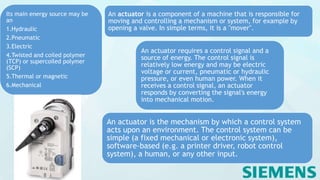
An actuator is a component of a machine that is responsible for
moving and controlling a mechanism or system, for example by
opening a valve. In simple terms, it is a "mover".
Its main energy source may be
an
1.Hydraulic
2.Pneumatic
3.Electric
4.Twisted and coiled polymer
(TCP) or supercoiled polymer
(SCP)
5.Thermal or magnetic
6.Mechanical
An actuator is the mechanism by which a control system
acts upon an environment. The control system can be
simple (a fixed mechanical or electronic system),
software-based (e.g. a printer driver, robot control
system), a human, or any other input.
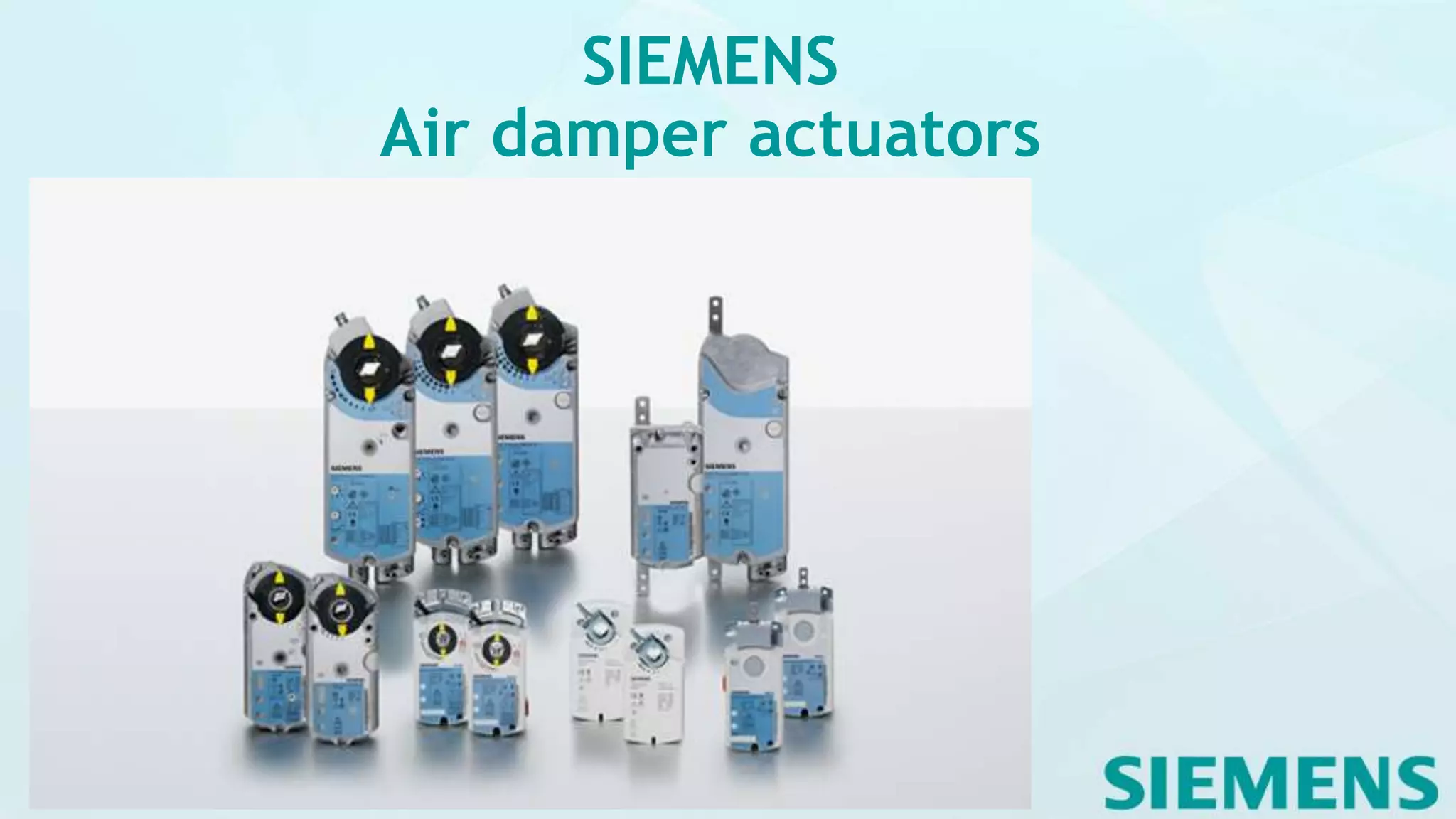
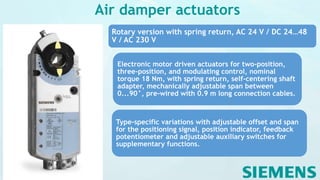
Air damper actuators
Electronic motor driven actuators for two-position,
three-position, and modulating control, nominal
torque 18 Nm, with spring return, self-centering shaft
adapter, mechanically adjustable span between
0...90°, pre-wired with 0.9 m long connection cables.
Type-specific variations with adjustable offset and span
for the positioning signal, position indicator, feedback
potentiometer and adjustable auxiliary switches for
supplementary functions.
Rotary version with spring return, AC 24 V / DC 24…48
V / AC 230 V
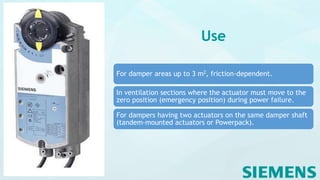
Use
For damper areas up to 3 m2, friction-dependent.
In ventilation sections where the actuator must move to the
zero position (emergency position) during power failure.
For dampers having two actuators on the same damper shaft
(tandem-mounted actuators or Powerpack).
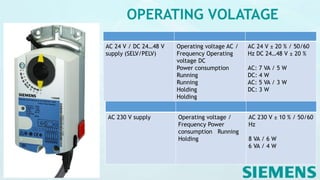
OPERATING VOLATAGE
AC 24 V / DC 24…48 V
supply (SELV/PELV)
Operating voltage AC /
Frequency Operating
voltage DC
Power consumption
Running
Running
Holding
Holding
AC 24 V ± 20 % / 50/60
Hz DC 24…48 V ± 20 %
AC: 7 VA / 5 W
DC: 4 W
AC: 5 VA / 3 W
DC: 3 W
AC 230 V supply Operating voltage /
Frequency Power
consumption Running
Holding
AC 230 V ± 10 % / 50/60
Hz
8 VA / 6 W
6 VA / 4 W
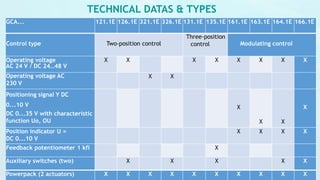
GCA... 121.1E 126.1E 321.1E 326.1E 131.1E 135.1E 161.1E 163.1E 164.1E 166.1E
Control type Two-position control
Three-position
control Modulating control
Operating voltage
AC 24 V / DC 24…48 V
X X X X X X X X
Operating voltage AC
230 V
X X
Positioning signal Y DC
0...10 V
DC 0...35 V with characteristic
function Uo, OU
X
X X
X
Position indicator U =
DC 0...10 V
X X X X
Feedback potentiometer 1 kfi X
Auxiliary switches (two) X X X X X
Powerpack (2 actuators) X X X X X X X X X X
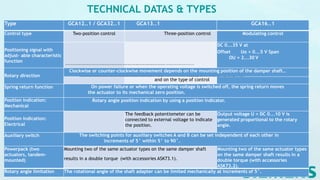
TECHNICAL DATAS & TYPES
Type GCA12..1 / GCA32..1 GCA13..1 GCA16..1
Control type Two-position control Three-position control Modulating control
Positioning signal with
adjust- able characteristic
function
DC 0...35 V at
Offset Uo = 0...5 V Span
OU = 2...30 V
Rotary direction
Clockwise or counter-clockwise movement depends on the mounting position of the damper shaft…
and on the type of control
Spring return function On power failure or when the operating voltage is switched off, the spring return moves
the actuator to its mechanical zero position.
Position indication:
Mechanical
Rotary angle position indication by using a position indicator.
Position indication:
Electrical
The feedback potentiometer can be
connected to external voltage to indicate
the position.
Output voltage U = DC 0...10 V is
generated proportional to the rotary
angle.
Auxiliary switch The switching points for auxiliary switches A and B can be set independent of each other in
increments of 5° within 5° to 90°.
Powerpack (two
actuators, tandem-
mounted)
Mounting two of the same actuator types on the same damper shaft
results in a double torque (with accessories ASK73.1).
Mounting two of the same actuator types
on the same damper shaft results in a
double torque (with accessories
ASK73.2).
Rotary angle limitation The rotational angle of the shaft adapter can be limited mechanically at increments of 5°.
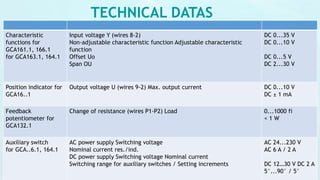
TECHNICAL DATAS
Characteristic
functions for
GCA161.1, 166.1
for GCA163.1, 164.1
Input voltage Y (wires 8-2)
Non-adjustable characteristic function Adjustable characteristic
function
Offset Uo
Span OU
DC 0...35 V
DC 0...10 V
DC 0...5 V
DC 2...30 V
Position indicator for
GCA16..1
Output voltage U (wires 9-2) Max. output current DC 0...10 V
DC ± 1 mA
Feedback
potentiometer for
GCA132.1
Change of resistance (wires P1-P2) Load 0...1000 fi
< 1 W
Auxiliary switch
for GCA..6.1, 164.1
AC power supply Switching voltage
Nominal current res./ind.
DC power supply Switching voltage Nominal current
Switching range for auxiliary switches / Setting increments
AC 24...230 V
AC 6 A / 2 A
DC 12…30 V DC 2 A
5°...90° / 5°
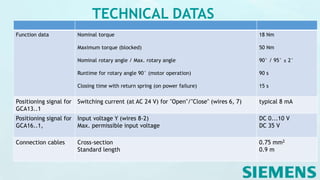
TECHNICAL DATAS
Function data Nominal torque
Maximum torque (blocked)
Nominal rotary angle / Max. rotary angle
Runtime for rotary angle 90° (motor operation)
Closing time with return spring (on power failure)
18 Nm
50 Nm
90° / 95° ± 2°
90 s
15 s
Positioning signal for
GCA13..1
Switching current (at AC 24 V) for "Open"/"Close" (wires 6, 7) typical 8 mA
Positioning signal for
GCA16..1,
Input voltage Y (wires 8-2)
Max. permissible input voltage
DC 0...10 V
DC 35 V
Connection cables Cross-section
Standard length
0.75 mm2
0.9 m
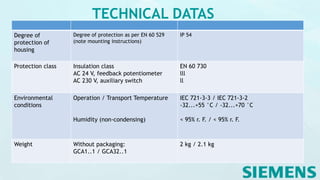
TECHNICAL DATAS
Degree of
protection of
housing
Degree of protection as per EN 60 529
(note mounting instructions)
IP 54
Protection class Insulation class
AC 24 V, feedback potentiometer
AC 230 V, auxiliary switch
EN 60 730
lll
ll
Environmental
conditions
Operation / Transport Temperature
Humidity (non-condensing)
IEC 721-3-3 / IEC 721-3-2
-32...+55 °C / -32...+70 °C
< 95% r. F. / < 95% r. F.
Weight Without packaging:
GCA1..1 / GCA32..1
2 kg / 2.1 kg
TECHNICAL DATAS
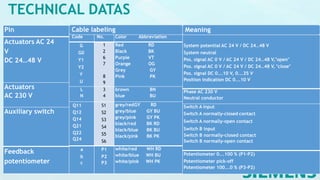
Pin
Actuators AC 24
V
DC 24…48 V
Actuators
AC 230 V
Auxiliary switch
Feedback
potentiometer
Code No. Color Abbreviation
G
G0
Y1
Y2
Y
U
1
2
6
7
8
9
Red RD
Black BK
Purple VT
Orange OG
Grey GY
Pink PK
L
N
3
4
brown BN
blue BU
Q11
Q12
Q14
Q21
Q22
Q24
S1
S2
S3
S4
S5
S6
grey/redGY RD
grey/blue GY BU
grey/pink GY PK
black/red BK RD
black/blue BK BU
black/pink BK PK
a
b
c
P1
P2
P3
white/red WH RD
white/blue WH BU
white/pink WH PK
Cable labeling
System potential AC 24 V / DC 24…48 V
System neutral
Pos. signal AC 0 V / AC 24 V / DC 24…48 V,"open"
Pos. signal AC 0 V / AC 24 V / DC 24…48 V, "close"
Pos. signal DC 0...10 V, 0...35 V
Position indication DC 0...10 V
Phase AC 230 V
Neutral conductor
Switch A input
Switch A normally-closed contact
Switch A normally-open contact
Switch B input
Switch B normally-closed contact
Switch B normally-open contact
Potentiometer 0...100 % (P1-P2)
Potentiometer pick-off
Potentiometer 100...0 % (P3-P2)
Meaning
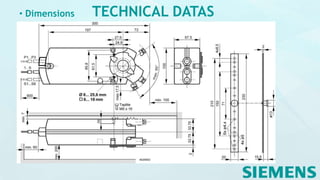
TECHNICAL DATAS• Dimensions
Air Damper Actuators siemens

Air Damper Actuators siemens

  • 1.
  • 2.
    A damper isa valve or plate that stops or regulates the flow of air inside a duct, chimney, VAV box, air handler, or other air-handling equipment. A damper may be used to cut off central air conditioning (heating or cooling) to an unused room, or to regulate it for room-by-room temperature and climate control. Its operation can be manual or automatic. Manual dampers are turned by a handle on the outside of a duct. Automatic dampers are used to regulate airflow constantly and are operated by electric or pneumatic motors, in turn controlled by a thermostat or building automation system. Automatic or motorized dampers may also be controlled by a solenoid, and the degree of air-flow calibrated, perhaps according to signals from the thermostat going to the actuator of the damper in order to modulate the flow of air-conditioned air in order to effect climate control.
  • 3.
    An actuator requiresa control signal and a source of energy. The control signal is relatively low energy and may be electric voltage or current, pneumatic or hydraulic pressure, or even human power. When it receives a control signal, an actuator responds by converting the signal's energy into mechanical motion. An actuator is a component of a machine that is responsible for moving and controlling a mechanism or system, for example by opening a valve. In simple terms, it is a "mover". Its main energy source may be an 1.Hydraulic 2.Pneumatic 3.Electric 4.Twisted and coiled polymer (TCP) or supercoiled polymer (SCP) 5.Thermal or magnetic 6.Mechanical An actuator is the mechanism by which a control system acts upon an environment. The control system can be simple (a fixed mechanical or electronic system), software-based (e.g. a printer driver, robot control system), a human, or any other input.
  • 4.
    Air damper actuators Electronicmotor driven actuators for two-position, three-position, and modulating control, nominal torque 18 Nm, with spring return, self-centering shaft adapter, mechanically adjustable span between 0...90°, pre-wired with 0.9 m long connection cables. Type-specific variations with adjustable offset and span for the positioning signal, position indicator, feedback potentiometer and adjustable auxiliary switches for supplementary functions. Rotary version with spring return, AC 24 V / DC 24…48 V / AC 230 V
  • 5.
    Use For damper areasup to 3 m2, friction-dependent. In ventilation sections where the actuator must move to the zero position (emergency position) during power failure. For dampers having two actuators on the same damper shaft (tandem-mounted actuators or Powerpack).
  • 6.
    OPERATING VOLATAGE AC 24V / DC 24…48 V supply (SELV/PELV) Operating voltage AC / Frequency Operating voltage DC Power consumption Running Running Holding Holding AC 24 V ± 20 % / 50/60 Hz DC 24…48 V ± 20 % AC: 7 VA / 5 W DC: 4 W AC: 5 VA / 3 W DC: 3 W AC 230 V supply Operating voltage / Frequency Power consumption Running Holding AC 230 V ± 10 % / 50/60 Hz 8 VA / 6 W 6 VA / 4 W
  • 7.
    GCA... 121.1E 126.1E321.1E 326.1E 131.1E 135.1E 161.1E 163.1E 164.1E 166.1E Control type Two-position control Three-position control Modulating control Operating voltage AC 24 V / DC 24…48 V X X X X X X X X Operating voltage AC 230 V X X Positioning signal Y DC 0...10 V DC 0...35 V with characteristic function Uo, OU X X X X Position indicator U = DC 0...10 V X X X X Feedback potentiometer 1 kfi X Auxiliary switches (two) X X X X X Powerpack (2 actuators) X X X X X X X X X X TECHNICAL DATAS & TYPES
  • 8.
    TECHNICAL DATAS &TYPES Type GCA12..1 / GCA32..1 GCA13..1 GCA16..1 Control type Two-position control Three-position control Modulating control Positioning signal with adjust- able characteristic function DC 0...35 V at Offset Uo = 0...5 V Span OU = 2...30 V Rotary direction Clockwise or counter-clockwise movement depends on the mounting position of the damper shaft… and on the type of control Spring return function On power failure or when the operating voltage is switched off, the spring return moves the actuator to its mechanical zero position. Position indication: Mechanical Rotary angle position indication by using a position indicator. Position indication: Electrical The feedback potentiometer can be connected to external voltage to indicate the position. Output voltage U = DC 0...10 V is generated proportional to the rotary angle. Auxiliary switch The switching points for auxiliary switches A and B can be set independent of each other in increments of 5° within 5° to 90°. Powerpack (two actuators, tandem- mounted) Mounting two of the same actuator types on the same damper shaft results in a double torque (with accessories ASK73.1). Mounting two of the same actuator types on the same damper shaft results in a double torque (with accessories ASK73.2). Rotary angle limitation The rotational angle of the shaft adapter can be limited mechanically at increments of 5°.
  • 9.
    TECHNICAL DATAS Characteristic functions for GCA161.1,166.1 for GCA163.1, 164.1 Input voltage Y (wires 8-2) Non-adjustable characteristic function Adjustable characteristic function Offset Uo Span OU DC 0...35 V DC 0...10 V DC 0...5 V DC 2...30 V Position indicator for GCA16..1 Output voltage U (wires 9-2) Max. output current DC 0...10 V DC ± 1 mA Feedback potentiometer for GCA132.1 Change of resistance (wires P1-P2) Load 0...1000 fi < 1 W Auxiliary switch for GCA..6.1, 164.1 AC power supply Switching voltage Nominal current res./ind. DC power supply Switching voltage Nominal current Switching range for auxiliary switches / Setting increments AC 24...230 V AC 6 A / 2 A DC 12…30 V DC 2 A 5°...90° / 5°
  • 10.
    TECHNICAL DATAS Function dataNominal torque Maximum torque (blocked) Nominal rotary angle / Max. rotary angle Runtime for rotary angle 90° (motor operation) Closing time with return spring (on power failure) 18 Nm 50 Nm 90° / 95° ± 2° 90 s 15 s Positioning signal for GCA13..1 Switching current (at AC 24 V) for "Open"/"Close" (wires 6, 7) typical 8 mA Positioning signal for GCA16..1, Input voltage Y (wires 8-2) Max. permissible input voltage DC 0...10 V DC 35 V Connection cables Cross-section Standard length 0.75 mm2 0.9 m
  • 11.
    TECHNICAL DATAS Degree of protectionof housing Degree of protection as per EN 60 529 (note mounting instructions) IP 54 Protection class Insulation class AC 24 V, feedback potentiometer AC 230 V, auxiliary switch EN 60 730 lll ll Environmental conditions Operation / Transport Temperature Humidity (non-condensing) IEC 721-3-3 / IEC 721-3-2 -32...+55 °C / -32...+70 °C < 95% r. F. / < 95% r. F. Weight Without packaging: GCA1..1 / GCA32..1 2 kg / 2.1 kg
  • 12.
    TECHNICAL DATAS Pin Actuators AC24 V DC 24…48 V Actuators AC 230 V Auxiliary switch Feedback potentiometer Code No. Color Abbreviation G G0 Y1 Y2 Y U 1 2 6 7 8 9 Red RD Black BK Purple VT Orange OG Grey GY Pink PK L N 3 4 brown BN blue BU Q11 Q12 Q14 Q21 Q22 Q24 S1 S2 S3 S4 S5 S6 grey/redGY RD grey/blue GY BU grey/pink GY PK black/red BK RD black/blue BK BU black/pink BK PK a b c P1 P2 P3 white/red WH RD white/blue WH BU white/pink WH PK Cable labeling System potential AC 24 V / DC 24…48 V System neutral Pos. signal AC 0 V / AC 24 V / DC 24…48 V,"open" Pos. signal AC 0 V / AC 24 V / DC 24…48 V, "close" Pos. signal DC 0...10 V, 0...35 V Position indication DC 0...10 V Phase AC 230 V Neutral conductor Switch A input Switch A normally-closed contact Switch A normally-open contact Switch B input Switch B normally-closed contact Switch B normally-open contact Potentiometer 0...100 % (P1-P2) Potentiometer pick-off Potentiometer 100...0 % (P3-P2) Meaning
  • 13.