Contents:
History first
A varying current in the
or primary winding creates a
varying magnetic flux in the
transformer's core and thus a
varying magnetic field through
the secondary winding.
History
This varying magnetic
field induces a
varying electromotive force
(EMF), or "voltage", in the
secondary winding. This effect
is called inductive coupling.
   A transformer is a device
    that transfers electrical
    energy from one circuit to
    another through
    inductively coupled
    conductors—the
    transformer's coils.
How it is used?
   A transformer is used to
    bring voltage up or down
    in an AC electrical circuit.
    A transformer can be
    used to convert AC power
    to DC power.
Responsible
    for the
 Development
      of
TRANSFORMER
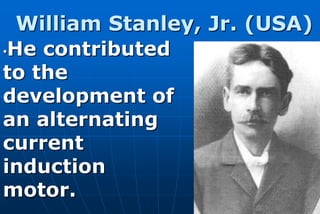
William Stanley, Jr. (USA)
•He contributed

to the
development of
an alternating
current
induction
motor.
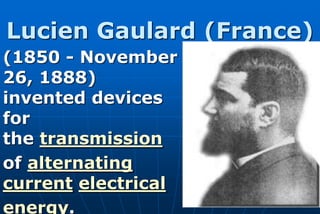
Lucien Gaulard (France)
(1850 - November
26, 1888)
invented devices
for
the transmission
of alternating
current electrical
energy.
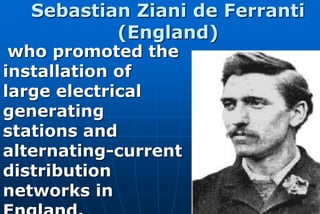
Sebastian Ziani de Ferranti
          (England)
 who promoted the
installation of
large electrical
generating
stations and
alternating-current
distribution
networks in
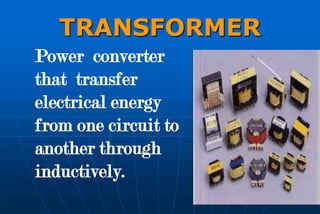
TRANSFORMER
Power converter
that transfer
electrical energy
from one circuit to
another through
inductively.
Principle
  transformer is based on two
  principles:
 (1) that an electric current can
  produce a magnetic field (
  electromagnetism)
 (2) that a changing magnetic field
  within a coil of coil induces a
  voltage across the ends of the coil
( electromagnetic induction)
TYPES OF TRANSFORMER

  Step Up Transformer

Step Down Transformer
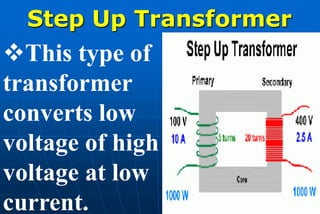
Step Up Transformer
This type of
transformer
converts low
voltage of high
voltage at low
current.
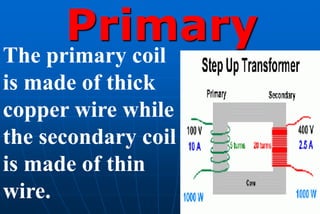
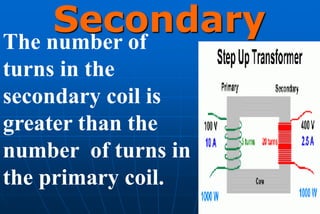
Primary
The primary coil
is made of thick
copper wire while
the secondary coil
is made of thin
wire.
Secondary
The number of
turns in the
secondary coil is
greater than the
number of turns in
the primary coil.
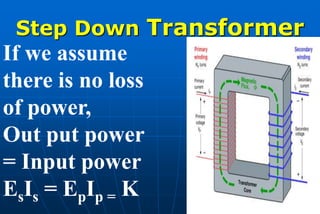
Step Down Transformer
If we assume
there is no loss
of power,
Out put power
= Input power
EsIs = EpIp = K
If a load is connected to the secondary
winding, current will flow in this winding, and
electrical energy will be transferred from the
primary circuit through the transformer to the
load. In an ideal transformer, the induced
voltage in the secondary winding (Vs) is in
proportion to the primary voltage (Vp) and is
given by the ratio of the number of turns in the
secondary (Ns) to the number of turns in the
primary (Np) as follows:
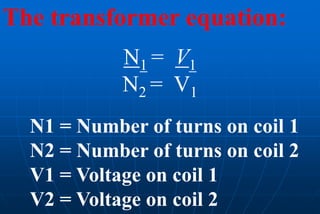
The transformer equation:
            N1 = V1
            N2 = V1
  N1 = Number of turns on coil 1
  N2 = Number of turns on coil 2
  V1 = Voltage on coil 1
  V2 = Voltage on coil 2
Advantage of Alternative
           Current
 Electric power distribution
  primarily used direct current at
  the same voltage used by motors
  and lights.
 Changing direct current voltage
  level required rotating machinery
  which was costly to purchased
  and install.
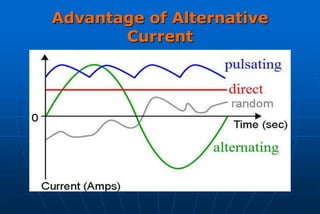
Advantage of Alternative
       Current
BASIC TRANSFORMER

   The basic transformer is an
    electrical device that transfers
    alternating-current energy
    from one circuit to another
    circuit by magnetic coupling of
    the primary and secondary
    windings of the transformer.
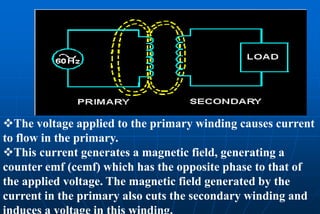
The voltage applied to the primary winding causes current
to flow in the primary.
This current generates a magnetic field, generating a
counter emf (cemf) which has the opposite phase to that of
the applied voltage. The magnetic field generated by the
current in the primary also cuts the secondary winding and
induces a voltage in this winding.
TRANSFORMER
     CONSTRUCTION
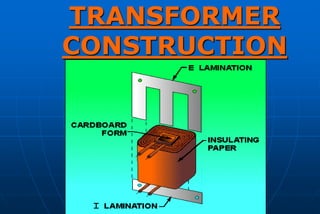
   A TRANSFORMER consists
    of two coils of insulated
    wire wound on a core. The
    primary winding is usually
    wound onto a form, then
    wrapped with an insulating
    material such as paper or
    cloth.
TRANSFORMER
CONSTRUCTION
Transformer Consructions
   The most common types of
    transformers are the shell-core
    and the hollow-core types. The
    type and shape of the core is
    dependent on the intended use
    of the transformer and the
    voltage applied to the current in
    the primary winding.
Exciting Current
   When voltage is
    applied to the primary
    of a
    transformer, exciting
    current flows in the
    primary.
The current causes a magnetic field
to be set up around both the
primary and the secondary
windings. The moving flux causes a
voltage to be induced into the
secondary winding, countering the
effects of the counter emf in the
primary.
Power of
         Transformer
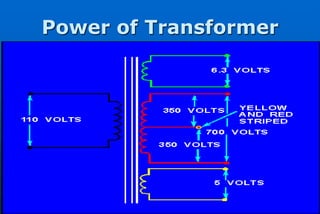
   A transformer with two or
    more windings wound on a
    laminated iron core. The
    transformer is used to supply
    stepped up and stepped down
    values of voltage to the
    various circuits in electrical
    equipment.
Power of Transformer
Application
 The major application of
  transformer is to increase
  voltage before transmitting
  electrical energy over long
  distances through the wire.
 Also used extensively in
  electronic products to step
  down the supply voltage to a
  level suitable for the low
  voltage circuits they contain.
Activity Time
Question…..
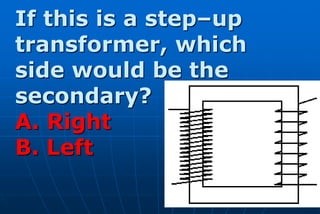
If this is a step–up
transformer, which
side would be the
secondary?
A. Right
B. Left
Correct Answer
 Is (b.) Left
 A step-up transformer raises
 voltage.The secondary would
 have more voltage and
 more coils: the left side.
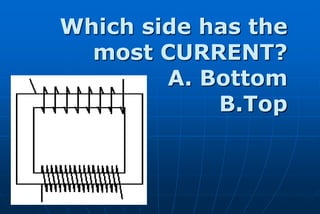
Which side has the
  most CURRENT?
        A. Bottom
            B.Top
A. Bottom because
  Power in must =
 Power out, the side
with the least voltage
must have the most
       current.
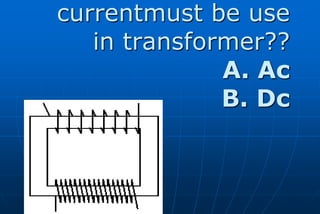
currentmust be use
   in transformer??
              A. Ac
              B. Dc
Answer : A. AC A
   transformer transfers
  voltage by transferring
magnetic flux. Magnetic flux
   occurs with changing
 magnetism and changing
    current: Alternating
          Current.
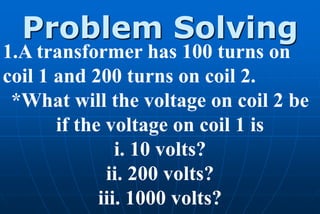
Problem Solving
1.A transformer has 100 turns on
coil 1 and 200 turns on coil 2.
 *What will the voltage on coil 2 be
       if the voltage on coil 1 is
                i. 10 volts?
              ii. 200 volts?
             iii. 1000 volts?
Created By:
Mallillin, Khate A.
• IV-2
•

Fernandez, Mariel
• IV-2
•

Aguilar, Marry Grace
• IV-2
•
References:
  • http://www.physicstutorial
    s.org/home/magnetism/tr
    ansformers
  • http://www.worsleyschool.
    net/science/files/transform
    ers/page.html
  • http://www.tpub.com/neet
    s/book2/5k.htm
  • *http://edisontechcenter.o
    rg/Transformers.html

Transfomer

  • 2.
  • 3.
    History first A varyingcurrent in the or primary winding creates a varying magnetic flux in the transformer's core and thus a varying magnetic field through the secondary winding.
  • 4.
    History This varying magnetic fieldinduces a varying electromotive force (EMF), or "voltage", in the secondary winding. This effect is called inductive coupling.
  • 5.
    A transformer is a device that transfers electrical energy from one circuit to another through inductively coupled conductors—the transformer's coils.
  • 6.
    How it isused?  A transformer is used to bring voltage up or down in an AC electrical circuit. A transformer can be used to convert AC power to DC power.
  • 8.
    Responsible for the Development of TRANSFORMER
  • 9.
    William Stanley, Jr.(USA) •He contributed to the development of an alternating current induction motor.
  • 10.
    Lucien Gaulard (France) (1850- November 26, 1888) invented devices for the transmission of alternating current electrical energy.
  • 11.
    Sebastian Ziani deFerranti (England) who promoted the installation of large electrical generating stations and alternating-current distribution networks in
  • 12.
    TRANSFORMER Power converter that transfer electricalenergy from one circuit to another through inductively.
  • 13.
    Principle  transformeris based on two principles:  (1) that an electric current can produce a magnetic field ( electromagnetism)  (2) that a changing magnetic field within a coil of coil induces a voltage across the ends of the coil ( electromagnetic induction)
  • 14.
    TYPES OF TRANSFORMER Step Up Transformer Step Down Transformer
  • 15.
    Step Up Transformer Thistype of transformer converts low voltage of high voltage at low current.
  • 16.
    Primary The primary coil ismade of thick copper wire while the secondary coil is made of thin wire.
  • 17.
    Secondary The number of turnsin the secondary coil is greater than the number of turns in the primary coil.
  • 18.
    Step Down Transformer Ifwe assume there is no loss of power, Out put power = Input power EsIs = EpIp = K
  • 19.
    If a loadis connected to the secondary winding, current will flow in this winding, and electrical energy will be transferred from the primary circuit through the transformer to the load. In an ideal transformer, the induced voltage in the secondary winding (Vs) is in proportion to the primary voltage (Vp) and is given by the ratio of the number of turns in the secondary (Ns) to the number of turns in the primary (Np) as follows:
  • 20.
    The transformer equation: N1 = V1 N2 = V1 N1 = Number of turns on coil 1 N2 = Number of turns on coil 2 V1 = Voltage on coil 1 V2 = Voltage on coil 2
  • 21.
    Advantage of Alternative Current  Electric power distribution primarily used direct current at the same voltage used by motors and lights.  Changing direct current voltage level required rotating machinery which was costly to purchased and install.
  • 22.
  • 23.
    BASIC TRANSFORMER  The basic transformer is an electrical device that transfers alternating-current energy from one circuit to another circuit by magnetic coupling of the primary and secondary windings of the transformer.
  • 24.
    The voltage appliedto the primary winding causes current to flow in the primary. This current generates a magnetic field, generating a counter emf (cemf) which has the opposite phase to that of the applied voltage. The magnetic field generated by the current in the primary also cuts the secondary winding and induces a voltage in this winding.
  • 25.
    TRANSFORMER CONSTRUCTION  A TRANSFORMER consists of two coils of insulated wire wound on a core. The primary winding is usually wound onto a form, then wrapped with an insulating material such as paper or cloth.
  • 26.
  • 27.
    Transformer Consructions  The most common types of transformers are the shell-core and the hollow-core types. The type and shape of the core is dependent on the intended use of the transformer and the voltage applied to the current in the primary winding.
  • 28.
    Exciting Current  When voltage is applied to the primary of a transformer, exciting current flows in the primary.
  • 29.
    The current causesa magnetic field to be set up around both the primary and the secondary windings. The moving flux causes a voltage to be induced into the secondary winding, countering the effects of the counter emf in the primary.
  • 30.
    Power of Transformer  A transformer with two or more windings wound on a laminated iron core. The transformer is used to supply stepped up and stepped down values of voltage to the various circuits in electrical equipment.
  • 31.
  • 32.
    Application  The majorapplication of transformer is to increase voltage before transmitting electrical energy over long distances through the wire.  Also used extensively in electronic products to step down the supply voltage to a level suitable for the low voltage circuits they contain.
  • 33.
  • 34.
  • 35.
    If this isa step–up transformer, which side would be the secondary? A. Right B. Left
  • 36.
    Correct Answer Is(b.) Left A step-up transformer raises voltage.The secondary would have more voltage and more coils: the left side.
  • 37.
    Which side hasthe most CURRENT? A. Bottom B.Top
  • 38.
    A. Bottom because Power in must = Power out, the side with the least voltage must have the most current.
  • 39.
    currentmust be use in transformer?? A. Ac B. Dc
  • 40.
    Answer : A.AC A transformer transfers voltage by transferring magnetic flux. Magnetic flux occurs with changing magnetism and changing current: Alternating Current.
  • 41.
    Problem Solving 1.A transformerhas 100 turns on coil 1 and 200 turns on coil 2. *What will the voltage on coil 2 be if the voltage on coil 1 is i. 10 volts? ii. 200 volts? iii. 1000 volts?
  • 44.
    Created By: Mallillin, KhateA. • IV-2 • Fernandez, Mariel • IV-2 • Aguilar, Marry Grace • IV-2 •
  • 45.
    References: •http://www.physicstutorial s.org/home/magnetism/tr ansformers • http://www.worsleyschool. net/science/files/transform ers/page.html • http://www.tpub.com/neet s/book2/5k.htm • *http://edisontechcenter.o rg/Transformers.html