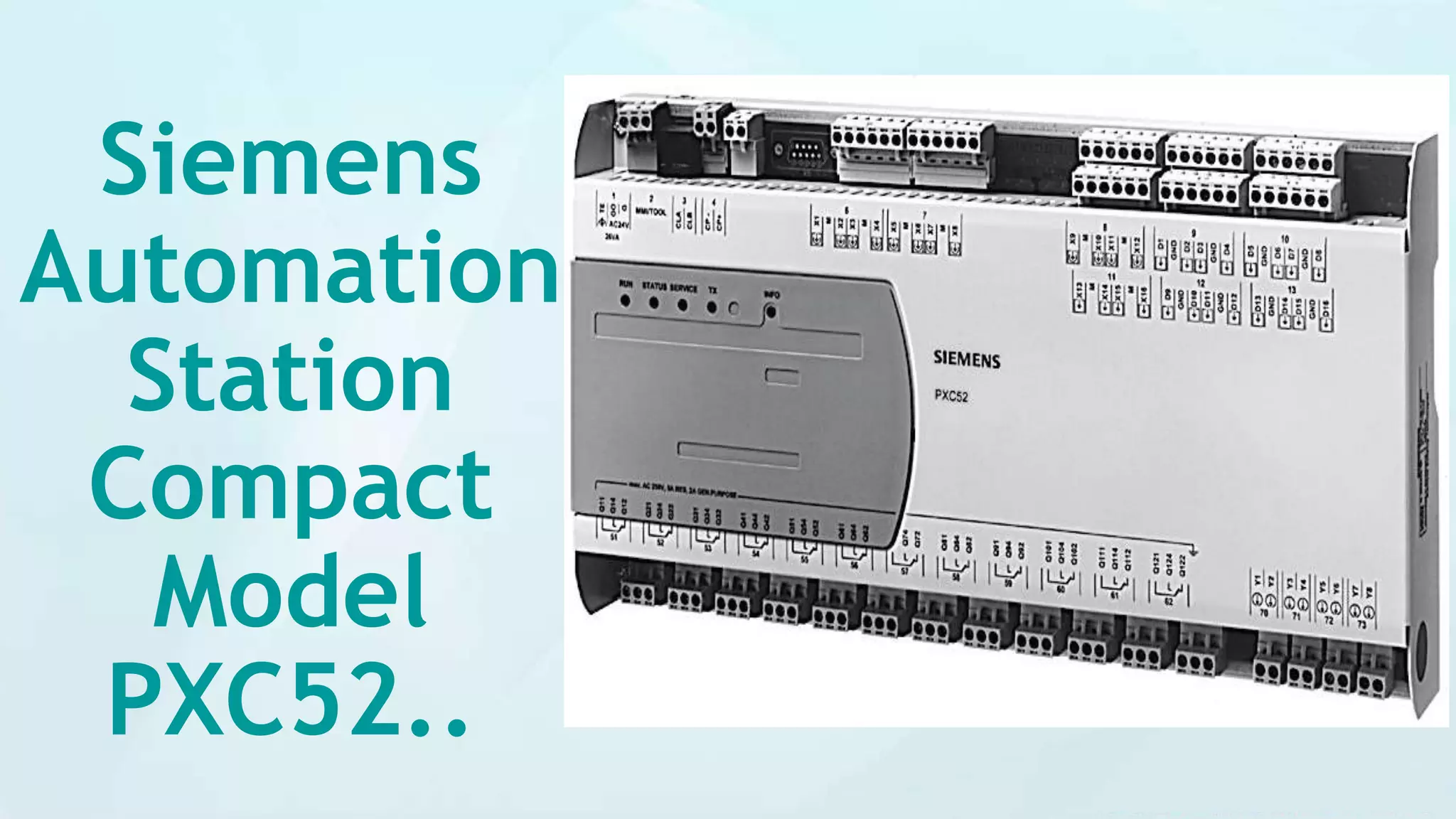
Siemens
Automation
Station
Compact
Model
PXC52..
USE
o Freely programmable compact automation stations for HVAC and building services
systems.
o The fixed data point mix ensures optimum efficiency for frequently used
applications with standard signals.
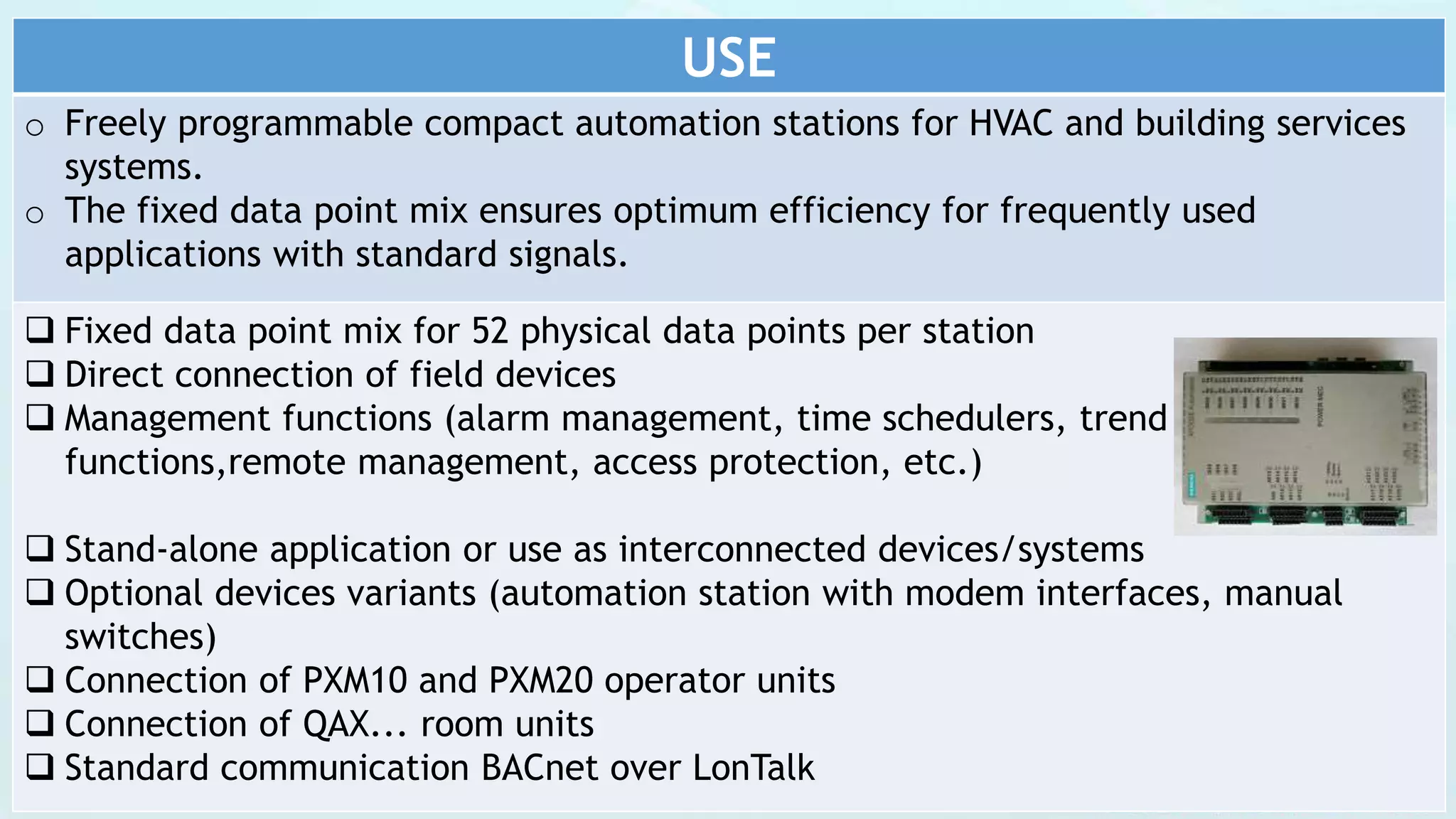
 Fixed data point mix for 52 physical data points per station
 Direct connection of field devices
 Management functions (alarm management, time schedulers, trend
functions,remote management, access protection, etc.)
 Stand-alone application or use as interconnected devices/systems
 Optional devices variants (automation station with modem interfaces, manual
switches)
 Connection of PXM10 and PXM20 operator units
 Connection of QAX... room units
 Standard communication BACnet over LonTalk
Functions
 These freely programmable automation stations provide the infrastructure for the
 provision and processing of system-specific and application-specific functions.
 Apart from the freely programmable control functions these units comprise
integrated
convenient management functions such as:
 Alarm management with alarm routing throughout the whole network.
 Three level alarm management (simple, basic and enhanced) with safety control
transmission and automatic transmission monitoring
 Time schedulers
 Trend functions
 Remote management functions
 Access protection for the whole network with individually defined user profiles
and categories
Programming
language
 Automation stations are freely programmable with the D-MAP
programming language (follows closely CEN Standard 1131).
 All function blocks available in libraries are graphically linked
with the plant operating programs.
Communication  The devices communicate via an open bus system in
accordance with the international standard BACnet protocol.
 Integrated peer-to-peer communication with other
automation stations and also with PXM10 and PXM20 operator
units.
Types
Device Type Data point mix
Automation station for 52 physical data points PXC52 UI DI AO DO
16 16 8 12
Compatibility
Operator unit  The automation stations are operated with the convenient PXM10
and PXM20 operator units with control buttons as well as displays
in graph form and clear text.
 The PXM20 unit can be used either locally of decentralized for all
plant connected together in one network, the PXM10 only locally.
Room units  A maximum of five room units QAX… (not QAX5…) can be operated
via the PPS2 bus connection.
 Details on the PPS2 communication are described in the DESIGO
Technical principles manual (chapter "I/O blocks", section "PPS2
addressing").
Technology
Inputs The universal inputs (UI) accept passive and active sensor elements as well as volt free
contacts for signal functions.
• Passive LG-Ni 1000, Pt 1000, T1
• Active 0 ... 10 V
• Binary Volt-free (DC 22 V)
The purely binary inputs (DI) enable signal and counter functions.
• Binary Volt-free (DC 24 V)
• Counters Volt-free up to 20 Hz (DC 24 V) only on D1 … D4 (PXC52up to version C)
• Counters Volt-free up to 25 Hz (DC 24 V) only on D1 … D4 (PXC52 version D and later)
Outputs On the one hand, universal outputs (AO) can control modulating actuators and, on the
other hand, can be programmed via the program structure for binary switching functions.
• Analogue 0 ... 10 V
• Binary 0 or DC 0 ...24 V, max. 22 mA
The relay outputs (DO) are designed for max. AC 250 V, 2 A.
Universal
inputs /
outputs (UIO),
PXC52 V5 and
later
From Desigo V5, the PXC52 is equipped with universal inputs / outputs (UIO), i.e.
The former UIs and AOs can all be parameterized as AI, DI, CI or AO.
However, the printing on the housing has not been changed.
Design
The compact construction enables the automation stations to be used in highly
confined spaces and makes them especially suitable for compact control panels or
buildings services systems with integrated control panels.
1 Metal housing
2 Front cover (hinged)
3 LED indicators
4 Printed circuit board
5 Plug-in screw terminal block
6 Upper terminals for operating voltage,
bus system and input peripherals
7 Lower terminals for output peripherals
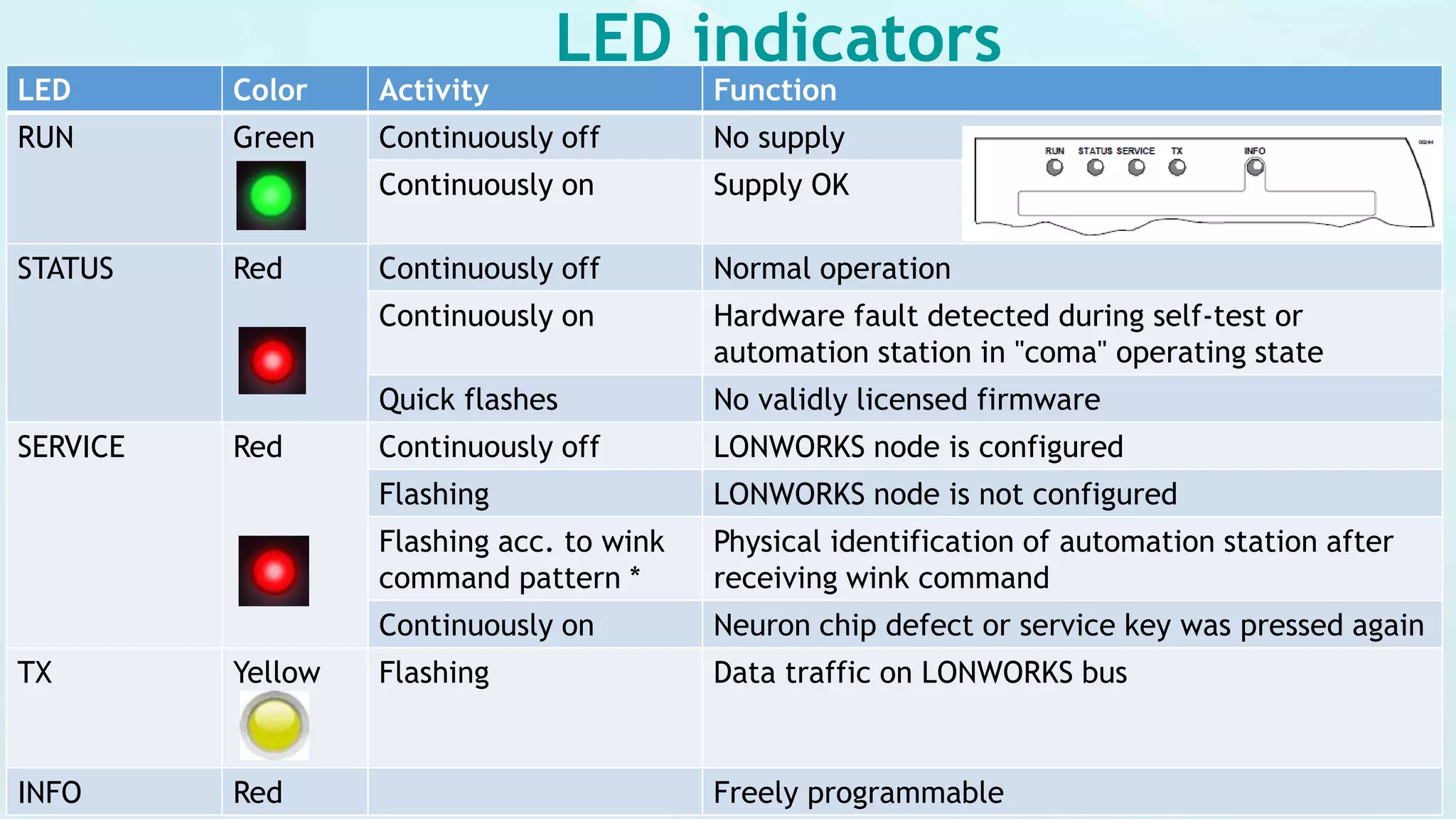
LED indicators
LED Color Activity Function
RUN Green Continuously off No supply
Continuously on Supply OK
STATUS Red Continuously off Normal operation
Continuously on Hardware fault detected during self-test or
automation station in "coma" operating state
Quick flashes No validly licensed firmware
SERVICE Red Continuously off LONWORKS node is configured
Flashing LONWORKS node is not configured
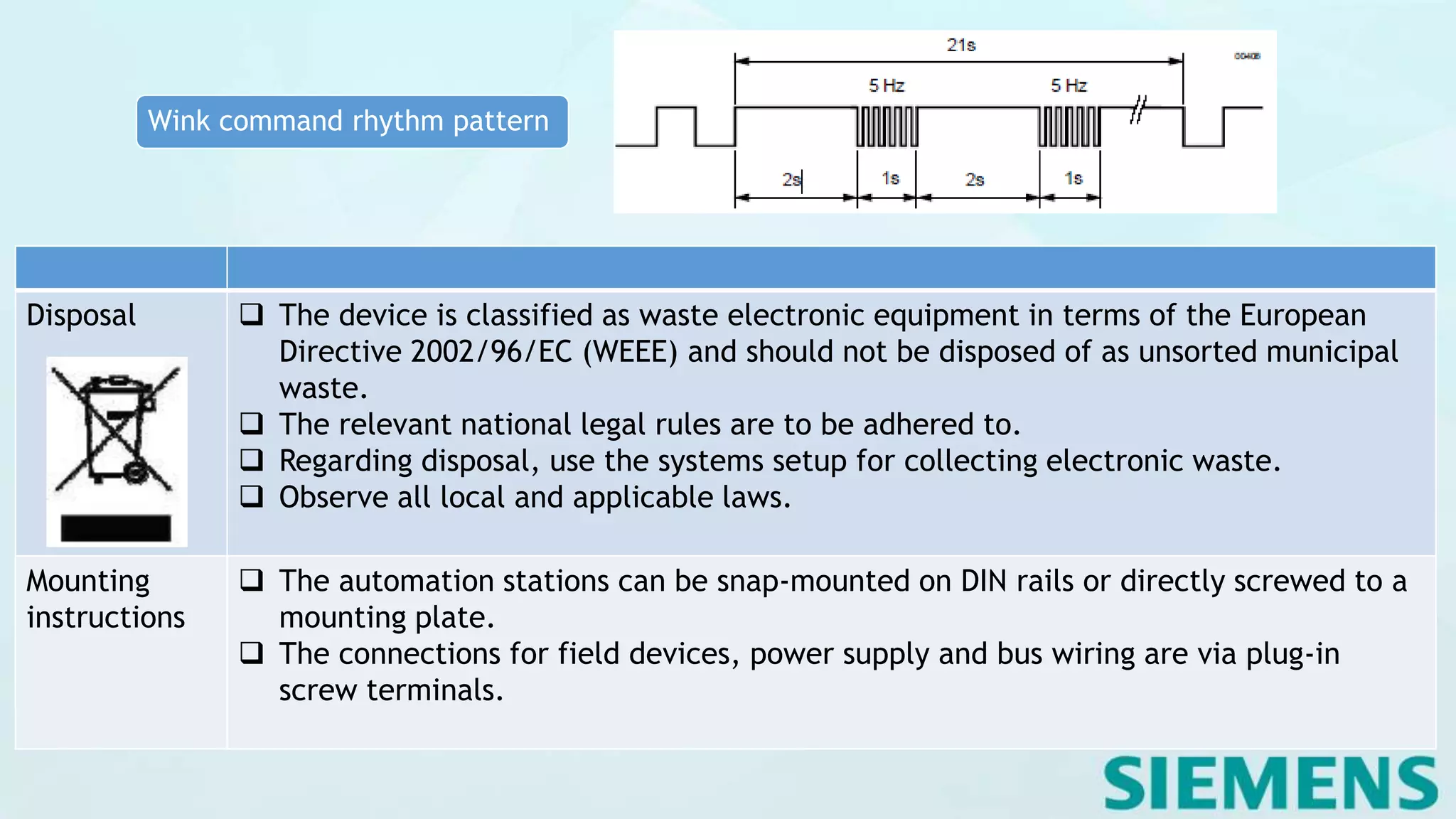
Flashing acc. to wink
command pattern *
Physical identification of automation station after
receiving wink command
Continuously on Neuron chip defect or service key was pressed again
TX Yellow Flashing Data traffic on LONWORKS bus
INFO Red Freely programmable
Wink command rhythm pattern
Disposal  The device is classified as waste electronic equipment in terms of the European
Directive 2002/96/EC (WEEE) and should not be disposed of as unsorted municipal
waste.
 The relevant national legal rules are to be adhered to.
 Regarding disposal, use the systems setup for collecting electronic waste.
 Observe all local and applicable laws.
Mounting
instructions
 The automation stations can be snap-mounted on DIN rails or directly screwed to a
mounting plate.
 The connections for field devices, power supply and bus wiring are via plug-in
screw terminals.
Commissioning
In order to prevent equipment damage and/or personal injuries always follow local safety regulations
and the required safety standards.
Loading plant
operating program
 Download the plant operating program to the automation station with the
PX Design tool in the DESIGO TOOLSET / XWORKS plus, direct via the RJ45
connector or the LON bus.
Setting parameters
and configurations
 Convenient tools are available for commissioning.
 Use the PX Design tool in the DESIGO TOOLSET/ XWORKS plus for setting the
control parameters and the configuration data.
 Data visible in the network can also be changed with a PXM10 or PXM20
operator unit.
Wiring test  It is possible to test field devices and the wiring as soon as the power supply
is connected, without first downloading the plant operating program.
 The test is carried out with a PXM20 operator unit.
Restart  Press the Reset button to force a restart.
Commissioning
Network connection  The network addresses are configured with Xworks Plus.
 In order to provide a unique identification in the LONWORKS network press
the service pin on the printed circuit board or send a wink command to the
relevant automation station (service LED flashes).
Force Firmware
Download
 If the Force Firmware Download Key is pressed during a restart (reset),
the current D-MAP program is deleted from the FLASH.
 The automation station waits briefly for the signal to activate the FW
Loader and then starts the automation station.
 Prerequisite: The automation station has conducted a node setup and no
application is loaded or was deleted in the CFC by clear/reset
(communication settings remain – which would not be the case when restart
erasing by pressing the reset key).
Position of buttons and batteries
1 Lithium battery
2 AA alkaline battery
3 Service pin
4 Force Firmware Download Key
5 Reset key
Maintenance
Battery
life
 Lithium batteries usually have a life span of at least four years.
 The automation station automatically sends a system event in order to indicate a low
charge.
 After the "Battery low" event there are several months of remaining life span.
 In the PXC52 version D and later, the database information stored in the SDRAM
memory is battery-backed (Alkaline AA Type).
 This eliminates the need for time consuming program and database re-entry in the
event of an extended power failure (up to 1 month).
 After the "Battery low" event there are several days of remaining life span under load.
 Alkaline batteries have a typical life span of 4 years without load.
 When one of the batteries needs to be replaced, the automation station automatically
sends a system event.
 an alarm message can also be sent to selected terminals.
Battery
change
 To change the battery swing the front cover open.
 As long as the device is supplied with AC 24 V, the battery may be removed for
unlimited time.
Caution  To prevent hardware damage by electrostatic discharge (ESD), a wrist strap with earth
cable must be used during the battery change.
Technical data
General device data Operating voltage SELV / PELV AC 24 V ± 20 %
Rated voltage AC 24 V
Frequency 50/60 Hz
Power consumption
(depending on device type):
max. 26 VA
Internal fuse Thermic, automatic reset
Weight
Type-PXC52 without packaging 1.820 kg with packaging 1.920 kg
Protection class Isolation protection class II
Ambient conditions Operation
Temperature
Humidity
Class 3K5 to IEC 60721
0 ... 50 °C
< 85 % rh
Transport
Temperature
Humidity
Class 2K3 to IEC 60721
– 25 ... 65 °C
< 95 % rh
Technical data
Operating
data
Processor Motorola PPC (MPC 885)
Memory space
FLASH
RAM
16 MB
RAM 64 MB
Data backup in case of power failure
Applications, parameter (FLASH) > 10 years
Real time clock (buffered by Lithium battery,
can be replaced on the plant)
> 10 years
Run-time data (buffered by Lithium battery,
can be replaced on the plant)
PXC52, up to version C:
> 10 years
Runtime data (buffered by AA alkaline,
can be replaced on the plant)
PXC52 version D and later:
Unused: 4 years.
Typically 1 month in case of supply
Failure (grid or AC 24 V)
Accuracy class 0,5
Scan cycle max. 1 s
Technical data
Universal
inputs
X...
Configurable by software
Measured value inputs
 Range
 Input resistance
 0 ... 11.0 V
 100 kΩ against M
Sensor inputs
Temperature sensors
 LG-Ni 1000, Pt 1000, T1
 Sensor current (continuous / pulsed)
 Resolution
 Measuring error at 25 °C (Ni 1000, PT 1000)
 Measuring error at 25 °C (T1)
 Scaling range – 50 ... 150 °C
 Approx. 2.5 mA / 1.5 mA peak
 0.2 K
 max. 0.2 K (without cable and sensor)
 max. 1.0 K (without cable and sensor)
Signal inputs
 Contact voltage
 Contact current
 Contact transfer resistance
 Contact isolation resistance
 DC 20 ... 25 V
 7 mA
 Max. 200 Ω (closed)
 Min. 50 kΩ (open)
Technical data
Binary
inputs D...
Contact voltage DC 20 ... 25 V
Contact current 7 mA
Contact transfer resistance Max. 200 Ω (closed)
Contact isolation resistance Min. 50 kΩ (open)
Binary
inputs
D1...D4
As D...;
additionally
counting
function
Counter frequency (symmetrical) Max. 25 Hz (PXC52 version D and later)
Min. closing/opening time 20 ms incl. bouncing
Max. bounce time 10 ms
Counter memory Max. 20 Hz (PXC52up to version C)
8 Bit 0...255 (all types)
max. cycle time 10 s at 25 Hz
max. cycle time 12 s at 20 Hz
Universal
outputs Y…
Configurable by software Proportional outputs
 Output voltage range
 Output current
 0 ... 11.0 V
 Max. 4 mA source, max. 1.5 mA sink
Binary outputs (for off-board relays)
 Output voltage range
 Load
 0/DC 0 24 V
 ≥ 1000 Ω
Technical data
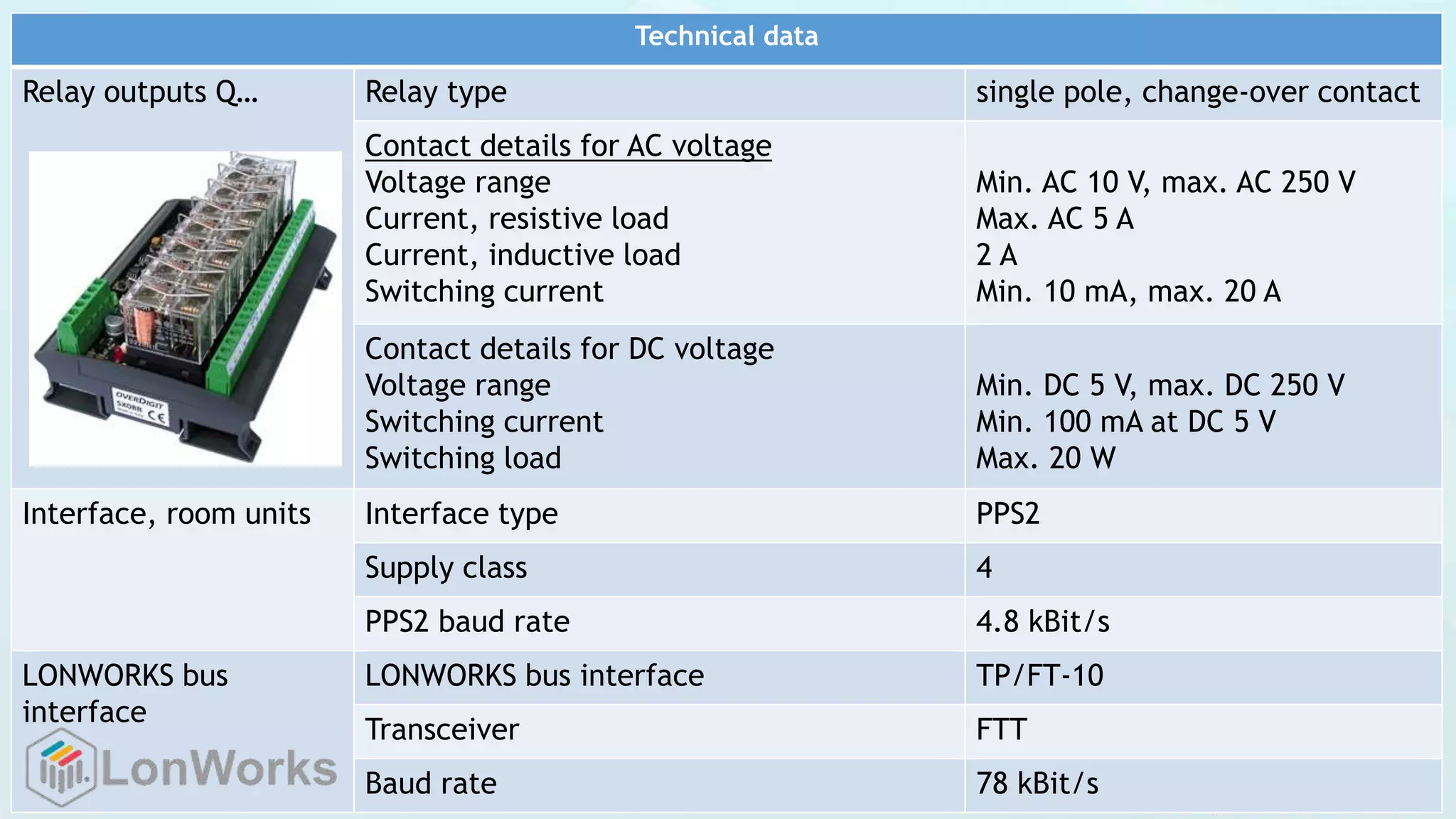
Relay outputs Q… Relay type single pole, change-over contact
Contact details for AC voltage
Voltage range
Current, resistive load
Current, inductive load
Switching current
Min. AC 10 V, max. AC 250 V
Max. AC 5 A
2 A
Min. 10 mA, max. 20 A
Contact details for DC voltage
Voltage range
Switching current
Switching load
Min. DC 5 V, max. DC 250 V
Min. 100 mA at DC 5 V
Max. 20 W
Interface, room units Interface type PPS2
Supply class 4
PPS2 baud rate 4.8 kBit/s
LONWORKS bus
interface
LONWORKS bus interface TP/FT-10
Transceiver FTT
Baud rate 78 kBit/s
Technical data
Plug-in screw
terminal
Power supply and signals Stranded of solid conductors,
0.25 … 2.5 mm2 or 2 x 1.5 mm2
Single cable lengths
LONWORKS bus Stranded or solid conductors, 2 x 1.0 mm2
Universal inputs X... Max. 100m where A = 1 mm2
Binary inputs D... Max. 100 m with diameters ≥ 0.6 mm
Universal outputs Y… Max. 100m where A ≥ 1.5 mm2
Relay outputs Q… Depends on load and local regulations
Interface, room unit
Cable type
Capacitance per unit length
Max. 125 m where A = 1.0 mm2
2-core, twisted pair, unscreened
Max. 56 nF/km
LONWORKS bus
Cable type
Cable length
ConCab or CAT5
See installation guide, CA110396
Connecting cable PXM10 or PXM20
/
DESIGO TOOLSET / XWORKS plus
Max. 3 m
Housing protection
standard
Protection standard to EN 60529 IP 20
The relay outputs are safely isolated from each other, from earth/cover and the remaining electronics
(AC 24 V) in accordance with SELV and PELV specifications.
The relay outputs can be used in mixing applications with AC 250 V and SELV/PELV circuits!
Standards and
directives
Product standard
Automatic electronic controls for
household and similar use Special requirements
for temperature dependent control devices
EN 60730-1
EN 60730-2-9
Electromagnetic compatibility
Interference immunity (industry)
Emitted interference (domestic)
EN 60730-1
EN 60730-1
Meets requirements for CE marking:
Electromagnetic compatibility
Low Voltage Directive
2004/108/EC
2006/96/EC
UL approbation UL 916: PAZX, PAZX7
Environmental
compatibility
The product environmental declarations
CA1E9211... contain data on RoHS compliance,
materials composition, packaging,
environmental benefit, disposal
ISO 14001 (Environment)
ISO 9001 (Quality)
SN 36350 (environmentally
compatible products)
2002/95/EC (RoHS)
Connection terminals
1 TE Functional earth
G/G0 Supply voltage AC 24 V
2 HMI / TOOL RJ45 socket (for PXM10 or PXM20 operator unit or DESIGO
TOOLSET / XWORKS plus)
3 CLA/CLB LONWORKS bus
4 CP+/CP- PPS2 bus (for QAX... room units) CFC IOAddr
6 ... 8..11 X1 ... X16 16 universal inputs *) X1: C=1.1
9 D1 ... D4 4 binary inputs (counters possible) D1: C=2.1
10..12..13 D5 ... D16 12 binary inputs D5: C=3.1
51 ... 62 Q11 ... Q122 12 relay outputs Q11: C=5.1
70 ... 73 Y1 ... Y8 8 universal outputs *) Y1: C=4.1
 From Desigo V5, the PXC52 is equipped with universal inputs / outputs (UIO), i.e. the former UIs
and AOs can all be parameterized as AI, DI, CI or AO.
 Signal type when no application is loaded (wiring test): X1...X16 = Y10S, Y1...Y8 = R1K
Caution!  Observe the technical data for the relay outputs.
 Local installation regulations must be observed.
Pin layout
2 Tool
socket
Standard RJ45 tool socket for LONMARK
compatible devices.
Pin Description
1 LONWORKS, Data A (CLA)
2 LONWORKS, Data B (CLB)
3 G0, GND
4 G/Plus
5 Unoccupied
6 Unoccupied
7 COM1/TxD
8 COM1/RxD
Connection diagrams
Peripheral supply
from system
transformer
Active and passive
sensors
Magnetic valves
Motorized valves
Peripheral supply from separate transformer
Magnetic valves
(example)
Do NOT earth the
separate
transformer
Connecting the room units
Notes
The room units are connected in
parallel (max. five devices).
To distinguish between them,
they can be addressed by use of
jumpers (address plug on the
printed circuit board).
The factory-setting is Address 1.
Dimensions
All dimensions in mm

Siemens Automation Station Compact Model PXC52

  • 1.
  • 2.
    USE o Freely programmablecompact automation stations for HVAC and building services systems. o The fixed data point mix ensures optimum efficiency for frequently used applications with standard signals.  Fixed data point mix for 52 physical data points per station  Direct connection of field devices  Management functions (alarm management, time schedulers, trend functions,remote management, access protection, etc.)  Stand-alone application or use as interconnected devices/systems  Optional devices variants (automation station with modem interfaces, manual switches)  Connection of PXM10 and PXM20 operator units  Connection of QAX... room units  Standard communication BACnet over LonTalk
  • 3.
    Functions  These freelyprogrammable automation stations provide the infrastructure for the  provision and processing of system-specific and application-specific functions.  Apart from the freely programmable control functions these units comprise integrated convenient management functions such as:  Alarm management with alarm routing throughout the whole network.  Three level alarm management (simple, basic and enhanced) with safety control transmission and automatic transmission monitoring  Time schedulers  Trend functions  Remote management functions  Access protection for the whole network with individually defined user profiles and categories
  • 4.
    Programming language  Automation stationsare freely programmable with the D-MAP programming language (follows closely CEN Standard 1131).  All function blocks available in libraries are graphically linked with the plant operating programs. Communication  The devices communicate via an open bus system in accordance with the international standard BACnet protocol.  Integrated peer-to-peer communication with other automation stations and also with PXM10 and PXM20 operator units. Types Device Type Data point mix Automation station for 52 physical data points PXC52 UI DI AO DO 16 16 8 12
  • 5.
    Compatibility Operator unit The automation stations are operated with the convenient PXM10 and PXM20 operator units with control buttons as well as displays in graph form and clear text.  The PXM20 unit can be used either locally of decentralized for all plant connected together in one network, the PXM10 only locally. Room units  A maximum of five room units QAX… (not QAX5…) can be operated via the PPS2 bus connection.  Details on the PPS2 communication are described in the DESIGO Technical principles manual (chapter "I/O blocks", section "PPS2 addressing").
  • 6.
    Technology Inputs The universalinputs (UI) accept passive and active sensor elements as well as volt free contacts for signal functions. • Passive LG-Ni 1000, Pt 1000, T1 • Active 0 ... 10 V • Binary Volt-free (DC 22 V) The purely binary inputs (DI) enable signal and counter functions. • Binary Volt-free (DC 24 V) • Counters Volt-free up to 20 Hz (DC 24 V) only on D1 … D4 (PXC52up to version C) • Counters Volt-free up to 25 Hz (DC 24 V) only on D1 … D4 (PXC52 version D and later) Outputs On the one hand, universal outputs (AO) can control modulating actuators and, on the other hand, can be programmed via the program structure for binary switching functions. • Analogue 0 ... 10 V • Binary 0 or DC 0 ...24 V, max. 22 mA The relay outputs (DO) are designed for max. AC 250 V, 2 A. Universal inputs / outputs (UIO), PXC52 V5 and later From Desigo V5, the PXC52 is equipped with universal inputs / outputs (UIO), i.e. The former UIs and AOs can all be parameterized as AI, DI, CI or AO. However, the printing on the housing has not been changed.
  • 7.
    Design The compact constructionenables the automation stations to be used in highly confined spaces and makes them especially suitable for compact control panels or buildings services systems with integrated control panels. 1 Metal housing 2 Front cover (hinged) 3 LED indicators 4 Printed circuit board 5 Plug-in screw terminal block 6 Upper terminals for operating voltage, bus system and input peripherals 7 Lower terminals for output peripherals
  • 8.
    LED indicators LED ColorActivity Function RUN Green Continuously off No supply Continuously on Supply OK STATUS Red Continuously off Normal operation Continuously on Hardware fault detected during self-test or automation station in "coma" operating state Quick flashes No validly licensed firmware SERVICE Red Continuously off LONWORKS node is configured Flashing LONWORKS node is not configured Flashing acc. to wink command pattern * Physical identification of automation station after receiving wink command Continuously on Neuron chip defect or service key was pressed again TX Yellow Flashing Data traffic on LONWORKS bus INFO Red Freely programmable
  • 9.
    Wink command rhythmpattern Disposal  The device is classified as waste electronic equipment in terms of the European Directive 2002/96/EC (WEEE) and should not be disposed of as unsorted municipal waste.  The relevant national legal rules are to be adhered to.  Regarding disposal, use the systems setup for collecting electronic waste.  Observe all local and applicable laws. Mounting instructions  The automation stations can be snap-mounted on DIN rails or directly screwed to a mounting plate.  The connections for field devices, power supply and bus wiring are via plug-in screw terminals.
  • 10.
    Commissioning In order toprevent equipment damage and/or personal injuries always follow local safety regulations and the required safety standards. Loading plant operating program  Download the plant operating program to the automation station with the PX Design tool in the DESIGO TOOLSET / XWORKS plus, direct via the RJ45 connector or the LON bus. Setting parameters and configurations  Convenient tools are available for commissioning.  Use the PX Design tool in the DESIGO TOOLSET/ XWORKS plus for setting the control parameters and the configuration data.  Data visible in the network can also be changed with a PXM10 or PXM20 operator unit. Wiring test  It is possible to test field devices and the wiring as soon as the power supply is connected, without first downloading the plant operating program.  The test is carried out with a PXM20 operator unit. Restart  Press the Reset button to force a restart.
  • 11.
    Commissioning Network connection The network addresses are configured with Xworks Plus.  In order to provide a unique identification in the LONWORKS network press the service pin on the printed circuit board or send a wink command to the relevant automation station (service LED flashes). Force Firmware Download  If the Force Firmware Download Key is pressed during a restart (reset), the current D-MAP program is deleted from the FLASH.  The automation station waits briefly for the signal to activate the FW Loader and then starts the automation station.  Prerequisite: The automation station has conducted a node setup and no application is loaded or was deleted in the CFC by clear/reset (communication settings remain – which would not be the case when restart erasing by pressing the reset key).
  • 12.
    Position of buttonsand batteries 1 Lithium battery 2 AA alkaline battery 3 Service pin 4 Force Firmware Download Key 5 Reset key
  • 13.
    Maintenance Battery life  Lithium batteriesusually have a life span of at least four years.  The automation station automatically sends a system event in order to indicate a low charge.  After the "Battery low" event there are several months of remaining life span.  In the PXC52 version D and later, the database information stored in the SDRAM memory is battery-backed (Alkaline AA Type).  This eliminates the need for time consuming program and database re-entry in the event of an extended power failure (up to 1 month).  After the "Battery low" event there are several days of remaining life span under load.  Alkaline batteries have a typical life span of 4 years without load.  When one of the batteries needs to be replaced, the automation station automatically sends a system event.  an alarm message can also be sent to selected terminals. Battery change  To change the battery swing the front cover open.  As long as the device is supplied with AC 24 V, the battery may be removed for unlimited time. Caution  To prevent hardware damage by electrostatic discharge (ESD), a wrist strap with earth cable must be used during the battery change.
  • 14.
    Technical data General devicedata Operating voltage SELV / PELV AC 24 V ± 20 % Rated voltage AC 24 V Frequency 50/60 Hz Power consumption (depending on device type): max. 26 VA Internal fuse Thermic, automatic reset Weight Type-PXC52 without packaging 1.820 kg with packaging 1.920 kg Protection class Isolation protection class II Ambient conditions Operation Temperature Humidity Class 3K5 to IEC 60721 0 ... 50 °C < 85 % rh Transport Temperature Humidity Class 2K3 to IEC 60721 – 25 ... 65 °C < 95 % rh
  • 15.
    Technical data Operating data Processor MotorolaPPC (MPC 885) Memory space FLASH RAM 16 MB RAM 64 MB Data backup in case of power failure Applications, parameter (FLASH) > 10 years Real time clock (buffered by Lithium battery, can be replaced on the plant) > 10 years Run-time data (buffered by Lithium battery, can be replaced on the plant) PXC52, up to version C: > 10 years Runtime data (buffered by AA alkaline, can be replaced on the plant) PXC52 version D and later: Unused: 4 years. Typically 1 month in case of supply Failure (grid or AC 24 V) Accuracy class 0,5 Scan cycle max. 1 s
  • 16.
    Technical data Universal inputs X... Configurable bysoftware Measured value inputs  Range  Input resistance  0 ... 11.0 V  100 kΩ against M Sensor inputs Temperature sensors  LG-Ni 1000, Pt 1000, T1  Sensor current (continuous / pulsed)  Resolution  Measuring error at 25 °C (Ni 1000, PT 1000)  Measuring error at 25 °C (T1)  Scaling range – 50 ... 150 °C  Approx. 2.5 mA / 1.5 mA peak  0.2 K  max. 0.2 K (without cable and sensor)  max. 1.0 K (without cable and sensor) Signal inputs  Contact voltage  Contact current  Contact transfer resistance  Contact isolation resistance  DC 20 ... 25 V  7 mA  Max. 200 Ω (closed)  Min. 50 kΩ (open)
  • 17.
    Technical data Binary inputs D... Contactvoltage DC 20 ... 25 V Contact current 7 mA Contact transfer resistance Max. 200 Ω (closed) Contact isolation resistance Min. 50 kΩ (open) Binary inputs D1...D4 As D...; additionally counting function Counter frequency (symmetrical) Max. 25 Hz (PXC52 version D and later) Min. closing/opening time 20 ms incl. bouncing Max. bounce time 10 ms Counter memory Max. 20 Hz (PXC52up to version C) 8 Bit 0...255 (all types) max. cycle time 10 s at 25 Hz max. cycle time 12 s at 20 Hz Universal outputs Y… Configurable by software Proportional outputs  Output voltage range  Output current  0 ... 11.0 V  Max. 4 mA source, max. 1.5 mA sink Binary outputs (for off-board relays)  Output voltage range  Load  0/DC 0 24 V  ≥ 1000 Ω
  • 18.
    Technical data Relay outputsQ… Relay type single pole, change-over contact Contact details for AC voltage Voltage range Current, resistive load Current, inductive load Switching current Min. AC 10 V, max. AC 250 V Max. AC 5 A 2 A Min. 10 mA, max. 20 A Contact details for DC voltage Voltage range Switching current Switching load Min. DC 5 V, max. DC 250 V Min. 100 mA at DC 5 V Max. 20 W Interface, room units Interface type PPS2 Supply class 4 PPS2 baud rate 4.8 kBit/s LONWORKS bus interface LONWORKS bus interface TP/FT-10 Transceiver FTT Baud rate 78 kBit/s
  • 19.
    Technical data Plug-in screw terminal Powersupply and signals Stranded of solid conductors, 0.25 … 2.5 mm2 or 2 x 1.5 mm2 Single cable lengths LONWORKS bus Stranded or solid conductors, 2 x 1.0 mm2 Universal inputs X... Max. 100m where A = 1 mm2 Binary inputs D... Max. 100 m with diameters ≥ 0.6 mm Universal outputs Y… Max. 100m where A ≥ 1.5 mm2 Relay outputs Q… Depends on load and local regulations Interface, room unit Cable type Capacitance per unit length Max. 125 m where A = 1.0 mm2 2-core, twisted pair, unscreened Max. 56 nF/km LONWORKS bus Cable type Cable length ConCab or CAT5 See installation guide, CA110396 Connecting cable PXM10 or PXM20 / DESIGO TOOLSET / XWORKS plus Max. 3 m Housing protection standard Protection standard to EN 60529 IP 20
  • 20.
    The relay outputsare safely isolated from each other, from earth/cover and the remaining electronics (AC 24 V) in accordance with SELV and PELV specifications. The relay outputs can be used in mixing applications with AC 250 V and SELV/PELV circuits! Standards and directives Product standard Automatic electronic controls for household and similar use Special requirements for temperature dependent control devices EN 60730-1 EN 60730-2-9 Electromagnetic compatibility Interference immunity (industry) Emitted interference (domestic) EN 60730-1 EN 60730-1 Meets requirements for CE marking: Electromagnetic compatibility Low Voltage Directive 2004/108/EC 2006/96/EC UL approbation UL 916: PAZX, PAZX7 Environmental compatibility The product environmental declarations CA1E9211... contain data on RoHS compliance, materials composition, packaging, environmental benefit, disposal ISO 14001 (Environment) ISO 9001 (Quality) SN 36350 (environmentally compatible products) 2002/95/EC (RoHS)
  • 21.
  • 22.
    Connection terminals 1 TEFunctional earth G/G0 Supply voltage AC 24 V 2 HMI / TOOL RJ45 socket (for PXM10 or PXM20 operator unit or DESIGO TOOLSET / XWORKS plus) 3 CLA/CLB LONWORKS bus 4 CP+/CP- PPS2 bus (for QAX... room units) CFC IOAddr 6 ... 8..11 X1 ... X16 16 universal inputs *) X1: C=1.1 9 D1 ... D4 4 binary inputs (counters possible) D1: C=2.1 10..12..13 D5 ... D16 12 binary inputs D5: C=3.1 51 ... 62 Q11 ... Q122 12 relay outputs Q11: C=5.1 70 ... 73 Y1 ... Y8 8 universal outputs *) Y1: C=4.1  From Desigo V5, the PXC52 is equipped with universal inputs / outputs (UIO), i.e. the former UIs and AOs can all be parameterized as AI, DI, CI or AO.  Signal type when no application is loaded (wiring test): X1...X16 = Y10S, Y1...Y8 = R1K Caution!  Observe the technical data for the relay outputs.  Local installation regulations must be observed.
  • 23.
    Pin layout 2 Tool socket StandardRJ45 tool socket for LONMARK compatible devices. Pin Description 1 LONWORKS, Data A (CLA) 2 LONWORKS, Data B (CLB) 3 G0, GND 4 G/Plus 5 Unoccupied 6 Unoccupied 7 COM1/TxD 8 COM1/RxD
  • 24.
    Connection diagrams Peripheral supply fromsystem transformer Active and passive sensors
  • 25.
  • 26.
  • 27.
    Peripheral supply fromseparate transformer Magnetic valves (example) Do NOT earth the separate transformer
  • 28.
    Connecting the roomunits Notes The room units are connected in parallel (max. five devices). To distinguish between them, they can be addressed by use of jumpers (address plug on the printed circuit board). The factory-setting is Address 1.
  • 29.