• the compactness: occupy a only about 1/3 the
build-size of an equally efficient electric motor;
• low weight: their weight represents about 1/5
the weight equally powerful electric motor;
• nonelectrical sparking:
• robust design
• easy maintainability: relatively easy assembly
and installation;
• overload capability: high load capacity without
the risk of any damage to standstill;
• easy control: possibility of step regulation of air
pressure or flow control;
• possibility of simple reversing of rotation: use
in two directions of rotation.
Pneumatic motors are categorized as:
1.Piston motors
• Radial
• Axial
2.Sliding-vane motors
• Balanced
• Unbalanced
3.Gear motors
4.Turbines (high flow)
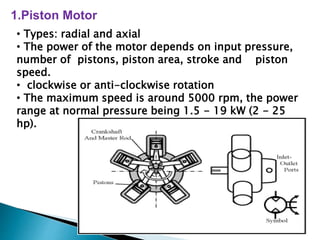
1.Piston Motor
• Types: radial and axial
• The power of the motor depends on input pressure,
number of pistons, piston area, stroke and piston
speed.
• clockwise or anti-clockwise rotation
• The maximum speed is around 5000 rpm, the power
range at normal pressure being 1.5 - 19 kW (2 - 25
hp).
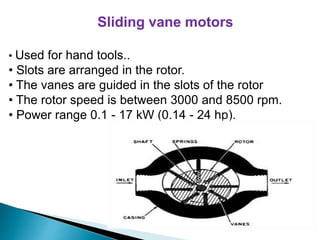
Sliding vane motors
• Used for hand tools..
• Slots are arranged in the rotor.
• The vanes are guided in the slots of the rotor
• The rotor speed is between 3000 and 8500 rpm.
• Power range 0.1 - 17 kW (0.14 - 24 hp).
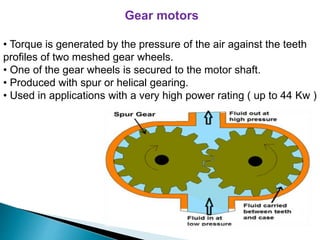
Gear motors
• Torque is generated by the pressure of the air against the teeth
profiles of two meshed gear wheels.
• One of the gear wheels is secured to the motor shaft.
• Produced with spur or helical gearing.
• Used in applications with a very high power rating ( up to 44 Kw )
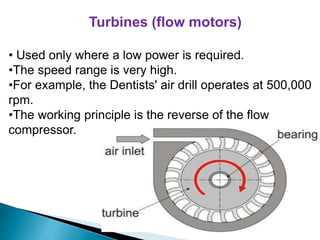
Turbines (flow motors)
• Used only where a low power is required.
•The speed range is very high.
•For example, the Dentists' air drill operates at 500,000
rpm.
•The working principle is the reverse of the flow
compressor.
Characteristics of pneumatic motors are:
•Smooth regulation of speed and torque
•Small size (weight)
•Overload safe
•Insensitive to dust, water, heat, cold
•Explosion proof
•Large speed selection
•Maintenance minimal
•Direction of rotation easily revers
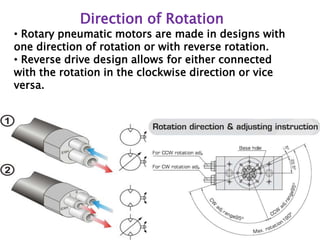
Direction of Rotation
• Rotary pneumatic motors are made in designs with
one direction of rotation or with reverse rotation.
• Reverse drive design allows for either connected
with the rotation in the clockwise direction or vice
versa.
Criteria for Air Motor Selection
1. the construction design of air motor;
2. used material;
3. direction of rotation;
4. determining working pressure;
5. calculation of required power;
6. determining of the working point
(interval);
7. determination of drive control method;
8. assessing of the suitability of oil use;
9. selection of auxiliary equipment;
10. conditions and forms of connection;
11. solving of noise level;
12. durability, reliability and maintenance.
References
•http://www.fabco-air.com/pdf/rotary_web.pdf
•http://www.southenterprise.com/main/catalogues/pne
umaticrotaryactuator.pdf
•http://pubs.sciepub.com/ajme/3/6/25/
•Rotary_Actuators_Platform_Catalogue_PDE2613TCUK.p
df(http://www.parker.com/literature/Pneumatics%20Div
ision%20Europe/PDEDocuments/Rotary_Actuators_Platf
orm_Catalogue_ PDE2613TCUK.pdf).I
•TSA-General-Catalogue.pdf
(http://www.tsabologna.com/pdf/TSA-General-
Catalogue.pdf).
•Z Turbine_OM-T0450E-000_OPERATION
MANUAL_EN_DE_FR_ES_IT_PT.pdf
Pneumatic rotary actuators

Pneumatic rotary actuators