Curriculum & Syllabus Design

LEARNING OUTCOMES &
LEARNING EXPERIENCES FOR
TECHNICALLY DEVELOPED
CURRICULUM PROJECTS

Dr. Azade Asgari
The preparation of learning outcomes and learning
experiences is the culmination of a technically
developed curriculum project.
Learning outcomes and learning experiences
display how the curriculum fits the community and
how teachers and school staff are expected to
deliver curriculum content to students .
It enable u an educator to evaluate description of
learning outcomes and learning experiences in
curriculum documents .
Intended Learning Outcomes and
Planned Learning Experiences
Learning outcomes results from students
experiences with the curriculum content
selected by developers and noted in their
content statement.
 Curriculum developers plan intended
learning outcomes –students achieve the
actual learning outcomes.
Definitions
Intended Learning Outcomes:
 Represent what learners are expected to be able to do with curriculum
content .
 Formal knowledge or skills can be stated as intended learning outcomes.
 Learning domains (attitudes, interests, appreciations ,thinking skills and
other cognitive strategies) are not easily stated as intended learning
outcomes.
 Outcomes and learning experiences reveals developers' values about
curricula delivery; revealing their priorities on respective –generative
knowledge.
 Verbs chosen to express actions on content are important measures of
broadness – narrowness.
 Learning outcomes include aims, goals and objectives –generality from
broad to narrow.
What Are Learning Outcomes?
Learning outcomes are goals that describe how a student
will be different because of a learning experience. More
specifically, learning outcomes are the knowledge, skills,
attitudes, and habits of mind that students take with them
from a learning experience.
Outcomes and learning experiences reveals developers'
values about curricula delivery; revealing their priorities on
respective –generative knowledge.
Verbs chosen to express actions on content are important
measures of broadness – narrowness.
Learning outcomes include aims, goals and objectives –
generality from broad to narrow.
Sample Learning Outcomes
 Students will be able to locate, apply and cite
effective secondary materials in their own texts.
 Students will be able to analyze and interpret texts
within the contexts they are written.
 Students will be able to demonstrate fluency with
formal vocabulary, artistic techniques and
procedures of two dimensional and threedimensional art practice.
Why Learning Outcomes
Student Learning Becomes Central
When The Focus Is On What The
Student Should Be Able To Achieve
By The End.
Technical Approach to Development
The most appropriate approach to curriculum
development, according to the traditional
literature, is the technical approach, the goal
of which is to teach more content more
efficiently with the greatest possible amount
of student achievement.
It Suggests :
 A deductive approach developers create
aims first.
 Translate them into goals.
 Finally into objectives .
 Objectives are transformed into learning
experiences.
 Aims and goals should be devised before
objectives and learning experiences.
AIMS ,GOALS &OBJECTIVES
AIMS
a. General, philosophical, and long term.
b. Serve as statements of purpose .
c. Are not measurable .
d. Exist to provide shape and direction for a
curriculum.
e. Can be made operational as a set of goals.
AIMS ,GOALS &OBJECTIVES
Aims refer to general guidelines for the teachers that
describe expected life outcomes based on some values.
Aims are stated in broader terms. They can not be
achieved completely. They are broadly phrased
statements borrowed from philosophy. They can be
applied to the educational system rather than an
individual school and classroom. Aims are usually
written in amorphous terms using words like: learn,
know, understand, appreciate, and these are not directly
measurable. Aims may serve as organizing principles of
educational direction for more than one grade.
AIMS ,GOALS &OBJECTIVES
GOALS
a. Depending on content generality ,planning
requirements at various levels of curriculum
decision making .
b. Can be measured to the extent of deciding.
c. Less long term than aims.
d. May be achievable within semester .
e. Too may encompass an entire program, subject
area, or multiple grade levels.
AIMS ,GOALS &OBJECTIVES
 OBJECTIVES
a. Come from goals.
b.Narrower statement of learning outcomes.
c. Vary -depending on how planners conceive of
content and their preferences.
d.Provide curriculum developers with opportunities
e. To state operationally what the goal statements
mean.
f. To provide direction to instructional planners.
AIMS ,GOALS &OBJECTIVES
Objectives provide great assistance to the
teachers in planning process of teaching.
A well planned teaching is based on well
stated objectives.
Many teachers resist using objectives in
their teaching and they think that it will
make their teaching limited
AIMS ,GOALS &OBJECTIVES
There Are Two Types Of Objectives:

1. Instructional Objectives .
2. Behavioral Objectives.
AIMS ,GOALS &OBJECTIVES
 Instructional Objectives:
provide a road map to the teacher to select
appropriate content, strategies, resources and
assessment.

 Behavioral Objectives:
classroom objectives based on the observable
behavior. They can be observed by the teachers
while the learners perform.
What Is The Differences Between
Aims, Goals & Objectives:
 Without aims, goals and objectives education is just like a
ship in the sea which has no specified direction to move.
 Aims and objectives are always linked, but often confused.
 Aims are the changes you hope to achieve as a result of
your work
 Objectives are the activities you undertake and the services
you offer to bring these changes about.
 The main difference between goals and objectives is the
level of specificity.
 Objectives are short but clear statements about the specific
outcomes we expect from students.
 The relationship between aims, goals and objectives can be
shown through the continuum.
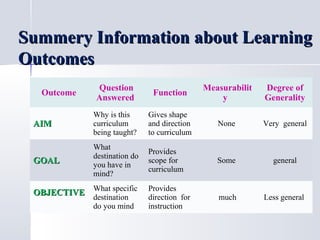
Summery Information about Learning
Outcomes
Question
Answered

Function

Measurabilit
y

Degree of
Generality

AIM

Why is this
curriculum
being taught?

Gives shape
and direction
to curriculum

None

Very general

GOAL

What
destination do
you have in
mind?

Provides
scope for
curriculum

Some

general

Provides
direction for
instruction

much

Less general

Outcome

OBJECTIVE What specific
destination
do you mind
Learning Experiences
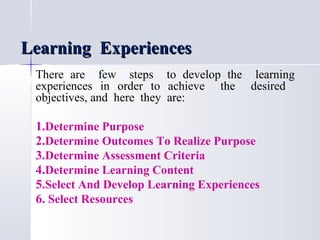
There are few steps to develop the learning
experiences in order to achieve the desired
objectives, and here they are:

1.Determine Purpose
2.Determine Outcomes To Realize Purpose
3.Determine Assessment Criteria
4.Determine Learning Content
5.Select And Develop Learning Experiences
6. Select Resources
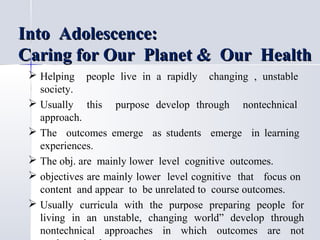
Into Adolescence:
Caring for Our Planet & Our Health
 Helping

people live in a rapidly

changing , unstable

society.
 Usually this purpose develop through nontechnical
approach.
 The outcomes emerge as students emerge in learning
experiences.
 The obj. are mainly lower level cognitive outcomes.
 objectives are mainly lower level cognitive that focus on
content and appear to be unrelated to course outcomes.
 Usually curricula with the purpose preparing people for
living in an unstable, changing world” develop through
nontechnical approaches in which outcomes are not
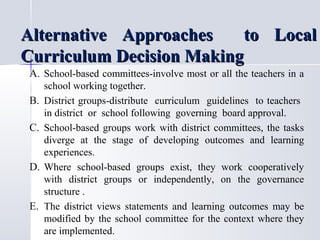
Alternative Approaches
to Local
Curriculum Decision Making
A. School-based committees-involve most or all the teachers in a
B.
C.

D.

E.

school working together.
District groups-distribute curriculum guidelines to teachers
in district or school following governing board approval.
School-based groups work with district committees, the tasks
diverge at the stage of developing outcomes and learning
experiences.
Where school-based groups exist, they work cooperatively
with district groups or independently, on the governance
structure .
The district views statements and learning outcomes may be
modified by the school committee for the context where they
are implemented.
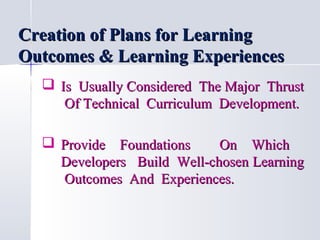
Creation of Plans for Learning
Outcomes & Learning Experiences
 Is Usually Considered The Major Thrust
Of Technical Curriculum Development.
 Provide Foundations
On Which
Developers Build Well-chosen Learning
Outcomes And Experiences.
Health Curriculum
The health education curriculum provides all
students with the skills and knowledge to
promote responsible lifetime decision making
and contribute to a healthy and safe society.

District Level
District committees have specific roles and
responsibilities, carrying out functions that
contribute to a wide variety of goals.
Health Curriculum
School Level:
The principle must work with teachers and staff in the
school to develop and implement a revised curriculum.
What the principle does know is that children in the school
and their parents/guardians need the information in this
curriculum.
Because the purpose of education is unchanged, teachers and
community members don’t question the aim of the
curriculum.
Some teachers and community members contribute ideas
centering on the needs of students and their family for
practical health information.
Reconsideration of Content
Organization
Because this is a subject-based curriculum,
the developers should also check on
sequence to see that the repeated ideas and
skills require greater depths than those that
preceded.
Curriculum developers should strive for
integration, making sure that affective and
cognitive learning work together.
Conclusion
Intended Learning Outcomes –Occupying
A Continuum Of Broadness –Narrowness
---Aims –Goals---objectives.
Learning Experiences Provide The Means
To Satisfy The Objectives.
Indicate How Ts And Ss Are To Interact
With The Content.
References
Inductive approach and Deductive approach in TESOL ( By International
Teacher Training Organization.13-Wilson's Curriculum Pages,
Writing Aims, Goals and Objective.
http://www.rotary.org/RIdocuments/en_pdf/249en.pdf
http://www.teachandlearn.ca/blog/2007/08/16/creating-learningexperiences
http://www.polyu.edu.hk/obe/GuideOBE/DefiningIntendedLearningOutco
mes.pdf
http://www1.harenet.ne.jp/~waring/er/aims.htm
http://www.thecanadianencyclopedia.com/index.cfm?
PgNm=TCE&Params=A1ARTA0002083
http://www.nes.scot.nhs.uk/Courses/ti/AimsObjectives.pdf
http://bashirsono.blogspot.com/2009/08/aims-goals-and-objectives.html

Learningoutcomesandlearningexperiencesfortechnicallydevelopedcurriculumprojectsintesl 100826002712-phpapp01

  • 1.
    Curriculum & SyllabusDesign LEARNING OUTCOMES & LEARNING EXPERIENCES FOR TECHNICALLY DEVELOPED CURRICULUM PROJECTS Dr. Azade Asgari
  • 2.
    The preparation oflearning outcomes and learning experiences is the culmination of a technically developed curriculum project. Learning outcomes and learning experiences display how the curriculum fits the community and how teachers and school staff are expected to deliver curriculum content to students . It enable u an educator to evaluate description of learning outcomes and learning experiences in curriculum documents .
  • 3.
    Intended Learning Outcomesand Planned Learning Experiences Learning outcomes results from students experiences with the curriculum content selected by developers and noted in their content statement.  Curriculum developers plan intended learning outcomes –students achieve the actual learning outcomes.
  • 4.
    Definitions Intended Learning Outcomes: Represent what learners are expected to be able to do with curriculum content .  Formal knowledge or skills can be stated as intended learning outcomes.  Learning domains (attitudes, interests, appreciations ,thinking skills and other cognitive strategies) are not easily stated as intended learning outcomes.  Outcomes and learning experiences reveals developers' values about curricula delivery; revealing their priorities on respective –generative knowledge.  Verbs chosen to express actions on content are important measures of broadness – narrowness.  Learning outcomes include aims, goals and objectives –generality from broad to narrow.
  • 5.
    What Are LearningOutcomes? Learning outcomes are goals that describe how a student will be different because of a learning experience. More specifically, learning outcomes are the knowledge, skills, attitudes, and habits of mind that students take with them from a learning experience. Outcomes and learning experiences reveals developers' values about curricula delivery; revealing their priorities on respective –generative knowledge. Verbs chosen to express actions on content are important measures of broadness – narrowness. Learning outcomes include aims, goals and objectives – generality from broad to narrow.
  • 6.
    Sample Learning Outcomes Students will be able to locate, apply and cite effective secondary materials in their own texts.  Students will be able to analyze and interpret texts within the contexts they are written.  Students will be able to demonstrate fluency with formal vocabulary, artistic techniques and procedures of two dimensional and threedimensional art practice.
  • 7.
    Why Learning Outcomes StudentLearning Becomes Central When The Focus Is On What The Student Should Be Able To Achieve By The End.
  • 8.
    Technical Approach toDevelopment The most appropriate approach to curriculum development, according to the traditional literature, is the technical approach, the goal of which is to teach more content more efficiently with the greatest possible amount of student achievement.
  • 9.
    It Suggests : A deductive approach developers create aims first.  Translate them into goals.  Finally into objectives .  Objectives are transformed into learning experiences.  Aims and goals should be devised before objectives and learning experiences.
  • 10.
    AIMS ,GOALS &OBJECTIVES AIMS a.General, philosophical, and long term. b. Serve as statements of purpose . c. Are not measurable . d. Exist to provide shape and direction for a curriculum. e. Can be made operational as a set of goals.
  • 11.
    AIMS ,GOALS &OBJECTIVES Aimsrefer to general guidelines for the teachers that describe expected life outcomes based on some values. Aims are stated in broader terms. They can not be achieved completely. They are broadly phrased statements borrowed from philosophy. They can be applied to the educational system rather than an individual school and classroom. Aims are usually written in amorphous terms using words like: learn, know, understand, appreciate, and these are not directly measurable. Aims may serve as organizing principles of educational direction for more than one grade.
  • 12.
    AIMS ,GOALS &OBJECTIVES GOALS a.Depending on content generality ,planning requirements at various levels of curriculum decision making . b. Can be measured to the extent of deciding. c. Less long term than aims. d. May be achievable within semester . e. Too may encompass an entire program, subject area, or multiple grade levels.
  • 13.
    AIMS ,GOALS &OBJECTIVES OBJECTIVES a. Come from goals. b.Narrower statement of learning outcomes. c. Vary -depending on how planners conceive of content and their preferences. d.Provide curriculum developers with opportunities e. To state operationally what the goal statements mean. f. To provide direction to instructional planners.
  • 14.
    AIMS ,GOALS &OBJECTIVES Objectivesprovide great assistance to the teachers in planning process of teaching. A well planned teaching is based on well stated objectives. Many teachers resist using objectives in their teaching and they think that it will make their teaching limited
  • 15.
    AIMS ,GOALS &OBJECTIVES ThereAre Two Types Of Objectives: 1. Instructional Objectives . 2. Behavioral Objectives.
  • 16.
    AIMS ,GOALS &OBJECTIVES Instructional Objectives: provide a road map to the teacher to select appropriate content, strategies, resources and assessment.  Behavioral Objectives: classroom objectives based on the observable behavior. They can be observed by the teachers while the learners perform.
  • 17.
    What Is TheDifferences Between Aims, Goals & Objectives:  Without aims, goals and objectives education is just like a ship in the sea which has no specified direction to move.  Aims and objectives are always linked, but often confused.  Aims are the changes you hope to achieve as a result of your work  Objectives are the activities you undertake and the services you offer to bring these changes about.  The main difference between goals and objectives is the level of specificity.  Objectives are short but clear statements about the specific outcomes we expect from students.  The relationship between aims, goals and objectives can be shown through the continuum.
  • 18.
    Summery Information aboutLearning Outcomes Question Answered Function Measurabilit y Degree of Generality AIM Why is this curriculum being taught? Gives shape and direction to curriculum None Very general GOAL What destination do you have in mind? Provides scope for curriculum Some general Provides direction for instruction much Less general Outcome OBJECTIVE What specific destination do you mind
  • 19.
  • 20.
    Learning Experiences There arefew steps to develop the learning experiences in order to achieve the desired objectives, and here they are: 1.Determine Purpose 2.Determine Outcomes To Realize Purpose 3.Determine Assessment Criteria 4.Determine Learning Content 5.Select And Develop Learning Experiences 6. Select Resources
  • 21.
    Into Adolescence: Caring forOur Planet & Our Health  Helping people live in a rapidly changing , unstable society.  Usually this purpose develop through nontechnical approach.  The outcomes emerge as students emerge in learning experiences.  The obj. are mainly lower level cognitive outcomes.  objectives are mainly lower level cognitive that focus on content and appear to be unrelated to course outcomes.  Usually curricula with the purpose preparing people for living in an unstable, changing world” develop through nontechnical approaches in which outcomes are not
  • 22.
    Alternative Approaches to Local CurriculumDecision Making A. School-based committees-involve most or all the teachers in a B. C. D. E. school working together. District groups-distribute curriculum guidelines to teachers in district or school following governing board approval. School-based groups work with district committees, the tasks diverge at the stage of developing outcomes and learning experiences. Where school-based groups exist, they work cooperatively with district groups or independently, on the governance structure . The district views statements and learning outcomes may be modified by the school committee for the context where they are implemented.
  • 23.
    Creation of Plansfor Learning Outcomes & Learning Experiences  Is Usually Considered The Major Thrust Of Technical Curriculum Development.  Provide Foundations On Which Developers Build Well-chosen Learning Outcomes And Experiences.
  • 24.
    Health Curriculum The healtheducation curriculum provides all students with the skills and knowledge to promote responsible lifetime decision making and contribute to a healthy and safe society. District Level District committees have specific roles and responsibilities, carrying out functions that contribute to a wide variety of goals.
  • 25.
    Health Curriculum School Level: Theprinciple must work with teachers and staff in the school to develop and implement a revised curriculum. What the principle does know is that children in the school and their parents/guardians need the information in this curriculum. Because the purpose of education is unchanged, teachers and community members don’t question the aim of the curriculum. Some teachers and community members contribute ideas centering on the needs of students and their family for practical health information.
  • 26.
    Reconsideration of Content Organization Becausethis is a subject-based curriculum, the developers should also check on sequence to see that the repeated ideas and skills require greater depths than those that preceded. Curriculum developers should strive for integration, making sure that affective and cognitive learning work together.
  • 27.
    Conclusion Intended Learning Outcomes–Occupying A Continuum Of Broadness –Narrowness ---Aims –Goals---objectives. Learning Experiences Provide The Means To Satisfy The Objectives. Indicate How Ts And Ss Are To Interact With The Content.
  • 28.
    References Inductive approach andDeductive approach in TESOL ( By International Teacher Training Organization.13-Wilson's Curriculum Pages, Writing Aims, Goals and Objective. http://www.rotary.org/RIdocuments/en_pdf/249en.pdf http://www.teachandlearn.ca/blog/2007/08/16/creating-learningexperiences http://www.polyu.edu.hk/obe/GuideOBE/DefiningIntendedLearningOutco mes.pdf http://www1.harenet.ne.jp/~waring/er/aims.htm http://www.thecanadianencyclopedia.com/index.cfm? PgNm=TCE&Params=A1ARTA0002083 http://www.nes.scot.nhs.uk/Courses/ti/AimsObjectives.pdf http://bashirsono.blogspot.com/2009/08/aims-goals-and-objectives.html