Attitude towards
death, grief and
bereavement
SUBMITTED BY: AMITA
Definitions of Death and Dying
Fischer (1998) Dying is a journey a person must
take in the last phase of life. It is the process
leading to the end. It can sometimes be a long
journey of progressive suffering on many levels.
Old persons often fear weakness, pain, physical
dependence, and mental deterioration more than
the cessation of life.
Fischer (1998) defined death as the final moment
of life, the end of life.
Attitude Towards Death
Attitudes toward death and dying vary widely across cultures, societies,
and individuals. Some may view death as a natural part of life, a
transition or passage to another state or existence, while others may
perceive it with fear, uncertainty, or avoidance due to the unknown.
Cultural and religious beliefs heavily influence attitudes toward death.
Some cultures celebrate death as a continuation of life or honor it
through ceremonies and rituals. Others may have specific beliefs about
the afterlife or reincarnation that shape their perspectives on dying.
On an individual level, attitudes toward death can be influenced by
personal experiences, philosophical beliefs, and one's understanding of
mortality. Some people embrace the concept of mortality, viewing it as a
motivator to live life to the fullest and cherish each moment.
Cont..
 As people become older, they usually become less interested in life after death and more concerned
about death and life after death. This is especially true of elderly people whose physical or mental
condition has begun to deteriorate. When health fails, they tend to concentrate on death. They have
the certain questions regarding death..
 The first question about death that is of profound interest to many elderly people is, "When will I
die?" While they know that no one can predict this with any degree of accuracy.
 " The second question about death is that "What is likely to cause my death?"" While statistics
show that heart disease, cancer, strokes, and accidents are the most common causes of death among
the elderly, many die from other causes.
 " Third question about death that many elderly people ask is: "What can I do to die as I wish to
die?" In the past, most men and women accepted the belief that death is a matter of "God's will"
and that the individual should have no voice in the matter.
 The fourth question that some elderly people ask themselves is whether they are justified in
taking their lives if, for one reason or other, they find life has become unbearable.
 The fifth question many elderly people ask is how can they have a "good" death. While a "good"
death may have different meanings for different people, most elderly people agree that it can be
considered "good" if, their important personal needs are met.
Different Viewpoints of Death
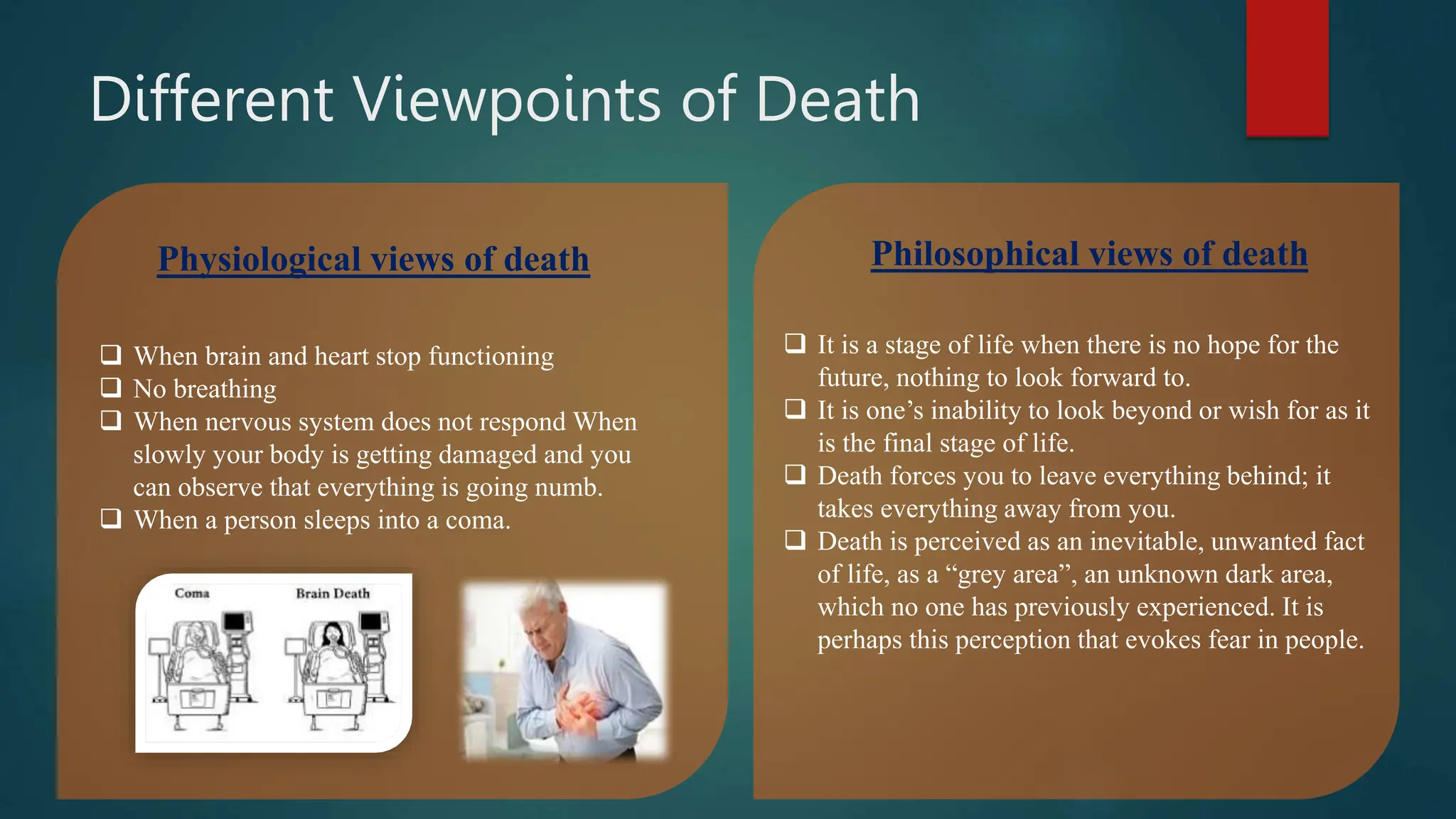
Physiological views of death
 When brain and heart stop functioning
 No breathing
 When nervous system does not respond When
slowly your body is getting damaged and you
can observe that everything is going numb.
 When a person sleeps into a coma.
Philosophical views of death
 It is a stage of life when there is no hope for the
future, nothing to look forward to.
 It is one’s inability to look beyond or wish for as it
is the final stage of life.
 Death forces you to leave everything behind; it
takes everything away from you.
 Death is perceived as an inevitable, unwanted fact
of life, as a “grey area”, an unknown dark area,
which no one has previously experienced. It is
perhaps this perception that evokes fear in people.
 Death is a kin to moving away from this materialistic world
and your soul is meeting with God, the supreme authority. It is
moving to a higher level. It is a beginning of new life. It is only
the end of physical entity of our physical being, when the soul
leaves the body’.
 Death’ to some means the end of merely the physical existence
and the beginning of a new life. It is part of a continuous
process.
 Death is also perceived as a great leveler that ‘visits everyone
without discrimination of caste class, or gender’.
 ‘Every moment since we took birth on this earth, we are
inching towards death’.
Spiritual views of death
Sex Differences in Interest in Death
 The research references on sex differences suggest that, elderly men have different interests in death
than elderly women.
 For the most part, men focus their attention on their own deaths-what will cause them, when they will
occur, etc. While they may be interested in the deaths of their wives, children, close friends, and
relatives, their interest is primarily egocentric.
 In the case of women, interest in death is likewise egocentric in the sense that their concern is how
death will affect them and the pattern of their lives. Their interest, however, is concentrated on their
husbands' deaths rather than on their own. Many engage in what has been called a "rehearsal for
widowhood." In this rehearsal, their concern is focused on how they will manage financially when their
husbands die, where they will live, what they will do with their time, etc. While some women,
unquestionably are interested in their own deaths.
 Communication and Expression: Women often tend to be more expressive about their
emotions, including those related to death. They might be more open to discussing feelings,
fears, and concerns about mortality, seeking support and sharing their thoughts. Men, on the
other hand, might be socialized to suppress emotions related to death, leading to a perception of
stoicism or a more reserved approach.
 Coping Mechanisms: Women might employ social support networks more readily to deal with
grief and loss. They may seek out community or family connections to navigate the emotional
impact of death. Men might sometimes lean towards individual coping mechanisms,
internalizing their emotions or finding comfort in activities or work.
 Cultural Influences: Cultural expectations and norms can strongly influence attitudes towards
death. In some cultures, men might be expected to display strength and resilience in the face of
death, while women might be encouraged to provide emotional support and caregiving.
 Spirituality and Beliefs: Both men and women might have varying religious or spiritual beliefs
that shape their perspectives on death. These beliefs can significantly impact how they approach
the concept of mortality, including notions of an afterlife, reincarnation, or the meaning of life
and death.
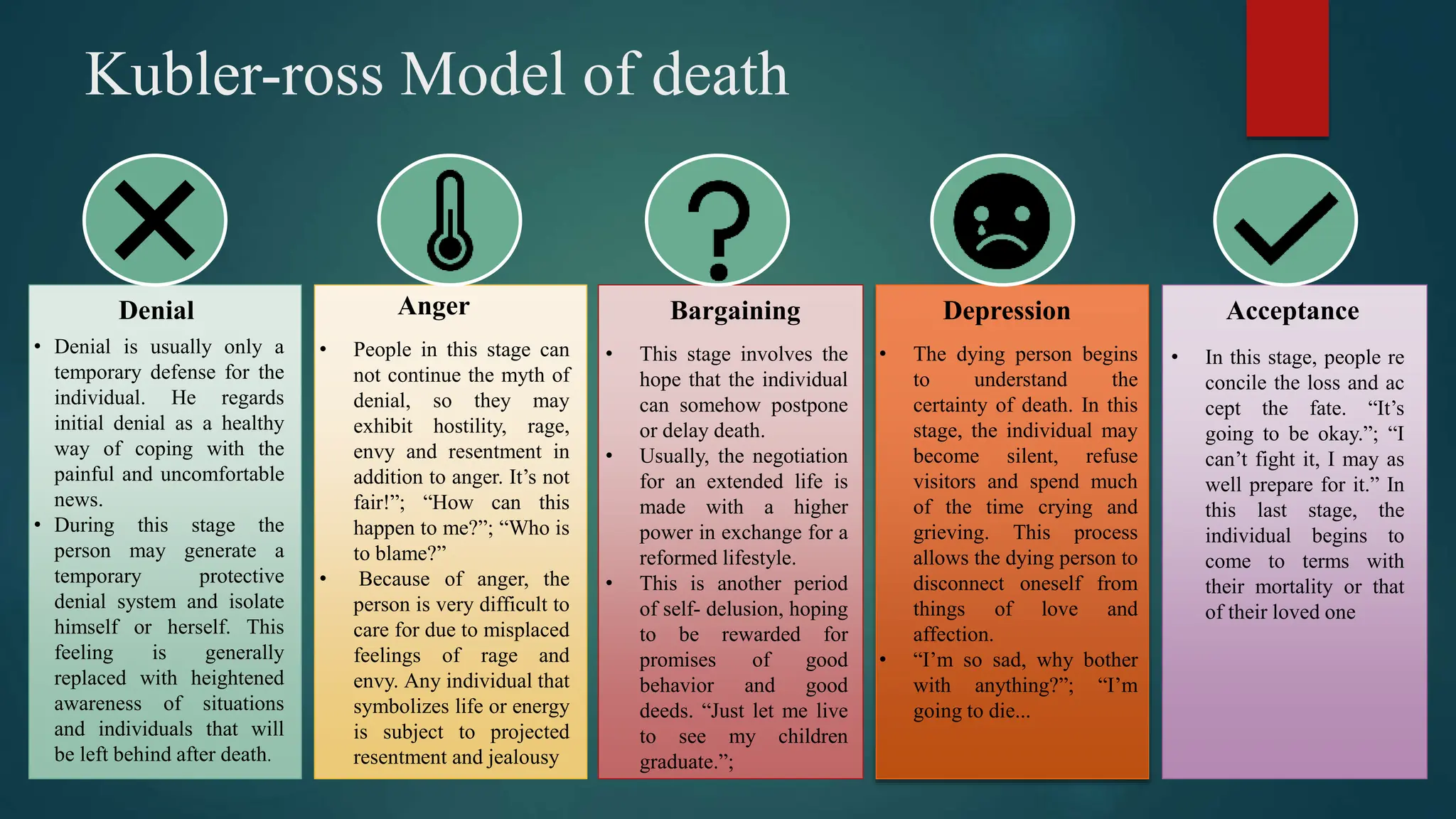
Kubler-ross Model of death
Denial
• Denial is usually only a
temporary defense for the
individual. He regards
initial denial as a healthy
way of coping with the
painful and uncomfortable
news.
• During this stage the
person may generate a
temporary protective
denial system and isolate
himself or herself. This
feeling is generally
replaced with heightened
awareness of situations
and individuals that will
be left behind after death.
Anger
• People in this stage can
not continue the myth of
denial, so they may
exhibit hostility, rage,
envy and resentment in
addition to anger. It’s not
fair!”; “How can this
happen to me?”; “Who is
to blame?”
• Because of anger, the
person is very difficult to
care for due to misplaced
feelings of rage and
envy. Any individual that
symbolizes life or energy
is subject to projected
resentment and jealousy
Bargaining
• This stage involves the
hope that the individual
can somehow postpone
or delay death.
• Usually, the negotiation
for an extended life is
made with a higher
power in exchange for a
reformed lifestyle.
• This is another period
of self- delusion, hoping
to be rewarded for
promises of good
behavior and good
deeds. “Just let me live
to see my children
graduate.”;
Depression
• The dying person begins
to understand the
certainty of death. In this
stage, the individual may
become silent, refuse
visitors and spend much
of the time crying and
grieving. This process
allows the dying person to
disconnect oneself from
things of love and
affection.
• “I’m so sad, why bother
with anything?”; “I’m
going to die...
Acceptance
• In this stage, people re
concile the loss and ac
cept the fate. “It’s
going to be okay.”; “I
can’t fight it, I may as
well prepare for it.” In
this last stage, the
individual begins to
come to terms with
their mortality or that
of their loved one
Death
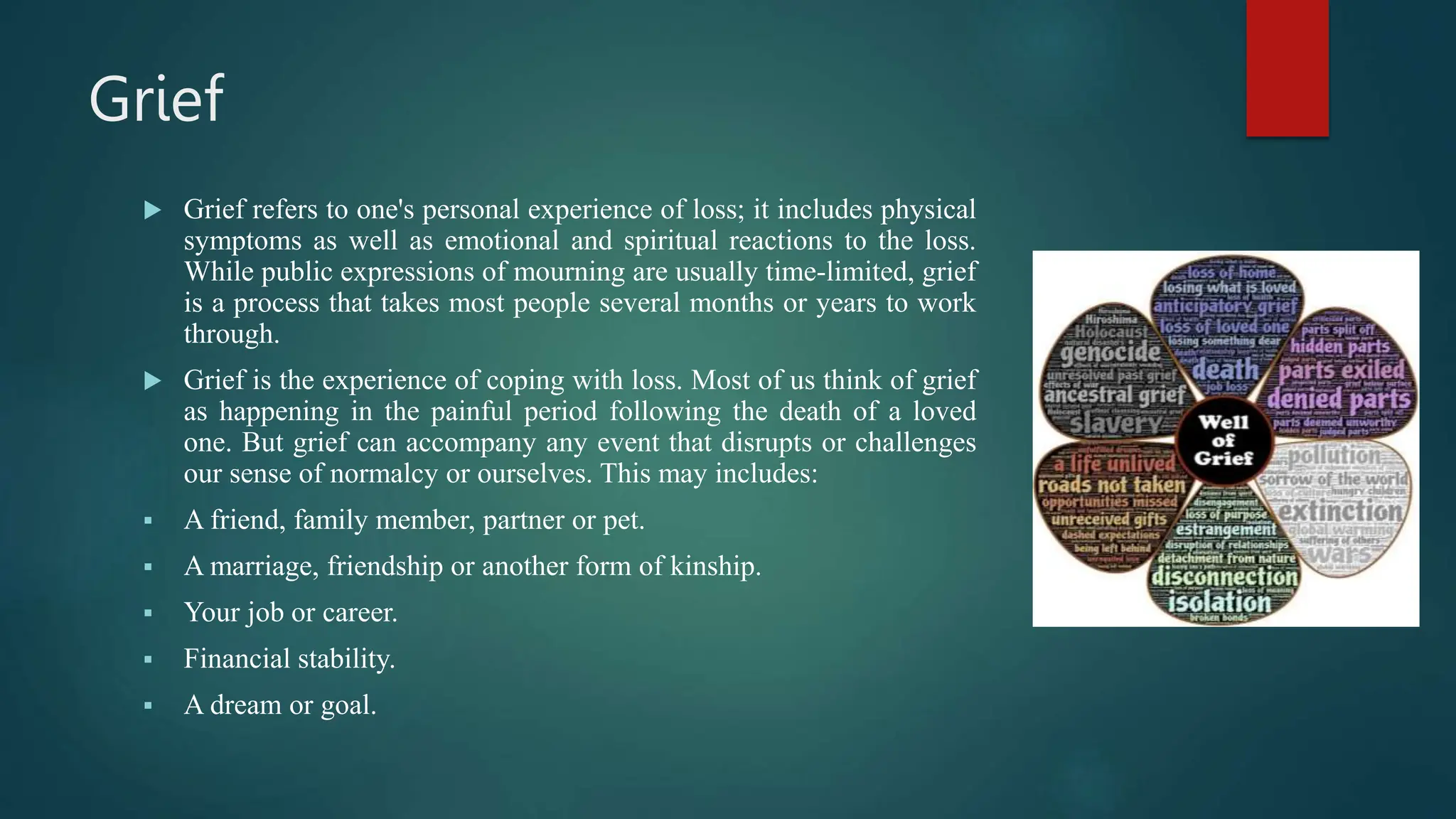
Grief
 Grief refers to one's personal experience of loss; it includes physical
symptoms as well as emotional and spiritual reactions to the loss.
While public expressions of mourning are usually time-limited, grief
is a process that takes most people several months or years to work
through.
 Grief is the experience of coping with loss. Most of us think of grief
as happening in the painful period following the death of a loved
one. But grief can accompany any event that disrupts or challenges
our sense of normalcy or ourselves. This may includes:
 A friend, family member, partner or pet.
 A marriage, friendship or another form of kinship.
 Your job or career.
 Financial stability.
 A dream or goal.
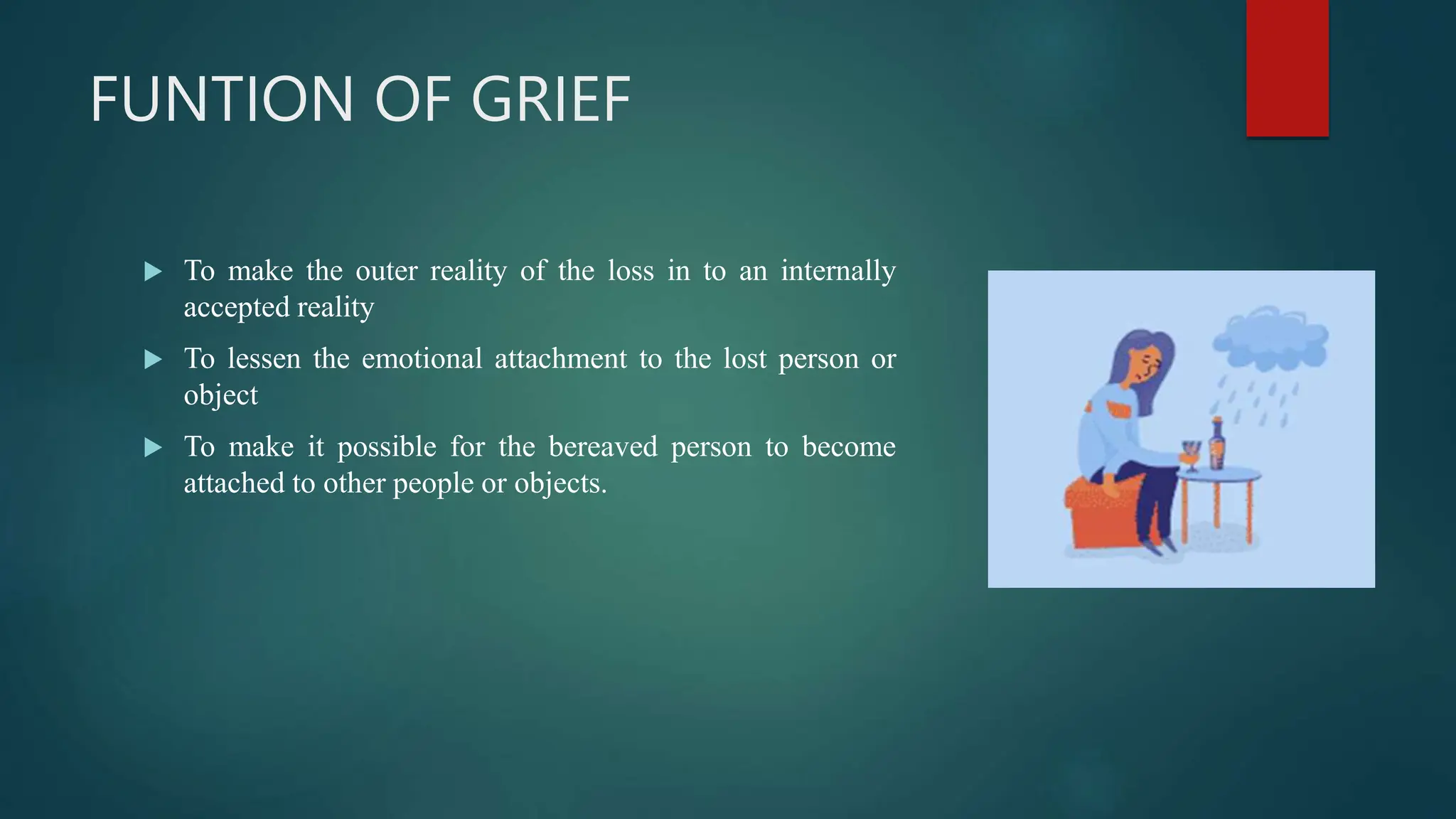
FUNTION OF GRIEF
 To make the outer reality of the loss in to an internally
accepted reality
 To lessen the emotional attachment to the lost person or
object
 To make it possible for the bereaved person to become
attached to other people or objects.
Types of grief
Attitude towards grief
 The child, 6-12 years old: School age children at this stage learn basic skills, but attach their cultural
values to it. Death of a loved one during a disaster or crisis event can result in a child not wanting to
leave home, hoping to reassure the safety of others. For the school aged child, like the younger child,
grief crisis may interrupt age appropriate activities and force a child to address issues for which the child
is not developmentally prepared. Children this age might believe that certain behavior will bring their
loved ones back. They might be preoccupied with fear. They might also experience sadness, anger,
anxiety and guilt.
 The adolescent, 13-19 years old: Adolescents often deal with self-esteem and identity issues. They want
to differentiate from their parents. If they lose a loved one during a disaster or crisis event, they might
feel guilty because of what they might have said to the person before they died. Adolescents just like the
young and the school aged child who experiencing this kind of loss during a disaster or crisis event may
experience an interruption of age-appropriate activities. Adolescents often express their grief and loss
issues through their body language and acting out behavior. In addition, adolescents might be internally
preoccupied with death, which might be manifested through poor school performance. Losses among
adolescents and young adults are relatively common (mostly grandparents.
 Adolescents may experience the loss of a close friend before the age of 15 years. Deaths among
adolescents and young adults are often caused by accidents, suicides, and homicides, placing them at
significant risk for traumatic bereavement occasioned by the traumatic deaths of their friends, romantic
partners, and family members. Sudden and violent deaths increase the risk of more intense and
complicated grief reactions than do more natural losses.
The young adult, 20-40 years old: Young adults can be devastated by the death of a loved one during a
disaster or crisis event. For example, losing one’s child can be paralyzing for parents. The parents might
blame themselves for not protecting their child better during the disaster or crisis event. Their emotions
might range greatly and include such things as loneliness, sadness, disbelief, anger, anxiety, etc. Young
adults losing a spouse or partner might feel emptiness and isolation and their social connections might
change as they are no longer a couple but an individual. Losing a spouse or partner at this age means not
only grieving, but assuming the (often unfamiliar) responsibilities and roles of the deceased and may
include helping children through grief.
The middle aged adults, 40-60 years old: Middle aged adults, similar to young adults, can be badly
impacted by the sudden loss of a loved one during a disaster or crisis event. They might grieve the loss of
their children and potential future grandchildren. They might feel guilty for not having been able to protect
their children. Losing a spouse or partner during a disaster or crisis event can leave middle aged adults
with (often unfamiliar) responsibilities and roles, experiencing financial hardship, and/or dealing with
grieving children. Middle aged adults might grieve future plans for retiring together.
The elderly adult, 60+ years: Elderly adults, often have experienced multiple losses, such as jobs, health,
independence, social roles, familiar living surroundings, and loved ones. Although loss is often expected
during this age, unexpected losses of children and/or spouses or partners during a disaster or crisis event
can be detrimental, since children are often also caregivers. Loss of a spouse or partner might result in
feeling more dependent on others. Often the elderly adult lacks the social support needed, which can be
detrimental during this time.
Bereavement
Bereavement refers to an emotional state of mourning the loss of
a loved one to death. It can be characterized by the intense grief
we experience after the death of a close one when our emotions
are at their extremity.
Bereavement is a period of grief and associated emotions that
people experience as they gradually adjust to the loss of
someone important to them. It encompasses several human
emotions from tremendous sorrow to extreme anger. The process
of adapting to a loss or how long the grief lasts can depend on
how close one was to the person who died.
SYMPTOMS OF BEREAVEMEN
Types of Bereavement
Four stages or phases in bereavement
Shock, disbelief, feelings of numbness This initial phase lasts about two weeks, during which
the bereaved person finally accepts the reality of the loved one's death.
Suffering the pain of grief This phase typically lasts for several months. Some people
undergo a mild temporary depression about six months after the loved one's death.
Adjusting to life without the loved one In this phase of bereavement, survivors may find
themselves taking on the loved one's roles and responsibilities as well as redefining their own
identities.
Moving forward with life, forming new relation-ships, and having positive expectations of the
future. Most people reach this stage within one to two years after the loved one's death.
How To Cope With Bereavement ?
attitude towards death, grief and bereavement

attitude towards death, grief and bereavement

  • 1.
    Attitude towards death, griefand bereavement SUBMITTED BY: AMITA
  • 2.
    Definitions of Deathand Dying Fischer (1998) Dying is a journey a person must take in the last phase of life. It is the process leading to the end. It can sometimes be a long journey of progressive suffering on many levels. Old persons often fear weakness, pain, physical dependence, and mental deterioration more than the cessation of life. Fischer (1998) defined death as the final moment of life, the end of life.
  • 3.
    Attitude Towards Death Attitudestoward death and dying vary widely across cultures, societies, and individuals. Some may view death as a natural part of life, a transition or passage to another state or existence, while others may perceive it with fear, uncertainty, or avoidance due to the unknown. Cultural and religious beliefs heavily influence attitudes toward death. Some cultures celebrate death as a continuation of life or honor it through ceremonies and rituals. Others may have specific beliefs about the afterlife or reincarnation that shape their perspectives on dying. On an individual level, attitudes toward death can be influenced by personal experiences, philosophical beliefs, and one's understanding of mortality. Some people embrace the concept of mortality, viewing it as a motivator to live life to the fullest and cherish each moment.
  • 4.
    Cont..  As peoplebecome older, they usually become less interested in life after death and more concerned about death and life after death. This is especially true of elderly people whose physical or mental condition has begun to deteriorate. When health fails, they tend to concentrate on death. They have the certain questions regarding death..  The first question about death that is of profound interest to many elderly people is, "When will I die?" While they know that no one can predict this with any degree of accuracy.  " The second question about death is that "What is likely to cause my death?"" While statistics show that heart disease, cancer, strokes, and accidents are the most common causes of death among the elderly, many die from other causes.  " Third question about death that many elderly people ask is: "What can I do to die as I wish to die?" In the past, most men and women accepted the belief that death is a matter of "God's will" and that the individual should have no voice in the matter.  The fourth question that some elderly people ask themselves is whether they are justified in taking their lives if, for one reason or other, they find life has become unbearable.  The fifth question many elderly people ask is how can they have a "good" death. While a "good" death may have different meanings for different people, most elderly people agree that it can be considered "good" if, their important personal needs are met.
  • 5.
    Different Viewpoints ofDeath Physiological views of death  When brain and heart stop functioning  No breathing  When nervous system does not respond When slowly your body is getting damaged and you can observe that everything is going numb.  When a person sleeps into a coma. Philosophical views of death  It is a stage of life when there is no hope for the future, nothing to look forward to.  It is one’s inability to look beyond or wish for as it is the final stage of life.  Death forces you to leave everything behind; it takes everything away from you.  Death is perceived as an inevitable, unwanted fact of life, as a “grey area”, an unknown dark area, which no one has previously experienced. It is perhaps this perception that evokes fear in people.
  • 6.
     Death isa kin to moving away from this materialistic world and your soul is meeting with God, the supreme authority. It is moving to a higher level. It is a beginning of new life. It is only the end of physical entity of our physical being, when the soul leaves the body’.  Death’ to some means the end of merely the physical existence and the beginning of a new life. It is part of a continuous process.  Death is also perceived as a great leveler that ‘visits everyone without discrimination of caste class, or gender’.  ‘Every moment since we took birth on this earth, we are inching towards death’. Spiritual views of death
  • 7.
    Sex Differences inInterest in Death  The research references on sex differences suggest that, elderly men have different interests in death than elderly women.  For the most part, men focus their attention on their own deaths-what will cause them, when they will occur, etc. While they may be interested in the deaths of their wives, children, close friends, and relatives, their interest is primarily egocentric.  In the case of women, interest in death is likewise egocentric in the sense that their concern is how death will affect them and the pattern of their lives. Their interest, however, is concentrated on their husbands' deaths rather than on their own. Many engage in what has been called a "rehearsal for widowhood." In this rehearsal, their concern is focused on how they will manage financially when their husbands die, where they will live, what they will do with their time, etc. While some women, unquestionably are interested in their own deaths.
  • 8.
     Communication andExpression: Women often tend to be more expressive about their emotions, including those related to death. They might be more open to discussing feelings, fears, and concerns about mortality, seeking support and sharing their thoughts. Men, on the other hand, might be socialized to suppress emotions related to death, leading to a perception of stoicism or a more reserved approach.  Coping Mechanisms: Women might employ social support networks more readily to deal with grief and loss. They may seek out community or family connections to navigate the emotional impact of death. Men might sometimes lean towards individual coping mechanisms, internalizing their emotions or finding comfort in activities or work.  Cultural Influences: Cultural expectations and norms can strongly influence attitudes towards death. In some cultures, men might be expected to display strength and resilience in the face of death, while women might be encouraged to provide emotional support and caregiving.  Spirituality and Beliefs: Both men and women might have varying religious or spiritual beliefs that shape their perspectives on death. These beliefs can significantly impact how they approach the concept of mortality, including notions of an afterlife, reincarnation, or the meaning of life and death.
  • 9.
    Kubler-ross Model ofdeath Denial • Denial is usually only a temporary defense for the individual. He regards initial denial as a healthy way of coping with the painful and uncomfortable news. • During this stage the person may generate a temporary protective denial system and isolate himself or herself. This feeling is generally replaced with heightened awareness of situations and individuals that will be left behind after death. Anger • People in this stage can not continue the myth of denial, so they may exhibit hostility, rage, envy and resentment in addition to anger. It’s not fair!”; “How can this happen to me?”; “Who is to blame?” • Because of anger, the person is very difficult to care for due to misplaced feelings of rage and envy. Any individual that symbolizes life or energy is subject to projected resentment and jealousy Bargaining • This stage involves the hope that the individual can somehow postpone or delay death. • Usually, the negotiation for an extended life is made with a higher power in exchange for a reformed lifestyle. • This is another period of self- delusion, hoping to be rewarded for promises of good behavior and good deeds. “Just let me live to see my children graduate.”; Depression • The dying person begins to understand the certainty of death. In this stage, the individual may become silent, refuse visitors and spend much of the time crying and grieving. This process allows the dying person to disconnect oneself from things of love and affection. • “I’m so sad, why bother with anything?”; “I’m going to die... Acceptance • In this stage, people re concile the loss and ac cept the fate. “It’s going to be okay.”; “I can’t fight it, I may as well prepare for it.” In this last stage, the individual begins to come to terms with their mortality or that of their loved one
  • 10.
  • 11.
    Grief  Grief refersto one's personal experience of loss; it includes physical symptoms as well as emotional and spiritual reactions to the loss. While public expressions of mourning are usually time-limited, grief is a process that takes most people several months or years to work through.  Grief is the experience of coping with loss. Most of us think of grief as happening in the painful period following the death of a loved one. But grief can accompany any event that disrupts or challenges our sense of normalcy or ourselves. This may includes:  A friend, family member, partner or pet.  A marriage, friendship or another form of kinship.  Your job or career.  Financial stability.  A dream or goal.
  • 12.
    FUNTION OF GRIEF To make the outer reality of the loss in to an internally accepted reality  To lessen the emotional attachment to the lost person or object  To make it possible for the bereaved person to become attached to other people or objects.
  • 13.
  • 14.
    Attitude towards grief The child, 6-12 years old: School age children at this stage learn basic skills, but attach their cultural values to it. Death of a loved one during a disaster or crisis event can result in a child not wanting to leave home, hoping to reassure the safety of others. For the school aged child, like the younger child, grief crisis may interrupt age appropriate activities and force a child to address issues for which the child is not developmentally prepared. Children this age might believe that certain behavior will bring their loved ones back. They might be preoccupied with fear. They might also experience sadness, anger, anxiety and guilt.  The adolescent, 13-19 years old: Adolescents often deal with self-esteem and identity issues. They want to differentiate from their parents. If they lose a loved one during a disaster or crisis event, they might feel guilty because of what they might have said to the person before they died. Adolescents just like the young and the school aged child who experiencing this kind of loss during a disaster or crisis event may experience an interruption of age-appropriate activities. Adolescents often express their grief and loss issues through their body language and acting out behavior. In addition, adolescents might be internally preoccupied with death, which might be manifested through poor school performance. Losses among adolescents and young adults are relatively common (mostly grandparents.  Adolescents may experience the loss of a close friend before the age of 15 years. Deaths among adolescents and young adults are often caused by accidents, suicides, and homicides, placing them at significant risk for traumatic bereavement occasioned by the traumatic deaths of their friends, romantic partners, and family members. Sudden and violent deaths increase the risk of more intense and complicated grief reactions than do more natural losses.
  • 15.
    The young adult,20-40 years old: Young adults can be devastated by the death of a loved one during a disaster or crisis event. For example, losing one’s child can be paralyzing for parents. The parents might blame themselves for not protecting their child better during the disaster or crisis event. Their emotions might range greatly and include such things as loneliness, sadness, disbelief, anger, anxiety, etc. Young adults losing a spouse or partner might feel emptiness and isolation and their social connections might change as they are no longer a couple but an individual. Losing a spouse or partner at this age means not only grieving, but assuming the (often unfamiliar) responsibilities and roles of the deceased and may include helping children through grief. The middle aged adults, 40-60 years old: Middle aged adults, similar to young adults, can be badly impacted by the sudden loss of a loved one during a disaster or crisis event. They might grieve the loss of their children and potential future grandchildren. They might feel guilty for not having been able to protect their children. Losing a spouse or partner during a disaster or crisis event can leave middle aged adults with (often unfamiliar) responsibilities and roles, experiencing financial hardship, and/or dealing with grieving children. Middle aged adults might grieve future plans for retiring together. The elderly adult, 60+ years: Elderly adults, often have experienced multiple losses, such as jobs, health, independence, social roles, familiar living surroundings, and loved ones. Although loss is often expected during this age, unexpected losses of children and/or spouses or partners during a disaster or crisis event can be detrimental, since children are often also caregivers. Loss of a spouse or partner might result in feeling more dependent on others. Often the elderly adult lacks the social support needed, which can be detrimental during this time.
  • 16.
    Bereavement Bereavement refers toan emotional state of mourning the loss of a loved one to death. It can be characterized by the intense grief we experience after the death of a close one when our emotions are at their extremity. Bereavement is a period of grief and associated emotions that people experience as they gradually adjust to the loss of someone important to them. It encompasses several human emotions from tremendous sorrow to extreme anger. The process of adapting to a loss or how long the grief lasts can depend on how close one was to the person who died.
  • 17.
  • 18.
  • 19.
    Four stages orphases in bereavement Shock, disbelief, feelings of numbness This initial phase lasts about two weeks, during which the bereaved person finally accepts the reality of the loved one's death. Suffering the pain of grief This phase typically lasts for several months. Some people undergo a mild temporary depression about six months after the loved one's death. Adjusting to life without the loved one In this phase of bereavement, survivors may find themselves taking on the loved one's roles and responsibilities as well as redefining their own identities. Moving forward with life, forming new relation-ships, and having positive expectations of the future. Most people reach this stage within one to two years after the loved one's death.
  • 20.
    How To CopeWith Bereavement ?