Chapter 19:
Death, Dying, and Bereavement
In This Chapter
The Experience of Death
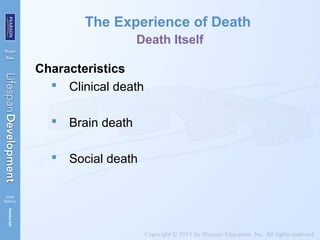
Death Itself
Characteristics
 Clinical death
 Brain death
 Social death
The Experience of Death
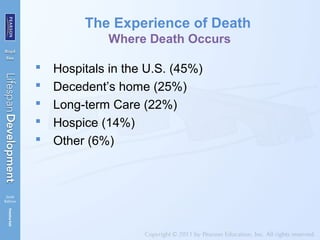
Where Death Occurs
 Hospitals in the U.S. (45%)
 Decedent’s home (25%)
 Long-term Care (22%)
 Hospice (14%)
 Other (6%)
The Experience of Death
Hospice Care
Philosophy
 Death viewed as normal
 Families and the patient encouraged to
prepare for death
 Family are involved in patient’s care
 Control of care is in the hands of the patient
and family
 Medical care is palliative rather than curative
Hospice Care
Types of Hospice Care
 Home-based programs
 Hospital-based programs
 Special hospice centers
 Hospice
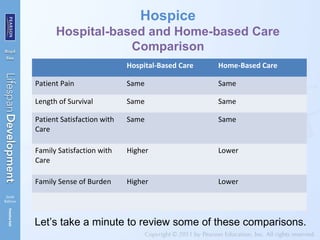
Hospice
Hospital-based and Home-based Care
Comparison
Hospital-Based Care Home-Based Care
Patient Pain Same Same
Length of Survival Same Same
Patient Satisfaction with
Care
Same Same
Family Satisfaction with
Care
Higher Lower
Family Sense of Burden Higher Lower
Let’s take a minute to review some of these comparisons.
Dying, Death, and Bereavement
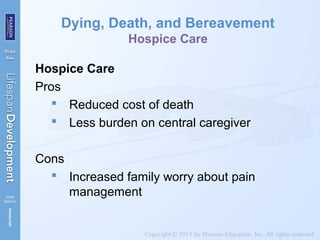
Hospice Care
Hospice Care
Pros
 Reduced cost of death
 Less burden on central caregiver
Cons
 Increased family worry about pain
management
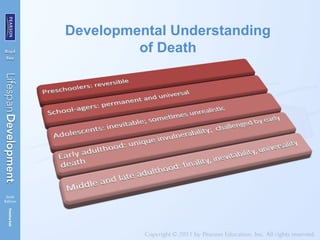
Developmental Understanding
of Death
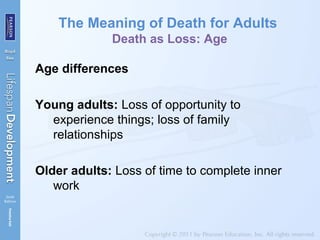
The Meaning of Death for Adults
Death as Loss: Age
Age differences
Young adults: Loss of opportunity to
experience things; loss of family
relationships
Older adults: Loss of time to complete inner
work
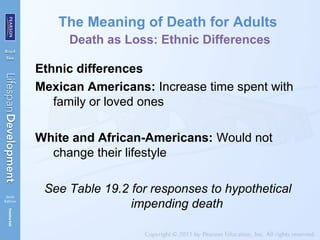
The Meaning of Death for Adults
Death as Loss: Ethnic Differences
Ethnic differences
Mexican Americans: Increase time spent with
family or loved ones
White and African-Americans: Would not
change their lifestyle
See Table 19.2 for responses to hypothetical
impending death
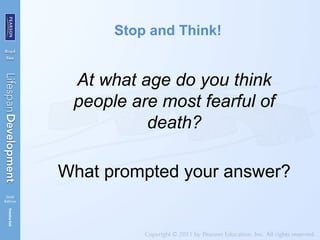
Stop and Think!
At what age do you think
people are most fearful of
death?
What prompted your answer?
Fear of Death
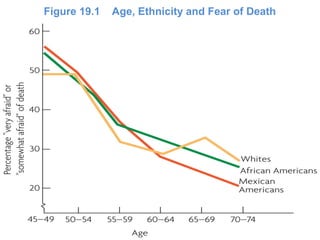
 Middle-aged adults most fearful of death
 Sense of unique invulnerability prevents
intense fear of death in young adults
 Older adults think and talk more about death
than anyone else
Fear of Death
Religious beliefs
Religious beliefs and fear of death
 Very religious adults less afraid of death
 Those totally irreligious may also fear
death less
Figure 19.1 Age, Ethnicity and Fear of Death
Fear of Death
Personal Worth
Fear of death reduced
 Adults accomplish goals or believe they
have become the person they set out to be
 Belief that life has purpose or meaning
How is this related to Erikson’s stage of
integrity versus despair?
Your loved one is dying of a terminal illness.
Would you use a hospice center? Why or
why not?
If you were told that you had a terminal disease
and only 6 months to live, how would you
want to spend your time until you died?
On a scale of 1– 5, with 5 being high, how much
do you fear death?
Questions To PonderQuestions To PonderQuestions To PonderQuestions To Ponder
The Process of Dying
Preparation for Death
Kinds of preparations
 Practical preparations
 Deeper preparations
 Older adults more likely to have made
these arrangements
The Process of Dying
Preparation for Death
Final preparations
 Unconscious changes just before death
 Terminal drop for psychological health
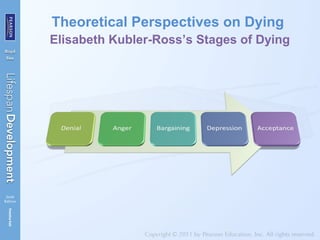
Theoretical Perspectives on Dying
Elisabeth Kubler-Ross’s Stages of Dying
Theoretical Perspectives on Dying
Criticisms of Kubler-Ross’s Theory
 Methodological problems
 Cultural specificity
 Stage concept unsupported
Theoretical Perspectives on Dying
Alternate Views
Two additional views
Shneidman: Dying process has many “themes”
Corr: Coping with death involves taking care of
specific tasks
Theoretical Perspectives on Dying
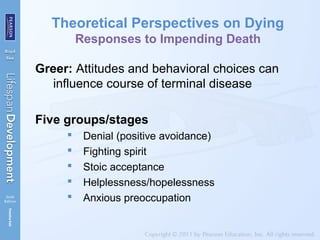
Responses to Impending Death
Greer: Attitudes and behavioral choices can
influence course of terminal disease
Five groups/stages
 Denial (positive avoidance)
 Fighting spirit
 Stoic acceptance
 Helplessness/hopelessness
 Anxious preoccupation
Theoretical Perspectives on Dying
Responses to Impending Death
Greer concluded that the message may be:
“Those who struggle the most, fight the
hardest, express their anger and hostility
openly, and who find some sources of joy in
their lives live longer.”
Theoretical Perspectives on Dying
Psychoanalytic Theory
 Traumatic death often followed by physical
or mental problems
 Grief therapy with children makes use of
defense mechanisms (sublimation,
identification)
Theoretical Perspectives on Grieving
Freud: Death of a loved one is an emotional
trauma
 Ego tries to insulate itself from unpleasant
emotions through defense mechanisms such as
denial
BUT
 Defense mechanisms provide only temporary
relief
How do people grieve in healthy ways?
Theoretical Perspectives on Grieving
Attachment Theory
Bowlby
 Intense grief likely to occur at loss of any
attachment figure
 Quality of attachment related to grief
Theoretical Perspectives on Grieving
Attachment Theory
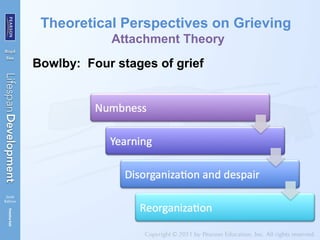
Bowlby: Four stages of grief
Theoretical Perspectives on Grieving
Attachment Theory
Sanders five stages of grief comparable to
Bowlby:
 Shock
 Awareness
 Conservation/withdrawal
 Healing
 Renewal
Theoretical Perspectives on Grieving
Attachment Theory
Revisionist Views
 Avoiding expressions of grief neither
prolongs grief nor inevitably creates mental
health problems
 Grieving does not occur in fixed stages
 Many themes present simultaneously but
one or another may dominate at one point in
time
 Adults develop different patterns of grieving
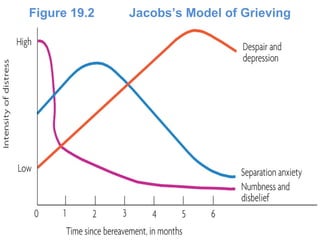
Figure 19.2 Jacobs’s Model of Grieving
Theoretical Perspectives on Grieving
Patterns of Grieving
Wortman and Silver
 Normal
 Chronic
 Delayed
 Absent
Theoretical Perspectives on Grieving
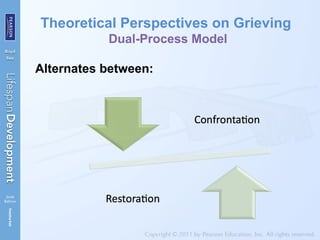
Dual-Process Model
Alternates between:
Theoretical Perspectives on Grieving
The Experience of Grieving: Death Rituals
Psychosocial functions of death rituals such
as funerals
 Help family and friends manage grief by
giving a specific set of roles
 Bring family members together in unique
ways
 Establish shared milestones for families
Theoretical Perspectives on Grieving
The Process of Grieving
Factors Associated with Grief: Age of the
Bereaved
 Children express feelings of grief like teens
and adults
 Teens often show prolonged grief responses
Theoretical Perspectives on Grieving
Factors Associated with Grief
Modes of Death and Grief
 Caregiver widows may show depression.
 Death with intrinsic meaning reduces grief.
 Sudden and violent deaths evoke more
intense grief.
 Suicide produces unique responses in
survivors.
Theoretical Perspectives on Grieving
Widowhood and Effects of Grief
 Immediate and long term effects on the
immune system
 Incidence of depression among widows and
widowers rises substantially
Theoretical Perspectives on Grieving
Pathological Grief
 Depression-like symptoms lasting longer
than 2 months
 Grief lasting longer than 6 months can lead
to long-term depression and physical
ailments
 Problems may continue for up to 2 years
after death of loved one
 BUT cultural practices may mimic
pathological grief
Theoretical Perspectives on Grieving
Sex Differences
 Spouse death more negative for men than
for women.
 Risk of death higher in men immediately
after a spouse’s death.
 Widowers withdraw in multiple ways.
 Alcohol use may influence depression.
 Social relationships remain important for
both sexes.
Theoretical Perspectives on Grieving
Preventing Long-Term Problems
 “Talk-it-out” approach to managing grief can help
prevent grief-related depression.
 Developing coherent personal narrative of events
surrounding spouse’s death helps manage grief.
 Participating in support groups helps.
 Appropriate amount of time off from work to grieve
is important.
Bee & Boyd, Lifespan Development, Chapter 19

  • 1.
  • 2.
  • 3.
    The Experience ofDeath Death Itself Characteristics  Clinical death  Brain death  Social death
  • 4.
    The Experience ofDeath Where Death Occurs  Hospitals in the U.S. (45%)  Decedent’s home (25%)  Long-term Care (22%)  Hospice (14%)  Other (6%)
  • 5.
    The Experience ofDeath Hospice Care Philosophy  Death viewed as normal  Families and the patient encouraged to prepare for death  Family are involved in patient’s care  Control of care is in the hands of the patient and family  Medical care is palliative rather than curative
  • 6.
    Hospice Care Types ofHospice Care  Home-based programs  Hospital-based programs  Special hospice centers  Hospice
  • 7.
    Hospice Hospital-based and Home-basedCare Comparison Hospital-Based Care Home-Based Care Patient Pain Same Same Length of Survival Same Same Patient Satisfaction with Care Same Same Family Satisfaction with Care Higher Lower Family Sense of Burden Higher Lower Let’s take a minute to review some of these comparisons.
  • 8.
    Dying, Death, andBereavement Hospice Care Hospice Care Pros  Reduced cost of death  Less burden on central caregiver Cons  Increased family worry about pain management
  • 9.
  • 10.
    The Meaning ofDeath for Adults Death as Loss: Age Age differences Young adults: Loss of opportunity to experience things; loss of family relationships Older adults: Loss of time to complete inner work
  • 11.
    The Meaning ofDeath for Adults Death as Loss: Ethnic Differences Ethnic differences Mexican Americans: Increase time spent with family or loved ones White and African-Americans: Would not change their lifestyle See Table 19.2 for responses to hypothetical impending death
  • 12.
    Stop and Think! Atwhat age do you think people are most fearful of death? What prompted your answer?
  • 13.
    Fear of Death Middle-aged adults most fearful of death  Sense of unique invulnerability prevents intense fear of death in young adults  Older adults think and talk more about death than anyone else
  • 14.
    Fear of Death Religiousbeliefs Religious beliefs and fear of death  Very religious adults less afraid of death  Those totally irreligious may also fear death less
  • 15.
    Figure 19.1 Age,Ethnicity and Fear of Death
  • 16.
    Fear of Death PersonalWorth Fear of death reduced  Adults accomplish goals or believe they have become the person they set out to be  Belief that life has purpose or meaning How is this related to Erikson’s stage of integrity versus despair?
  • 17.
    Your loved oneis dying of a terminal illness. Would you use a hospice center? Why or why not? If you were told that you had a terminal disease and only 6 months to live, how would you want to spend your time until you died? On a scale of 1– 5, with 5 being high, how much do you fear death? Questions To PonderQuestions To PonderQuestions To PonderQuestions To Ponder
  • 18.
    The Process ofDying Preparation for Death Kinds of preparations  Practical preparations  Deeper preparations  Older adults more likely to have made these arrangements
  • 19.
    The Process ofDying Preparation for Death Final preparations  Unconscious changes just before death  Terminal drop for psychological health
  • 20.
    Theoretical Perspectives onDying Elisabeth Kubler-Ross’s Stages of Dying
  • 21.
    Theoretical Perspectives onDying Criticisms of Kubler-Ross’s Theory  Methodological problems  Cultural specificity  Stage concept unsupported
  • 22.
    Theoretical Perspectives onDying Alternate Views Two additional views Shneidman: Dying process has many “themes” Corr: Coping with death involves taking care of specific tasks
  • 23.
    Theoretical Perspectives onDying Responses to Impending Death Greer: Attitudes and behavioral choices can influence course of terminal disease Five groups/stages  Denial (positive avoidance)  Fighting spirit  Stoic acceptance  Helplessness/hopelessness  Anxious preoccupation
  • 24.
    Theoretical Perspectives onDying Responses to Impending Death Greer concluded that the message may be: “Those who struggle the most, fight the hardest, express their anger and hostility openly, and who find some sources of joy in their lives live longer.”
  • 25.
    Theoretical Perspectives onDying Psychoanalytic Theory  Traumatic death often followed by physical or mental problems  Grief therapy with children makes use of defense mechanisms (sublimation, identification)
  • 26.
    Theoretical Perspectives onGrieving Freud: Death of a loved one is an emotional trauma  Ego tries to insulate itself from unpleasant emotions through defense mechanisms such as denial BUT  Defense mechanisms provide only temporary relief How do people grieve in healthy ways?
  • 27.
    Theoretical Perspectives onGrieving Attachment Theory Bowlby  Intense grief likely to occur at loss of any attachment figure  Quality of attachment related to grief
  • 28.
    Theoretical Perspectives onGrieving Attachment Theory Bowlby: Four stages of grief
  • 29.
    Theoretical Perspectives onGrieving Attachment Theory Sanders five stages of grief comparable to Bowlby:  Shock  Awareness  Conservation/withdrawal  Healing  Renewal
  • 30.
    Theoretical Perspectives onGrieving Attachment Theory Revisionist Views  Avoiding expressions of grief neither prolongs grief nor inevitably creates mental health problems  Grieving does not occur in fixed stages  Many themes present simultaneously but one or another may dominate at one point in time  Adults develop different patterns of grieving
  • 31.
    Figure 19.2 Jacobs’sModel of Grieving
  • 32.
    Theoretical Perspectives onGrieving Patterns of Grieving Wortman and Silver  Normal  Chronic  Delayed  Absent
  • 33.
    Theoretical Perspectives onGrieving Dual-Process Model Alternates between:
  • 34.
    Theoretical Perspectives onGrieving The Experience of Grieving: Death Rituals Psychosocial functions of death rituals such as funerals  Help family and friends manage grief by giving a specific set of roles  Bring family members together in unique ways  Establish shared milestones for families
  • 35.
    Theoretical Perspectives onGrieving The Process of Grieving Factors Associated with Grief: Age of the Bereaved  Children express feelings of grief like teens and adults  Teens often show prolonged grief responses
  • 36.
    Theoretical Perspectives onGrieving Factors Associated with Grief Modes of Death and Grief  Caregiver widows may show depression.  Death with intrinsic meaning reduces grief.  Sudden and violent deaths evoke more intense grief.  Suicide produces unique responses in survivors.
  • 37.
    Theoretical Perspectives onGrieving Widowhood and Effects of Grief  Immediate and long term effects on the immune system  Incidence of depression among widows and widowers rises substantially
  • 38.
    Theoretical Perspectives onGrieving Pathological Grief  Depression-like symptoms lasting longer than 2 months  Grief lasting longer than 6 months can lead to long-term depression and physical ailments  Problems may continue for up to 2 years after death of loved one  BUT cultural practices may mimic pathological grief
  • 39.
    Theoretical Perspectives onGrieving Sex Differences  Spouse death more negative for men than for women.  Risk of death higher in men immediately after a spouse’s death.  Widowers withdraw in multiple ways.  Alcohol use may influence depression.  Social relationships remain important for both sexes.
  • 40.
    Theoretical Perspectives onGrieving Preventing Long-Term Problems  “Talk-it-out” approach to managing grief can help prevent grief-related depression.  Developing coherent personal narrative of events surrounding spouse’s death helps manage grief.  Participating in support groups helps.  Appropriate amount of time off from work to grieve is important.

Editor's Notes

  • #4 Death is a process as well as a state. The experience of death is shaped by the circumstances surrounding the end of life. Clinical death: The few minutes after the heart stops pumping, breathing stops, and there is no evidence of brain activity but resuscitation is still possible. Brain death: The person no longer has reflexes or any response to vigorous external stimuli; may still be able to breathe and survive for some time. Social death: Decedent treated like a corpse by others.
  • #5 Hospitals in the U.S. Once the majority of deaths Now slightly under half of deaths Decedent’s home Currently 25% of deaths Long-term Care Currently 22% of deaths Among old old, death in nursing home common Why has this changed? Rising health-care costs Changing views about the process of dying
  • #6 Preparation for death should include examination of feelings, planning for after death, and talking openly about death. The family should be involved in the patients care as much as possible because it gives the patient emotional support and allow each family member to come to some resolution of their relationship with the dying person. The patient and the family decides if the person will stay at home or be hospitalized. Palliative care emphasizes controlling pain and maximizing comfort rather than invasive, life-prolonging measures.
  • #7 See Table 19.1 on hospice care. Home-based programs Family caregiver(s) specially trained health-care workers Special hospice centers Small number of patients cared for by specially trained health-care workers in homelike settings Hospital-based programs Palliative care provided by hospital personal with daily family involvement Hospice Special hospice centers tend to promote home-like environment.
  • #10 Preschool aged children do not understand inevitable, universal and irreversible nature of death Believe some lucky people can avoid death, for example, by magic Teaching young children about biological life can help them understand death Preschool aged children do not understand death and believe it can be reversed – through prayer, magic, or wishful thinking. Personal life experiences bring death home to both children and adolescents School-aged children Understand permanence and universality of death Adolescents Understand death is inevitable Unrealistic beliefs about personal death contribute to adolescent suicide Sometimes even believe that death is a pleasurable experience Text discusses death of famous people who are young and the resulting feelings of loss and the changes in feelings of invulnerability. Unique invulnerability – believe bad things, including death, happen to others but not to self Believe they possess unique characteristics protecting them from death Show increased fear of death following open discussion of the process of dying Sudden loss of a loved one often shakes young adult ideas about death and invulnerability So do early deaths, such as Princess Diana’s Death changes roles and relationships of everyone else in the family One’s view of time may be shaped by death Middle-aged and older adults preoccupied with the past are more often fearful and anxious about death
  • #12 See Table 19.2 to see ethnic and age differences in response to death.
  • #14 Older adults think and talk more about death than anyone else Leads to less fear and anxiety May fear a period of end-of-life uncertainty more than death itself
  • #15 Very religious adults less afraid of death View death as a transition from one life to another Most Americans believe in an afterlife Religion provides adults with death stories that help them cope with their own deaths Those totally irreligious may also fear death less
  • #17 Adults who have accomplished goals or believe they have become the person they set out to be have less fear of death Belief that life has purpose or meaning reduces fear of death Supports Erikson’s theory of ego integrity versus despair stage at end of life
  • #19 Practical preparations Purchasing life insurance Making a will Directives regarding end-of-life care – living will Direct health care professionals about wishes for feeding tubes, or invasive measures to prolong life Advance funeral planning Deeper preparations Some process of reminiscence
  • #20 Terminal drop for psychological health Drop in memory and learning Individuals become less emotional, introspective, and aggressive; more conventional, dependent and warm
  • #21 See Table 19.3 for stages.
  • #22 Methodological problems Kubler-Ross only interviewed 200 cancer patients nor did she explain her sample Cultural specificity Cross-cultural studies suggest diversity in beliefs about what is a “good death” The stage concept Not all dying patients exhibit all five emotions, and seldom in a specific order Only depression common among Western patients Collectivist cultures may find bargaining less important. Native Americans think of death as part of nature’s cycle, death is to be faced with composure. Mexican culture – death is a mirror of the person’s life. Death is celebrated in a national feast day. Religious beliefs may not follow the model.
  • #23 Shneidman Thanatologist (scientific studies of death) Dying process has many “themes.” Terror, uncertainty, rescue fantasies, incredulity, fear of pain and many more Corr Coping with death involves taking care of specific tasks, e.g., maximizing psychological security For health professionals, thinking in terms of helping the patient perform tasks is more helpful than themes. Satisfying bodily needs and minimizing physical stress. Maximizing psychological security, autonomy, and richness of life. Sustaining and enhancing significant interpersonal attachments. Identifying, developing, or reaffirming sources of spiritual energy, and thereby fostering hope.
  • #24 Greer checked the survival rates of these 5 groups after 5, 10, and 15 years. See Table 19.4 for outcome rates. 35% who showed denial or fighting spirit had died at 15 years. 76% of the others were dead 15 years later. Data from studies of patients with melanoma and aids support this theory.
  • #25 Difficult patients who question and challenge those around them last longer Optimism may also help survival Social support important This may be appropriate for cancer-like illnesses, but not others, such as heart disease
  • #26 Traumatic death often followed by physical or mental problems including post-traumatic stress disorder Grief therapy with children makes use of defense mechanisms Sublimation: Expressing feelings through art Identification: Watch popular films to discuss young characters’ feelings and compare characters’ feelings with their own
  • #27 To stay healthy, people must eventually examine their emotions directly This approach urges emotional expression and “working through” grief
  • #28 See Table 19.5 for stages of grief.
  • #29 See Table 19.5 for stages of grief.
  • #31 Compromise model: Themes have a trajectory (Jacobs, Figure 19.2)
  • #33 Normal Person feels great distress immediately following the loss with relatively rapid recovery Chronic Distress continues at high level for years Delayed Person feels little distress first few months but high distress months or years later (least common) Absent Person feels no notable distress either immediately or at later time (quite common)
  • #34 Alternates between: Confrontation Confronting loss and grieving and Restoration Focus on moving forward in life
  • #35 Funerals, wakes, and other death rituals.Help family and friends manage grief by giving a specific set of roles to play Expected and prohibited behaviors Role content differs markedly from culture to culture Bring family members together like no other occasion Inspire shared reminiscences and renew family relationships Can strengthen family ties, and clarify new roles Funerals establish shared milestones for families Ceremony and ritual help survivors understand meaning of death Place death in philosophical or religious context
  • #36 Children express feelings of grief like teens and adults Sadness, crying, loss of appetite, age-appropriate anger Resolve their grief within the first year after death Teens often show prolonged grief responses More likely to grieve for celebrities More likely to idealize peers’ suicides Counter-factual thinking about their ability to have prevented the death
  • #37 Widows who have cared for spouses during illness less often show depression after death. Death that has intrinsic meaning reduces grief Sudden and violent deaths evoke more intense grief Random crime Politically motivated mass murder (such as 9-1-1) Suicide produces unique responses in survivors Family and close friends report feelings of rejection and anger Many feel that they should have prevented the suicide Bereaved less likely to discuss the loss
  • #38 Immediate and long term effects on the immune system Immune system responses suppressed initially after death but returned to normal a year later Ethnicity may affect physical responses to grief Incidence of depression among widows and widowers rises substantially Length of depression can be highly variable Mental health history, lack of social support, quality of relationship with spouse, and economic changes influence length and quality of depression
  • #39 Depression-like symptoms following death of loved one lasting longer than 2 months Grief lasting longer than 6 months can lead to long-term depression and physical ailments such as cancer and heart disease Problems may continue for up to 2 years after death of loved one BUT cultural practices may dictate how long grief should last—do not confuse with pathological grief
  • #40 Death of a spouse more negative for men than for women Risk of death from natural causes or suicide higher in men immediately after death of a spouse Widowers withdraw from social activities Widowers find it difficult to return to earlier levels of emotional functioning Alcohol use may play a role in higher levels of depression Social relationships important for both sexes of survivors