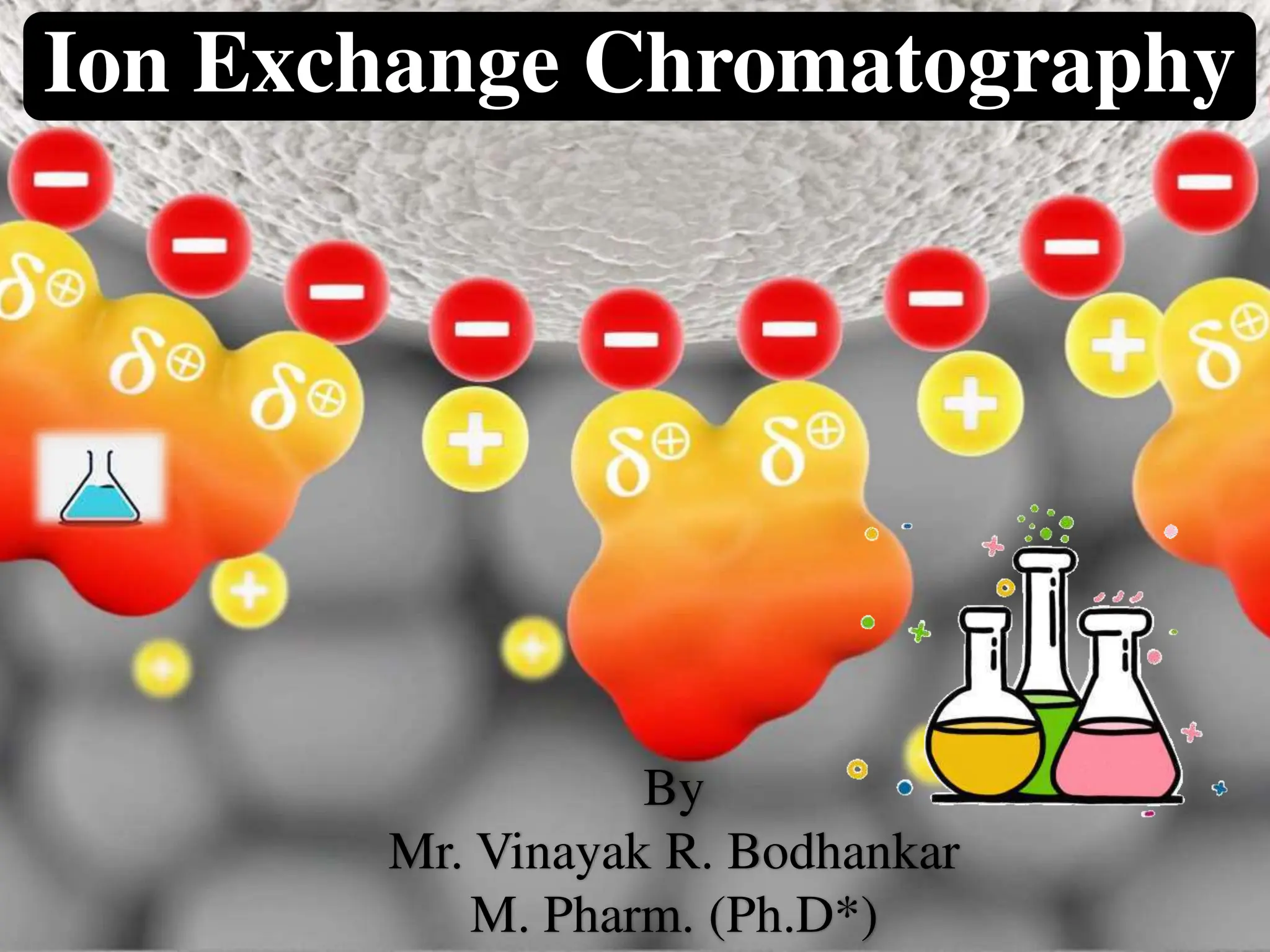
Ion Exchange Chromatography
By
Mr. Vinayak R. Bodhankar
M. Pharm. (Ph.D*)
Content
 Introduction
 Classification of Resins
 Factor affecting ion exchange
 Methodology
 Applications
 INTRODUCTION
 It is type of adsorption chromatography.
 Ion exchange chromatography is a process by which a mixture of charged ions
can be separated by using an ion exchange resin which exchanges ions
according to their relative affinities.
 It is applicable only for the charged particles i.e. compound containing ions
 Proteins, Nucleotides, Amino acids Ions (Cations or anions)
 Used for detection as well as quantitation of ions.
 Mobile phase: Liquid
 Stationary phase: Ion exchange resin (Solid frame having pores containing
ions)
 PRINCIPLE
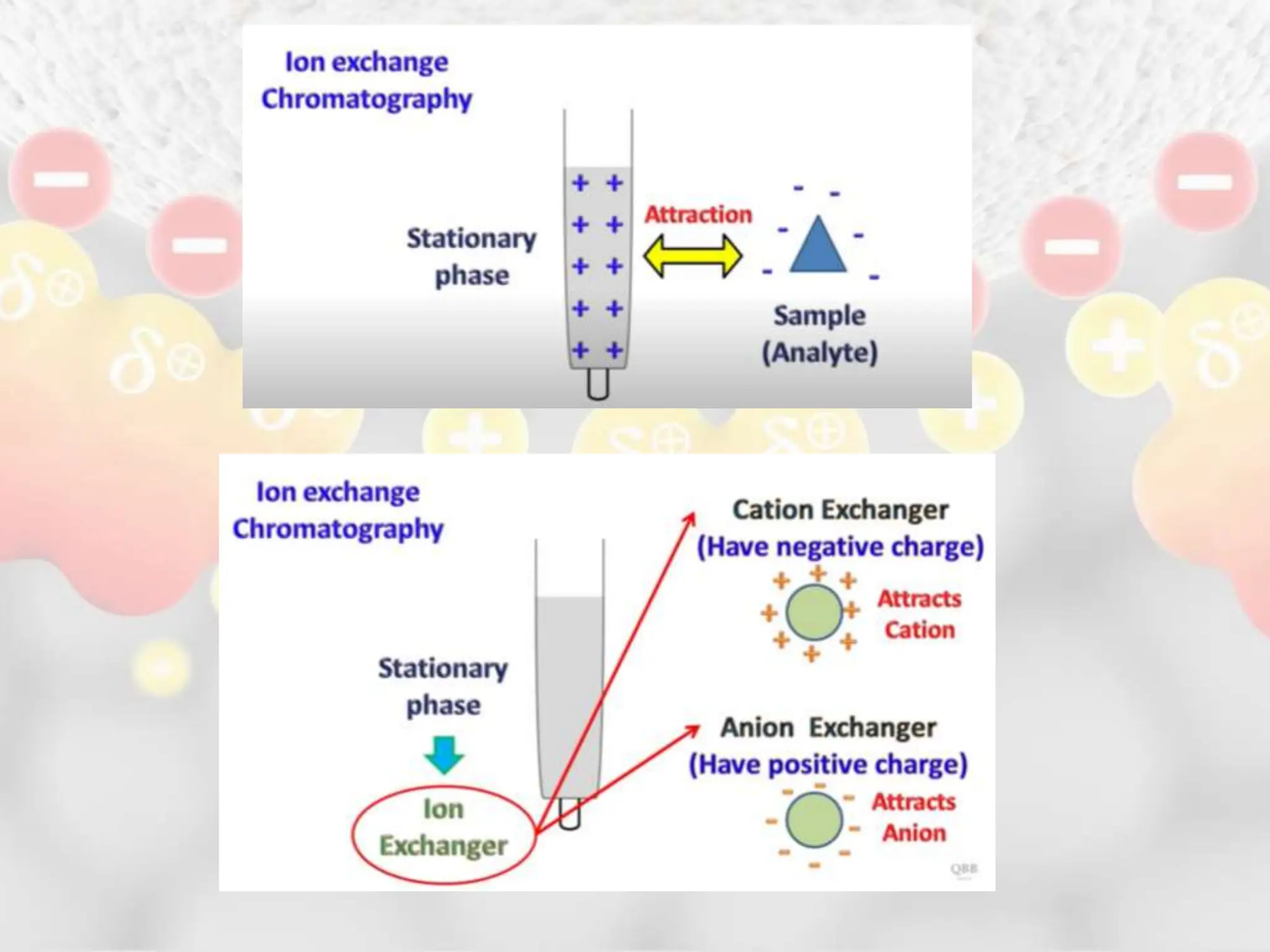
 The principle of separation is by reversible exchange of ions between the target
ions present in the sample solution to the ions present on ion exchangers
 Resin takes the ion from sample and release ion from itself
i.e. cation – anion, anion – cation
 In this process, two types of exchangers i.e., cationic and anionic exchangers
can be used.
 Cationic exchangers possess negatively charged group, and these will attract
positively charged cations. These exchangers are also called “Acidic ion
exchange” materials.
 Anionic exchangers have positively charged groups that will attract negatively
charged anions. These are also called “Basic ion exchange” materials.
 Collection of elute from column and finally measurement of cation and anion.
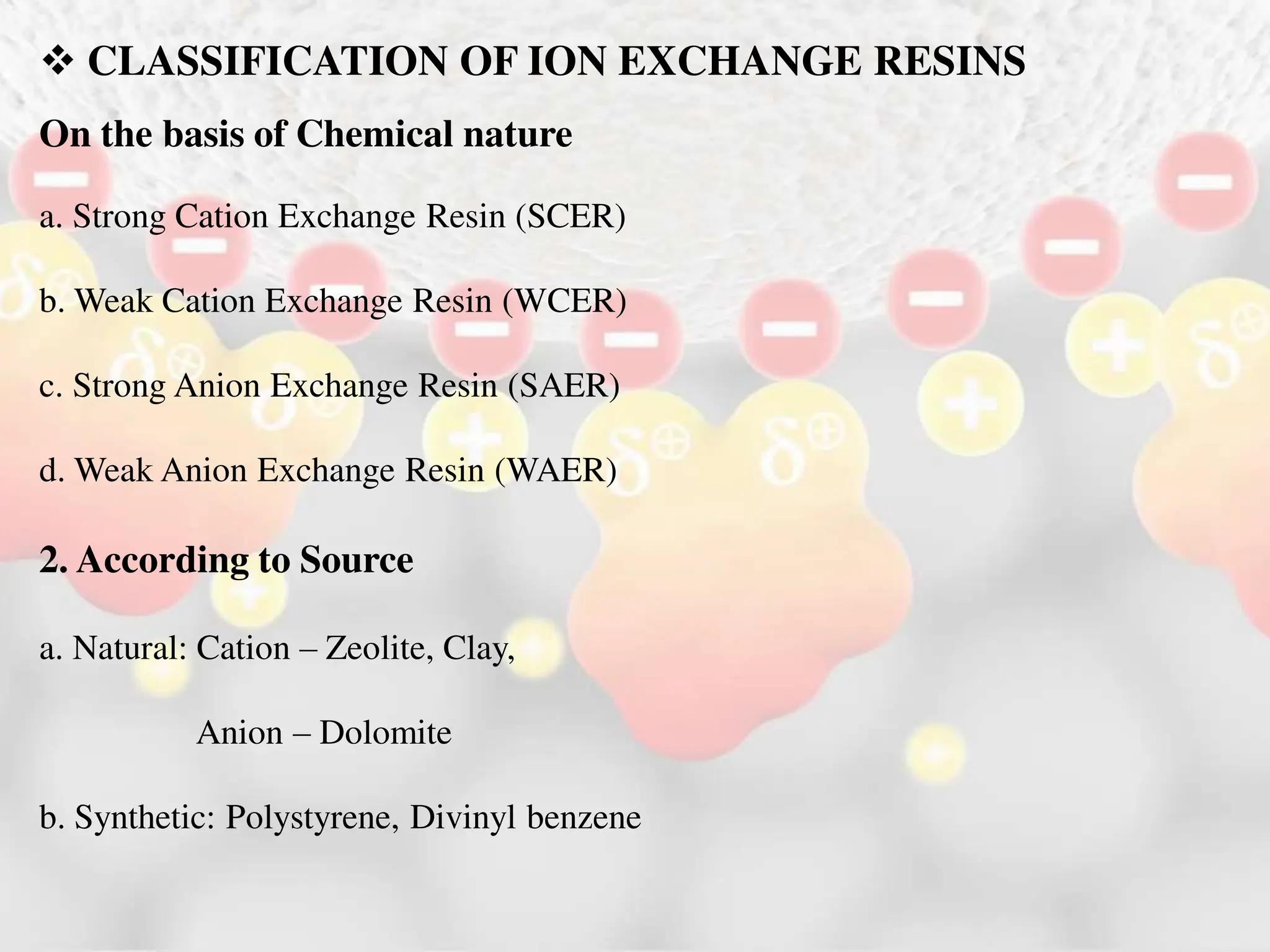
 CLASSIFICATION OF ION EXCHANGE RESINS
On the basis of Chemical nature
a. Strong Cation Exchange Resin (SCER)
b. Weak Cation Exchange Resin (WCER)
c. Strong Anion Exchange Resin (SAER)
d. Weak Anion Exchange Resin (WAER)
2. According to Source
a. Natural: Cation – Zeolite, Clay,
Anion – Dolomite
b. Synthetic: Polystyrene, Divinyl benzene
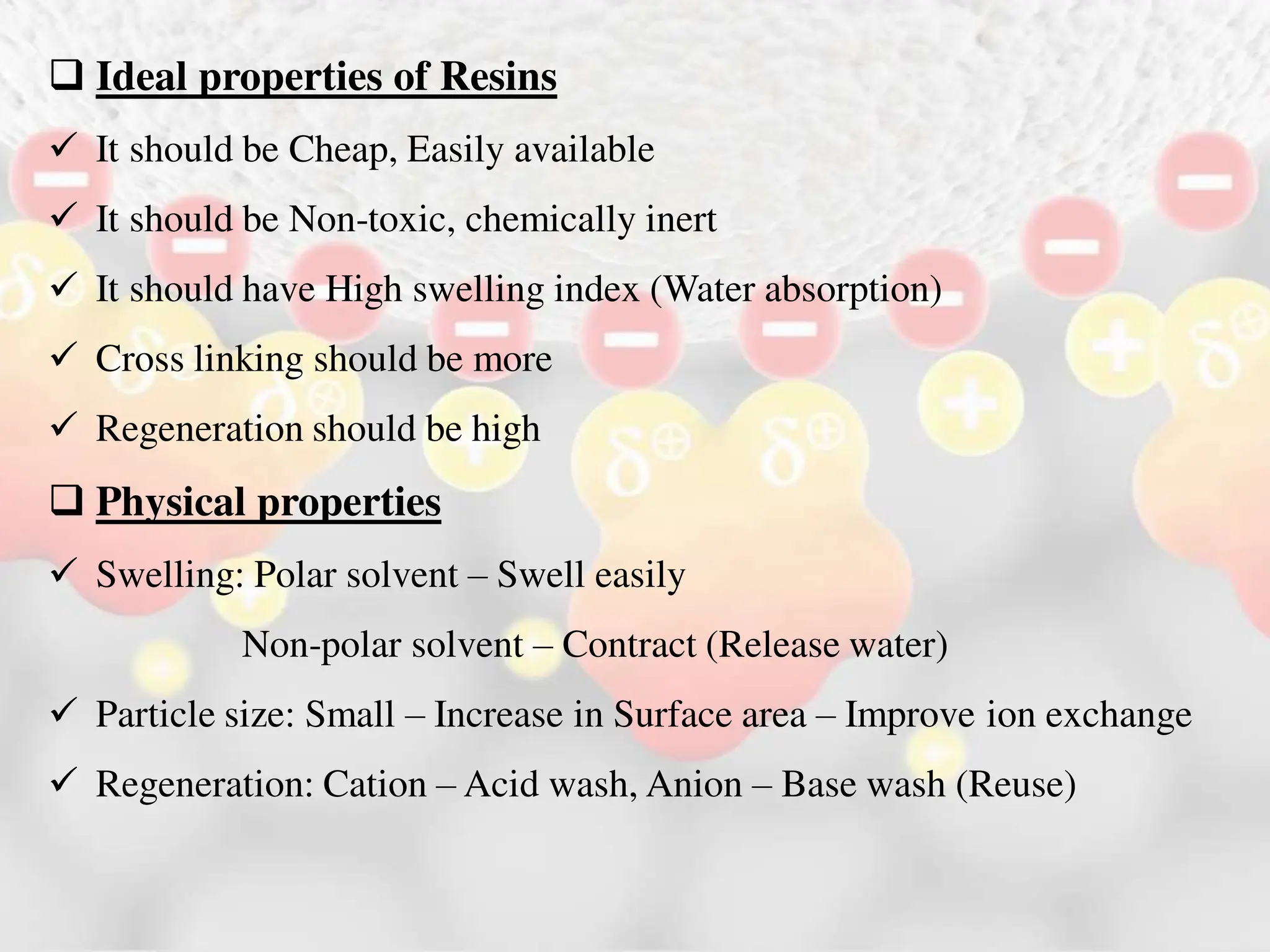
 Ideal properties of Resins
 It should be Cheap, Easily available
 It should be Non-toxic, chemically inert
 It should have High swelling index (Water absorption)
 Cross linking should be more
 Regeneration should be high
 Physical properties
 Swelling: Polar solvent – Swell easily
Non-polar solvent – Contract (Release water)
 Particle size: Small – Increase in Surface area – Improve ion exchange
 Regeneration: Cation – Acid wash, Anion – Base wash (Reuse)
 PRACTICAL REQUIREMENTS / METHODOLOGY
1. Column material and dimension
2. Type of ion exchange resin & the selection depend on following properties
a) Type of ions
b) Nature of ions
c) Efficiency of resin
d) Particle size
e) Structural type
3. Packing of column
4. Mobile phase - acids, alkali, and buffers.
5. Development of chromatogram
6. Analysis of the Effluent
1. Column material and dimensions:
 Columns used in the laboratories are made up of glass. In industries are made
up of either high quality stainless steel or polymers which are resistant to strong
acids and alkalis.
 The column dimensions are also important and a length: diameter ratio of
20:1 to 100:1 for higher efficiency can be used.
2. Type of ion exchange resin:
 Type of ions - cations (or) anions
 Nature of ions: Strong (or) weak
 Efficiency of the resin: It is measured by ion exchange capacity
Ion exchange capacity:
 It is the total ion exchange capacity in terms of the exchangable functional
groups expressed as milli equivalents per gram of the ion exchange resin.
m. Eq/g=1000/eq. wt
 Particle size of the resin: Porous, Pellicular
 Amount of the cross linking agent: Which decides swelling of the resin
3. Packing of the Column:
 Wet packing method is used.
 Resin + Mobile phase - packing in the column uniformly.
4. Mobile Phase:
 Organic solvents are less useful and they are not used at all.
 Only strengths of acids, alkalies and buffers are used as eluting solvents.
 E.g. 0.1N HCL, IN NaOH, Phosphate buffer, Acetate buffer, Borate buffer,
phthalate buffer, etc.
5. Development of the Chromatogram & Elution
 After introduction of the sample, development of the chromatogram is done by
using different mobile phases. As, mentioned earlier, organic solvents are less
useful and only acids, alkalis and buffers of different pH are used.
 There are two elution technique:
1. Isocratic elution
2. Gradient elution
6. Analysis of the Effluent:
 Several methods of analysis can be used which depends up on the nature & the
quantity of the sample.
1. Spectrophotometric method
2. Polarographic method
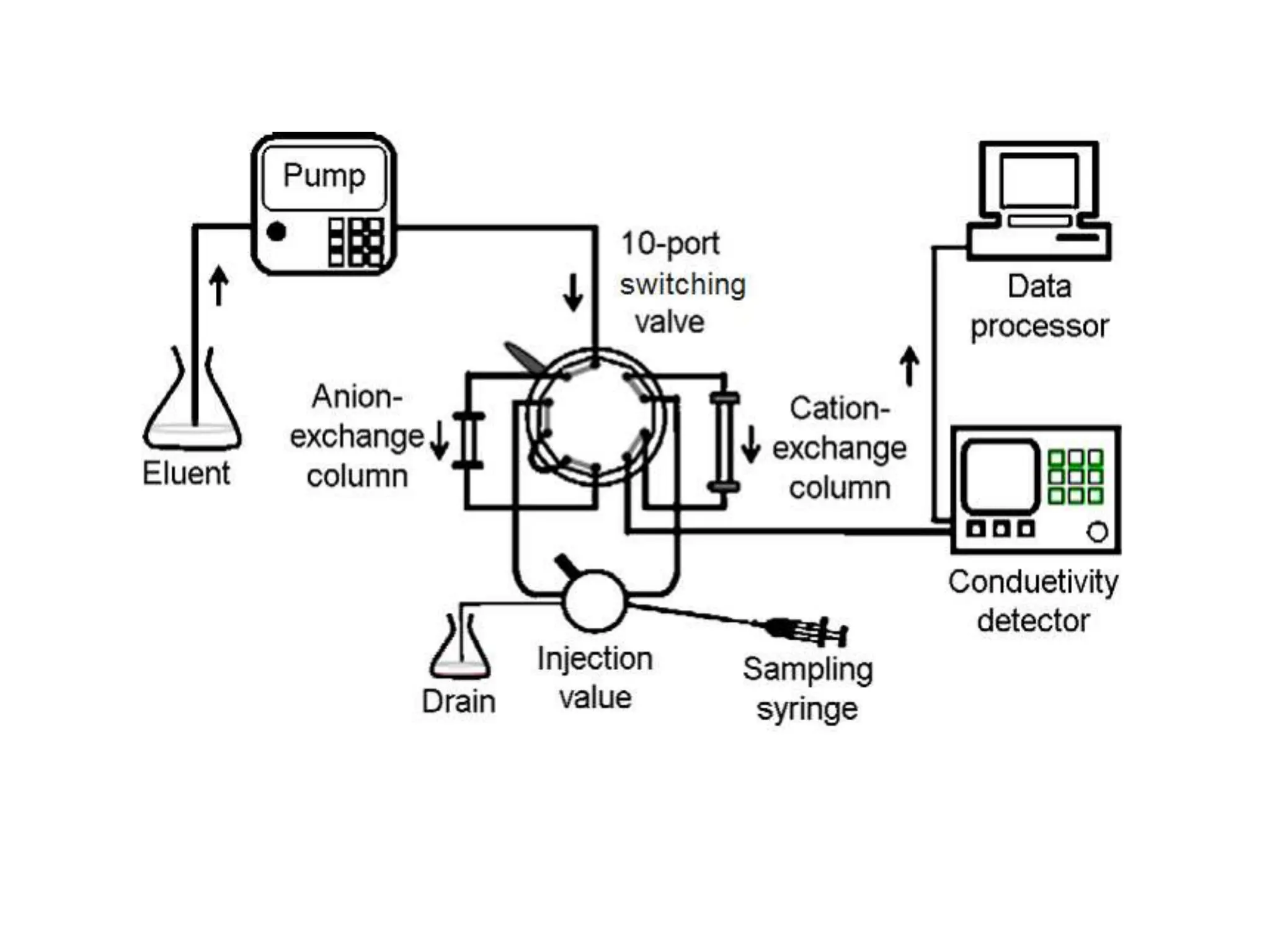
3. Conductometric method
4. Amperometric method
5. Flame photometric method
6. Radio chemical methods
Geiger muller counter
ionization chamber method.
 After analyzing similar fraction are mixed in order to get pure ions or
compound of each type.
 FACTORS AFFECTING ION EXCHANGE SEPARATIONS:
1. Nature and properties of ion exchange resins.
2. Nature of exchanging ions.
1. Nature and properties of ion exchange resins:
 Cross linking and swelling is important factor which depends on the proportion of
cross linking agent.
 When more cross linking agent is present, they are more rigid, but swells less.
 When swelling is less, separation of different sizes is difficult as they cannot pass
through the pores present and it becomes selective to ions of different sizes.
2. Nature of exchanging ions:
a. Valency of ions
b. Size of ions
c. Polarity
d. Concentration & charge of ions
 If resin has higher +ve charge and solution has lower +ve charge, exchange is
favored at higher concentration.
 If the resin has lower +ve charge and solution has higher +ve charge, then
exchange is favored at low concentration.
 MECHANISM OF ION EXCHANGE RESIN
 The ion exchangers behave as a porous network which carry a surplus electric
charge distributed over the surface and throughout the pores. The surplus charge
is compensated by ions of opposite charge.
 When the ionization takes place they are exchanged with the ions of opposite
charge which migrate into the solution.
 In this process, chemical bonds are not formed but exchange occurs by
diffusion in two different stages.
a) Film diffusion.
b) Particle diffusion
 APPLICATIONS
 Softening and demineralization of water.
 For extraction of enzymes from tissue.
 Purification of solution from ionic impurities.
 Separation of inorganic ions.
 Separation of sugar, amino acids and proteins.
 As ion exchange column in HPLC.

Ion Exchange chromatography by Mr. Vinayak

  • 1.
    Ion Exchange Chromatography By Mr.Vinayak R. Bodhankar M. Pharm. (Ph.D*)
  • 2.
    Content  Introduction  Classificationof Resins  Factor affecting ion exchange  Methodology  Applications
  • 3.
     INTRODUCTION  Itis type of adsorption chromatography.  Ion exchange chromatography is a process by which a mixture of charged ions can be separated by using an ion exchange resin which exchanges ions according to their relative affinities.  It is applicable only for the charged particles i.e. compound containing ions  Proteins, Nucleotides, Amino acids Ions (Cations or anions)  Used for detection as well as quantitation of ions.  Mobile phase: Liquid  Stationary phase: Ion exchange resin (Solid frame having pores containing ions)
  • 4.
     PRINCIPLE  Theprinciple of separation is by reversible exchange of ions between the target ions present in the sample solution to the ions present on ion exchangers  Resin takes the ion from sample and release ion from itself i.e. cation – anion, anion – cation  In this process, two types of exchangers i.e., cationic and anionic exchangers can be used.  Cationic exchangers possess negatively charged group, and these will attract positively charged cations. These exchangers are also called “Acidic ion exchange” materials.  Anionic exchangers have positively charged groups that will attract negatively charged anions. These are also called “Basic ion exchange” materials.  Collection of elute from column and finally measurement of cation and anion.
  • 6.
     CLASSIFICATION OFION EXCHANGE RESINS On the basis of Chemical nature a. Strong Cation Exchange Resin (SCER) b. Weak Cation Exchange Resin (WCER) c. Strong Anion Exchange Resin (SAER) d. Weak Anion Exchange Resin (WAER) 2. According to Source a. Natural: Cation – Zeolite, Clay, Anion – Dolomite b. Synthetic: Polystyrene, Divinyl benzene
  • 7.
     Ideal propertiesof Resins  It should be Cheap, Easily available  It should be Non-toxic, chemically inert  It should have High swelling index (Water absorption)  Cross linking should be more  Regeneration should be high  Physical properties  Swelling: Polar solvent – Swell easily Non-polar solvent – Contract (Release water)  Particle size: Small – Increase in Surface area – Improve ion exchange  Regeneration: Cation – Acid wash, Anion – Base wash (Reuse)
  • 9.
     PRACTICAL REQUIREMENTS/ METHODOLOGY 1. Column material and dimension 2. Type of ion exchange resin & the selection depend on following properties a) Type of ions b) Nature of ions c) Efficiency of resin d) Particle size e) Structural type 3. Packing of column 4. Mobile phase - acids, alkali, and buffers. 5. Development of chromatogram 6. Analysis of the Effluent
  • 10.
    1. Column materialand dimensions:  Columns used in the laboratories are made up of glass. In industries are made up of either high quality stainless steel or polymers which are resistant to strong acids and alkalis.  The column dimensions are also important and a length: diameter ratio of 20:1 to 100:1 for higher efficiency can be used. 2. Type of ion exchange resin:  Type of ions - cations (or) anions  Nature of ions: Strong (or) weak  Efficiency of the resin: It is measured by ion exchange capacity
  • 11.
    Ion exchange capacity: It is the total ion exchange capacity in terms of the exchangable functional groups expressed as milli equivalents per gram of the ion exchange resin. m. Eq/g=1000/eq. wt  Particle size of the resin: Porous, Pellicular  Amount of the cross linking agent: Which decides swelling of the resin 3. Packing of the Column:  Wet packing method is used.  Resin + Mobile phase - packing in the column uniformly.
  • 12.
    4. Mobile Phase: Organic solvents are less useful and they are not used at all.  Only strengths of acids, alkalies and buffers are used as eluting solvents.  E.g. 0.1N HCL, IN NaOH, Phosphate buffer, Acetate buffer, Borate buffer, phthalate buffer, etc. 5. Development of the Chromatogram & Elution  After introduction of the sample, development of the chromatogram is done by using different mobile phases. As, mentioned earlier, organic solvents are less useful and only acids, alkalis and buffers of different pH are used.  There are two elution technique: 1. Isocratic elution 2. Gradient elution
  • 13.
    6. Analysis ofthe Effluent:  Several methods of analysis can be used which depends up on the nature & the quantity of the sample. 1. Spectrophotometric method 2. Polarographic method 3. Conductometric method 4. Amperometric method 5. Flame photometric method 6. Radio chemical methods Geiger muller counter ionization chamber method.  After analyzing similar fraction are mixed in order to get pure ions or compound of each type.
  • 14.
     FACTORS AFFECTINGION EXCHANGE SEPARATIONS: 1. Nature and properties of ion exchange resins. 2. Nature of exchanging ions. 1. Nature and properties of ion exchange resins:  Cross linking and swelling is important factor which depends on the proportion of cross linking agent.  When more cross linking agent is present, they are more rigid, but swells less.  When swelling is less, separation of different sizes is difficult as they cannot pass through the pores present and it becomes selective to ions of different sizes.
  • 15.
    2. Nature ofexchanging ions: a. Valency of ions b. Size of ions c. Polarity d. Concentration & charge of ions  If resin has higher +ve charge and solution has lower +ve charge, exchange is favored at higher concentration.  If the resin has lower +ve charge and solution has higher +ve charge, then exchange is favored at low concentration.
  • 16.
     MECHANISM OFION EXCHANGE RESIN  The ion exchangers behave as a porous network which carry a surplus electric charge distributed over the surface and throughout the pores. The surplus charge is compensated by ions of opposite charge.  When the ionization takes place they are exchanged with the ions of opposite charge which migrate into the solution.  In this process, chemical bonds are not formed but exchange occurs by diffusion in two different stages. a) Film diffusion. b) Particle diffusion
  • 17.
     APPLICATIONS  Softeningand demineralization of water.  For extraction of enzymes from tissue.  Purification of solution from ionic impurities.  Separation of inorganic ions.  Separation of sugar, amino acids and proteins.  As ion exchange column in HPLC.