Dr Hadi Rohani,- Blog: www.hadirohani.blogfa.com
Evaluating Aerobic and
anaerobic Fitness
Dr Hadi Rohani,- Blog: www.hadirohani.blogfa.com
Definition of Aerobic Fitness
• Capacity to meet the energy demands of
sustained, submaximal work
• Capacity to deliver oxygen to working
muscles
• Capacity to extract oxygen at working
muscles
• VO2max – maximal volume of oxygen one
can consume during exhaustion exercise
– best index of aerobic capacity
Dr Hadi Rohani,- Blog: www.hadirohani.blogfa.com
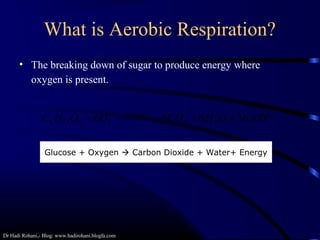
What is Aerobic Respiration?
• The breaking down of sugar to produce energy where
oxygen is present.
ATPOHCOOOHC Enzymes
36666 2226126 ++ →+
Glucose + Oxygen  Carbon Dioxide + Water+ Energy
Dr Hadi Rohani,- Blog: www.hadirohani.blogfa.com
Anaerobic Respiration refers to the
oxidation of molecules in the
absence of oxygen to produce energy
It is also known
As Fermentation
Dr Hadi Rohani,- Blog: www.hadirohani.blogfa.com
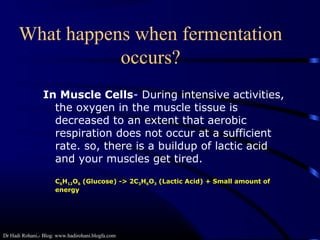
In Muscle Cells- During intensive activities,
the oxygen in the muscle tissue is
decreased to an extent that aerobic
respiration does not occur at a sufficient
rate. so, there is a buildup of lactic acid
and your muscles get tired.
C6H12O6 (Glucose) -> 2C3H6O3 (Lactic Acid) + Small amount of
energy
What happens when fermentation
occurs?
Dr Hadi Rohani,- Blog: www.hadirohani.blogfa.com
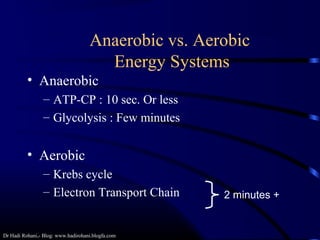
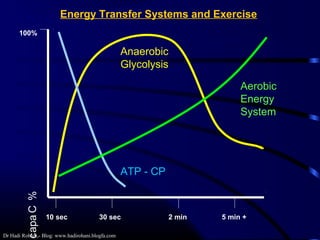
Anaerobic vs. Aerobic
Energy Systems
• Anaerobic
– ATP-CP : 10 sec. Or less
– Glycolysis : Few minutes
• Aerobic
– Krebs cycle
– Electron Transport Chain 2 minutes +
Dr Hadi Rohani,- Blog: www.hadirohani.blogfa.com
100%%Capac
10 sec 30 sec 2 min 5 min +
Energy Transfer Systems and Exercise
Aerobic
Energy
System
Anaerobic
Glycolysis
ATP - CP
Dr Hadi Rohani,- Blog: www.hadirohani.blogfa.com
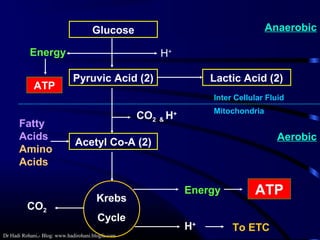
Glucose
Pyruvic Acid (2)
Energy H+
Lactic Acid (2)
Acetyl Co-A (2)
CO2 & H+
Krebs
Cycle
CO2
H+
Energy ATP
ATP
Mitochondria
Inter Cellular Fluid
To ETC
Anaerobic
Aerobic
Fatty
Acids
Amino
Acids
Dr Hadi Rohani,- Blog: www.hadirohani.blogfa.com
VO2 max
• Delivery factors:
– Blood supply (cardiac output, redistribution of
blood flow)
– Carrying capacity (Hb, RBC)
• Extraction factors:
– Muscle mass
– Capillary density
Dr Hadi Rohani,- Blog: www.hadirohani.blogfa.com
VO2 max
• Measured during maximal exercise
• Incremental test
• Components:
– O2, CO2, VE
• Can be expressed in absolute or relative
terms
– Absolute – l·min-1
or ml·min-1
– Relative - ml·kg-1
·min-1
Dr Hadi Rohani,- Blog: www.hadirohani.blogfa.com
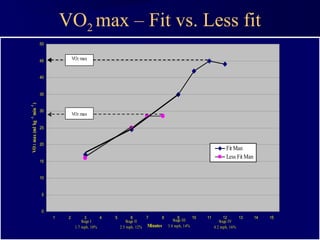
VO2 max – Fit vs. Less fit
0
5
10
15
20
25
30
35
40
45
50
1 2 3 4 5 6 7 8 9 10 11 12 13 14 15
Minutes
VO2max(ml.
kg-1.
min-1
)
Fit Man
Less Fit Man
VO2 max
VO2 max
Stage I
1.7 mph, 10%
Stage II
2.5 mph, 12%
Stage III
3.4 mph, 14%
Stage IV
4.2 mph, 16%
Dr Hadi Rohani,- Blog: www.hadirohani.blogfa.com
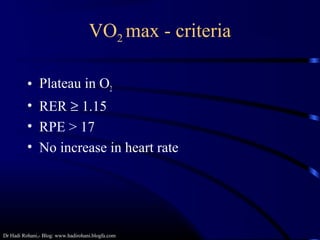
VO2 max - criteria
• Plateau in O2
• RER ≥ 1.15
• RPE > 17
• No increase in heart rate
Dr Hadi Rohani,- Blog: www.hadirohani.blogfa.com
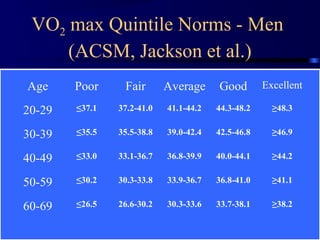
VO2 max Quintile Norms - Men
(ACSM, Jackson et al.)
Age Poor Fair Average Good Excellent
20-29 ≤37.1 37.2-41.0 41.1-44.2 44.3-48.2 ≥48.3
30-39 ≤35.5 35.5-38.8 39.0-42.4 42.5-46.8 ≥46.9
40-49 ≤33.0 33.1-36.7 36.8-39.9 40.0-44.1 ≥44.2
50-59 ≤30.2 30.3-33.8 33.9-36.7 36.8-41.0 ≥41.1
60-69 ≤26.5 26.6-30.2 30.3-33.6 33.7-38.1 ≥38.2
Dr Hadi Rohani,- Blog: www.hadirohani.blogfa.com
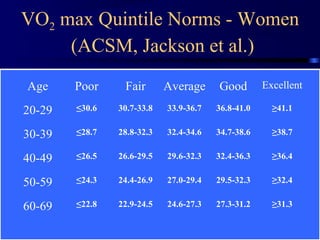
VO2 max Quintile Norms - Women
(ACSM, Jackson et al.)
Age Poor Fair Average Good Excellent
20-29 ≤30.6 30.7-33.8 33.9-36.7 36.8-41.0 ≥41.1
30-39 ≤28.7 28.8-32.3 32.4-34.6 34.7-38.6 ≥38.7
40-49 ≤26.5 26.6-29.5 29.6-32.3 32.4-36.3 ≥36.4
50-59 ≤24.3 24.4-26.9 27.0-29.4 29.5-32.3 ≥32.4
60-69 ≤22.8 22.9-24.5 24.6-27.3 27.3-31.2 ≥31.3
Dr Hadi Rohani,- Blog: www.hadirohani.blogfa.com
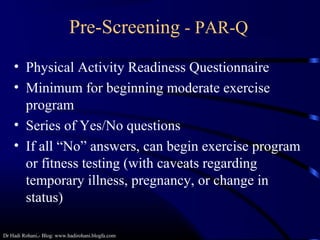
Pre-Screening - PAR-Q
• Physical Activity Readiness Questionnaire
• Minimum for beginning moderate exercise
program
• Series of Yes/No questions
• If all “No” answers, can begin exercise program
or fitness testing (with caveats regarding
temporary illness, pregnancy, or change in
status)
Dr Hadi Rohani,- Blog: www.hadirohani.blogfa.com
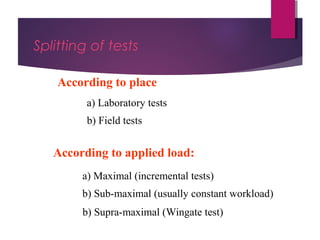
Splitting of tests
According to applied load:
According to place
a) Maximal (incremental tests)
b) Sub-maximal (usually constant workload)
b) Supra-maximal (Wingate test)
a) Laboratory tests
b) Field tests
Dr Hadi Rohani,- Blog: www.hadirohani.blogfa.com
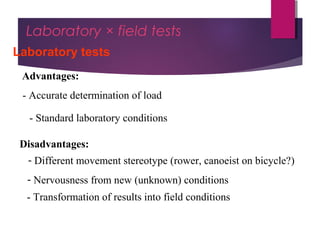
Laboratory × field tests
Laboratory tests
Disadvantages:
- Different movement stereotype (rower, canoeist on bicycle?)
- Transformation of results into field conditions
- Accurate determination of load
Advantages:
- Standard laboratory conditions
- Nervousness from new (unknown) conditions
Dr Hadi Rohani,- Blog: www.hadirohani.blogfa.com
Laboratory × field tests
Field tests
Disadvantages:
- Relatively inaccurate determination of power
- The problem of accurate measurement
- Known conditions – athletic stadium, ice ring, sport hall, etc.
Advantages:
- Identical movement stereotype
- Direct use in training
Dr Hadi Rohani,- Blog: www.hadirohani.blogfa.com
Maximal × submaximal tests
Maximal tests
- Direct assessment of maximal capacity of organism
Advantages:
Disadvantages:
- Dependence on will and motivation
- Risk factor
- Restriction before competition
Dr Hadi Rohani,- Blog: www.hadirohani.blogfa.com
Maximal × submaximal tests
Sub-maximal tests
- Safer
Advantages:
Disadvantages:
- Lower dependence on tested person (more comfortable)
- Bigger changes of monitored parameters due to training
- Restriction before competition
- Often based on estimation (presumption) of HRmax, etc.
Dr Hadi Rohani,- Blog: www.hadirohani.blogfa.com
The conditions in exercise
laboratory
1. Enviroment
2. Equipment
3. Safeness
- Calm (few persons)
- Air circulation (ACE)
- Temperature (18-22˚C), humidity 40-60%
- calibration, functionality
- Emergency (phone number)
- Presence of physician, defibrillator, drogs
Dr Hadi Rohani,- Blog: www.hadirohani.blogfa.com
The conditions in exercise
laboratory
4. Tested person
- Healthy
- Avoid drinking coffee, alcohol and smoking (at least
12 hours before)
- At least 2 hours after food intake
Dr Hadi Rohani,- Blog: www.hadirohani.blogfa.com
Bicycle ergometer × treadmill
Bicycle ergometer
- mechanical efficiency 20 – 25%
-W (load) = resistance (mechanical, electromagnetical)
+ revolutions/min (50 – 70)Advantages:
- space, noise, accuracy of set load
- easer and safer making
Disadvantages:
- engagement of smaller muscle mass, lack of familiarity
- lower oxygen consumption, lower HR , etc.
- taking of blood sample, measurement of blood pressure.
Dr Hadi Rohani,- Blog: www.hadirohani.blogfa.com
Bicycle ergometer × treadmill
Treadmill
- mechanical efficiency no more than 15 %
-W (load) = speed (km/hour) + elevation (%, °)
Advantages:
- natural movement, only one possibility for children
- engagement of most muscle mass
Disadvantages:
- space demands, noise
- risk of fall, problems of measurement of BP and blood sample
- achievement of “real” maximum (higher O2 consumption, HR)
Dr Hadi Rohani,- Blog: www.hadirohani.blogfa.com
Submaximal Tests Principles
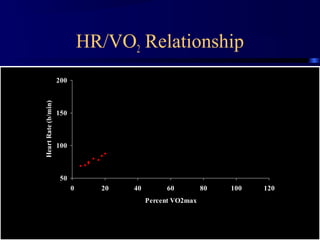
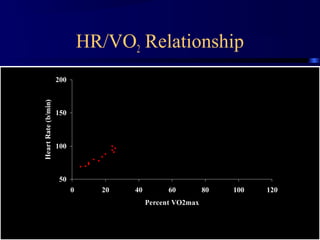
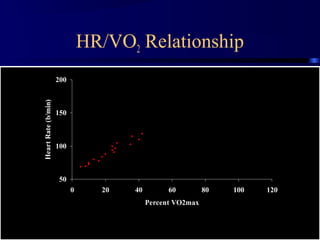
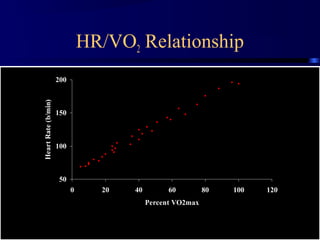
• Heart rate increases in proportion to VO2
during aerobic exercise.
• VO2 max is reached at maximal heart rate.
Dr Hadi Rohani,- Blog: www.hadirohani.blogfa.com
HR/VO2 Relationship
50
100
150
200
0 20 40 60 80 100 120
Percent VO2max
HeartRate(b/min)
Dr Hadi Rohani,- Blog: www.hadirohani.blogfa.com
HR/VO2 Relationship
50
100
150
200
0 20 40 60 80 100 120
Percent VO2max
HeartRate(b/min)
Dr Hadi Rohani,- Blog: www.hadirohani.blogfa.com
HR/VO2 Relationship
50
100
150
200
0 20 40 60 80 100 120
Percent VO2max
HeartRate(b/min)
Dr Hadi Rohani,- Blog: www.hadirohani.blogfa.com
HR/VO2 Relationship
50
100
150
200
0 20 40 60 80 100 120
Percent VO2max
HeartRate(b/min)
Dr Hadi Rohani,- Blog: www.hadirohani.blogfa.com
Types of Submaximal Tests
• Cycle Tests
– YMCA
– Astrand
• Step Tests
– Over 30 exist
• Walking/Running
– 1.5 mile run
– Rockport 1 mile walk
– Many others exist
Dr Hadi Rohani,- Blog: www.hadirohani.blogfa.com
Laboratory-based Maximal Tests of
Aerobic Fitness
• Goal is to systematically increase exercise
intensity until participant reaches exhaustion.
• VO2max can be measured by open-circuit
spirometry.
– expired gases are measured with metabolic
measurement system.
• VO2max can be estimated from maximal
treadmill time.
– Bruce protocol
– Balke protocol
Dr Hadi Rohani,- Blog: www.hadirohani.blogfa.com
The Bruce Protocol
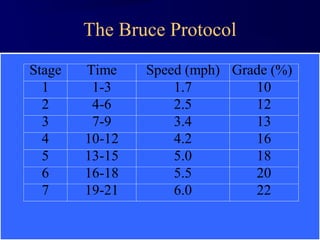
Stage Time Speed (mph) Grade (%)
1 1-3 1.7 10
2 4-6 2.5 12
3 7-9 3.4 13
4 10-12 4.2 16
5 13-15 5.0 18
6 16-18 5.5 20
7 19-21 6.0 22
Dr Hadi Rohani,- Blog: www.hadirohani.blogfa.com
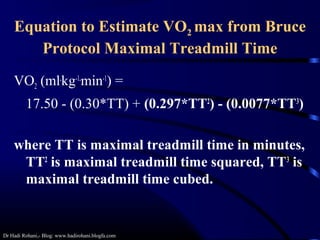
Equation to Estimate VO2 max from Bruce
Protocol Maximal Treadmill Time
VO2 (ml.
kg-1.
min-1
) =
17.50 - (0.30*TT) + (0.297*TT2
) - (0.0077*TT3
)
where TT is maximal treadmill time in minutes,
TT2
is maximal treadmill time squared, TT3
is
maximal treadmill time cubed.
Dr Hadi Rohani,- Blog: www.hadirohani.blogfa.com
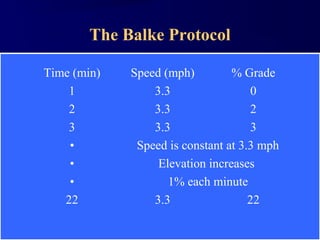
The Balke Protocol
Time (min) Speed (mph) % Grade
1 3.3 0
2 3.3 2
3 3.3 3
• Speed is constant at 3.3 mph
• Elevation increases
• 1% each minute
22 3.3 22
Dr Hadi Rohani,- Blog: www.hadirohani.blogfa.com
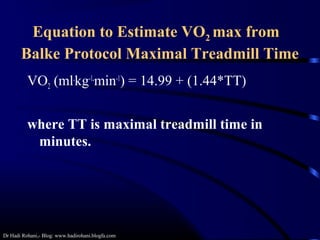
Equation to Estimate VO2 max from
Balke Protocol Maximal Treadmill Time
VO2 (ml.
kg-1.
min-1
) = 14.99 + (1.44*TT)
where TT is maximal treadmill time in
minutes.
Dr Hadi Rohani,- Blog: www.hadirohani.blogfa.com
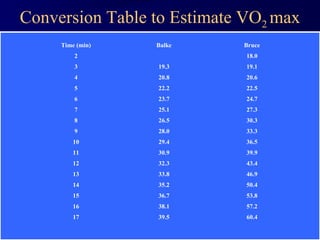
Conversion Table to Estimate VO2 max
Time (min) Balke Bruce
2 18.0
3 19.3 19.1
4 20.8 20.6
5 22.2 22.5
6 23.7 24.7
7 25.1 27.3
8 26.5 30.3
9 28.0 33.3
10 29.4 36.5
11 30.9 39.9
12 32.3 43.4
13 33.8 46.9
14 35.2 50.4
15 36.7 53.8
16 38.1 57.2
17 39.5 60.4
Dr Hadi Rohani,- Blog: www.hadirohani.blogfa.com
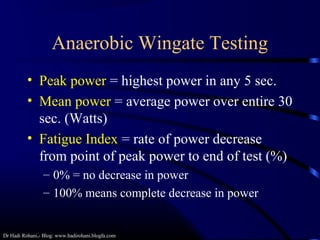
Anaerobic Wingate Testing
• Peak power = highest power in any 5 sec.
• Mean power = average power over entire 30
sec. (Watts)
• Fatigue Index = rate of power decrease
from point of peak power to end of test (%)
– 0% = no decrease in power
– 100% means complete decrease in power
Dr Hadi Rohani,- Blog: www.hadirohani.blogfa.com
Anaerobic Wingate Testing
• Supramaximal – power output that would
require 2-4 times the VO2max
– 60 – 85% of ATP from CP/ATP or glycolytic
• Peak Power – first 2 – 10 seconds
– Major contribution from ATP/CP
• Mean power – over 30 sec.
– Major contribution from glycolytic
– Lactate values from 6 – 15 X resting
– Significant correlation with FT fiber %
Dr Hadi Rohani,- Blog: www.hadirohani.blogfa.com
Factors Affecting Wingate
• Warm-up seems to improve MP
• Drop in body temp. seems to decrease
anaerobic performance
• Motivation (reward/punishment) seems to
improve performance
Dr Hadi Rohani,- Blog: www.hadirohani.blogfa.com

Aerobic and anaerobic tests

  • 1.
    Dr Hadi Rohani,-Blog: www.hadirohani.blogfa.com Evaluating Aerobic and anaerobic Fitness
  • 2.
    Dr Hadi Rohani,-Blog: www.hadirohani.blogfa.com Definition of Aerobic Fitness • Capacity to meet the energy demands of sustained, submaximal work • Capacity to deliver oxygen to working muscles • Capacity to extract oxygen at working muscles • VO2max – maximal volume of oxygen one can consume during exhaustion exercise – best index of aerobic capacity
  • 3.
    Dr Hadi Rohani,-Blog: www.hadirohani.blogfa.com What is Aerobic Respiration? • The breaking down of sugar to produce energy where oxygen is present. ATPOHCOOOHC Enzymes 36666 2226126 ++ →+ Glucose + Oxygen  Carbon Dioxide + Water+ Energy
  • 4.
    Dr Hadi Rohani,-Blog: www.hadirohani.blogfa.com Anaerobic Respiration refers to the oxidation of molecules in the absence of oxygen to produce energy It is also known As Fermentation
  • 5.
    Dr Hadi Rohani,-Blog: www.hadirohani.blogfa.com In Muscle Cells- During intensive activities, the oxygen in the muscle tissue is decreased to an extent that aerobic respiration does not occur at a sufficient rate. so, there is a buildup of lactic acid and your muscles get tired. C6H12O6 (Glucose) -> 2C3H6O3 (Lactic Acid) + Small amount of energy What happens when fermentation occurs?
  • 6.
    Dr Hadi Rohani,-Blog: www.hadirohani.blogfa.com Anaerobic vs. Aerobic Energy Systems • Anaerobic – ATP-CP : 10 sec. Or less – Glycolysis : Few minutes • Aerobic – Krebs cycle – Electron Transport Chain 2 minutes +
  • 7.
    Dr Hadi Rohani,-Blog: www.hadirohani.blogfa.com 100%%Capac 10 sec 30 sec 2 min 5 min + Energy Transfer Systems and Exercise Aerobic Energy System Anaerobic Glycolysis ATP - CP
  • 8.
    Dr Hadi Rohani,-Blog: www.hadirohani.blogfa.com Glucose Pyruvic Acid (2) Energy H+ Lactic Acid (2) Acetyl Co-A (2) CO2 & H+ Krebs Cycle CO2 H+ Energy ATP ATP Mitochondria Inter Cellular Fluid To ETC Anaerobic Aerobic Fatty Acids Amino Acids
  • 9.
    Dr Hadi Rohani,-Blog: www.hadirohani.blogfa.com
  • 10.
    Dr Hadi Rohani,-Blog: www.hadirohani.blogfa.com VO2 max • Delivery factors: – Blood supply (cardiac output, redistribution of blood flow) – Carrying capacity (Hb, RBC) • Extraction factors: – Muscle mass – Capillary density
  • 11.
    Dr Hadi Rohani,-Blog: www.hadirohani.blogfa.com VO2 max • Measured during maximal exercise • Incremental test • Components: – O2, CO2, VE • Can be expressed in absolute or relative terms – Absolute – l·min-1 or ml·min-1 – Relative - ml·kg-1 ·min-1
  • 12.
    Dr Hadi Rohani,-Blog: www.hadirohani.blogfa.com VO2 max – Fit vs. Less fit 0 5 10 15 20 25 30 35 40 45 50 1 2 3 4 5 6 7 8 9 10 11 12 13 14 15 Minutes VO2max(ml. kg-1. min-1 ) Fit Man Less Fit Man VO2 max VO2 max Stage I 1.7 mph, 10% Stage II 2.5 mph, 12% Stage III 3.4 mph, 14% Stage IV 4.2 mph, 16%
  • 13.
    Dr Hadi Rohani,-Blog: www.hadirohani.blogfa.com VO2 max - criteria • Plateau in O2 • RER ≥ 1.15 • RPE > 17 • No increase in heart rate
  • 14.
    Dr Hadi Rohani,-Blog: www.hadirohani.blogfa.com VO2 max Quintile Norms - Men (ACSM, Jackson et al.) Age Poor Fair Average Good Excellent 20-29 ≤37.1 37.2-41.0 41.1-44.2 44.3-48.2 ≥48.3 30-39 ≤35.5 35.5-38.8 39.0-42.4 42.5-46.8 ≥46.9 40-49 ≤33.0 33.1-36.7 36.8-39.9 40.0-44.1 ≥44.2 50-59 ≤30.2 30.3-33.8 33.9-36.7 36.8-41.0 ≥41.1 60-69 ≤26.5 26.6-30.2 30.3-33.6 33.7-38.1 ≥38.2
  • 15.
    Dr Hadi Rohani,-Blog: www.hadirohani.blogfa.com VO2 max Quintile Norms - Women (ACSM, Jackson et al.) Age Poor Fair Average Good Excellent 20-29 ≤30.6 30.7-33.8 33.9-36.7 36.8-41.0 ≥41.1 30-39 ≤28.7 28.8-32.3 32.4-34.6 34.7-38.6 ≥38.7 40-49 ≤26.5 26.6-29.5 29.6-32.3 32.4-36.3 ≥36.4 50-59 ≤24.3 24.4-26.9 27.0-29.4 29.5-32.3 ≥32.4 60-69 ≤22.8 22.9-24.5 24.6-27.3 27.3-31.2 ≥31.3
  • 16.
    Dr Hadi Rohani,-Blog: www.hadirohani.blogfa.com Pre-Screening - PAR-Q • Physical Activity Readiness Questionnaire • Minimum for beginning moderate exercise program • Series of Yes/No questions • If all “No” answers, can begin exercise program or fitness testing (with caveats regarding temporary illness, pregnancy, or change in status)
  • 17.
    Dr Hadi Rohani,-Blog: www.hadirohani.blogfa.com Splitting of tests According to applied load: According to place a) Maximal (incremental tests) b) Sub-maximal (usually constant workload) b) Supra-maximal (Wingate test) a) Laboratory tests b) Field tests
  • 18.
    Dr Hadi Rohani,-Blog: www.hadirohani.blogfa.com Laboratory × field tests Laboratory tests Disadvantages: - Different movement stereotype (rower, canoeist on bicycle?) - Transformation of results into field conditions - Accurate determination of load Advantages: - Standard laboratory conditions - Nervousness from new (unknown) conditions
  • 19.
    Dr Hadi Rohani,-Blog: www.hadirohani.blogfa.com Laboratory × field tests Field tests Disadvantages: - Relatively inaccurate determination of power - The problem of accurate measurement - Known conditions – athletic stadium, ice ring, sport hall, etc. Advantages: - Identical movement stereotype - Direct use in training
  • 20.
    Dr Hadi Rohani,-Blog: www.hadirohani.blogfa.com Maximal × submaximal tests Maximal tests - Direct assessment of maximal capacity of organism Advantages: Disadvantages: - Dependence on will and motivation - Risk factor - Restriction before competition
  • 21.
    Dr Hadi Rohani,-Blog: www.hadirohani.blogfa.com Maximal × submaximal tests Sub-maximal tests - Safer Advantages: Disadvantages: - Lower dependence on tested person (more comfortable) - Bigger changes of monitored parameters due to training - Restriction before competition - Often based on estimation (presumption) of HRmax, etc.
  • 22.
    Dr Hadi Rohani,-Blog: www.hadirohani.blogfa.com The conditions in exercise laboratory 1. Enviroment 2. Equipment 3. Safeness - Calm (few persons) - Air circulation (ACE) - Temperature (18-22˚C), humidity 40-60% - calibration, functionality - Emergency (phone number) - Presence of physician, defibrillator, drogs
  • 23.
    Dr Hadi Rohani,-Blog: www.hadirohani.blogfa.com The conditions in exercise laboratory 4. Tested person - Healthy - Avoid drinking coffee, alcohol and smoking (at least 12 hours before) - At least 2 hours after food intake
  • 24.
    Dr Hadi Rohani,-Blog: www.hadirohani.blogfa.com Bicycle ergometer × treadmill Bicycle ergometer - mechanical efficiency 20 – 25% -W (load) = resistance (mechanical, electromagnetical) + revolutions/min (50 – 70)Advantages: - space, noise, accuracy of set load - easer and safer making Disadvantages: - engagement of smaller muscle mass, lack of familiarity - lower oxygen consumption, lower HR , etc. - taking of blood sample, measurement of blood pressure.
  • 25.
    Dr Hadi Rohani,-Blog: www.hadirohani.blogfa.com Bicycle ergometer × treadmill Treadmill - mechanical efficiency no more than 15 % -W (load) = speed (km/hour) + elevation (%, °) Advantages: - natural movement, only one possibility for children - engagement of most muscle mass Disadvantages: - space demands, noise - risk of fall, problems of measurement of BP and blood sample - achievement of “real” maximum (higher O2 consumption, HR)
  • 26.
    Dr Hadi Rohani,-Blog: www.hadirohani.blogfa.com Submaximal Tests Principles • Heart rate increases in proportion to VO2 during aerobic exercise. • VO2 max is reached at maximal heart rate.
  • 27.
    Dr Hadi Rohani,-Blog: www.hadirohani.blogfa.com HR/VO2 Relationship 50 100 150 200 0 20 40 60 80 100 120 Percent VO2max HeartRate(b/min)
  • 28.
    Dr Hadi Rohani,-Blog: www.hadirohani.blogfa.com HR/VO2 Relationship 50 100 150 200 0 20 40 60 80 100 120 Percent VO2max HeartRate(b/min)
  • 29.
    Dr Hadi Rohani,-Blog: www.hadirohani.blogfa.com HR/VO2 Relationship 50 100 150 200 0 20 40 60 80 100 120 Percent VO2max HeartRate(b/min)
  • 30.
    Dr Hadi Rohani,-Blog: www.hadirohani.blogfa.com HR/VO2 Relationship 50 100 150 200 0 20 40 60 80 100 120 Percent VO2max HeartRate(b/min)
  • 31.
    Dr Hadi Rohani,-Blog: www.hadirohani.blogfa.com Types of Submaximal Tests • Cycle Tests – YMCA – Astrand • Step Tests – Over 30 exist • Walking/Running – 1.5 mile run – Rockport 1 mile walk – Many others exist
  • 32.
    Dr Hadi Rohani,-Blog: www.hadirohani.blogfa.com Laboratory-based Maximal Tests of Aerobic Fitness • Goal is to systematically increase exercise intensity until participant reaches exhaustion. • VO2max can be measured by open-circuit spirometry. – expired gases are measured with metabolic measurement system. • VO2max can be estimated from maximal treadmill time. – Bruce protocol – Balke protocol
  • 33.
    Dr Hadi Rohani,-Blog: www.hadirohani.blogfa.com The Bruce Protocol Stage Time Speed (mph) Grade (%) 1 1-3 1.7 10 2 4-6 2.5 12 3 7-9 3.4 13 4 10-12 4.2 16 5 13-15 5.0 18 6 16-18 5.5 20 7 19-21 6.0 22
  • 34.
    Dr Hadi Rohani,-Blog: www.hadirohani.blogfa.com Equation to Estimate VO2 max from Bruce Protocol Maximal Treadmill Time VO2 (ml. kg-1. min-1 ) = 17.50 - (0.30*TT) + (0.297*TT2 ) - (0.0077*TT3 ) where TT is maximal treadmill time in minutes, TT2 is maximal treadmill time squared, TT3 is maximal treadmill time cubed.
  • 35.
    Dr Hadi Rohani,-Blog: www.hadirohani.blogfa.com The Balke Protocol Time (min) Speed (mph) % Grade 1 3.3 0 2 3.3 2 3 3.3 3 • Speed is constant at 3.3 mph • Elevation increases • 1% each minute 22 3.3 22
  • 36.
    Dr Hadi Rohani,-Blog: www.hadirohani.blogfa.com Equation to Estimate VO2 max from Balke Protocol Maximal Treadmill Time VO2 (ml. kg-1. min-1 ) = 14.99 + (1.44*TT) where TT is maximal treadmill time in minutes.
  • 37.
    Dr Hadi Rohani,-Blog: www.hadirohani.blogfa.com Conversion Table to Estimate VO2 max Time (min) Balke Bruce 2 18.0 3 19.3 19.1 4 20.8 20.6 5 22.2 22.5 6 23.7 24.7 7 25.1 27.3 8 26.5 30.3 9 28.0 33.3 10 29.4 36.5 11 30.9 39.9 12 32.3 43.4 13 33.8 46.9 14 35.2 50.4 15 36.7 53.8 16 38.1 57.2 17 39.5 60.4
  • 38.
    Dr Hadi Rohani,-Blog: www.hadirohani.blogfa.com Anaerobic Wingate Testing • Peak power = highest power in any 5 sec. • Mean power = average power over entire 30 sec. (Watts) • Fatigue Index = rate of power decrease from point of peak power to end of test (%) – 0% = no decrease in power – 100% means complete decrease in power
  • 39.
    Dr Hadi Rohani,-Blog: www.hadirohani.blogfa.com Anaerobic Wingate Testing • Supramaximal – power output that would require 2-4 times the VO2max – 60 – 85% of ATP from CP/ATP or glycolytic • Peak Power – first 2 – 10 seconds – Major contribution from ATP/CP • Mean power – over 30 sec. – Major contribution from glycolytic – Lactate values from 6 – 15 X resting – Significant correlation with FT fiber %
  • 40.
    Dr Hadi Rohani,-Blog: www.hadirohani.blogfa.com Factors Affecting Wingate • Warm-up seems to improve MP • Drop in body temp. seems to decrease anaerobic performance • Motivation (reward/punishment) seems to improve performance
  • 41.
    Dr Hadi Rohani,-Blog: www.hadirohani.blogfa.com