Partial Differential
Equations: An Introduction
for Engineers
Welcome to the world of Partial Differential Equations (PDEs), essential tools
engineers use to analyze complex phenomena.
by Laughs Unfiltered
What are Partial Differential Equations (PDEs)?
Definition
PDEs are equations involving functions of multiple variables
and their partial derivatives.
Examples
Heat equation: models temperature distribution over time
Wave equation: describes vibrations and waves
Understanding Order and Degree of PDEs
Order
Highest order of any partial derivative in the PDE.
Degree
Power of the highest order partial derivative, assuming the
equation is polynomial.
Classifying PDEs
Linear PDEs
Partial derivatives appear
linearly, no products or
powers.
Nonlinear PDEs
Include products or nonlinear
functions of derivatives.
Homogeneous PDEs
Zero on the right side of the
equation.
Non-homogeneous
PDEs
Non-zero term on the right
side.
Forming PDEs: Eliminating
Arbitrary Constants and
Functions
Start with General Solution
Includes arbitrary constants or functions.
Differentiation
Differentiate to eliminate constants or functions.
Elimination
Combine equations to form the PDE.
Solving PDEs: Separation of
Variables Method
1 Step 1: Assume
Solution Form
Express solution as product of
single-variable functions.
2 Step 2: Substitute and
Separate
Rewrite PDE to isolate
variables on each side.
3 Step 3: Solve Resulting ODEs
Solve ordinary differential equations for each variable.
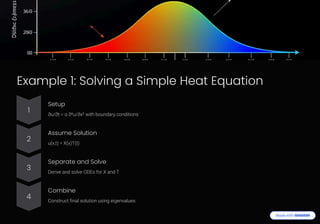
Example 1: Solving a Simple Heat Equation
1
Setup
"u/"t = ³ "²u/"x² with boundary conditions
2
Assume Solution
u(x,t) = X(x)T(t)
3
Separate and Solve
Derive and solve ODEs for X and T
4
Combine
Construct final solution using eigenvalues
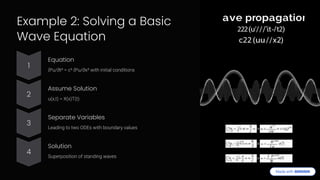
Example 2: Solving a Basic
Wave Equation
1
Equation
"²u/"t² = c² "²u/"x² with initial conditions
2
Assume Solution
u(x,t) = X(x)T(t)
3
Separate Variables
Leading to two ODEs with boundary values
4
Solution
Superposition of standing waves
Real-World Applications of PDEs in Engineering
Fluid Mechanics
Navier-Stokes equations to
model fluid flow.
Heat Transfer
Heat equation predicts
temperature distribution.
Electromagnetics
Maxwell's equations describe
electric and magnetic fields.
Structural
Engineering
PDEs model stress and
deformation in materials.
Conclusion: Key Takeaways
& Further Exploration
PDEs model complex phenomena in engineering and science.
Understanding order, degree, and classification is crucial.
Separation of variables is a fundamental solution method.
Explore advanced methods and diverse real-world applications next.


Partial-Differential-Equations-An-Introduction-for-Engineers.pdf

  • 1.
    Partial Differential Equations: AnIntroduction for Engineers Welcome to the world of Partial Differential Equations (PDEs), essential tools engineers use to analyze complex phenomena. by Laughs Unfiltered
  • 2.
    What are PartialDifferential Equations (PDEs)? Definition PDEs are equations involving functions of multiple variables and their partial derivatives. Examples Heat equation: models temperature distribution over time Wave equation: describes vibrations and waves
  • 3.
    Understanding Order andDegree of PDEs Order Highest order of any partial derivative in the PDE. Degree Power of the highest order partial derivative, assuming the equation is polynomial.
  • 4.
    Classifying PDEs Linear PDEs Partialderivatives appear linearly, no products or powers. Nonlinear PDEs Include products or nonlinear functions of derivatives. Homogeneous PDEs Zero on the right side of the equation. Non-homogeneous PDEs Non-zero term on the right side.
  • 5.
    Forming PDEs: Eliminating ArbitraryConstants and Functions Start with General Solution Includes arbitrary constants or functions. Differentiation Differentiate to eliminate constants or functions. Elimination Combine equations to form the PDE.
  • 6.
    Solving PDEs: Separationof Variables Method 1 Step 1: Assume Solution Form Express solution as product of single-variable functions. 2 Step 2: Substitute and Separate Rewrite PDE to isolate variables on each side. 3 Step 3: Solve Resulting ODEs Solve ordinary differential equations for each variable.
  • 7.
    Example 1: Solvinga Simple Heat Equation 1 Setup "u/"t = ³ "²u/"x² with boundary conditions 2 Assume Solution u(x,t) = X(x)T(t) 3 Separate and Solve Derive and solve ODEs for X and T 4 Combine Construct final solution using eigenvalues
  • 8.
    Example 2: Solvinga Basic Wave Equation 1 Equation "²u/"t² = c² "²u/"x² with initial conditions 2 Assume Solution u(x,t) = X(x)T(t) 3 Separate Variables Leading to two ODEs with boundary values 4 Solution Superposition of standing waves
  • 9.
    Real-World Applications ofPDEs in Engineering Fluid Mechanics Navier-Stokes equations to model fluid flow. Heat Transfer Heat equation predicts temperature distribution. Electromagnetics Maxwell's equations describe electric and magnetic fields. Structural Engineering PDEs model stress and deformation in materials.
  • 10.
    Conclusion: Key Takeaways &Further Exploration PDEs model complex phenomena in engineering and science. Understanding order, degree, and classification is crucial. Separation of variables is a fundamental solution method. Explore advanced methods and diverse real-world applications next.