ADVERBS - FUNCTION

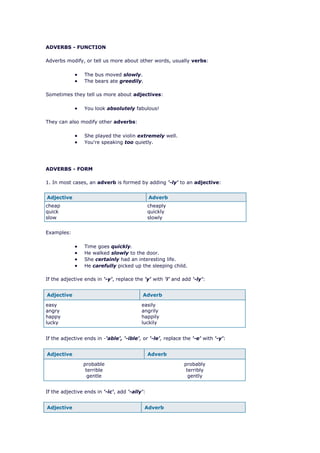
Adverbs modify, or tell us more about other words, usually verbs:

                 The bus moved slowly.
                 The bears ate greedily.

Sometimes they tell us more about adjectives:

                 You look absolutely fabulous!

They can also modify other adverbs:

                 She played the violin extremely well.
                 You're speaking too quietly.


ADVERBS - FORM

1. In most cases, an adverb is formed by adding '-ly' to an adjective:


Adjective                                      Adverb
cheap                                          cheaply
quick                                          quickly
slow                                           slowly


Examples:

                 Time goes quickly.
                 He walked slowly to the door.
                 She certainly had an interesting life.
                 He carefully picked up the sleeping child.

If the adjective ends in '-y', replace the 'y' with 'i' and add '-ly':


Adjective                                  Adverb

easy                                      easily
angry                                     angrily
happy                                     happily
lucky                                     luckily


If the adjective ends in -'able', '-ible', or '-le', replace the '-e' with '-y':


Adjective                                      Adverb

                probable                                     probably
                 terrible                                     terribly
                  gentle                                       gently


If the adjective ends in '-ic', add '-ally':


Adjective                                  Adverb
basic                                   basically
              economic                                economically
                tragic                                  tragically


Note: Exception: public - publicly

2. Some adverbs have the same form as the adjective:


                              Adjective / Adverb

                 early                                      late
                  fast                                      near
                 hard                                     straight
                 high                                      wrong


Compare:

                It is a fast car.
                He drives very fast.
                This is a hard exercise.
                He works hard.
                We saw many high buildings.
                The bird flew high in the sky.

3. 'Well' and 'good'

'Well' is the adverb that corresponds to the adjective 'good'.

Examples:

                He is a good student.
                He studies well.
                She is a good pianist.
                She plays the piano well.
                They are good swimmers.
                They swim well.


KINDS OF ADVERBS

ADVERBS OF CERTAINTY

These adverbs express how certain or sure we feel about an action or event.

Common adverbs of certainty:

certainly, definitely, probably, undoubtedly, surely

Adverbs of certainty go before the main verb but after the verb 'to be':

                He definitely left the house this morning.
                He is probably in the park.

With other auxiliary verb, these adverbs go between the auxiliary and the main verb:

                He has certainly forgotten the meeting.
He will probably remember tomorrow.

Sometimes these adverbs can be placed at the beginning of the sentence:

               Undoubtedly, Winston Churchill was a great politician.

BE CAREFUL! with surely. When it is placed at the beginning of the sentence, it means the
speaker thinks something is true, but is looking for confirmation:

Example:

               Surely you've got a bicycle?


KINDS OF ADVERBS

RELATIVE ADVERBS

The following adverbs can be used to join sentences or clauses. They replace the more
formal structure of preposition + which in a relative clause:

where, when, why

Examples:

               That's the restaurant where we met for the first time.
               (where = at/in which)
               I remember the day when we first met.
               (when = on which)
               There was a very hot summer the year when he was born.
               (when = in which)
               Tell me (the reason) why you were late home.
               (why = for which, but could replace the whole phrase 'the reason for which')

COMPARATIVE FORMS OF ADVERBS

In general, comparative and superlative forms of adverbs are the same as for adjectives:

               add -er or -est to short adverbs:


Adverb                  Comparative                 Superlative
hard                   harder                       the hardest
late                   later                        the latest
fast                   faster                       the fastest


Example:

               Jim works harder than his brother.
               Everyone in the race ran fast, but John ran the fastest of all.

with adverbs ending in -ly, use more for the comparative and most for the superlative:


Adverb                 Comparative                   Superlative
quietly               more quietly                   most quietly
slowly                more slowly                    most slowly
seriously               more seriously                  most seriously


Example:

                 The teacher spoke more slowly to help us to understand.
                 Could you sing more quietly please?

Some adverbs have irregular comparative forms:


Adverb                     Comparative                   Superlative
badly                      worse                         worst
far                        farther/further               farthest/furthest
little                     less                          least
well                       better                        best
Example:

                 The little boy ran further than his friends.
                 You're driving worse today than yesterday !

BE CAREFUL! Sometimes 'most' can mean 'very':

                 We were most grateful for your help
                 I am most impressed by this application.

         KINDS OF ADVERBS
         There are several classes or 'kinds' of adverbs that we use for specific functions:
         1. Adverbs of manner
         2. Adverbs of place
         3. Adverbs of time
         4. Adverbs of certainty
         5. Adverbs of degree
         6. Interrogative adverbs
         7. Relative adverbs
         8. Viewpoint and commenting adverbs

KINDS OF ADVERBS

ADVERBS OF MANNER

Adverbs of manner tell us how something happens. They are usually placed after the main
verb or after the object.

Examples:

                 He swims well, (after the main verb)
                 He ran... rapidly, slowly, quickly..
                 She spoke... softly, loudly, aggressively..
                 James coughed loudly to attract her attention.
                 He plays the flute beautifully. (after the object)
                 He ate the chocolate cake greedily.

BE CAREFUL! The adverb should not be put between the verb and the object:

                 He ate greedily the chocolate cake [incorrect]
                 He ate the chocolate cake greedily [correct]
If there is a preposition before the object, e.g. at, towards, we can place the adverb
either before the preposition or after the object.

Example:

                The child ran happily towards his mother.
                The child ran towards his mother happily.

Sometimes an adverb of manner is placed before a verb + object to add emphasis:

                He gently woke the sleeping woman.

Some writers put an adverb of manner at the beginning of the sentence to catch our
attention and make us curious:

                Slowly she picked up the knife.

(We want to know what happened slowly, who did it slowly, why they did it slowly)

However, adverbs should always come AFTER intransitive verbs (=verbs which have no
object).

Example:

                The town grew quickly
                He waited patiently

Also, these common adverbs are almost always placed AFTER the verb:

                well
                badly
                hard
                fast

The position of the adverb is important when there is more than one verb in a sentence. If
the adverb is placed after a clause, then it modifies the whole action described by the
clause.

Notice the difference in meaning between the following pairs of sentences:

                She quickly agreed to re-type the letter (= her agreement was quick)
                She agreed to re-type the letter quickly (= the re-typing was quick)
                He quietly asked me to leave the house (= his request was quiet)
                He asked me to leave the house quietly (= the leaving was quiet)

KINDS OF ADVERBS

ADVERBS OF PLACE

Adverbs of place tell us where something happens.
They are usually placed after the main verb or after the object:

Example:

after the main verb:

                I looked everywhere
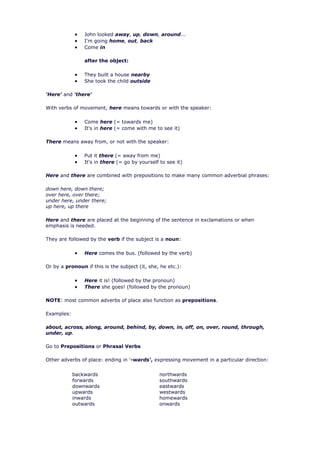
John looked away, up, down, around...
                I'm going home, out, back
                Come in

                after the object:

                They built a house nearby
                She took the child outside

'Here' and 'there'

With verbs of movement, here means towards or with the speaker:

                Come here (= towards me)
                It's in here (= come with me to see it)

There means away from, or not with the speaker:

                Put it there (= away from me)
                It's in there (= go by yourself to see it)

Here and there are combined with prepositions to make many common adverbial phrases:

down here, down there;
over here, over there;
under here, under there;
up here, up there

Here and there are placed at the beginning of the sentence in exclamations or when
emphasis is needed.

They are followed by the verb if the subject is a noun:

                Here comes the bus. (followed by the verb)

Or by a pronoun if this is the subject (it, she, he etc.):

                Here it is! (followed by the pronoun)
                There she goes! (followed by the pronoun)

NOTE: most common adverbs of place also function as prepositions.

Examples:

about, across, along, around, behind, by, down, in, off, on, over, round, through,
under, up.

Go to Prepositions or Phrasal Verbs

Other adverbs of place: ending in '-wards', expressing movement in a particular direction:


            backwards                           northwards
            forwards                            southwards
            downwards                           eastwards
            upwards                             westwards
            inwards                             homewards
            outwards                            onwards
Example:

               Cats don't usually walk backwards.
               The ship sailed westwards.

BE CAREFUL! 'Towards' is a preposition, not an adverb, so it is always followed by a
noun or a pronoun:

               He walked towards the car.
               She ran towards me.

expressing both movement and location:

ahead, abroad, overseas, uphill, downhill, sideways, indoors, outdoors

Example:

               The child went indoors.
               He lived and worked abroad.

KINDS OF ADVERBS

ADVERBS OF TIME

Adverbs of time tell us when an action happened, but also for how long, and how often.

Examples:

               When: today, yesterday, later, now, last year
               For how long: all day, not long, for a while, since last year
               How often: sometimes, frequently, never, often, yearly

"When" adverbs are usually placed at the end of the sentence:

               Goldilocks went to the Bears' house yesterday.
               I'm going to tidy my room tomorrow.

This is a "neutral" position, but some "when" adverbs can be put in other positions to give a
different emphasis

Compare:

               Later Goldilocks ate some porridge. (the time is more important)
               Goldilocks later ate some porridge. (this is more formal, like a policeman's
               report)
               Goldilocks ate some porridge later. (this is neutral, no particular emphasis)

"For how long" adverbs are usually placed at the end of the sentence:

               She stayed in the Bears' house all day.
               My mother lived in France for a year.

Notice: 'for' is always followed by an expression of duration:

               for three days,
               for a week,
               for several years,
for two centuries.

'since' is always followed by an expression of a point in time:

                    since Monday,
                    since 1997,
                    since the last war.

"How often" adverbs expressing the frequency of an action are usually placed before the
main verb but after auxiliary verbs (such as be, have, may, must):

                    I often eat vegetarian food. (before the main verb)
                    He never drinks milk. (before the main verb)
                    You must always fasten your seat belt. (after the auxiliary must)
                    She is never sea-sick.(after the auxiliary is)
                    I have never forgotten my first kiss. (after the auxiliary have and before the
                    main verb forgotten)

Some other "how often" adverbs express the exact number of times an action happens
and are usually placed at the end of the sentence:

                    This magazine is published monthly.
                    He visits his mother once a week.

When a frequency adverb is placed at the end of a sentence it is much stronger.

Compare:

                    She regularly visits France.
                    She visits France regularly.

Adverbs that can be used in these two positions:

                    frequently,
                    generally,
                    normally,
                    occasionally,
                    often,
                    regularly,
                    sometimes,
                    usually

'Yet' and 'still'

Yet is used in questions and in negative sentences, and is placed at the end of the
sentence or after not.

                    Have you finished your work yet? (= a simple request for information) No,
                    not yet. (= simple negative answer)
                    They haven't met him yet. (= simple negative statement)
                    Haven't you finished yet? (= expressing slight surprise)

Still expresses continuity; it is used in positive sentences and questions, and is placed
before the main verb and after auxiliary verbs (such as be, have, might, will)

                    I am still hungry.
                    She is still waiting for you
                    Are you still here?
Do you still work for the BBC?

ORDER OF ADVERBS OF TIME

If you need to use more than one adverb of time at the end of a sentence, use them in this
order:

1: 'how long'
2: 'how often'
3: 'when' (think of 'low')

Example:

               1 + 2 : I work (1) for five hours (2) every day
               2 + 3 : The magazine was published (2) weekly (3) last year.
               1 + 3 : I was abroad (1) for two months (3) last year.
               1 + 2 + 3 : She worked in a hospital (1) for two days (2) every week (3)
               last year.


RELATIVE ADVERBS

The following adverbs can be used to join sentences or clauses.
They replace the more formal structure of preposition + which in a
relative clause:

where, when, why

Examples:

               That's the restaurant where we met for the first time.
               (where = at/in which)
               I remember the day when we first met.
               (when = on which)
               There was a very hot summer the year when he was
               born.
               (when = in which)
               Tell me (the reason) why you were late home.
               (why = for which, but could replace the whole phrase
               'the reason for which')

KINDS OF ADVERBS

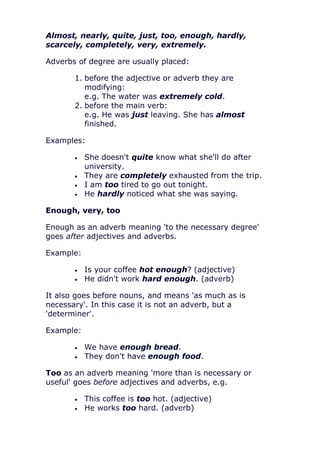
ADVERBS OF DEGREE

Adverbs of degree tell us about the intensity or degree of
an action, an adjective or another adverb.

Common adverbs of degree:
Almost, nearly, quite, just, too, enough, hardly,
scarcely, completely, very, extremely.

Adverbs of degree are usually placed:

       1. before the adjective or adverb they are
          modifying:
          e.g. The water was extremely cold.
       2. before the main verb:
          e.g. He was just leaving. She has almost
          finished.

Examples:

           She doesn't quite know what she'll do after
           university.
           They are completely exhausted from the trip.
           I am too tired to go out tonight.
           He hardly noticed what she was saying.

Enough, very, too

Enough as an adverb meaning 'to the necessary degree'
goes after adjectives and adverbs.

Example:

           Is your coffee hot enough? (adjective)
           He didn't work hard enough. (adverb)

It also goes before nouns, and means 'as much as is
necessary'. In this case it is not an adverb, but a
'determiner'.

Example:

           We have enough bread.
           They don't have enough food.

Too as an adverb meaning 'more than is necessary or
useful' goes before adjectives and adverbs, e.g.

           This coffee is too hot. (adjective)
           He works too hard. (adverb)
Enough and too with adjectives can be followed by 'for
someone/something'.

Example:

           The dress was big enough for me.
           She's not experienced enough for this job.
           The coffee was too hot for me.
           The dress was too small for her.

We can also use 'to + infinitive' after enough and too with
adjectives/adverb.

Example:

           The coffee was too hot to drink.
           He didn't work hard enough to pass the exam.
           She's not old enough to get married.
           You're too young to have grandchildren!

Very goes before an adverb or adjective to make it
stronger.

Example:

           The girl was very beautiful. (adjective)
           He worked very quickly. (adverb)

If we want to make a negative form of an adjective or
adverb, we can use a word of opposite meaning, or not
very.

Example:

           The girl was ugly OR The girl was not very
           beautiful
           He worked slowly OR He didn't work very
           quickly.

BE CAREFUL! There is a big difference between too and
very.

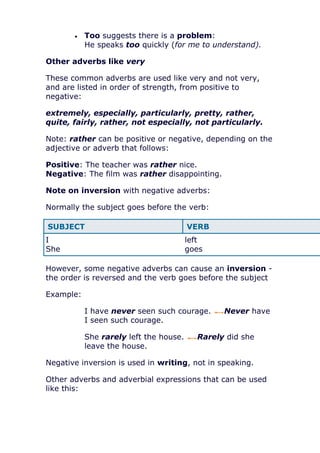
           Very expresses a fact:
           He speaks very quickly.
Too suggests there is a problem:
           He speaks too quickly (for me to understand).

Other adverbs like very

These common adverbs are used like very and not very,
and are listed in order of strength, from positive to
negative:

extremely, especially, particularly, pretty, rather,
quite, fairly, rather, not especially, not particularly.

Note: rather can be positive or negative, depending on the
adjective or adverb that follows:

Positive: The teacher was rather nice.
Negative: The film was rather disappointing.

Note on inversion with negative adverbs:

Normally the subject goes before the verb:

SUBJECT                                 VERB
I                                       left
She                                     goes

However, some negative adverbs can cause an inversion -
the order is reversed and the verb goes before the subject

Example:

           I have never seen such courage.      Never have
           I seen such courage.

           She rarely left the house.     Rarely did she
           leave the house.

Negative inversion is used in writing, not in speaking.

Other adverbs and adverbial expressions that can be used
like this:
seldom, scarcely, hardly, not only .....
but also, no sooner .....
than, not until, under no circumstances.

KINDS OF ADVERBS

INTERROGATIVE ADVERBS

These are:

why, where, how, when

They are usually placed at the beginning of a question.

Examples:

          Why are you so late?
          Where is my passport?
          How are you?
          How much is that coat?
          When does the train arrive?

Notice that how can be used in four different ways:

1. meaning 'in what way?':
How did you make this sauce?
How do you start the car?

2. with adjectives:
How tall are you?
How old is your house?

3. with much and many:
How much are these tomatoes?
How many people are coming to the party?

4. with other adverbs:
How quickly can you read this?
How often do you go to London?
KINDS OF ADVERBS

VIEWPOINT AND COMMENTING ADVERBS

There are some adverbs and adverbial expressions
which tell us about the speaker's viewpoint or
opinion about an action, or make some comment on
the action.

Viewpoint

Frankly, I think he is a liar. (= this is my frank,
honest opinion)
Theoretically, you should pay a fine. (= from a
theoretical point of view but there may be another
way of looking at the situation)

These adverbs are placed at the beginning of the
sentence and are separated from the rest of the
sentence by a comma.

Some common Viewpoint adverbs:

honestly, seriously, confidentially, personally,
surprisingly, ideally, economically, officially,
obviously, clearly, surely, undoubtedly.

Examples:

          Personally, I'd rather go by train.
          Surprisingly, this car is cheaper than the
          smaller model.
          Geographically, Britain is rather cut off
          from the rest of Europe.

Commenting

          She is certainly the best person for the
          job.
          You obviously enjoyed your meal.

These are very similar to viewpoint adverbs, and
often the same words, but they go in a different
position - after the verb to be and before the main
verb.

Some common Commenting adverbs:

definitely, certainly, obviously, simply.

Adverbs

  • 1.
    ADVERBS - FUNCTION Adverbsmodify, or tell us more about other words, usually verbs: The bus moved slowly. The bears ate greedily. Sometimes they tell us more about adjectives: You look absolutely fabulous! They can also modify other adverbs: She played the violin extremely well. You're speaking too quietly. ADVERBS - FORM 1. In most cases, an adverb is formed by adding '-ly' to an adjective: Adjective Adverb cheap cheaply quick quickly slow slowly Examples: Time goes quickly. He walked slowly to the door. She certainly had an interesting life. He carefully picked up the sleeping child. If the adjective ends in '-y', replace the 'y' with 'i' and add '-ly': Adjective Adverb easy easily angry angrily happy happily lucky luckily If the adjective ends in -'able', '-ible', or '-le', replace the '-e' with '-y': Adjective Adverb probable probably terrible terribly gentle gently If the adjective ends in '-ic', add '-ally': Adjective Adverb
  • 2.
    basic basically economic economically tragic tragically Note: Exception: public - publicly 2. Some adverbs have the same form as the adjective: Adjective / Adverb early late fast near hard straight high wrong Compare: It is a fast car. He drives very fast. This is a hard exercise. He works hard. We saw many high buildings. The bird flew high in the sky. 3. 'Well' and 'good' 'Well' is the adverb that corresponds to the adjective 'good'. Examples: He is a good student. He studies well. She is a good pianist. She plays the piano well. They are good swimmers. They swim well. KINDS OF ADVERBS ADVERBS OF CERTAINTY These adverbs express how certain or sure we feel about an action or event. Common adverbs of certainty: certainly, definitely, probably, undoubtedly, surely Adverbs of certainty go before the main verb but after the verb 'to be': He definitely left the house this morning. He is probably in the park. With other auxiliary verb, these adverbs go between the auxiliary and the main verb: He has certainly forgotten the meeting.
  • 3.
    He will probablyremember tomorrow. Sometimes these adverbs can be placed at the beginning of the sentence: Undoubtedly, Winston Churchill was a great politician. BE CAREFUL! with surely. When it is placed at the beginning of the sentence, it means the speaker thinks something is true, but is looking for confirmation: Example: Surely you've got a bicycle? KINDS OF ADVERBS RELATIVE ADVERBS The following adverbs can be used to join sentences or clauses. They replace the more formal structure of preposition + which in a relative clause: where, when, why Examples: That's the restaurant where we met for the first time. (where = at/in which) I remember the day when we first met. (when = on which) There was a very hot summer the year when he was born. (when = in which) Tell me (the reason) why you were late home. (why = for which, but could replace the whole phrase 'the reason for which') COMPARATIVE FORMS OF ADVERBS In general, comparative and superlative forms of adverbs are the same as for adjectives: add -er or -est to short adverbs: Adverb Comparative Superlative hard harder the hardest late later the latest fast faster the fastest Example: Jim works harder than his brother. Everyone in the race ran fast, but John ran the fastest of all. with adverbs ending in -ly, use more for the comparative and most for the superlative: Adverb Comparative Superlative quietly more quietly most quietly slowly more slowly most slowly
  • 4.
    seriously more seriously most seriously Example: The teacher spoke more slowly to help us to understand. Could you sing more quietly please? Some adverbs have irregular comparative forms: Adverb Comparative Superlative badly worse worst far farther/further farthest/furthest little less least well better best Example: The little boy ran further than his friends. You're driving worse today than yesterday ! BE CAREFUL! Sometimes 'most' can mean 'very': We were most grateful for your help I am most impressed by this application. KINDS OF ADVERBS There are several classes or 'kinds' of adverbs that we use for specific functions: 1. Adverbs of manner 2. Adverbs of place 3. Adverbs of time 4. Adverbs of certainty 5. Adverbs of degree 6. Interrogative adverbs 7. Relative adverbs 8. Viewpoint and commenting adverbs KINDS OF ADVERBS ADVERBS OF MANNER Adverbs of manner tell us how something happens. They are usually placed after the main verb or after the object. Examples: He swims well, (after the main verb) He ran... rapidly, slowly, quickly.. She spoke... softly, loudly, aggressively.. James coughed loudly to attract her attention. He plays the flute beautifully. (after the object) He ate the chocolate cake greedily. BE CAREFUL! The adverb should not be put between the verb and the object: He ate greedily the chocolate cake [incorrect] He ate the chocolate cake greedily [correct]
  • 5.
    If there isa preposition before the object, e.g. at, towards, we can place the adverb either before the preposition or after the object. Example: The child ran happily towards his mother. The child ran towards his mother happily. Sometimes an adverb of manner is placed before a verb + object to add emphasis: He gently woke the sleeping woman. Some writers put an adverb of manner at the beginning of the sentence to catch our attention and make us curious: Slowly she picked up the knife. (We want to know what happened slowly, who did it slowly, why they did it slowly) However, adverbs should always come AFTER intransitive verbs (=verbs which have no object). Example: The town grew quickly He waited patiently Also, these common adverbs are almost always placed AFTER the verb: well badly hard fast The position of the adverb is important when there is more than one verb in a sentence. If the adverb is placed after a clause, then it modifies the whole action described by the clause. Notice the difference in meaning between the following pairs of sentences: She quickly agreed to re-type the letter (= her agreement was quick) She agreed to re-type the letter quickly (= the re-typing was quick) He quietly asked me to leave the house (= his request was quiet) He asked me to leave the house quietly (= the leaving was quiet) KINDS OF ADVERBS ADVERBS OF PLACE Adverbs of place tell us where something happens. They are usually placed after the main verb or after the object: Example: after the main verb: I looked everywhere
  • 6.
    John looked away,up, down, around... I'm going home, out, back Come in after the object: They built a house nearby She took the child outside 'Here' and 'there' With verbs of movement, here means towards or with the speaker: Come here (= towards me) It's in here (= come with me to see it) There means away from, or not with the speaker: Put it there (= away from me) It's in there (= go by yourself to see it) Here and there are combined with prepositions to make many common adverbial phrases: down here, down there; over here, over there; under here, under there; up here, up there Here and there are placed at the beginning of the sentence in exclamations or when emphasis is needed. They are followed by the verb if the subject is a noun: Here comes the bus. (followed by the verb) Or by a pronoun if this is the subject (it, she, he etc.): Here it is! (followed by the pronoun) There she goes! (followed by the pronoun) NOTE: most common adverbs of place also function as prepositions. Examples: about, across, along, around, behind, by, down, in, off, on, over, round, through, under, up. Go to Prepositions or Phrasal Verbs Other adverbs of place: ending in '-wards', expressing movement in a particular direction: backwards northwards forwards southwards downwards eastwards upwards westwards inwards homewards outwards onwards
  • 7.
    Example: Cats don't usually walk backwards. The ship sailed westwards. BE CAREFUL! 'Towards' is a preposition, not an adverb, so it is always followed by a noun or a pronoun: He walked towards the car. She ran towards me. expressing both movement and location: ahead, abroad, overseas, uphill, downhill, sideways, indoors, outdoors Example: The child went indoors. He lived and worked abroad. KINDS OF ADVERBS ADVERBS OF TIME Adverbs of time tell us when an action happened, but also for how long, and how often. Examples: When: today, yesterday, later, now, last year For how long: all day, not long, for a while, since last year How often: sometimes, frequently, never, often, yearly "When" adverbs are usually placed at the end of the sentence: Goldilocks went to the Bears' house yesterday. I'm going to tidy my room tomorrow. This is a "neutral" position, but some "when" adverbs can be put in other positions to give a different emphasis Compare: Later Goldilocks ate some porridge. (the time is more important) Goldilocks later ate some porridge. (this is more formal, like a policeman's report) Goldilocks ate some porridge later. (this is neutral, no particular emphasis) "For how long" adverbs are usually placed at the end of the sentence: She stayed in the Bears' house all day. My mother lived in France for a year. Notice: 'for' is always followed by an expression of duration: for three days, for a week, for several years,
  • 8.
    for two centuries. 'since'is always followed by an expression of a point in time: since Monday, since 1997, since the last war. "How often" adverbs expressing the frequency of an action are usually placed before the main verb but after auxiliary verbs (such as be, have, may, must): I often eat vegetarian food. (before the main verb) He never drinks milk. (before the main verb) You must always fasten your seat belt. (after the auxiliary must) She is never sea-sick.(after the auxiliary is) I have never forgotten my first kiss. (after the auxiliary have and before the main verb forgotten) Some other "how often" adverbs express the exact number of times an action happens and are usually placed at the end of the sentence: This magazine is published monthly. He visits his mother once a week. When a frequency adverb is placed at the end of a sentence it is much stronger. Compare: She regularly visits France. She visits France regularly. Adverbs that can be used in these two positions: frequently, generally, normally, occasionally, often, regularly, sometimes, usually 'Yet' and 'still' Yet is used in questions and in negative sentences, and is placed at the end of the sentence or after not. Have you finished your work yet? (= a simple request for information) No, not yet. (= simple negative answer) They haven't met him yet. (= simple negative statement) Haven't you finished yet? (= expressing slight surprise) Still expresses continuity; it is used in positive sentences and questions, and is placed before the main verb and after auxiliary verbs (such as be, have, might, will) I am still hungry. She is still waiting for you Are you still here?
  • 9.
    Do you stillwork for the BBC? ORDER OF ADVERBS OF TIME If you need to use more than one adverb of time at the end of a sentence, use them in this order: 1: 'how long' 2: 'how often' 3: 'when' (think of 'low') Example: 1 + 2 : I work (1) for five hours (2) every day 2 + 3 : The magazine was published (2) weekly (3) last year. 1 + 3 : I was abroad (1) for two months (3) last year. 1 + 2 + 3 : She worked in a hospital (1) for two days (2) every week (3) last year. RELATIVE ADVERBS The following adverbs can be used to join sentences or clauses. They replace the more formal structure of preposition + which in a relative clause: where, when, why Examples: That's the restaurant where we met for the first time. (where = at/in which) I remember the day when we first met. (when = on which) There was a very hot summer the year when he was born. (when = in which) Tell me (the reason) why you were late home. (why = for which, but could replace the whole phrase 'the reason for which') KINDS OF ADVERBS ADVERBS OF DEGREE Adverbs of degree tell us about the intensity or degree of an action, an adjective or another adverb. Common adverbs of degree:
  • 10.
    Almost, nearly, quite,just, too, enough, hardly, scarcely, completely, very, extremely. Adverbs of degree are usually placed: 1. before the adjective or adverb they are modifying: e.g. The water was extremely cold. 2. before the main verb: e.g. He was just leaving. She has almost finished. Examples: She doesn't quite know what she'll do after university. They are completely exhausted from the trip. I am too tired to go out tonight. He hardly noticed what she was saying. Enough, very, too Enough as an adverb meaning 'to the necessary degree' goes after adjectives and adverbs. Example: Is your coffee hot enough? (adjective) He didn't work hard enough. (adverb) It also goes before nouns, and means 'as much as is necessary'. In this case it is not an adverb, but a 'determiner'. Example: We have enough bread. They don't have enough food. Too as an adverb meaning 'more than is necessary or useful' goes before adjectives and adverbs, e.g. This coffee is too hot. (adjective) He works too hard. (adverb)
  • 11.
    Enough and toowith adjectives can be followed by 'for someone/something'. Example: The dress was big enough for me. She's not experienced enough for this job. The coffee was too hot for me. The dress was too small for her. We can also use 'to + infinitive' after enough and too with adjectives/adverb. Example: The coffee was too hot to drink. He didn't work hard enough to pass the exam. She's not old enough to get married. You're too young to have grandchildren! Very goes before an adverb or adjective to make it stronger. Example: The girl was very beautiful. (adjective) He worked very quickly. (adverb) If we want to make a negative form of an adjective or adverb, we can use a word of opposite meaning, or not very. Example: The girl was ugly OR The girl was not very beautiful He worked slowly OR He didn't work very quickly. BE CAREFUL! There is a big difference between too and very. Very expresses a fact: He speaks very quickly.
  • 12.
    Too suggests thereis a problem: He speaks too quickly (for me to understand). Other adverbs like very These common adverbs are used like very and not very, and are listed in order of strength, from positive to negative: extremely, especially, particularly, pretty, rather, quite, fairly, rather, not especially, not particularly. Note: rather can be positive or negative, depending on the adjective or adverb that follows: Positive: The teacher was rather nice. Negative: The film was rather disappointing. Note on inversion with negative adverbs: Normally the subject goes before the verb: SUBJECT VERB I left She goes However, some negative adverbs can cause an inversion - the order is reversed and the verb goes before the subject Example: I have never seen such courage. Never have I seen such courage. She rarely left the house. Rarely did she leave the house. Negative inversion is used in writing, not in speaking. Other adverbs and adverbial expressions that can be used like this:
  • 13.
    seldom, scarcely, hardly,not only ..... but also, no sooner ..... than, not until, under no circumstances. KINDS OF ADVERBS INTERROGATIVE ADVERBS These are: why, where, how, when They are usually placed at the beginning of a question. Examples: Why are you so late? Where is my passport? How are you? How much is that coat? When does the train arrive? Notice that how can be used in four different ways: 1. meaning 'in what way?': How did you make this sauce? How do you start the car? 2. with adjectives: How tall are you? How old is your house? 3. with much and many: How much are these tomatoes? How many people are coming to the party? 4. with other adverbs: How quickly can you read this? How often do you go to London?
  • 14.
    KINDS OF ADVERBS VIEWPOINTAND COMMENTING ADVERBS There are some adverbs and adverbial expressions which tell us about the speaker's viewpoint or opinion about an action, or make some comment on the action. Viewpoint Frankly, I think he is a liar. (= this is my frank, honest opinion) Theoretically, you should pay a fine. (= from a theoretical point of view but there may be another way of looking at the situation) These adverbs are placed at the beginning of the sentence and are separated from the rest of the sentence by a comma. Some common Viewpoint adverbs: honestly, seriously, confidentially, personally, surprisingly, ideally, economically, officially, obviously, clearly, surely, undoubtedly. Examples: Personally, I'd rather go by train. Surprisingly, this car is cheaper than the smaller model. Geographically, Britain is rather cut off from the rest of Europe. Commenting She is certainly the best person for the job. You obviously enjoyed your meal. These are very similar to viewpoint adverbs, and
  • 15.
    often the samewords, but they go in a different position - after the verb to be and before the main verb. Some common Commenting adverbs: definitely, certainly, obviously, simply.