Adverb
Prepared by Shoaib Mirza
Adverb
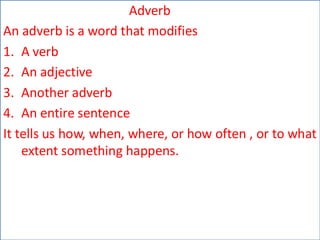
An adverb is a word that modifies
1. A verb
2. An adjective
3. Another adverb
4. An entire sentence
It tells us how, when, where, or how often , or to what
extent something happens.
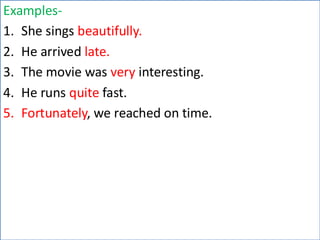
Examples-
1. She sings beautifully.
2. He arrived late.
3. The movie was very interesting.
4. He runs quite fast.
5. Fortunately, we reached on time.
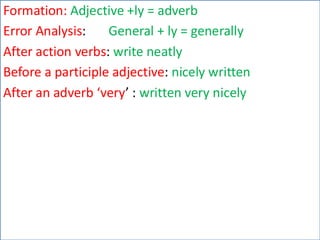
Formation: Adjective +ly = adverb
Error Analysis: General + ly = generally
After action verbs: write neatly
Before a participle adjective: nicely written
After an adverb ‘very’ : written very nicely
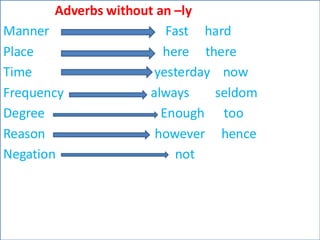
Adverbs without an –ly
Manner Fast hard
Place here there
Time yesterday now
Frequency always seldom
Degree Enough too
Reason however hence
Negation not
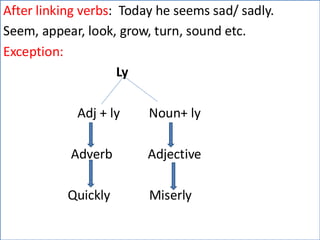
After linking verbs: Today he seems sad/ sadly.
Seem, appear, look, grow, turn, sound etc.
Exception:
Ly
Adj + ly Noun+ ly
Adverb Adjective
Quickly Miserly
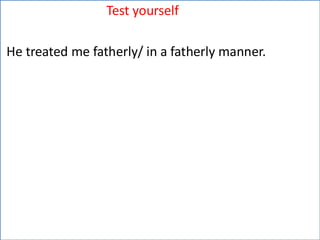
Test yourself
He treated me fatherly/ in a fatherly manner.
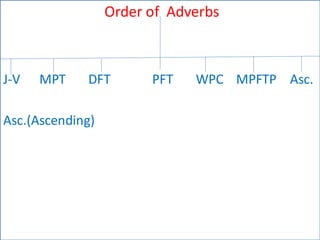
Order of Adverbs
J-V MPT DFT PFT WPC MPFTP Asc.
Asc.(Ascending)
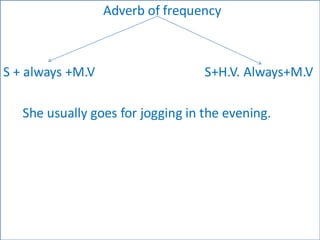
Adverb of frequency
S + always +M.V S+H.V. Always+M.V
She usually goes for jogging in the evening.
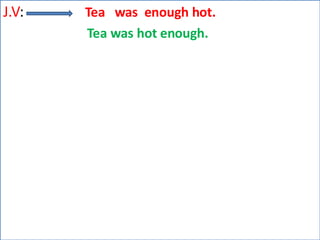
J.V: Tea was enough hot.
Tea was hot enough.
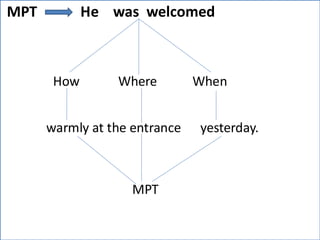
MPT He was welcomed
How Where When
warmly at the entrance yesterday.
MPT
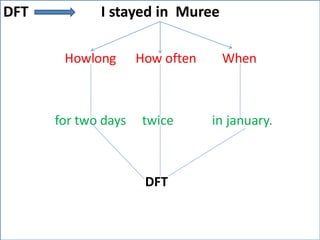
DFT I stayed in Muree
Howlong How often When
for two days twice in january.
DFT
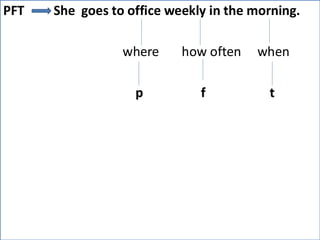
PFT She goes to office weekly in the morning.
where how often when
p f t
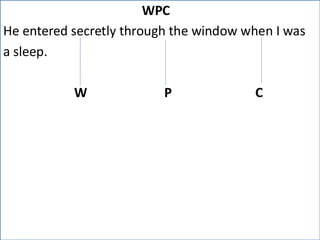
WPC
He entered secretly through the window when I was
a sleep.
W P C
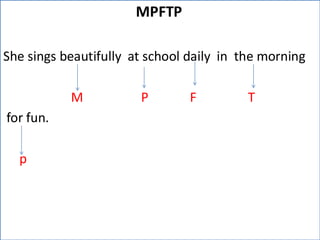
MPFTP
She sings beautifully at school daily in the morning
M P F T
for fun.
p
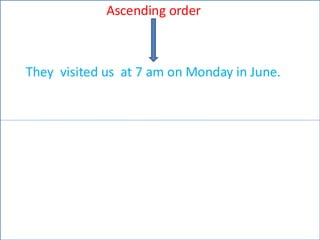
Ascending order
They visited us at 7 am on Monday in June.
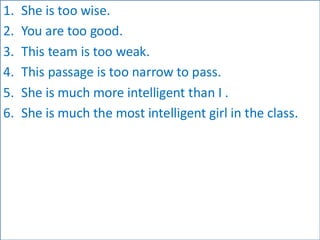
1. She is too wise.
2. You are too good.
3. This team is too weak.
4. This passage is too narrow to pass.
5. She is much more intelligent than I .
6. She is much the most intelligent girl in the class.
Too/Very
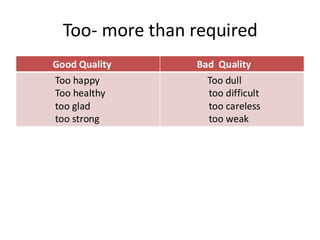
Too- more than required
Good Quality Bad Quality
Too happy
Too healthy
too glad
too strong
Too dull
too difficult
too careless
too weak
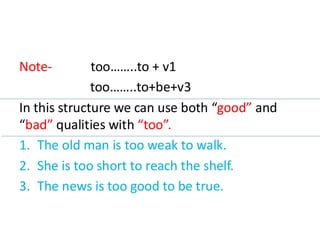
Note- too……..to + v1
too……..to+be+v3
In this structure we can use both “good” and
“bad” qualities with “too”.
1. The old man is too weak to walk.
2. She is too short to reach the shelf.
3. The news is too good to be true.
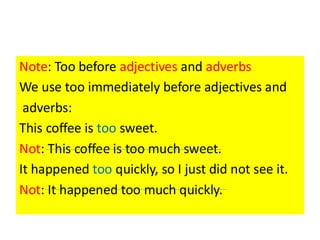
Note: Too before adjectives and adverbs
We use too immediately before adjectives and
adverbs:
This coffee is too sweet.
Not: This coffee is too much sweet.
It happened too quickly, so I just did not see it.
Not: It happened too much quickly.
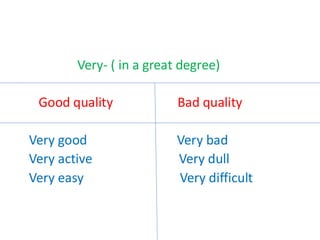
Very- ( in a great degree)
Good quality Bad quality
Very good Very bad
Very active Very dull
Very easy Very difficult
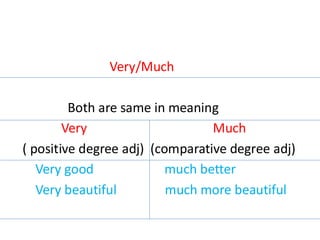
Very/Much
Both are same in meaning
Very Much
( positive degree adj) (comparative degree adj)
Very good much better
Very beautiful much more beautiful
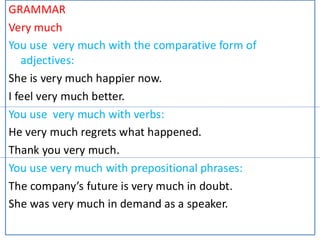
GRAMMAR
Very much
You use very much with the comparative form of
adjectives:
She is very much happier now.
I feel very much better.
You use very much with verbs:
He very much regrets what happened.
Thank you very much.
You use very much with prepositional phrases:
The company’s future is very much in doubt.
She was very much in demand as a speaker.
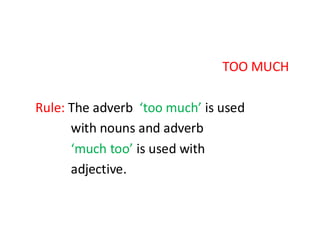
TOO MUCH
Rule: The adverb ‘too much’ is used
with nouns and adverb
‘much too’ is used with
adjective.
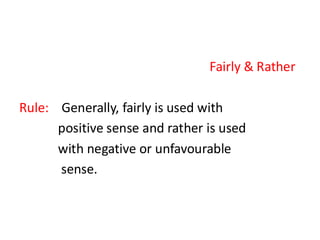
Fairly & Rather
Rule: Generally, fairly is used with
positive sense and rather is used
with negative or unfavourable
sense.
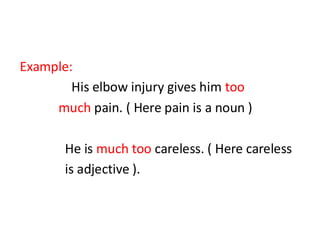
Example:
His elbow injury gives him too
much pain. ( Here pain is a noun )
He is much too careless. ( Here careless
is adjective ).
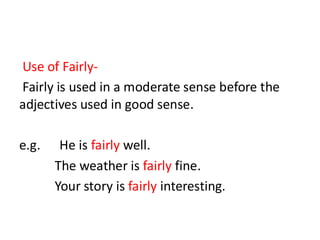
Use of Fairly-
Fairly is used in a moderate sense before the
adjectives used in good sense.
e.g. He is fairly well.
The weather is fairly fine.
Your story is fairly interesting.
Use of Rather-
Rather is also used in the moderate sense
before the adjectives used in bad sense.
e.g. Ali is rather hopeless.
The weather is rather bad.
The description of the incident is rather
boring.
Fairly is never preceded by too wherever we use
rather before the adverb too.
John is rather too wise.
Fairly doesn’t take the article a immediately
after it, but this is not the case with rather.
Abraham is rather a stupid boy.
Much or very with past participle
When a past participle is part of a passive verb,
we can put much or very much before it, but not
very.
He is much admired by his students.
Pakistan trade position has been much
weakened by inflation.
When a past participle is used as an adjective
, we usually prefer very .This common with
words referring to mental states , feelings, and
reactions.
A very frightened animal. ( compound Adj.)
A very shocked expression
The children were very bored.
She looked very surprised.

Adverb.pdf (best English presentation )

  • 1.
  • 2.
    Adverb An adverb isa word that modifies 1. A verb 2. An adjective 3. Another adverb 4. An entire sentence It tells us how, when, where, or how often , or to what extent something happens.
  • 3.
    Examples- 1. She singsbeautifully. 2. He arrived late. 3. The movie was very interesting. 4. He runs quite fast. 5. Fortunately, we reached on time.
  • 4.
    Formation: Adjective +ly= adverb Error Analysis: General + ly = generally After action verbs: write neatly Before a participle adjective: nicely written After an adverb ‘very’ : written very nicely
  • 5.
    Adverbs without an–ly Manner Fast hard Place here there Time yesterday now Frequency always seldom Degree Enough too Reason however hence Negation not
  • 6.
    After linking verbs:Today he seems sad/ sadly. Seem, appear, look, grow, turn, sound etc. Exception: Ly Adj + ly Noun+ ly Adverb Adjective Quickly Miserly
  • 7.
    Test yourself He treatedme fatherly/ in a fatherly manner.
  • 8.
    Order of Adverbs J-VMPT DFT PFT WPC MPFTP Asc. Asc.(Ascending)
  • 9.
    Adverb of frequency S+ always +M.V S+H.V. Always+M.V She usually goes for jogging in the evening.
  • 10.
    J.V: Tea wasenough hot. Tea was hot enough.
  • 11.
    MPT He waswelcomed How Where When warmly at the entrance yesterday. MPT
  • 12.
    DFT I stayedin Muree Howlong How often When for two days twice in january. DFT
  • 13.
    PFT She goesto office weekly in the morning. where how often when p f t
  • 14.
    WPC He entered secretlythrough the window when I was a sleep. W P C
  • 15.
    MPFTP She sings beautifullyat school daily in the morning M P F T for fun. p
  • 16.
    Ascending order They visitedus at 7 am on Monday in June.
  • 17.
    1. She istoo wise. 2. You are too good. 3. This team is too weak. 4. This passage is too narrow to pass. 5. She is much more intelligent than I . 6. She is much the most intelligent girl in the class.
  • 18.
  • 19.
    Too- more thanrequired Good Quality Bad Quality Too happy Too healthy too glad too strong Too dull too difficult too careless too weak
  • 20.
    Note- too……..to +v1 too……..to+be+v3 In this structure we can use both “good” and “bad” qualities with “too”. 1. The old man is too weak to walk. 2. She is too short to reach the shelf. 3. The news is too good to be true.
  • 21.
    Note: Too beforeadjectives and adverbs We use too immediately before adjectives and adverbs: This coffee is too sweet. Not: This coffee is too much sweet. It happened too quickly, so I just did not see it. Not: It happened too much quickly.
  • 22.
    Very- ( ina great degree) Good quality Bad quality Very good Very bad Very active Very dull Very easy Very difficult
  • 23.
    Very/Much Both are samein meaning Very Much ( positive degree adj) (comparative degree adj) Very good much better Very beautiful much more beautiful
  • 24.
    GRAMMAR Very much You usevery much with the comparative form of adjectives: She is very much happier now. I feel very much better. You use very much with verbs: He very much regrets what happened. Thank you very much. You use very much with prepositional phrases: The company’s future is very much in doubt. She was very much in demand as a speaker.
  • 25.
    TOO MUCH Rule: Theadverb ‘too much’ is used with nouns and adverb ‘much too’ is used with adjective.
  • 26.
    Fairly & Rather Rule:Generally, fairly is used with positive sense and rather is used with negative or unfavourable sense.
  • 27.
    Example: His elbow injurygives him too much pain. ( Here pain is a noun ) He is much too careless. ( Here careless is adjective ).
  • 28.
    Use of Fairly- Fairlyis used in a moderate sense before the adjectives used in good sense. e.g. He is fairly well. The weather is fairly fine. Your story is fairly interesting.
  • 29.
    Use of Rather- Ratheris also used in the moderate sense before the adjectives used in bad sense. e.g. Ali is rather hopeless. The weather is rather bad. The description of the incident is rather boring.
  • 30.
    Fairly is neverpreceded by too wherever we use rather before the adverb too. John is rather too wise. Fairly doesn’t take the article a immediately after it, but this is not the case with rather. Abraham is rather a stupid boy.
  • 31.
    Much or verywith past participle When a past participle is part of a passive verb, we can put much or very much before it, but not very. He is much admired by his students. Pakistan trade position has been much weakened by inflation.
  • 32.
    When a pastparticiple is used as an adjective , we usually prefer very .This common with words referring to mental states , feelings, and reactions. A very frightened animal. ( compound Adj.) A very shocked expression The children were very bored. She looked very surprised.