ADVERB
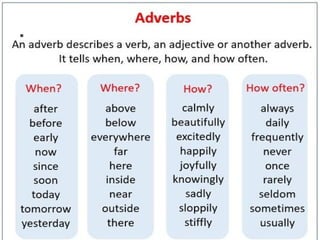
An adverb is a word or expression that modifies the meaning of a
verb, an adjective or another adverb and usually describes when,
where, how ,how many times and to what extent something happens.
 Adverbs are often recognized by the suffix "-ly"
at the end of the word, such as "quickly" which
comes from the adjective "quick". However, not
all adverbs end in "-ly".
EG-
 Some examples of adverbs include "very,"
"often," "never," "always," "sometimes," and
"seldom".
FORMATION OF ADVERB FROM
ADJECTIVES
 1.TO DESCRIBE/MODIFY VERBS
 She dances(how) beautifully.
 The football team played badly.
 2. TO MODIFY ADJECTIVES
 It was an extremely bad(how bad) match.
 They were extremely tired.
 3.ADVERBS
 The football team played extremely badly(how
badly).
 She spoke very softly.
What it Modifies
 TO MODIFY SENTENCES
 Unfortunately, the flight to Delhi had been
cancelled.
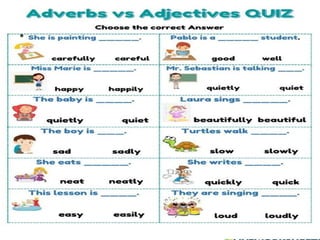
 Adjectives tell us something about a personor a
thing.
 It can modify nouns or pronouns.
 eg-Sunil is a careful driver.(noun- sunil. This is
actually about the driver)
 She is beautiful.(pronoun- she)
 Adverbs tell us in what way someone does
something
 It can modify verbs,adjectives or another adverb .
 Eg- Sunil drives carefully.(action/verb –drive.This is
about his way of driving)
Difference Adverbs and Adjectives
.
.
.
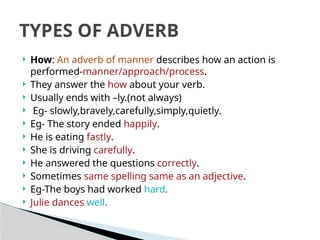
 How: An adverb of manner describes how an action is
performed-manner/approach/process.
 They answer the how about your verb.
 Usually ends with –ly.(not always)
 Eg- slowly,bravely,carefully,simply,quietly.
 Eg- The story ended happily.
 He is eating fastly.
 She is driving carefully.
 He answered the questions correctly.
 Sometimes same spelling same as an adjective.
 Eg-The boys had worked hard.
 Julie dances well.
TYPES OF ADVERB
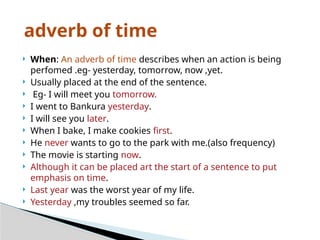
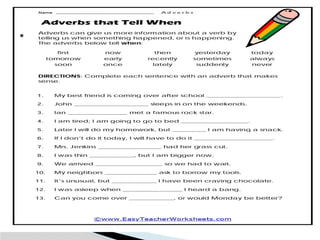
 When: An adverb of time describes when an action is being
perfomed .eg- yesterday, tomorrow, now ,yet.
 Usually placed at the end of the sentence.
 Eg- I will meet you tomorrow.
 I went to Bankura yesterday.
 I will see you later.
 When I bake, I make cookies first.
 He never wants to go to the park with me.(also frequency)
 The movie is starting now.
 Although it can be placed art the start of a sentence to put
emphasis on time.
 Last year was the worst year of my life.
 Yesterday ,my troubles seemed so far.
adverb of time
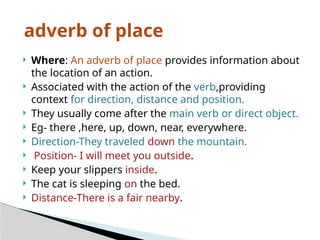
 Where: An adverb of place provides information about
the location of an action.
 Associated with the action of the verb,providing
context for direction, distance and position.
 They usually come after the main verb or direct object.
 Eg- there ,here, up, down, near, everywhere.
 Direction-They traveled down the mountain.
 Position- I will meet you outside.
 Keep your slippers inside.
 The cat is sleeping on the bed.
 Distance-There is a fair nearby.
adverb of place
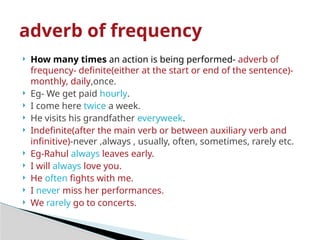
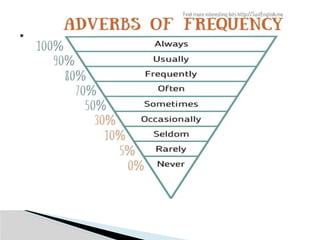
 How many times an action is being performed- adverb of
frequency- definite(either at the start or end of the sentence)-
monthly, daily,once.
 Eg- We get paid hourly.
 I come here twice a week.
 He visits his grandfather everyweek.
 Indefinite(after the main verb or between auxiliary verb and
infinitive)-never ,always , usually, often, sometimes, rarely etc.
 Eg-Rahul always leaves early.
 I will always love you.
 He often fights with me.
 I never miss her performances.
 We rarely go to concerts.
adverb of frequency
.
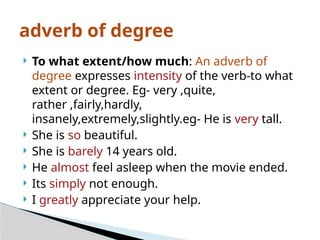
 To what extent/how much: An adverb of
degree expresses intensity of the verb-to what
extent or degree. Eg- very ,quite,
rather ,fairly,hardly,
insanely,extremely,slightly.eg- He is very tall.
 She is so beautiful.
 She is barely 14 years old.
 He almost feel asleep when the movie ended.
 Its simply not enough.
 I greatly appreciate your help.
adverb of degree
https://youtu.be/ePxNKUKWNDM?
feature=shared
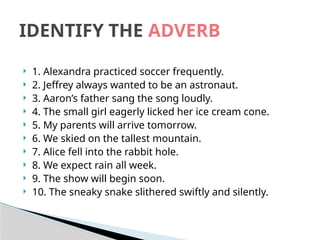
 1. Alexandra practiced soccer frequently.
 2. Jeffrey always wanted to be an astronaut.
 3. Aaron’s father sang the song loudly.
 4. The small girl eagerly licked her ice cream cone.
 5. My parents will arrive tomorrow.
 6. We skied on the tallest mountain.
 7. Alice fell into the rabbit hole.
 8. We expect rain all week.
 9. The show will begin soon.
 10. The sneaky snake slithered swiftly and silently.
IDENTIFY THE ADVERB
.
.
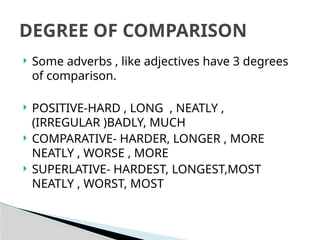
 Some adverbs , like adjectives have 3 degrees
of comparison.
 POSITIVE-HARD , LONG , NEATLY ,
(IRREGULAR )BADLY, MUCH
 COMPARATIVE- HARDER, LONGER , MORE
NEATLY , WORSE , MORE
 SUPERLATIVE- HARDEST, LONGEST,MOST
NEATLY , WORST, MOST
DEGREE OF COMPARISON
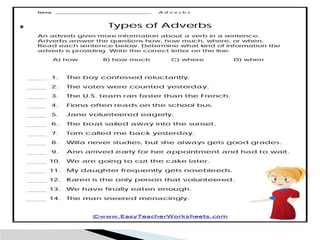
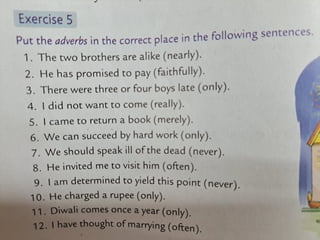
Exercise
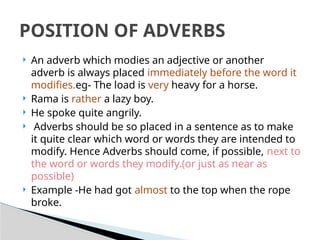
 An adverb which modies an adjective or another
adverb is always placed immediately before the word it
modifies.eg- The load is very heavy for a horse.
 Rama is rather a lazy boy.
 He spoke quite angrily.
 Adverbs should be so placed in a sentence as to make
it quite clear which word or words they are intended to
modify. Hence Adverbs should come, if possible, next to
the word or words they modify.(or just as near as
possible)
 Example -He had got almost to the top when the rope
broke.
POSITION OF ADVERBS
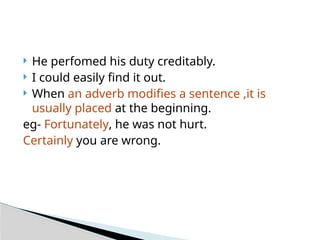
 He perfomed his duty creditably.
 I could easily find it out.
 When an adverb modifies a sentence ,it is
usually placed at the beginning.
eg- Fortunately, he was not hurt.
Certainly you are wrong.
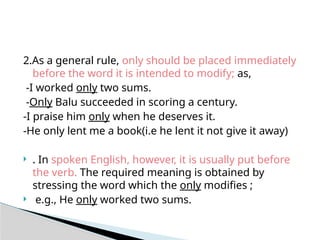
2.As a general rule, only should be placed immediately
before the word it is intended to modify; as,
-I worked only two sums.
-Only Balu succeeded in scoring a century.
-I praise him only when he deserves it.
-He only lent me a book(i.e he lent it not give it away)
 . In spoken English, however, it is usually put before
the verb. The required meaning is obtained by
stressing the word which the only modifies ;
 e.g., He only worked two sums.
exercise
 The adverbs ever, never, scarcely, ever are
often misplaced, as in the following sentence-
 Quite the most remarkable article we ever
remember to have read. [Say : we remember
ever ….]
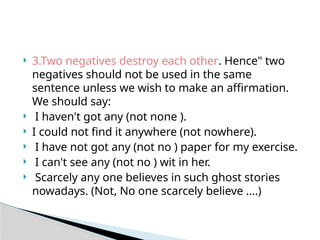
 3.Two negatives destroy each other. Hence" two
negatives should not be used in the same
sentence unless we wish to make an affirmation.
We should say:
 I haven't got any (not none ).
 I could not find it anywhere (not nowhere).
 I have not got any (not no ) paper for my exercise.
 I can't see any (not no ) wit in her.
 Scarcely any one believes in such ghost stories
nowadays. (Not, No one scarcely believe ….)
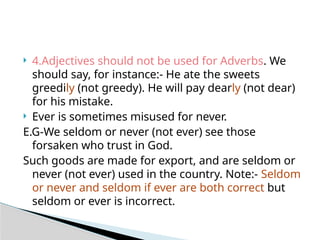
 4.Adjectives should not be used for Adverbs. We
should say, for instance:- He ate the sweets
greedily (not greedy). He will pay dearly (not dear)
for his mistake.
 Ever is sometimes misused for never.
E.G-We seldom or never (not ever) see those
forsaken who trust in God.
Such goods are made for export, and are seldom or
never (not ever) used in the country. Note:- Seldom
or never and seldom if ever are both correct but
seldom or ever is incorrect.
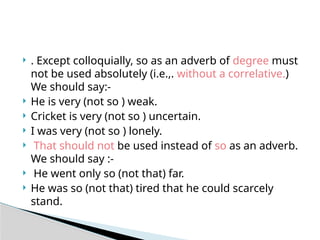
 . Except colloquially, so as an adverb of degree must
not be used absolutely (i.e.,. without a correlative.)
We should say:-
 He is very (not so ) weak.
 Cricket is very (not so ) uncertain.
 I was very (not so ) lonely.
 That should not be used instead of so as an adverb.
We should say :-
 He went only so (not that) far.
 He was so (not that) tired that he could scarcely
stand.
ADVERB.pptx for school students language ppt

ADVERB.pptx for school students language ppt

  • 1.
    ADVERB An adverb isa word or expression that modifies the meaning of a verb, an adjective or another adverb and usually describes when, where, how ,how many times and to what extent something happens.
  • 2.
     Adverbs areoften recognized by the suffix "-ly" at the end of the word, such as "quickly" which comes from the adjective "quick". However, not all adverbs end in "-ly". EG-  Some examples of adverbs include "very," "often," "never," "always," "sometimes," and "seldom". FORMATION OF ADVERB FROM ADJECTIVES
  • 3.
     1.TO DESCRIBE/MODIFYVERBS  She dances(how) beautifully.  The football team played badly.  2. TO MODIFY ADJECTIVES  It was an extremely bad(how bad) match.  They were extremely tired.  3.ADVERBS  The football team played extremely badly(how badly).  She spoke very softly. What it Modifies
  • 4.
     TO MODIFYSENTENCES  Unfortunately, the flight to Delhi had been cancelled.
  • 5.
     Adjectives tellus something about a personor a thing.  It can modify nouns or pronouns.  eg-Sunil is a careful driver.(noun- sunil. This is actually about the driver)  She is beautiful.(pronoun- she)  Adverbs tell us in what way someone does something  It can modify verbs,adjectives or another adverb .  Eg- Sunil drives carefully.(action/verb –drive.This is about his way of driving) Difference Adverbs and Adjectives
  • 6.
  • 7.
  • 8.
  • 9.
     How: Anadverb of manner describes how an action is performed-manner/approach/process.  They answer the how about your verb.  Usually ends with –ly.(not always)  Eg- slowly,bravely,carefully,simply,quietly.  Eg- The story ended happily.  He is eating fastly.  She is driving carefully.  He answered the questions correctly.  Sometimes same spelling same as an adjective.  Eg-The boys had worked hard.  Julie dances well. TYPES OF ADVERB
  • 10.
     When: Anadverb of time describes when an action is being perfomed .eg- yesterday, tomorrow, now ,yet.  Usually placed at the end of the sentence.  Eg- I will meet you tomorrow.  I went to Bankura yesterday.  I will see you later.  When I bake, I make cookies first.  He never wants to go to the park with me.(also frequency)  The movie is starting now.  Although it can be placed art the start of a sentence to put emphasis on time.  Last year was the worst year of my life.  Yesterday ,my troubles seemed so far. adverb of time
  • 11.
     Where: Anadverb of place provides information about the location of an action.  Associated with the action of the verb,providing context for direction, distance and position.  They usually come after the main verb or direct object.  Eg- there ,here, up, down, near, everywhere.  Direction-They traveled down the mountain.  Position- I will meet you outside.  Keep your slippers inside.  The cat is sleeping on the bed.  Distance-There is a fair nearby. adverb of place
  • 12.
     How manytimes an action is being performed- adverb of frequency- definite(either at the start or end of the sentence)- monthly, daily,once.  Eg- We get paid hourly.  I come here twice a week.  He visits his grandfather everyweek.  Indefinite(after the main verb or between auxiliary verb and infinitive)-never ,always , usually, often, sometimes, rarely etc.  Eg-Rahul always leaves early.  I will always love you.  He often fights with me.  I never miss her performances.  We rarely go to concerts. adverb of frequency
  • 13.
  • 14.
     To whatextent/how much: An adverb of degree expresses intensity of the verb-to what extent or degree. Eg- very ,quite, rather ,fairly,hardly, insanely,extremely,slightly.eg- He is very tall.  She is so beautiful.  She is barely 14 years old.  He almost feel asleep when the movie ended.  Its simply not enough.  I greatly appreciate your help. adverb of degree
  • 15.
  • 16.
     1. Alexandrapracticed soccer frequently.  2. Jeffrey always wanted to be an astronaut.  3. Aaron’s father sang the song loudly.  4. The small girl eagerly licked her ice cream cone.  5. My parents will arrive tomorrow.  6. We skied on the tallest mountain.  7. Alice fell into the rabbit hole.  8. We expect rain all week.  9. The show will begin soon.  10. The sneaky snake slithered swiftly and silently. IDENTIFY THE ADVERB
  • 17.
  • 18.
  • 19.
     Some adverbs, like adjectives have 3 degrees of comparison.  POSITIVE-HARD , LONG , NEATLY , (IRREGULAR )BADLY, MUCH  COMPARATIVE- HARDER, LONGER , MORE NEATLY , WORSE , MORE  SUPERLATIVE- HARDEST, LONGEST,MOST NEATLY , WORST, MOST DEGREE OF COMPARISON
  • 20.
  • 21.
     An adverbwhich modies an adjective or another adverb is always placed immediately before the word it modifies.eg- The load is very heavy for a horse.  Rama is rather a lazy boy.  He spoke quite angrily.  Adverbs should be so placed in a sentence as to make it quite clear which word or words they are intended to modify. Hence Adverbs should come, if possible, next to the word or words they modify.(or just as near as possible)  Example -He had got almost to the top when the rope broke. POSITION OF ADVERBS
  • 22.
     He perfomedhis duty creditably.  I could easily find it out.  When an adverb modifies a sentence ,it is usually placed at the beginning. eg- Fortunately, he was not hurt. Certainly you are wrong.
  • 23.
    2.As a generalrule, only should be placed immediately before the word it is intended to modify; as, -I worked only two sums. -Only Balu succeeded in scoring a century. -I praise him only when he deserves it. -He only lent me a book(i.e he lent it not give it away)  . In spoken English, however, it is usually put before the verb. The required meaning is obtained by stressing the word which the only modifies ;  e.g., He only worked two sums.
  • 24.
  • 25.
     The adverbsever, never, scarcely, ever are often misplaced, as in the following sentence-  Quite the most remarkable article we ever remember to have read. [Say : we remember ever ….]
  • 26.
     3.Two negativesdestroy each other. Hence" two negatives should not be used in the same sentence unless we wish to make an affirmation. We should say:  I haven't got any (not none ).  I could not find it anywhere (not nowhere).  I have not got any (not no ) paper for my exercise.  I can't see any (not no ) wit in her.  Scarcely any one believes in such ghost stories nowadays. (Not, No one scarcely believe ….)
  • 27.
     4.Adjectives shouldnot be used for Adverbs. We should say, for instance:- He ate the sweets greedily (not greedy). He will pay dearly (not dear) for his mistake.  Ever is sometimes misused for never. E.G-We seldom or never (not ever) see those forsaken who trust in God. Such goods are made for export, and are seldom or never (not ever) used in the country. Note:- Seldom or never and seldom if ever are both correct but seldom or ever is incorrect.
  • 28.
     . Exceptcolloquially, so as an adverb of degree must not be used absolutely (i.e.,. without a correlative.) We should say:-  He is very (not so ) weak.  Cricket is very (not so ) uncertain.  I was very (not so ) lonely.  That should not be used instead of so as an adverb. We should say :-  He went only so (not that) far.  He was so (not that) tired that he could scarcely stand.