Achieving Quality in Teaching by using Instructional Design Modelsby Mrs. Jhonna C. Sacote
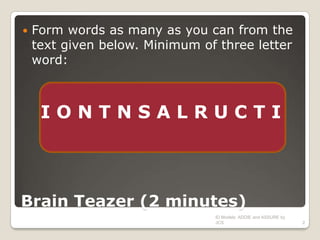
Form words as many as you can from the text given below. Minimum of three letter word:I O N T N S A L R U C T I Brain Teazer (2 minutes)ID Models: ADDIE and ASSURE by JCS2
Some answersID Models: ADDIE and ASSURE by JCS3
ID Models: ADDIE and ASSURE by JCS4Awareness and Create Instructional Plan using ADDIE and ASSURE modelsGoal
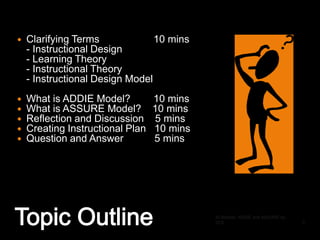
ID Models: ADDIE and ASSURE by JCS5Clarifying Terms		   10 mins	- Instructional Design	- Learning Theory	- Instructional Theory	- Instructional Design ModelWhat is ADDIE Model?	   10 minsWhat is ASSURE Model?    10 minsReflection and Discussion    5 minsCreating Instructional Plan   10 minsQuestion and Answer           5 minsTopic Outline
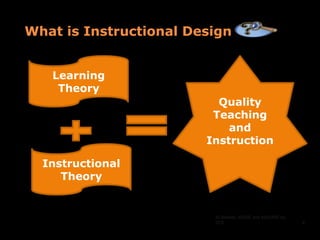
ID Models: ADDIE and ASSURE by JCS6What is Instructional DesignLearning TheoryQuality Teaching and InstructionInstructional Theory
ID Models: ADDIE and ASSURE by JCS7CognitiveExperiencesEnvironmental influencesEmotionalhttp://www.google.com/imgres?imgurl=http://www.dancampbell.us/podcast/learning-theory.jpg&imgrefurl=http://www.feedage.com/feeds/2164830/the-learning-theory-
ID Models: ADDIE and ASSURE by JCS8Instructional TheoryHow to structure Material for promoting education…http://www.google.com/images?hl=en&biw=1280&bih=832&gbv=2&tbs=isch%3A1&sa=1&q=instructional+theory&aq=f&aqi=&aql=&oq=&gs_rfai=
ID Models: ADDIE and ASSURE by JCS9Instructional Design ModelHow to teach?How to Bring people to learn?http://www.google.com/images?hl=en&biw=1280&bih=832&gbv=2&tbs=isch%3A1&sa=1&q=instructional+design+models&aq=f&aqi=g1&aql=&oq=&gs_rfai=
ID Models: ADDIE and ASSURE by JCS10ADDIEImage from http://img.amazon.ca/images/I/31zEaGNTdpL._SL500_AA240_.jpg
11Structured Course Development and Learning Been around for a long timeADDIE
ID Models: ADDIE and ASSURE by JCS12ANALYSISWHO?wHAT?wHEN?WHere?
ID Models: ADDIE and ASSURE by JCS13
ID Models: ADDIE and ASSURE by JCS14DevelopmentWrite the insruction
ID Models: ADDIE and ASSURE by JCS15EXECUTE AND TEST FOR EFFECTIVENESS
ID Models: ADDIE and ASSURE by JCS16WAS THE INSTRUCTION EFFECTIVE?
17Image from http://technoscribe.files.wordpress.com/2009/08/addie.jpg, http://edweb.sdsu.edu/Courses/EDTEC700/ETP/images/addie.jpg, http://www.ivyvilos.com/images/addiemodel.gif& http://gramconsulting.com/wp-content/uploads/2009/09/addie_model.jpg
ID Models: ADDIE and ASSURE by JCS18ADDIE Template from: http://captaincaptivate.com/content/captivate_templates.pdf
ID Models: ADDIE and ASSURE by JCS19ASSUREImage from http://vig-fp.prenhall.com/bigcovers/0137132395.jpg
20Developed by Heinich, Molenda, Russell & Smaldino (1999).Classroom orientation model.Note the selection of materials instead of development.ASSURE
ID Models: ADDIE and ASSURE by JCS21AnalyzeLearners
ID Models: ADDIE and ASSURE by JCS22Goals and Objectives State
ID Models: ADDIE and ASSURE by JCS23materialsmethods
ID Models: ADDIE and ASSURE by JCS24
ID Models: ADDIE and ASSURE by JCS25REQUIRE LEARNERPARTICIPATION
ID Models: ADDIE and ASSURE by JCS26
ID Models: ADDIE and ASSURE by JCS27
28REFLECT!
ID Models: ADDIE and ASSURE by JCS29Now Let’s Create…
ADDIE Model Instructional PlanADDIE and ASSURE TemplateID Models: ADDIE and ASSURE by JCS30ASSURE Model Instructional Plan
www.instructionaldesign.orghttp://edutechwiki.unige.ch/en/Instructional_design_methodhttp://fog.ccsf.cc.ca.us/~mmalacho/OnLine/ADDIE.html#AMhttp://www.e-learningguru.com/articles/art2_1.htmhttp://easylearningweb.blogspot.com/2010/02/using-addie-model-for-training-best.htmlhttp://www.nwlink.com/~donclark/history_isd/addie.htmlhttp://www.about-elearning.com/instructional-design-models.htmlhttp://ezinearticles.com/?The-ADDIE-Model---Why-Use-It?&id=859615http://en.wikipedia.org/wiki/Learning_theory_(education)http://en.wikipedia.org/wiki/Instructional_theorywww.google.com/imageswww.flickr.comResourcesID Models: ADDIE and ASSURE by JCS31
Please visit these links:www.elearningguild.com (E-learning Tips)
www.udutu.com (Online E-learning Tool)

ADDIE and ASSURE

Editor's Notes

  • #5 Give the overview about the presentation and how can they apply the models on their work.ADDIE suited for developing elearning materialASSURE model is a classroom oriented model. Can be applied for developing a learning material for classroom purposes.
  • #6 What are the topics to be presented?In addition, at the end of this presentation, I would like the audience to reflect on the question that will be given. I will present also some links that would help them to understand more about instructional designing and e-learning development.
  • #7 the systematic development of instructional specifications using learning and instructional theory to ensure the quality of instruction. What is our department goal?One of our goals is to offer to all students high quality teaching, learning, and training opportunity and provide society with professionals of international standards.- In designing and developing instructional material or learning materials, it is beneficial for all the teachers to follow certain standards and systematic approach to be able to achieve a quality education for all the students.
  • #8 In psychology and education, learning is commonly defined as a process that brings together cognitive, emotional, and environmental influences and experiences for acquiring, enhancing, or making changes in one's knowledge, skills, values, and world views (Illeris, 2000; Ormorod, 1995).In learning, if one item is not present or lacking, complete learning won’t happen.
  • #9 Instructional theory is a discipline that focuses on how to structure material for promoting the education of human beings, particularly youth.It is use in designing and developing the instructional material for a particular training or class.
  • #10 Instructional Design model is a method and represents a class of a pedagogical design ex. How to teach, how to bring people to learn, etc.The framework or structure to follow in designing and developing our learning materials. The framework or structure to follow in organizing how to bring people to learn, how to teach and etc.
  • #12 A generic, systematic, step-by-step framework used by instructional designers, developers and trainers to ensure course development and learning does not occur in a haphazard, unstructured way.Been around for a long time. Came about with the development of the Cold War after World War II as the US military struggled with itself to find a way to create more effectivetraining programs for increasingly complex subjects.
  • #13 A(Analysis) – Who? What? When? Where? A: Analysis1. Who are the learners? What are their ages, cultural backgrounds, past experiences, interests, educational goals, etc.?2. What are the needs of the learners?3. What are the skills, knowledge, attitudes and/or behaviors that need to be learned?4. What are the current instructional strategies being employed? What needs to be improved upon, added, clarified, etc.?5. What are the instructional goals of the project?6. What are the delivery options? What will the learning environment be like? Will it be face-to-face or online or blended? If online, what might be the differences between web-based and classroom-based learning?7. What constraints might limit the scope of your project (e.g. timeframe, human resources, financial support, technical skills, technical resources, technical support, etc.)?
  • #14 D (Design) – A blueprint of Instruction.D: Design1. What types of media do you want to use (e.g. graphics / video / audio)? Will you create these materials yourself or will you have them done by someone else?2. What resources do you have at your disposal to complete the project?3. What type of activities will you create: individual, interactive, collaborative, etc.?4. What pedagogical approach will you use in designing your project (e.g. behaviourist, constructivist, etc.)?5. How will you sequence the various activities of your project? Will you set up the project as one task or several tasks staggered over time? Will you divide the learning activities into units, lessons, modules, etc.? Will the content progress from simple to complex?6. What cognitive skills are required of the students to meet the learning goals of the project? How will you determine which methods / media / environment will best allow students to develop these cognitive skills?7. What skills do you expect the learners to have acquired after completing each activity? What method will you use to determine whether students have acquired the desired competencies?8. What does the project look like on paper? Would creating a concept map help you see how the learning activities match up with the learning objectives of the project?9. In the case of an online project, what type of user-interface do you want? What will be the “look and feel” of the site?10. How will learners determine whether or not they understand the material? What mechanism will you design to provide feedback to learners?11. How will you ensure that your project’s activities appeal to students with different interests and learning styles? Will you use a variety of delivery options or types of media?12. What exactly is the “content” of the project?
  • #15 D: Development1. Are you on schedule with respect to the creation of materials?2. Are the team members working together in an effective manner?3. Is each member fulfilling his/her responsibilities in terms of the production of materials?4. Do the newly produced materials function as expected?
  • #16 I: Implementation1. What information might you want to record as you observe students engaging with the learning materials for the first time?2. When you first introduce the materials to instructors, do they appear interested? Enthusiastic? Resistant? Critical?3. During the training session for instructors, do instructors catch on quickly or do they encounter unforeseen problems?4. How will you react to “bugs” (i.e. when you present activities to students and they do not go as planned)?5. Do you have a “back up” in case of technical or other problems?6. Will you start with a small-scale or large-scale implementation?7. When you first introduce the materials to a group of students, do they require constant guidance or can they work independently?
  • #17 E: Evaluate1. What factors / criteria will you use to determine the effectiveness of the project (e.g. development of higher-order problem-solving skills, increased motivation, improved learning, etc.)?2. How and when will you collect data relating to the overall effectiveness of the project?3. How will you analyze the feedback collected from students?4. How will you decide whether or not you need to revise any aspects of the project before full implementation?5. How will you measure the content validity and reliability of the project?6. How will you assess whether the instructions are clear?7. How will you assess the reaction of learners to the instructional materials?8. To whom will you submit a report outlining the results of the evaluation?
  • #21 Developed by Heinich, Molenda, Russell & Smaldino (1999).Classroom orientation model.Note the selection of materials instead of development.
  • #22 A: Analyze learnersWho are your students? While this seems to be common sense, the step is important to mention because keeping your students in mind will help ensure that you work diligently to find those materials and resources that will be most appropriate and useful to your students. You should know who your students are (e. g. , demographics, prior knowledge, learning styles, academic abilities) on a multitude of levels, and use this knowledge in every lesson you plan.
  • #23 S: State standards & objectivesYou will have a curriculum to teach in your classroom, with specific objectives that will become the focus of individual lessons. What are these objectives? What should be the outcomes of the lessons that your students will know or learn? Each lesson will probably be tied to curricular objectives and this step reminds you to keep these objectives as the focus of the student learning.
  • #24 S: Select Stategies, technology, media & materialsWhen choosing the media and materials to help you teach a lesson, you will first choose a method for delivering your instruction. For example, you might decide that having your students work in small cooperative groups is most appropriate, or you might determine that a lesson is best taught using a tutorial. You then select the media that best supplements or enhances the method of teaching you have chosen. The media could include technology solutions (e. g. , CD-ROMs, DVDs, calculators, software, Internet resources, videos); print resources, such as a textbook; or any combination of the various media types. You will have to decide which materials and media can best help your students master the learning objectives you have identified.
  • #25 U: Utilize technology, media & materialsIn the last step you identified specific media and materials to help meet your learning objectives. In this step, the lesson is actually taught and the media and materials get implemented. This is also the step that should have a backup plan in place. Technology solutions can break down, so an alternative solution should be available. For this reason, a teacher should always test the media first, to help prevent disappointment. In other words, make sure you have tried the software or device to ensure that it is age appropriate, level appropriate, usable, and valid for the lesson and objectives being taught. Evaluating the media will also raise any red flags (e. g. , is any training going to be required? Is an extension cord going to be necessary?).
  • #26 R: Require learner participationYour students are going find learning more meaningful when they are actively involved in the learning process and not sitting there passively. Are there strategies you can use to get your students practicing? Thinking? Solving? Creating? Developing? Analyzing? More often than not, a lecture is not going to allow your students to move beyond passive learning. On the other hand, integrating technology into a lesson almost necessitates that you use a teaching method beyond lecturing. How can you best facilitate the learning process?
  • #27 E: Evaluate and ReviseThis is one of the most important steps, but is often overlooked. Becoming a good teacher requires that you constantly evaluate your own teaching, evaluate the student learning, and make needed revisions for the next lesson and for the next time you teach the current lesson. Always striving to improve is the first step to becoming a better teacher. Evaluation occurs when you determine the worth of your teaching methods and the media you used. During the evaluation stage, you should ask yourself questions such as, “Did this lesson meet the objectives?” “Did students gain from this lesson?” “Can this lesson be improved?” “How so?” “Could individual work or group work have been more effective for parts of this lesson?” “Was the media appropriate?” “Are there other technology solutions that might have worked better?” While this is not a comprehensive list of questions, this should provide you with some direction for the evaluation stage. You might also ask students to reflect on their learning and the experience they had in the lesson. Perhaps your students will have feedback that could help you to improve the lesson for next time, or feedback that could help you improve future lessons for them. Having things go wrong does not make a teacher a bad teacher. However, failing to take corrective and preventative actions for the future is bad teaching.