Slide 1
© 2004 By Default!A Free sample background from www.awesomebackgrounds.com
Guiding Principles in the
Selection & Organization
of Content
Selection &
Organization of
Content
Slide 2
© 2004 By Default!A Free sample background from www.awesomebackgrounds.com
“There are dull teachers, dull
textbook, dull films, but nodull
subjects.”
Slide 3
© 2004 By Default!A Free sample background from www.awesomebackgrounds.com
First Principle
1. One guiding principle related to subject
matter content is to observe the
following qualities in the selection and
organization of content:
a.) Validity
b.) Significance
c.) Balance
d.) Self-sufficiency
e.) Interest
f.) Utility
g.) Feasibility*
Slide 4
© 2004 By Default!A Free sample background from www.awesomebackgrounds.com
Question:
Would you prefer to tackle all the topics
for the accomplishment of the syllabus
or you’ll prefer to leave the
unaccomplished lessons for the sake of
better understanding?
GRADES or LIFETIME LESSON?
Slide 5
© 2004 By Default!A Free sample background from www.awesomebackgrounds.com
Second Principle
2. At the base of the structure of cognitive
subject matter content is facts. We can’t
do away with facts but be sure to go
beyond facts by constructing an
increasingly richer and more
sophisticated knowledge base and by
working out a process of conceptual
understanding.
Slide 6
© 2004 By Default!A Free sample background from www.awesomebackgrounds.com
Second Principle
a.) Providing opportunities for
experimentation
b.) Presenting the ideas of others
c.) Emphasizing conceptual understanding
Slide 7
© 2004 By Default!A Free sample background from www.awesomebackgrounds.com
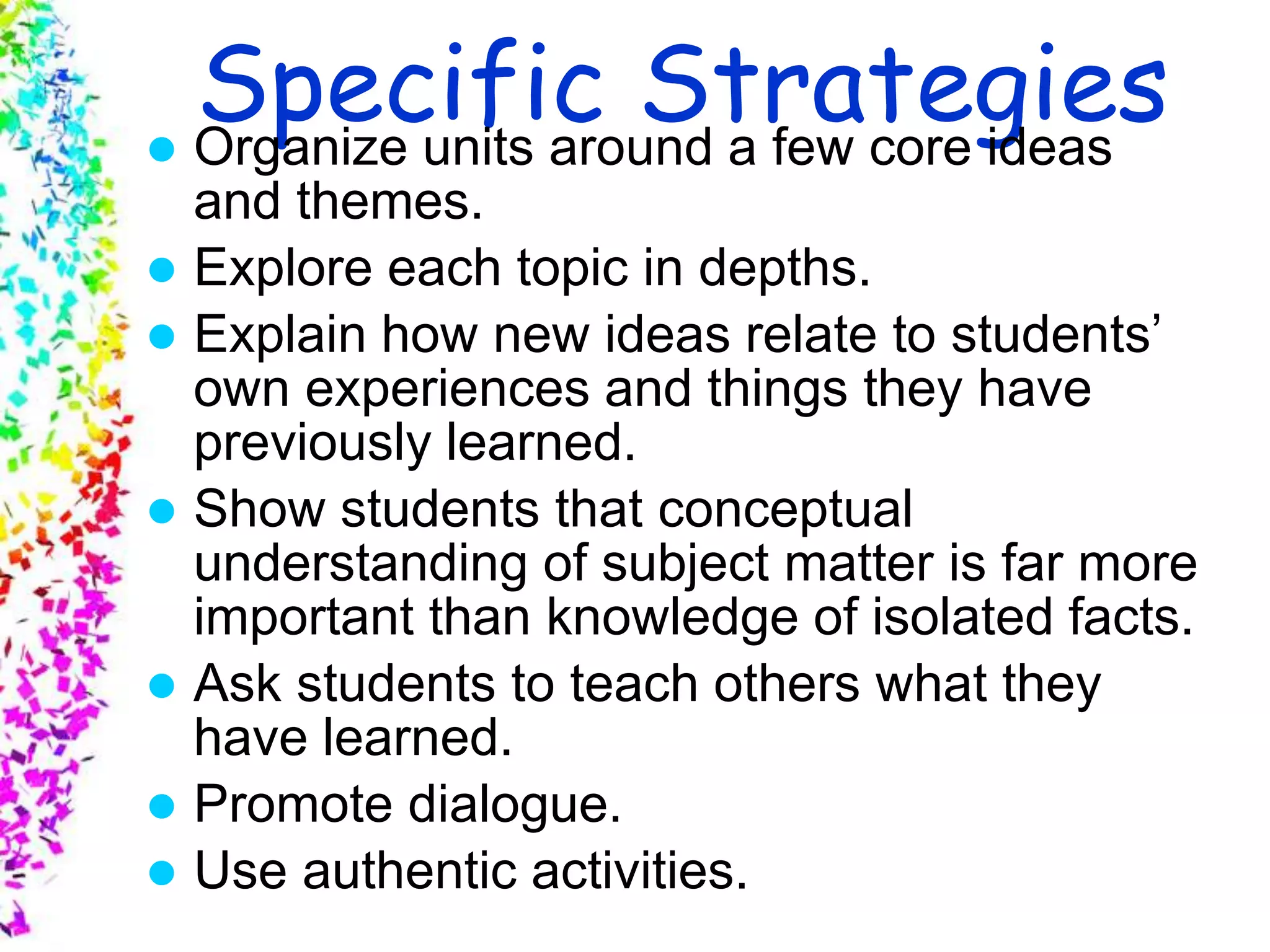
Specific Strategies Organize units around a few core ideas
and themes.
 Explore each topic in depths.
 Explain how new ideas relate to students’
own experiences and things they have
previously learned.
 Show students that conceptual
understanding of subject matter is far more
important than knowledge of isolated facts.
 Ask students to teach others what they
have learned.
 Promote dialogue.
 Use authentic activities.
Slide 8
© 2004 By Default!A Free sample background from www.awesomebackgrounds.com
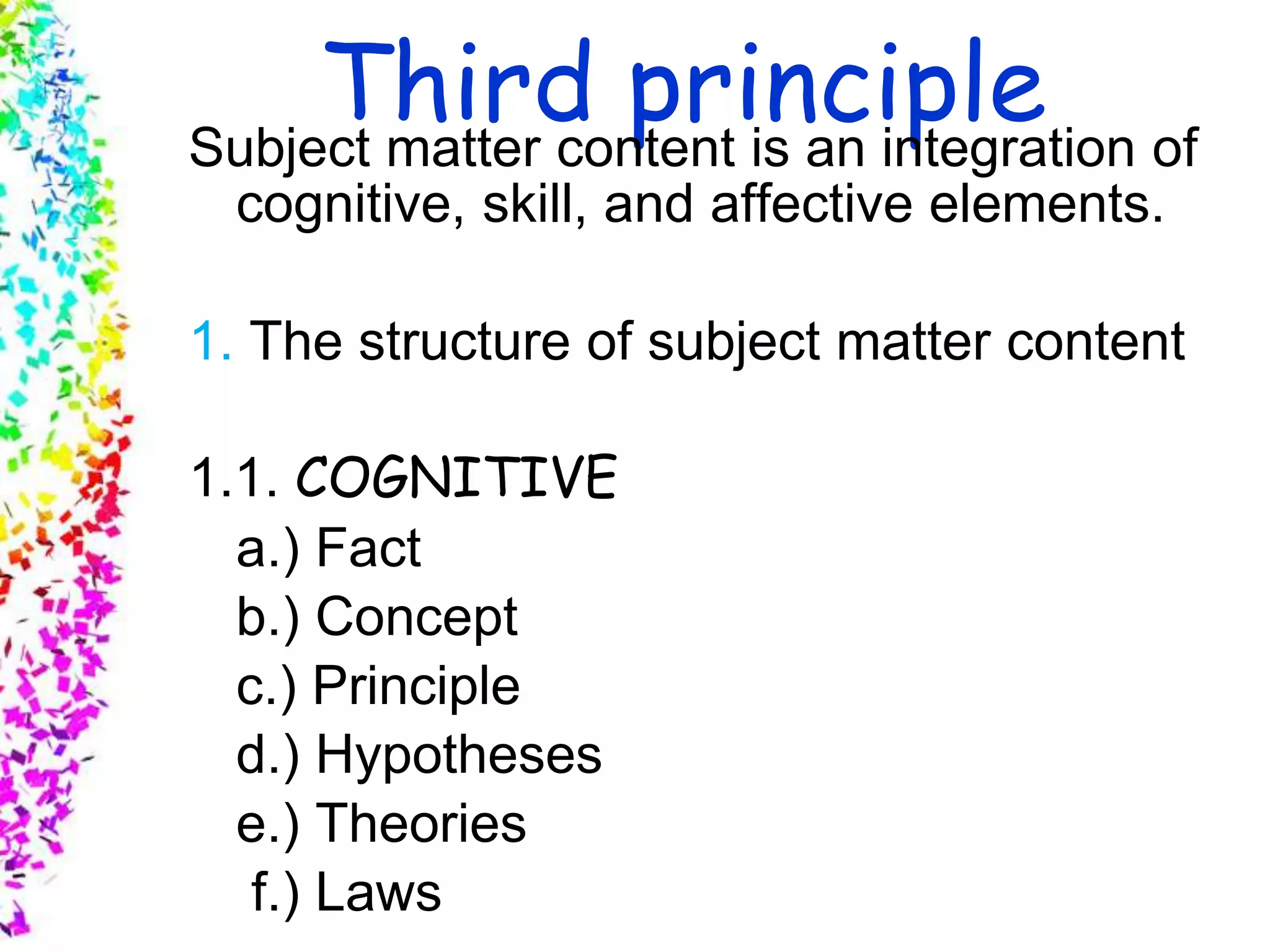
Third principleSubject matter content is an integration of
cognitive, skill, and affective elements.
1. The structure of subject matter content
1.1. COGNITIVE
a.) Fact
b.) Concept
c.) Principle
d.) Hypotheses
e.) Theories
f.) Laws
Slide 9
© 2004 By Default!A Free sample background from www.awesomebackgrounds.com
Third principle
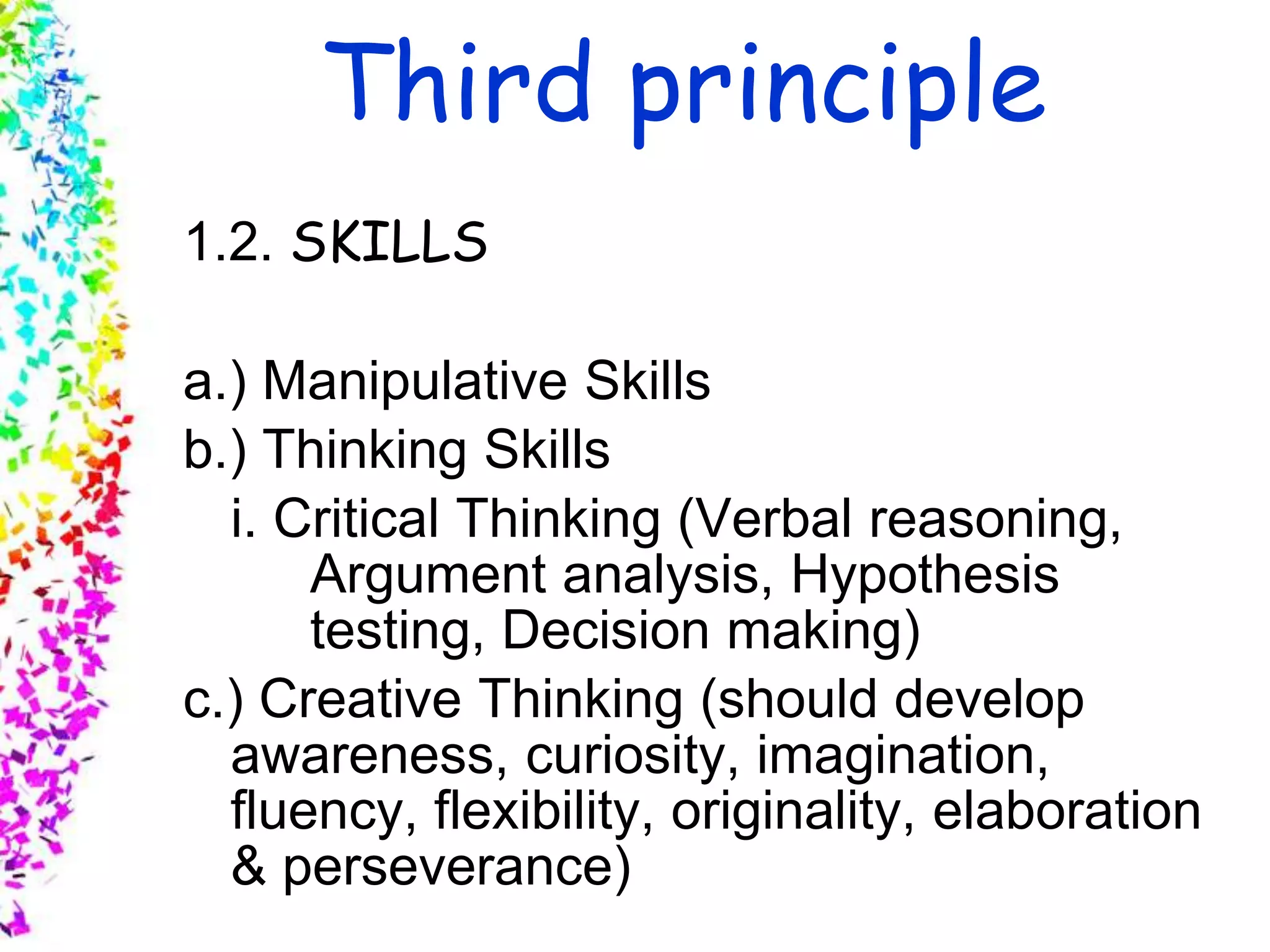
1.2. SKILLS
a.) Manipulative Skills
b.) Thinking Skills
i. Critical Thinking (Verbal reasoning,
Argument analysis, Hypothesis
testing, Decision making)
c.) Creative Thinking (should develop
awareness, curiosity, imagination,
fluency, flexibility, originality, elaboration
& perseverance)
Slide 10
© 2004 By Default!A Free sample background from www.awesomebackgrounds.com
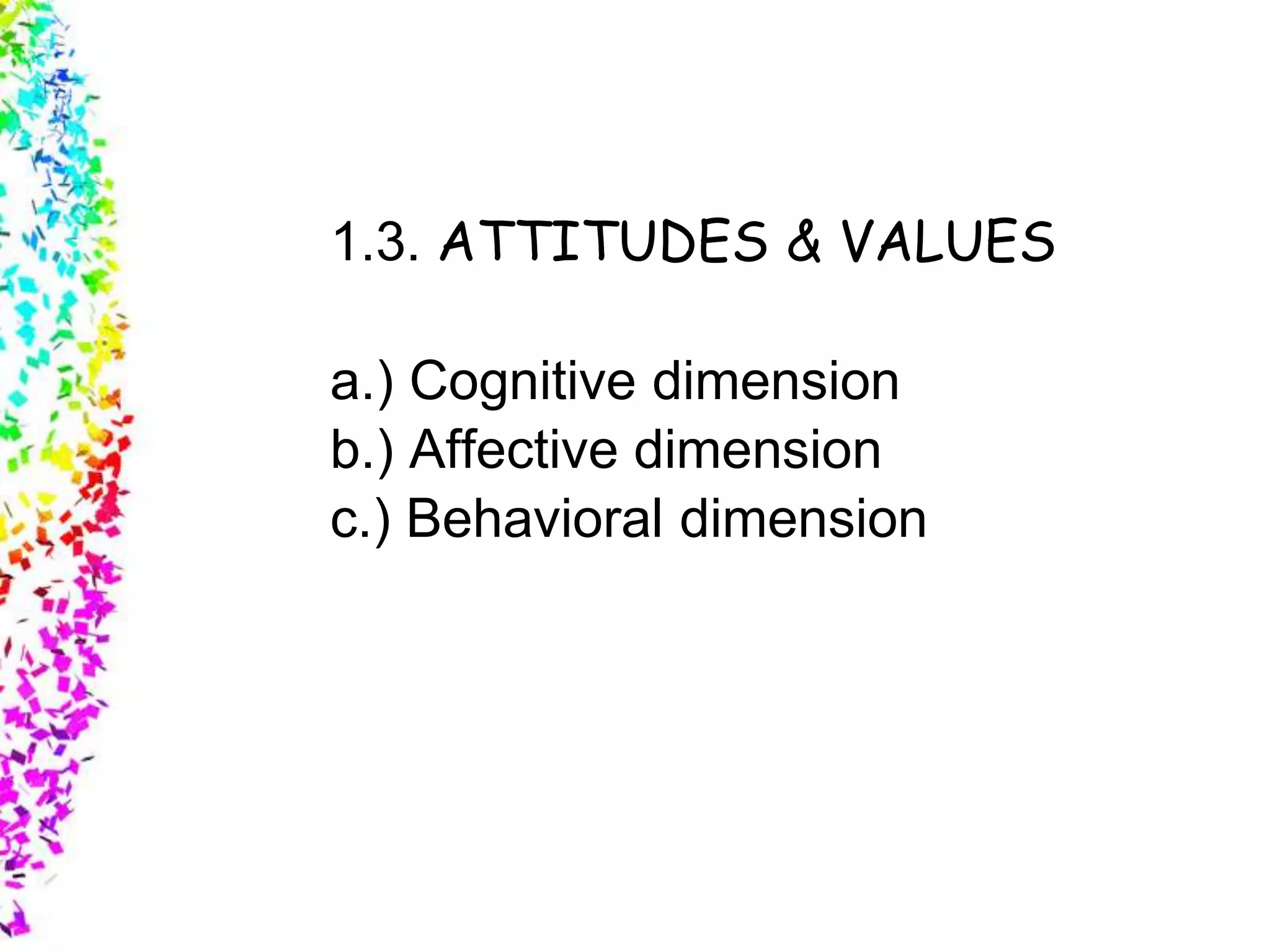
1.3. ATTITUDES & VALUES
a.) Cognitive dimension
b.) Affective dimension
c.) Behavioral dimension
Slide 11
© 2004 By Default!A Free sample background from www.awesomebackgrounds.com
Bangit, Joana Marie P.
Bayan, Melissa S.
Thank you
for listening!
God bless! 

Selection and Organization of Content

  • 1.
    Slide 1 © 2004By Default!A Free sample background from www.awesomebackgrounds.com Guiding Principles in the Selection & Organization of Content Selection & Organization of Content
  • 2.
    Slide 2 © 2004By Default!A Free sample background from www.awesomebackgrounds.com “There are dull teachers, dull textbook, dull films, but nodull subjects.”
  • 3.
    Slide 3 © 2004By Default!A Free sample background from www.awesomebackgrounds.com First Principle 1. One guiding principle related to subject matter content is to observe the following qualities in the selection and organization of content: a.) Validity b.) Significance c.) Balance d.) Self-sufficiency e.) Interest f.) Utility g.) Feasibility*
  • 4.
    Slide 4 © 2004By Default!A Free sample background from www.awesomebackgrounds.com Question: Would you prefer to tackle all the topics for the accomplishment of the syllabus or you’ll prefer to leave the unaccomplished lessons for the sake of better understanding? GRADES or LIFETIME LESSON?
  • 5.
    Slide 5 © 2004By Default!A Free sample background from www.awesomebackgrounds.com Second Principle 2. At the base of the structure of cognitive subject matter content is facts. We can’t do away with facts but be sure to go beyond facts by constructing an increasingly richer and more sophisticated knowledge base and by working out a process of conceptual understanding.
  • 6.
    Slide 6 © 2004By Default!A Free sample background from www.awesomebackgrounds.com Second Principle a.) Providing opportunities for experimentation b.) Presenting the ideas of others c.) Emphasizing conceptual understanding
  • 7.
    Slide 7 © 2004By Default!A Free sample background from www.awesomebackgrounds.com Specific Strategies Organize units around a few core ideas and themes.  Explore each topic in depths.  Explain how new ideas relate to students’ own experiences and things they have previously learned.  Show students that conceptual understanding of subject matter is far more important than knowledge of isolated facts.  Ask students to teach others what they have learned.  Promote dialogue.  Use authentic activities.
  • 8.
    Slide 8 © 2004By Default!A Free sample background from www.awesomebackgrounds.com Third principleSubject matter content is an integration of cognitive, skill, and affective elements. 1. The structure of subject matter content 1.1. COGNITIVE a.) Fact b.) Concept c.) Principle d.) Hypotheses e.) Theories f.) Laws
  • 9.
    Slide 9 © 2004By Default!A Free sample background from www.awesomebackgrounds.com Third principle 1.2. SKILLS a.) Manipulative Skills b.) Thinking Skills i. Critical Thinking (Verbal reasoning, Argument analysis, Hypothesis testing, Decision making) c.) Creative Thinking (should develop awareness, curiosity, imagination, fluency, flexibility, originality, elaboration & perseverance)
  • 10.
    Slide 10 © 2004By Default!A Free sample background from www.awesomebackgrounds.com 1.3. ATTITUDES & VALUES a.) Cognitive dimension b.) Affective dimension c.) Behavioral dimension
  • 11.
    Slide 11 © 2004By Default!A Free sample background from www.awesomebackgrounds.com Bangit, Joana Marie P. Bayan, Melissa S. Thank you for listening! God bless! 