Morrison, Ross & Kemp
         (MRK) Model
A holistic learner approach to instructional
design that considers all factors in the
environment.


                              Julie Kenney & Ellen
                              Shortell
Learner-Focused Approach
 The instructional designer initially asks 6 questions
  related to the skills or knowledge to be learned.
 Based on the info attained, the ID determines
  which 9 “elements” are to be used to develop an
  instructional development plan.
 Can start with any of the 9 elements.
 No interdependencies between the 9 elements.
 Needs constant planning, design, development and
  assessment to ensure effective instruction.
Morrison, Ross & Kemp
6 Initial Questions
 1. Required level of learner readiness
 2. Instructional strategies and media that
    are most appropriate for the content and
    the target population
 3. Level of learner support required
 4. Measurement of achievement
 5. Strategies for formative evaluation
 6. Strategies for summative evaluation
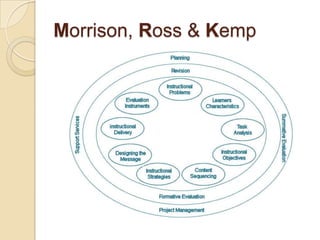
9 Key Elements – within Oval
1.   Identify instructional problems, and specify goals for
     designing an instructional program.
2.   Examine learner characteristic that should receive attention
     during planning.
3.   Identify subject content, and analyze task components
     related to stated goals and purposes.
4.   State instructional objectives for the learner.
5.   Sequence content within each instructional unit for logical
     learning.
6.   Design instructional strategies so that each learner can
     master the objectives.
7.   Plan the instructional message and delivery.
8.   Develop evaluation instruments to assess objectives.
9.   Select resources to support instruction and learning
     activities.
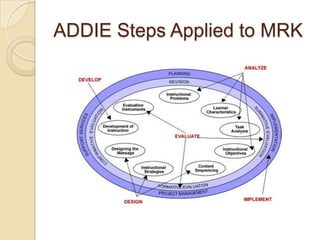
ADDIE Steps Applied to MRK
Planning and Revision
 The use of ovals for the two out rings emphasizes
  the models flexibility and continuous refinement.
 The inner oval (surrounding the core) illustrates
  that revision/formative evaluation activities can be
  undertaken at each stage of the development
  process.
 The outer oval highlights three elements – namely
  project planning, project management, and support
  services.
Benefits of MRK
 Project Planning
 Project Management
 Support Services (during development
  and actual instruction)
 Ease of use by less experienced
  designers/teachers
 Holistic approach to instructional
  design as it considers all factors in the
  environment
What makes it different from
other models?
 Instruction is considered from learner
  perspective
 Continuous refinement
 Flexibility – no define start or end point
 General systems or object-oriented
  view
 Support and Project Management of
  the instructional design process
Helpful Resources
   Instructional Designers Job aids
    (MRK)
    ◦ http://aesthetech.weebly.com/morrison-
      ross--kemp.html
   Designing Effect Instruction (6th
    Edition)
    ◦ Gary R. Morrison, Steven M. Ross,
      Howard K. Kallman, Jerrold E. Kemp
Sources
   Michael Hanley (2009, June 10). Discovering Instructional
    Design 11: The Kemp Model
    Retrieved from:
    http://michaelhanley.ie/elearningcurve/discovering-instructional-
    design-11-the-kemp-model/2009/06/10/
   The Herridge Group, Inc. (2004, December ) PDF document
    Retrieved from:
    http://www.herridgegroup.com/pdfs/The%20use%20of%20Traditi
    onal%20ISD%20for%20eLearning.pdf
   AestheTECH. Instructional Design – Morrison, Ross & Kemp
    Retrieved from: http://aesthetech.weebly.com/morrison-ross--
    kemp.html
   Brooke Loren Seidman. Understanding Instructional Design
    Retrieved from:
    http://plaza.ufl.edu/brooke83/ID%20website%20template/kmr.ht
    ml
   Yavuz Akbulut, MA. (2007, April) Implications of two well-known
    models for instructional designers in distance education: Dick-
    Carey Versus Morrison-Ross-Kemp. Turkish Online Journal of
    Distance Education-TOJDE, ISSN 1302-6488, Volume: 8
    Number:2 Articule:5
    Retrieved from

Morrison, Ross & Kemp (MRK) Model

  • 1.
    Morrison, Ross &Kemp (MRK) Model A holistic learner approach to instructional design that considers all factors in the environment. Julie Kenney & Ellen Shortell
  • 2.
    Learner-Focused Approach  Theinstructional designer initially asks 6 questions related to the skills or knowledge to be learned.  Based on the info attained, the ID determines which 9 “elements” are to be used to develop an instructional development plan.  Can start with any of the 9 elements.  No interdependencies between the 9 elements.  Needs constant planning, design, development and assessment to ensure effective instruction.
  • 3.
  • 4.
    6 Initial Questions 1. Required level of learner readiness 2. Instructional strategies and media that are most appropriate for the content and the target population 3. Level of learner support required 4. Measurement of achievement 5. Strategies for formative evaluation 6. Strategies for summative evaluation
  • 5.
    9 Key Elements– within Oval 1. Identify instructional problems, and specify goals for designing an instructional program. 2. Examine learner characteristic that should receive attention during planning. 3. Identify subject content, and analyze task components related to stated goals and purposes. 4. State instructional objectives for the learner. 5. Sequence content within each instructional unit for logical learning. 6. Design instructional strategies so that each learner can master the objectives. 7. Plan the instructional message and delivery. 8. Develop evaluation instruments to assess objectives. 9. Select resources to support instruction and learning activities.
  • 6.
  • 7.
    Planning and Revision The use of ovals for the two out rings emphasizes the models flexibility and continuous refinement.  The inner oval (surrounding the core) illustrates that revision/formative evaluation activities can be undertaken at each stage of the development process.  The outer oval highlights three elements – namely project planning, project management, and support services.
  • 8.
    Benefits of MRK Project Planning  Project Management  Support Services (during development and actual instruction)  Ease of use by less experienced designers/teachers  Holistic approach to instructional design as it considers all factors in the environment
  • 9.
    What makes itdifferent from other models?  Instruction is considered from learner perspective  Continuous refinement  Flexibility – no define start or end point  General systems or object-oriented view  Support and Project Management of the instructional design process
  • 10.
    Helpful Resources  Instructional Designers Job aids (MRK) ◦ http://aesthetech.weebly.com/morrison- ross--kemp.html  Designing Effect Instruction (6th Edition) ◦ Gary R. Morrison, Steven M. Ross, Howard K. Kallman, Jerrold E. Kemp
  • 11.
    Sources  Michael Hanley (2009, June 10). Discovering Instructional Design 11: The Kemp Model Retrieved from: http://michaelhanley.ie/elearningcurve/discovering-instructional- design-11-the-kemp-model/2009/06/10/  The Herridge Group, Inc. (2004, December ) PDF document Retrieved from: http://www.herridgegroup.com/pdfs/The%20use%20of%20Traditi onal%20ISD%20for%20eLearning.pdf  AestheTECH. Instructional Design – Morrison, Ross & Kemp Retrieved from: http://aesthetech.weebly.com/morrison-ross-- kemp.html  Brooke Loren Seidman. Understanding Instructional Design Retrieved from: http://plaza.ufl.edu/brooke83/ID%20website%20template/kmr.ht ml  Yavuz Akbulut, MA. (2007, April) Implications of two well-known models for instructional designers in distance education: Dick- Carey Versus Morrison-Ross-Kemp. Turkish Online Journal of Distance Education-TOJDE, ISSN 1302-6488, Volume: 8 Number:2 Articule:5 Retrieved from