PRESENTED BY
MISS LALRIN MUANI K.
3RD YR BPO
CMC VELLORE
INTRODUCTION
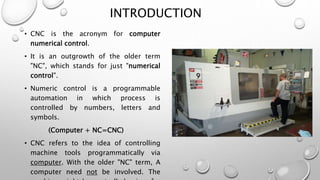
• CNC is the acronym for computer
numerical control.
• It is an outgrowth of the older term
"NC", which stands for just "numerical
control".
• Numeric control is a programmable
automation in which process is
controlled by numbers, letters and
symbols.
(Computer + NC=CNC)
• CNC refers to the idea of controlling
machine tools programmatically via
computer. With the older "NC" term, A
computer need not be involved. The
INTRODUCTION
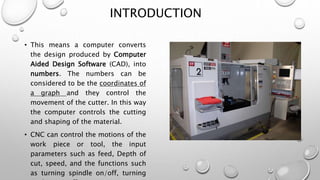
• This means a computer converts
the design produced by Computer
Aided Design Software (CAD), into
numbers. The numbers can be
considered to be the coordinates of
a graph and they control the
movement of the cutter. In this way
the computer controls the cutting
and shaping of the material.
• CNC can control the motions of the
work piece or tool, the input
parameters such as feed, Depth of
cut, speed, and the functions such
as turning spindle on/off, turning
APPLICATIONS
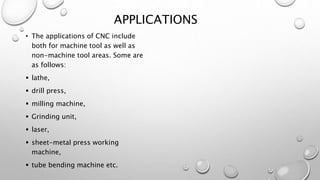
• The applications of CNC include
both for machine tool as well as
non-machine tool areas. Some are
as follows:
 lathe,
 drill press,
 milling machine,
 Grinding unit,
 laser,
 sheet-metal press working
machine,
 tube bending machine etc.
 welding machines (arc and resistance),
 Measuring machine,
 electronic assembly,
 tape laying and
 filament winding machines for Composites etc.
• This Technology is applied to Prosthetics and Orthotics field as well.
HISTORY
• The first NC machines were built
in the 1940s and 1950s by Prof.
John T Parson.
• Conceived method of using
punched cards containing
coordinate position data to
control the machine tool.
• In 1948, Parson demonstrated
his concept to U.S Air Force
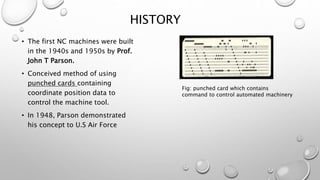
Fig: punched card which contains
command to control automated machinery
HISTORY
• CNC machine came to existence
after evolution of computer
around 1980.
• Modern CNC Machine are
improving further as the
technology is changing with
variety of functions according to
applications.
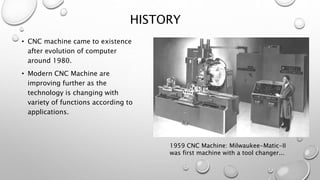
1959 CNC Machine: Milwaukee-Matic-II
was first machine with a tool changer...
COMPUTER NUMERICAL CONTROL
ADVANTAGES
• Easier to program
• Easy storage of existing
programs
• Easy to change program
• Avoid human error
• CNC machines are safe to
operate
• Complex geometry is
produced as cheaply as
simple ones
DISADVANTAGES
• Costly setup than manually
operated machines.
• Skilled operators
• Computers, programming
knowledge required
• Maintenance is difficult.
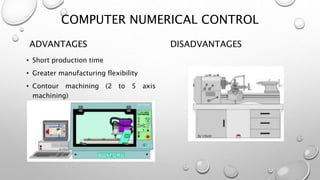
COMPUTER NUMERICAL CONTROL
ADVANTAGES
• Short production time
• Greater manufacturing flexibility
• Contour machining (2 to 5 axis
machining)
DISADVANTAGES
DIRECT NUMERICAL CONTROL
ADVANTAGES
• Greater computation and flexibility.
• Eliminates use of punched tapes.
• Convenient storage of NC Part Programme
in computer file.
• Direct conversion of data from CAD to NC
program.
• Increases Productivity
• Save time.
DISADVANTAGES
• The only disadvantage of the DNC is
if the computers breaks down, but
the computer is so reliable that this is
unlikely to occur..
• Some type like Terminal-based DNC
system and Network-based DND
system are expensive.
NUMERICAL CONTROL
ADVANTAGES
• Higher productivity- reduction in time of
set up, work piece handling time, tool
changing time.
• Reduced non-productive time.
• Reduced fixturing.
• Greater accuracy and repeatability
• Reduced inventory
• Reduced floor requirements.
• Operator skill level reduced
• NC machine are safer to operate.
DISADVANTAGES
• high investment cost.
• High maintenance effort.
• Need for skilled programmers.
• High utilization required.
ELEMENTS OF CNC MACHINE
• A CNC machine consists of following 6 major elements:
i. Input device
ii. Machine control unit
iii. Machine tool
iv. Driving system
v. Feedback devices
vi. Display unit
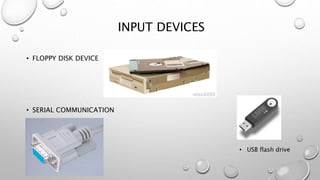
INPUT DEVICES
• FLOPPY DISK DEVICE
• SERIAL COMMUNICATION
• USB flash drive
MACHINE CONTROL UNIT (MCU)
• the machine control unit is the heart od CNC system. There are two sub-units in
the machine control unit:
• Data Processing Unit(DPU)
• Control Loop Unit(CLU)
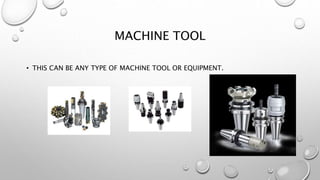
MACHINE TOOL
• THIS CAN BE ANY TYPE OF MACHINE TOOL OR EQUIPMENT.
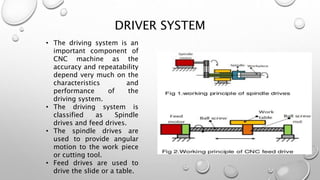
DRIVER SYSTEM
• The driving system is an
important component of
CNC machine as the
accuracy and repeatability
depend very much on the
characteristics and
performance of the
driving system.
• The driving system is
classified as Spindle
drives and feed drives.
• The spindle drives are
used to provide angular
motion to the work piece
or cutting tool.
• Feed drives are used to
drive the slide or a table.
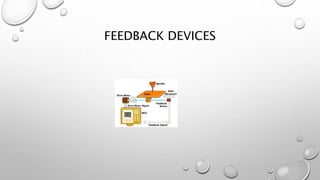
FEEDBACK DEVICES
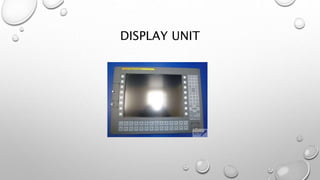
DISPLAY UNIT
computer numerical control

computer numerical control

  • 1.
    PRESENTED BY MISS LALRINMUANI K. 3RD YR BPO CMC VELLORE
  • 2.
    INTRODUCTION • CNC isthe acronym for computer numerical control. • It is an outgrowth of the older term "NC", which stands for just "numerical control". • Numeric control is a programmable automation in which process is controlled by numbers, letters and symbols. (Computer + NC=CNC) • CNC refers to the idea of controlling machine tools programmatically via computer. With the older "NC" term, A computer need not be involved. The
  • 3.
    INTRODUCTION • This meansa computer converts the design produced by Computer Aided Design Software (CAD), into numbers. The numbers can be considered to be the coordinates of a graph and they control the movement of the cutter. In this way the computer controls the cutting and shaping of the material. • CNC can control the motions of the work piece or tool, the input parameters such as feed, Depth of cut, speed, and the functions such as turning spindle on/off, turning
  • 4.
    APPLICATIONS • The applicationsof CNC include both for machine tool as well as non-machine tool areas. Some are as follows:  lathe,  drill press,  milling machine,  Grinding unit,  laser,  sheet-metal press working machine,  tube bending machine etc.
  • 5.
     welding machines(arc and resistance),  Measuring machine,  electronic assembly,  tape laying and  filament winding machines for Composites etc. • This Technology is applied to Prosthetics and Orthotics field as well.
  • 6.
    HISTORY • The firstNC machines were built in the 1940s and 1950s by Prof. John T Parson. • Conceived method of using punched cards containing coordinate position data to control the machine tool. • In 1948, Parson demonstrated his concept to U.S Air Force Fig: punched card which contains command to control automated machinery
  • 7.
    HISTORY • CNC machinecame to existence after evolution of computer around 1980. • Modern CNC Machine are improving further as the technology is changing with variety of functions according to applications. 1959 CNC Machine: Milwaukee-Matic-II was first machine with a tool changer...
  • 8.
    COMPUTER NUMERICAL CONTROL ADVANTAGES •Easier to program • Easy storage of existing programs • Easy to change program • Avoid human error • CNC machines are safe to operate • Complex geometry is produced as cheaply as simple ones DISADVANTAGES • Costly setup than manually operated machines. • Skilled operators • Computers, programming knowledge required • Maintenance is difficult.
  • 9.
    COMPUTER NUMERICAL CONTROL ADVANTAGES •Short production time • Greater manufacturing flexibility • Contour machining (2 to 5 axis machining) DISADVANTAGES
  • 10.
    DIRECT NUMERICAL CONTROL ADVANTAGES •Greater computation and flexibility. • Eliminates use of punched tapes. • Convenient storage of NC Part Programme in computer file. • Direct conversion of data from CAD to NC program. • Increases Productivity • Save time. DISADVANTAGES • The only disadvantage of the DNC is if the computers breaks down, but the computer is so reliable that this is unlikely to occur.. • Some type like Terminal-based DNC system and Network-based DND system are expensive.
  • 11.
    NUMERICAL CONTROL ADVANTAGES • Higherproductivity- reduction in time of set up, work piece handling time, tool changing time. • Reduced non-productive time. • Reduced fixturing. • Greater accuracy and repeatability • Reduced inventory • Reduced floor requirements. • Operator skill level reduced • NC machine are safer to operate. DISADVANTAGES • high investment cost. • High maintenance effort. • Need for skilled programmers. • High utilization required.
  • 12.
    ELEMENTS OF CNCMACHINE • A CNC machine consists of following 6 major elements: i. Input device ii. Machine control unit iii. Machine tool iv. Driving system v. Feedback devices vi. Display unit
  • 13.
    INPUT DEVICES • FLOPPYDISK DEVICE • SERIAL COMMUNICATION • USB flash drive
  • 14.
    MACHINE CONTROL UNIT(MCU) • the machine control unit is the heart od CNC system. There are two sub-units in the machine control unit: • Data Processing Unit(DPU) • Control Loop Unit(CLU)
  • 15.
    MACHINE TOOL • THISCAN BE ANY TYPE OF MACHINE TOOL OR EQUIPMENT.
  • 16.
    DRIVER SYSTEM • Thedriving system is an important component of CNC machine as the accuracy and repeatability depend very much on the characteristics and performance of the driving system. • The driving system is classified as Spindle drives and feed drives. • The spindle drives are used to provide angular motion to the work piece or cutting tool. • Feed drives are used to drive the slide or a table.
  • 17.
  • 18.