MAGNETIC GRIPPERS
Magnetic grippers are used extensively on ferrous materials. In
general, magnetic grippers offer the following advantages in robotic
handling operations
*Variations in part size can be tolerated
*Pickup times are very fast
*They have ability to handle metal parts with holes
*Only one surface is required for gripping
The residual magnetism remaining in the work piece may cause
problems. Mother potential disadvantage is the problem of picking up
one sheet at a time from a stack. The magnetic attraction tends to
penetrate beyond the top sheet in the stack, resulting in the possibility
that more than a single sheet will be lifted by the magnet.
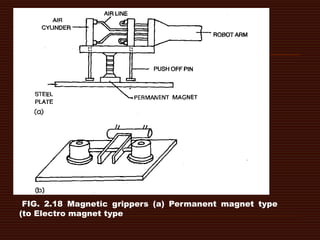
FIG. 2.18 Magnetic grippers (a) Permanent magnet type
(to Electro magnet type
Electromagnets or permanent magnets. Electromagnetic grippers are
easier to control, but require a source of dc power and an appropriate
controller. When the part is to be released, the control unit reverses
the polarity at a reduced power level before switching off the
electromagnet. This procedure acts to cancel the residual magnetism
in the work piece ensuring a positive release of the part.
Permanent magnets do not require an external power and hence they
can be used in hazardous and explosive environments, because there
is no danger of sparks which might cause ignition in such
environments. When the part is to be released at the end of the
handling cycle, in case of permanent magnet grippers, some means of
separating the part from the magnet must be provided.
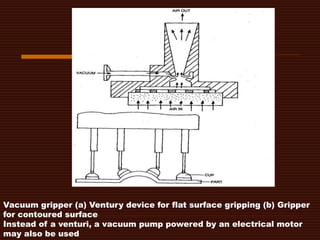
Vacuum gripper (a) Ventury device for flat surface gripping (b) Gripper
for contoured surface
Instead of a venturi, a vacuum pump powered by an electrical motor
may also be used
ADHESIVE GRIPPERS
An adhesive substance can be used for grasping action in gripper
design.
The requirements on the items to be handled are that they must be
gripped on one side only.
The reliability of this gripping device is diminished with each
successive operation cycle as the adhesive substance loses its
tackiness on repeated use.
To overcome this limitation, the adhesive material can be loaded In
the form of a continuous ribbon into a feeding mechanism attached to
the robot wrist
HOOKS, SCOOPS AND OTHER MISCELLANEOUS DEVICES
Hooks can be used as end-effectors to handle containers and to load and unload
parts hanging from overhead conveyors. The item to be handled by a hook must
have some sort of handle to enable the hook to hold it Ladles and scoops can be
used to handle certain materials in liquid or powder form. One of the limitations is
that the amount of material being scooped by the robot is sometimes difficult to
control.
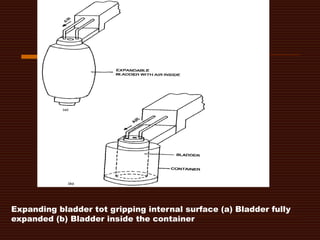
Other types of grippers Include inflatable devices, in which an inflatable bladder is
expanded to grasp the object. The inflatable bladder is fabricated out of some
elastic material like rubber, which makes it appropriate for gripping fragile objects.
In contrast to the typical mechanical grippers where a concentrated force is applied
an the object, the gripper applies a uniform grasping pressure against the surface of
the object.
Expanding bladder tot gripping internal surface (a) Bladder fully
expanded (b) Bladder inside the container
between the part surface and the finger surface, the acceleration of the part and the
orientation of the direction of motion during acceleration with respect to the
direction of the fingers. This may be demonstrated through the analysis of several
examples given below

uni-2.ppt

  • 1.
    MAGNETIC GRIPPERS Magnetic grippersare used extensively on ferrous materials. In general, magnetic grippers offer the following advantages in robotic handling operations *Variations in part size can be tolerated *Pickup times are very fast *They have ability to handle metal parts with holes *Only one surface is required for gripping The residual magnetism remaining in the work piece may cause problems. Mother potential disadvantage is the problem of picking up one sheet at a time from a stack. The magnetic attraction tends to penetrate beyond the top sheet in the stack, resulting in the possibility that more than a single sheet will be lifted by the magnet.
  • 2.
    FIG. 2.18 Magneticgrippers (a) Permanent magnet type (to Electro magnet type
  • 3.
    Electromagnets or permanentmagnets. Electromagnetic grippers are easier to control, but require a source of dc power and an appropriate controller. When the part is to be released, the control unit reverses the polarity at a reduced power level before switching off the electromagnet. This procedure acts to cancel the residual magnetism in the work piece ensuring a positive release of the part. Permanent magnets do not require an external power and hence they can be used in hazardous and explosive environments, because there is no danger of sparks which might cause ignition in such environments. When the part is to be released at the end of the handling cycle, in case of permanent magnet grippers, some means of separating the part from the magnet must be provided.
  • 4.
    Vacuum gripper (a)Ventury device for flat surface gripping (b) Gripper for contoured surface Instead of a venturi, a vacuum pump powered by an electrical motor may also be used
  • 5.
    ADHESIVE GRIPPERS An adhesivesubstance can be used for grasping action in gripper design. The requirements on the items to be handled are that they must be gripped on one side only. The reliability of this gripping device is diminished with each successive operation cycle as the adhesive substance loses its tackiness on repeated use. To overcome this limitation, the adhesive material can be loaded In the form of a continuous ribbon into a feeding mechanism attached to the robot wrist
  • 6.
    HOOKS, SCOOPS ANDOTHER MISCELLANEOUS DEVICES Hooks can be used as end-effectors to handle containers and to load and unload parts hanging from overhead conveyors. The item to be handled by a hook must have some sort of handle to enable the hook to hold it Ladles and scoops can be used to handle certain materials in liquid or powder form. One of the limitations is that the amount of material being scooped by the robot is sometimes difficult to control. Other types of grippers Include inflatable devices, in which an inflatable bladder is expanded to grasp the object. The inflatable bladder is fabricated out of some elastic material like rubber, which makes it appropriate for gripping fragile objects. In contrast to the typical mechanical grippers where a concentrated force is applied an the object, the gripper applies a uniform grasping pressure against the surface of the object.
  • 7.
    Expanding bladder totgripping internal surface (a) Bladder fully expanded (b) Bladder inside the container
  • 8.
    between the partsurface and the finger surface, the acceleration of the part and the orientation of the direction of motion during acceleration with respect to the direction of the fingers. This may be demonstrated through the analysis of several examples given below